Stock Pitch Questions: What Judges and Interviewers Ask, From 3 University Guides
Stock pitch questions from Columbia, Duke and Kentucky guides: the four a portfolio manager always asks, the risk questions, and how to answer them.

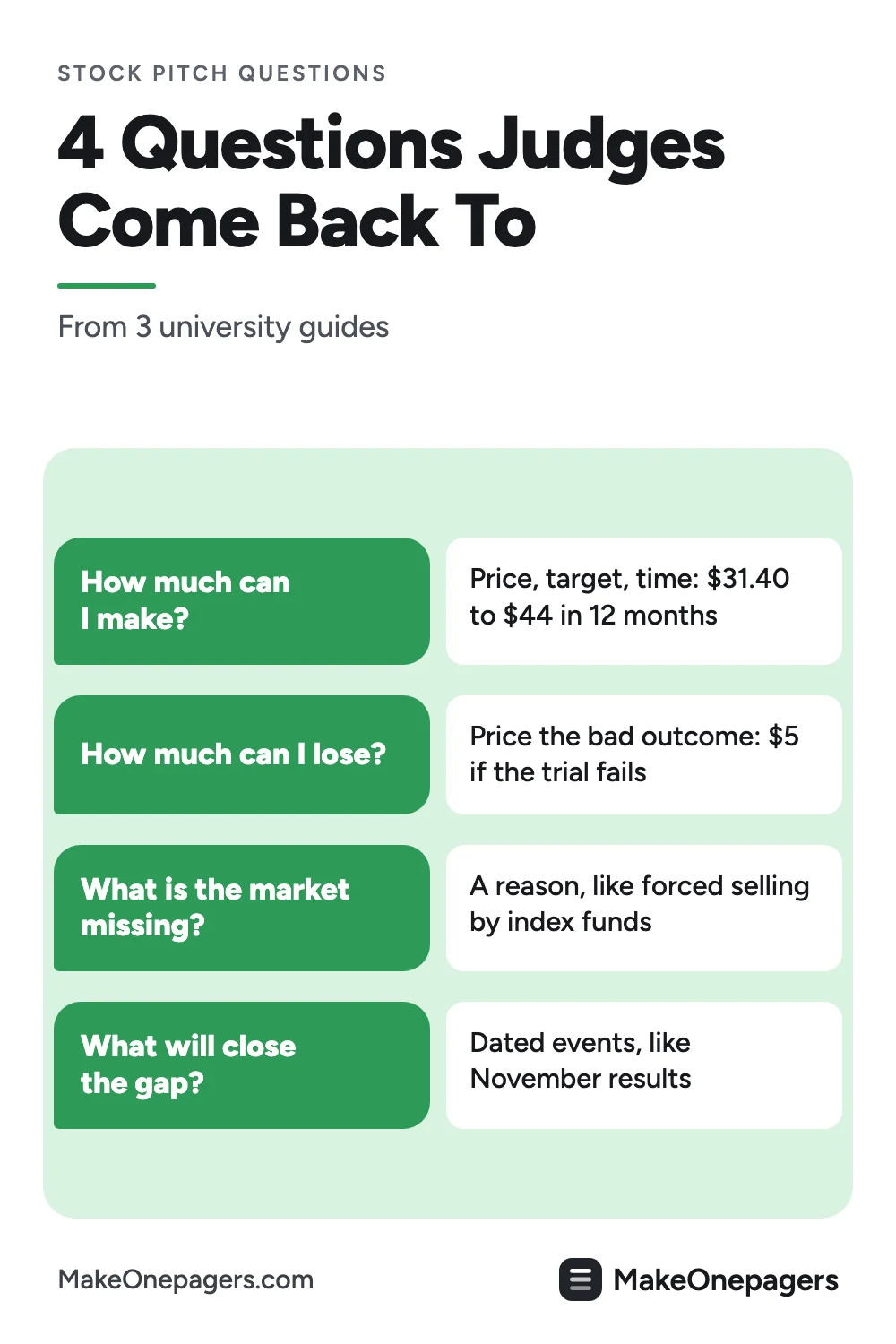
The stock pitch questions you'll face almost always come back to four: how much can I make, how much can I lose, why is this stock mispriced, and what will make other investors see it. After that, expect pointed questions on your risks and your numbers. Judges and interviewers are less interested in your pitch than in how you hold up once they start pushing on it. Start from a free one pager template.
One‑Pager examples
Real One-Pagers made with MakeOnepagers. Open any one to edit it as your own.
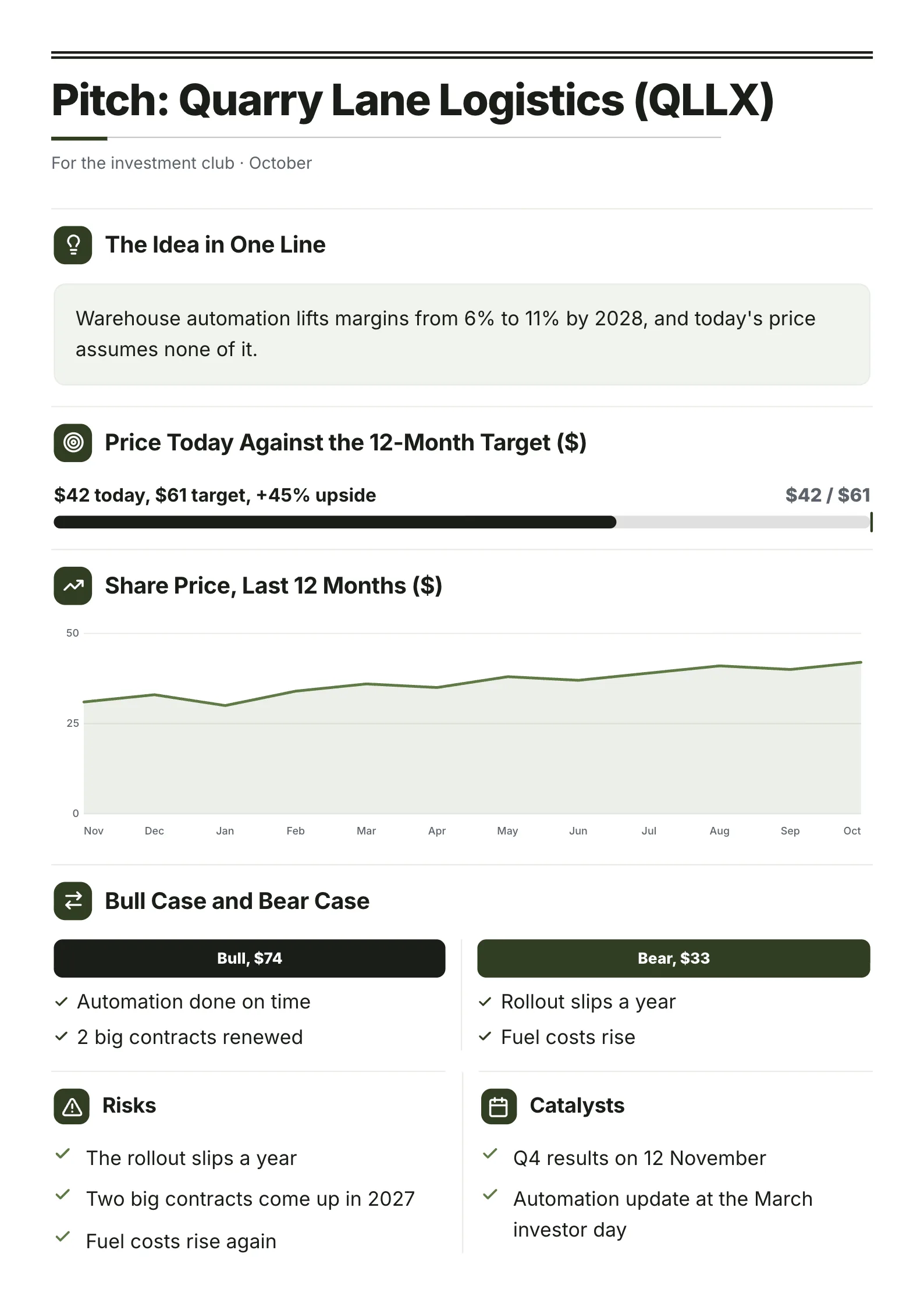 Stock PitchEdit for free(opens in a new tab)
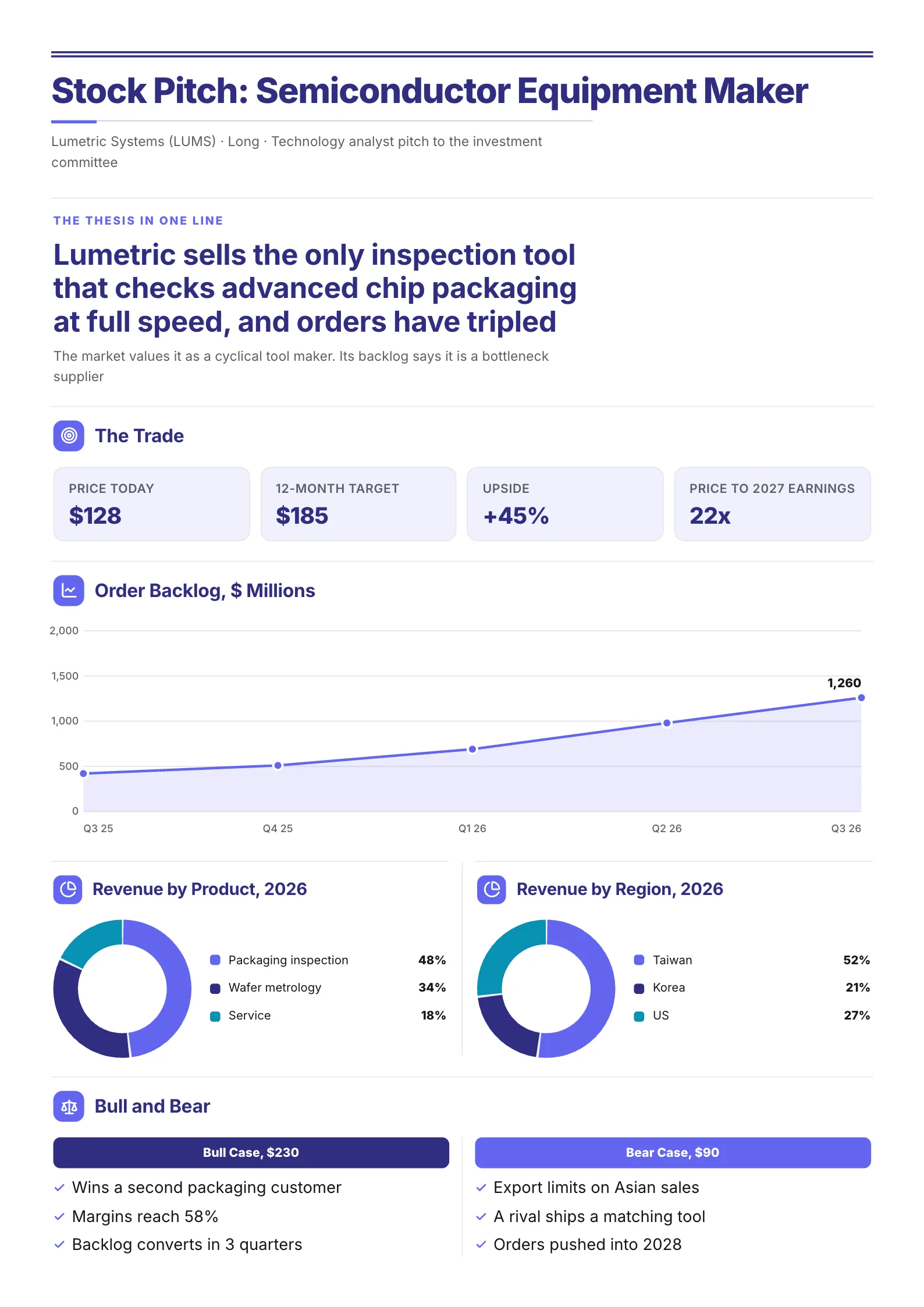 Stock Pitch: Semiconductor Equipment MakerEdit for free(opens in a new tab)
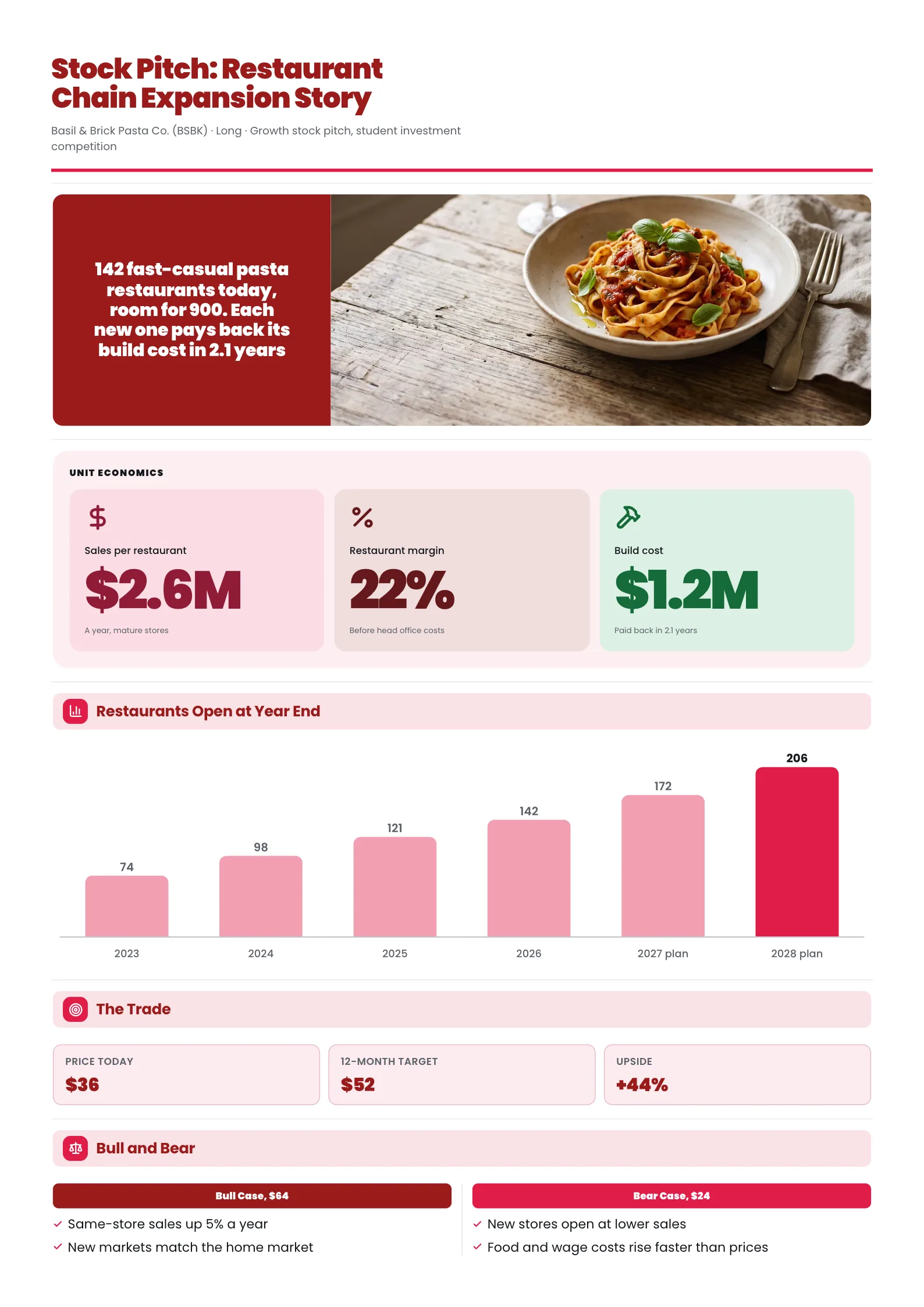 Stock Pitch: Restaurant Chain Expansion StoryEdit for free(opens in a new tab)
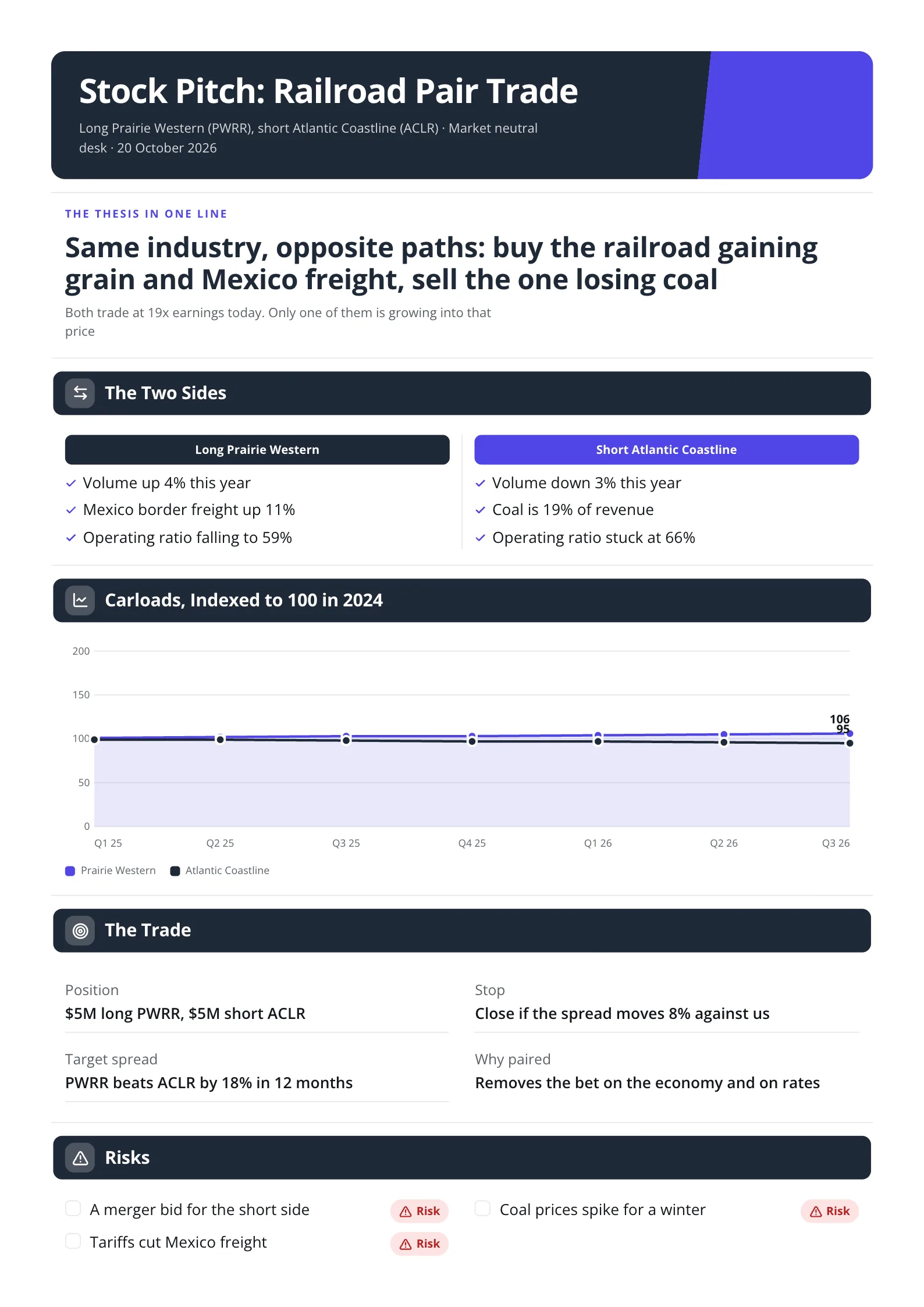 Stock Pitch: Railroad Pair TradeEdit for free(opens in a new tab)
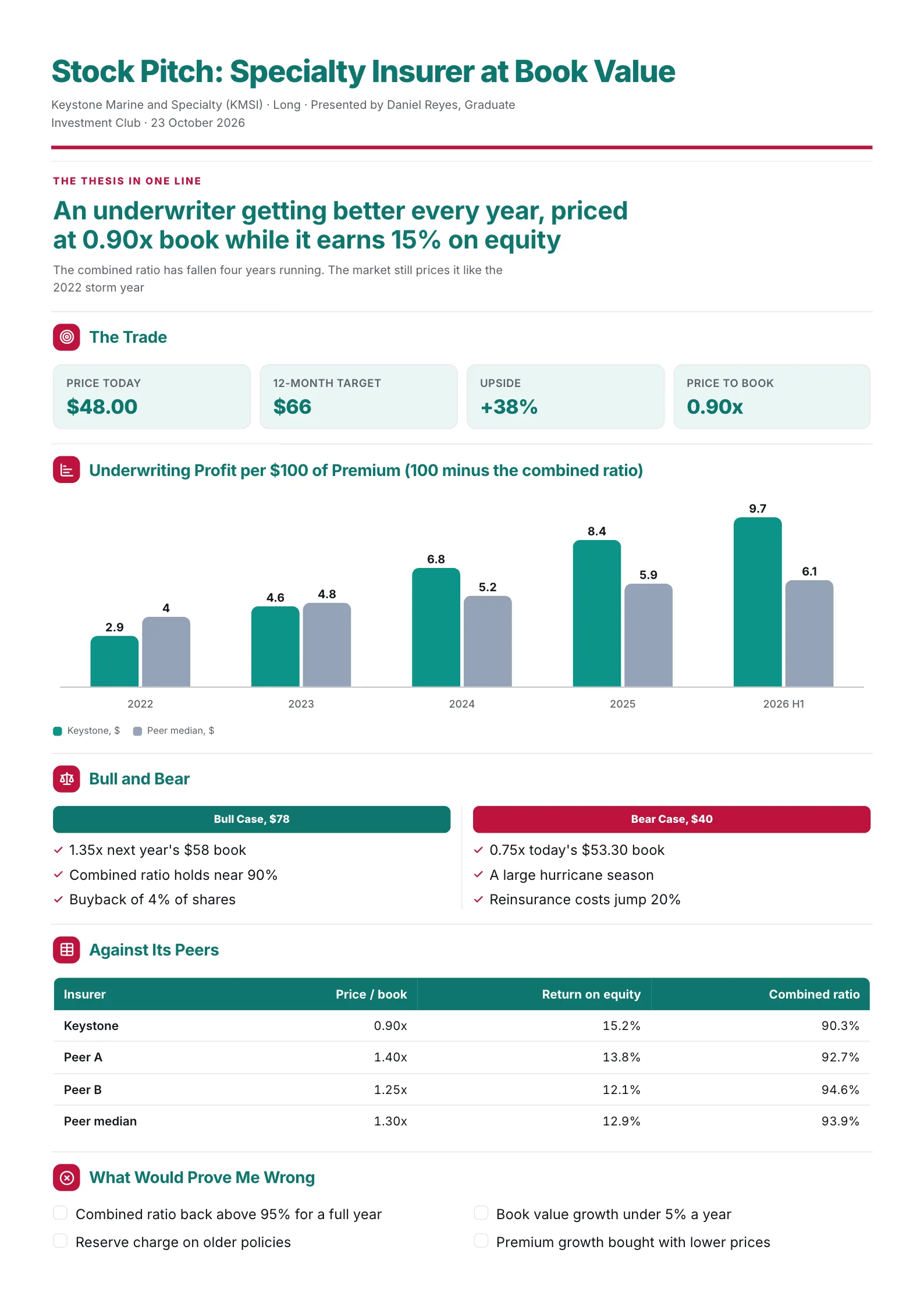 Stock Pitch: Specialty Insurer at Book ValueEdit for free(opens in a new tab)
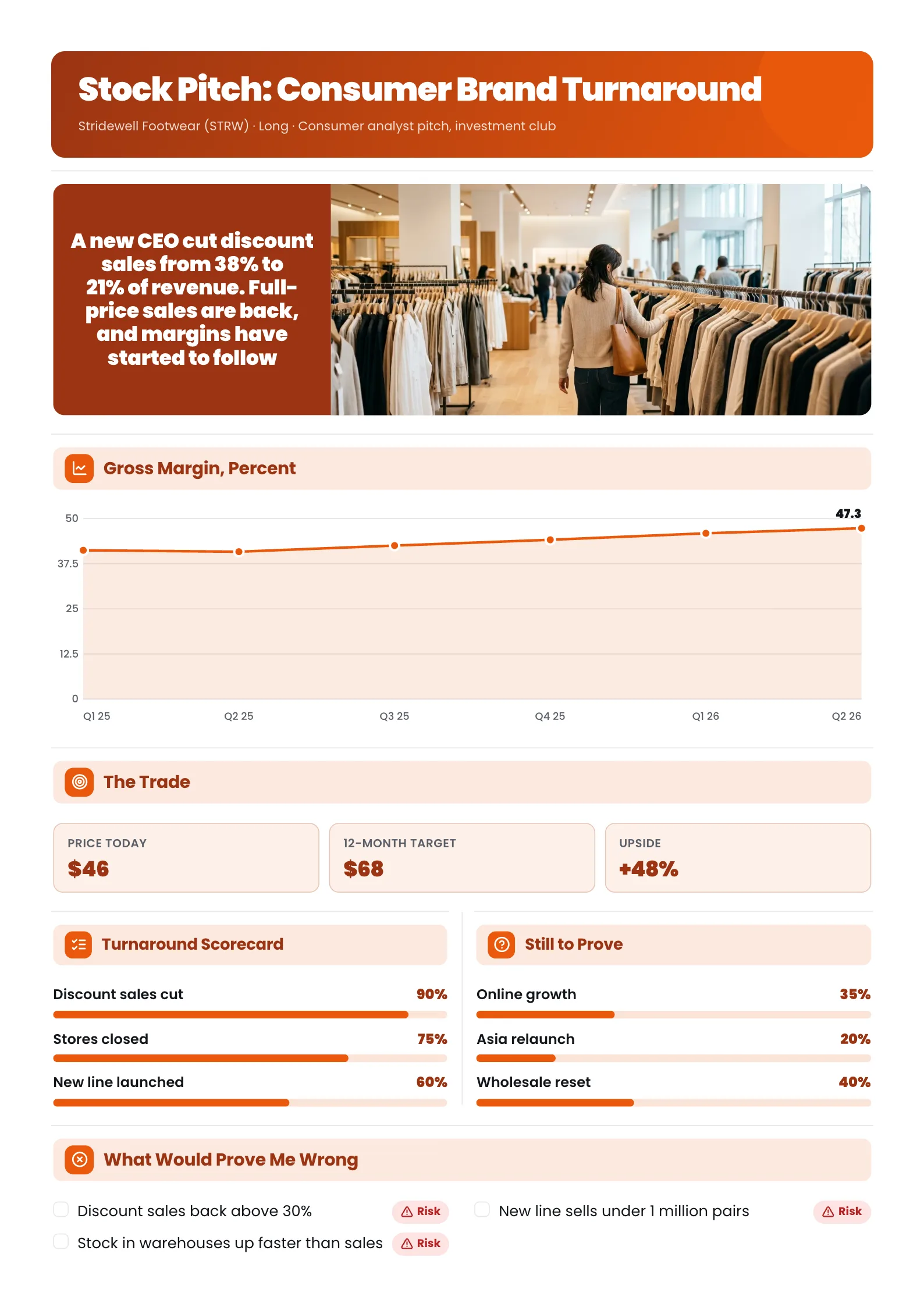 Stock Pitch: Consumer Brand TurnaroundEdit for free(opens in a new tab)
We read three guides that university programs give students before a pitch, from Columbia, Duke and the University of Kentucky. The Columbia deck sets the timing: about 2 minutes for your pitch, then 5 to 8 minutes of questions. So most of your time in the room is spent answering, and your preparation should match.
The three guides we read
| Guide | Who wrote it | What it says about questions |
|---|---|---|
| Introduction to Stock Pitching | Columbia Student Investment Management Association, September 2022 | 2 minutes to present and 5 to 8 minutes of questions. Risks are "most commonly asked in Q&A". Lists four questions a portfolio manager asks. |
| Stock Pitch Worksheet | Duke University, Financial Economics Program | A pitch has three parts: story, numbers, valuation. Interviewers expect more depth in the Q&A, so hold some back. |
| Stock Pitch Competition Tips and Help | University of Kentucky, Gatton College of Business and Economics | Asks what the market is getting wrong and why. Tells you to be ready for questions and build an appendix. |
All three read October 30, 2026.
The Columbia deck's four portfolio manager questions make a good spine for your preparation. Each section below takes one of them, shows what a judge is really asking, and points to a one-page pitch that answers it.
"How much can I make?"
This is the upside question, and you should answer it with a price and a percentage in your first breath. Don't make the judge do the math.
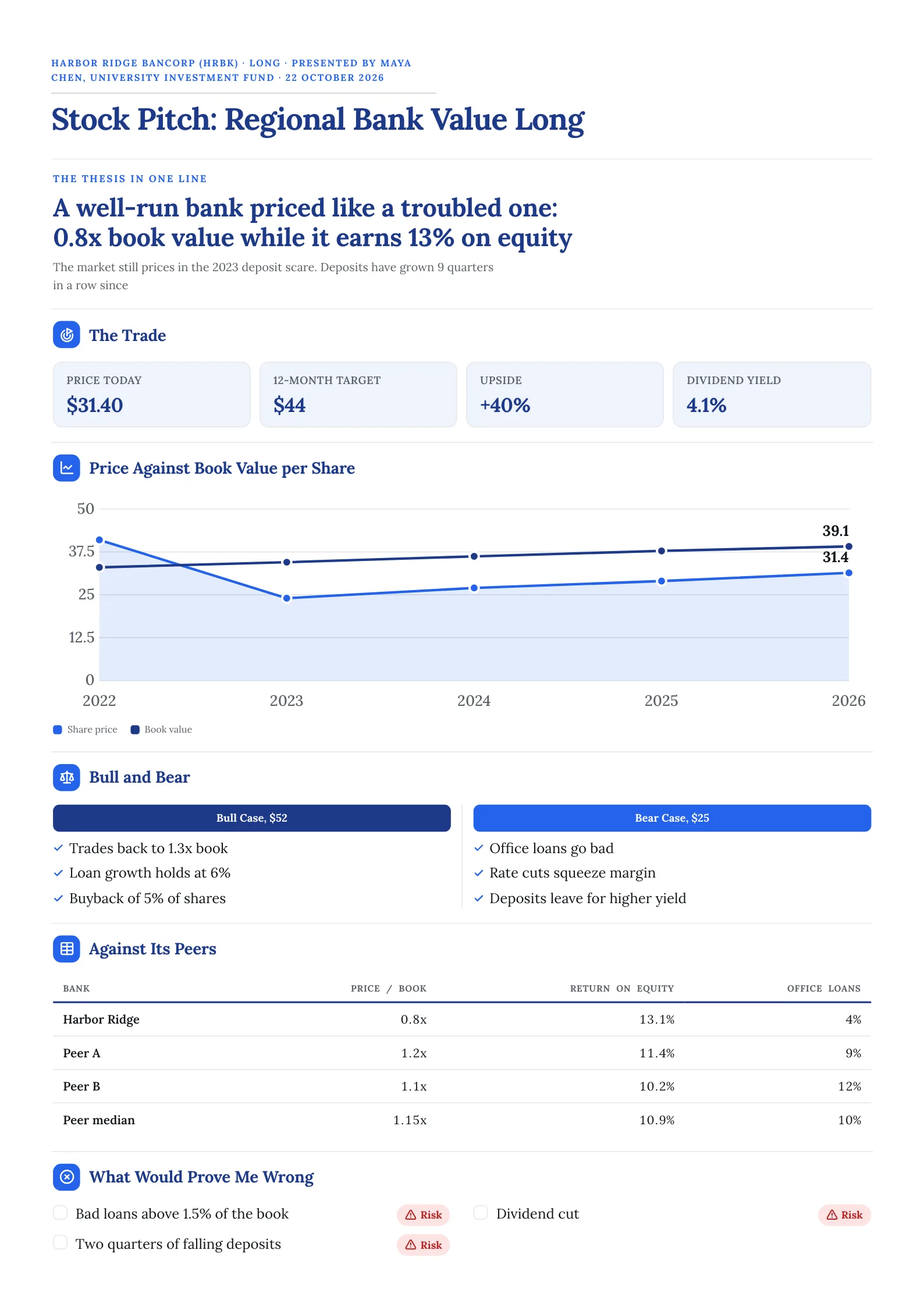
A strong answer names three numbers: the price today, your target and the time frame. The regional bank pitch below does it in one row, right under its thesis. The stock is $31.40, the 12-month target is $44, and that's 40% upside, plus a 4.1% dividend while you wait. Expect the follow-up right away: why $44? Have your valuation method ready, and a second method that lands near the same price. The Kentucky guide asks for several valuation methods, and a second one is your best answer to that follow-up.
 Edit this template
Sample names and figures. Price, target and upside sit in one row under the thesis, before any chart.
"How much can I lose?"
The downside question tests your judgment more than your math. A judge wants to know that you've priced the bad outcome and sized the bet to match it.
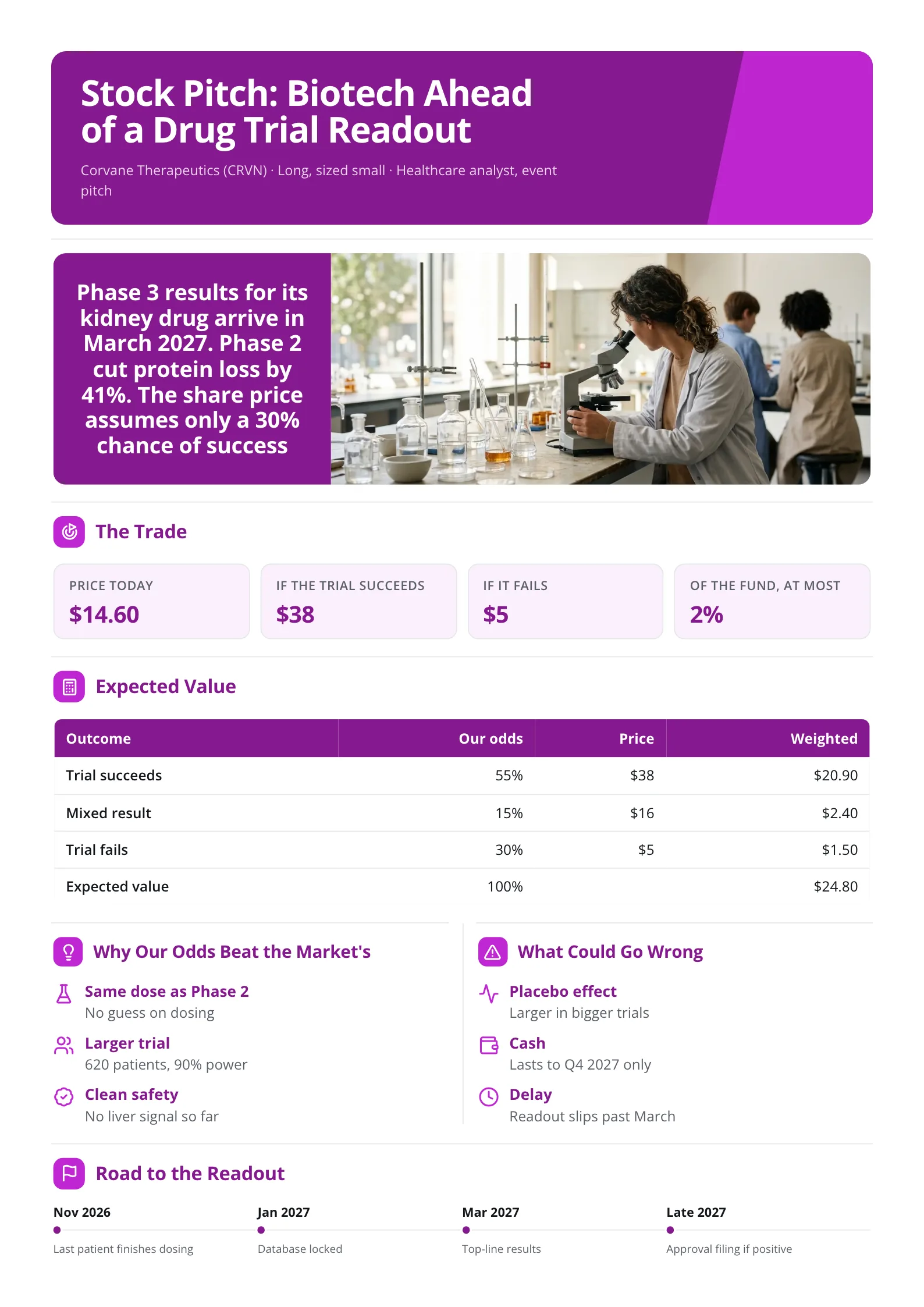
The biotech pitch below shows how to answer when the outcome is all or nothing. The stock is $14.60 ahead of a drug trial result. If the trial succeeds, the pitch says $38. If the result is mixed, $16. If it fails, $5. Weighting each outcome by the pitcher's odds gives an expected value of $24.80. That breaks down as $20.90 from success, $2.40 from a mixed result and $1.50 from failure. Then it caps the position at 2% of the fund. Your answer to "how much can I lose" should include both pieces: the price in the bad case, and how much of the portfolio you'd risk on it.
 Edit this template
Sample names and figures. The expected value table answers the downside question before the judge asks it.
"Is it too good to be true?"
This is the Columbia deck's third question, and it's close to the Kentucky guide's favorite: what is the market getting wrong, and why? If a stock is as cheap as you say, a judge will want to know why nobody else has bought it. You need a reason the price is wrong that isn't "investors are missing it".
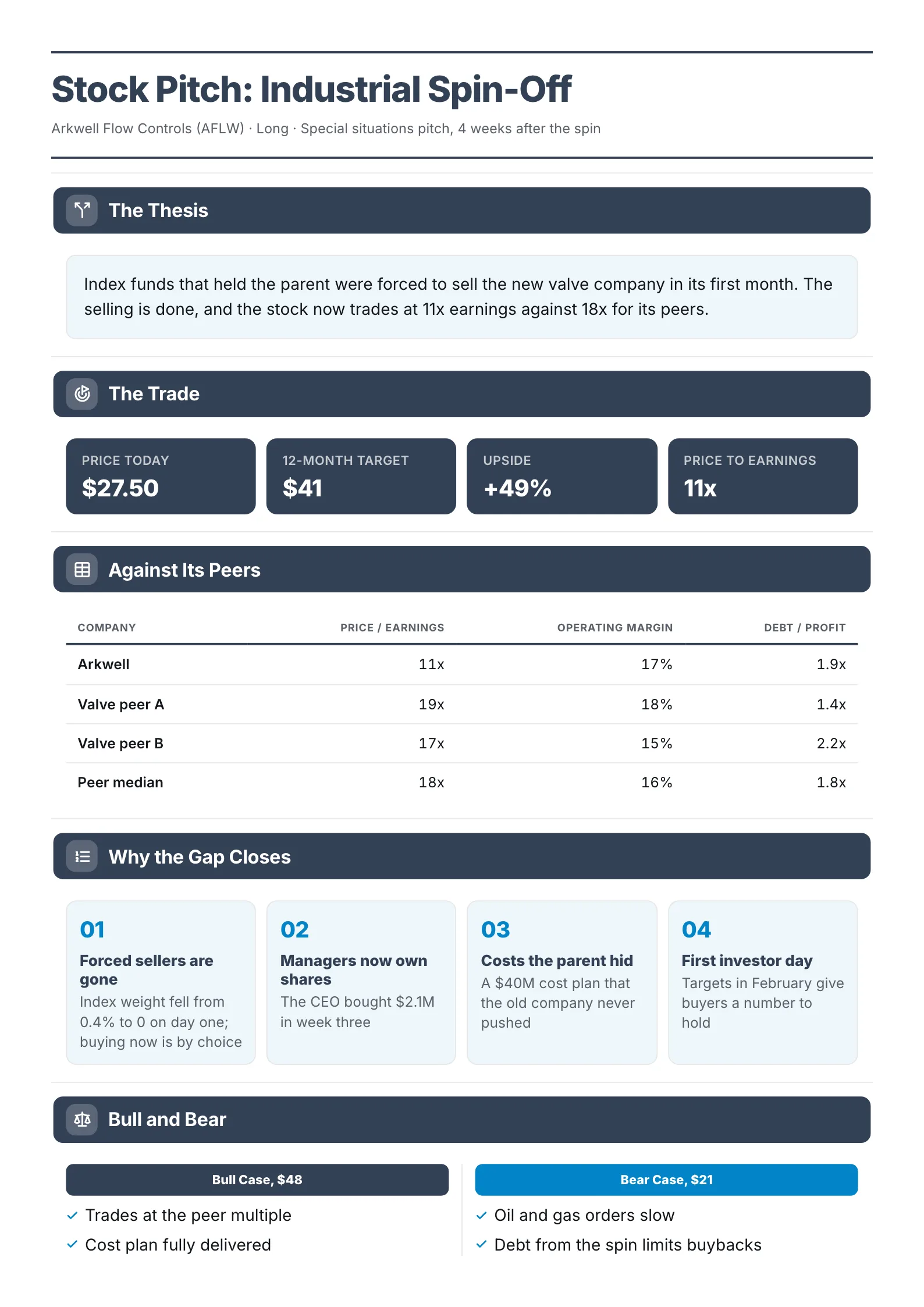
The best reasons are mechanical. The spin-off pitch below has one. Index funds that held the parent company had to sell the new company's shares in its first month, whatever the price. That forced selling left the stock at 11 times earnings against 18 for its peers. The pitch adds a second sign: the CEO bought $2.1 million of stock in week three. Name who was selling and why they had no choice, and the "too good to be true" question loses its bite.
 Edit this template
Sample names and figures. Forced index selling is the reason the gap exists, and the pitch says so.
"How will the next guy figure it out?"
That's the Columbia deck's wording for the catalyst question. Even if you're right, the stock only moves when other investors change their minds. The judge wants to know what event will make them do it, and when.
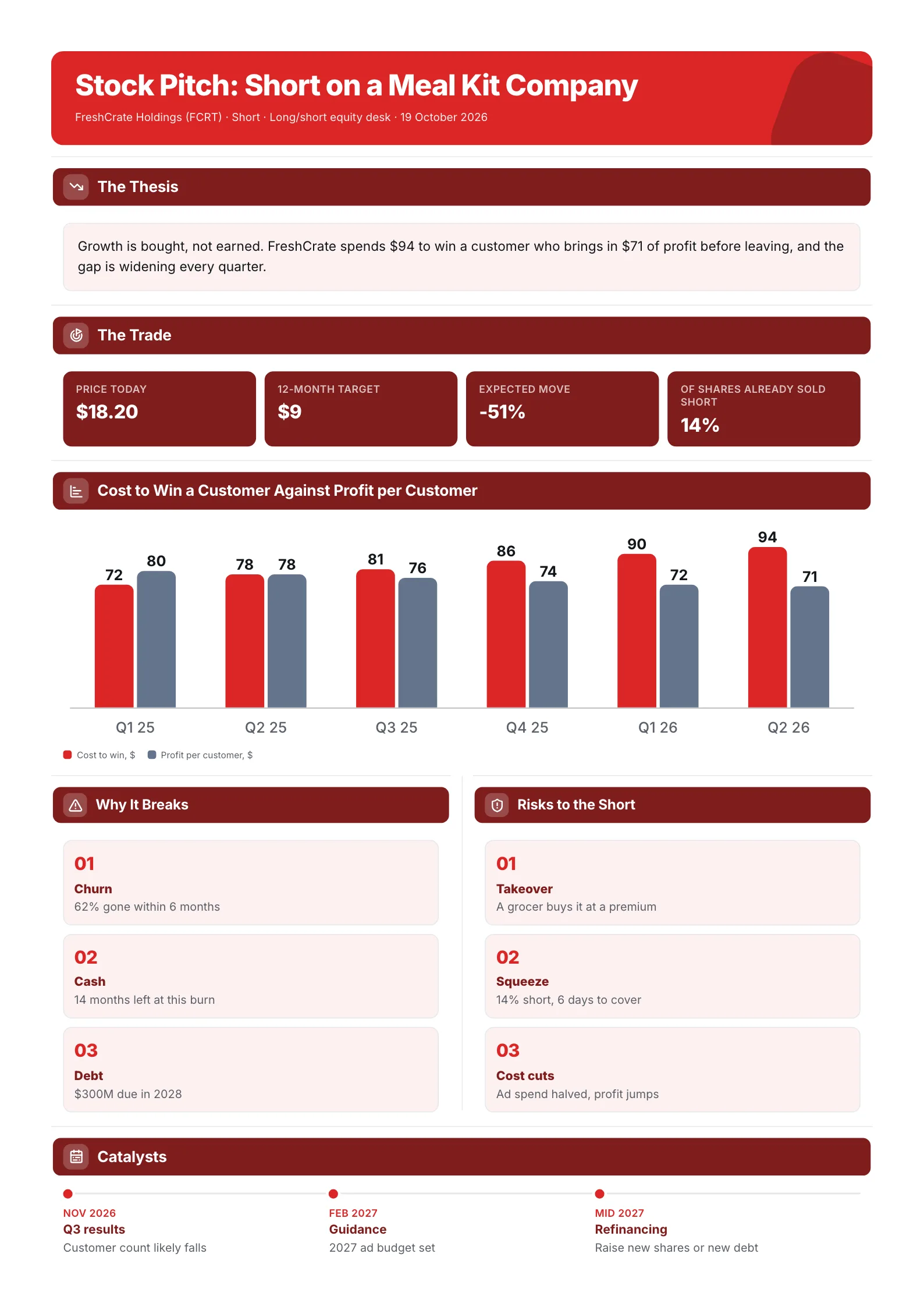
Name dated events. The short pitch on a meal kit company below lists three: third-quarter results in November 2026, guidance in February 2027 and a refinancing in mid 2027. Its target is $9 from $18.20, a 51% drop. It also answers the question a short always gets: what if the stock goes up first? With 14% of shares already sold short and 6 days to cover, a squeeze is a named risk on the page. Give your catalysts dates, and your judge can come back in a few months and check your call. That's the kind of pitch a fund manager remembers, because it can be scored.
 Edit this template
Sample names and figures. Three dated catalysts tell the judge when the thesis will be tested.
The risk questions, which come most often
The Columbia deck calls risks the topic most often raised in Q&A. Judges will ask what could go wrong, and then what would make you sell. Those are two different questions.
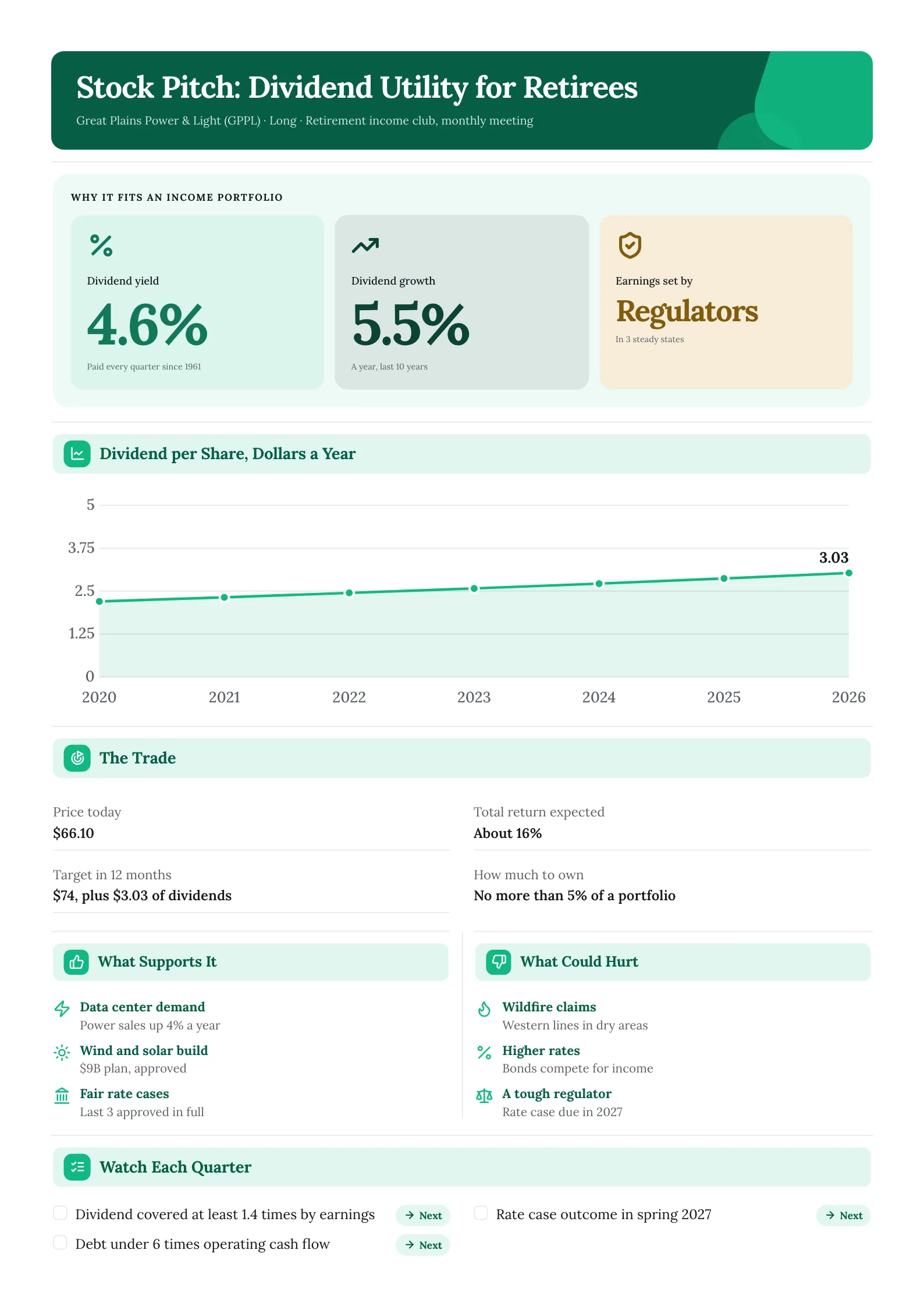
For the first, list risks that only your company carries. The utility pitch below names wildfire claims on its western lines, higher interest rates making bonds more attractive, and a rate case due in 2027. For the second, give a test you can check. The regional bank pitch above gives three sell triggers. Bad loans pass 1.5% of the loan book, deposits shrink for two straight quarters, or the bank lowers its payout. A specific line you'd sell at reads as confidence, and it's much easier to defend under pressure.
The utility pitch also answers a quieter risk question: how much should someone own? Its answer is no more than 5% of a portfolio, for a stock at $66.10 with a $74 target and $3.03 of dividends, about 16.5% in total.
 Edit this template
Sample names and figures. Position size is a risk answer, and this pitch gives it in plain numbers.
The numbers questions
The Duke worksheet expects the interviewer to go deeper than your pitch did. Its worked example lists the price, the 52-week range and the market cap, and its checklist adds earnings, margins, debt, credit rating, free cash flow, and the P/E and EV/EBITDA multiples. Be ready for questions like these:
- What's the free cash flow, and is it growing?
- What multiple did you use, and why that one?
- How much debt does the company carry, and what's its credit rating?
- How does it compare with its two closest peers?
- What's already priced in at today's price?
The worksheet's advice is to hold some detail back for the Q&A. Your one page carries the headline numbers. Your appendix carries the rest, so you can turn to it when a judge asks.
How to prepare for the Q&A
Write down every question in this post and answer each one in two sentences. Then ask a friend to pick five at random and push back on your answers. Time yourself. A good answer to a pointed question is short, and a rambling one usually means you haven't settled the point in your own head yet. Two of the guides tell you to build an appendix, and that's where the long answers live.
In an interview there may be no slides at all. "Pitch me a stock" can come in the middle of a conversation, so have a spoken version that fits in about a minute: the company, long or short, your target and the one reason the market has it wrong. Then stop, and let the interviewer choose what to dig into.
When you don't know an answer, the Columbia deck says it's fine to say so. A clear "I don't know, but here's how I'd find out" holds up better than a guess a judge can take apart. For the full structure of the pitch itself, see how to write a stock pitch. For a page you can fill in, start from our stock pitch template post.
The page is the opening, the questions are the test
Your pitch gets you two minutes. The questions decide how the room remembers you. Put your target, your downside, your reason the price is wrong and your dated catalysts on one page, so every one of the four questions points back to a line you've already shown. A MakeOnepagers stock pitch layout has a place for each of them.
Frequently asked questions
What questions are asked in a stock pitch interview?
Expect the upside, the downside, why the stock is mispriced and what will make it move. Then come questions on risks, valuation, free cash flow and debt.
How long is a stock pitch?
In the Columbia club's format, about 2 minutes to present and 5 to 8 minutes of questions. Interviews vary, so practice a 1-minute spoken version and a 2-minute version with your page.
What is a catalyst in a stock pitch?
A dated event that makes other investors see what you see, like an earnings report, a trial result or an investor day. Without one, a cheap stock can stay cheap.
What if I can't answer a question?
Say so, then say how you'd find out. The Columbia deck allows it, and it's safer than a confident wrong answer.




