Stock Pitch Examples by Call, With Every Upside Checked
Stock pitch examples sorted by the call they make, with every price target checked on five templates and five student fund pitches.

A stock pitch makes one call. You go long when you think the price will rise, and you go short when you think it will fall. Some pitches bet on a single date, like a drug trial result. Start from a free one pager template.
One‑Pager examples
Real One-Pagers made with MakeOnepagers. Open any one to edit it as your own.
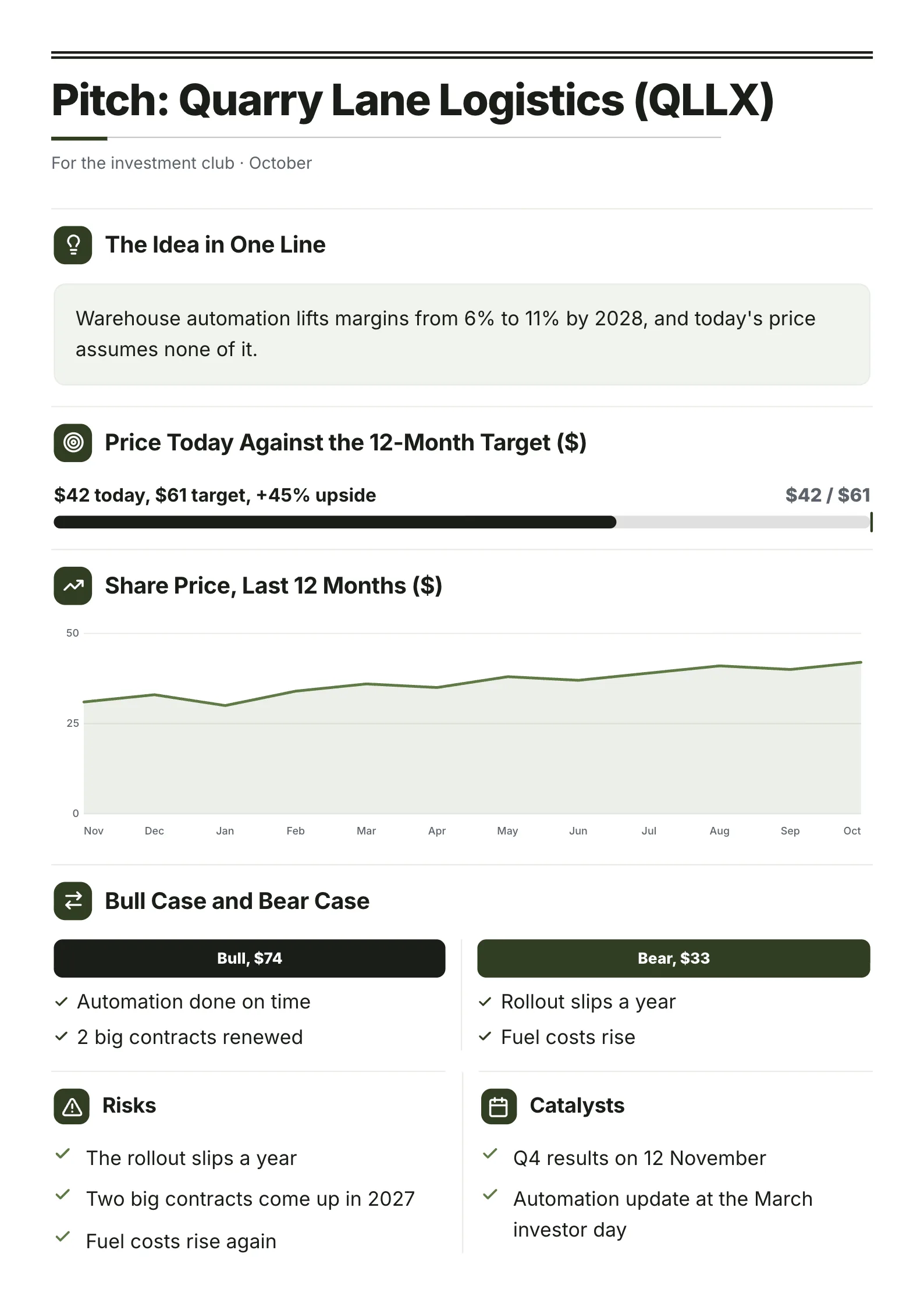 Stock PitchEdit for free(opens in a new tab)
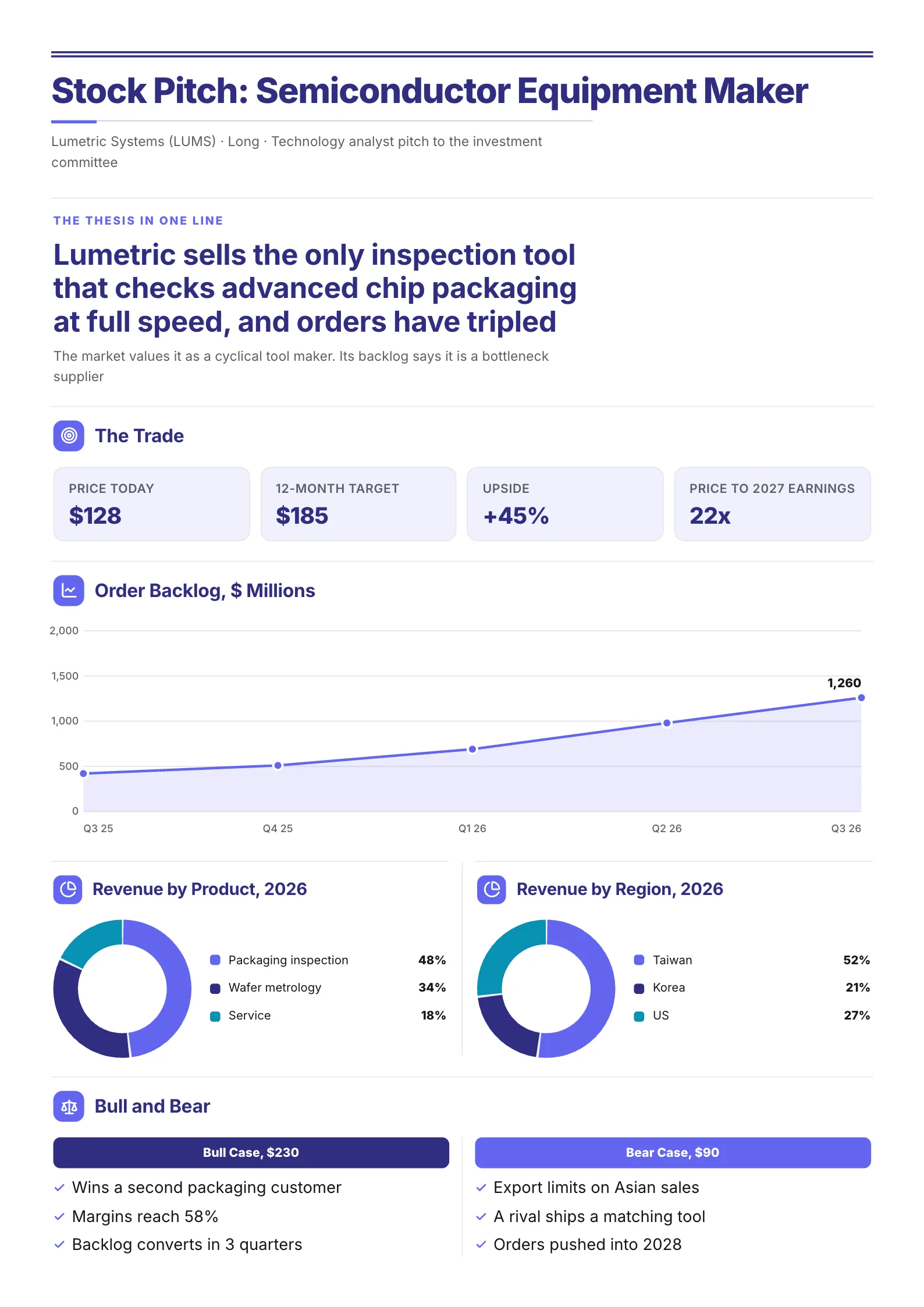 Stock Pitch: Semiconductor Equipment MakerEdit for free(opens in a new tab)
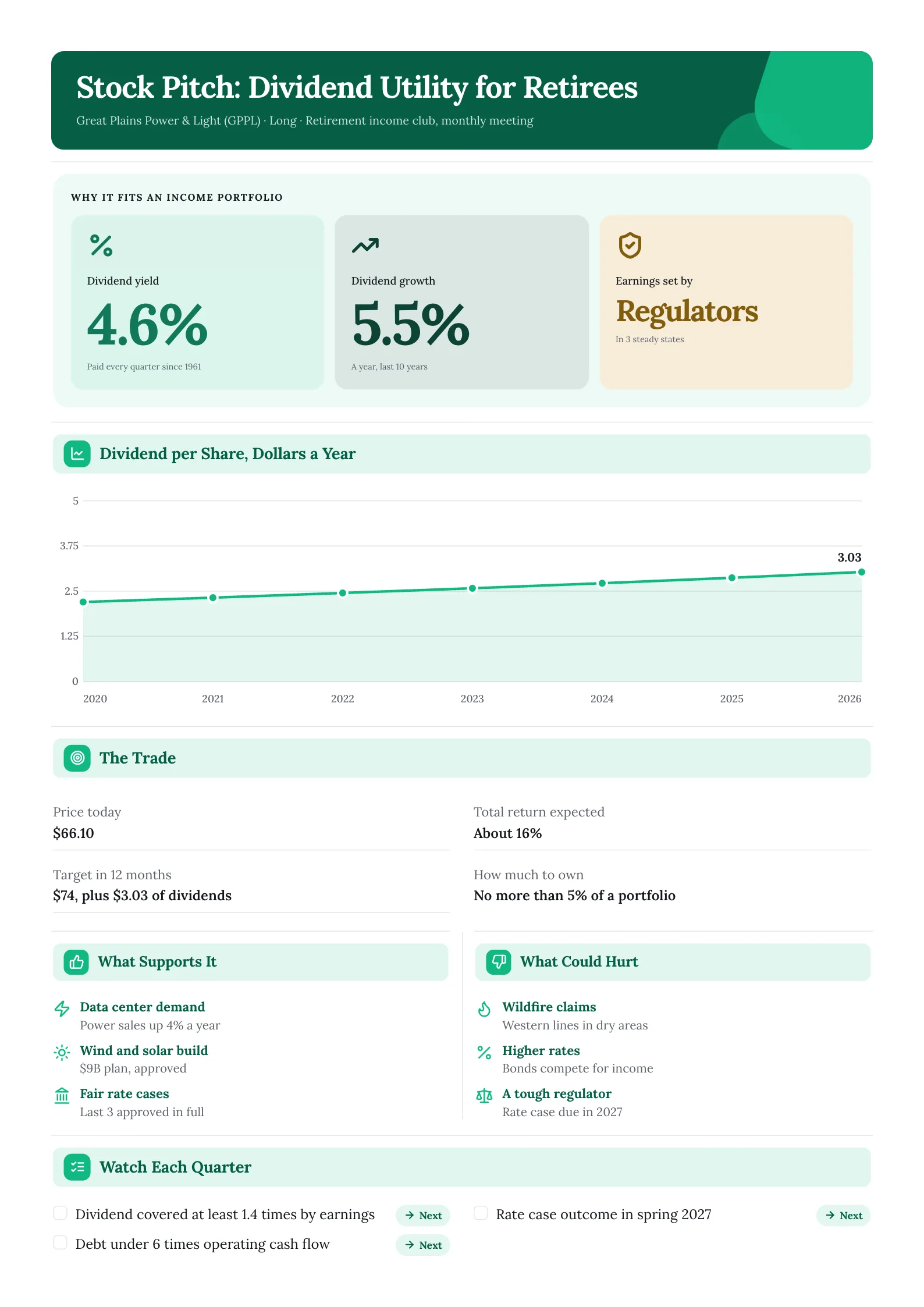 Stock Pitch: Dividend Utility for RetireesEdit for free(opens in a new tab)
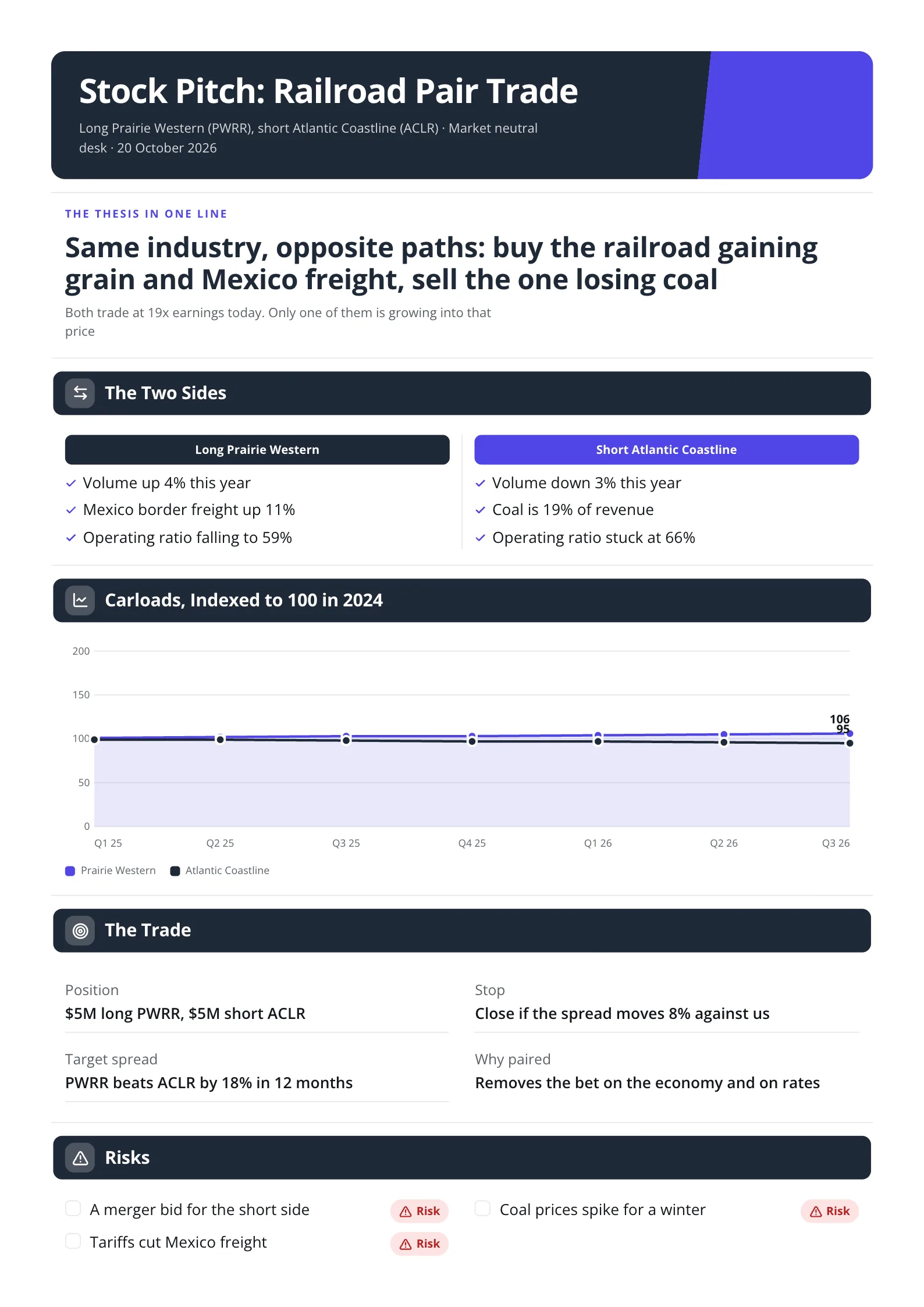 Stock Pitch: Railroad Pair TradeEdit for free(opens in a new tab)
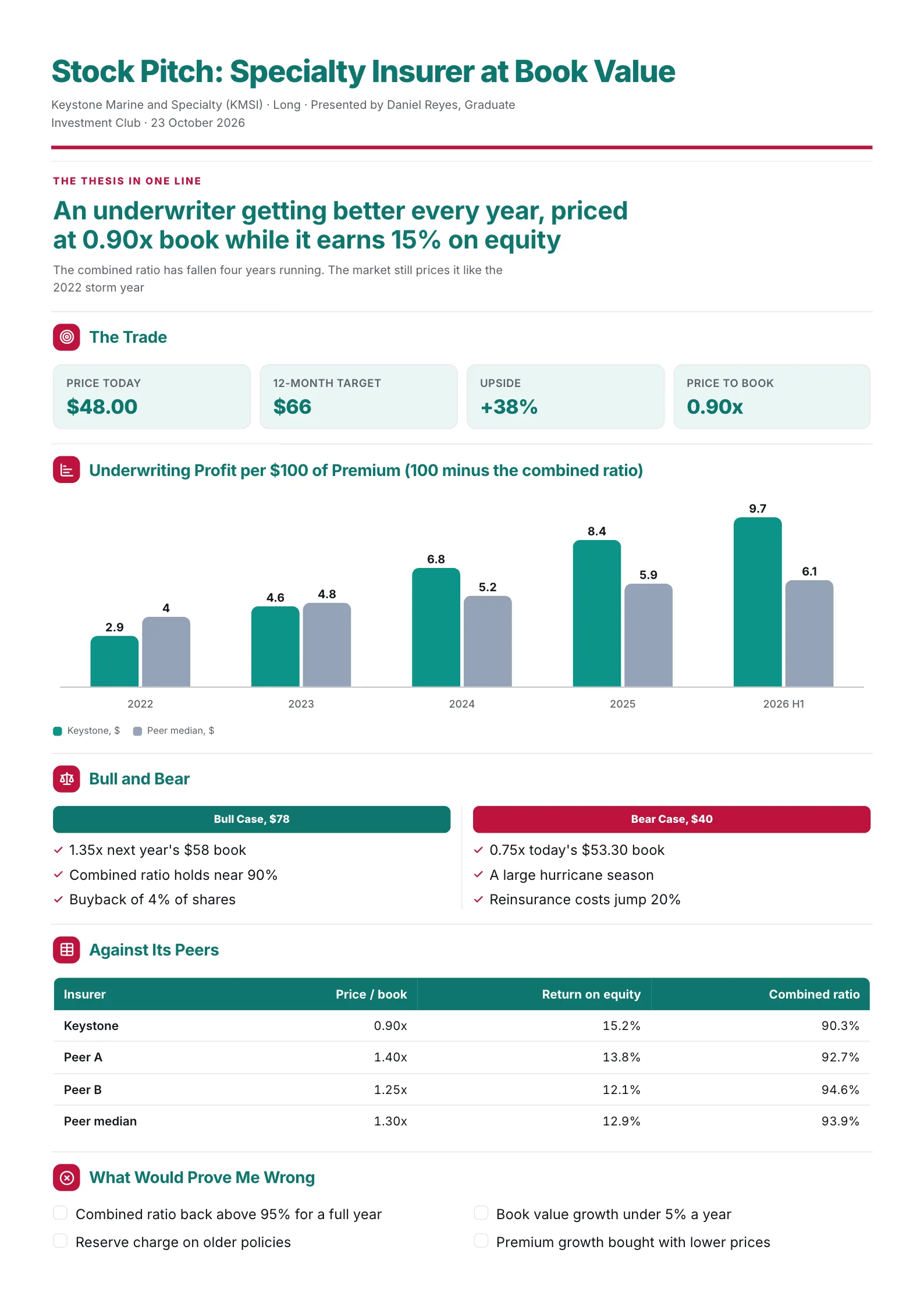 Stock Pitch: Specialty Insurer at Book ValueEdit for free(opens in a new tab)
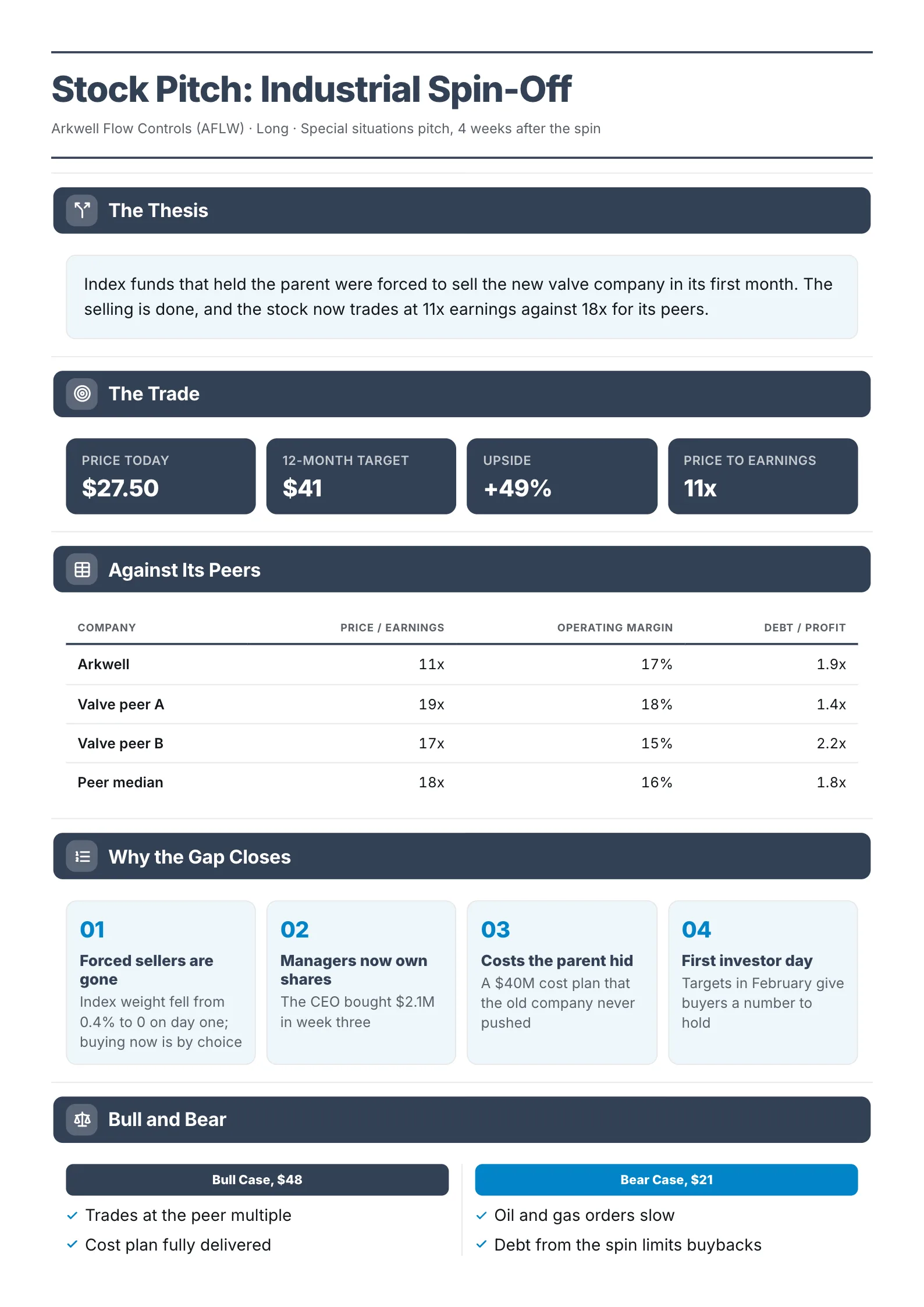 Stock Pitch: Industrial Spin-OffEdit for free(opens in a new tab)
We sorted five stock pitch examples from our MakeOnepagers templates by that call. For each one we pulled apart the thesis line, the target math and the risks. Beside each template sits a real pitch that student fund members posted on the Phoenix Funds page at the University of Chicago, and we ran the same checks on it.
These examples show how pitches are built, so you can build your own. None of them is advice to buy or sell a stock.
How we checked the math
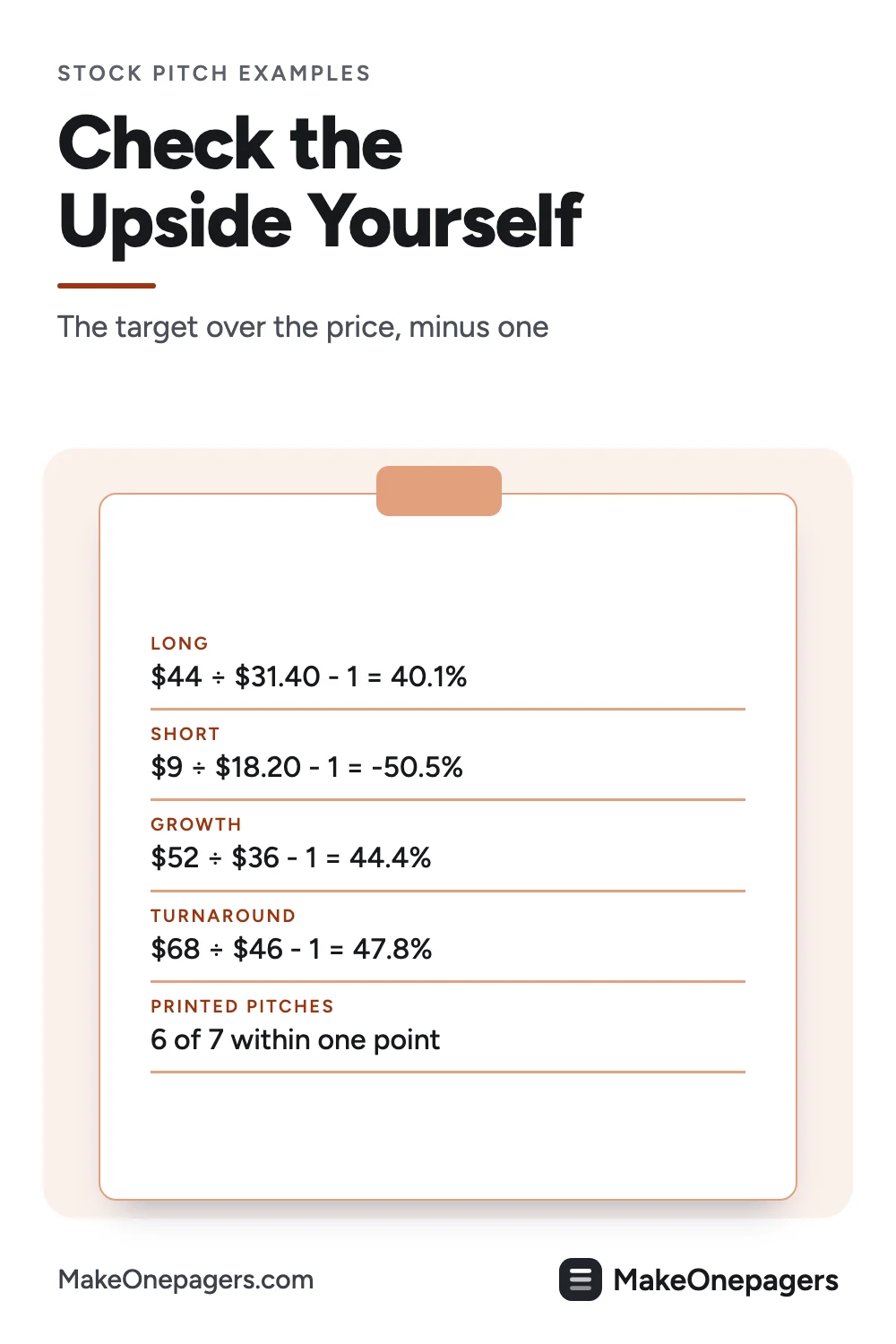
Upside is the target divided by today's price, minus one. For a short, the same sum gives a negative number. We ran it on every example.
Seven of the ten print a price, a target and a percentage. Six of those seven add up to within one point. The seventh is Boeing's, in the turnarounds section below. The other three leave out one of the three numbers, so you can only check part of their math. Our stock pitch template post puts all three in one of its six parts, the price today against the 12-month target.
Value longs: cheap for a reason you think is wrong
 Edit this template
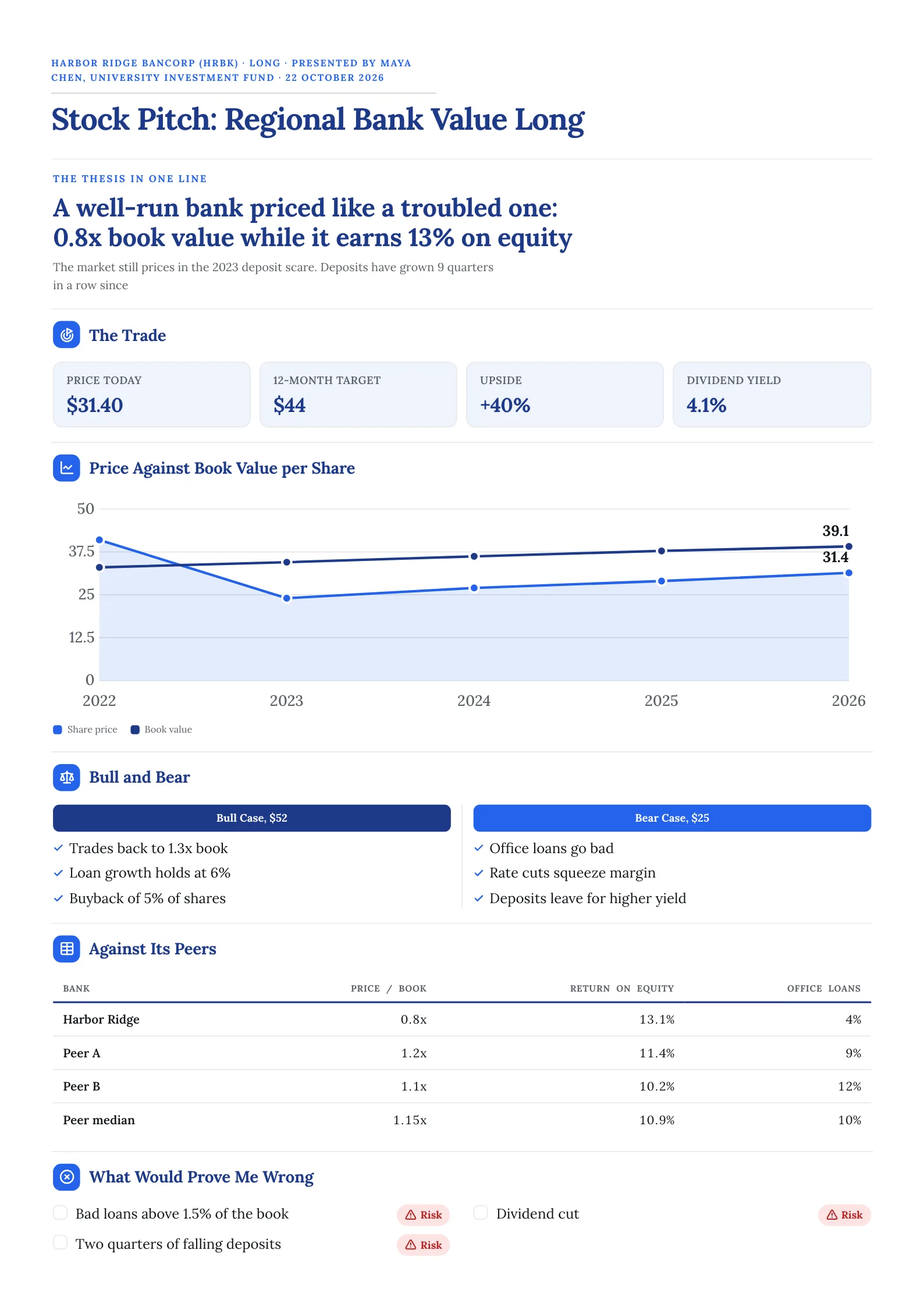
A bank pitch that sets the share price against book value for five years.
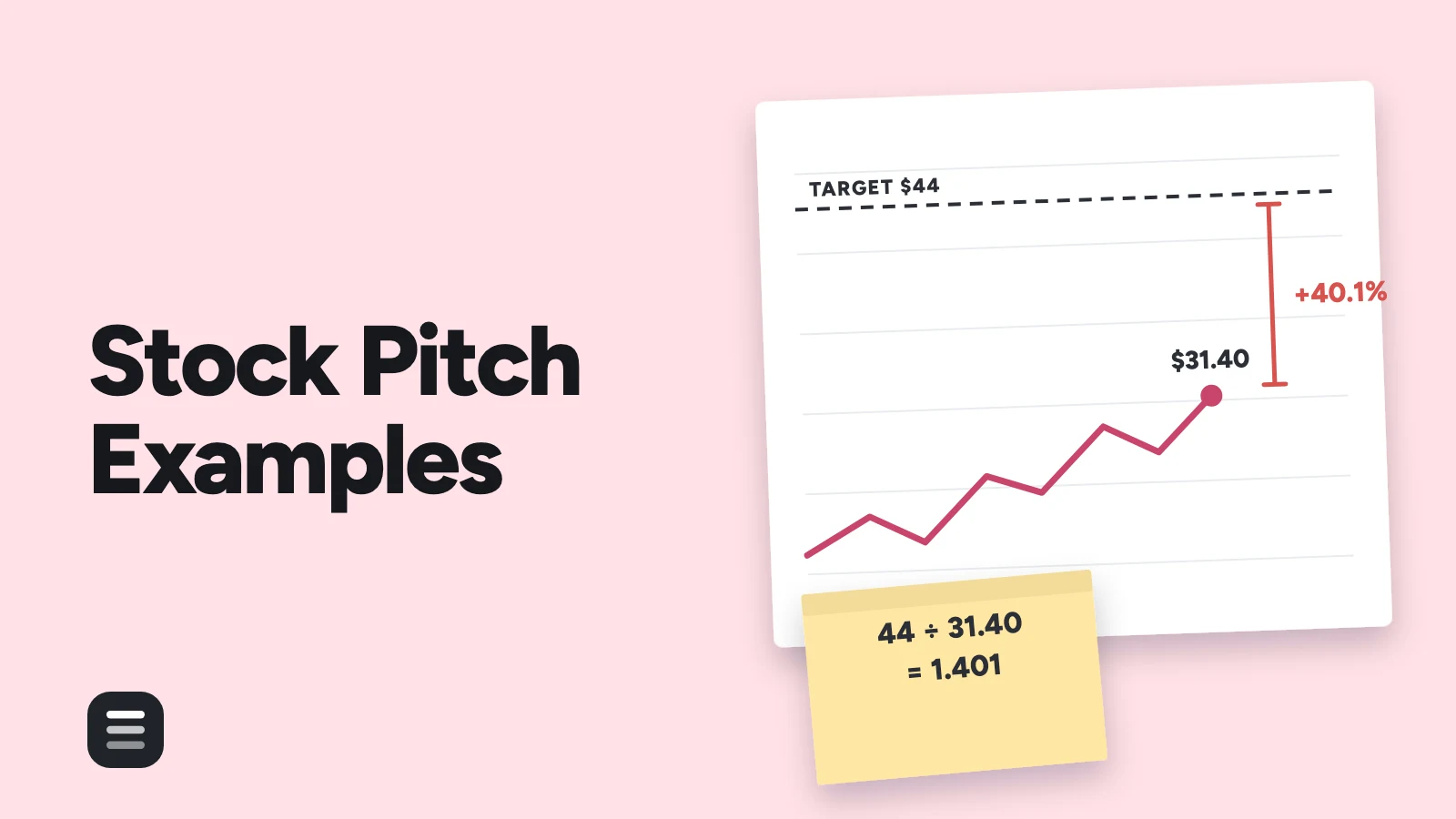
The Harbor Ridge Bancorp template says the bank trades at 0.8 times book value while it earns 13% on equity. Check it against the chart: $31.40 divided by $39.10 of book value is 0.80. The target is $44, and $44 over $31.40 is 40.1%. The sheet says 40%, so it holds.
Notice what the 40% leaves out. The bank also pays a 4.1% dividend, which sits in its own box. Say so when you add income to your upside, because a reader will compare your number with theirs.
The risks come as a short list called "What Would Prove Me Wrong," and each one has a line you could watch: bad loans above 1.5% of the book, two quarters of falling deposits, or a dividend cut. You can test each of yours every quarter too.
The student version. The Textron pitch calls a buy at $98.63 with a $134.50 valuation and 36% upside. The math gives 36.4%, so it checks out. Its revenue figure of $14.80 billion matches the $14,799 million in Textron's 10-K for fiscal 2025.
The Lockheed Martin sample is a buy with three percentages: a bear case of 21.78%, a target of 34.82% and a bull case of 50.32%. Even its bear case makes money.
Shorts: a price you think will fall
 Edit this template
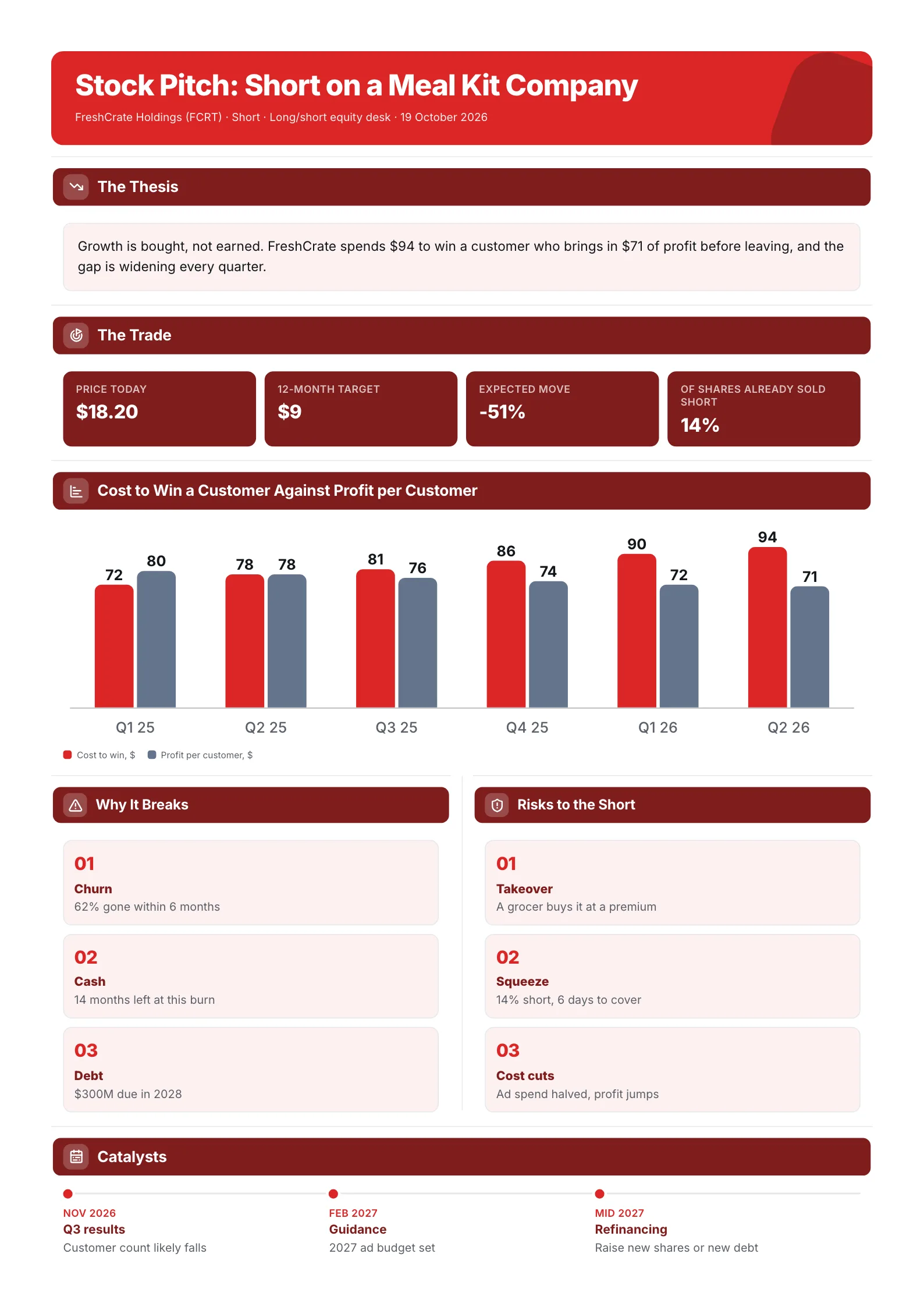
The meal kit short tracks the cost to win a customer against what that customer earns.
The FreshCrate thesis rests on two numbers. Winning one customer costs the company $94, and that customer brings in $71 of profit before leaving. In the first quarter of 2025 it was $72 against $80. The trade goes from $18.20 to $9, which is down 50.5%. The sheet rounds that to 51%.
A short carries a risk a long doesn't. If the price rises, your loss has no ceiling. So this template boxes up three ways the short could go wrong. A buyer could pay a premium for the company, short sellers holding 14% of the shares would need 6 days to cover in a squeeze, and fast cost cuts could lift profit. Then it dates its catalysts, from third-quarter results in November 2026 to a refinancing in mid 2027.
The student version. The Netflix pitch is a sell. Its first valuation gives $767.63, a downside of 21.71%. Its second gives $760.40 and 22.45%. Both check against the $980.56 share price in the pitch's own cost-of-capital table, though its trading statistics slide shows $973.70.
The first valuation slide shows a third number. The Gordon growth method lands at $306.82, a downside of 68.71%, which is $461 below the figure the pitch uses. Its bull case of $774.88 is also below the price, so every case shown says sell.
We checked one input against the source. The pitch's 2024 revenue cell reads 39,000,966, and Netflix's 10-K for 2024 reports $39,000,966 thousand. If two of your methods land that far apart, show both and tell your reader which one you trust and why.
Growth: paying for stores that don't exist yet
 Edit this template
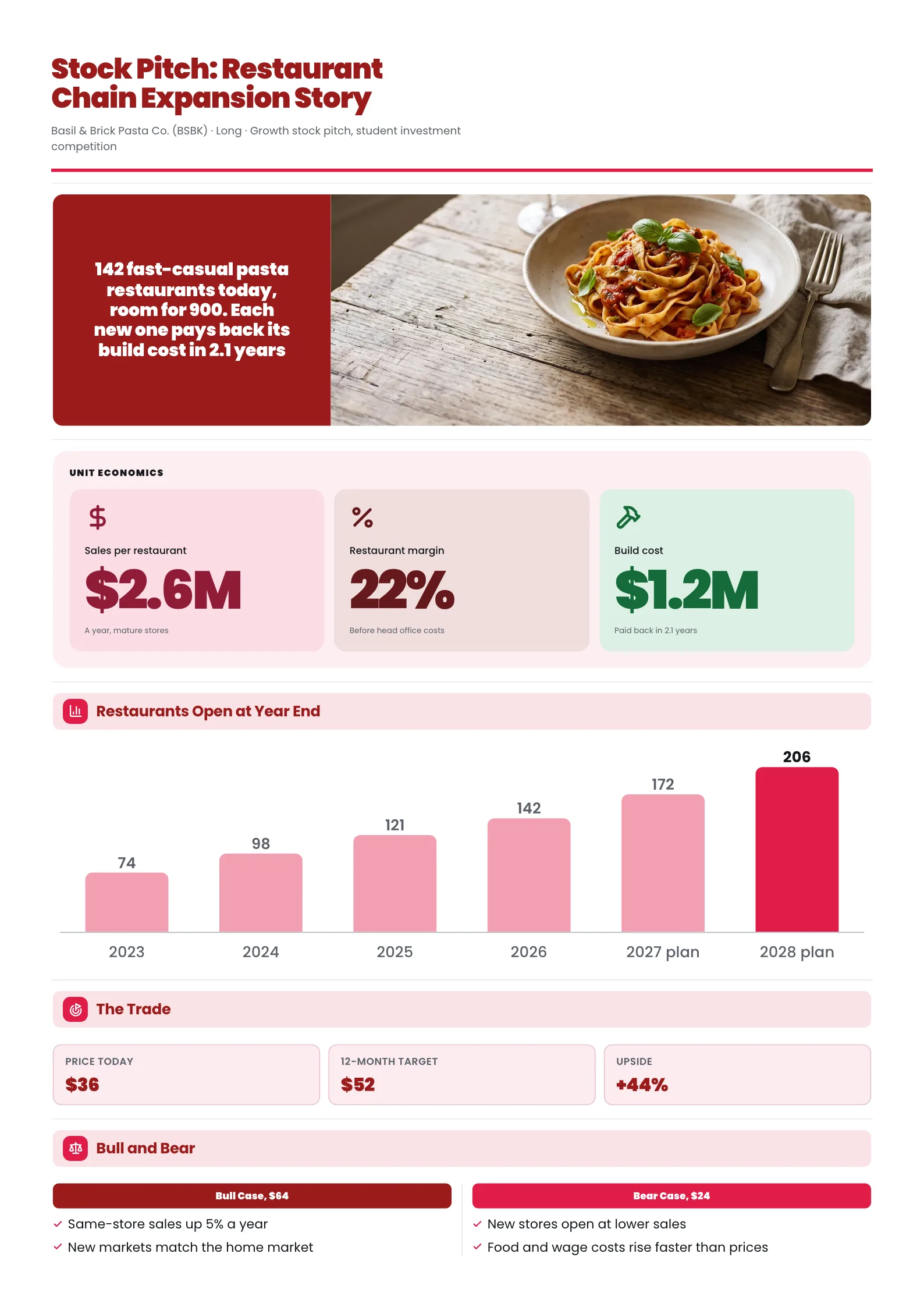
The pasta chain pitch shows restaurant count by year and what one new store earns.
Basil & Brick has 142 restaurants and tells you it has room for 900. The claim that carries the pitch is payback. A new store costs $1.2 million and pays it back in 2.1 years. You can check that from the sheet: $2.6 million of sales at a 22% margin is $572,000 a year, and $1.2 million divided by $572,000 is 2.1.
Check the trade yourself. It runs from $36 to $52, an upside of 44.4% against the 44% shown. The bull case of $64 is 78% up. The bear case of $24 is 33% down, and it names why: new stores that open at lower sales, and costs rising faster than prices.
The student version. A pitch on TPR, the company that owns Coach and Kate Spade, builds a growth case on Kate Spade's rebrand and sales in Asia. It shows the price at $85.42 on February 28, 2025, then a bear case of $123.20, a base of $138.30 and a bull of $196.40.
It never prints an upside percentage or the word buy in its text. Do the math and the base case is 62% up, the bear 44% up and the bull 130% up. Its fiscal 2024 revenue of $6.671 billion matches the $6,671.2 million in the company's 10-K for fiscal 2024. Put your call and your upside on the page yourself, so your reader doesn't need a calculator.
Turnarounds: a new plan that has started to show
 Edit this template
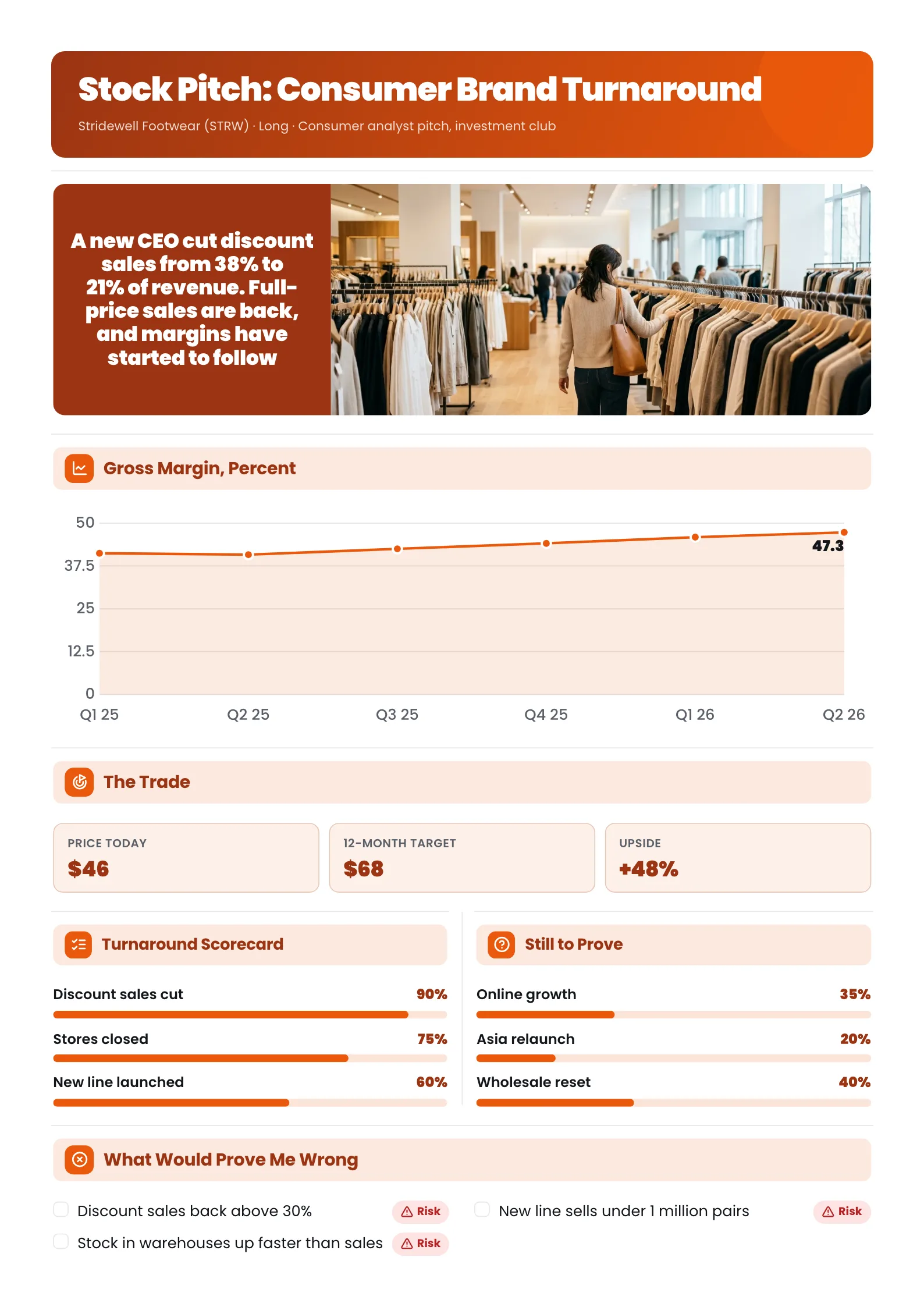
The footwear turnaround scores what the new CEO has done against what's still left to prove.
At Stridewell, a new CEO cut discount sales from 38% of revenue to 21%. Gross margin climbed from 41.2% to 47.3% over six quarters. The target of $68 against a price of $46 is 47.8% up, shown as 48%.
The scorecard splits the turnaround in two. It rates the finished steps, like the discount cut, beside the steps that still have to work, like online growth and the Asia relaunch. Your reader sees how much of the turnaround the target already assumes.
The student version. The Boeing sample treats the company's crisis as a catalyst for fixing its supply chain. Its valuation slide shows a current price of $187.76, a target of $265.00 and "38.00% Premium to Current." Divide $265.00 by $187.76 and you get 41.1%.
The slide doesn't tell you which number moved. Compute your upside in the same cell as your target, and the two can't drift apart. Boeing's 10-K for 2023 puts that year's revenue at $77.8 billion, the size of the business the pitch is valuing.
Event pitches: one date decides it
 Edit this template
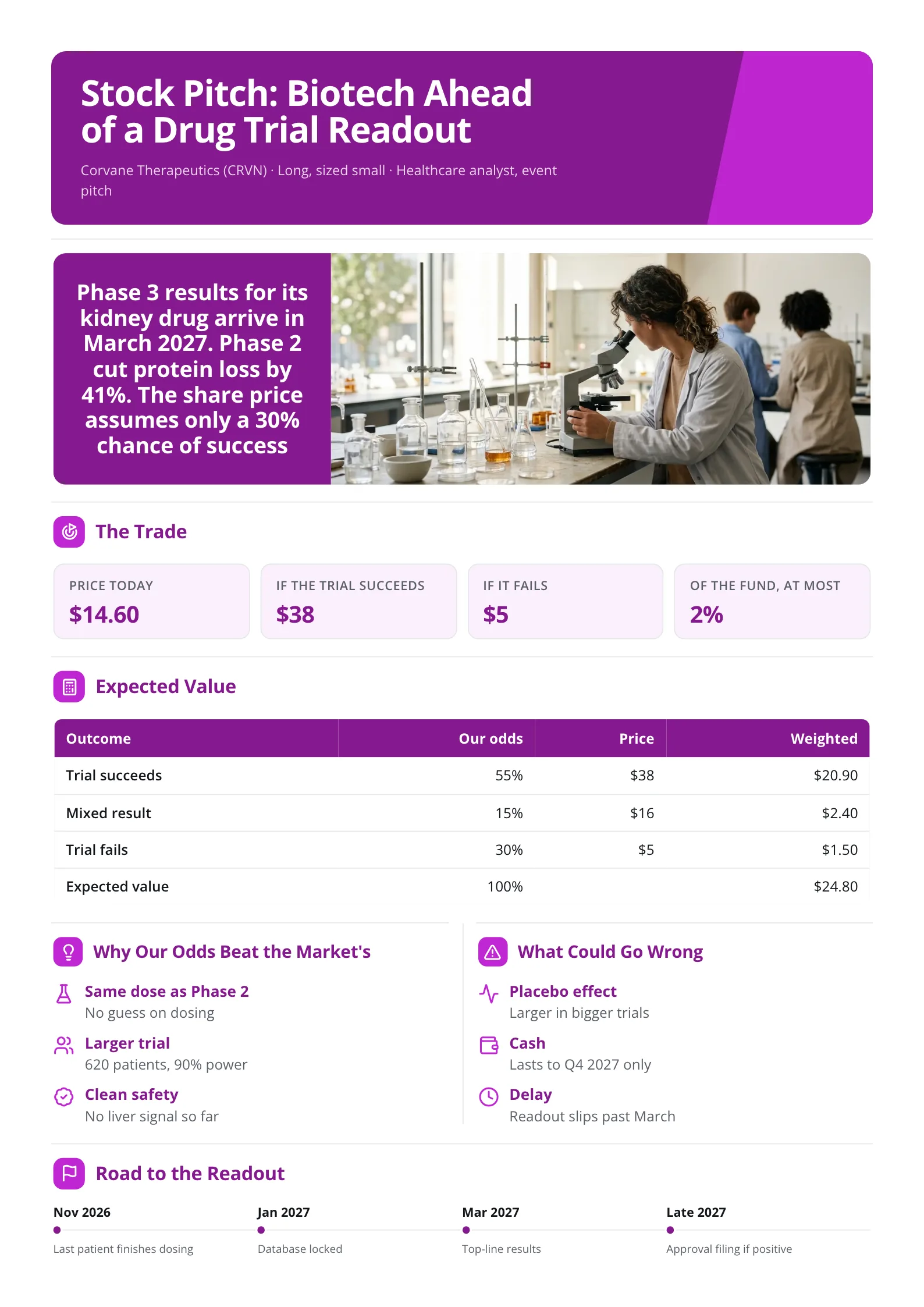
The biotech pitch weights each trial outcome by its odds before it names a value.
You get a date first: Corvane's kidney drug reports Phase 3 results in March 2027. The pitch gives three outcomes with odds:
- Trial succeeds: 55% odds times $38 is $20.90.
- Mixed result: 15% times $16 is $2.40.
- Trial fails: 30% times $5 is $1.50.
Those add to $24.80 against a price of $14.60. Each line checks. The pitch also caps the position at 2% of the fund, because a failed trial takes the price to $5.
None of the five student pitches we read is an event pitch. McGill's checklist comes close when it describes bull and bear scenarios built on how many new drugs win approval. The template goes one step further and gives each scenario its odds, which is what you'll want when one date decides the trade.
What student competitions ask you to hand in
| Competition | What you submit | Call allowed | Stock rules | On stage |
|---|---|---|---|---|
| Citadel Fall 2026 | Memo of 2 pages at most, appendix included, plus an Excel model | Long or short, 3 to 12 months | One of 8 listed US stocks | 10 minutes plus 10 of questions |
| Blue Chips, University of Chicago, 2026 | 15 slides, not counting title and appendix, plus a model, with no names on it | Long only | NYSE or Nasdaq, market cap over $2 billion | Live round with judges |
| Appalachian State, Sustainable Horizons | A slide deck | A company poised for sustainable growth | Market cap of $1 billion or more, price of $5 or more | 10 minutes plus 10 of questions |
| McGill Desautels Capital Management | Full pitch with a one-slide executive summary | Buy or sell | A buy needs at least 20% upside | About 30 minutes plus questions |
Source: our count of each linked rules page, read October 30, 2026.
Two of these line up closely with a one-page pitch. Citadel caps your whole memo at two pages. McGill wants the executive summary on one slide, with the price, a target with its upside, one key risk and the call. Most of that fits in the thesis line and trade box at the top of the templates you've just read. Our guide on how to write a stock pitch read 12 student fund theses beside 5 judging rulebooks and found that none of the 12 wrote down a target price.
McGill's 20% floor is easy to test on the examples here, and on your own pitch. The three template longs that print an upside sit between 40% and 48%. The student longs run from 34.82% to the 62% base case in the Coach and Kate Spade pitch. Every one clears it.
McGill also asks for fewer theses, "say 2," and for the likelihood and impact of each risk. Citadel asks for the return profile and the risks that could drive a big move either way. Two theses, a checked upside and risks you could watch cover the parts of these rules that live on your page.
Check your own sum before you present
Seven of the ten pitches here gave a reader enough to check the upside, and one of them didn't add up. Run the same test on yours before anyone else does. Divide your target by today's price and subtract one, then compare the answer with the percentage you printed. Do it again for your bear case and your bull case.
After the math, pick one input in your model, like revenue, and match it to the company's 10-K, the way the Netflix, Textron and Coach and Kate Spade pitches all match theirs.




