Sales Forecast vs Sales Projection: One Question Sorts Them
Sales forecast vs sales projection: what accountants, the SEC and the SBA each mean, why their words clash, and Census data on the season a flat number misses.

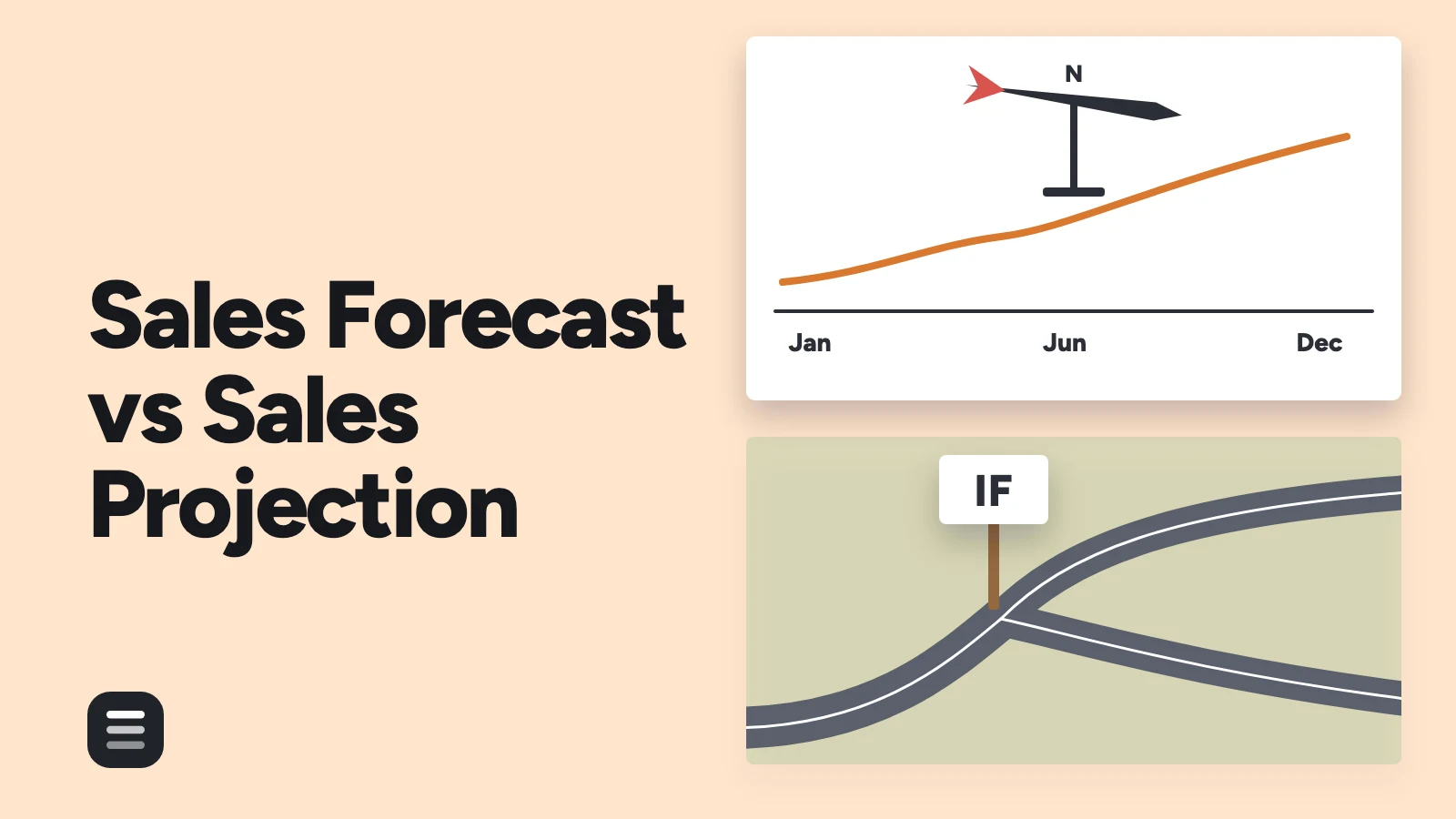
A sales forecast is the number you expect to reach. A sales projection is the number you'd reach if something you can't yet count on comes true. So the question to ask of any sales figure is short: do you expect this, or are you asking "what if"? Start from a free one pager template.
One‑Pager examples
Real One-Pagers made with MakeOnepagers. Open any one to edit it as your own.
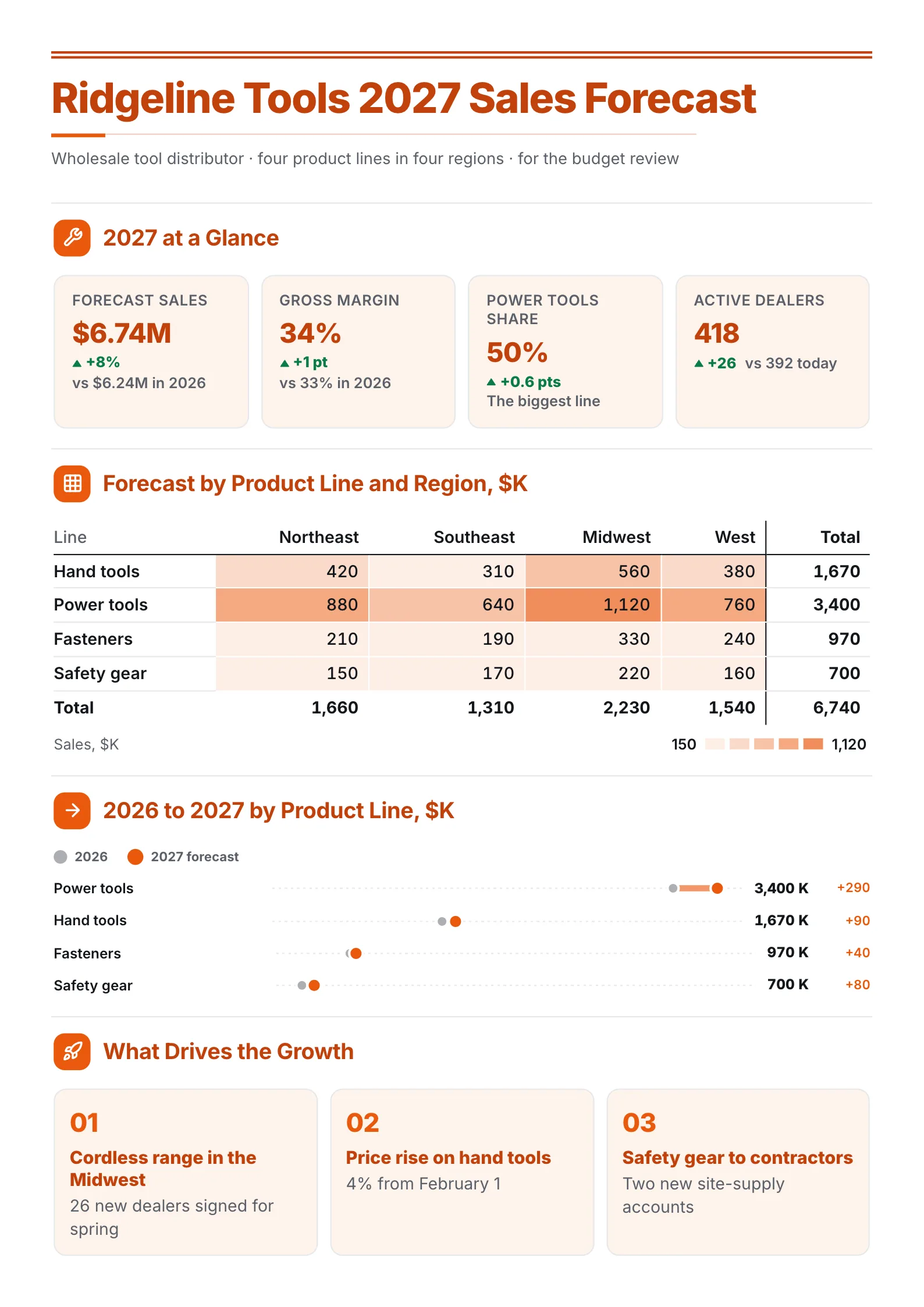 Sales Forecast: Distributor by RegionEdit for free(opens in a new tab)
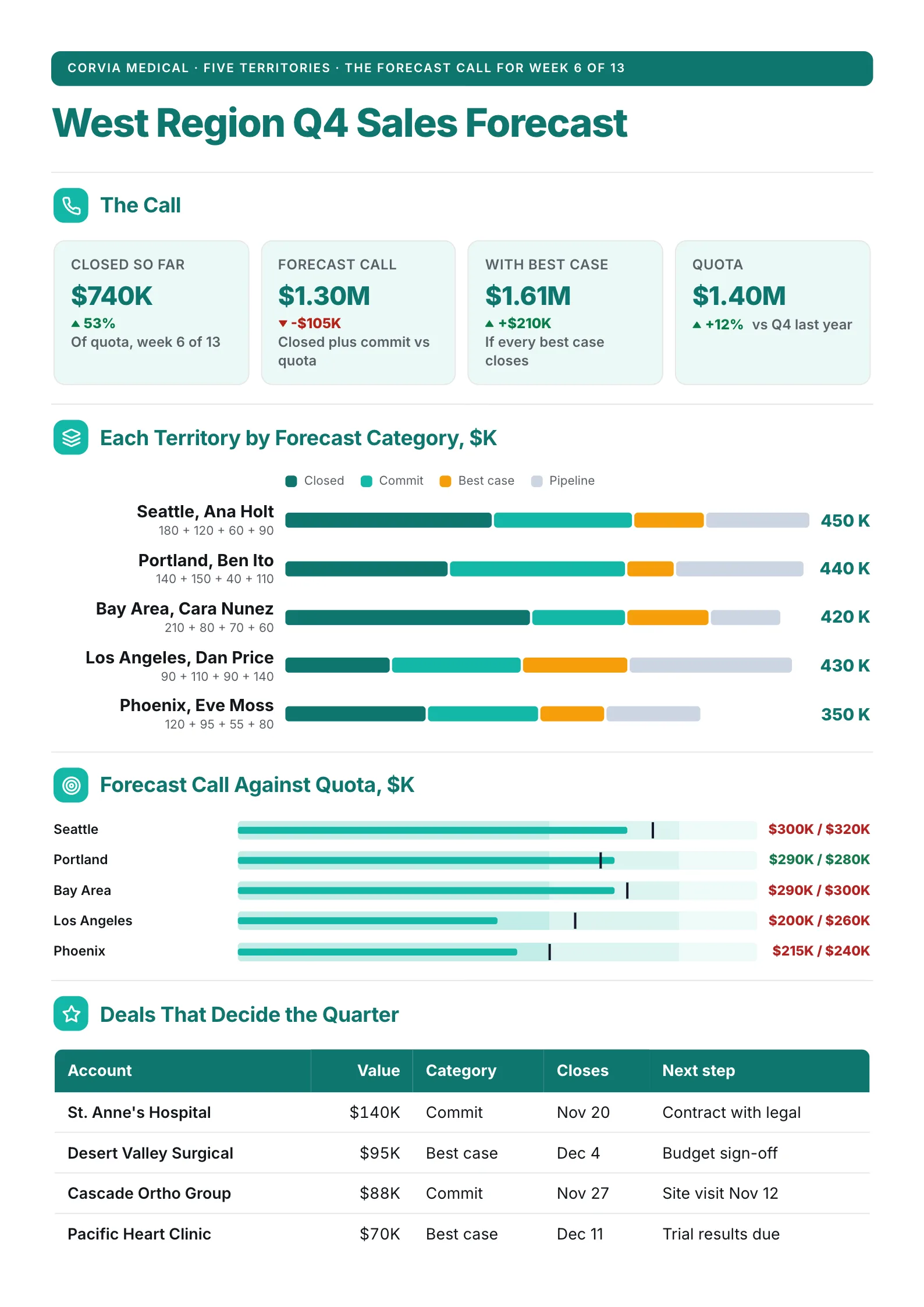 Sales Forecast: Regional Forecast CallEdit for free(opens in a new tab)
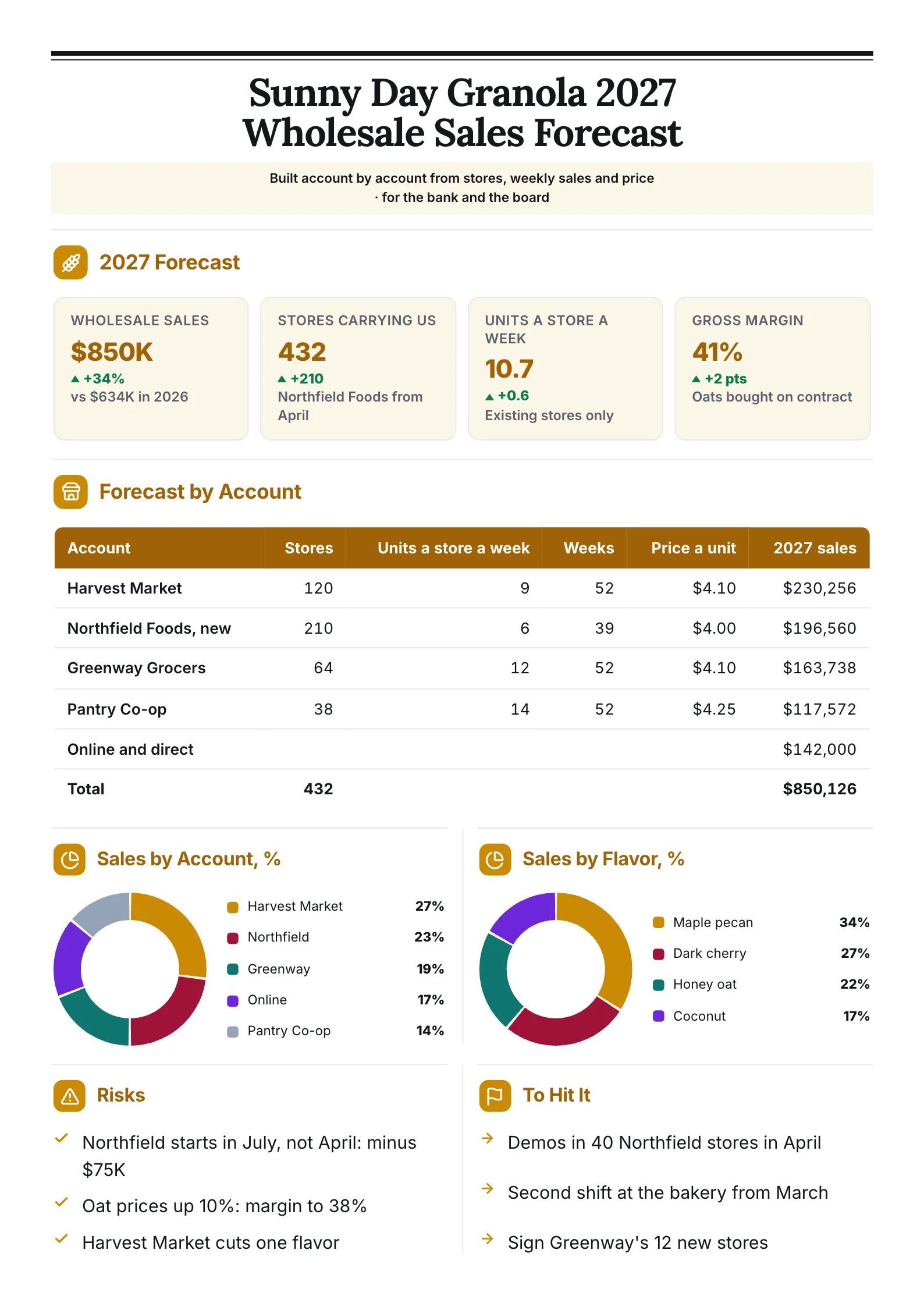 Sales Forecast: Wholesale AccountsEdit for free(opens in a new tab)
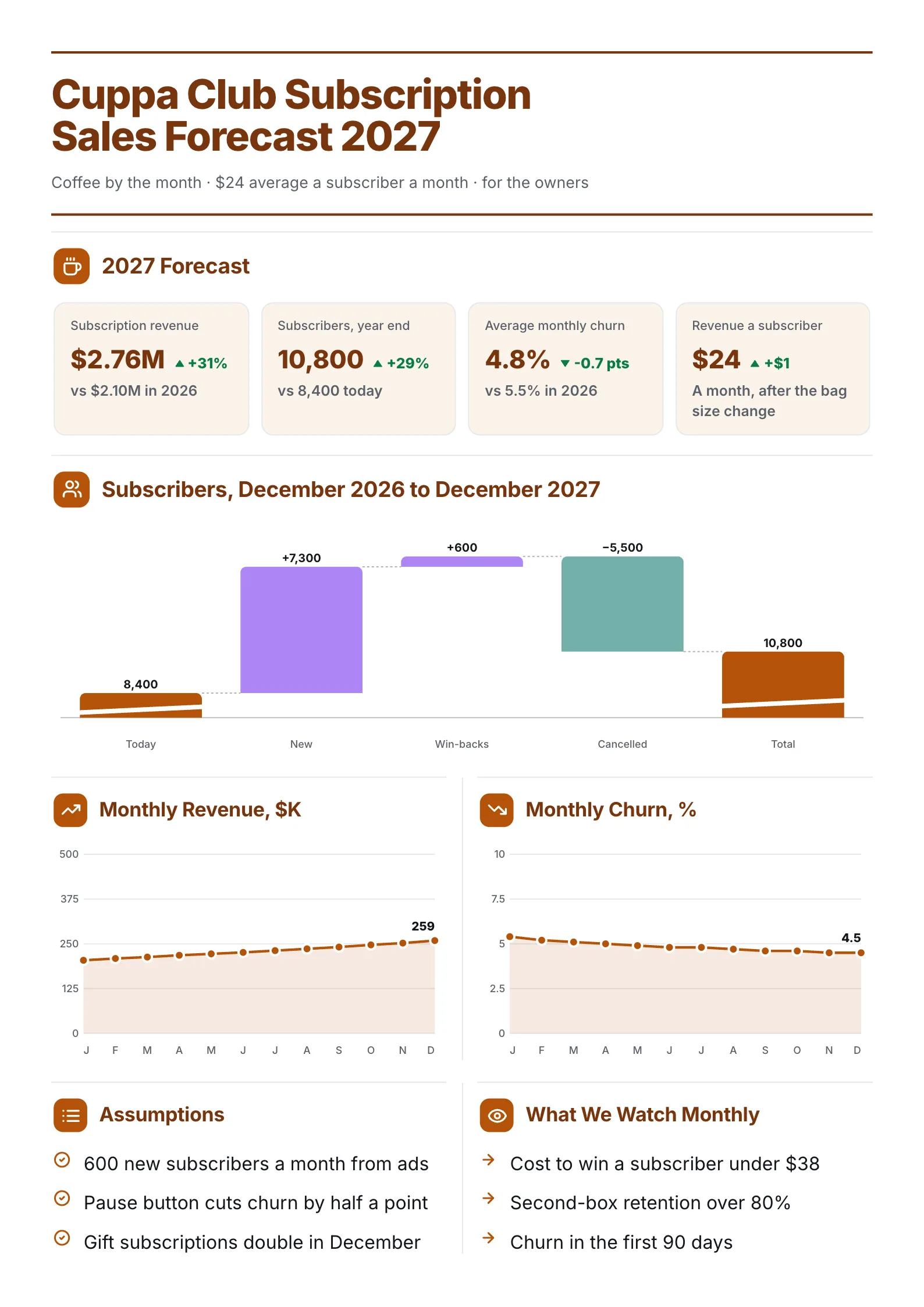 Sales Forecast: Subscription BusinessEdit for free(opens in a new tab)
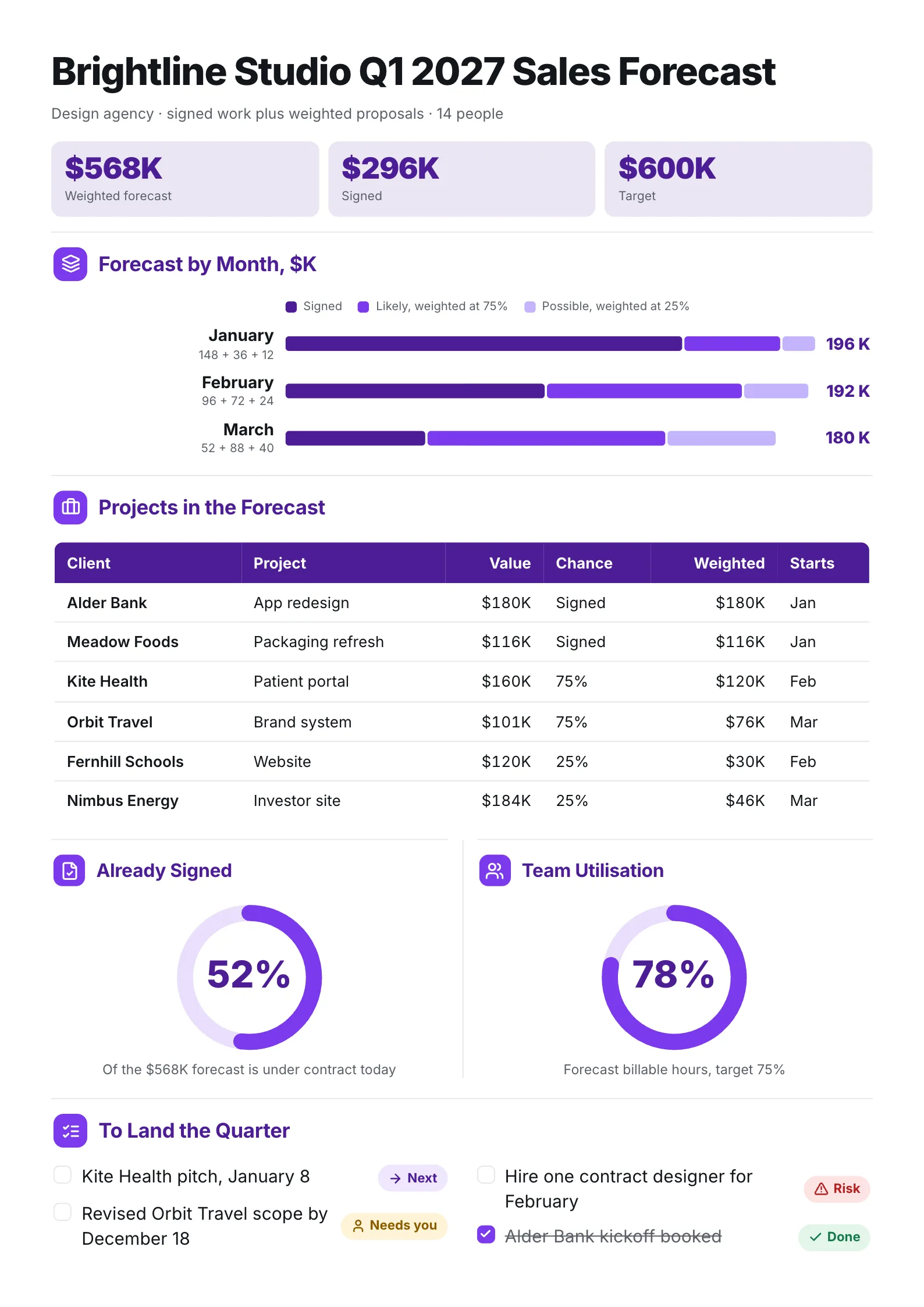 Sales Forecast: Agency QuarterlyEdit for free(opens in a new tab)
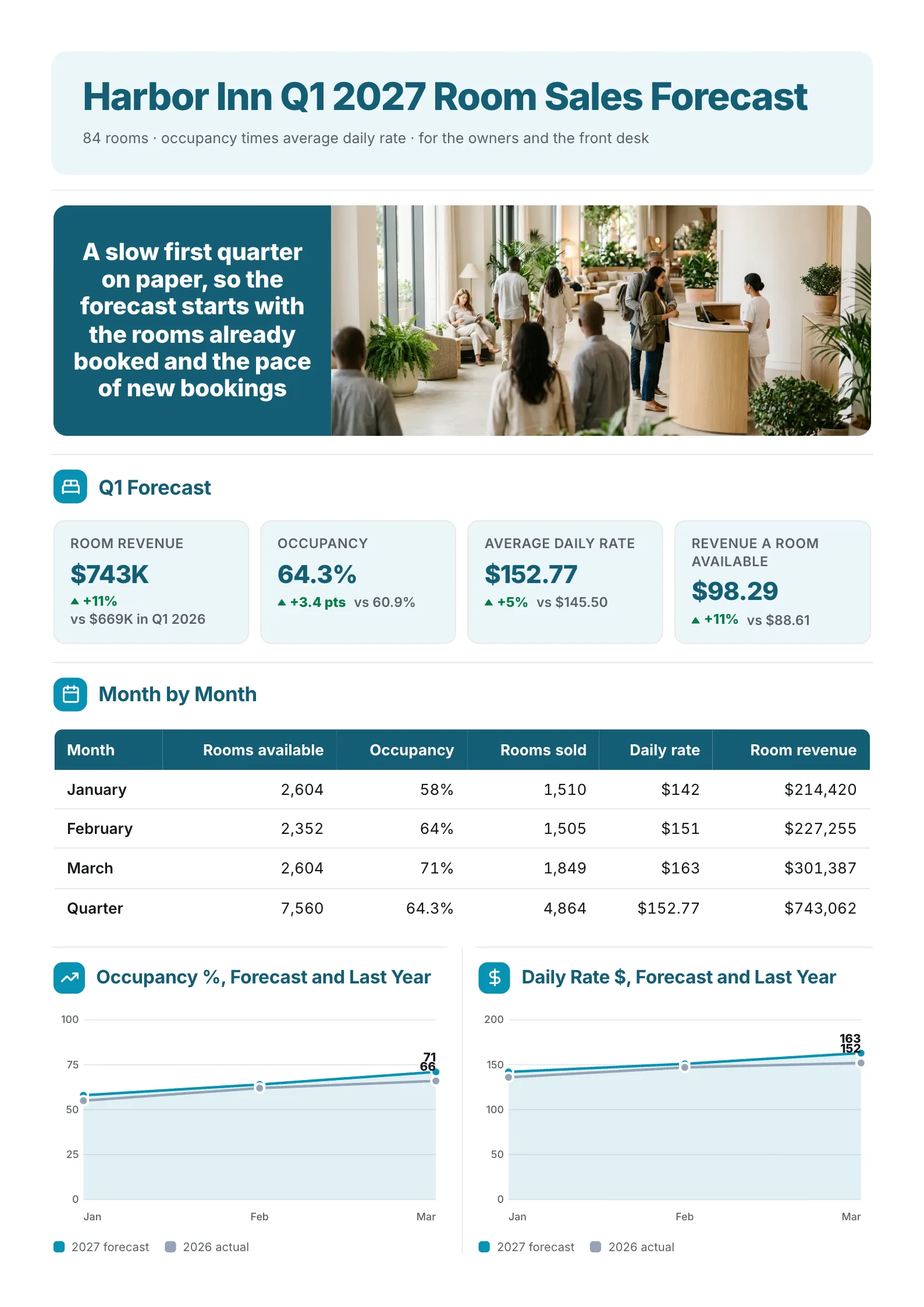 Sales Forecast: Hotel RoomsEdit for free(opens in a new tab)
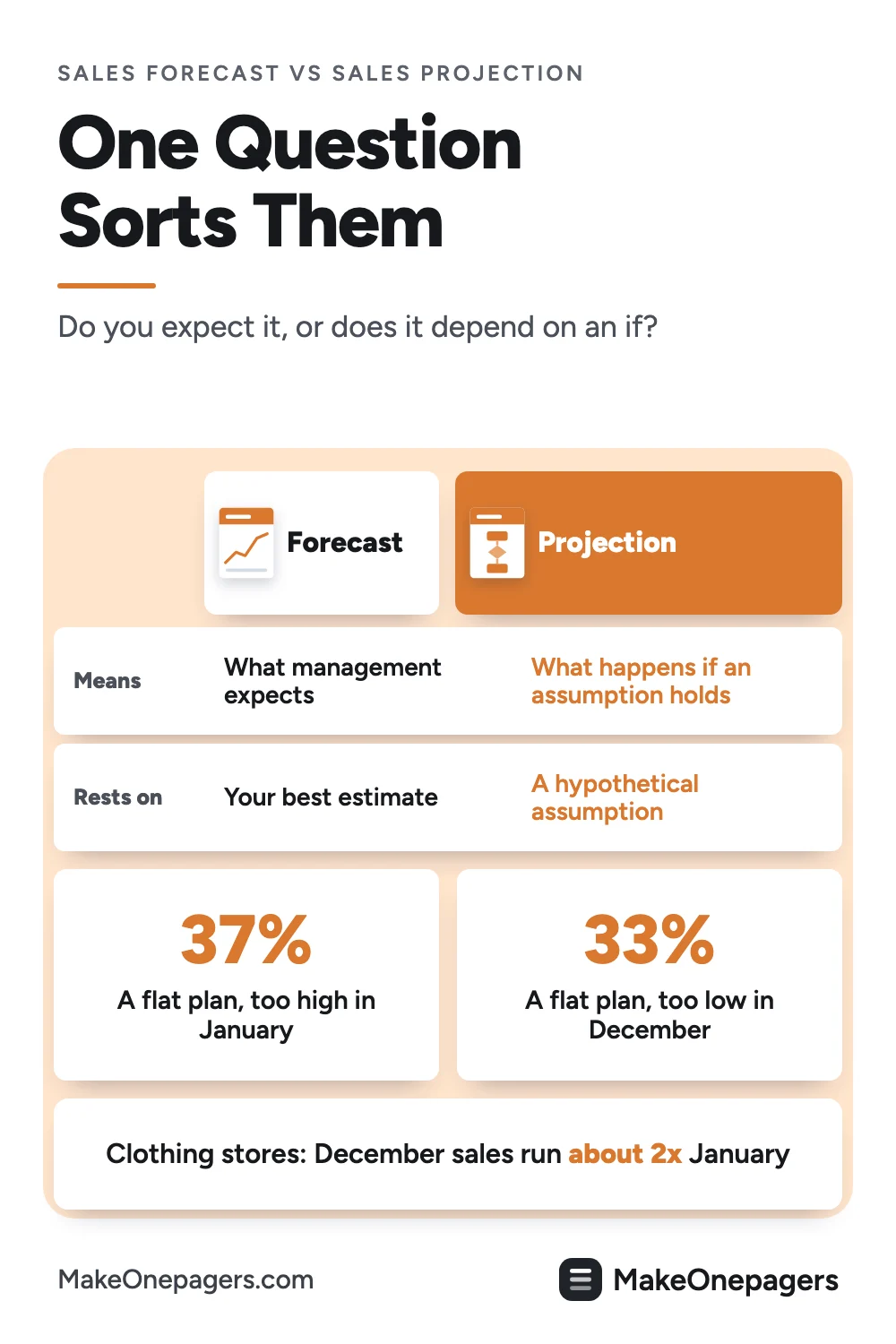
That's the accountant's split, and it's useful. Outside accounting, though, the two words get swapped constantly, even by government agencies. Below, we'll show who says what, then sort real-looking sales plans using the test.
Who uses which word
| Source | Word it uses | What it means there |
|---|---|---|
| Journal of Accountancy | Both, kept apart | Forecast is what management expects. Projection rests on hypothetical assumptions |
| SEC Regulation S-K, 229.10(b) | Projection | Management's good-faith view of future performance, with a reasonable basis |
| SEC Regulation S-X, 210.11-03 | Forecast | In filings about a transaction: at least 12 months ahead, with key assumptions set out |
| SBA business plan guide | Mostly projection | Your expected numbers for a loan, for five years ahead |
The Journal of Accountancy piece dates from 1999 and its archive warns it may be out of date, but it states the distinction most plainly. Its examples of a projection are a startup that depends on investor money and a plan where sales triple every year. An existing business whose results don't hang on one event is its model for a forecast.
The SEC's Regulation S-K page says "projection" 21 times and never "forecast", while the S-X page says "forecast" 12 times and never "projection". We counted the whole page for each, headings included. The SBA's section is headed "Financial projections", and then it asks for "forecasted" statements in the same breath.
So you can't assume your banker, your investor and your accountant share a definition. Writing your assumptions on the page settles it, whichever label you pick.
How to sort your own number
Run your sales figure through these questions.
| Question | Points to a forecast | Points to a projection |
|---|---|---|
| Where does the number start? | Your own past sales or live pipeline | A market size, a pilot or a plan |
| Does it depend on one event? | No, it continues what's happening | Yes, such as funding, a launch or a new hire |
| Would you bet your budget on it? | Yes, you'd staff to it | Not yet |
| How does it change when you're wrong? | You revise it at the next check | You change the assumption and rerun it |
| How far out is it most useful? | The next quarters | Years, or any scenario |
Plenty of good plans hold both. A base case you expect is a forecast, and a "what if the summer is mild" case beside it is a projection.
What a flat number gets wrong
Either kind fails if you divide a yearly number by 12. That's a common shortcut, and Census Bureau retail data shows how far off it lands. These are 2025 U.S. sales before any seasonal adjustment, in millions of dollars.
| Kind of store | Low month | High month | High vs low |
|---|---|---|---|
| Book stores | February: $511 | December: $1,041 | About 2x |
| Clothing stores | January: $13,533 | December: $27,542 | About 2x |
| Sporting goods stores | February: $3,673 | December: $7,270 | About 2x |
| Building materials and garden | February: $32,944 | May: $49,214 | About 1.5x |
| All retail and food services | February: $605,151 | December: $780,707 | About 1.3x |
Clothing stores sold $222,691 million over the year, or about $18,558 million a month on average. A flat plan would have run 37% too high in January and 33% too low in December. The Census Bureau's own seasonally adjusted clothing line barely moves, from $18,009 million in January to $19,070 million in December, so most of that swing is the calendar.
The SBA points the same way. It wants your first year in quarterly or even monthly detail, and your longer years can stay broader.
Five sales plans, sorted
All of these samples are titled "sales forecast", and all use made-up companies. They come from MakeOnepagers. Holding them to the accountant's test is more useful than taking the label at face value.
Forecast: an online store's holiday season
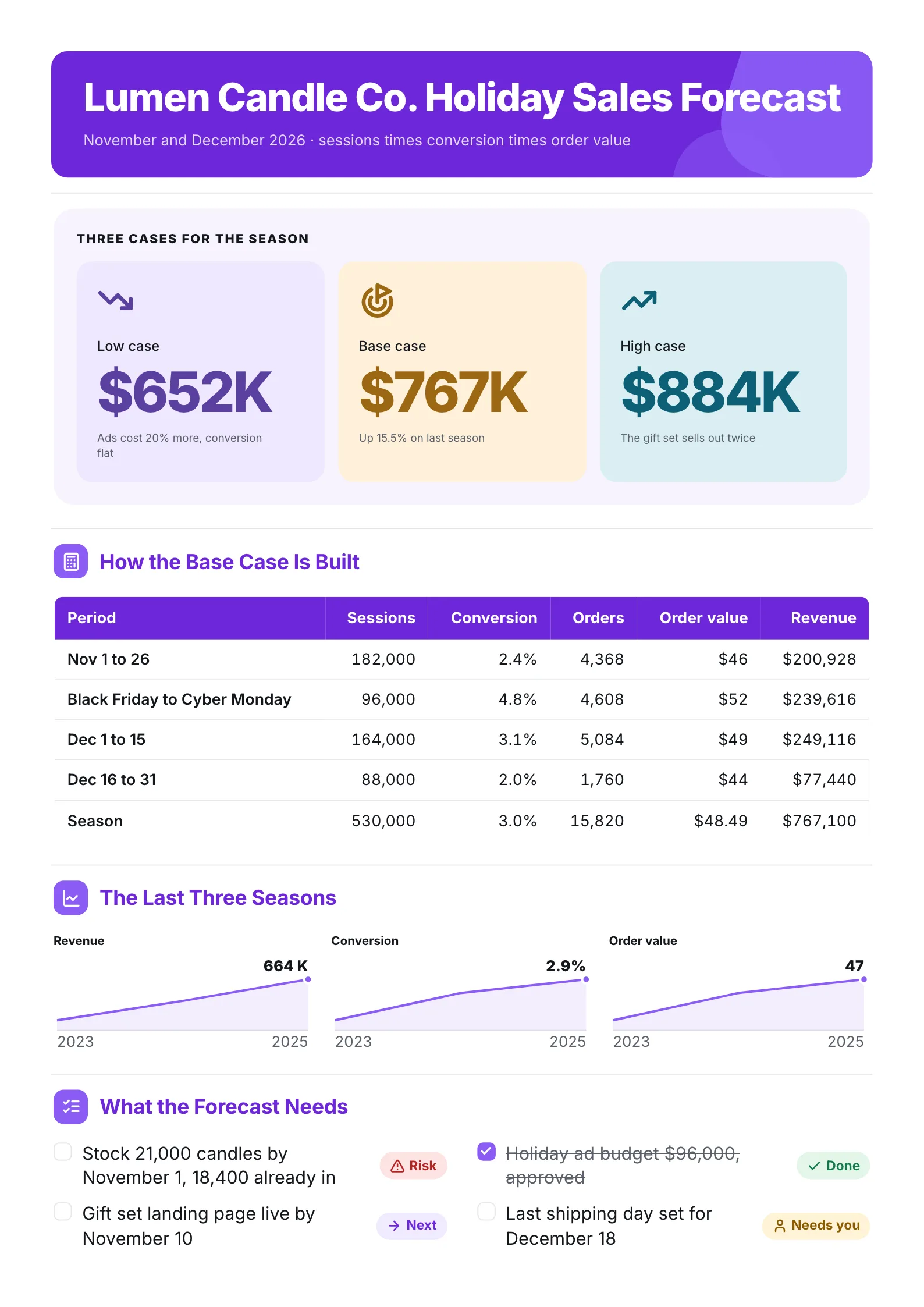
Three past seasons of $488K, $571K and $664K sit behind Lumen Candle's base case of $767K. You can check how it's built, since each stretch of the season has its own visits, orders and revenue.
 Edit this template
Black Friday to Cyber Monday carries $239,616 from just 96,000 sessions, which an annual average would hide.
Forecast: a software team's next quarter
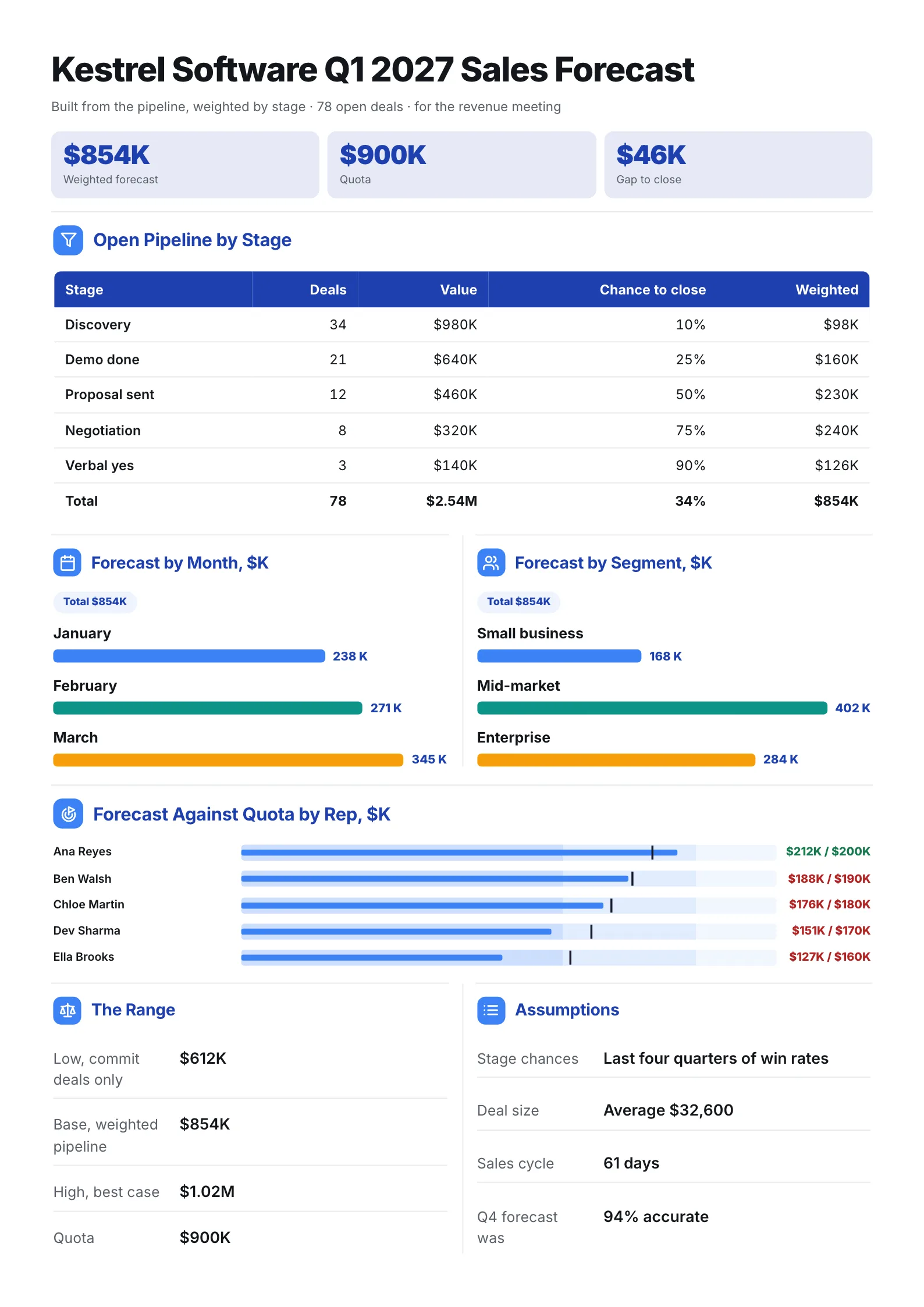
Pipeline forecasts stay close to what's real, because each open deal is weighted by how often that stage has closed. Kestrel's 78 deals worth $2.54M come down to $854K, using win rates from the last four quarters.
 Edit this template
Its last forecast's 94% accuracy is on the sheet, so your reader can judge how far to trust this one.
Forecast with projections around it: a solar installer
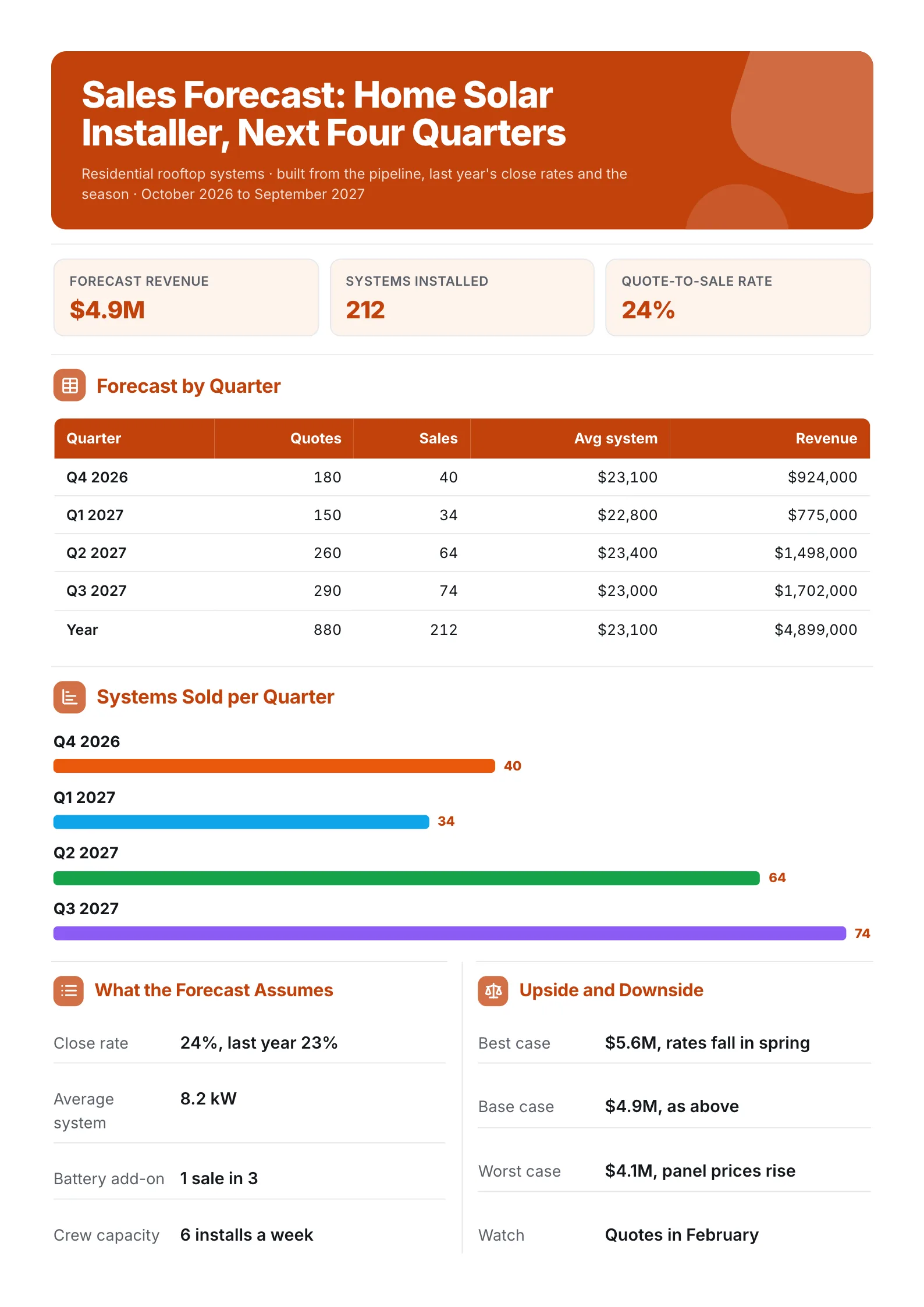
The middle number comes from last year's close rates and the season, at $4.9M on 212 systems. Around it sit two "if" cases: $5.6M if rates fall in spring and $4.1M if panel prices rise.
 Edit this template
Sales drop to 34 systems in the first quarter of 2027 and climb to 74 by the third, so the season stays visible.
Mostly projections: a heating and cooling company
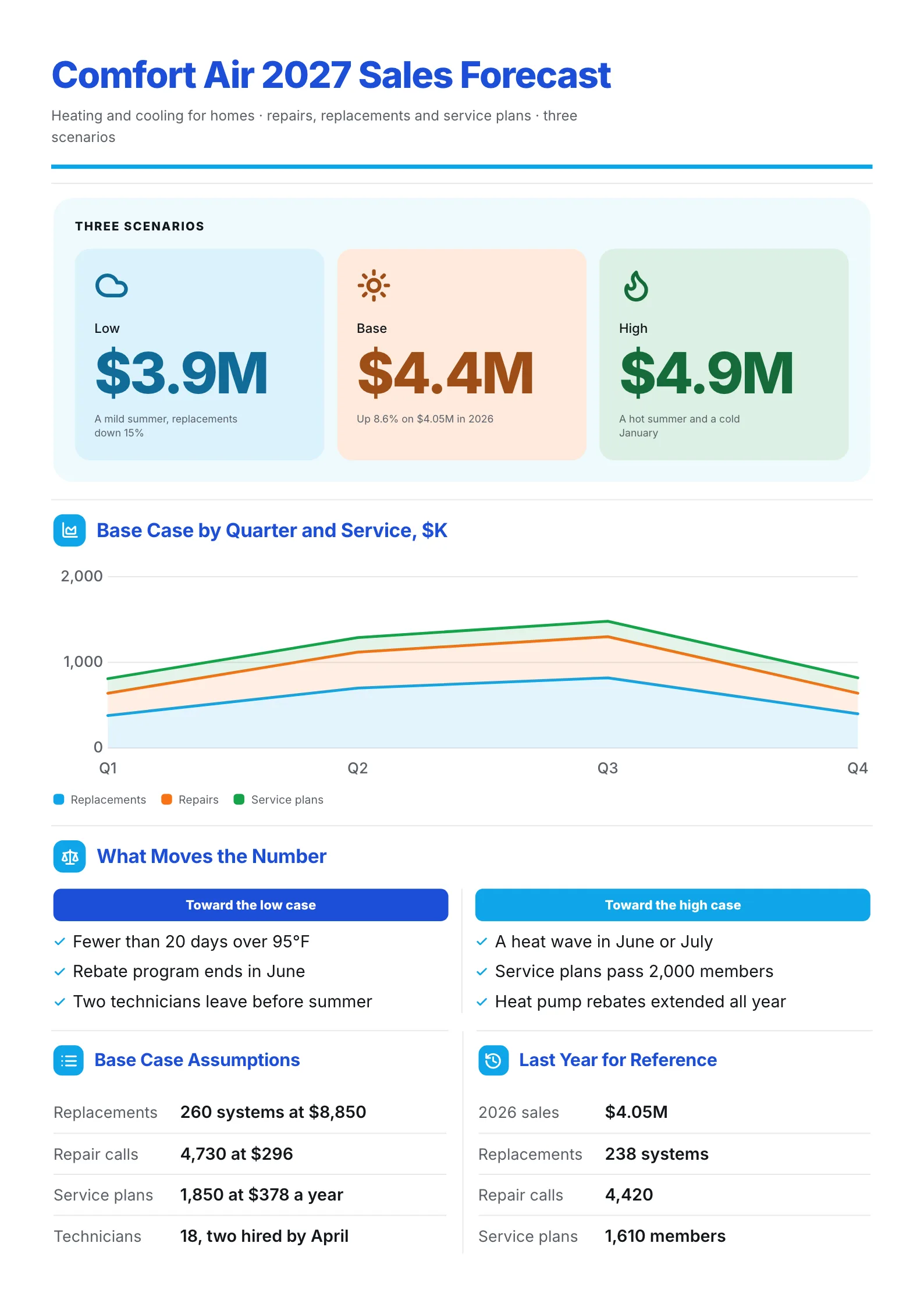
Comfort Air offers three scenarios for 2027, and two of them depend on weather nobody can promise. A mild summer gives $3.9M, a hot summer and a cold January give $4.9M, and the $4.4M base is the one to staff to.
 Edit this template
"What Moves the Number" lists the events behind each case, such as a June heat wave or a rebate ending.
Projection under a forecast label: a new sales team
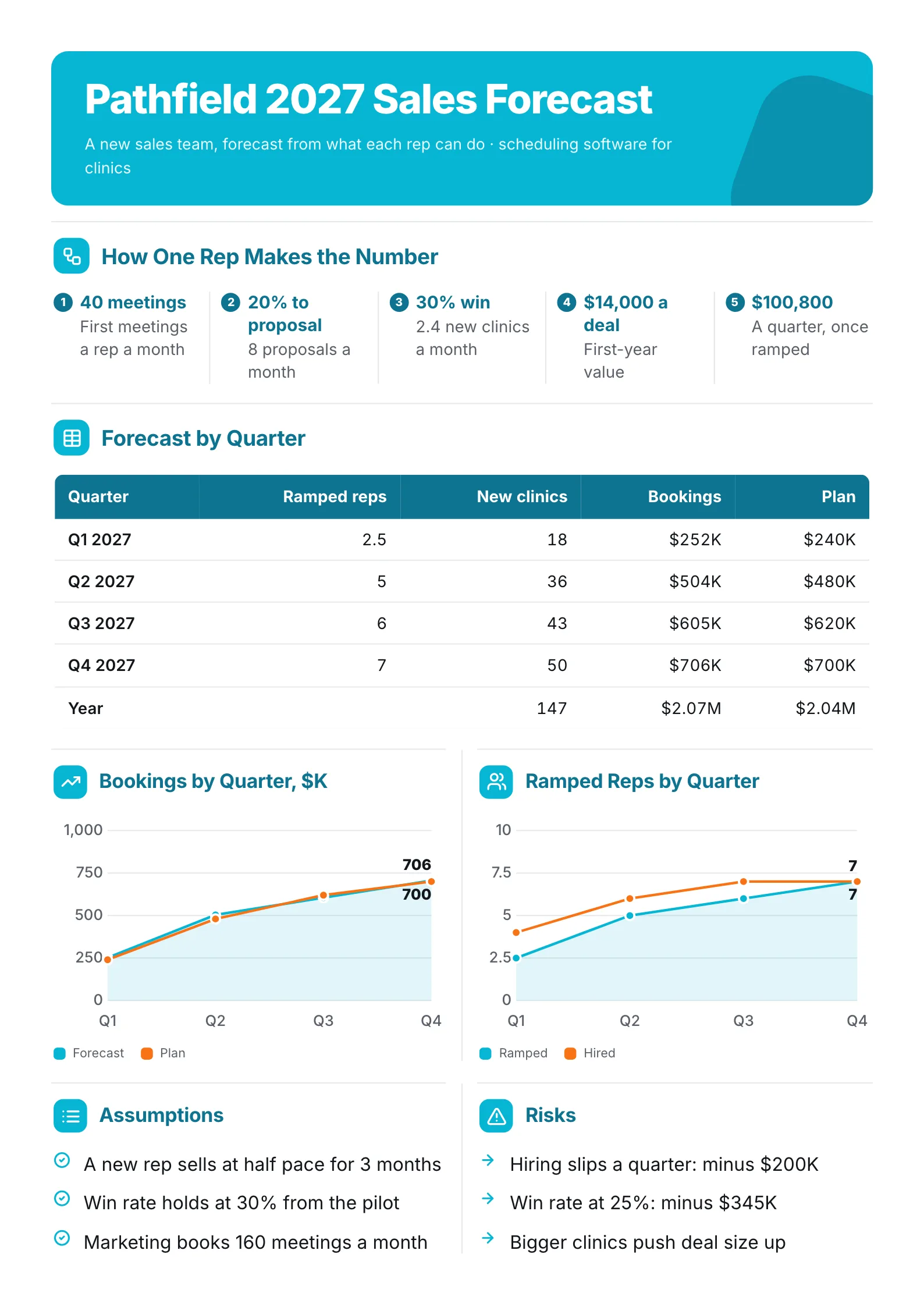
Pathfield's $2.07M depends on reps who aren't all hired yet and a win rate of 30% that comes from a pilot. By the accountant's test, that's a projection. The label matters less than the honesty of the page, and this one prices its risks: a quarter's hiring delay costs $200K.
 Edit this template
Each risk has a dollar figure, so an investor can rerun the plan in their head.
Which one your reader wants
| Reader | Give them | Include |
|---|---|---|
| Your own team, for staffing and stock | Forecast | Monthly figures with the season in them |
| A bank, for a loan | Forecast if you have history, with assumptions | Quarterly or monthly first year, as the SBA asks |
| An investor in a new business | Projection, labeled honestly | The assumptions and what each one costs if wrong |
| Your board, for a budget | Forecast plus low and high cases | What would move you from one to another |
Once you know which you need, our guide to creating a sales forecast covers the build, and the sales forecast template gives you a layout to start from. More filled-in plans are in these sales forecast examples.
Frequently asked questions
Is a sales projection the same as a sales forecast?
People often use them interchangeably, and the SBA's own guide does. Accountants separate them: a forecast is what you expect, and a projection shows what follows from an assumption you can't yet count on.
Which is more accurate, a sales forecast or a sales projection?
A forecast should land closer because it starts from your real sales. A projection isn't really trying to be accurate in that sense, since it answers a "what if". Track your forecast against actual sales each period, as the Kestrel sample does.
Can a startup make a sales forecast?
With no past sales to start from, a startup is usually making a projection, whatever the title says. The SEC's rule notes a history isn't always required for a reasonable basis, so what matters is showing where each assumption came from, such as a pilot.
How far ahead should a sales forecast go?
The SEC's rule for forecasts in transaction filings uses at least 12 months, and the SBA asks for five years in a loan plan, with more detail in year one. Treat the near months as your forecast, and read the later years more like projections.




