Safety Data Sheet Example: 5 Real SDSs, Each as a One‑Pager
Safety data sheet examples from 10 real SDSs (5 to 16 pages), and 5 One-Pager summaries for spray paint, cement, propane, an e-bike battery and a quat cleaner.

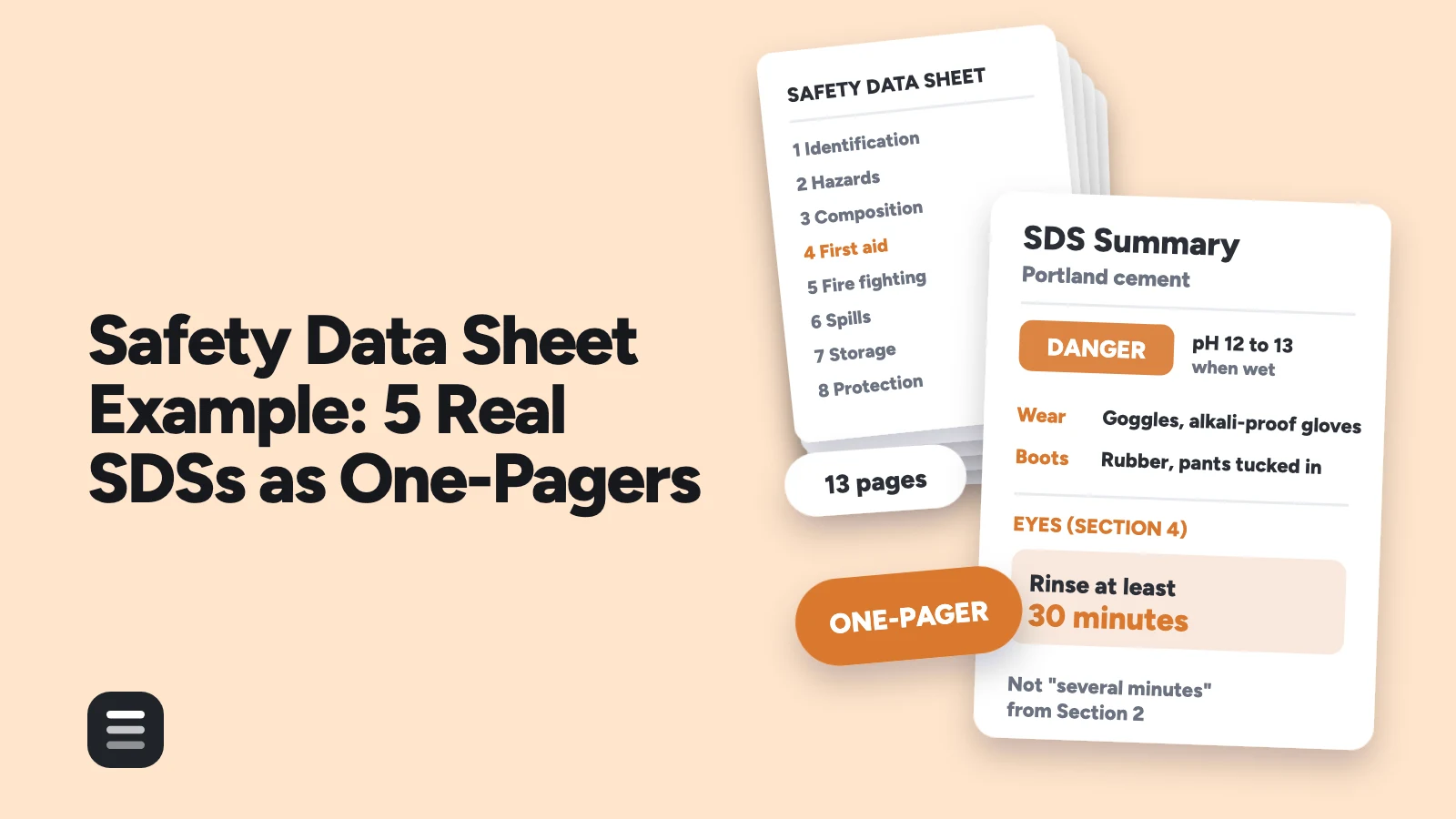
Looking for a safety data sheet example you can actually learn from? Below you'll find 10 real SDSs from manufacturers and suppliers, measured section by section. You'll also see 5 summaries made on MakeOnepagers, each one checked against a real sheet from a supplier. Every summary opens as a template you can edit for free.
One‑Pager examples
Real One-Pagers made with MakeOnepagers. Open any one to edit it as your own.
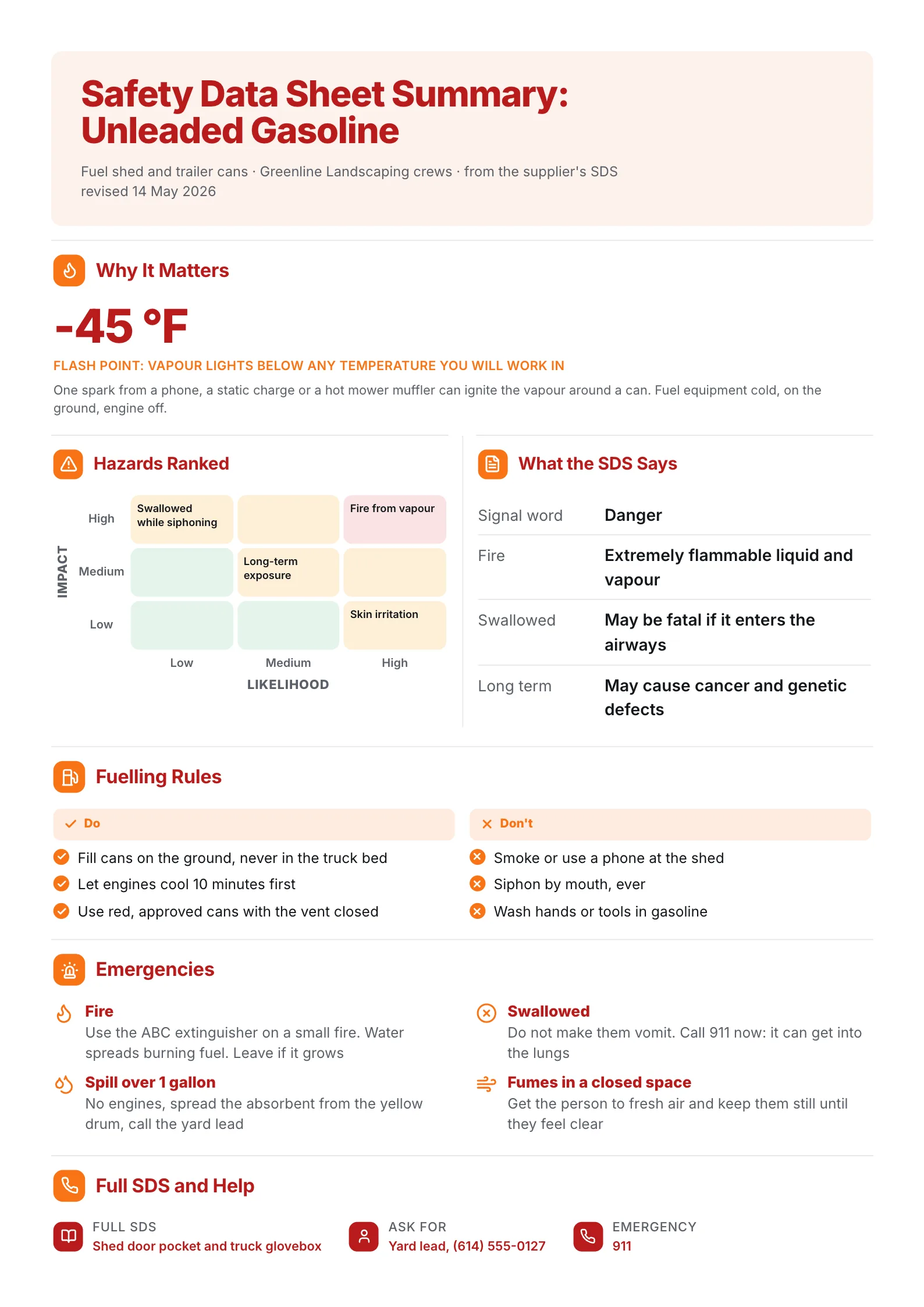 Safety Data Sheet Summary: Gasoline for Landscaping CrewsEdit for free(opens in a new tab)
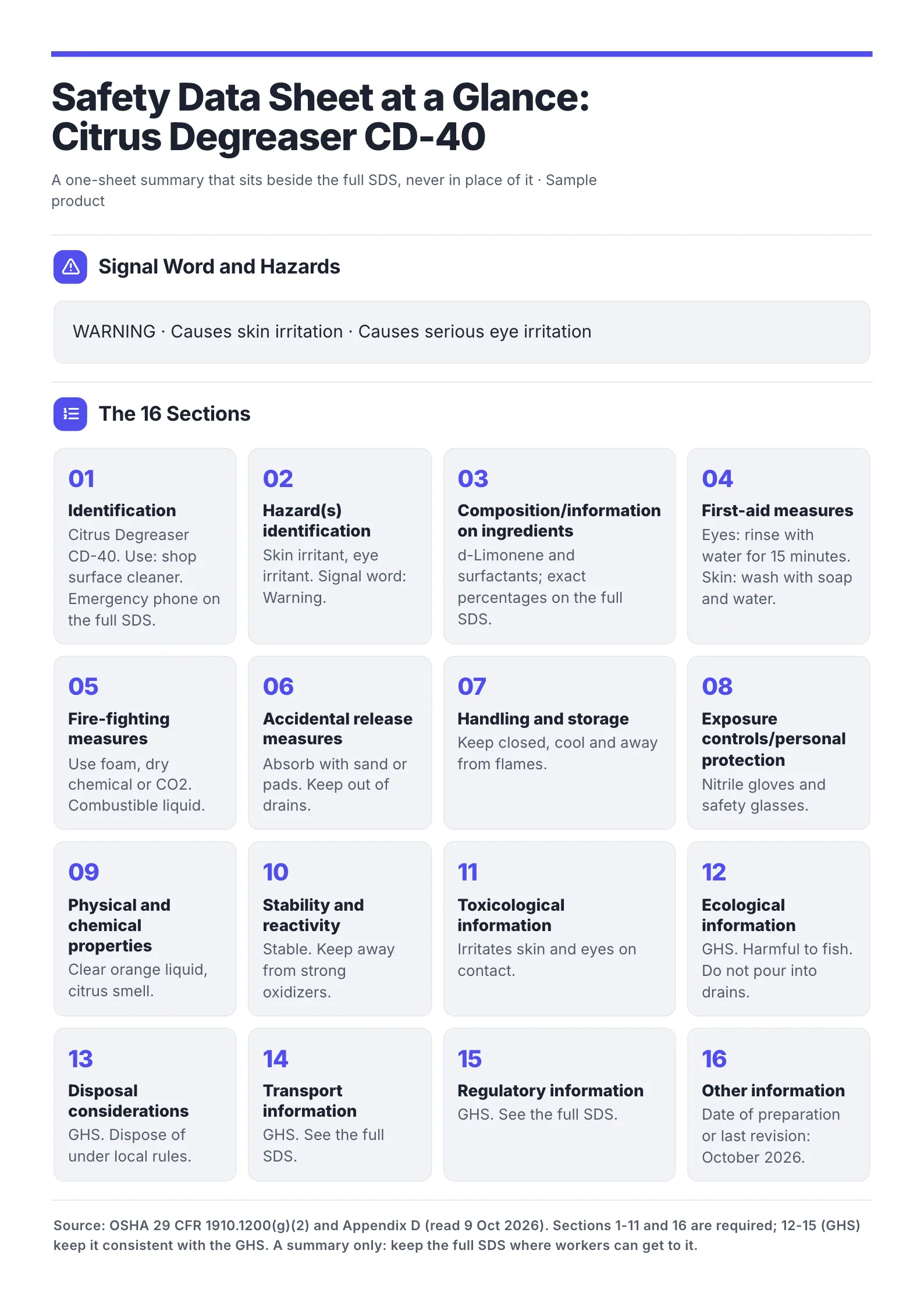 Safety Data Sheet SummaryEdit for free(opens in a new tab)
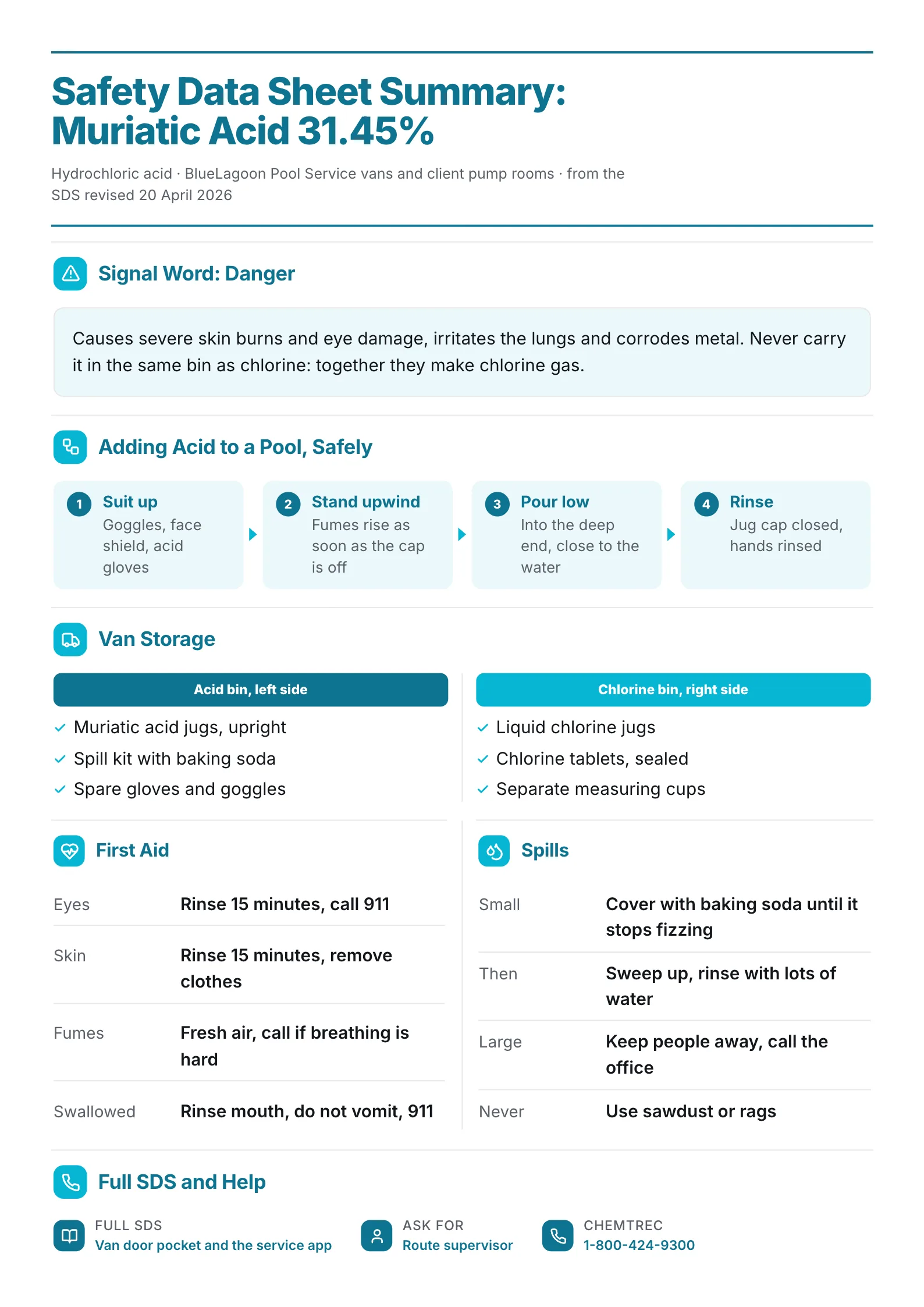 Safety Data Sheet Summary: Muriatic Acid for Pool ServiceEdit for free(opens in a new tab)
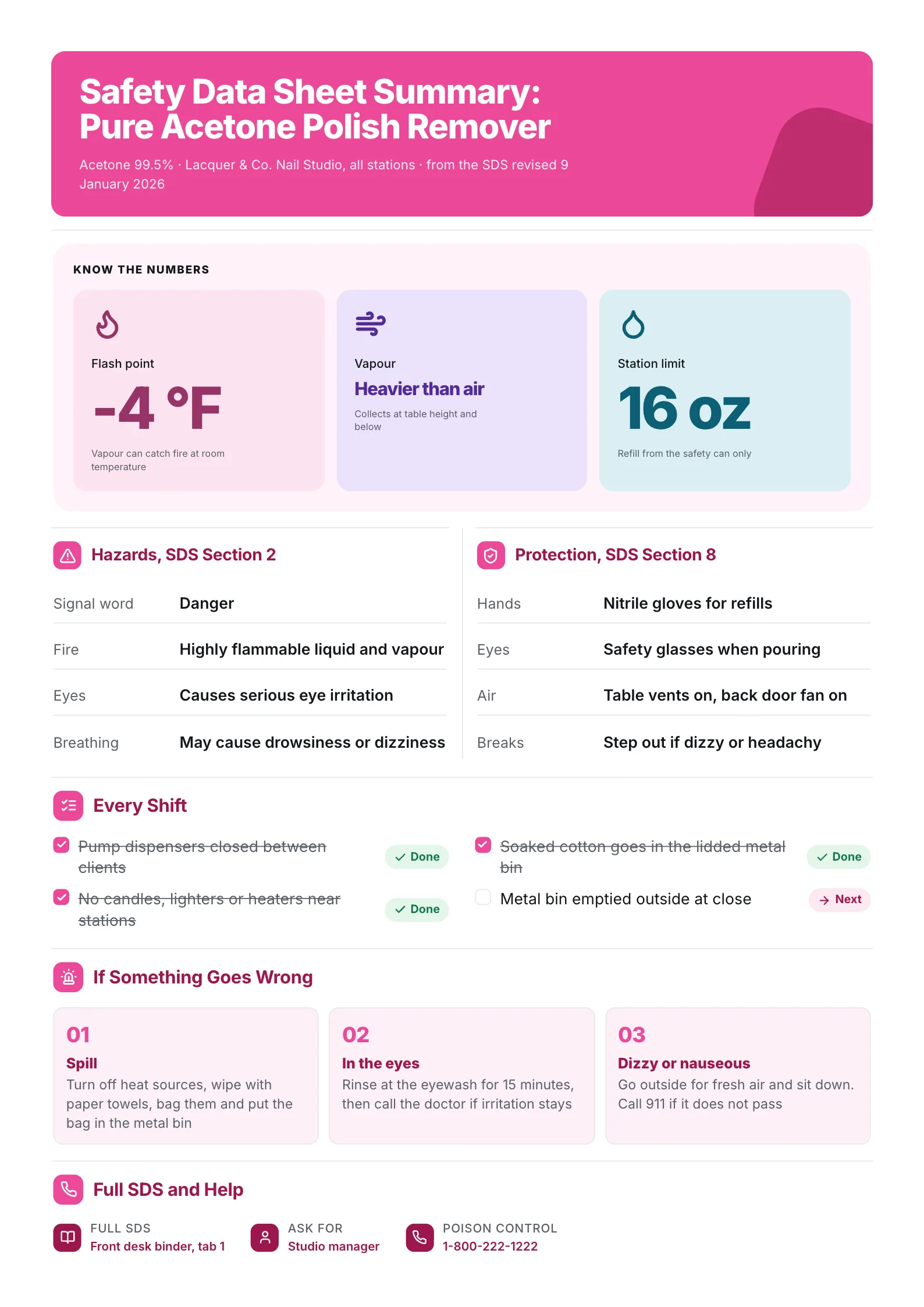 Safety Data Sheet Summary: Acetone for Nail SalonsEdit for free(opens in a new tab)
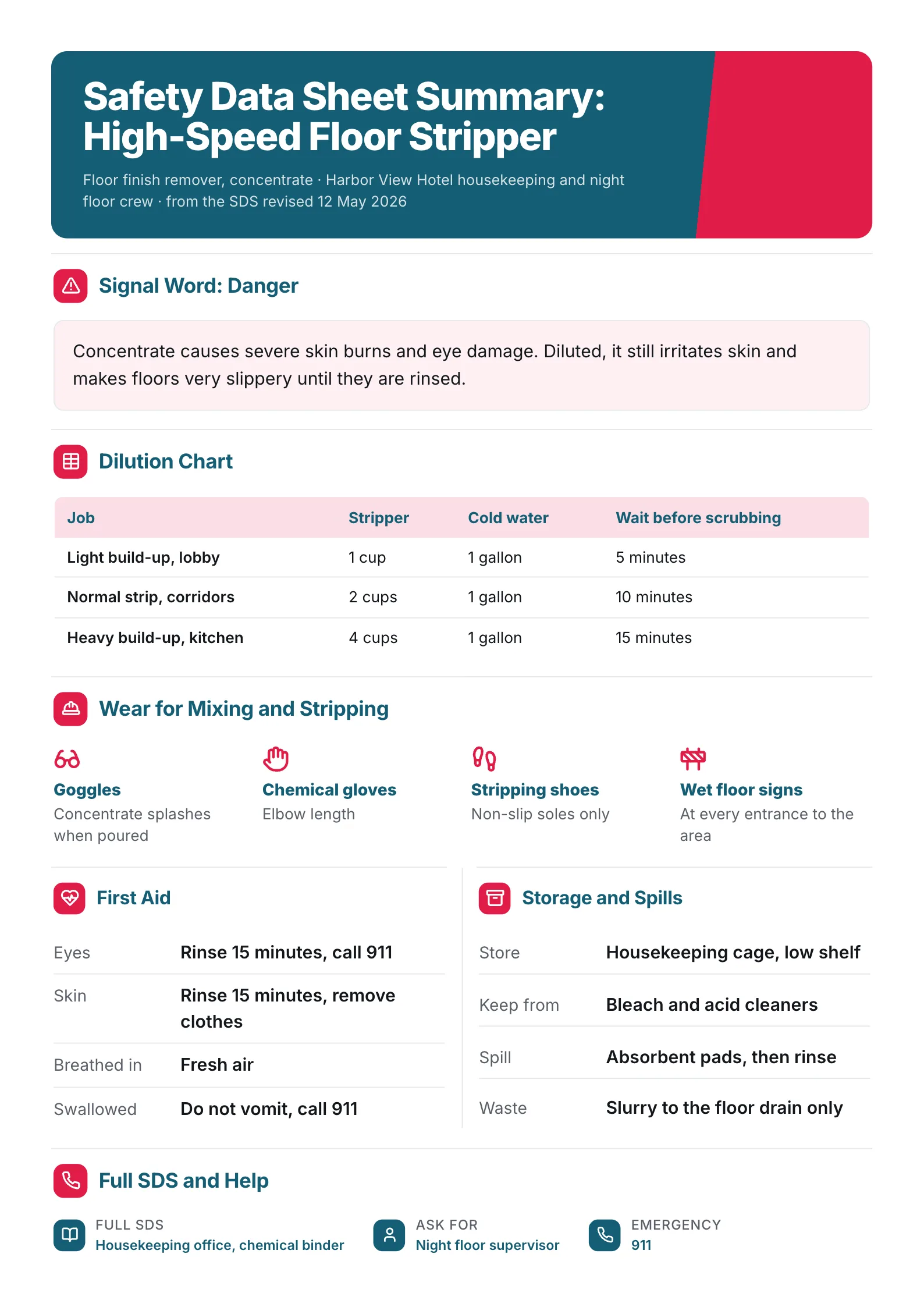 Safety Data Sheet Summary: Floor Stripper for HousekeepingEdit for free(opens in a new tab)
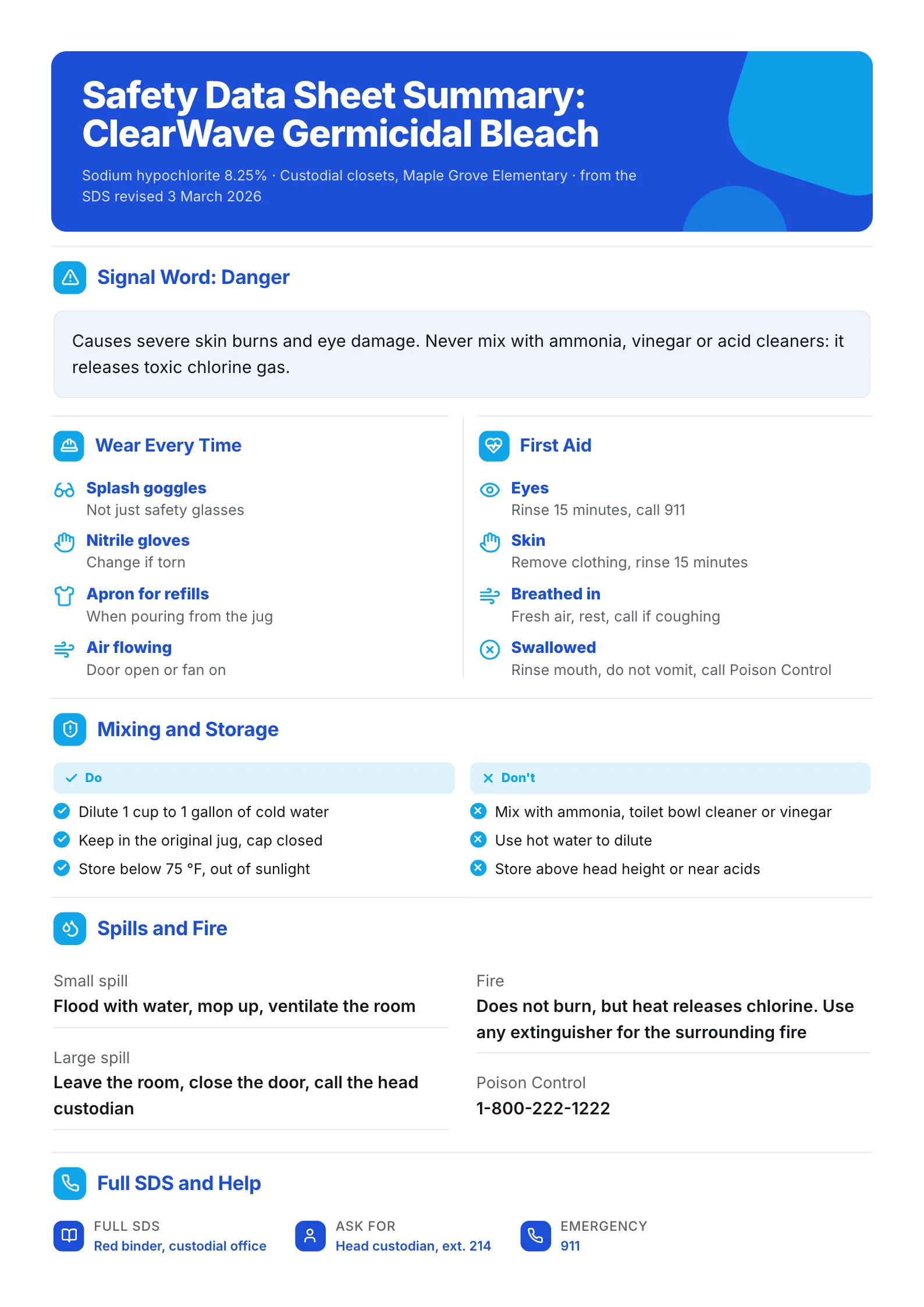 Safety Data Sheet Summary: Bleach for School CustodiansEdit for free(opens in a new tab)
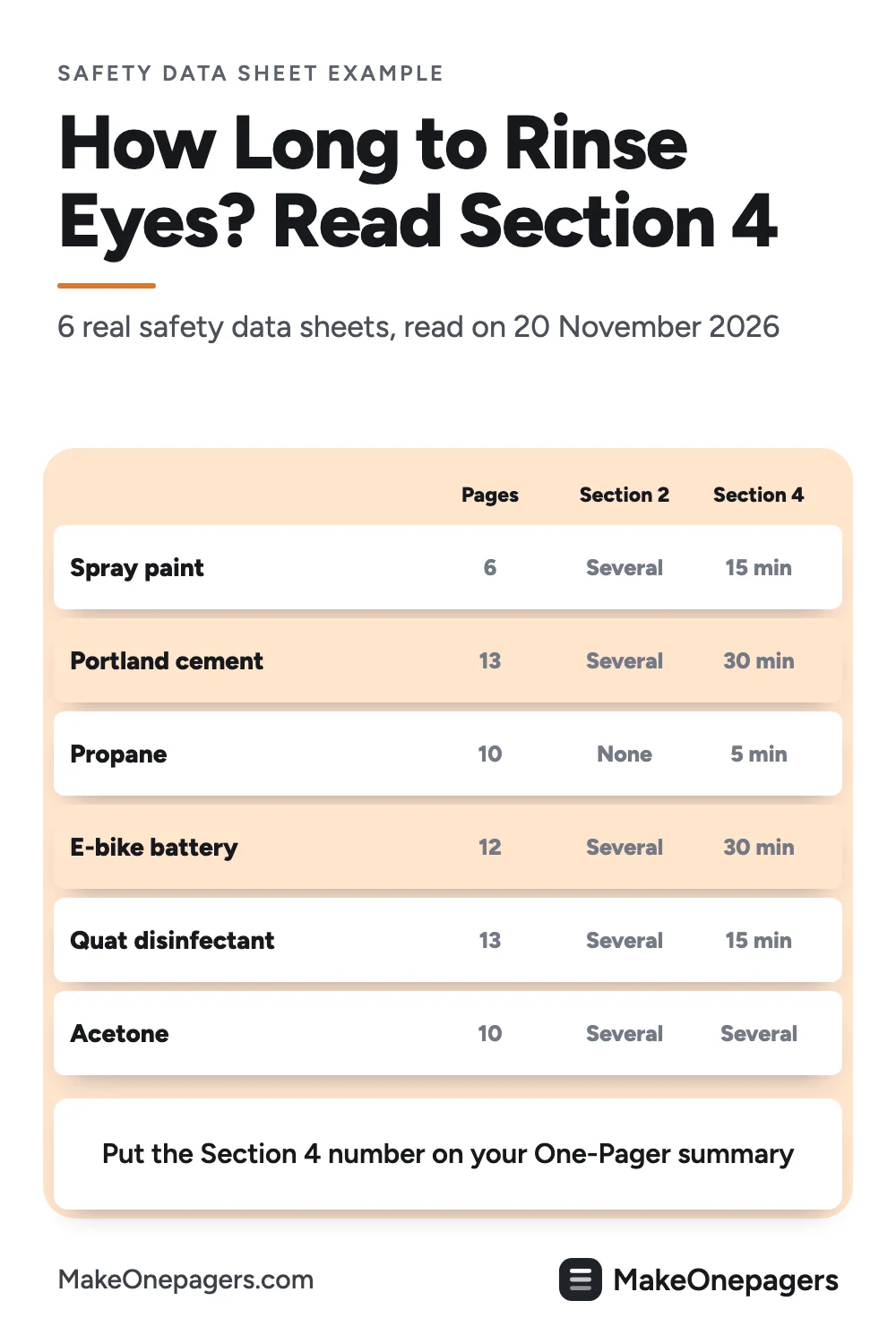
Most examples you'll find online show one blank form or one sample sheet. Mitti's SDS checklist names no chemical at all. Visme's roundup shows nine sheets for things like dry ice and copy paper. ECU's guide explains the sections in about 570 words. None of them puts a real sheet beside the short version a crew reads, so none of them shows you where the two can disagree. That's what this post does.
Use this post to read and summarize an SDS. Your supplier's full SDS always comes first, and nothing here is legal advice.
What a safety data sheet example looks like
Every SDS for a hazardous chemical sold in the US must use the same 16 headings, in the same order. OSHA's Hazard Communication Standard lists them in 29 CFR 1910.1200(g)(2):
- Identification
- Hazard(s) identification
- Composition/information on ingredients
- First-aid measures
- Fire-fighting measures
- Accidental release measures
- Handling and storage
- Exposure controls/personal protection
- Physical and chemical properties
- Stability and reactivity
- Toxicological information
- Ecological information
- Disposal considerations
- Transport information
- Regulatory information
- Other information, including the date of preparation or last revision
Sections 12 to 15 must be there to match the global GHS format. But the rule itself says "OSHA will not be enforcing information requirements in sections 12 through 15," because ecology, disposal, transport and other laws sit with other agencies. So when you summarize a sheet for your workers, the lines you need come from sections 1 to 11.
10 real safety data sheets, measured
We downloaded 10 US safety data sheets on 20 November 2026 and read each one. Some came from the maker's own site, others from copies posted by a college, a state agency, a retailer or a dealer.
| Product | Who issued it | Date on the sheet | Pages | Signal word | Eye first aid in Section 4 |
|---|---|---|---|---|---|
| Painter's Touch 2X flat matte clear spray | Rust-Oleum | Revised 8 Aug 2023 | 6 | Danger | At least 15 minutes |
| Portland cement | Quikrete | Version 15 May 2025 (issue date 1 Nov 2016, prior issue 2 Feb 2024) | 13 | Danger | At least 30 minutes |
| Propane | Williams | Revised 26 Jul 2024 | 10 | Danger | At least 5 minutes |
| E-bike (lithium-ion battery) | Denago eBikes | Issued 26 Apr 2022 | 12 | Danger | At least 30 minutes, battery contents |
| Cell Block 64 quat disinfectant | California Correctional Training and Rehabilitation Authority | Version 6.1, 22 Oct 2025 | 13 | Danger | At least 15 minutes |
| SolVantage acetone | Brulin | Issued 9 Dec 2021 | 10 | Danger | "Several minutes" |
| Germicidal Bleach | Clorox | Issued 3 Jul 2019 | 9 | Danger | At least 15 minutes |
| Unleaded gasoline, all grades | Hess | Revised 30 Aug 2012 | 16 | Danger | At least 15 minutes |
| Muriatic acid 31.45% | Sunbelt Chemicals | Revised 29 Jan 2010 | 5 | No GHS signal word line (label reads "DANGER, CORROSIVE") | At least 15 minutes |
| Isopropyl alcohol 70% | EDM3 Solutions | Issued 21 May 2024 | 11 | Danger | "Several minutes" |
Here's what the table shows you:
- No real SDS is short. The 10 sheets add up to 105 pages. The shortest is 5 pages and the longest is 16. That's why crews need a One-Pager version on the wall.
- Section 2 and Section 4 often disagree. Seven sheets print the standard GHS line "Rinse cautiously with water for several minutes" in Section 2. On five of those seven, Section 4 then gives a real number: 15 or 30 minutes.
- One bleach sheet gives three answers. Clorox's sheet says "several minutes" in Section 2, "at least 15 minutes" in Section 4, and "15-20 minutes" in the EPA label text it reprints in Section 15.
- The oldest sheet uses an older format. The 2010 muriatic acid sheet is titled "Material Safety Data Sheet" and puts ingredients in section 2 and hazards in section 3. Today's rule puts hazards in section 2. If your sheet looks like that, ask your supplier for a current one.
- Dates can be odd. Quikrete's sheet prints a version date of 15 May 2025, an issue date of 1 November 2016 and a prior issue date of 2 February 2024. Copy the version date onto your summary, so you can match it to the next one.
5 safety data sheet examples, each as a One-Pager
Each summary below fits on one sheet of paper. Under each one, you'll see how it compares with a real SDS for a similar product, and what you'd change to match your own supplier's sheet.
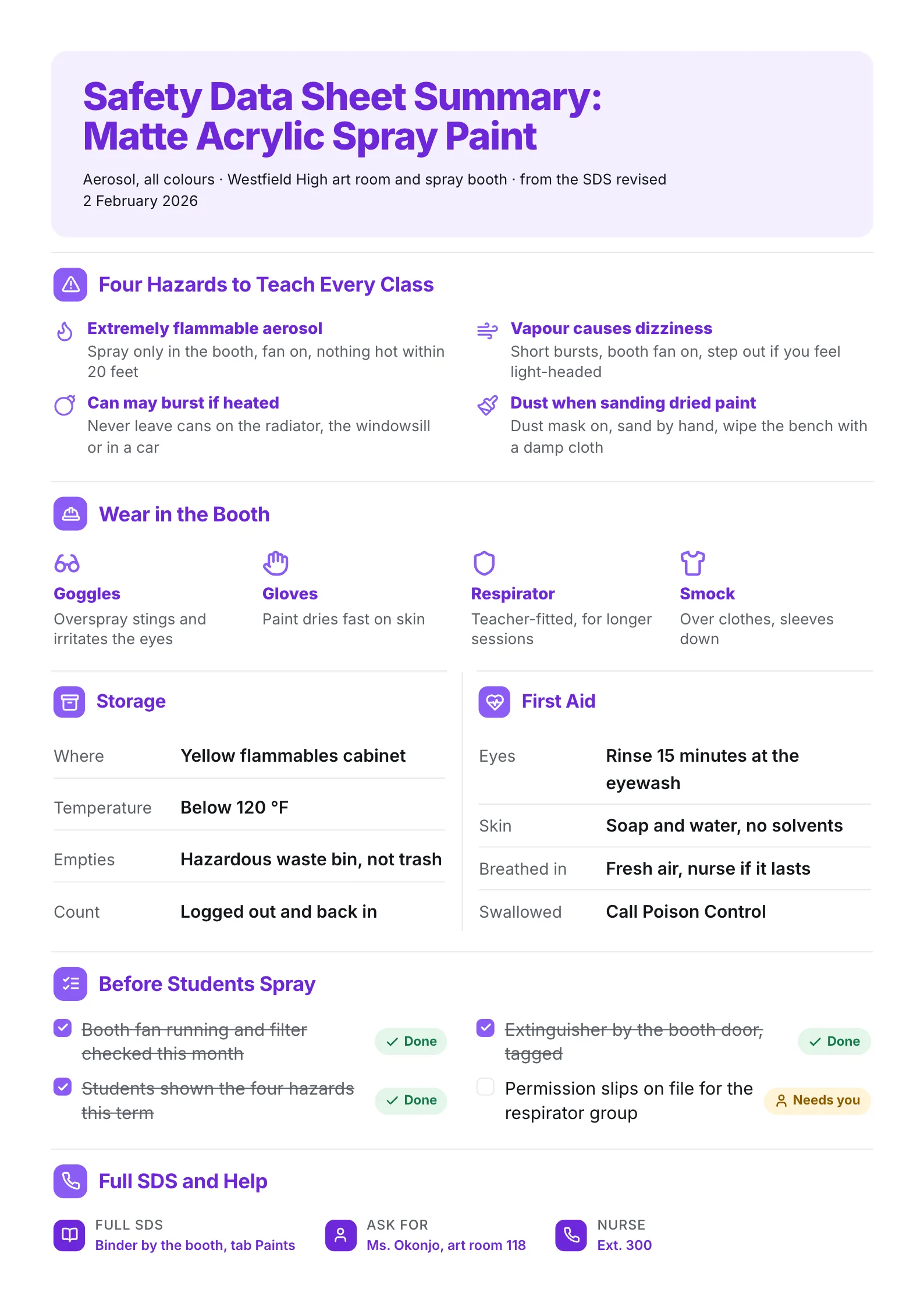
Spray paint for a school art room
 Edit this template
This summary turns a long aerosol sheet into four hazards a teacher can say out loud: an extremely flammable aerosol, a can that may burst if heated, vapor that causes dizziness and dust from sanding dried paint. Each hazard sits beside the one rule that controls it.
The numbers match the real sheet. Rust-Oleum's spray SDS tells you not to store cans above 120°F (49°C), and its Section 4 says to flush your eyes "for at least 15 minutes". This summary uses both. Its "Before Students Spray" checklist goes past the SDS. It covers the booth fan, the extinguisher tag and the respirator permission slips, which is the part a substitute teacher needs most.
You can edit this spray paint safety data sheet summary for free.
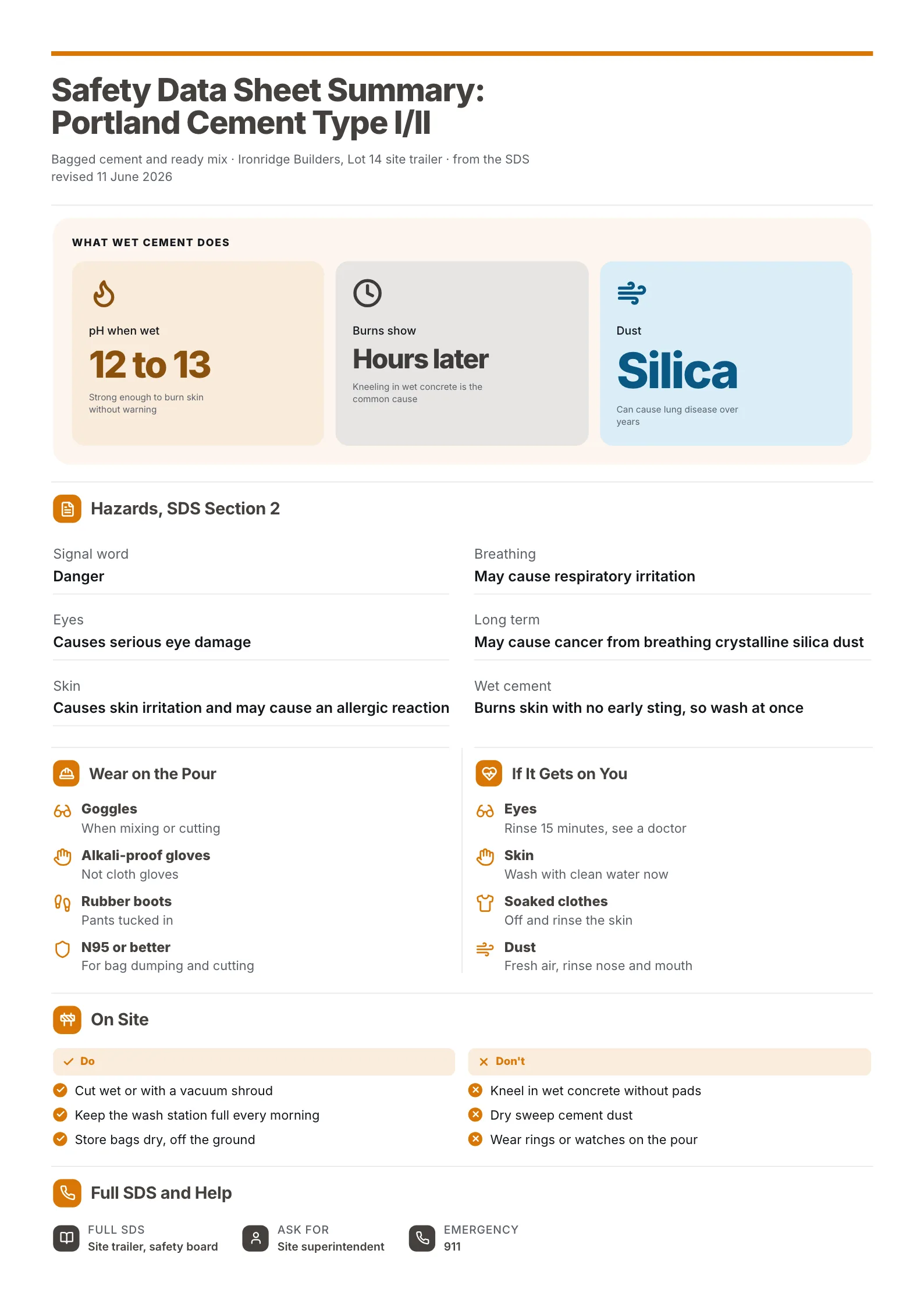
Portland cement on a building site
 Edit this template
Wet cement burns without stinging first, and this summary leads with that fact. Its top box gives the pH of wet cement as 12 to 13, and warns that burns can show up hours later. Kneeling in wet concrete is the usual cause.
Now compare it with Quikrete's own Portland cement SDS. Quikrete classifies its cement as H314, "Causes severe skin burns and eye damage," and says to keep rinsing your eyes "for at least 30 minutes." The summary above says 15 minutes and lists skin irritation. Different suppliers do classify cement differently. So if your bags say Quikrete, change the eye box to 30 minutes and the skin line to severe burns, so the sheet on the trailer wall matches the sheet in the binder.
You can edit this Portland cement safety data sheet summary for free.
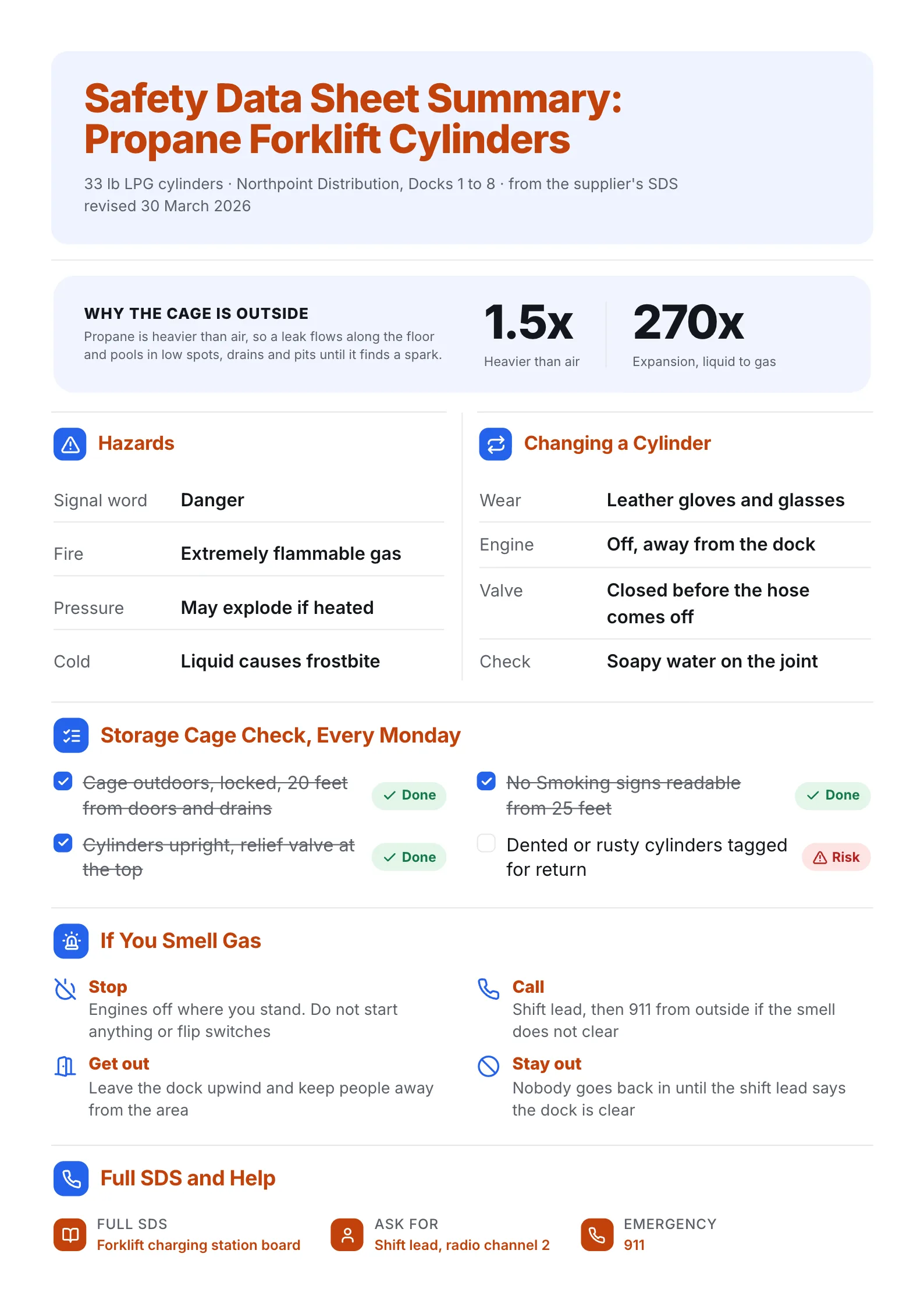
Propane cylinders for warehouse forklifts
 Edit this template
A forklift driver needs to know three things about propane: it burns, it's under pressure and the liquid freezes skin. This summary puts those three hazards at the top. Then it adds the routine the SDS can't write for your site, like the Monday check of the storage cage and the four steps to take if someone smells gas.
The Williams propane SDS backs up the hazards. It lists propane as an extremely flammable gas with a flash point of -104 °C (-155.2 °F). Its Section 4 asks for an eye rinse of "at least 5 minutes," the shortest of all 10 sheets. Its Section 8 adds one line worth copying: "If material is cold, wear thermally resistant protective gloves." The summary says leather gloves, so check that your gloves are rated for cold before you keep that line.
You can edit this propane forklift safety data sheet summary for free.
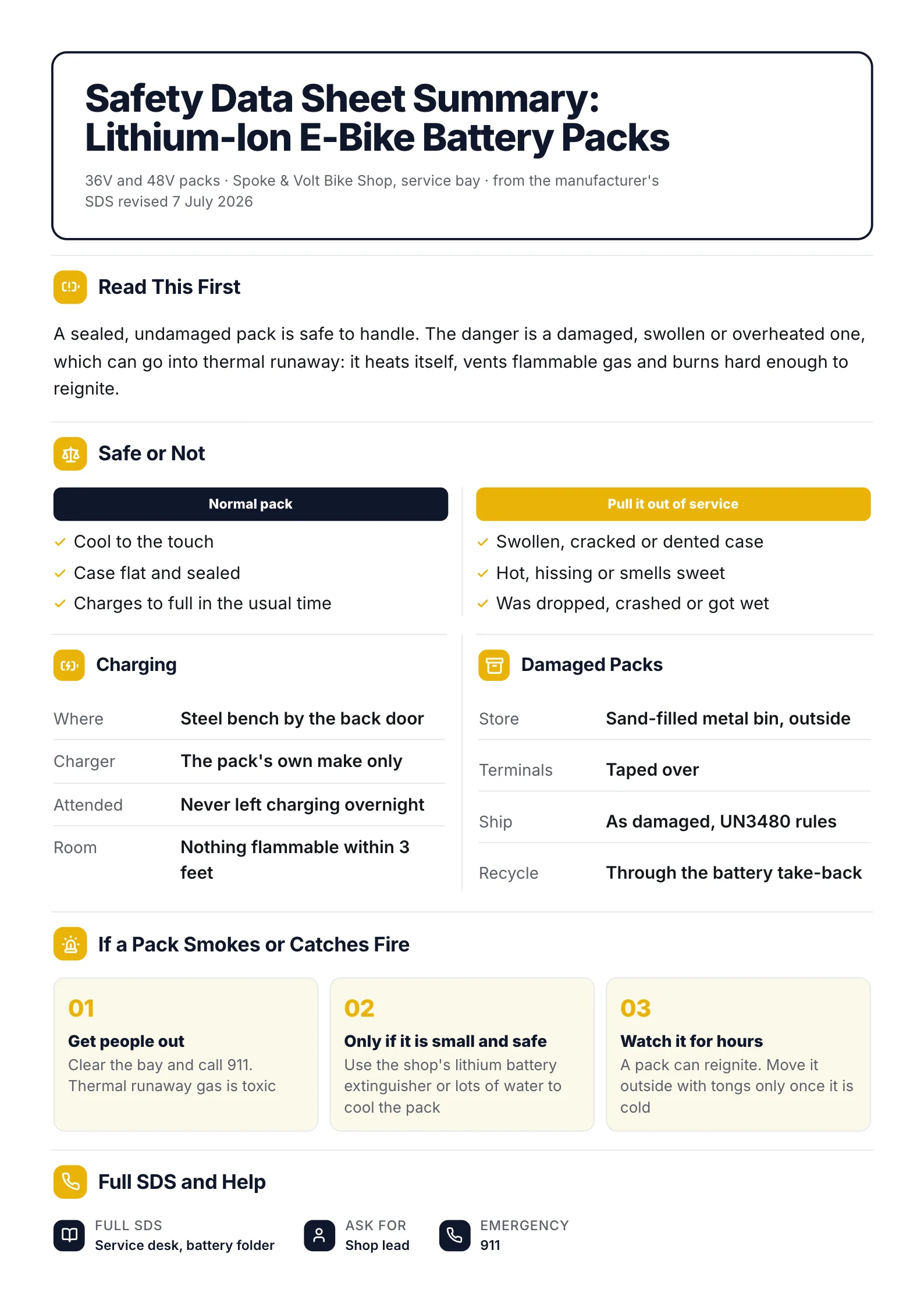
Lithium-ion e-bike batteries in a bike shop
 Edit this template
Do batteries even need an SDS? OSHA says yes for work use. In a 15 December 2015 letter, OSHA said a lithium-ion battery "cannot be considered an article". It added that makers and importers of non-consumer batteries "must develop and make available safety data sheets."
The Denago eBikes SDS shows why a shop needs the short version. It runs 12 pages, and most of it covers chemicals you only meet when a pack is damaged. Lithium hexafluorophosphate, listed at 10 to 20% by weight, is classed as toxic if swallowed (H301). Section 5 lists water spray "in flooding amounts" as suitable for a fire, and the next line, under unsuitable media, warns that water "may generate heat and increase fire intensity." This summary settles that for the staff. Get people out first, and cool a small fire with lots of water or the shop's battery extinguisher. Watch the pack for hours, because it can reignite.
You can edit this lithium-ion battery safety data sheet summary for free.
Quat disinfectant in a vet clinic
 Edit this template
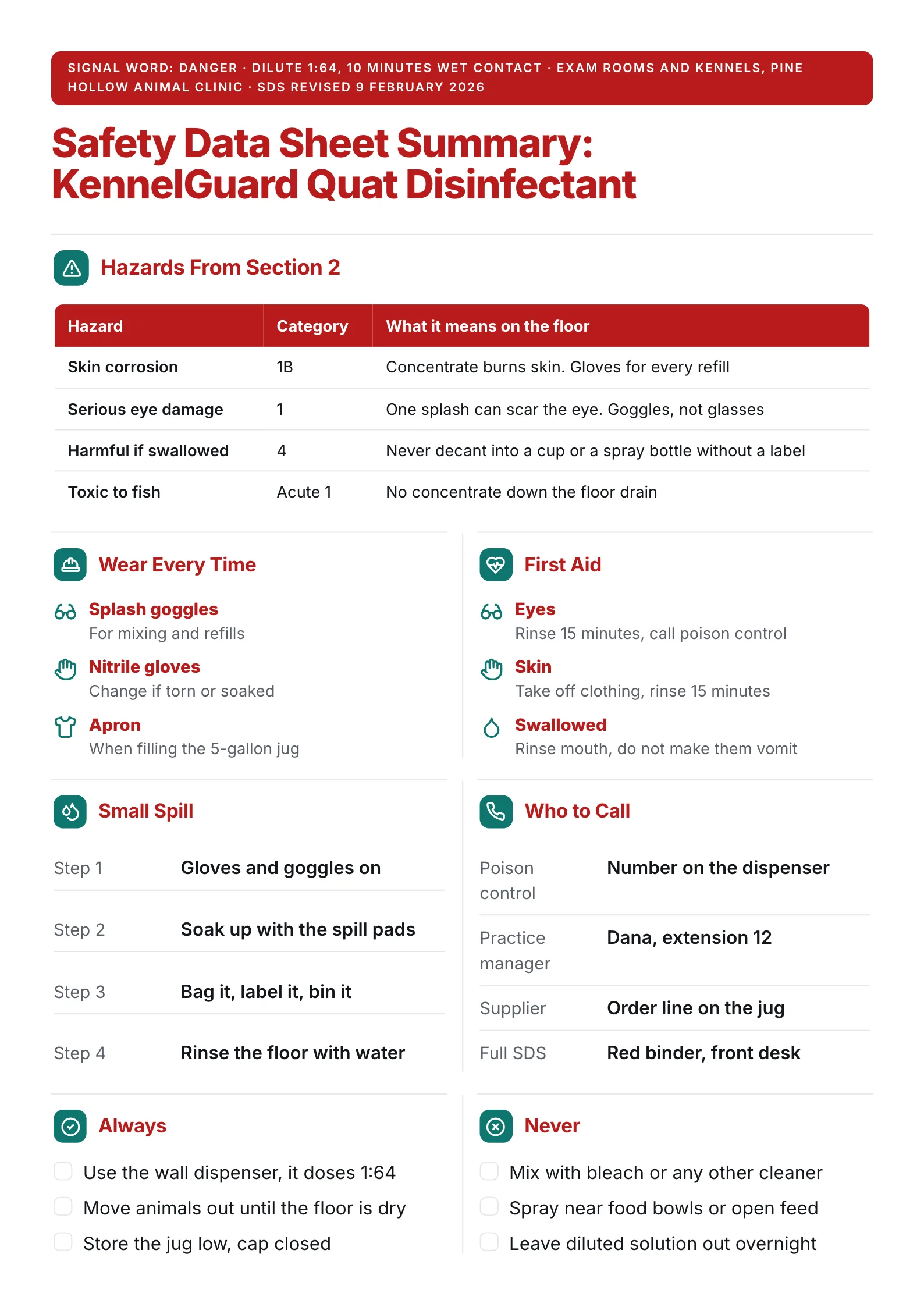
Quat cleaners come with two hazard levels: one for the concentrate and one for the diluted spray. This summary puts the dilution in the subtitle (1:64), so nobody uses the jug straight.
The Cell Block 64 SDS, a quat disinfectant also used at 1:64, shows why that matters. Its concentrate is classified "Causes serious eye damage," while the diluted product drops to "Causes eye irritation." Its Section 4 says to rinse eyes "for at least 15 minutes." Section 10 lists strong oxidizing agents as incompatible, and bleach is one. So the summary's "Never" list starts there: never mix it with bleach. The other two rules, no spraying near food bowls and no diluted solution left out overnight, are the clinic's own.
You can edit this quat disinfectant safety data sheet summary for free.
How to turn an SDS into a One-Pager summary
Here's the order that works with any sheet:
- Copy the header from Section 1. Use the product name exactly as printed, the supplier, the emergency phone number and the date from Section 16 or the page footer.
- Take the signal word and hazard lines from Section 2. Use the exact wording, such as "Danger" and "Highly flammable liquid and vapor." Don't soften it.
- Take first aid from Section 4. Skip the stock phrases in Section 2. If Section 4 gives a number of minutes, put that number on the One-Pager.
- Take what to wear from Section 8. Name the glove material when the sheet names one, such as nitrile, neoprene or alkali-resistant.
- Pull one or two numbers from Section 9. For a flammable liquid, the flash point is the one people need. For cement or acid, it's the pH.
- Add your own site. Where the full SDS is kept, who to ask, and the rules for your room, van or booth. The supplier can't write that part.
Then hang the summary beside the full SDS, never in its place. OSHA's rule, paragraph (g)(8), says your SDSs must be "readily accessible during each work shift to employees when they are in their work area(s)." Keeping them electronically is fine, as long as nothing gets in the way of immediate access. The One-Pager helps people find the right line quickly. It doesn't replace the sheet.
The 2026 and 2027 deadlines
OSHA updated the Hazard Communication Standard in 2024, effective 19 July 2024. Under paragraph (j), makers and importers had until 19 May 2026 to update their sheets for single substances. Employers had until 20 November 2026 to update any alternative workplace labels, their written program and training "as necessary" for any newly identified hazards of those substances. For mixtures, makers have until 19 November 2027.
What does that mean for your summaries? If a supplier sent you a revised SDS this year, check the date on your One-Pager against it. A summary copied from an old sheet goes out of date when the sheet changes. And the rule gives suppliers three months to add significant new hazard information to an SDS once they learn of it.
Mistakes to avoid on an SDS summary
- Copying "several minutes". Section 2 uses standard GHS phrases. Section 4 is where the supplier gives the real first aid, and on our 10 sheets it ranged from 5 to 30 minutes, or gave no number at all.
- Using someone else's sheet. Two cement suppliers can classify the same product differently. Read the SDS for the product you actually buy.
- Dropping the date. Without the SDS date on the summary, nobody can tell when it's out of date.
- Leaving out where the full SDS lives. Every example above ends with "Full SDS and Help": where the binder is, who to ask and the emergency number.
- Treating the summary as the SDS. It's a quick guide that sits next to the real sheet.
Pick the summary closest to your product
Start with the example nearest to what you use. Then open your own supplier's SDS beside it and copy in the signal word, the Section 4 first aid, the Section 8 gear and the date. You can edit any of these summaries on MakeOnepagers and download your sheet for free. If you'd rather start blank, the safety data sheet summary layout puts all 16 sections in numbered boxes.
Frequently asked questions
What does an example of a safety data sheet look like?
It's a document with 16 numbered sections in a fixed order, from Identification to Other information. The 10 real sheets in our table run 5 to 16 pages. Section 2 holds the signal word and pictograms, Section 4 the first aid and Section 8 the protective gear. The five summaries above show the same facts on one sheet each.
Does OSHA require all 16 sections on an SDS?
The sheet must carry all 16 headings in order. OSHA enforces sections 1 to 11 and 16. It does not enforce the content of sections 12 to 15 (ecology, disposal, transport and other regulations), because other agencies cover those.
Is there an SDS example for acetone?
Yes. Brulin's SolVantage acetone SDS, issued 9 December 2021, runs 10 pages, carries the signal word "Danger" and gives a flash point of -20 °C (-4 °F). Our grid below includes an acetone safety data sheet summary for a nail salon, with the same -4 °F flash point at the top.
Can a One‑Pager summary replace the SDS?
No. OSHA requires the full SDS to be readily accessible to workers during every shift. A One-Pager summary is a guide that points to the right lines and tells people where the full sheet is kept.
How often does an SDS need to be updated?
An SDS has no expiry date. But the maker must add significant new information about a hazard, or how to protect against it, within three months of learning it. Our 10 sheets carried dates from 2010 to 2025, so ask your supplier whether yours is current.




