Proposal Examples That Ask for a Dollar Figure by a Date
5 proposal examples on one page, from a $624,000 solar roof to a $40,000 training program, plus what to borrow from the federal solicitation layout.

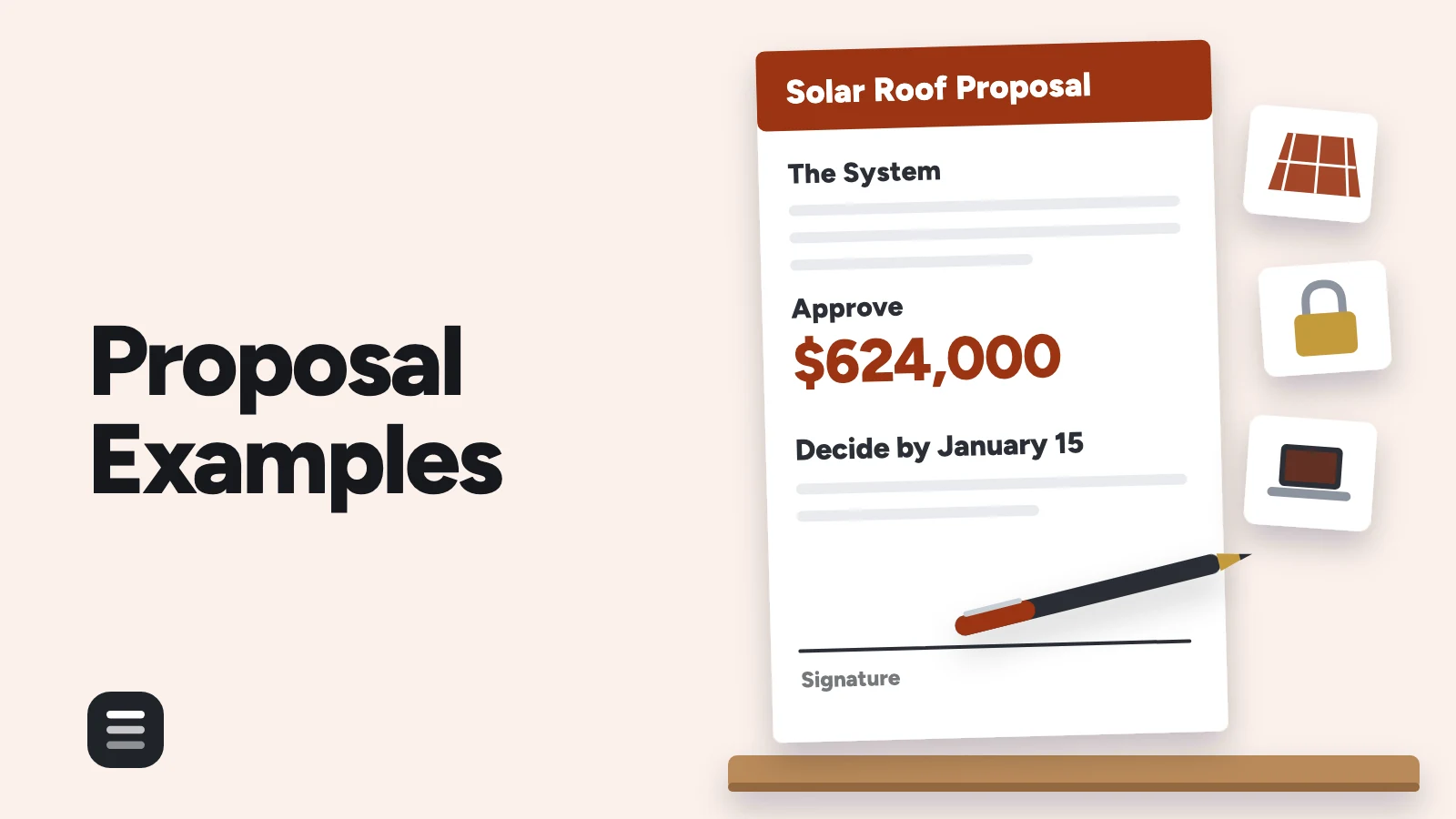
Every proposal example below asks for a dollar amount by a deadline. The rest of the page is there to make saying yes easy. Start from a free one pager template.
One‑Pager examples
Real One-Pagers made with MakeOnepagers. Open any one to edit it as your own.
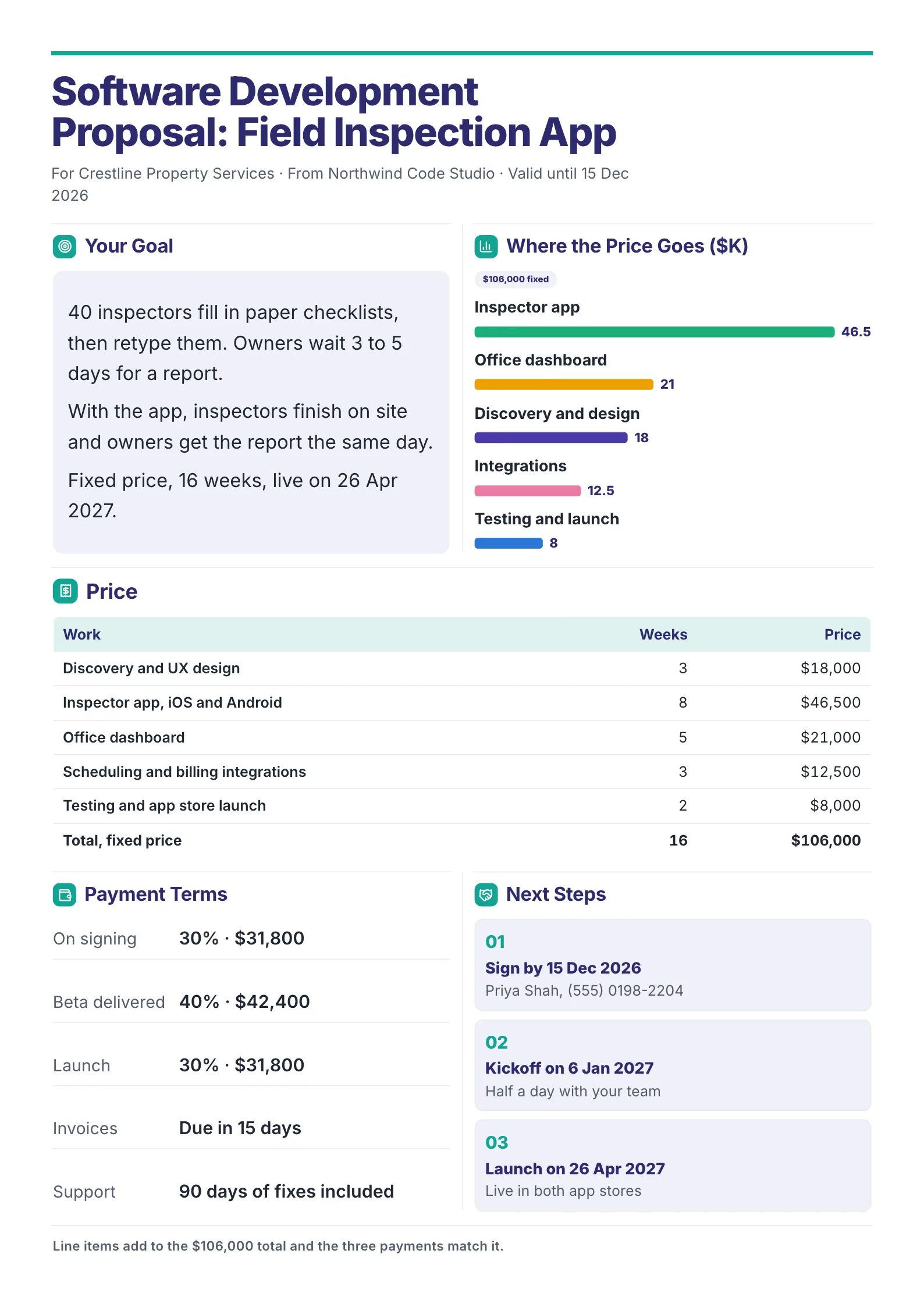 Software Development ProposalEdit for free(opens in a new tab)
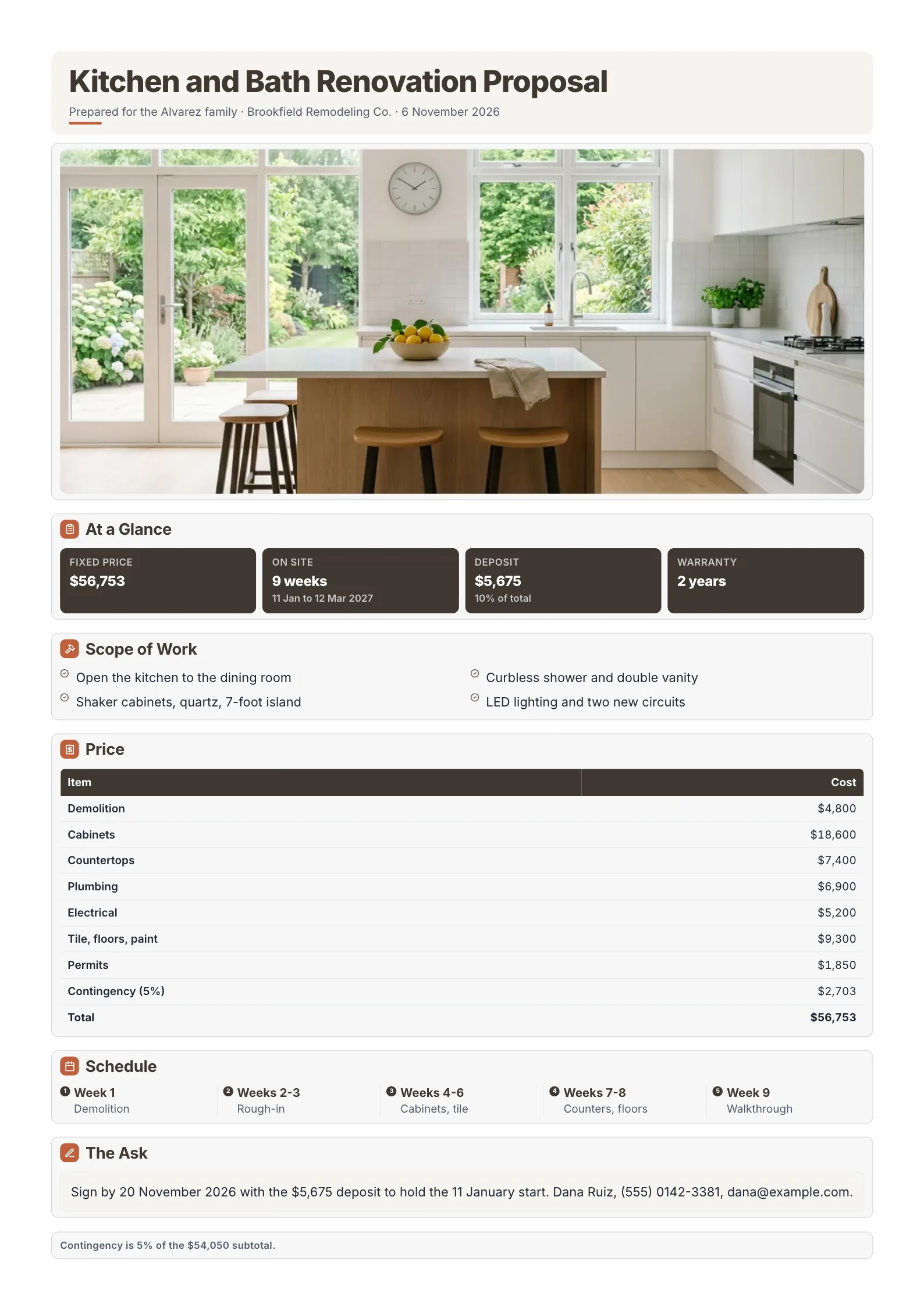 Renovation ProposalEdit for free(opens in a new tab)
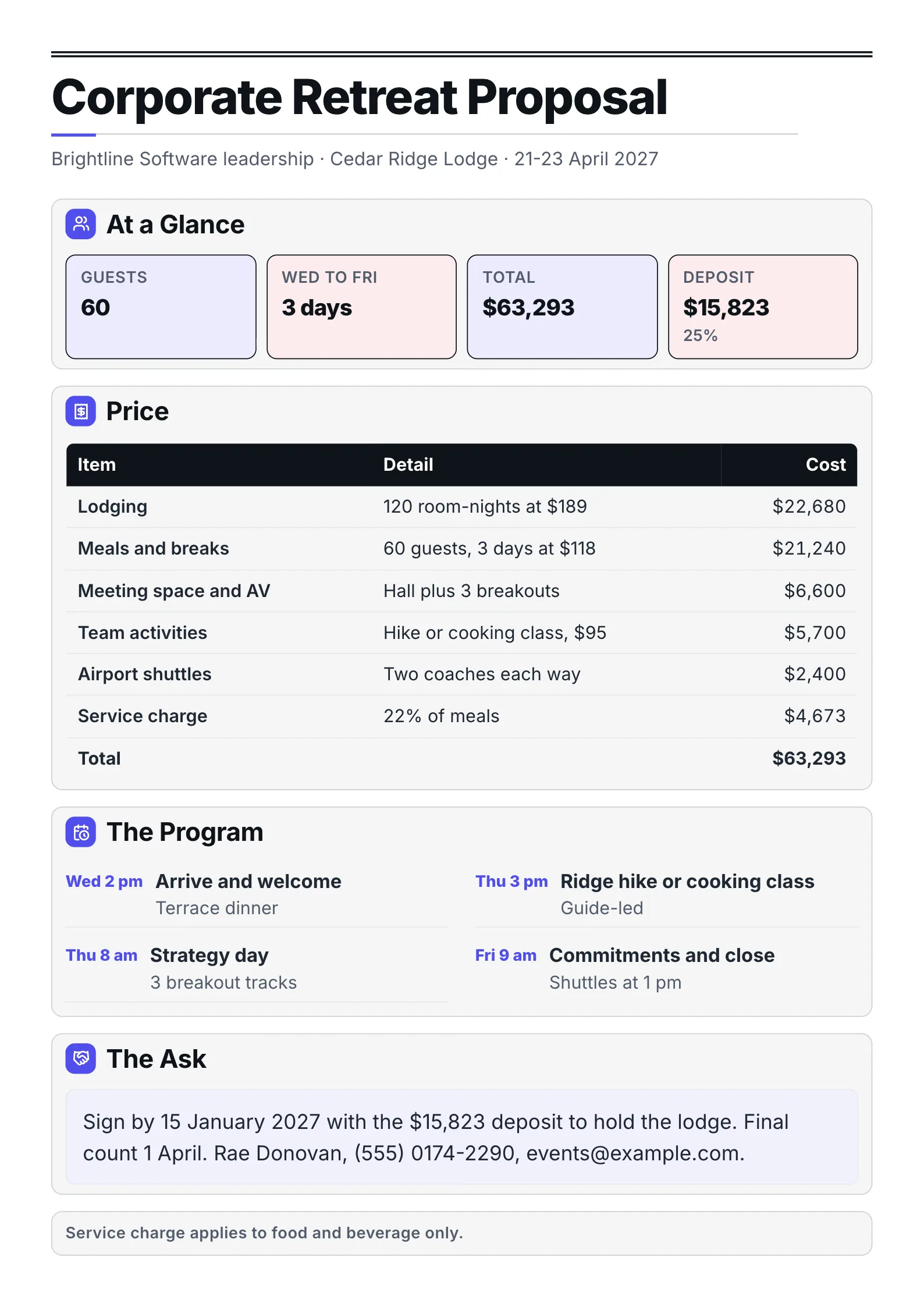 Corporate Retreat ProposalEdit for free(opens in a new tab)
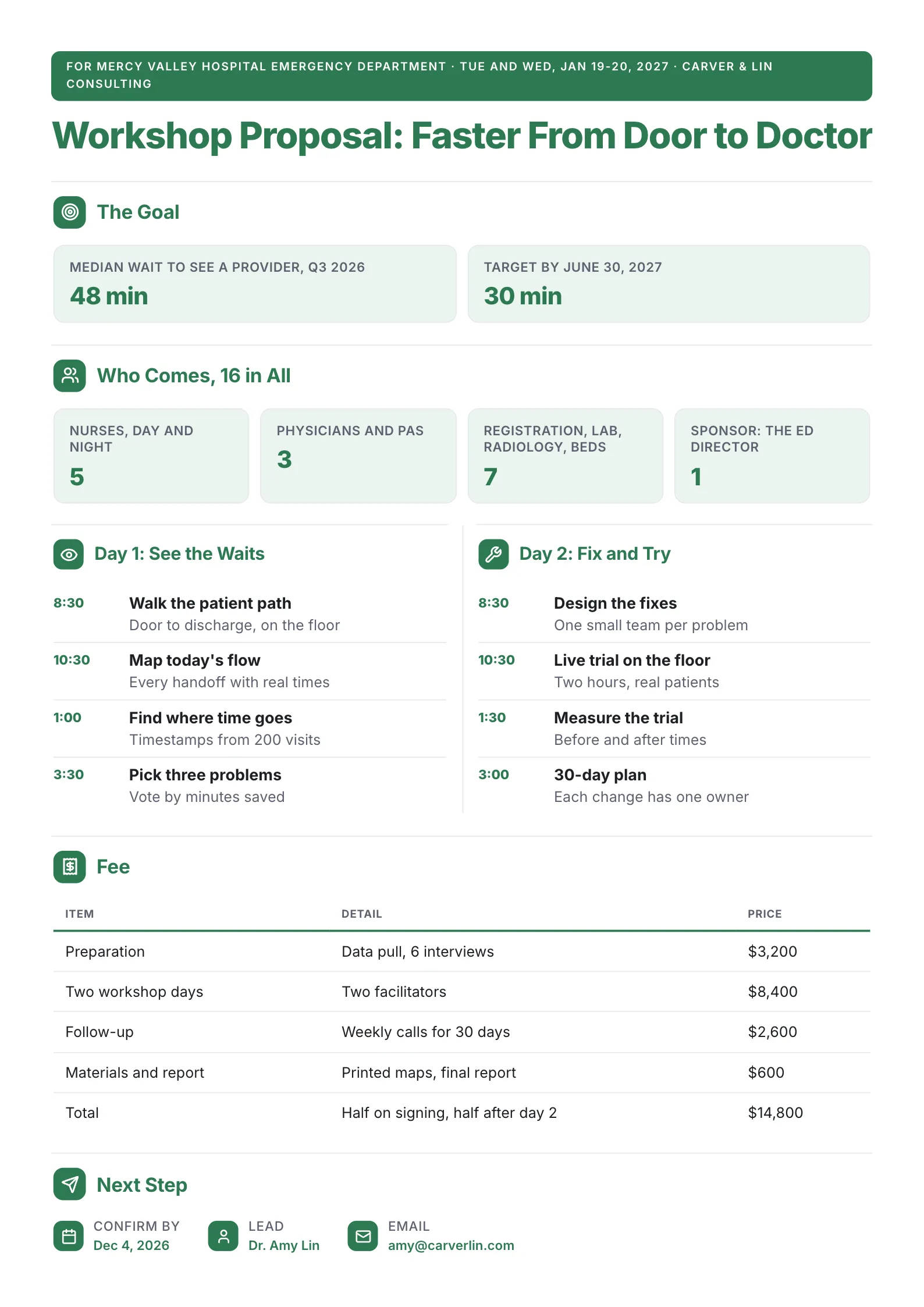 Workshop Proposal One-PagerEdit for free(opens in a new tab)
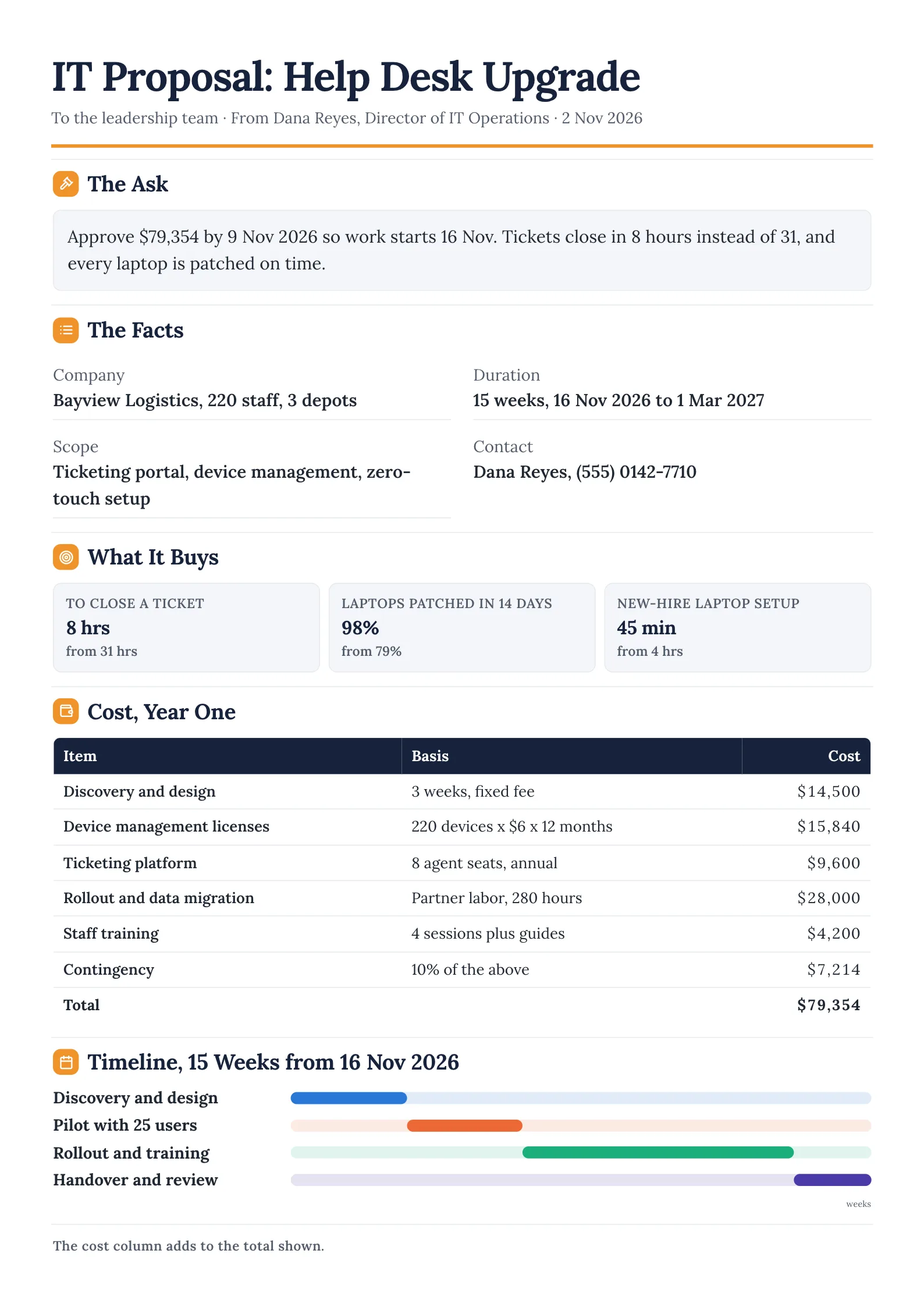 IT ProposalEdit for free(opens in a new tab)
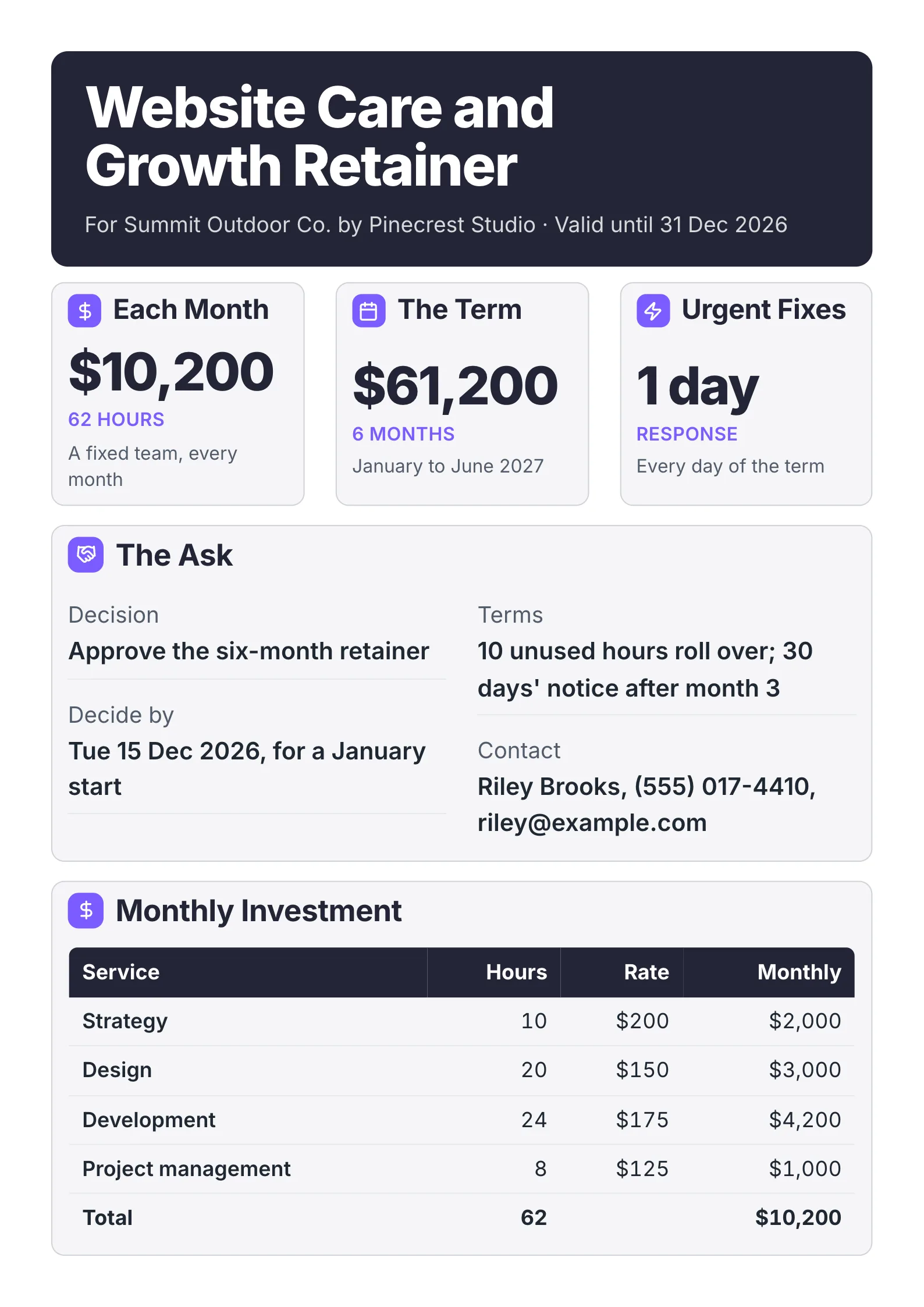 Retainer ProposalEdit for free(opens in a new tab)
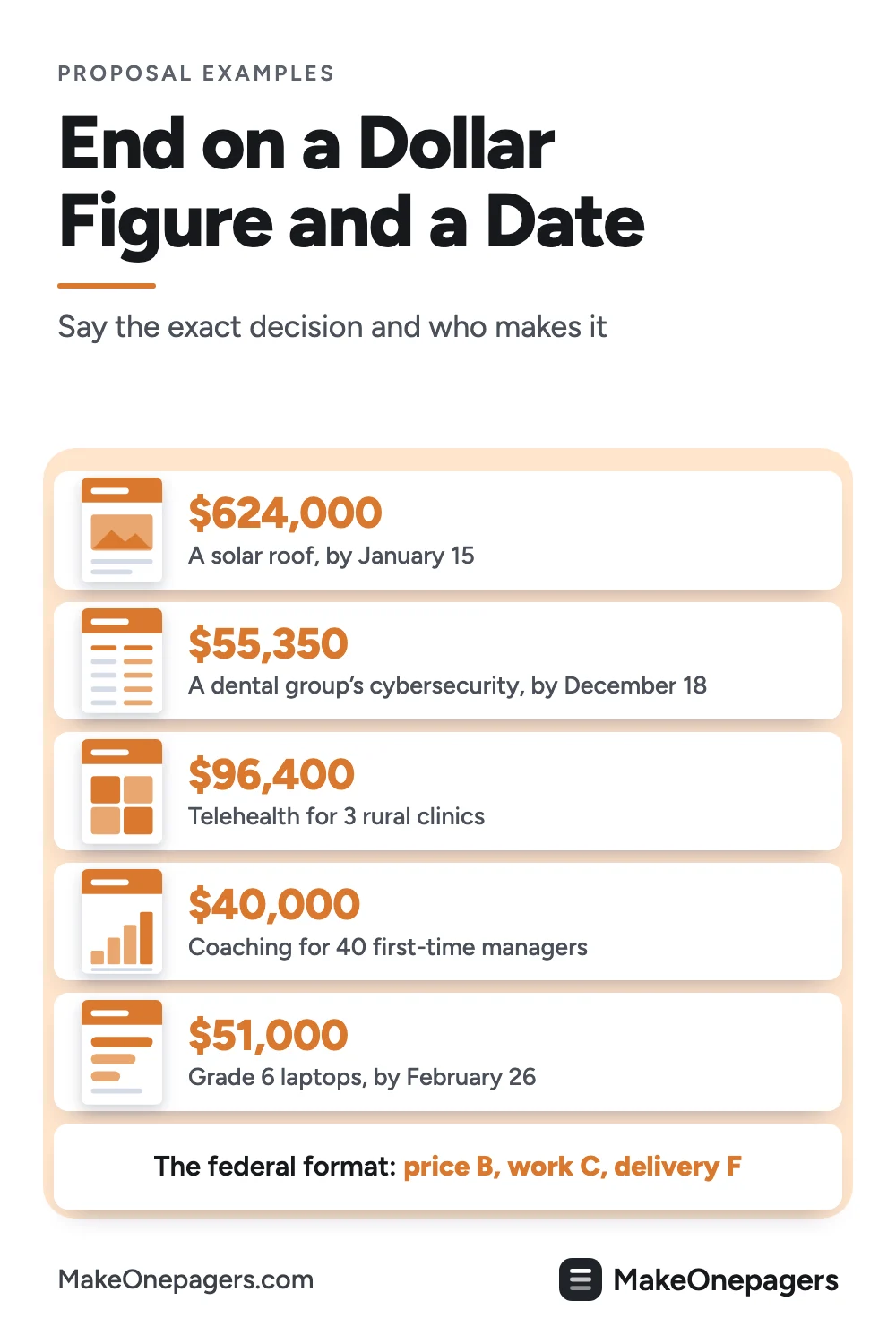
A solar roof for a cold storage warehouse and a cybersecurity plan for a dental group come from vendors selling to a client. A telehealth program for rural clinics, a coaching program for new managers and laptops for a grade 6 class come from teams asking their own leaders for budget, which may be closer to what you're writing. After the five comes the layout federal agencies use for solicitations, and the parts of it worth borrowing.
A solar roof, priced to the dollar
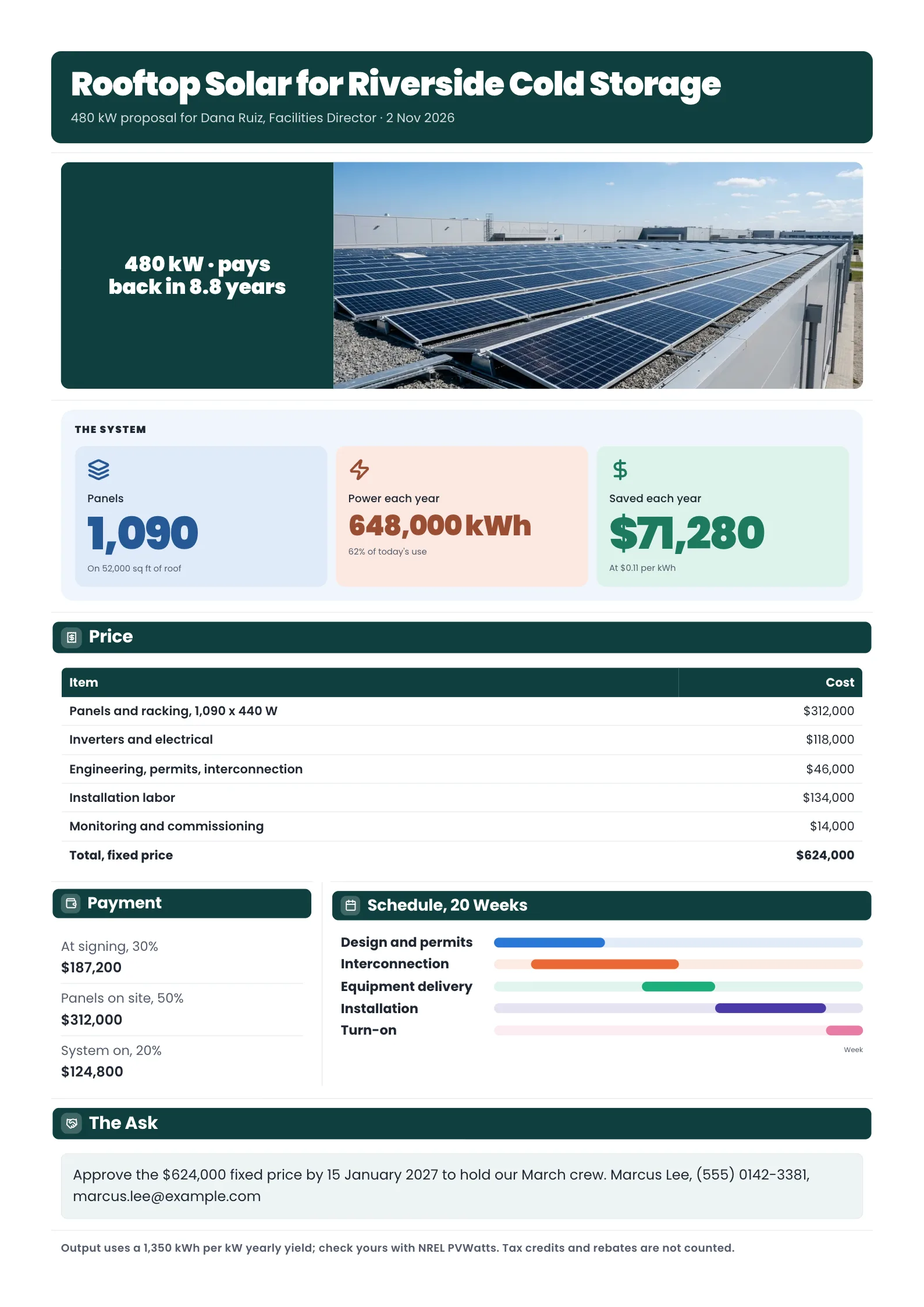
This proposal offers a 480 kW rooftop system to Riverside Cold Storage, addressed to Dana Ruiz, the facilities director, on November 2, 2026. The headline says what you'd want to know first: 480 kW that pays back in 8.8 years.
 Edit this template
A sample proposal with sample prices. The three payments add up to the fixed price.
"The System" gives you three numbers a facilities director can check. There are 1,090 panels on 52,000 sq ft of roof, producing 648,000 kWh a year, or 62% of today's use. That saves $71,280 a year at $0.11 per kWh. Pick numbers your reader can check against their own bills.
The price is split into three payments tied to progress: 30% at signing ($187,200), 50% when the panels are on site ($312,000) and 20% when the system is on ($124,800). Together they make the $624,000 fixed price. A 20-week schedule takes you from design and permits all the way to turn-on.
The ask tells Dana exactly what to do. Approve the fixed price by January 15, 2027 to hold the March crew. A footnote says how output was estimated and that tax credits and rebates aren't counted, so the payback isn't padded.
Cybersecurity for a dental group
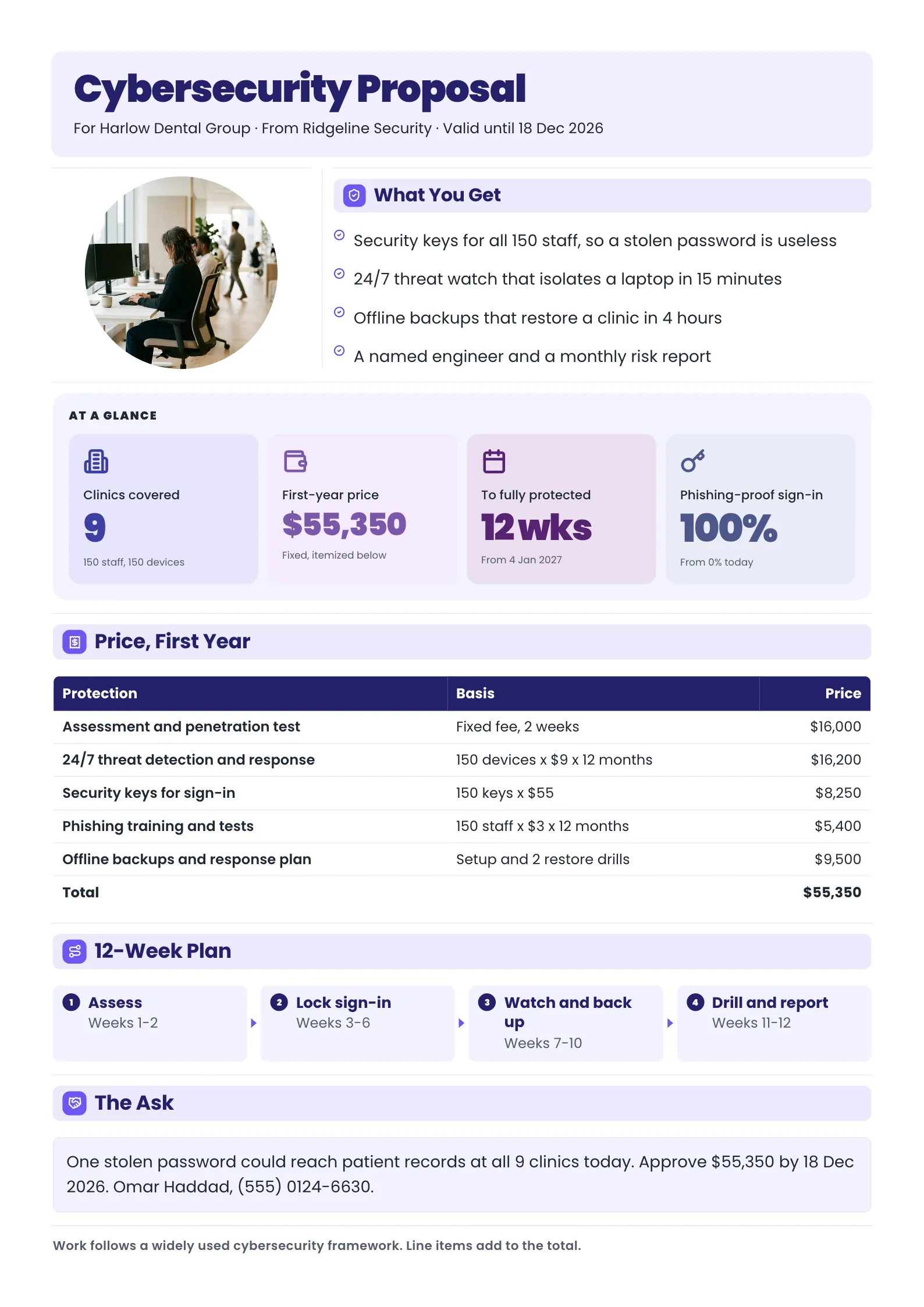
Ridgeline Security's proposal to Harlow Dental Group is valid until December 18, 2026. The scope is 9 clinics with 150 staff and 150 devices.
 Edit this template
Ridgeline and Harlow are invented. The ask opens with the risk, then names the price.
Harlow's owners get four numbers under "At a Glance": 9 clinics, a first-year price of $55,350 (fixed and itemized), 12 weeks to fully protected starting January 4, 2027, and phishing-proof sign-in going from 0% today to 100%.
The 12-week plan gives you four stages. Assess in weeks 1 and 2, lock down sign-in in weeks 3 to 6, set up monitoring and backups in weeks 7 to 10, and drill and report in weeks 11 and 12.
The ask leads with the reason to act. One stolen password could reach patient records at all 9 clinics today. Then it asks the reader to approve $55,350 by December 18, 2026, and names the person to call.
Telehealth for three rural clinics
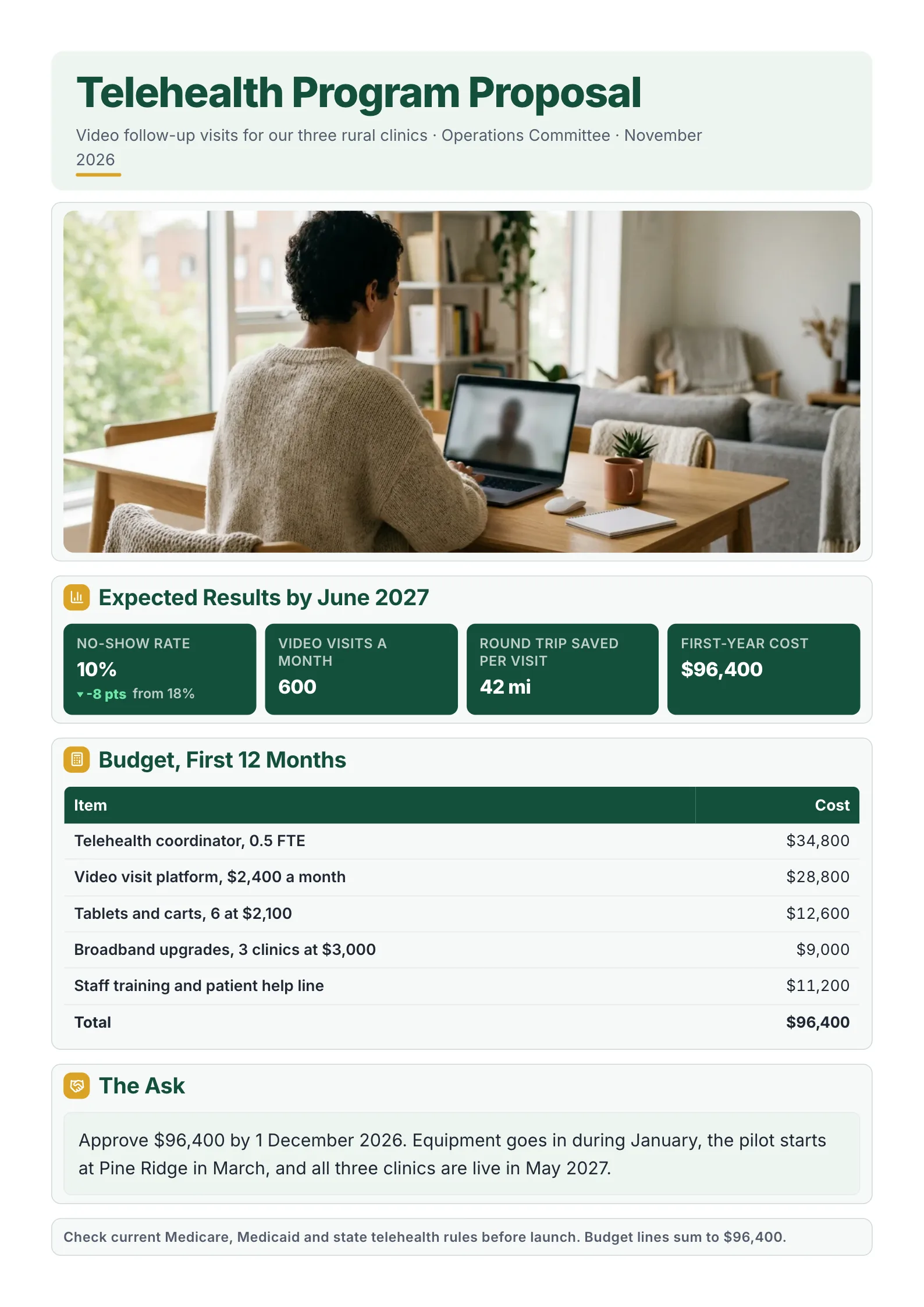
If you need your own leaders' approval, study this one. It goes to an operations committee in November 2026. It asks for video follow-up visits at three rural clinics, and it leads with what the committee gets by June 2027.
 Edit this template
A sample proposal. Results come before cost, so the committee reads the benefit first.
The results row is what your committee will remember. A 10% no-show rate, 600 video visits a month and 42 miles of round trip saved for each patient per visit. The first-year cost of $96,400 sits in the same row, so benefit and price are read together. Put your own benefit and price in one row, so your reader can't see one without the other.
The ask turns the money into a calendar. Approve $96,400 by December 1, 2026. Equipment goes in during January, the pilot starts at Pine Ridge in March, and all three clinics are live in May 2027. A footnote reminds the team to check current Medicare, Medicaid and state telehealth rules before launch.
Coaching for 40 first-time managers
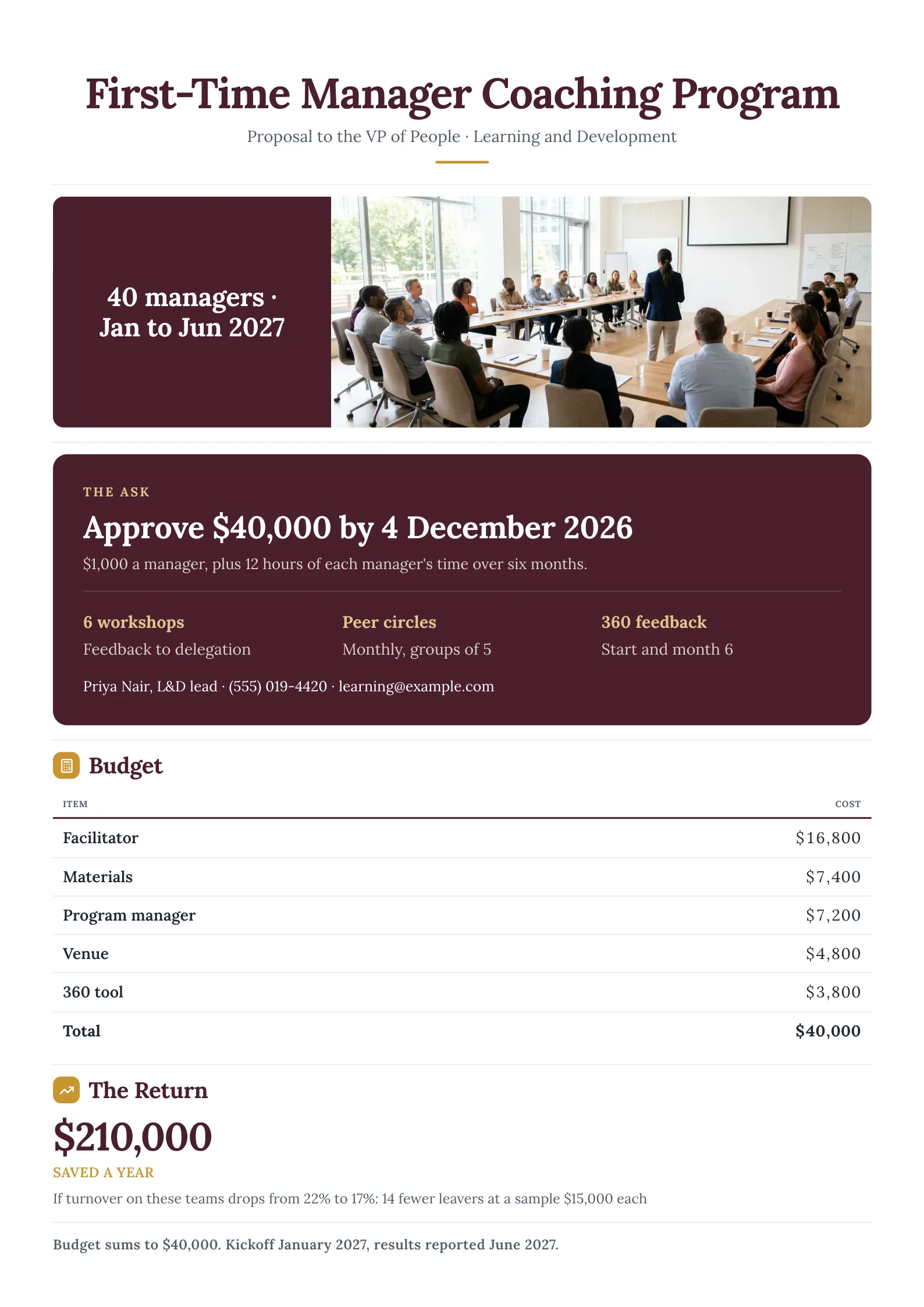
Learning and Development is asking the VP of People to fund a coaching program for 40 first-time managers from January to June 2027. This is an internal proposal, and it asks the VP for time as well as money.
 Edit this template
A sample program with a sample return. The ask names the hidden cost, people's time.
The ask is "Approve $40,000 by December 4, 2026," and it names the full cost: $1,000 a manager, plus 12 hours of each manager's time over six months. Naming the hours up front heads off the objection your VP would raise.
The managers get three parts. Six workshops covering everything from feedback to delegation. Peer circles, monthly, in groups of 5. And 360 feedback at the start and again at month 6, so you can measure the change.
The return gives you one number: $210,000 saved a year, against a budget that sums to $40,000. Kickoff is January 2027, with results reported in June.
Laptops for every grade 6 student
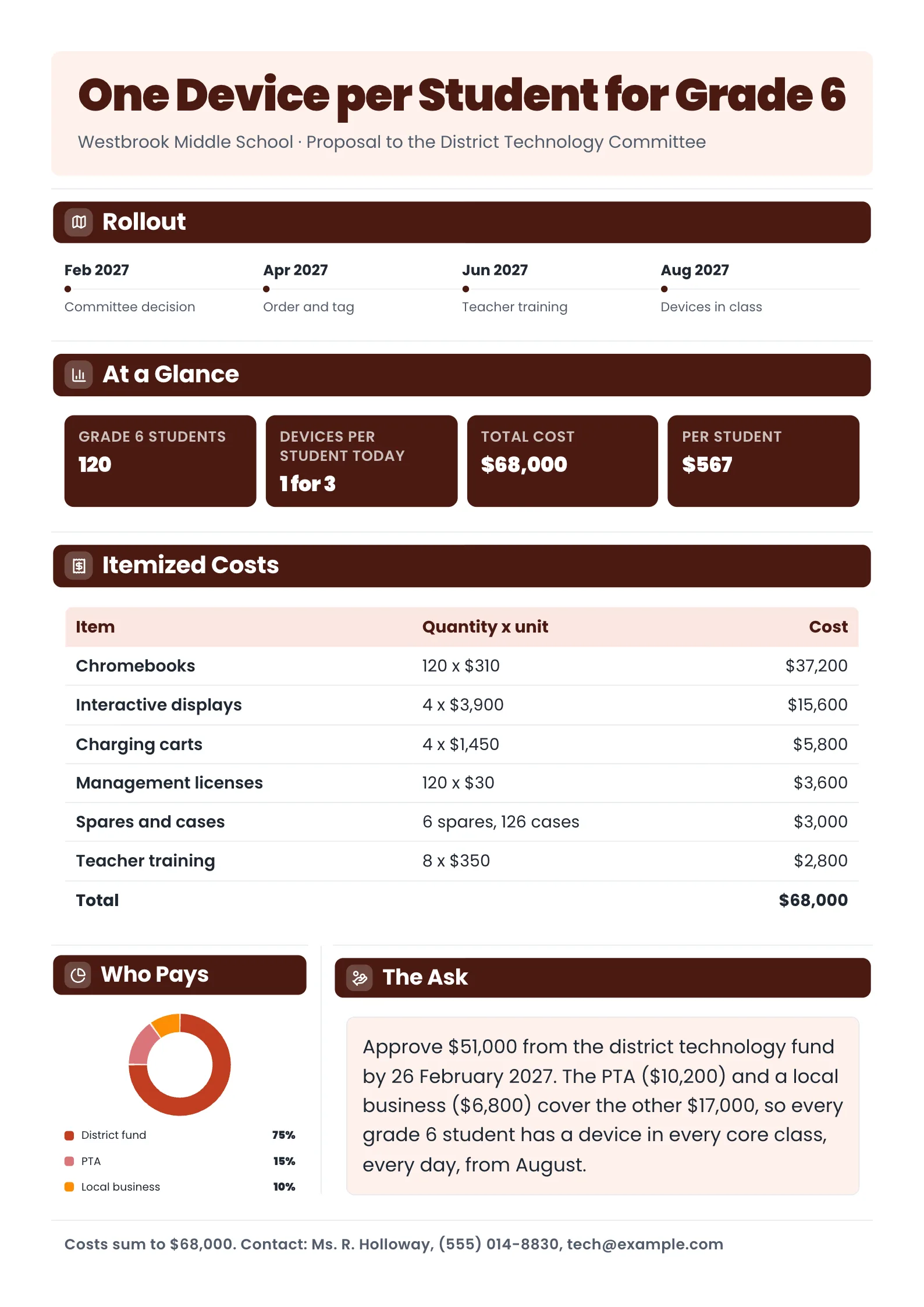
Westbrook Middle School is asking the district technology committee for one device per student in grade 6. Today they share 1 device for every 3 students.
 Edit this template
Westbrook is invented. "Who Pays" shows the committee it isn't funding the whole thing.
"At a Glance" lays out the math: 120 students, a $68,000 total and $567 per student. That per-student number is the one your committee will compare against other requests.
"Who Pays" cuts the committee's share to $51,000 of the $68,000, with the PTA adding $10,200 and a local business $6,800. So the ask is for $51,000, approved by February 26, 2027, and every grade 6 student gets a device in every core class, every day, from August. When you're asking for less than the full cost, show who else is paying.
Selling to a client after a sales call? Our sales proposal template counts what 8 published templates include and shows you which parts most of them skip.
How a federal solicitation is laid out, and what to borrow
Federal agencies use a standard layout for their solicitations, so offerors know where everything goes. We read FAR 15.204-1 on October 30, 2026. Its Table 15-1 has four parts and thirteen sections.
| FAR section | What it holds | The same thing in our examples |
|---|---|---|
| A | Solicitation or contract form | The header: who it's from, who it's for, the date |
| B | Supplies or services and prices or costs | Solar's three payments; the cybersecurity price, first year |
| C | Description, specifications or statement of work | Solar's "The System"; the training program's three parts |
| F | Deliveries or performance | Solar's 20-week schedule; cybersecurity's 12-week plan |
The rule says solicitations include Parts I to IV, and Part IV (sections K to M) isn't physically included in the final contract. Your one-page proposal skips most of that paperwork. Price, work and delivery are the three to keep on your one page.
End on a date and a dollar figure
Read the closing sentence you wrote. It should name an amount and a deadline, like the solar page's "Approve the $624,000 fixed price by January 15, 2027 to hold our March crew." That proposal, from MakeOnepagers, even says what's lost by waiting: the crew's March slot. Give your reader that same reason to sign this week.
Frequently asked questions
What should a proposal include?
What you'll deliver, what it costs, when it happens and the decision you need by a date. Add the result the reader gets. For the business version, see our business proposal template post.
How long should a proposal be?
One page is enough for an approval decision like the five above. A detailed statement of work can follow once the reader says yes.
Should I put the price on the first page?
Yes. Every example here does, and the solar proposal breaks it into payments. For more layouts, see our business proposal template guide.




