Project Summary Examples: 5 Funded NSF Abstracts and 5 One-Page Summaries
Project summary examples for research, a museum kickoff, a hospital closeout, a client site and a city park, beside 5 funded NSF abstracts we measured.

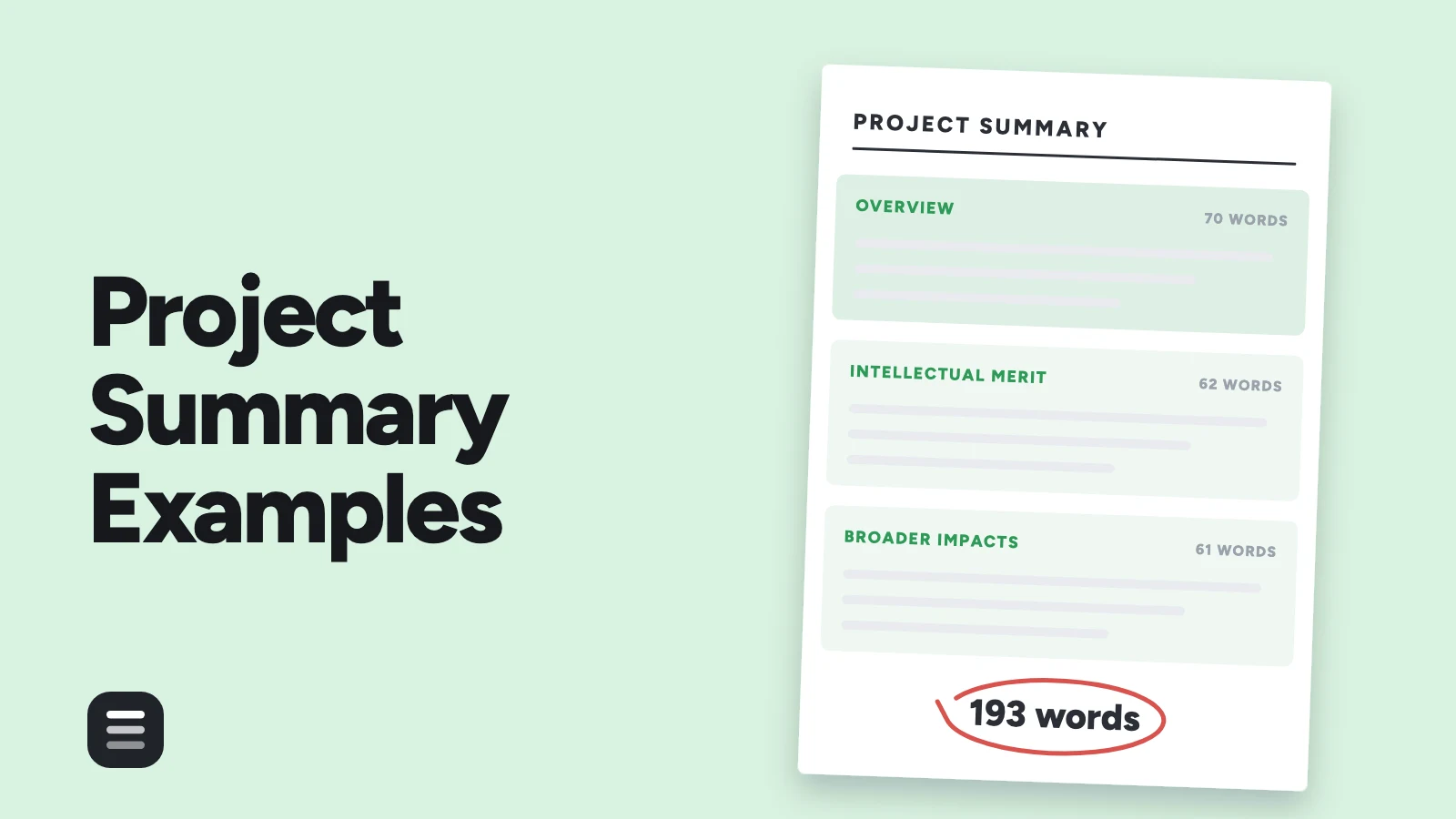
A project summary might ask for a research grant, open a museum exhibition, close out a hospital system, hand a website back to a client or report a city park to council. This post has a project summary example for each, and all five open as one-page layouts in MakeOnepagers. We tested every one against the rule the National Science Foundation gives for its own Project Summary, which asks you three things on no more than one page. What will your project do? What new knowledge could it add? Who outside your team benefits?
One‑Pager examples
Real One-Pagers made with MakeOnepagers. Open any one to edit it as your own.
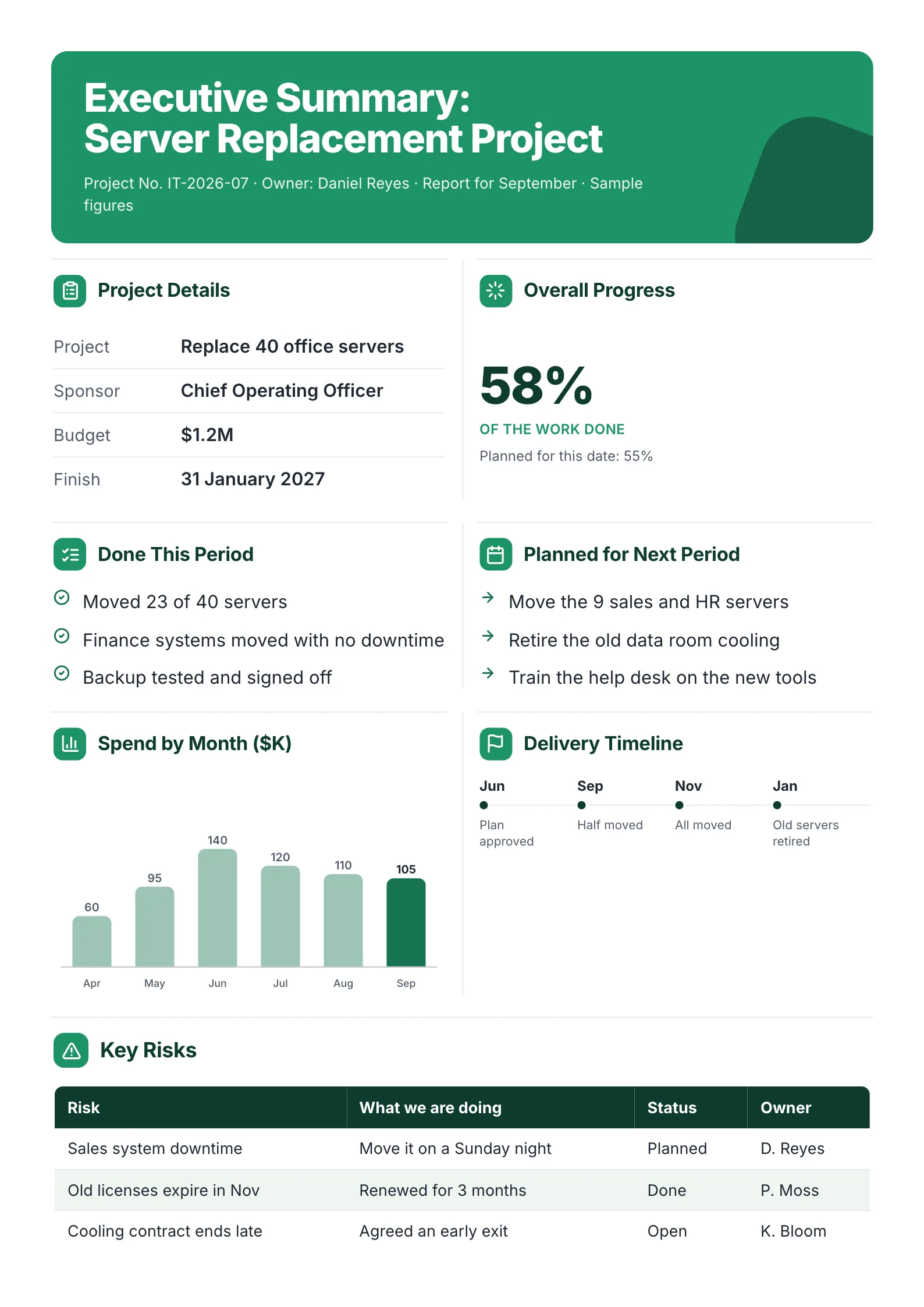 Executive Summary of a Project ReportEdit for free(opens in a new tab)
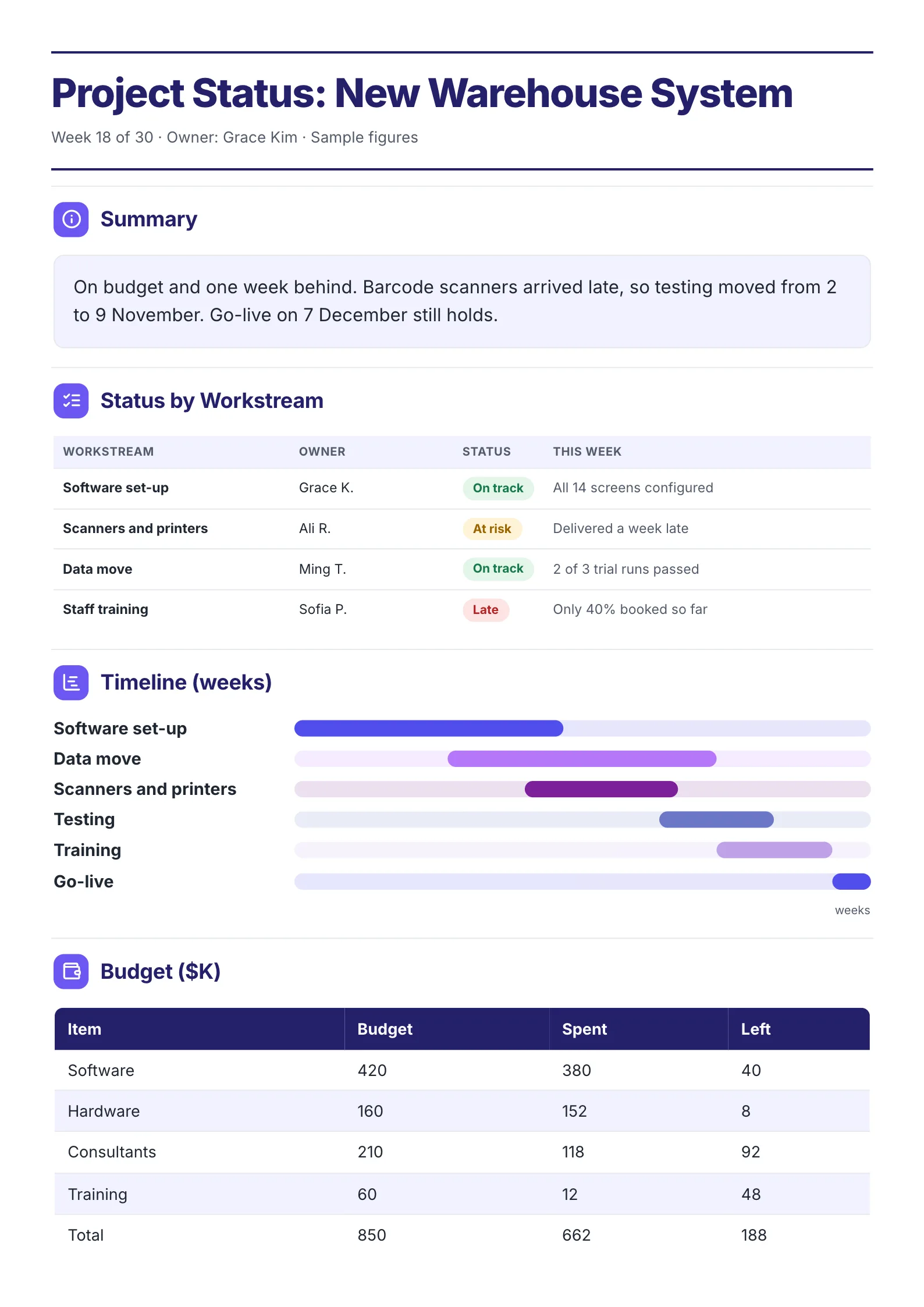 Project Status SummaryEdit for free(opens in a new tab)
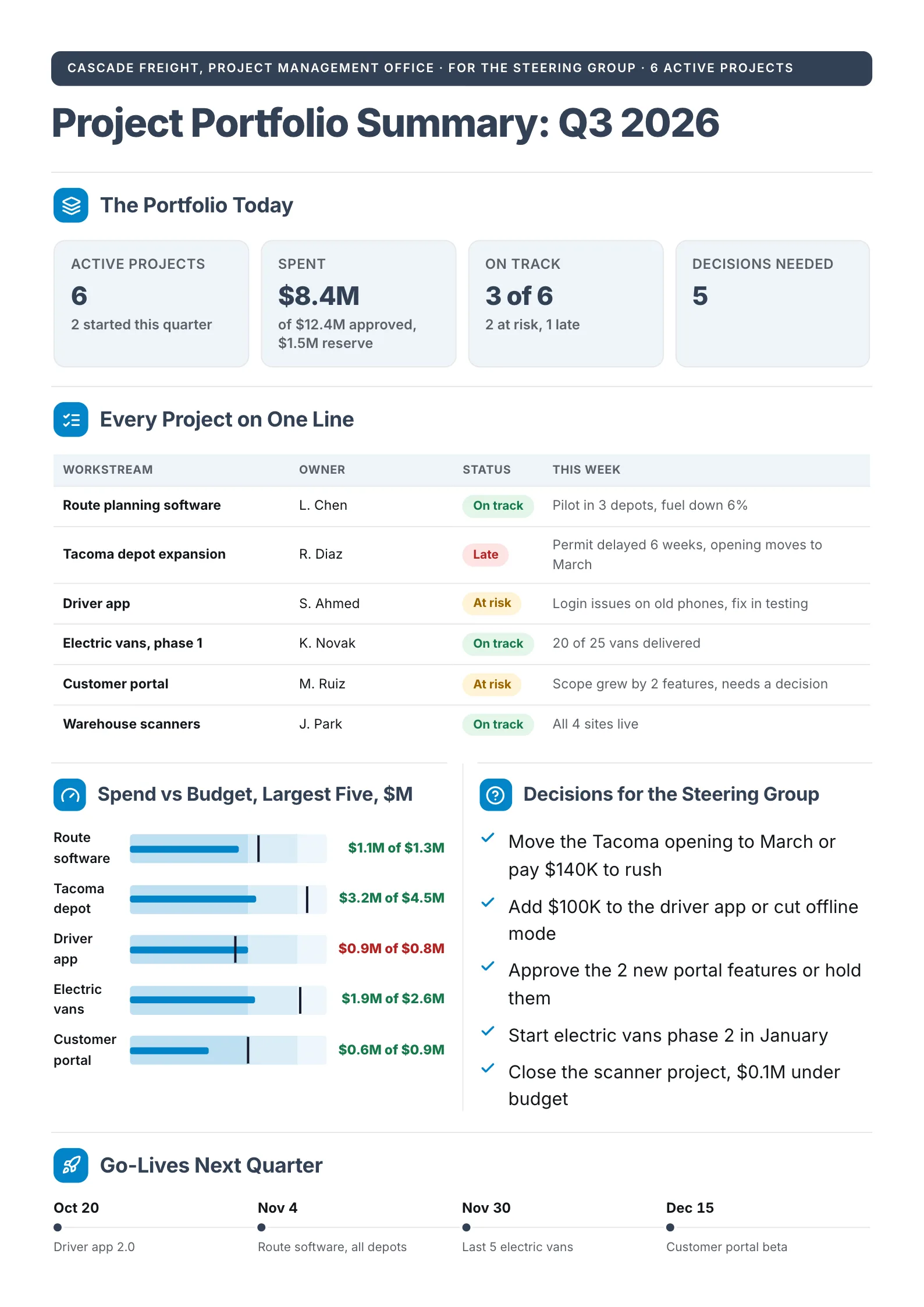 Project Summary: PortfolioEdit for free(opens in a new tab)
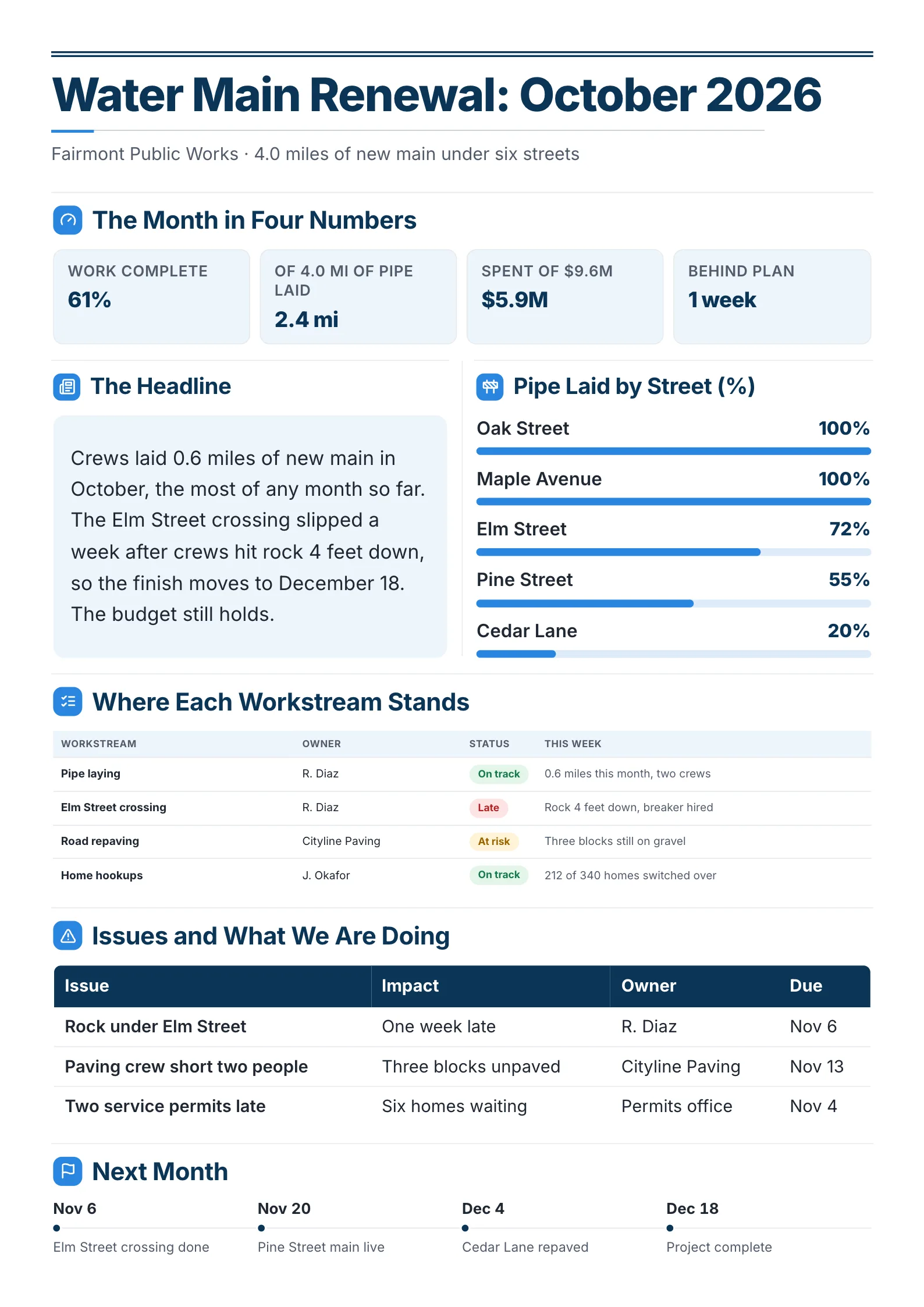 Monthly Project Summary ReportEdit for free(opens in a new tab)
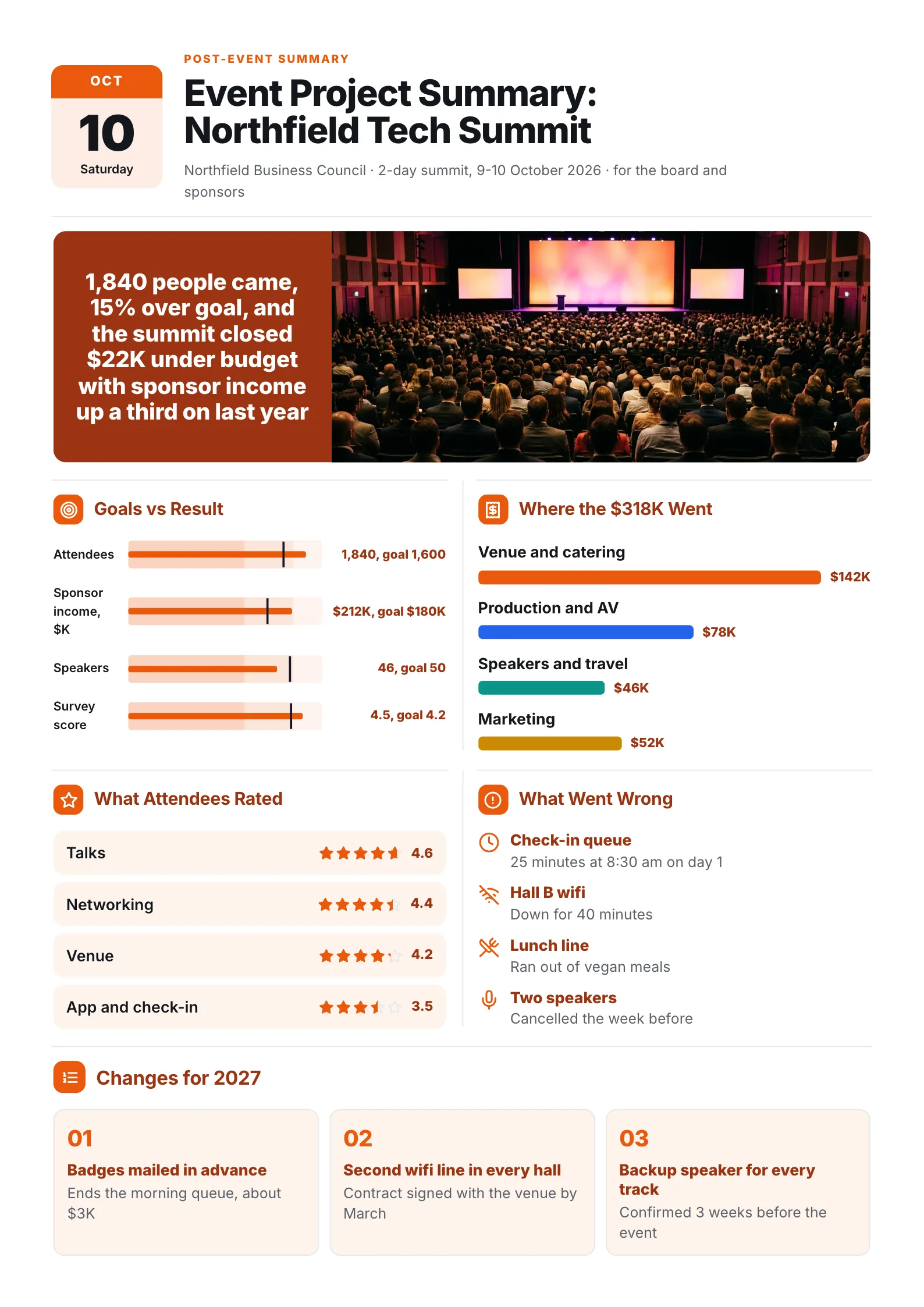 Project Summary: Event Wrap-UpEdit for free(opens in a new tab)
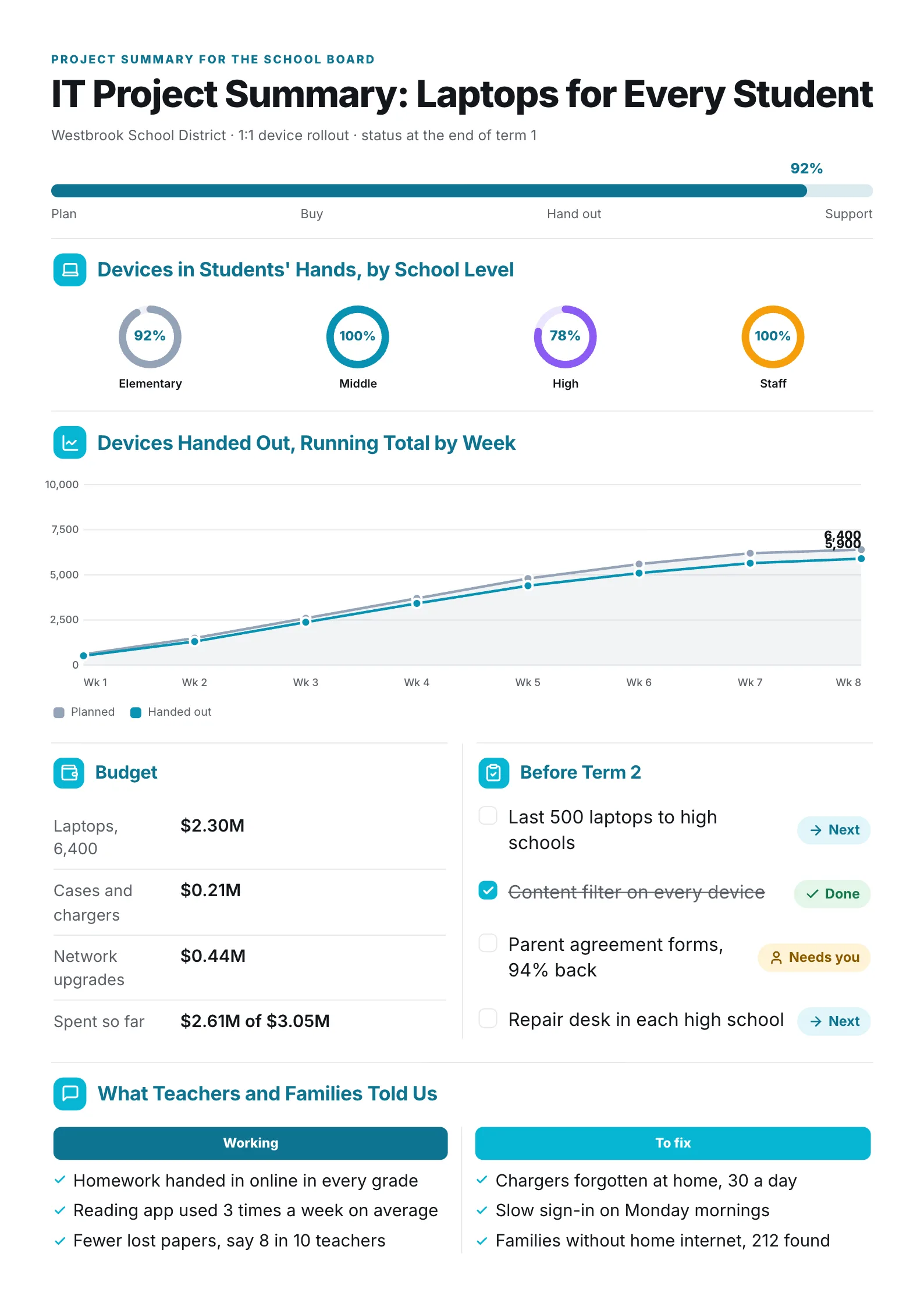 Project Summary: IT RolloutEdit for free(opens in a new tab)
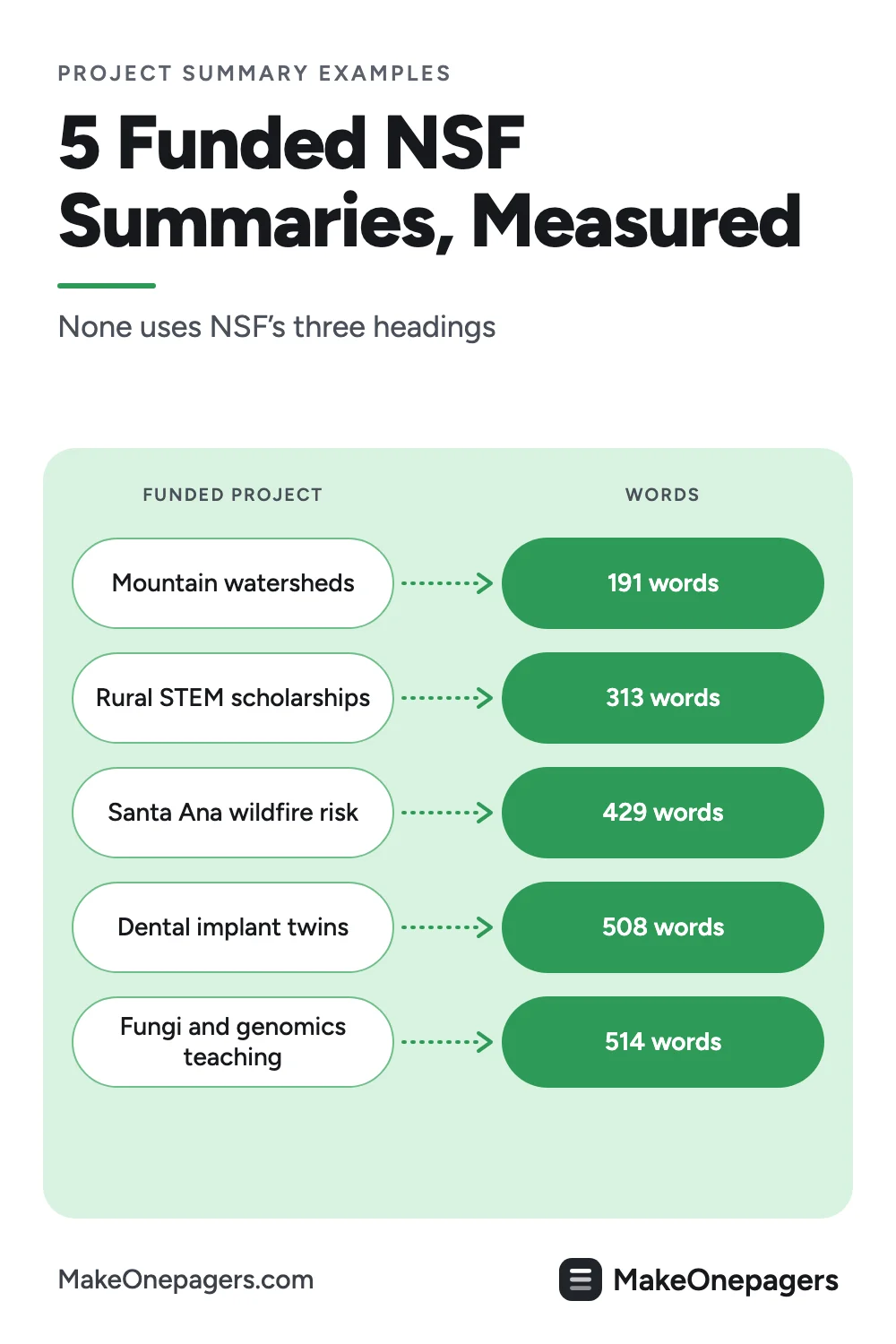
We then measured the public abstracts of 5 NSF-funded projects that start in 2027. They run from 191 words to 514, none of them uses NSF's three headings, and each still gives all three answers.
The rule we used as the test
NSF's Proposal and Award Policies and Procedures Guide, edition 24-1, says each proposal must contain a summary "not more than one page in length." It has three parts.
- An overview. What would happen if the proposal were funded, plus the objectives and the methods.
- Intellectual merit. The potential to advance knowledge.
- Broader impacts. The potential to benefit society.
Two more lines in the rule matter for any summary you write, grant or not. It should make sense to people in related fields and, where possible, to a broad scientific audience. And it "should not be an abstract of the proposal." So your summary is a document of its own. It isn't the first page of the long version cut short.
1. A research summary in NSF's own headings
 Edit this template
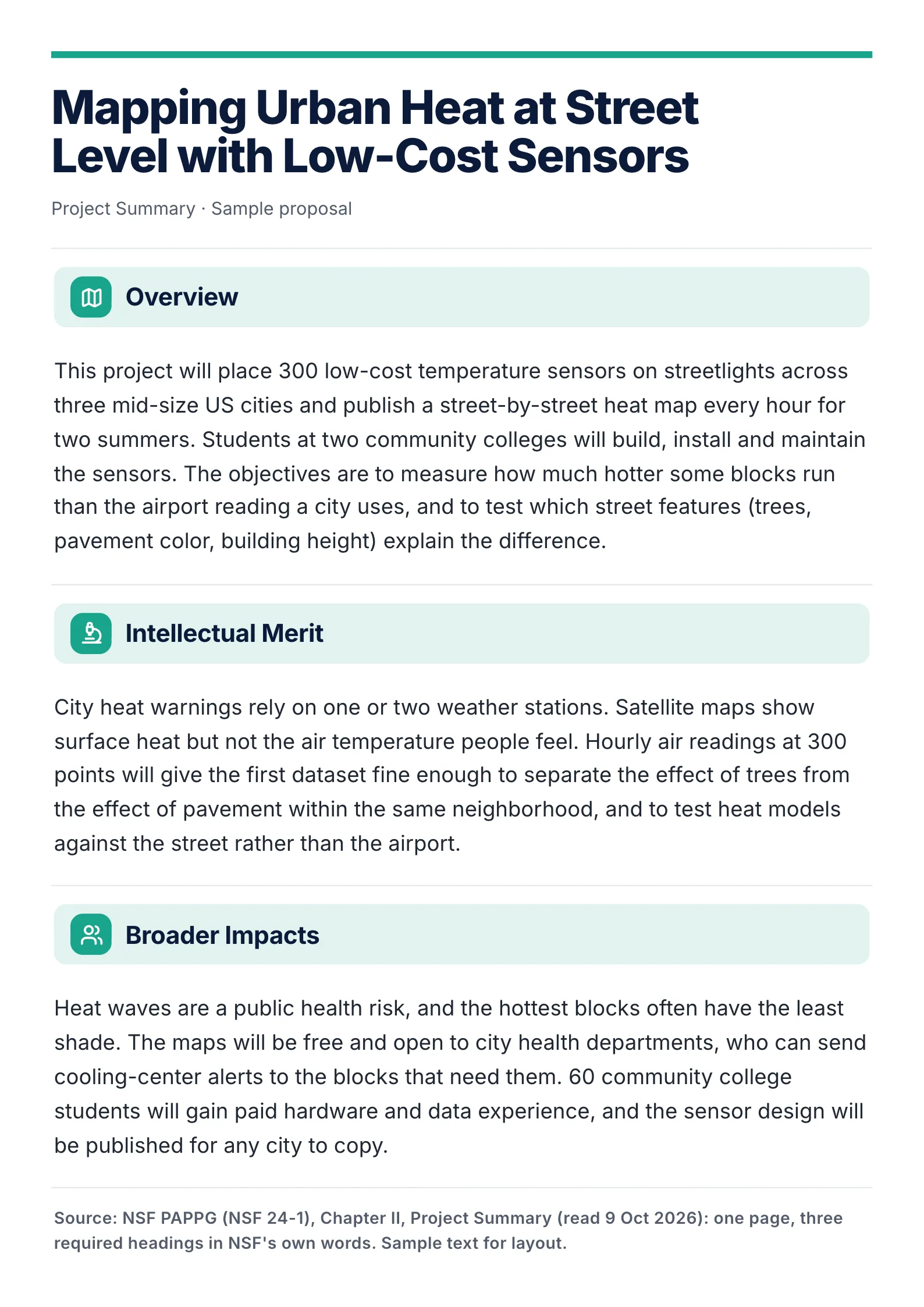
Three bands, three headings, and each band under 75 words.
This sample proposes 300 low-cost temperature sensors on streetlights in three mid-size US cities, with an hourly heat map for two summers. The whole page holds 193 words.
The three bands are nearly equal, 70, 62 and 61 words. No part crowds out another, and each answer comes in the first sentence of its band. The merit band opens with the gap ("City heat warnings rely on one or two weather stations"). The impacts band opens with the health risk. If your funder prints headings, copy them word for word, the way this sample does, so your reviewer never has to hunt for an answer. Our NSF project summary example goes through each paragraph line by line.
2. Five funded NSF projects, measured
Here's what real funded summaries look like once you can read them in public. NSF posts an abstract for every award, and we pulled 5 that start in 2027 from its award API, so you can open each one yourself. Word counts include the 25-word sentence NSF adds to the end of every one.
| Award | Who | Words | Paragraphs | Aims numbered? |
|---|---|---|---|---|
| Disturbances in mountain watersheds | Boise State University | 191 | 2 | No |
| Scholarships for STEM students in rural Appalachia | Marshall University | 313 | 2 | No |
| Santa Ana wildfire risk | University of Wyoming | 429 | 2 | Yes, 5 |
| Digital twins for dental implants | Texas A&M Engineering Experiment Station | 508 | 3 | No, 4 parts in order |
| Fungi, slime molds and genomics teaching | Tuskegee University | 514 | 2 | Yes, 3 |
Source: our count of each abstract as NSF's award API returned it, October 30, 2026.
The shortest one still answers all three
You can read the 191-word Boise State abstract in under a minute. Its first paragraph says wildfires and debris flows threaten water in mountain streams, names the Payette River watershed in Idaho, and promises field safety training for students. Its second paragraph names the methods: field experiments, continuous monitoring and models. So in two short paragraphs you get the overview, what the science will add and a benefit people outside the lab can see.
The wildfire abstract numbers its aims
The University of Wyoming project sets out five aims, numbered (1) to (5). Each one names a product, such as a 0.6-km weather reanalysis of Southern California from 1950 to 2028 and burn probability maps at 30-meter detail. Tuskegee numbers its three aims the same way, so your reviewer can tick each output off while reading. Number your aims when each one ends in something your reviewer can hold, like a map or a dataset.
The dental abstract explains its own jargon
The Texas A&M project needs words like "digital twin" and "All-on-4." Its first paragraph defines both the first time it uses them. All-on-4 means four dental implants holding a fixed set of teeth in one jaw, and a digital twin is "a computer-based representation of a patient and treatment." Then the second paragraph goes fully technical, and a short third one notes that the National Institutes of Health shares the funding. That split is the pattern in 4 of our 5 abstracts, one paragraph your neighbor could follow and then one for the specialist. Your own summary can split the same way. Marshall's scholarship abstract is the exception, since a scholarship program has nothing technical to explain.
What none of them do
None of the 5 uses the headings Overview, Intellectual Merit or Broader Impacts. Those headings belong on the summary inside your proposal. The public abstract reads as plain prose, so the version you post for everyone else can drop them too.
3. The same three questions, outside a grant
Most project summaries you'll write never go near a funder. Your sponsor wants the plan, your client wants results and a council wants to know where the money went. NSF's three questions still work as a test. Change the words a little and they become: what is the project, what did we learn or change, and who gains? Here's how four summaries outside the grant world answer them.
A kickoff summary for a museum exhibition
 Edit this template
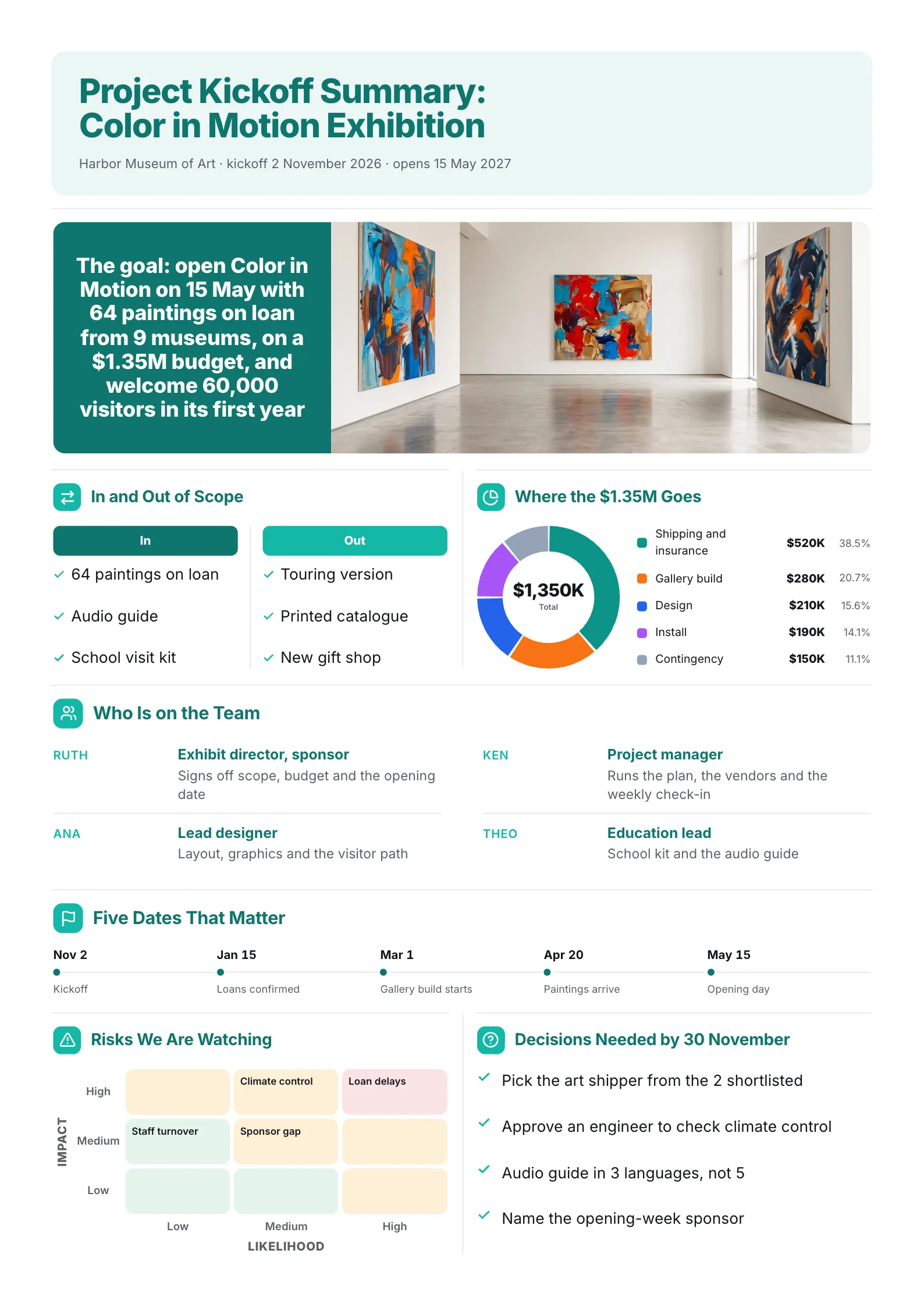
The goal sits in one sentence at the top, and the decisions due by November 30 sit at the bottom.
This sample opens the Color in Motion exhibition project at a museum. The goal line packs in the whole overview: 64 paintings on loan from 9 museums, a $1.35M budget and 60,000 visitors in the first year, opening May 15.
A kickoff has nothing to report yet, so you can't answer the "what did we learn" question. This one swaps in a list of what's in scope and what's out. The audio guide is in, a printed catalog is out. Then it closes with four decisions needed by November 30, like picking one of 2 shortlisted art shippers. When your project is just starting, end the page with the choices your sponsor has to make.
A closeout summary for a hospital system
 Edit this template
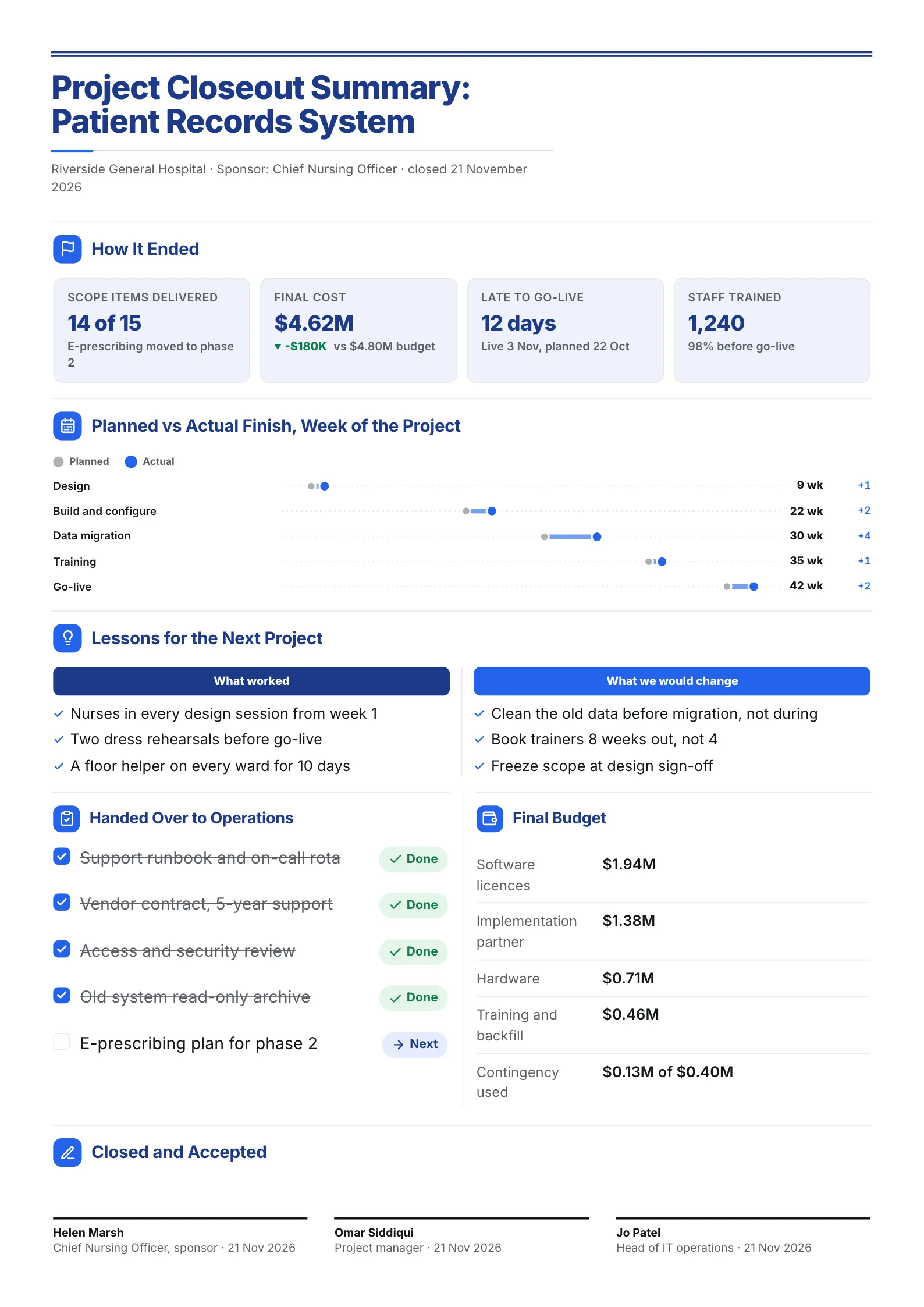
The top row holds the four results a sponsor checks first.
This one closes a hospital's patient records project. Its top row says "what happened" in four numbers you can check. It delivered 14 of 15 scope items and cost $4.62M against a $4.80M budget. It went live 12 days late, and 1,240 staff were trained.
The "what is new" question becomes "Lessons for the Next Project," split into what worked and what to change. The line about booking trainers 8 weeks out instead of 4 is one your next team can act on. Write each of your lessons that way, with the number you'd change. The "who gains" answer is the handover list to the operations team, and three people sign the page on November 21, 2026.
A client hand-back summary for a bakery website
 Edit this template
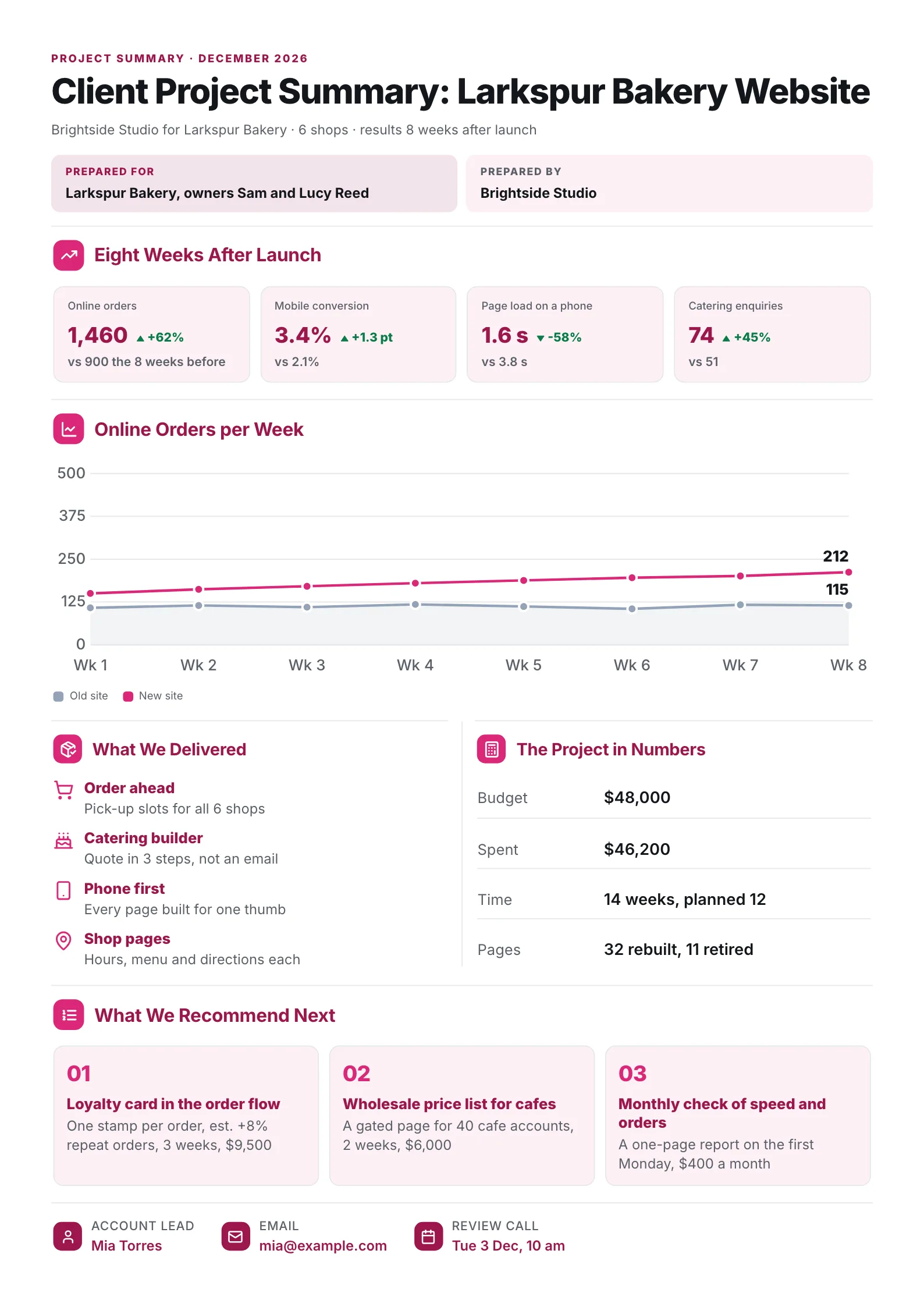
Each result sits beside the number from before launch, so the client sees the change at once.
A studio wrote this one for a bakery eight weeks after its new site launched. Wait until your client has a few weeks of real numbers before you write yours. Every result has its old number next to it. Online orders went from 900 to 1,460, up 62%. Mobile conversion went from 2.1% to 3.4%, and a phone page now loads in 1.6 seconds against 3.8.
Your client is the one who gains here, so the page talks to them. It's also honest about the miss. The project ran 14 weeks against a planned 12, and that line sits next to the $46,200 spent of a $48,000 budget. If your project ran late, put the delay beside a number that went right, so your client reads both together. It ends with three next steps, each priced, such as a loyalty card for $9,500.
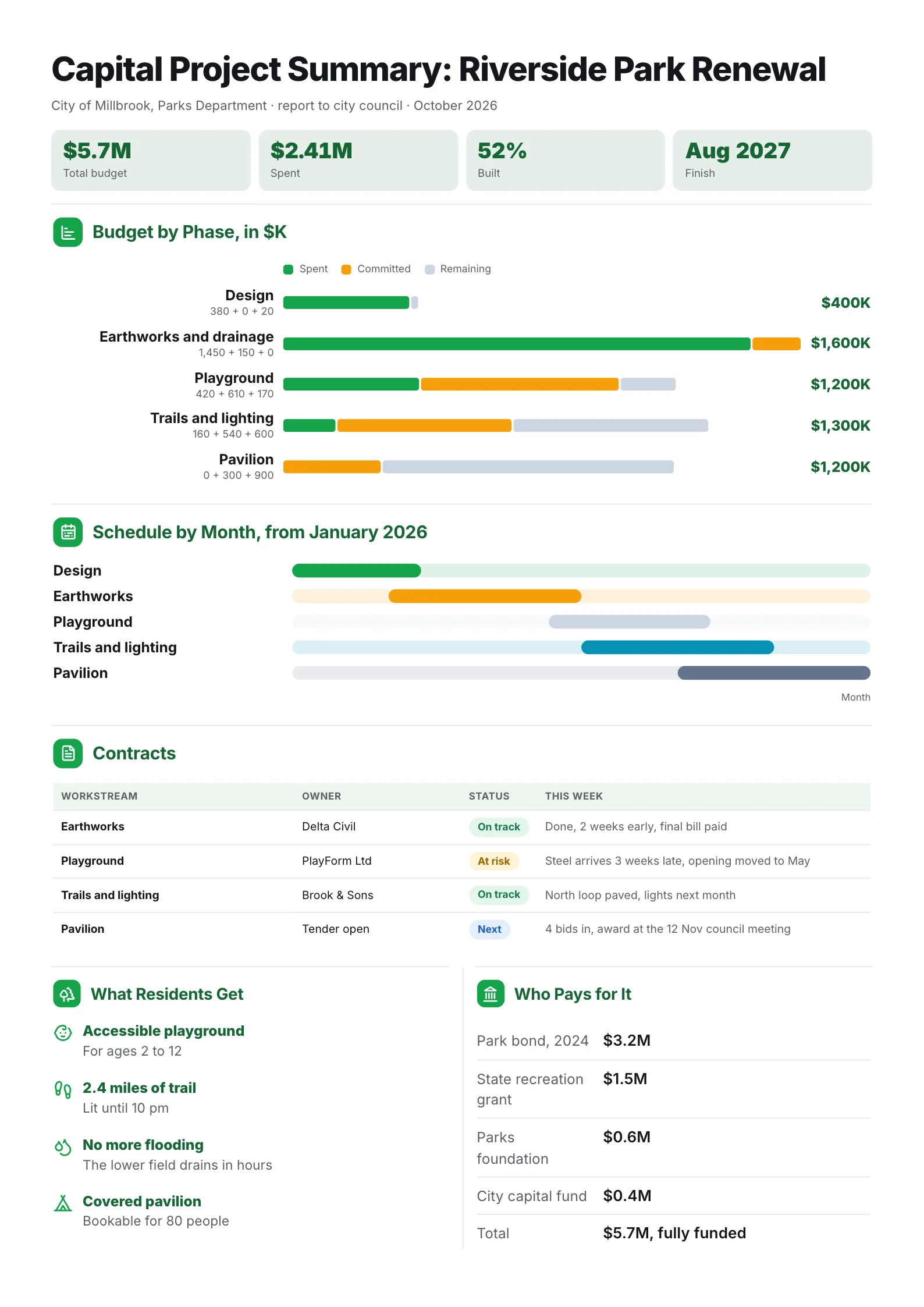
A capital project summary for a city council
 Edit this template
You see where the money comes from and what residents get on the same page as the schedule.
A parks department wrote this report for its city council, and it catches a park renewal partway through. The "who gains" answer gets its own block, "What Residents Get," with an accessible playground for ages 2 to 12, 2.4 miles of lit trail and a lower field that drains in hours.
The page also answers the question every council member asks, which is who pays, and your report should answer it too. The $5.7M total splits into a 2024 park bond of $3.2M, a state grant of $1.5M, the parks foundation at $0.6M and the city fund at $0.4M. Contract status names one slip in plain words. Playground steel arrives 3 weeks late, so that opening moves to May. Give your council the new date in the same sentence as the delay, as this page does.
The first question each reader asks
These five summaries lead with five different questions, because your reader changes with the moment. Status and monthly versions are in our project summary template post.
| Moment | Reader | What they ask first | Sample to start from |
|---|---|---|---|
| Asking for money | Grant reviewer | Is this new, and does it matter? | Research summary |
| Starting work | Sponsor | What's in, what's out, what do I decide? | Museum kickoff |
| Finishing work | Sponsor and operations | Did we deliver, and what did we learn? | Hospital closeout |
| Handing back | Client | What changed for my business? | Bakery website |
| Reporting public money | Council and residents | Where did the money go, and what do we get? | City park |
Find your row, then put your answer to its first question in the top third of the page, where the eye lands first.
Frequently asked questions
How long should a project summary be?
One page is the norm, and NSF makes it a rule for research proposals. In words, the funded abstracts we measured ran from 191 to 514. Our research sample holds 193 words in three parts. Past one page, cut detail before you cut any of the three answers.
Is a project summary the same as an abstract?
Not for NSF. Its guide says the Project Summary "should not be an abstract of the proposal." The abstract NSF publishes after an award is a separate, public text. It reads as plain prose with no section headings.
Is a project summary the same as an executive summary?
No. An executive summary opens a longer report or plan and condenses it for leaders, while a project summary is usually the whole document. The museum kickoff above stands on its own with its scope, budget and four decisions, and the hospital closeout carries its own results and three sign-offs, with nothing else for the reader to open.
What should a project summary for a client include?
What you delivered, the results with their before numbers, what it cost against budget, and what you'd do next. Our bakery example covers all four on one page and prices each next step.
Can I use the NSF format for a school or internal project?
Yes. Rename the headings to what your project is, what's new about it and who benefits. A class recycling project, for example, would say what the class will collect, what it expects to learn about the school's waste and who gains from the change.




