BlogGuide
NSF Project Summary Example: The 3 Required Parts, Explained
An NSF project summary example built on PAPPG 24-1, read at the source: the 3 required parts, what each must say, the one-page limit, a template.

By MakeOnepagers Team
Updated · 8 min read
An NSF project summary example shows the three parts every full NSF research proposal must open with: an Overview of what the project will do, a statement of its Intellectual Merit, and a statement of its Broader Impacts, all on no more than one page. Those rules come from NSF's current Proposal and Award Policies and Procedures Guide, PAPPG 24-1, Chapter II.D.2.b, which we read on nsf.gov on 12 October 2026. Below: what each part must say in NSF's words, a filled example with notes on every paragraph, and the mistakes that get a summary returned.
One‑Pager examples
Real One-Pagers made with MakeOnepagers. Open any one to edit it as your own.
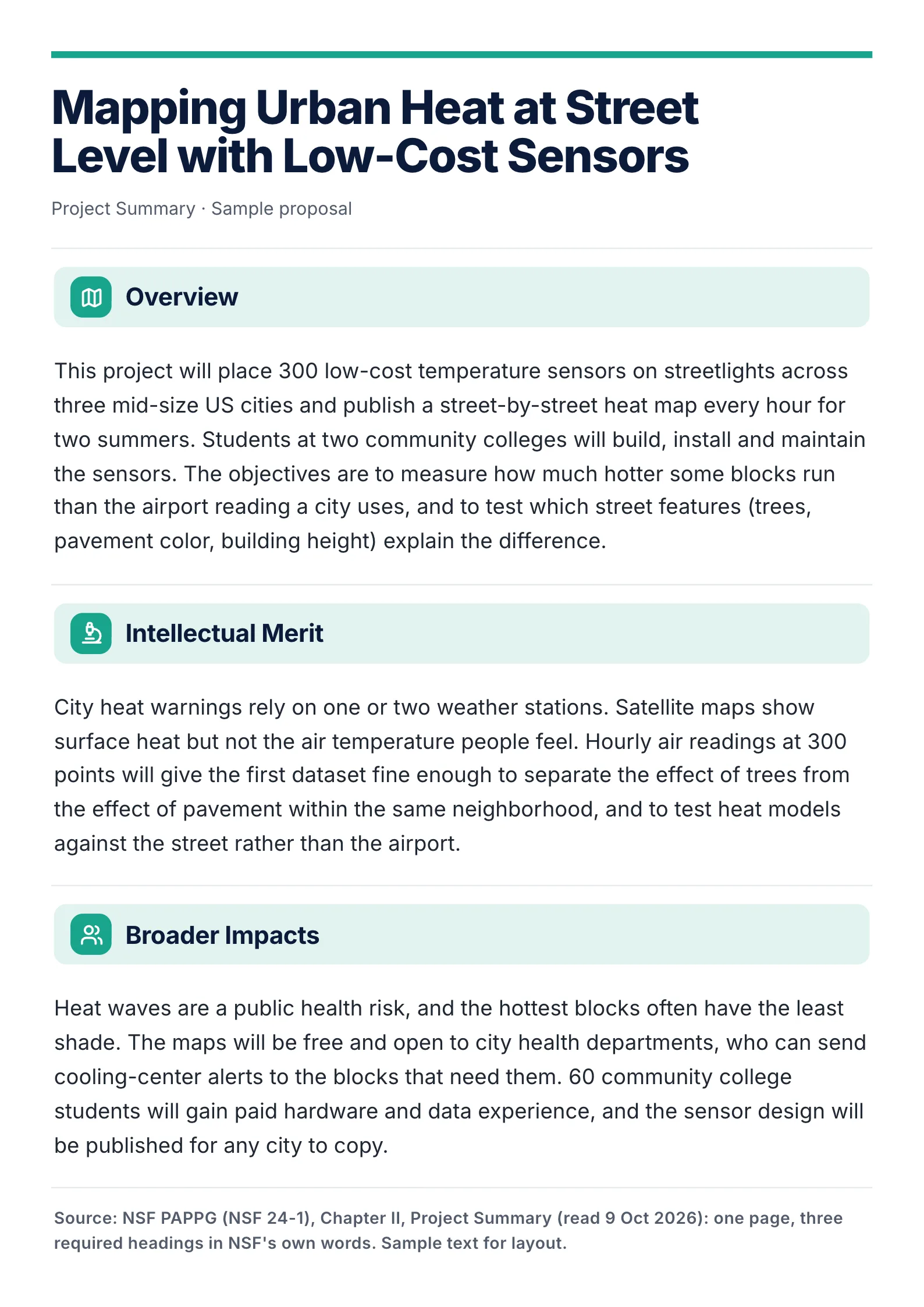 NSF Project SummaryEdit for free(opens in a new tab)
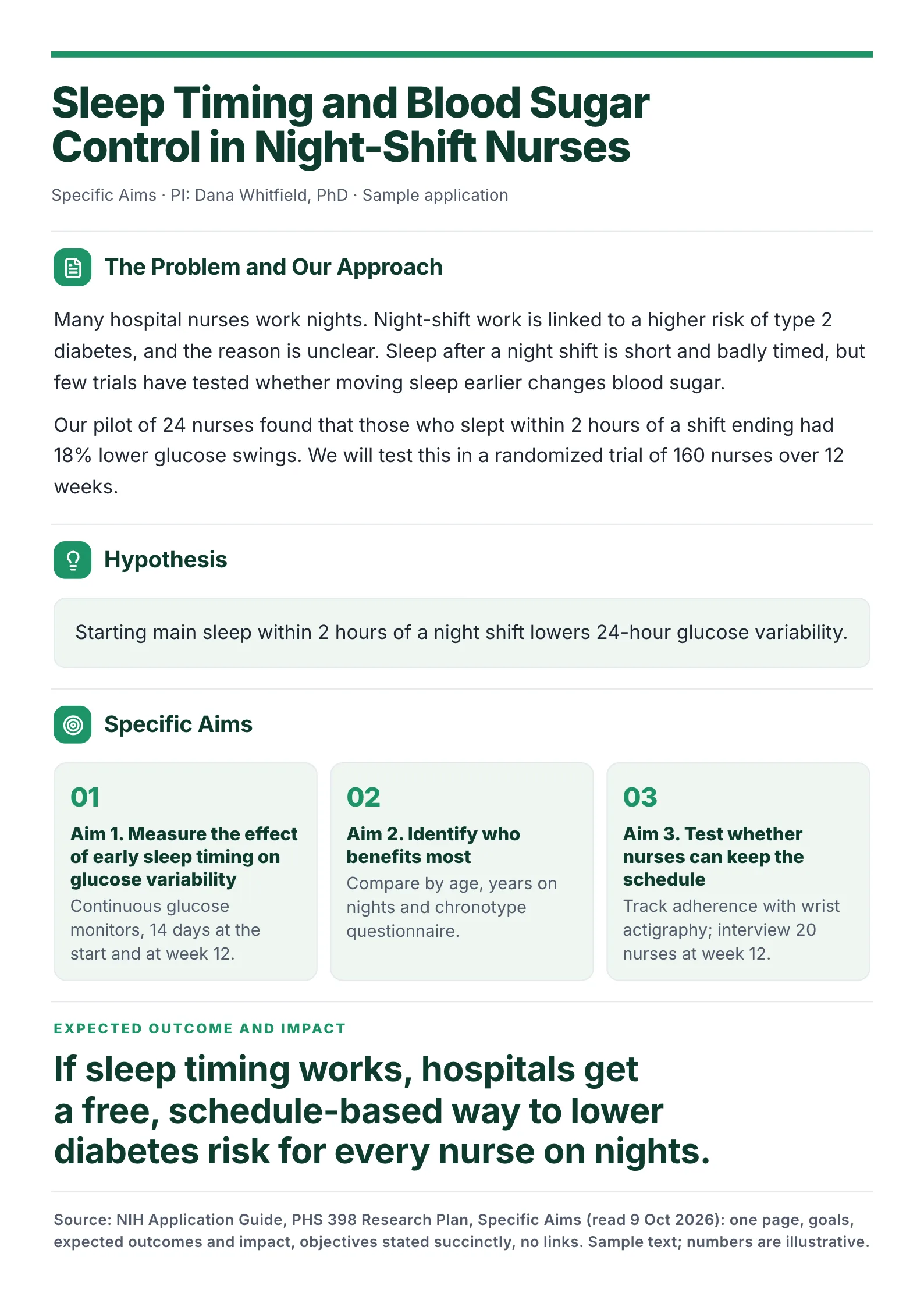 NIH Specific AimsEdit for free(opens in a new tab)
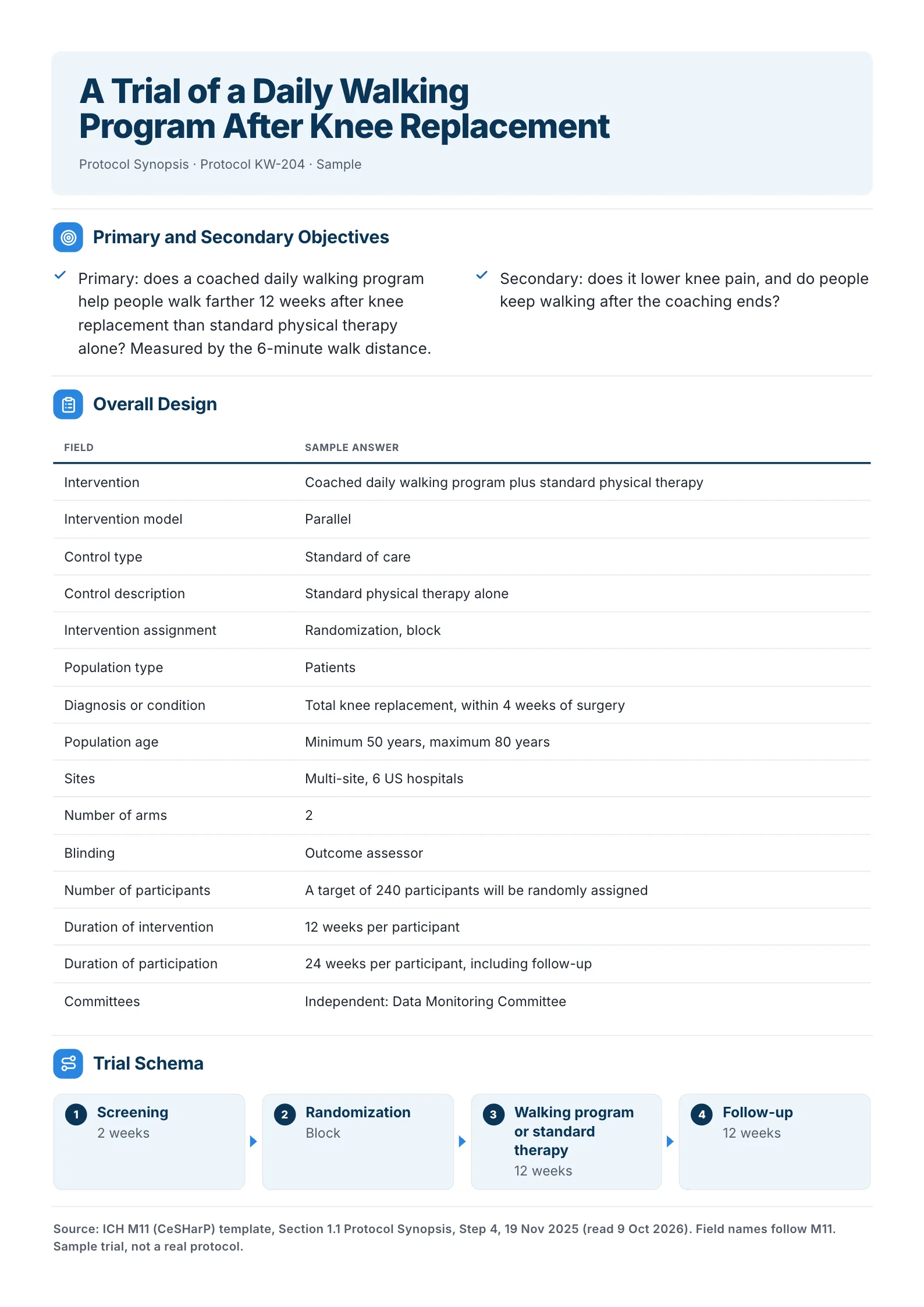 Clinical Protocol SynopsisEdit for free(opens in a new tab)
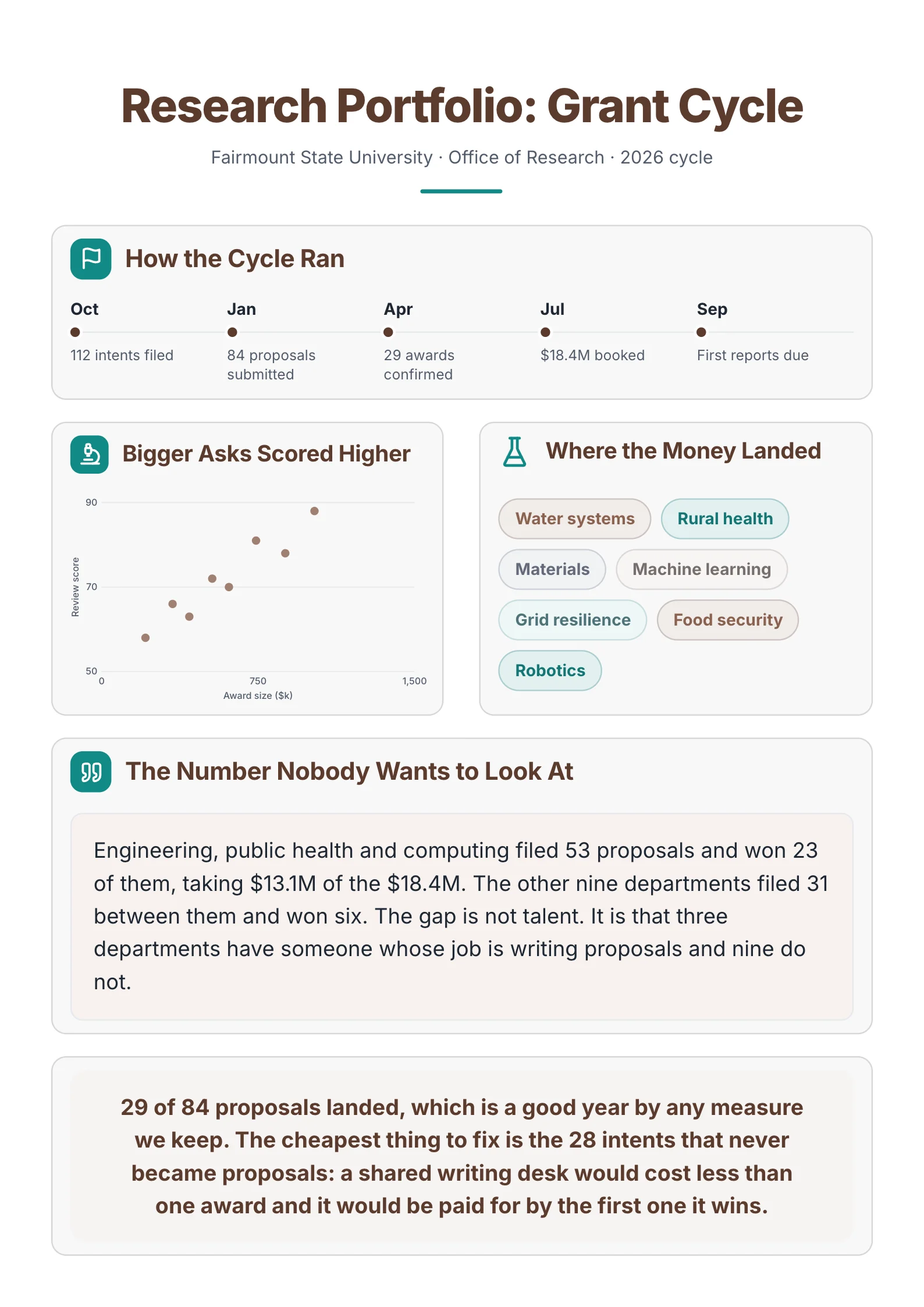 Research Funding ReviewEdit for free(opens in a new tab)
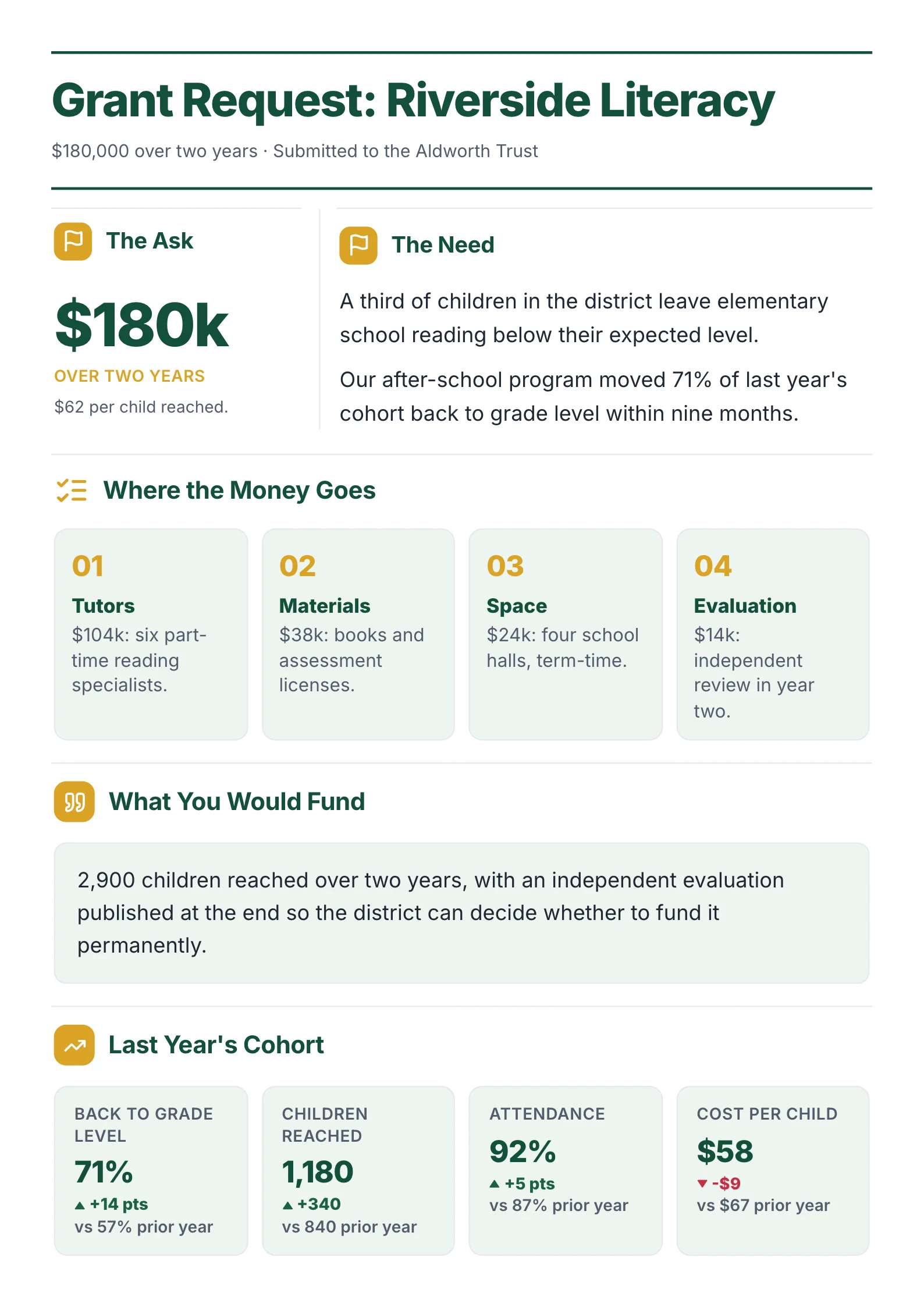 Grant RequestEdit for free(opens in a new tab)
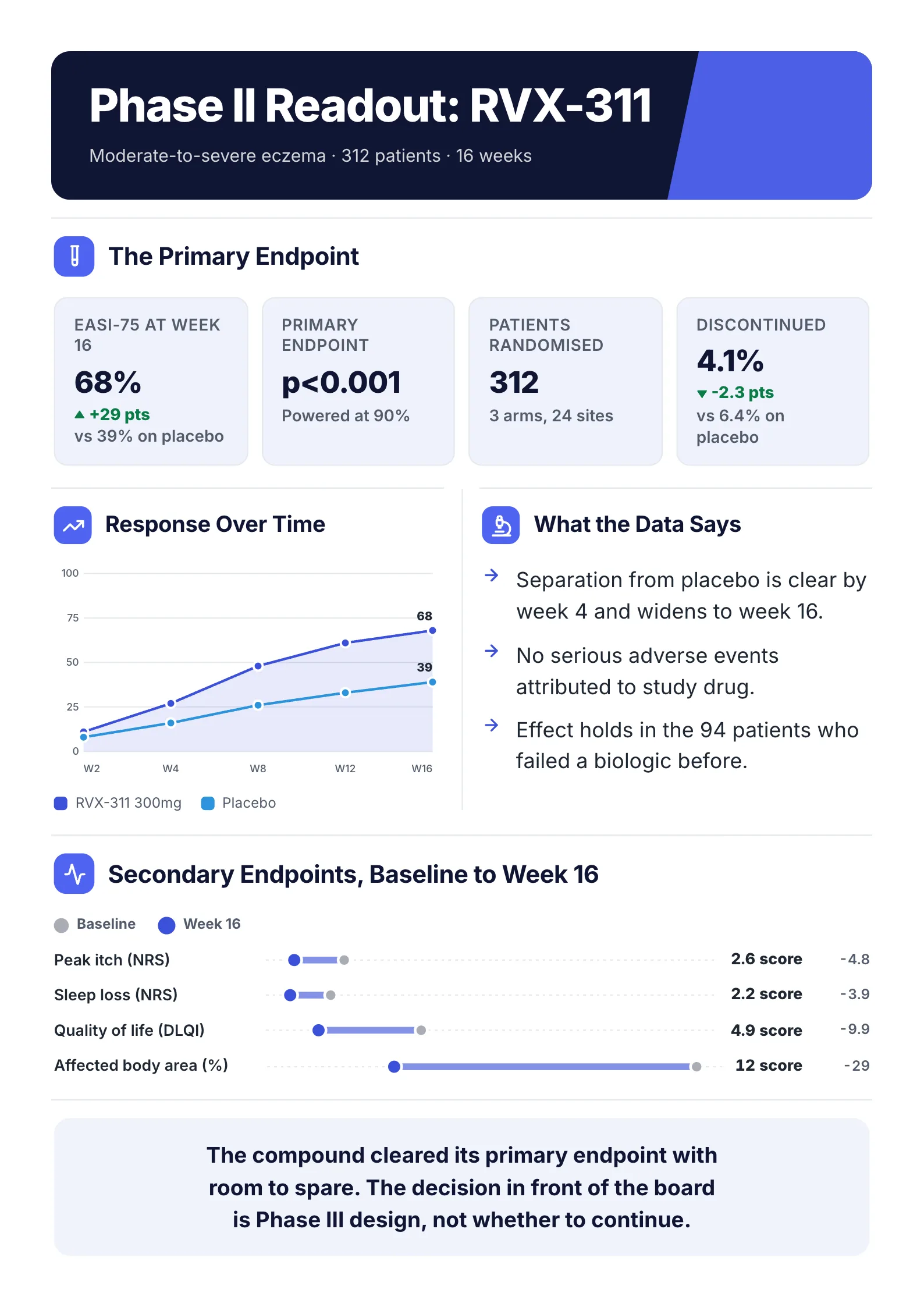 Clinical Trial ResultsEdit for free(opens in a new tab)
What NSF says a project summary is
The rule is short enough to quote nearly in full. "Each proposal must contain a summary of the proposed project not more than one page in length." It "consists of an overview, a statement on the intellectual merit of the proposed activity, and a statement on the broader impacts of the proposed activity."
Then two lines that shape how it should read:
- It "should be informative to other persons working in the same or related fields, and, insofar as possible, understandable to a broad audience within the scientific domain."
- "It should not be an abstract of the proposal."
That second line is the one most first drafts break. An abstract compresses the whole proposal. A project summary answers three questions, each under its own heading.
The PAPPG also lists the Project Summary among the sections a full research proposal "must contain". A missing one means the proposal is not accepted or is returned without review.
The 3 required parts, in NSF's words
| Part | What NSF says it contains | The question it answers |
|---|---|---|
| Overview | "a description of the activity that would result if the proposal were funded and a statement of objectives and methods to be employed" | What will you do, and how? |
| Intellectual Merit | the "potential of the proposed activity to advance knowledge" | What will we know that we do not know now? |
| Broader Impacts | the "potential of the proposed activity to benefit society and contribute to the achievement of specific, desired societal outcomes" | Who benefits outside the field, and how? |
Overview
Start with the activity, not the background. The rule asks for what "would result if the proposal were funded", then the objectives and the methods. One short paragraph usually does it.
Intellectual Merit
Say what is unknown, and what this project will make known. NSF reviews every proposal on two criteria, Intellectual Merit and Broader Impacts, so the summary is where reviewers first look for both.
Broader Impacts
Name who benefits and how. The PAPPG gives examples of societal outcomes NSF values, including improved STEM education, public engagement with science, a globally competitive STEM workforce, partnerships between academia and industry, and the use of science to inform public policy. It also says the examples are not a complete or required list.
An NSF project summary example
 Edit this template
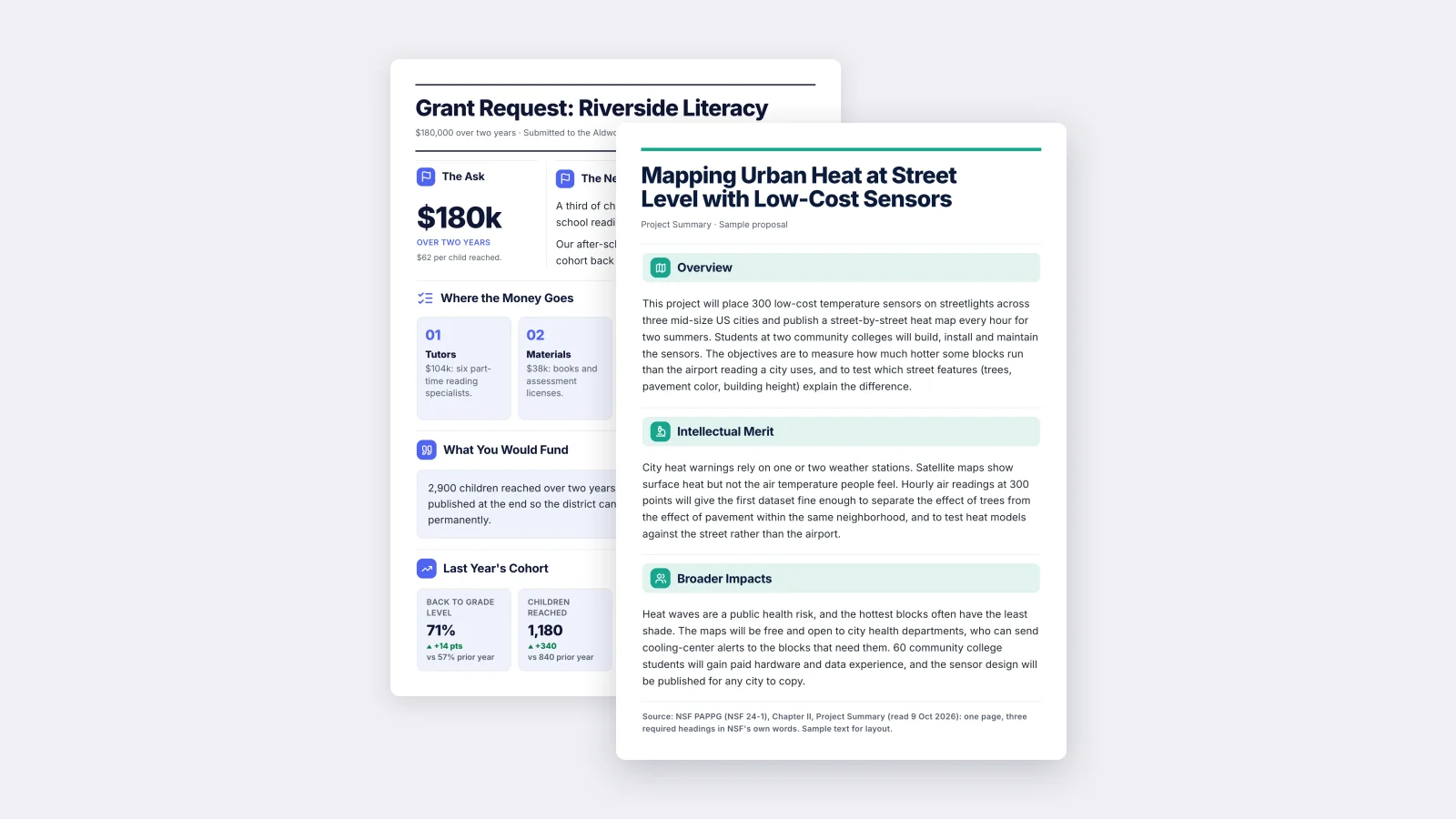
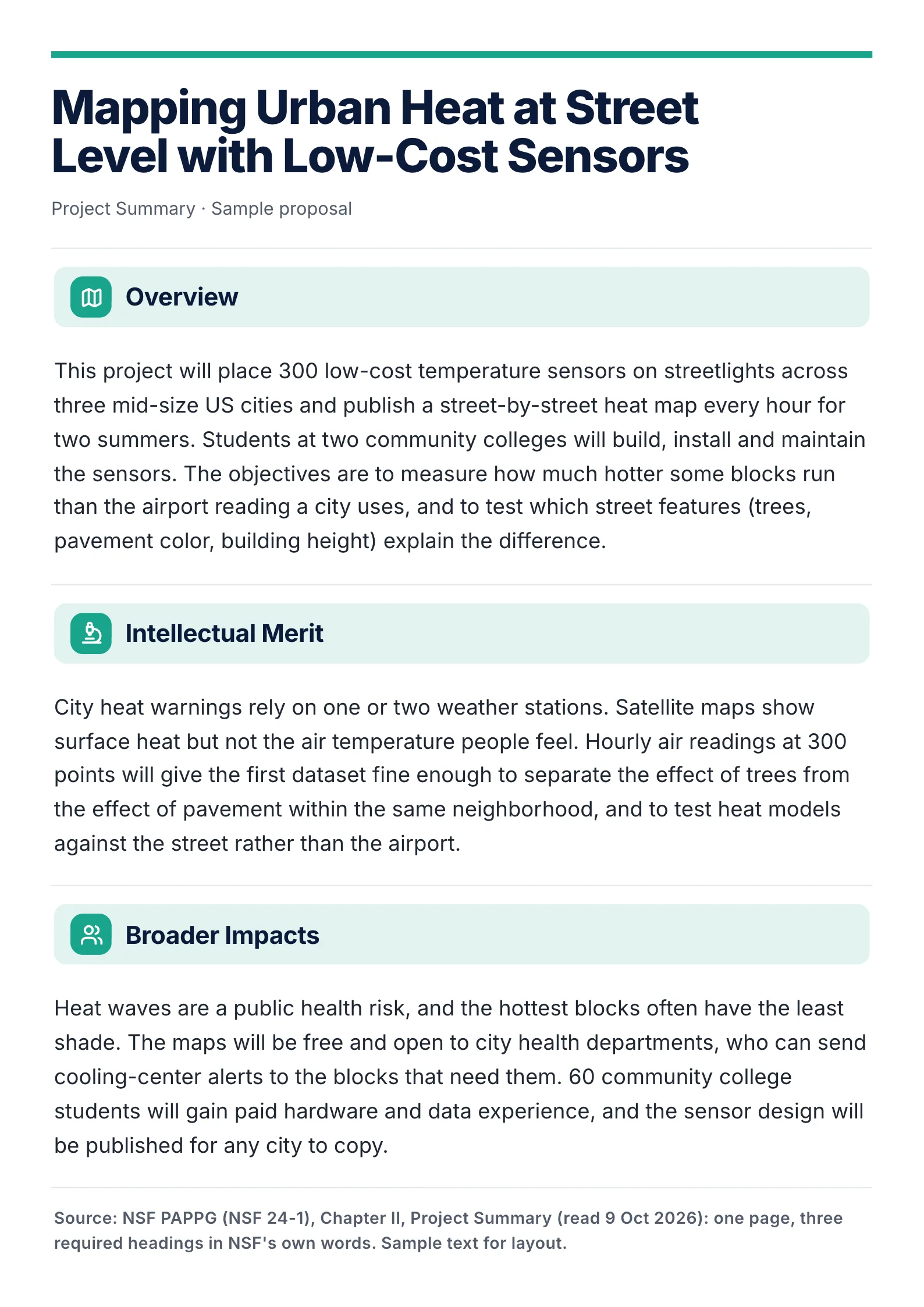
A sample proposal: street-level heat maps from 300 low-cost sensors, under NSF's three headings.
What each paragraph does:
- The Overview opens with the activity and its numbers. "This project will place 300 low-cost temperature sensors on streetlights across three mid-size US cities and publish a street-by-street heat map every hour for two summers." Then who does the work, then the objectives: "to measure how much hotter some blocks run than the airport reading a city uses, and to test which street features (trees, pavement color, building height) explain the difference."
- Intellectual Merit names the gap, then the advance. City heat warnings "rely on one or two weather stations"; satellites show surface heat, not air temperature. Hourly readings at 300 points will separate "the effect of trees from the effect of pavement within the same neighborhood."
- Broader Impacts names three groups who benefit. City health departments get free maps to send cooling-center alerts; "60 community college students will gain paid hardware and data experience"; and the sensor design is published for any city to copy.
The sample is deliberately short: 1,161 characters and 193 words across the three parts. A real summary can use the whole page. The proposal is a sample, not a funded project. Open it as a template: NSF project summary template.
How to write an NSF project summary in 6 steps
- Write the Project Description first. The summary condenses its aims and its Broader Impacts section; it can't come before them.
- Write the Overview as "This project will...", then the objectives, then the methods, in that order.
- Write Intellectual Merit as a gap and an advance. One sentence on what is not known, one or two on what this project will show.
- Write Broader Impacts as named people and named outcomes. "Students" is vague. "60 community college students, paid" is not.
- Read it as a scientist from the next field over. NSF asks that it be understandable "insofar as possible" to a broad audience within the scientific domain.
- Paste it into the three boxes and check the page. Keep each part under its own heading, and make sure the combined text fits on one page.
Already have a draft Project Description? Drop it into the free AI One-Pager generator to get a first One-Pager back in three parts, then rewrite every sentence in your own words and check it against the rule.
Text boxes, uploads and the one-page check
Research.gov collects the Project Summary as three separate text boxes, one per part. NSF's own system notice says that since 26 September 2016 its automated check confirms that the combined text of the three boxes, or an uploaded PDF if the summary contains special characters, does not exceed one page, replacing an older check of 4,600 characters. The current PAPPG states the limit as one page and does not give a character count.
If you do upload a PDF, PAPPG 24-1's format rules apply to "all uploaded sections of a proposal":
| Rule | PAPPG 24-1, Chapter II.B.2 |
|---|---|
| Fonts | Arial (not Arial Narrow), Courier New or Palatino Linotype at 10 points or larger; Times New Roman or Computer Modern at 11 points or larger |
| Line spacing | No more than six lines of text within a vertical inch |
| Margins | At least one inch in all directions |
| Paper | No larger than US Letter |
We checked our template against NSF's rules
We opened our template in the editor on 12 October 2026 and measured it.
| Rule | Our template | Result |
|---|---|---|
| One page | One page | Pass |
| Three parts under NSF's names | Overview, Intellectual Merit, Broader Impacts | Pass |
| Overview has the activity, objectives and methods | All three, in that order | Pass |
| Body text 10 points or larger | 11.6 points | Pass |
| All other text 10 points or larger, if uploaded | Subtitle 9.8 points, source line 9 points | Fail |
| An NSF-listed font, if uploaded | Inter, and the editor's other fonts are not on NSF's list | Fail |
| One-inch margins, if uploaded | 0.46 inches at the sides | Fail |
| US Letter, if uploaded | Opens at A4; switch to Letter before you download | Fix |
So use the One-Pager the way most applicants use a summary draft: to agree the wording with co-investigators, your department and your research office, and to share the project with partners. Paste the final text into the three boxes. Don't upload the designed One-Pager as your Project Summary.
The one-page summaries around a grant
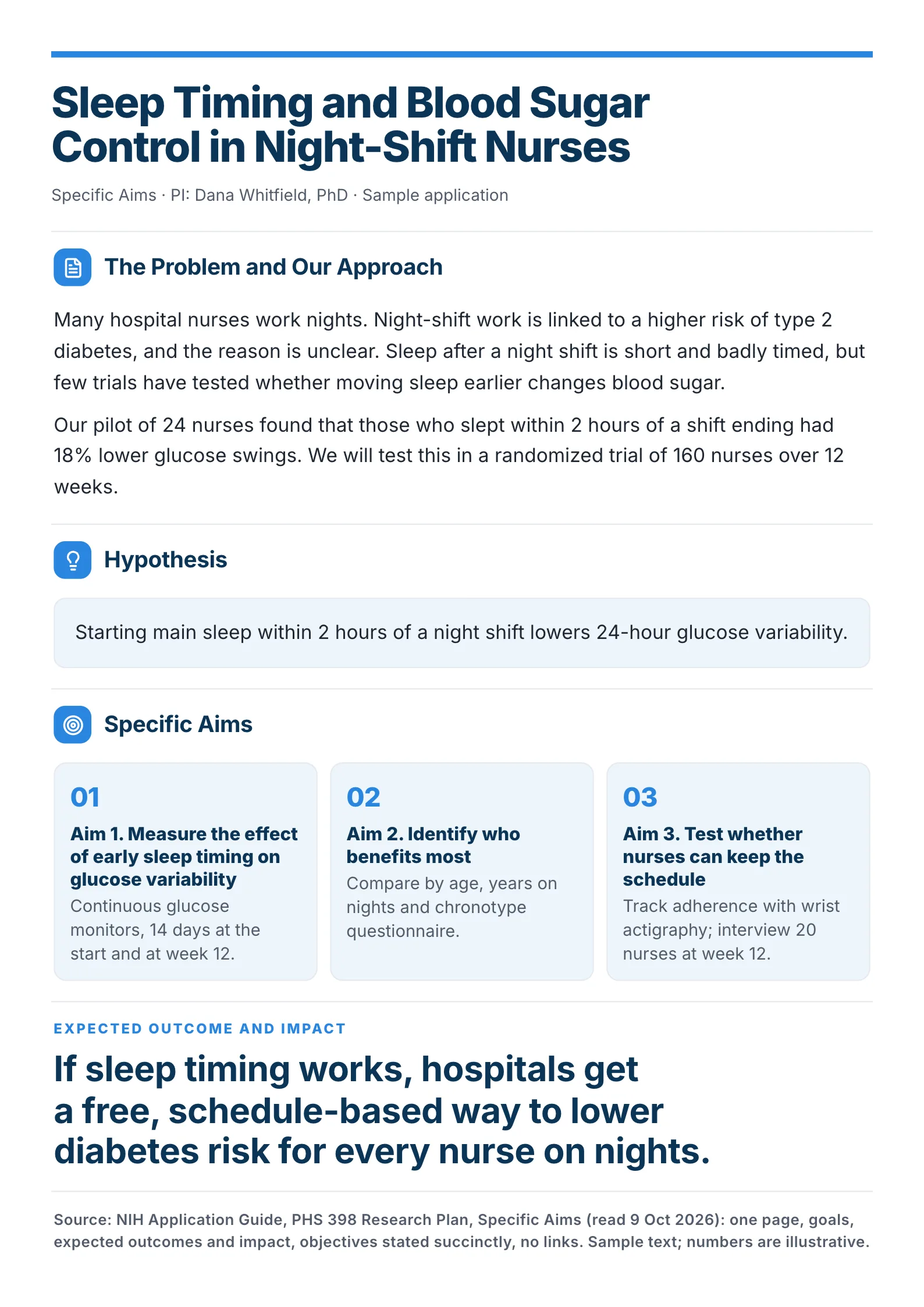
NIH has its own one-page front door, the Specific Aims page, with different rules and a different shape.
 Edit this template
A sample NIH application on sleep timing in night-shift nurses: the problem, a hypothesis, three aims and the expected outcome.
See the specific aims page template for NIH, or the clinical protocol synopsis template for a trial that is already funded.
NSF project summary mistakes
| Mistake | Fix |
|---|---|
| An abstract of the whole proposal | Three parts, three questions, as the PAPPG asks |
| Merging Intellectual Merit and Broader Impacts | Keep each under its own heading |
| Broader Impacts that only says "society will benefit" | Name the people, the number and the outcome |
| Jargon only your subfield knows | Write for a scientist in a related field |
| Planning to a 4,600-character count | Plan to one page, which is what the system checks |
| A summary that no longer matches the Project Description | Rewrite it after the last edit to the description |
Make your NSF project summary
Open the free NSF project summary template, replace the sample heat-mapping project with yours under the three headings, share it with your co-investigators, then paste the final text into Research.gov.
Frequently asked questions
What are the three parts of an NSF project summary?
An Overview, a statement on Intellectual Merit and a statement on Broader Impacts. PAPPG 24-1 requires all three, on no more than one page.
How long is an NSF project summary?
No more than one page. The current PAPPG does not set a character count, and NSF's system has checked the combined text against one page, not 4,600 characters, since September 2016.
Should an NSF project summary be written in the first or third person?
The current PAPPG does not say. It asks that the summary be informative to people in related fields and understandable to a broad audience within the scientific domain. Check your program solicitation, which can add its own instructions.
What is the difference between Intellectual Merit and Broader Impacts?
Intellectual Merit is the potential to advance knowledge. Broader Impacts is the potential to benefit society and contribute to specific, desired societal outcomes. A project needs both, and the summary states each separately.
Can I use an NSF project summary template?
Yes, for drafting. Many universities share Word templates, and you can edit the free NSF project summary template on MakeOnepagers to agree the wording and share the project. The text you submit goes into Research.gov's three boxes.