Profit and Loss Examples With the Sentence That Explains the Numbers
5 profit and loss examples on one page, from a dental practice to a candle shop, and how a freelancer's statement maps to IRS Schedule C lines.

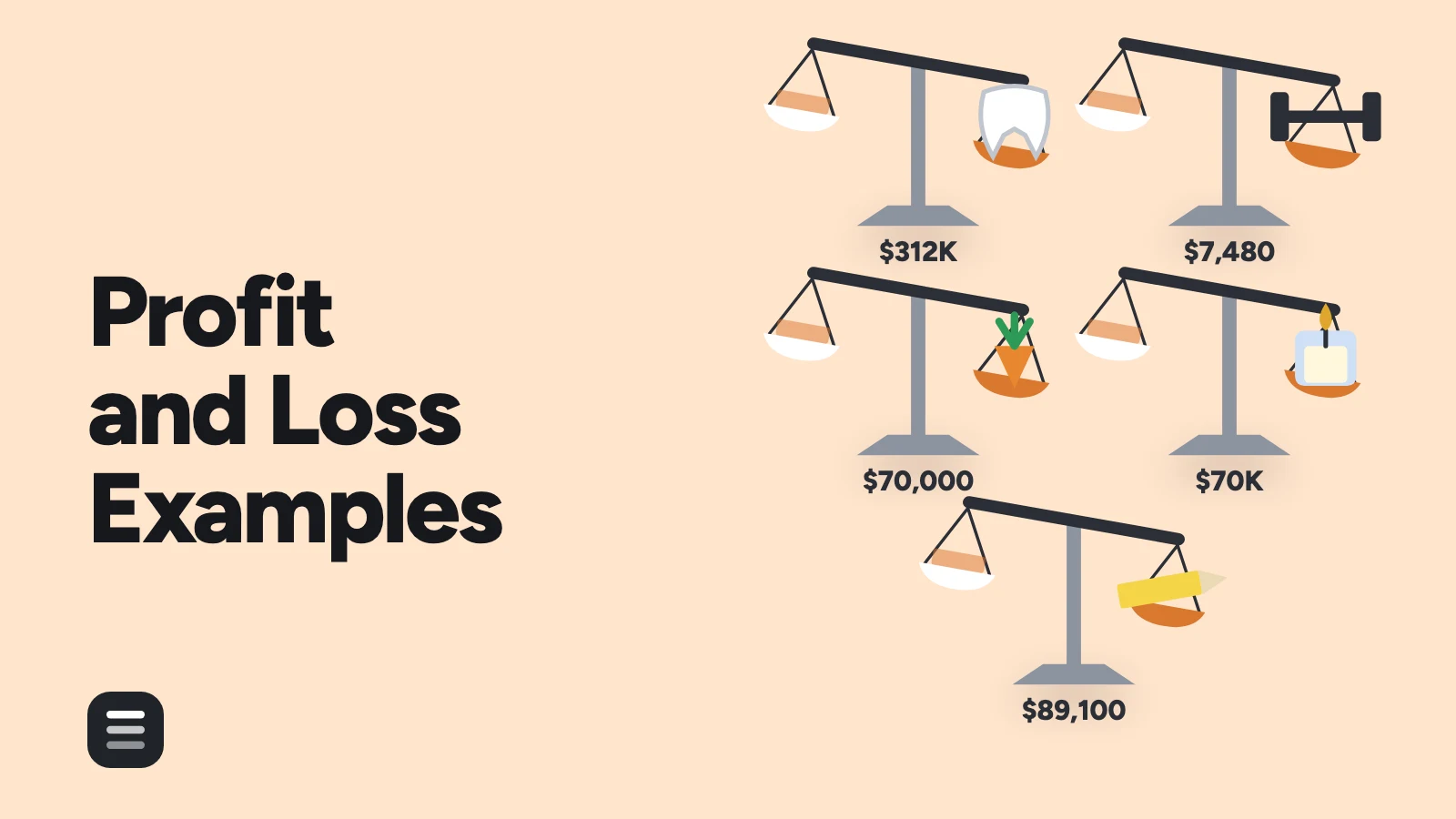
Did we make money this month, and why? Each profit and loss example below answers that on one page, with the reason in words beside the numbers. Start from a free one pager template.
One‑Pager examples
Real One-Pagers made with MakeOnepagers. Open any one to edit it as your own.
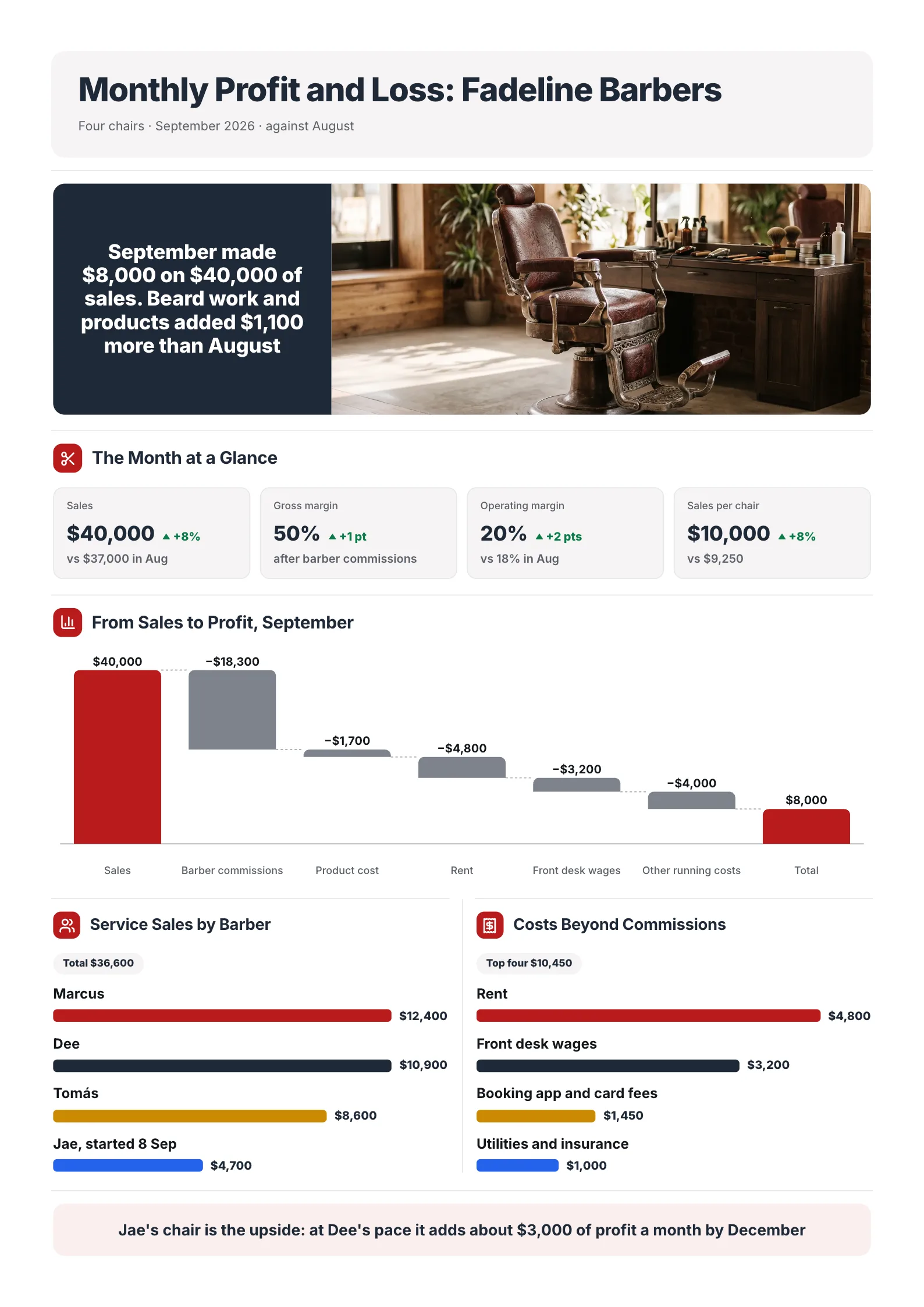 Profit and Loss: BarbershopEdit for free(opens in a new tab)
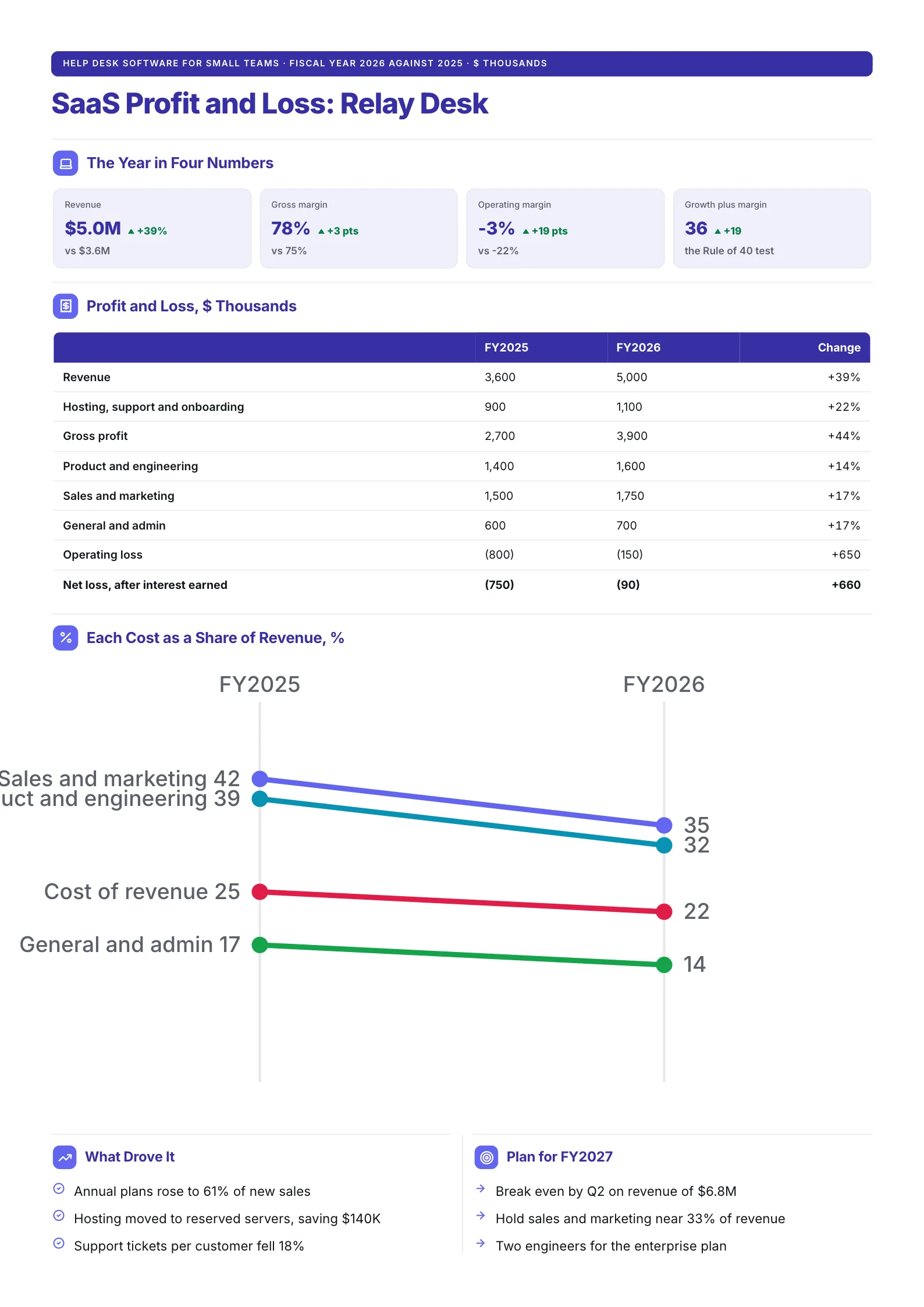 Profit and Loss: SaaSEdit for free(opens in a new tab)
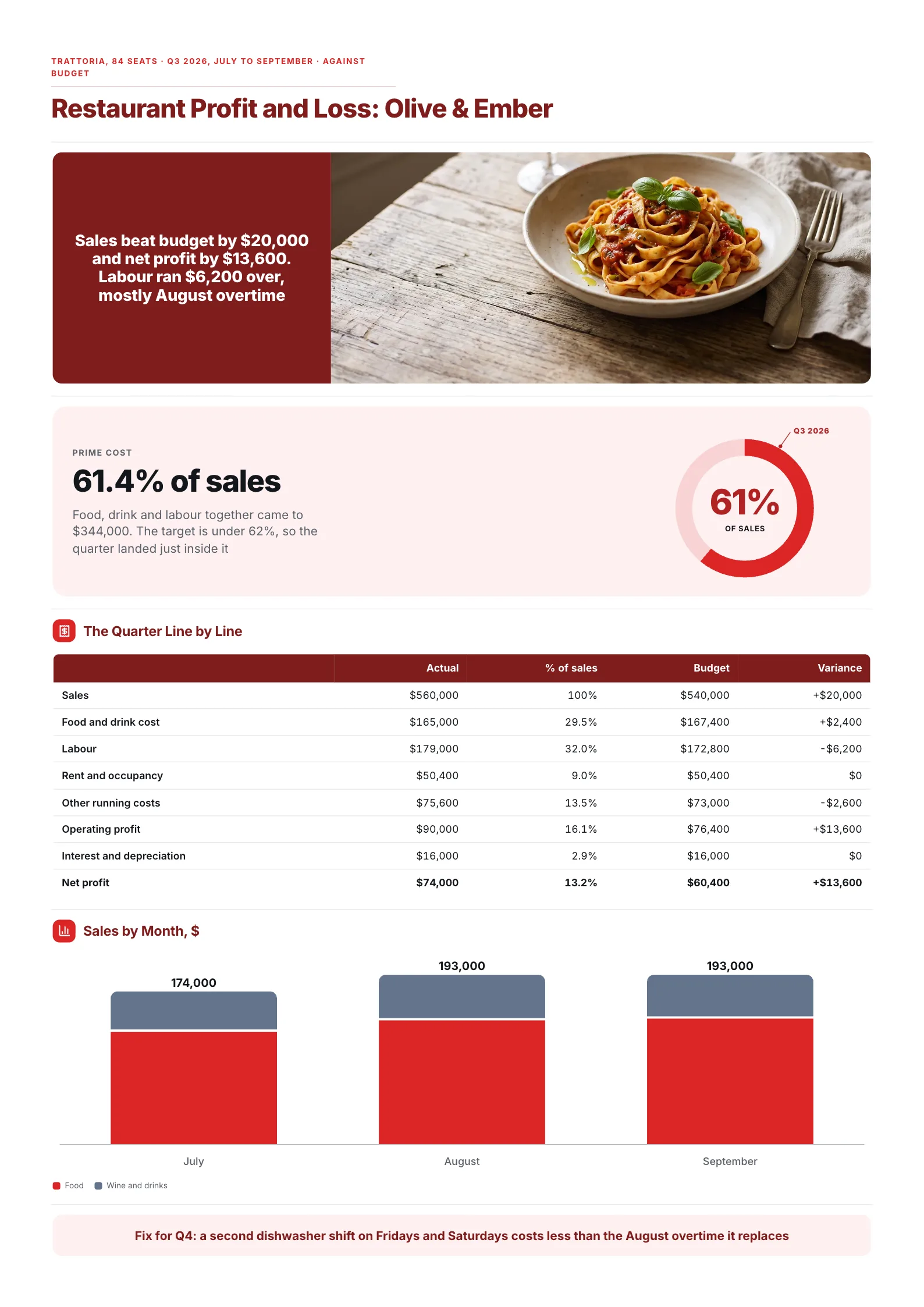 Profit and Loss: RestaurantEdit for free(opens in a new tab)
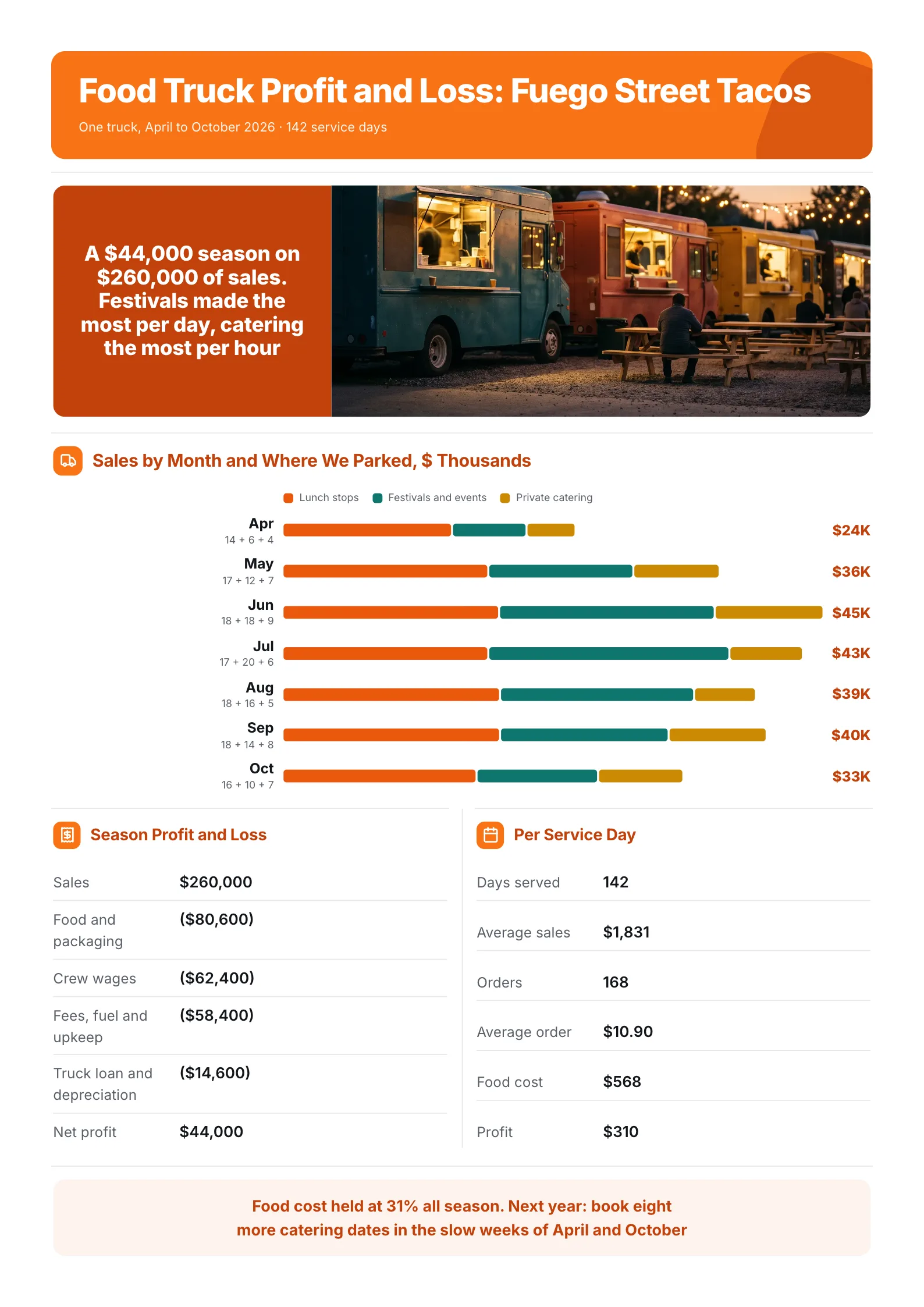 Profit and Loss: Food TruckEdit for free(opens in a new tab)
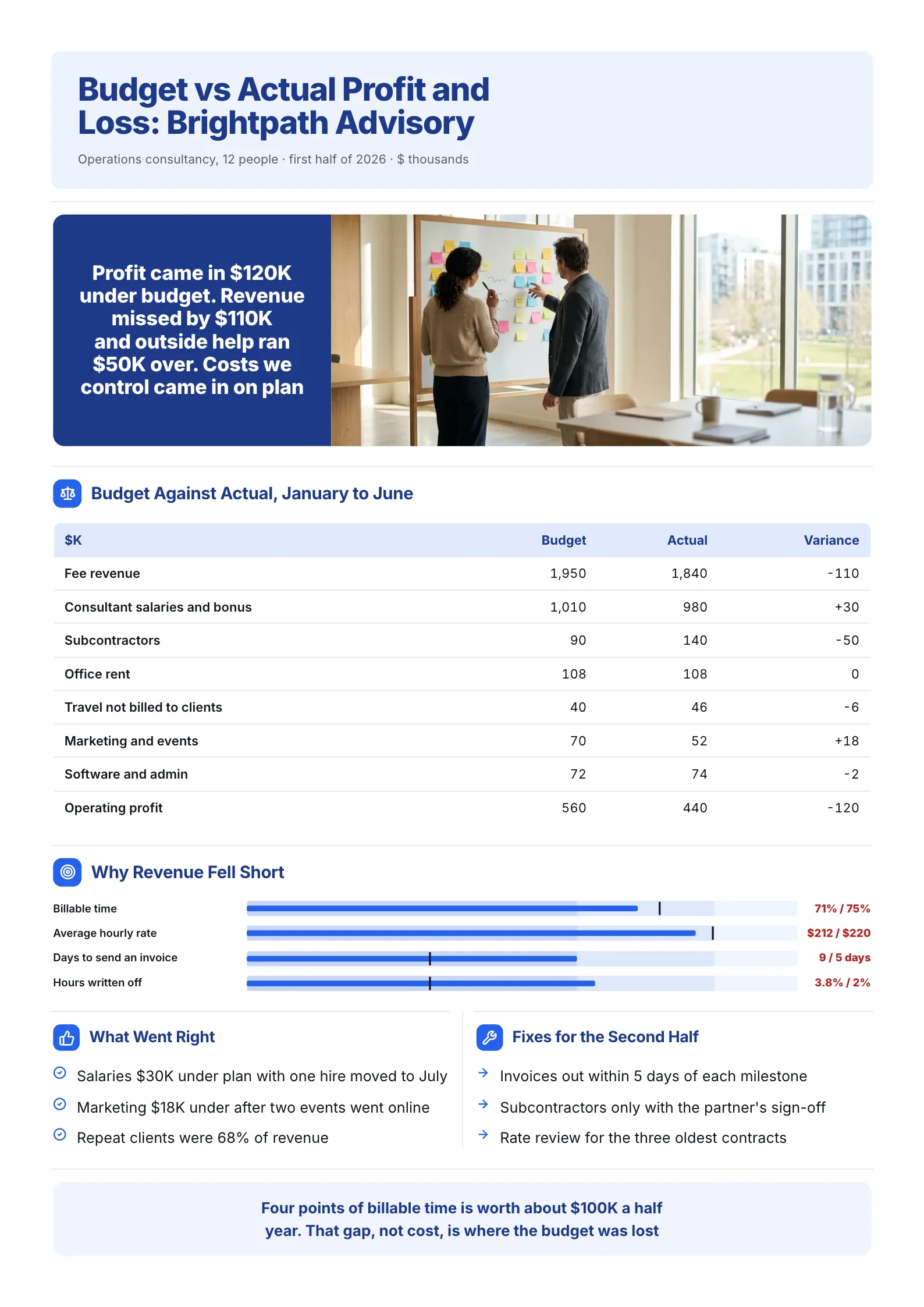 Profit and Loss: Budget vs ActualEdit for free(opens in a new tab)
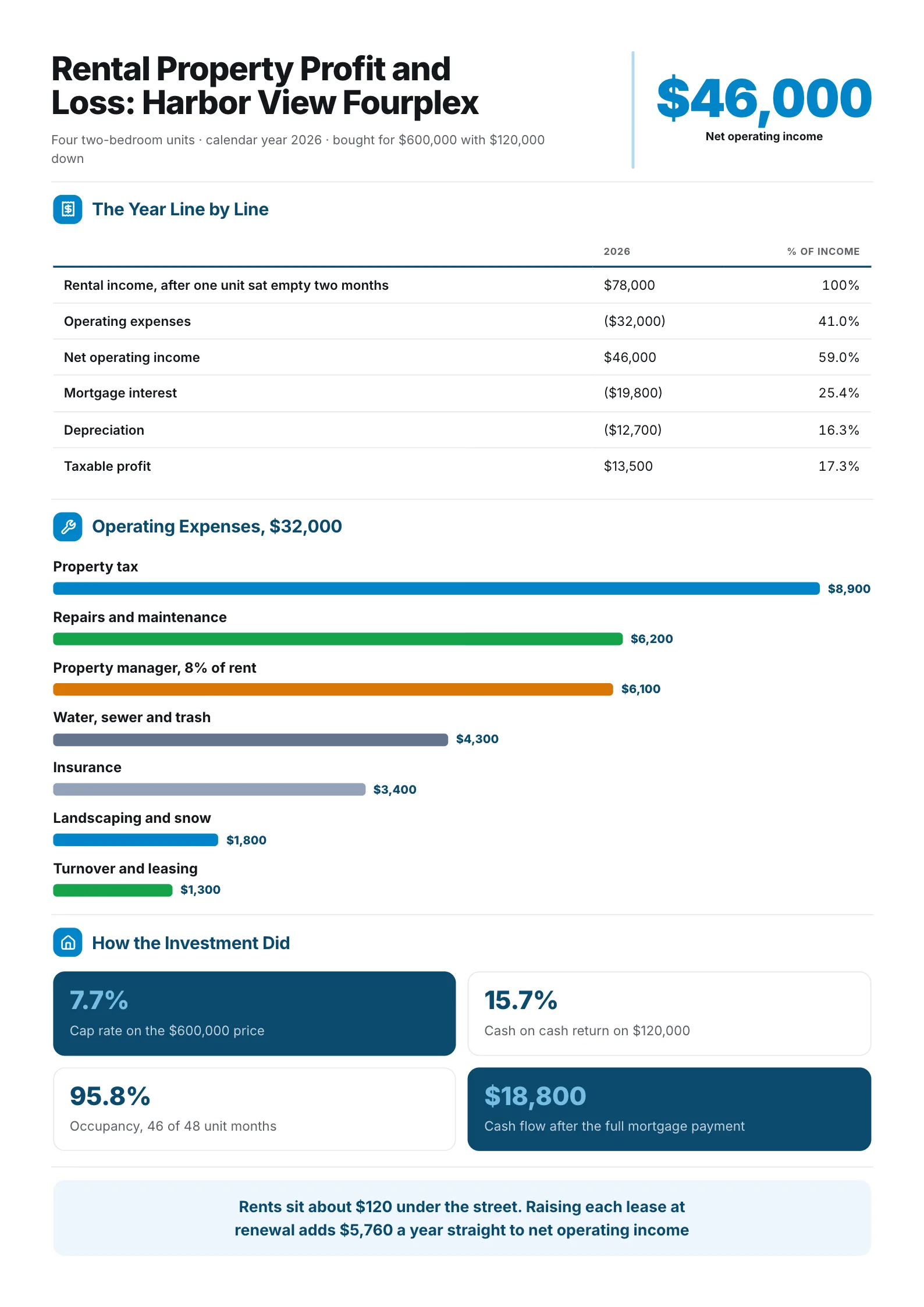 Profit and Loss: Rental PropertyEdit for free(opens in a new tab)
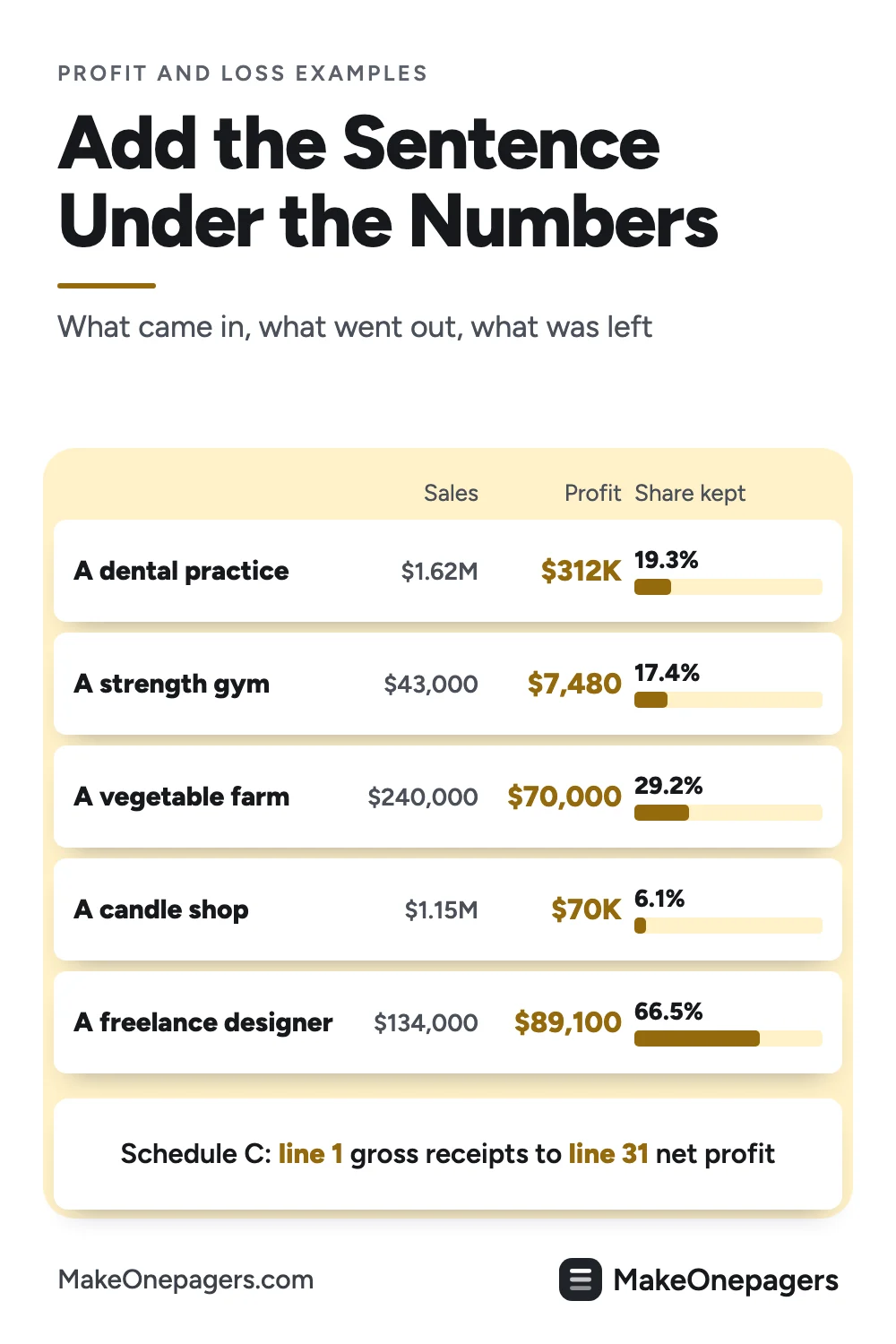
Start with the period you report on, because that's what sets the page. A strength gym reports by the month and a vegetable farm by the season. A dental practice and an online candle shop each cover nine months, and a freelance designer covers a full tax year. Her page then lines up with IRS Schedule C, the form a sole proprietor fills in at tax time.
A dental practice, for the partners' meeting
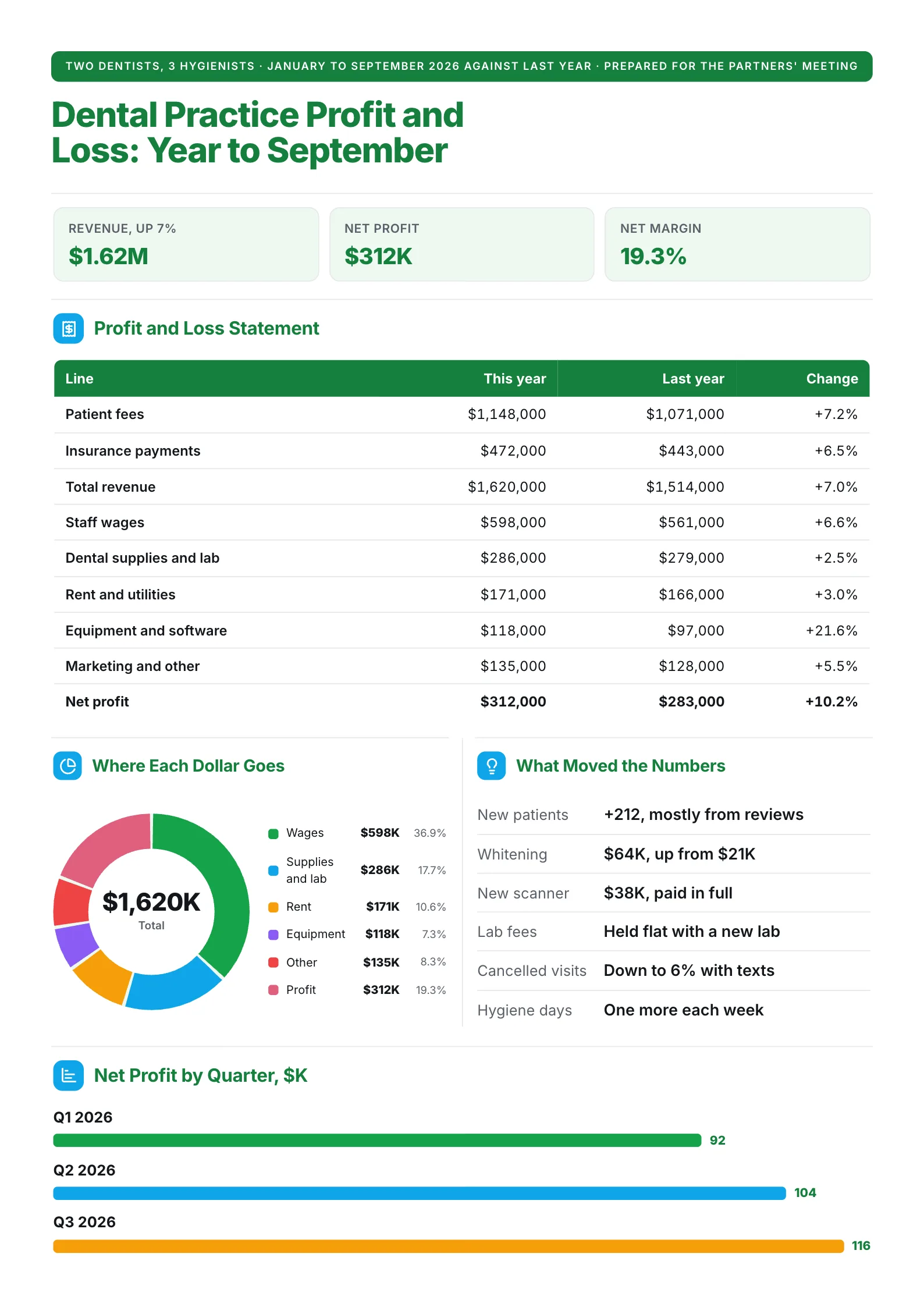
This statement covers January to September 2026 for a practice with two dentists and 3 hygienists, compared with last year. It's prepared for a partners' meeting, so it starts with the three numbers you'd ask about as a partner.
 Edit this template
A sample practice with sample results. "What Moved the Numbers" gives the reasons.
Revenue is $1.62M, up 7%. Net profit is $312K, a 19.3% net margin. If you only had a minute, those three would tell you the year is going well.
"What Moved the Numbers" explains why in six short lines. New patients rose by 212, mostly from reviews. Whitening brought in $64K, up from $21K. A new scanner cost $38K, paid in full. Lab fees held flat with a new lab. Missed visits fell to 6% with text reminders, and hygiene added one more day each week. You'd know what to keep doing without reading the full ledger.
A strength gym, one month at a time
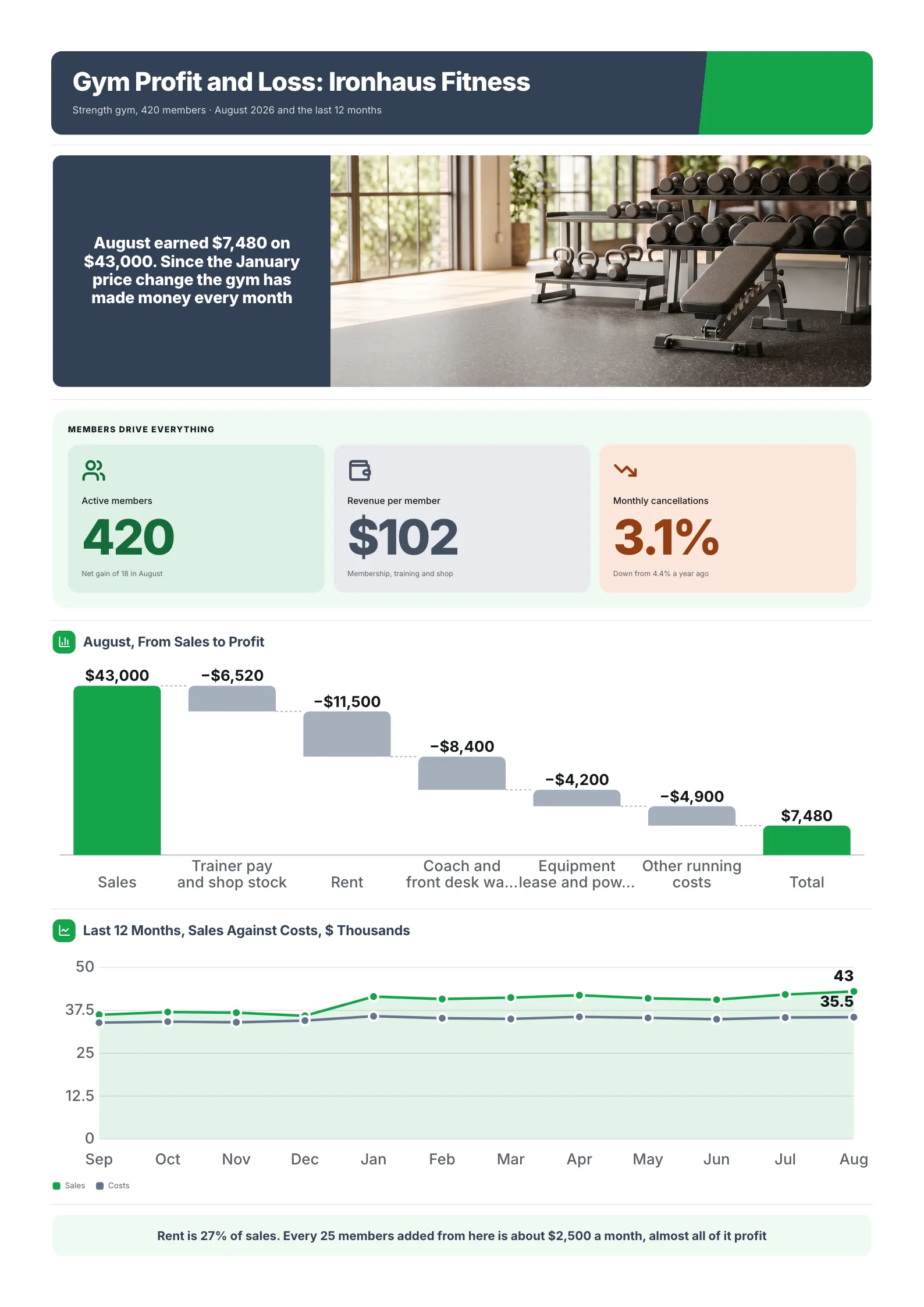
Ironhaus Fitness has 420 members. Its statement covers August 2026 and the last 12 months, and it opens with a sentence: August earned $7,480 on $43,000.
 Edit this template
Ironhaus is invented. A gym's profit lives in its member count, so members get the top row.
"Members Drive Everything" is the right heading for a gym. There are 420 active members, a net gain of 18 in August. Revenue per member is $102, across membership, training and the shop. Monthly churn is 3.1%, down from 4.4% a year ago.
The "From Sales to Profit" waterfall starts at $43,000 of sales. Then it takes off trainer pay and shop stock ($6,520), rent ($11,500), coach and front desk wages ($8,400), equipment lease and power ($4,200) and other costs ($4,900), leaving $7,480. The footer gives you the lever: rent is 27% of sales, and every 25 members added from here is worth about $2,500.
A vegetable farm, one season
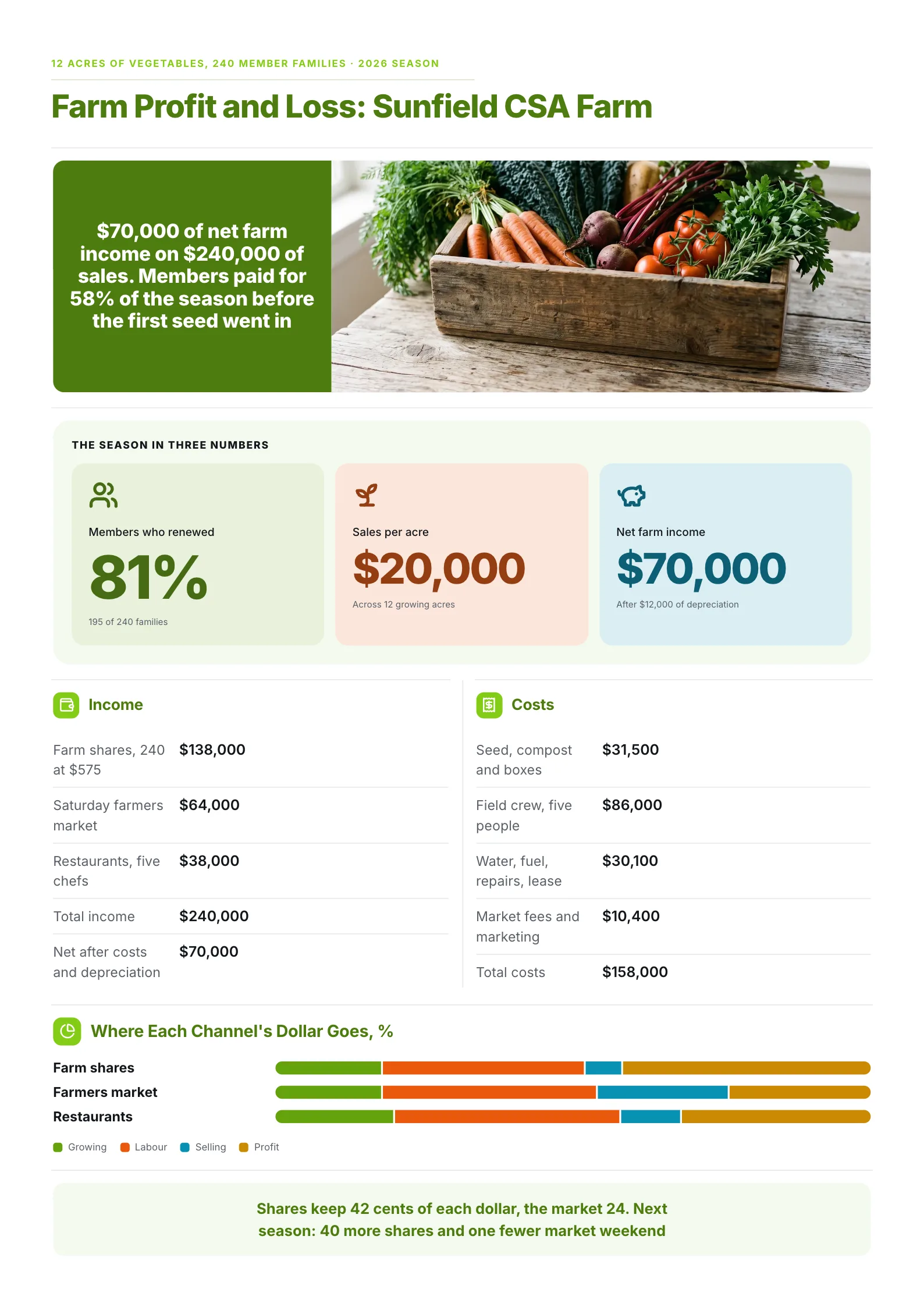
Sunfield CSA Farm grows on 12 acres for 240 member families. Its statement covers the 2026 season.
 Edit this template
Sunfield is a sample farm. Depreciation is shown, so the net figure is honest.
Sunfield's members pay for 58% of the season before the first seed goes in, and that's what makes a $158,000 cost line safe to carry. Farm shares, 240 at $575, bring $138,000. The Saturday farmers market brings $64,000, and five restaurant chefs bring $38,000, for $240,000 in total.
Costs include $31,500 for seed, compost and boxes and $86,000 for a field crew of five, and they total $158,000. After $12,000 of depreciation, net farm income is $70,000. "The Season in Three Numbers" repeats that figure and adds what a farmer plans around: 81% of members renewed (195 of 240 families), and sales came to $20,000 an acre.
An online candle shop, nine months in
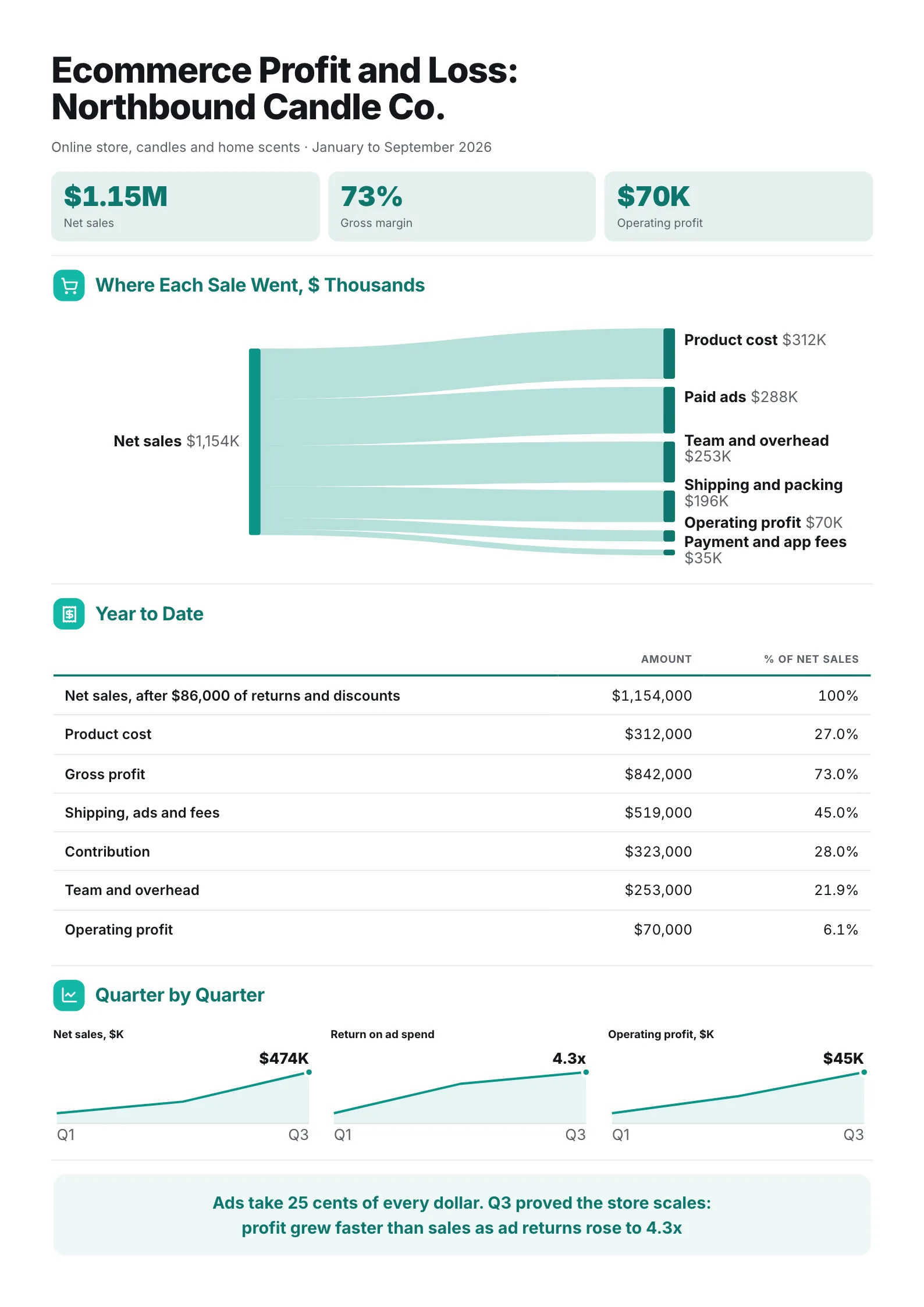
Northbound Candle Co. sells candles and home scents online. Its statement covers January to September 2026 and shows where each sale went, ads included.
 Edit this template
A sample store. For an online shop, ad spend gets its own line in the story.
Northbound's top row reads $1.15M in net sales, a 73% gross margin and $70K of operating profit. The gap between that high margin and that small profit is the story, and the footer tells it: ads take 25 cents of every dollar.
The quarter-by-quarter chart gives you the good news. Q3 proved the store scales, with profit growing faster than sales as return on ad spend rose to 4.3x. If you run an online store, put your ad return next to your profit, since one drives the other.
A freelance designer, ready for tax time
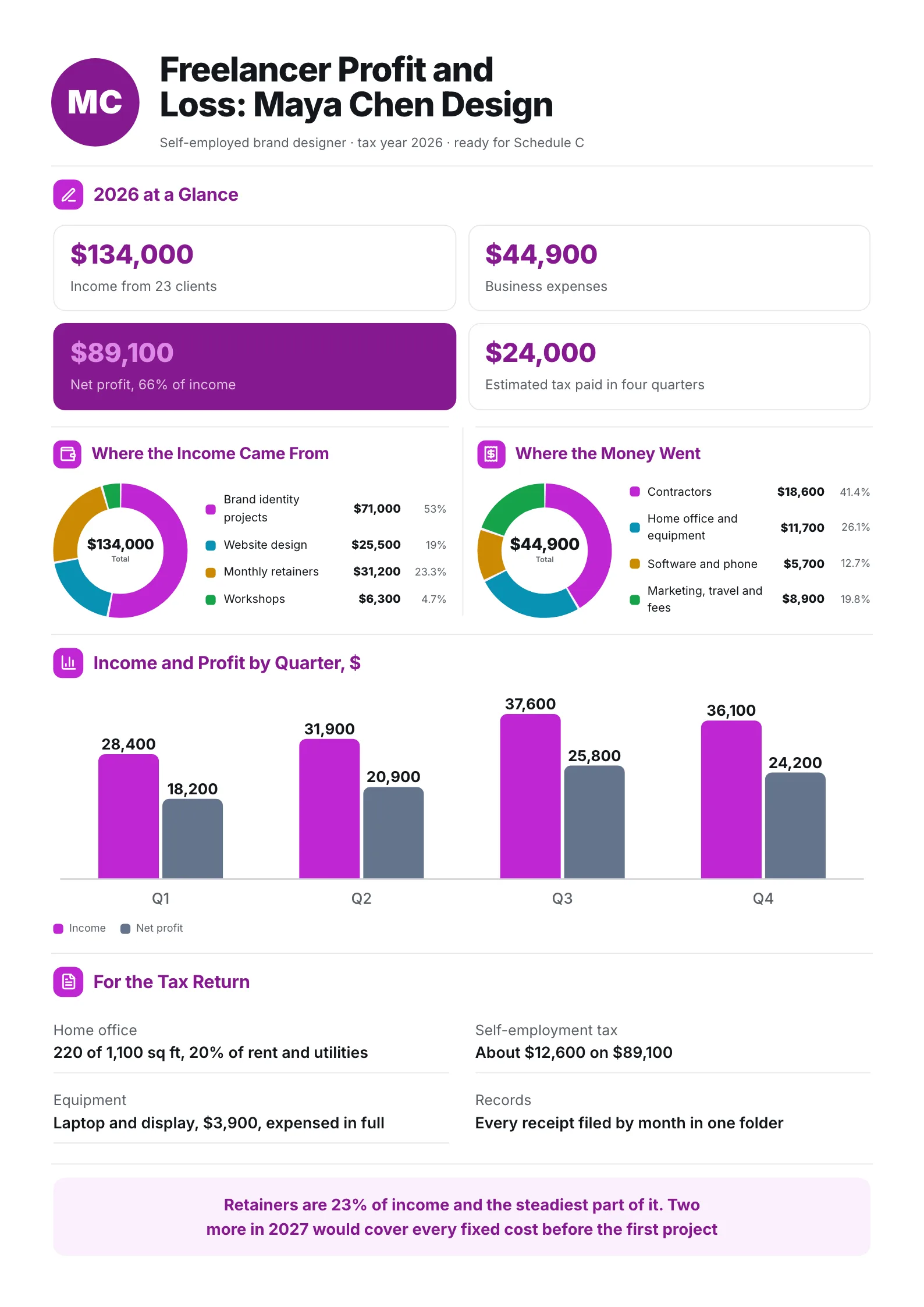
Maya Chen Design is a self-employed brand designer, and her statement for tax year 2026 is marked "ready for Schedule C." It's the example to copy if you file as a sole proprietor.
 Edit this template
A sample designer with sample figures. The tax notes box saves an hour with the accountant.
Maya's year comes down to four numbers: $134,000 of income from 23 clients, $44,900 of business expenses, $89,100 of net profit (66% of income) and $24,000 of estimated tax paid across four quarters.
Expenses break into contractors ($18,600), home office and equipment ($11,700), software and phone ($5,700) and marketing, travel and fees ($8,900). "For the Tax Return" holds the notes your preparer needs. The home office is 220 of 1,100 sq ft, or 20% of rent and utilities. A laptop and display cost $3,900, expensed in full. Self-employment tax comes to about $12,600 on $89,100.
The footer finds a lever: retainers are 23% of income and the steadiest part of it.
How a freelancer's statement maps to Schedule C
Sole proprietors report profit or loss on Schedule C. We read the 2026 Schedule C on October 30, 2026, and lined Maya's page up against it.
| Schedule C line | What the form calls it | Where it sits on Maya's page |
|---|---|---|
| 1 | Gross receipts or sales | Income from 23 clients, $134,000 |
| 7 | Gross income (lines 5 and 6 added) | The same $134,000, with no goods sold |
| 8 | Advertising | Part of marketing, travel and fees |
| 11 | Contract labor | Contractors, $18,600 |
| 13 | Depreciation and section 179 | The $3,900 laptop and display, expensed in full |
| 24a | Travel | Part of marketing, travel and fees |
| 25 | Utilities | The phone part of software and phone |
| 27b | Other expenses | The software part of software and phone |
| 28 | Total expenses before business use of home (lines 8 through 27b) | Business expenses, less the home office share |
| 30 | Expenses for business use of your home (Form 8829 unless the simplified method) | The 20% home office share |
| 31 | Net profit or (loss): line 29 less line 30 | Net profit, $89,100 |
If you keep your monthly statement in this order, your year-end statement nearly fills in the form for you. Your tax preparer will still decide what goes on which line.
Write the sentence under the numbers
Every statement here says in words what its totals mean. "August earned $7,480 on $43,000" tells you the result. Ironhaus's page from MakeOnepagers then adds that every 25 members is worth about $2,500, which tells you what to do about it. Write that second sentence for your own month before you send the numbers to anyone.
Frequently asked questions
What goes on a profit and loss statement?
Revenue at the top, then the cost of what you sold, then running costs like rent and wages, and profit at the bottom. Add a sentence explaining what moved. Our profit and loss template guide walks through each line.
How often should I make a profit and loss statement?
Monthly for most small businesses, so problems show up while they're small. The gym and barbershop in our library report monthly, the farm by season and the freelancer by tax year.
Is a profit and loss statement the same as an income statement?
Yes, they're two names for the same report. For a blank layout, see our profit and loss template post.




