BlogGuide
Personal Budget Template: Free One-Page Monthly Budget
A free one-page personal budget template for a household, the 6 parts a monthly budget needs, a worked example on $6,200 take-home pay and the mistakes that make budgets fail by week two.

By MakeOnepagers Team
Updated · 4 min read
A personal budget template puts a month of money on one page: what comes in, where it goes, what you spent against what you planned, how much you saved and which bills are coming. Budgets in long spreadsheets tend to stop by week two, because opening a file with twelve tabs feels like homework. A one-page personal budget can go on the fridge, and the whole household can see it in ten seconds. Below are the six parts a monthly budget needs, a free template you can copy and a worked example.
One‑Pager examples
Real One-Pagers made with MakeOnepagers. Open any one to edit it as your own.
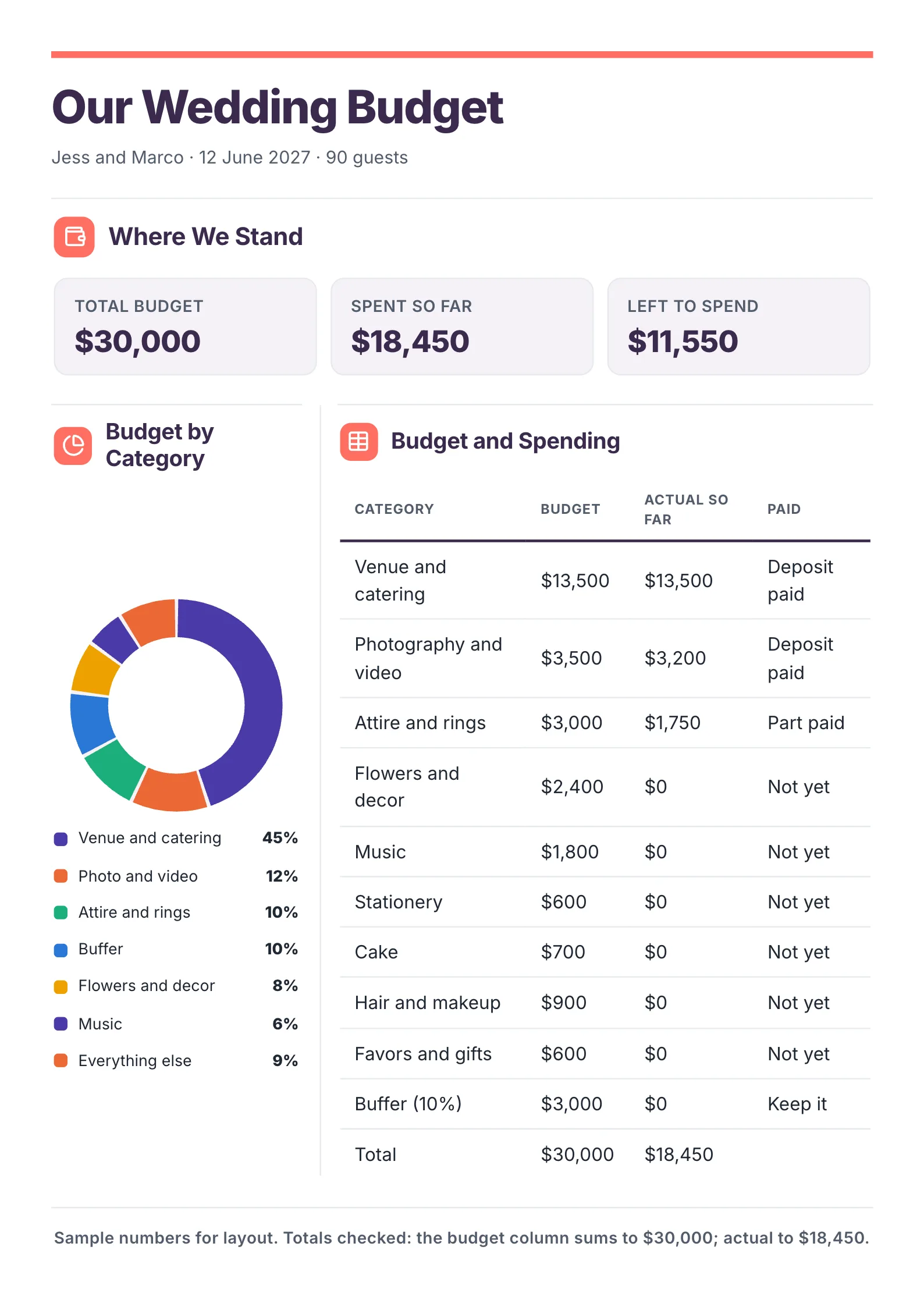 Wedding Budget One-PagerEdit for free(opens in a new tab)
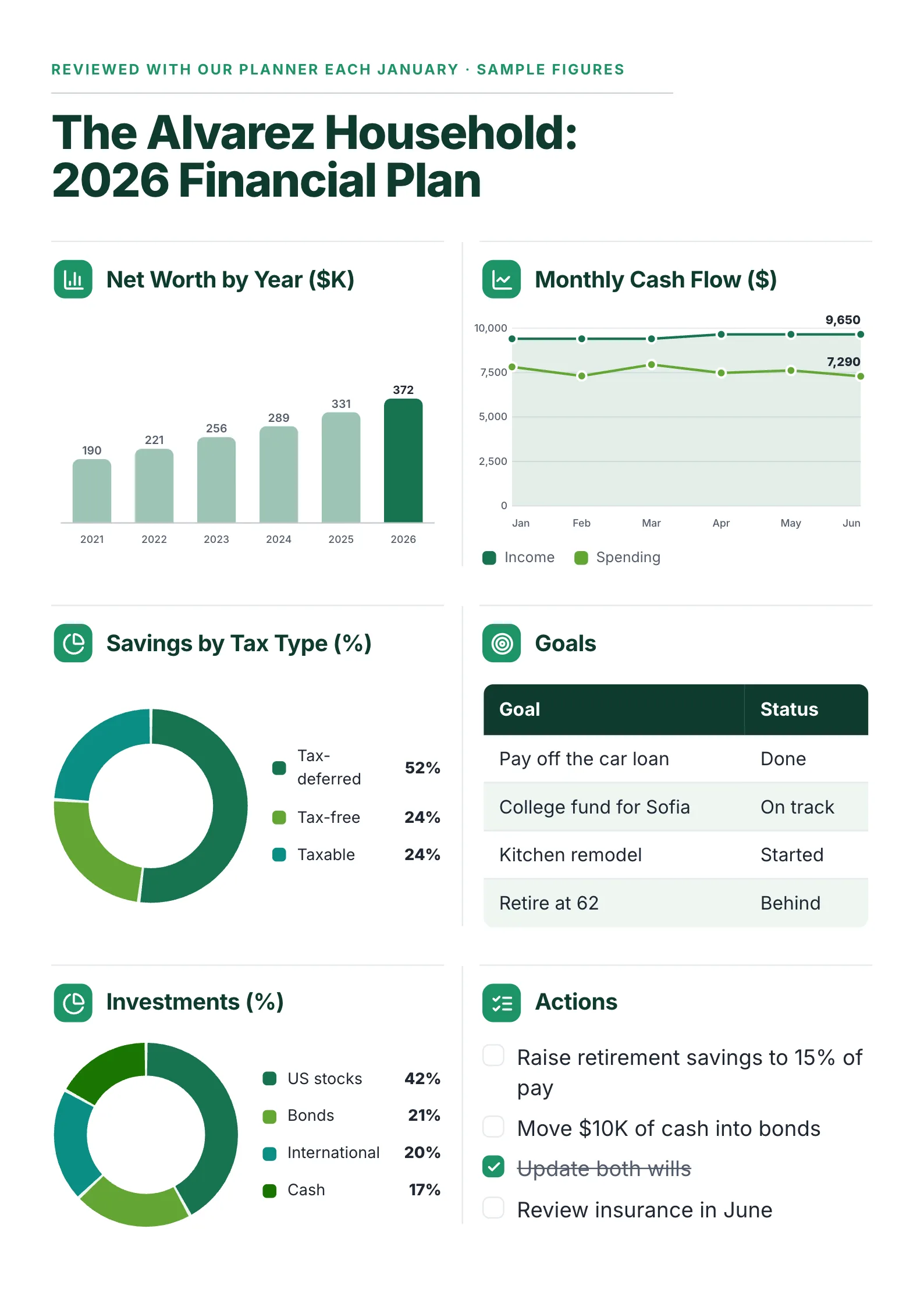 Financial Planning One-PagerEdit for free(opens in a new tab)
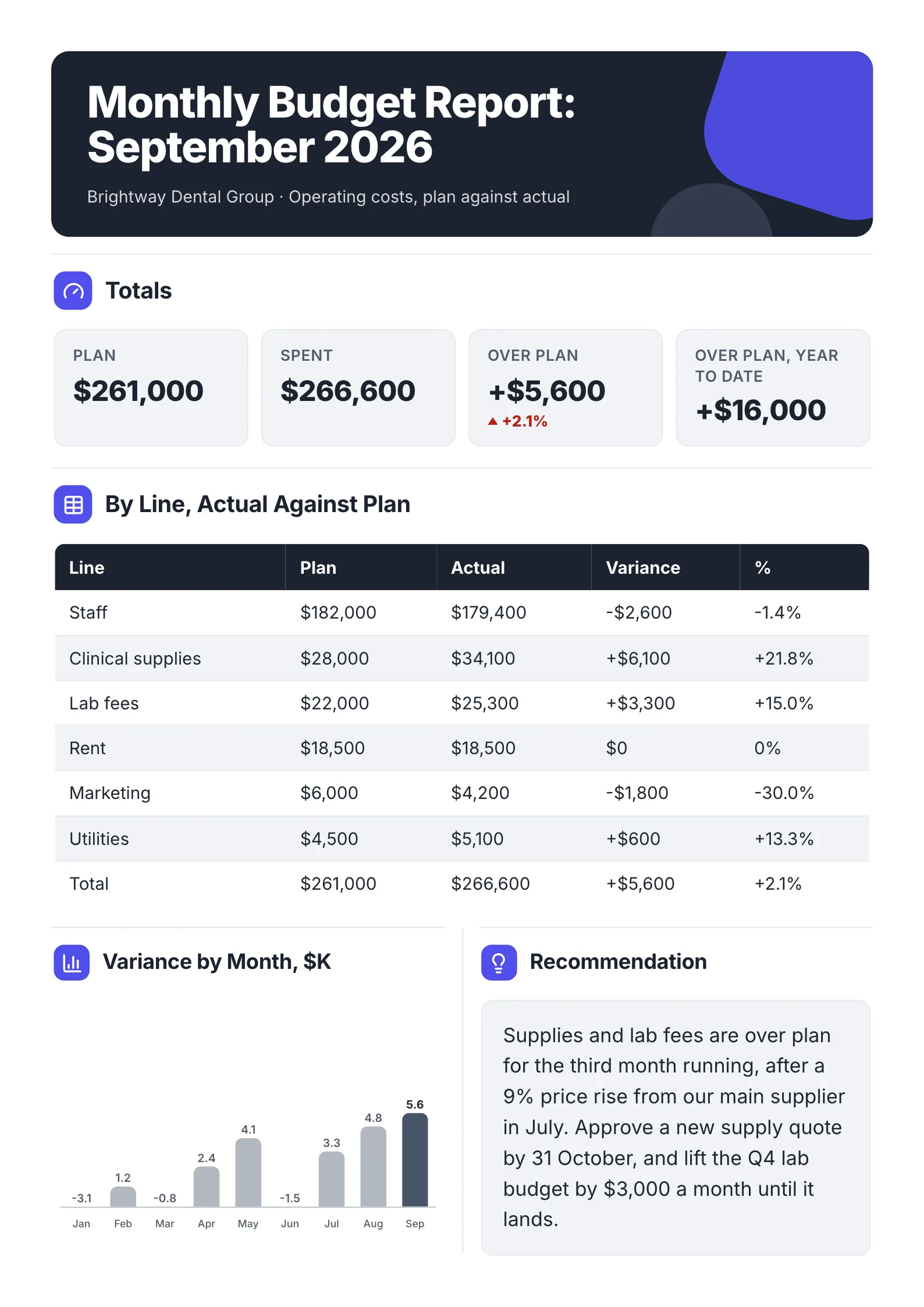 Monthly Budget ReportEdit for free(opens in a new tab)
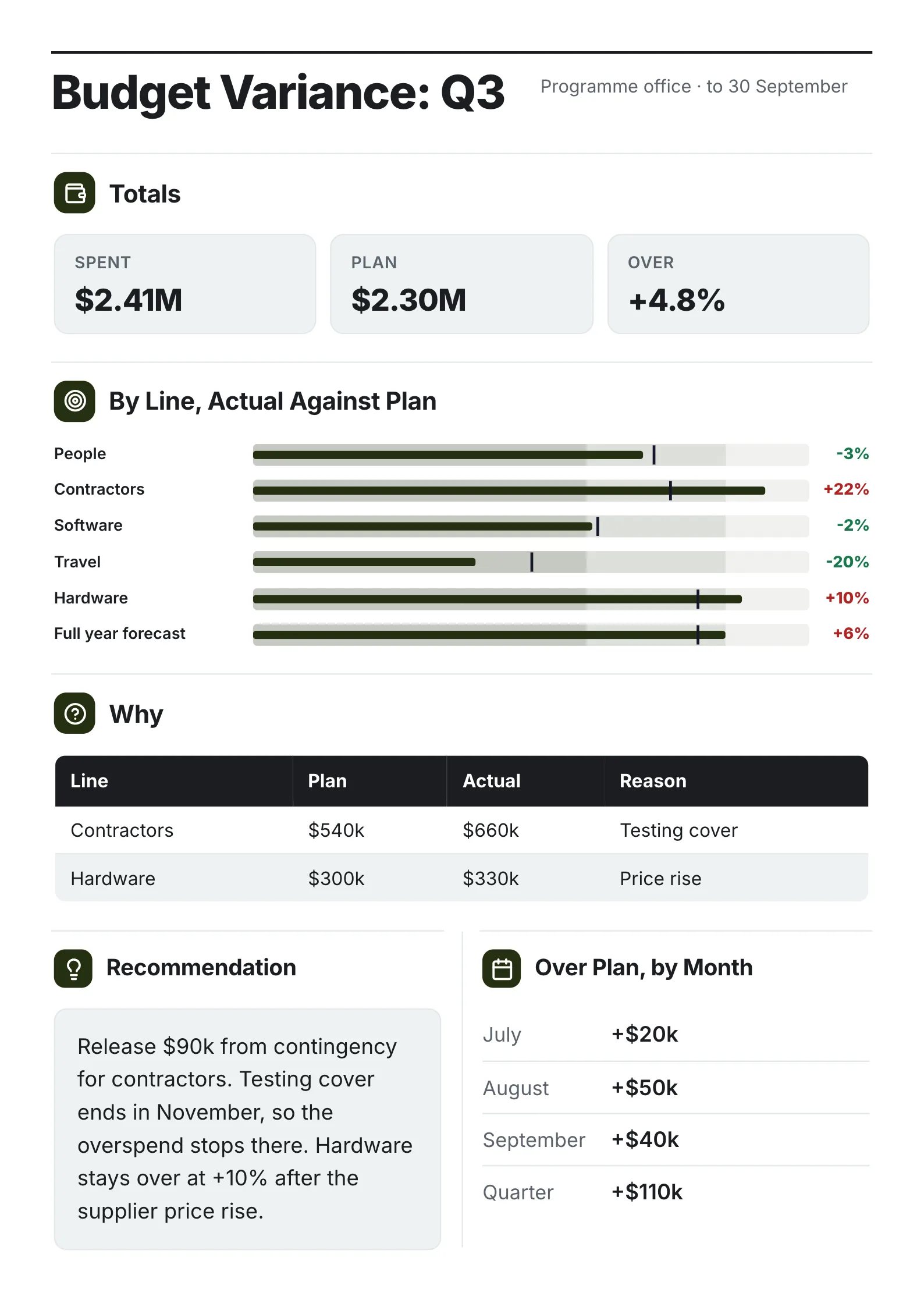 Budget Variance ReportEdit for free(opens in a new tab)
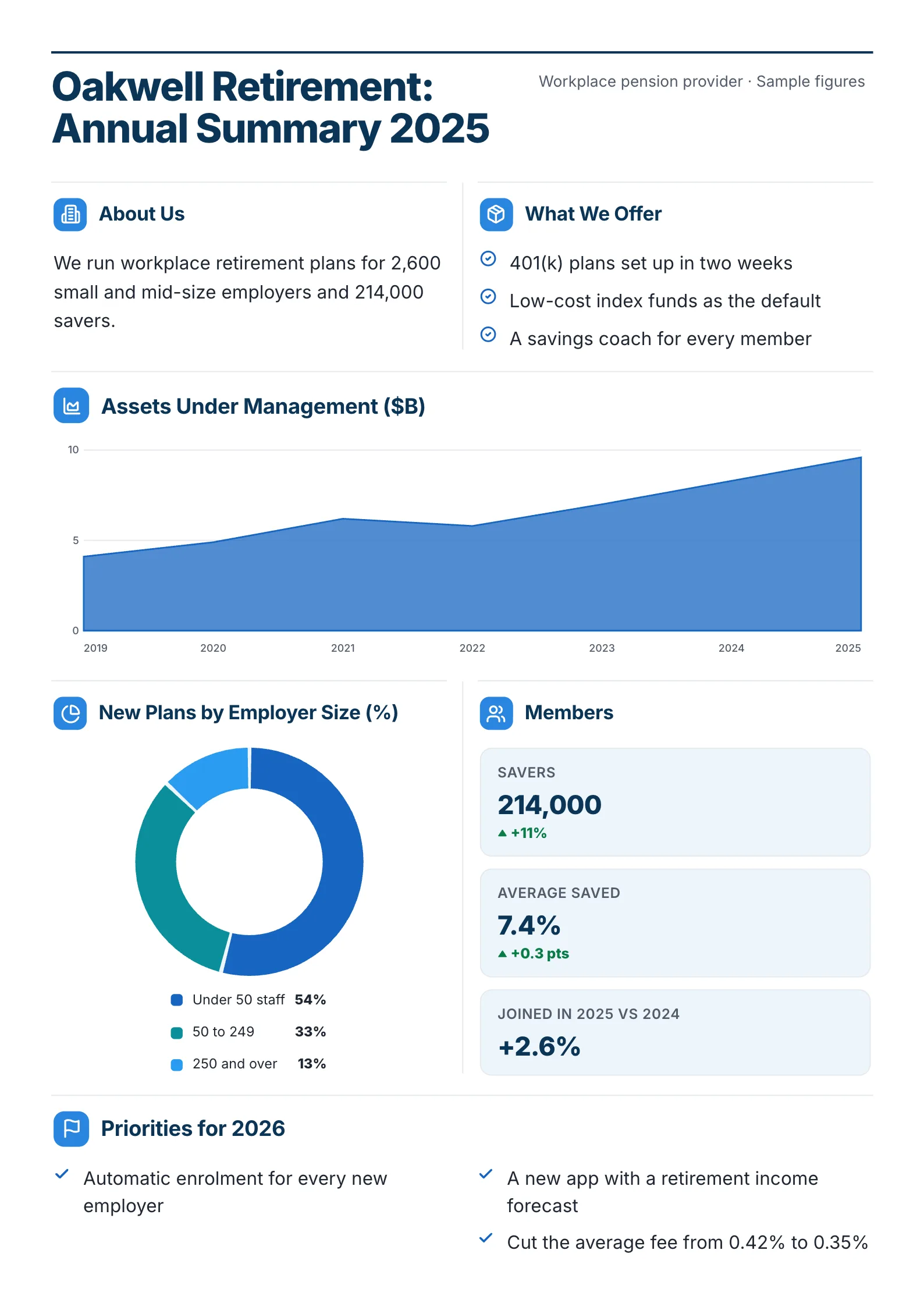 Retirement Plans Annual SummaryEdit for free(opens in a new tab)
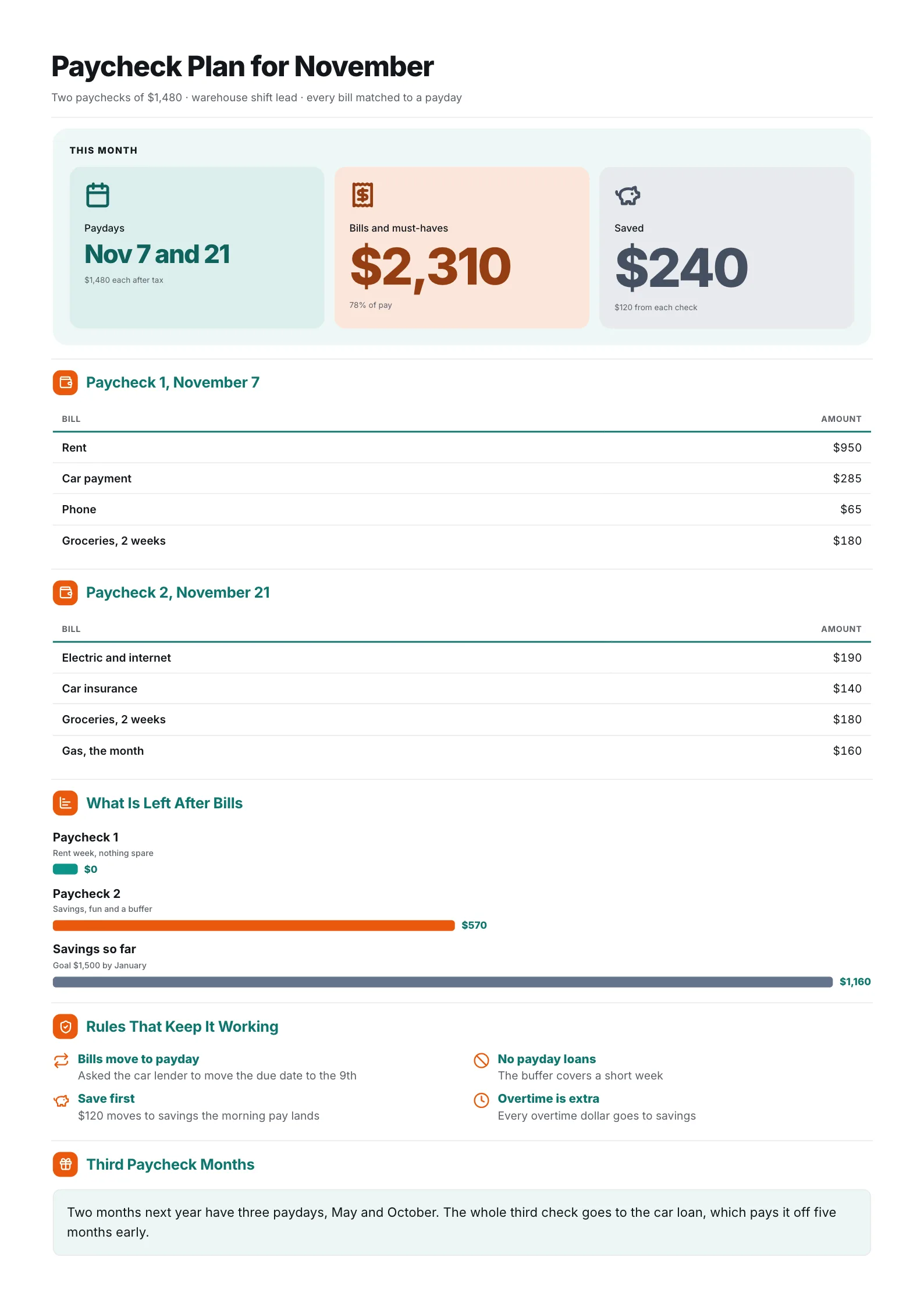 Personal Budget: Biweekly Paycheck PlanEdit for free(opens in a new tab)
The example was made with MakeOnepagers. It opens as a template you can edit for free: every word, chart and color.
What is a personal budget?
A personal budget is a plan for your money over a month: how much comes in after tax, how much goes to each category and how much is saved. It is also a record, because each month you compare what you planned with what you actually spent.
A useful budget is short enough to check every week and honest about where money really goes.
The 6 parts of a personal budget
- Take-home pay: what lands in the account each month, after tax.
- Where it goes: a share for each category, such as housing, food, transport, bills, saving and fun.
- Spent against plan: for the categories that drift, the amount spent beside the amount planned.
- Saved, month by month: so progress is visible.
- Bills coming up: the big ones in the next two months, with dates.
- Next month: two or three changes, written down.
A free personal budget template
Copy this into a document, or open the example below and edit it.
| Part | What to write, with an example |
|---|---|
| Title | Month and household. Our Budget: October, the Park household |
| Take-home | Monthly, after tax. $6,200 |
| Where it goes | 6 shares. Housing 32%, saving 20%, food 14% |
| Spent against plan | 4 categories. Food $870 of $800 |
| Saved by month | 6 months. $6,390 in all |
| Bills coming up | 3, with dates. Car insurance, $640 on 3 November |
| Next month | 3 changes. Cap eating out at $250 |
Personal budget example
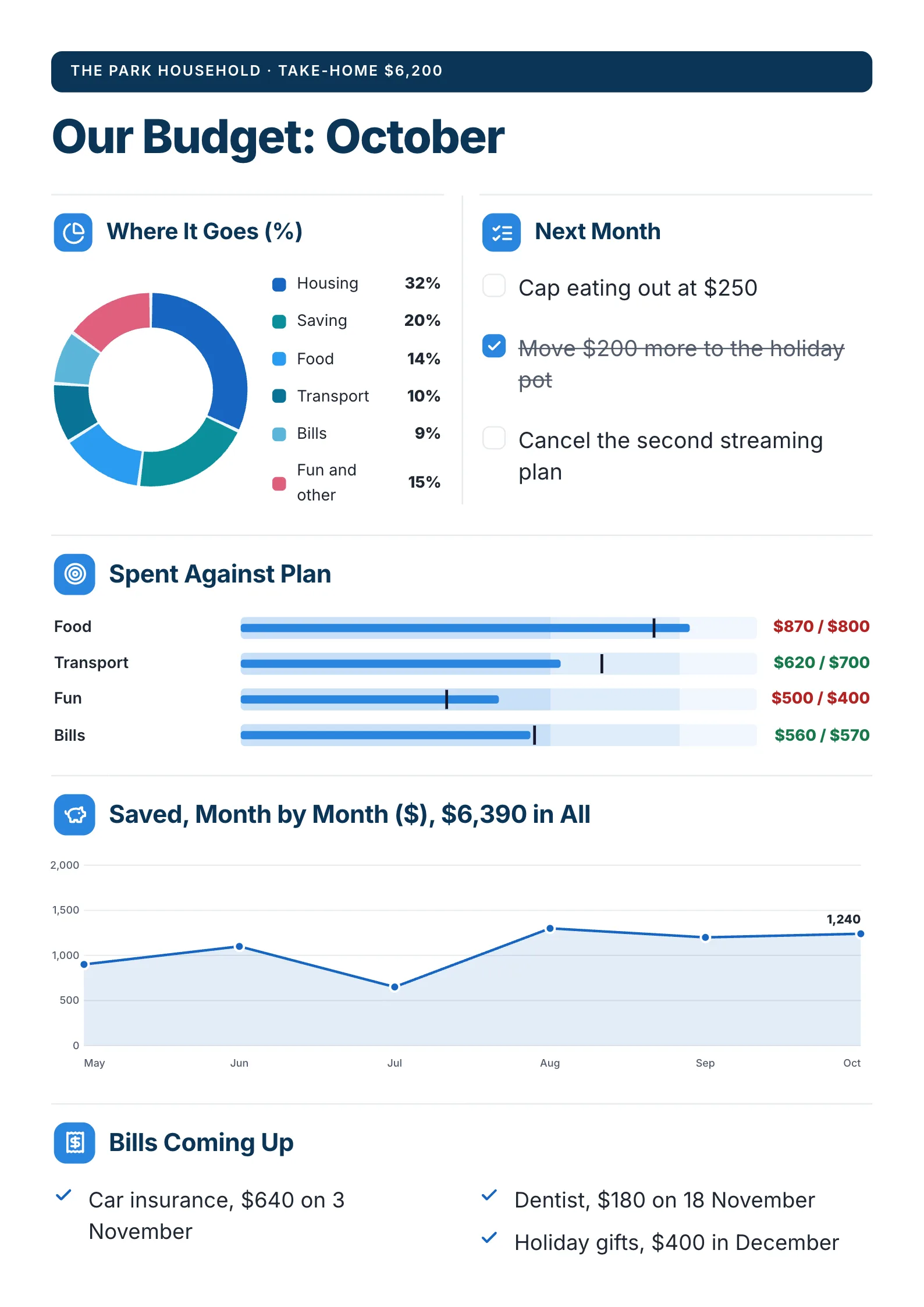 Edit this template
A household's month on one page: the plan, what really happened and what changes next.
What to copy:
- Saving as a category, not what is left over: 20% of take-home pay, set before fun and food. What is left over at the end of a month is usually nothing.
- Spent against plan as bars: food $870 of $800 and fun $500 of $400 are over, transport $620 of $700 is under. The two problems are obvious at a glance.
- Savings by month, with the total: $6,390 since May, with a dip to $650 in July. One bad month does not erase the trend.
- Three changes for next month, each a single action: cap eating out at $250, move $200 more to the holiday pot, cancel the second streaming plan.
Edit for free: personal budget template.
Budgeting methods that fit on one page
| Method | How it works | Good for |
|---|---|---|
| 50/30/20 | 50% needs, 30% wants, 20% saving | A simple starting point |
| Zero-based | Every dollar gets a job until nothing is unassigned | Tight months, paying off debt |
| Pay yourself first | Saving comes out on payday, the rest is spent freely | People who hate tracking |
The example uses pay yourself first: 20% to saving, then a plan for the rest.
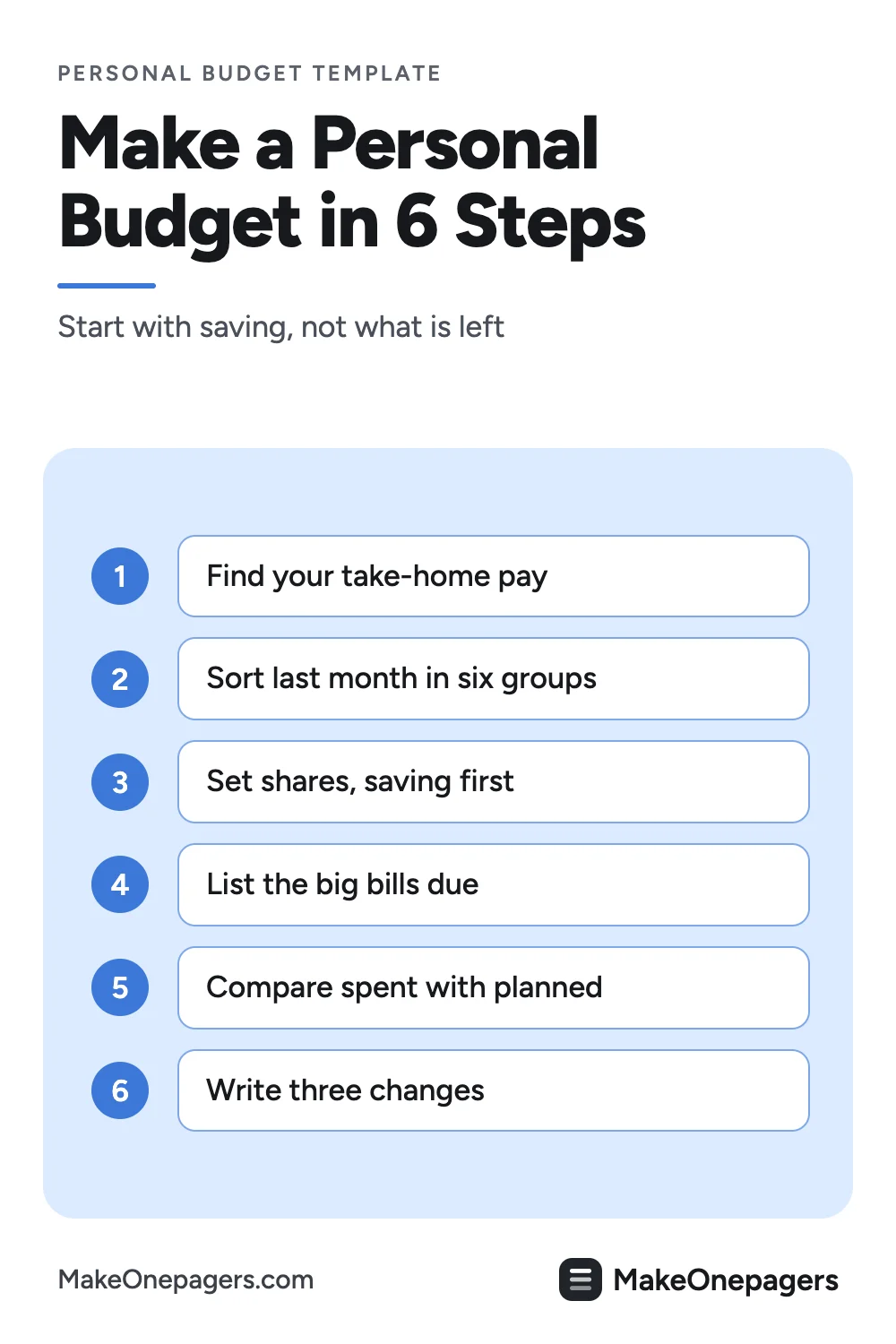
How to make a personal budget in 6 steps
- Find your take-home pay for one month.
- Pull last month's spending from your bank and sort it into six categories.
- Set a share for each, starting with saving.
- List the big bills due in the next two months.
- At the end of the month, compare spent with planned.
- Write three changes for next month and put the page where you will see it.
Have your spending in a spreadsheet or a bank export? Drop it into the free AI One-Pager generator and get it back as a designed one-page budget.
Personal budget mistakes
- Forgetting the yearly bills. Car insurance and gifts arrive every year, and they still wreck a month. List them ahead.
- Too many categories. Thirty lines means nobody checks. Six is enough.
- Never comparing. A plan without the actual figures beside it changes nothing.
- No changes. Each month should end with something to do differently.
Make your personal budget
Open the free personal budget template and put in your numbers, or drop your spending export into the free AI One-Pager generator and get a finished budget back.
Frequently asked questions
What should a personal budget include?
Take-home pay, spending by category, what was spent against the plan, savings by month, upcoming bills and a few changes for next month.
What is the 50/30/20 rule?
A simple budget split: 50% of take-home pay for needs, 30% for wants and 20% for saving or paying down debt.
How often should I check my budget?
Once a week for a quick look, and once a month to compare spent with planned and set the next month.
Is a one-page budget enough?
For most households, yes. The detail lives in your bank account. The page is for decisions.