One Pager Format: What 5 Official Guides Agree On, and Where They Don't
The one pager format from 5 official guides, NSF and the University of Michigan included: the sections, the font size, the length and what to leave off.


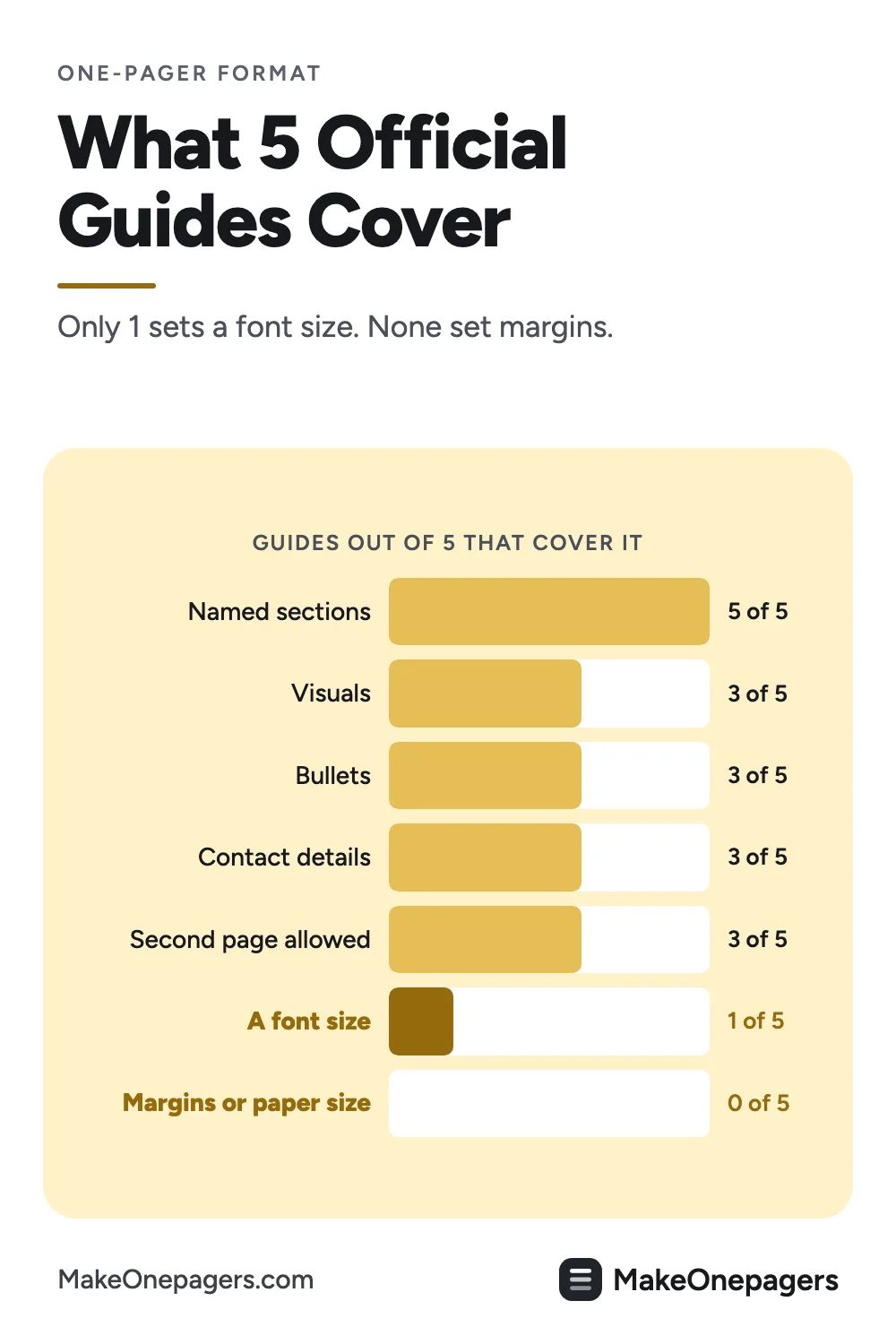
The one pager format is a short list of named sections in a set order, on a single sheet. We read the one-pager guides that five public bodies and nonprofits give out, to see how strict that format really is. They come from NSF, the University of Michigan, an international education nonprofit, a Virginia state agency and a Montana state program. All five tell you which sections to write. Only one gives a font size, and none gives margins. Three of the five even allow a one-pager that runs a little past one page. Start from a free one pager template.
One‑Pager examples
Real One-Pagers made with MakeOnepagers. Open any one to edit it as your own.
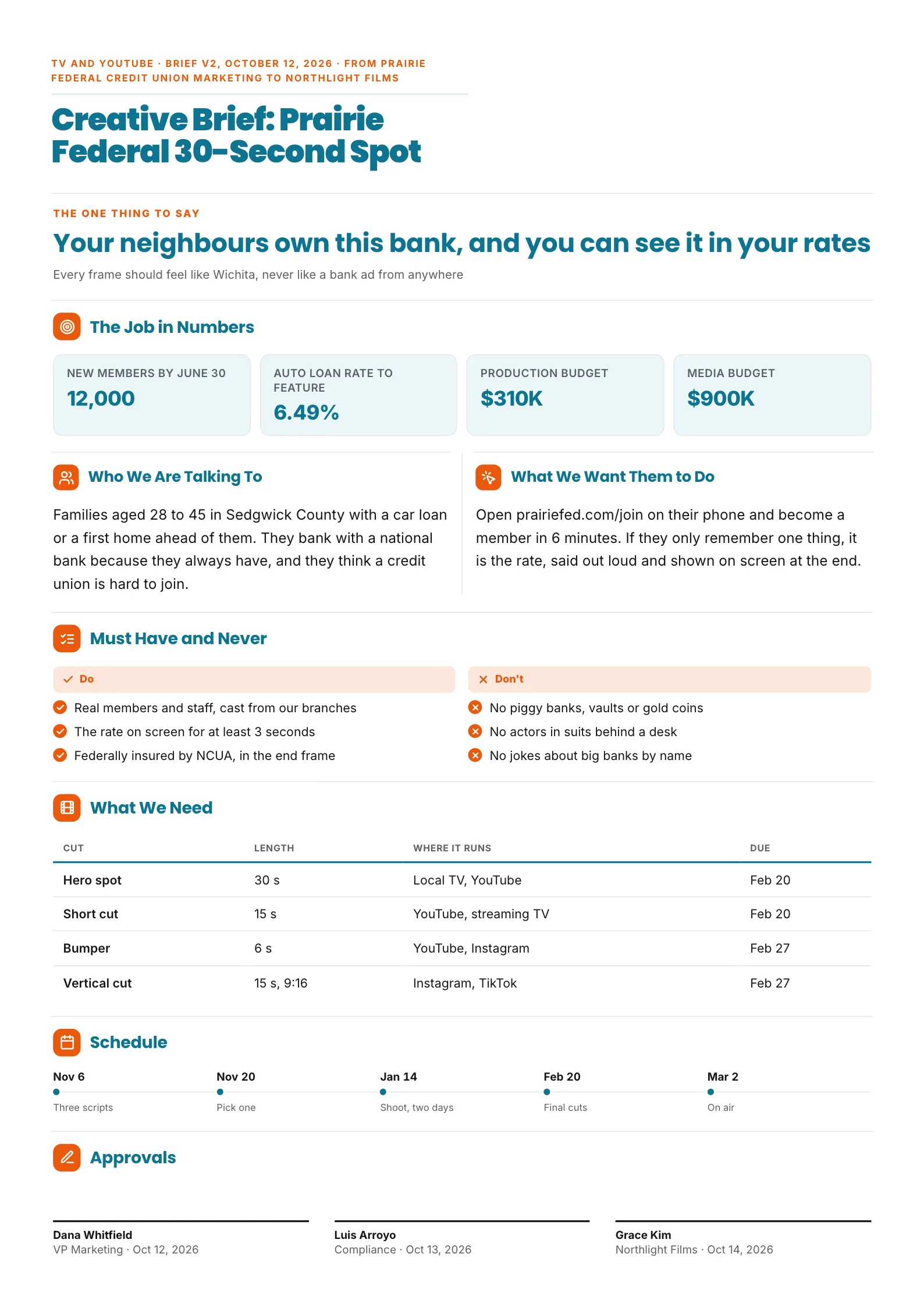 Creative Brief: Video AdEdit for free(opens in a new tab)
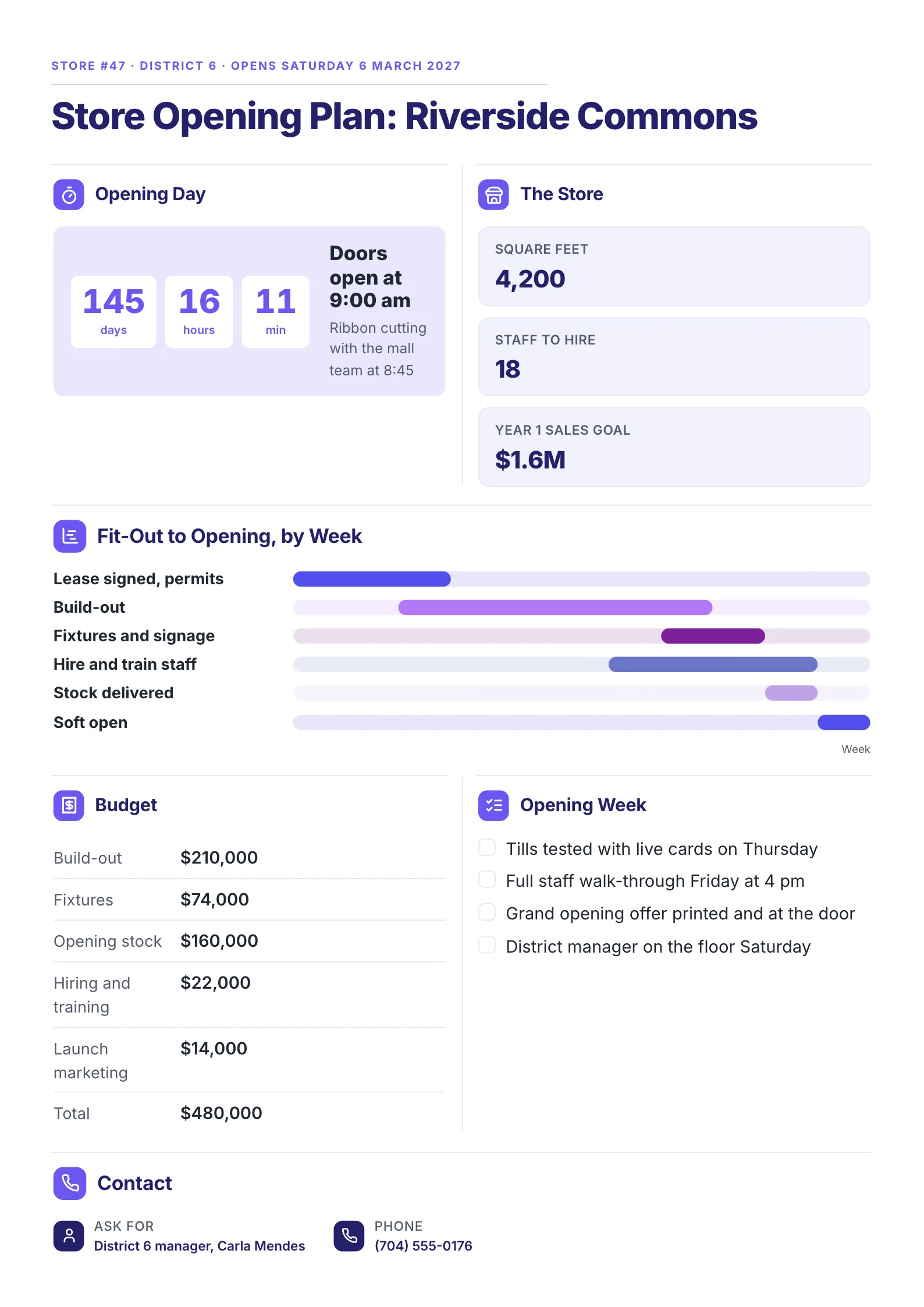 Store Opening PlanEdit for free(opens in a new tab)
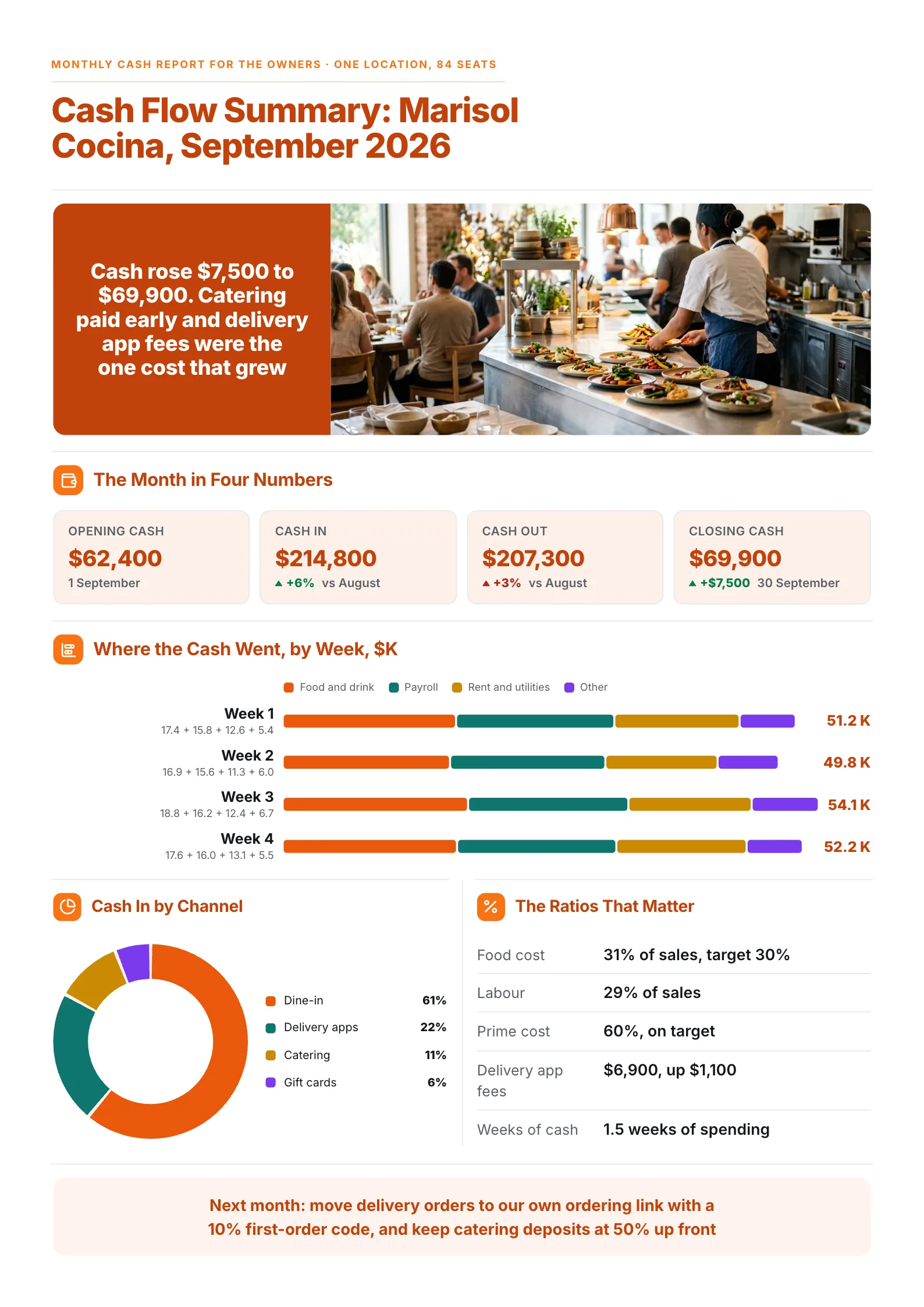 Cash Flow Summary: Restaurant MonthEdit for free(opens in a new tab)
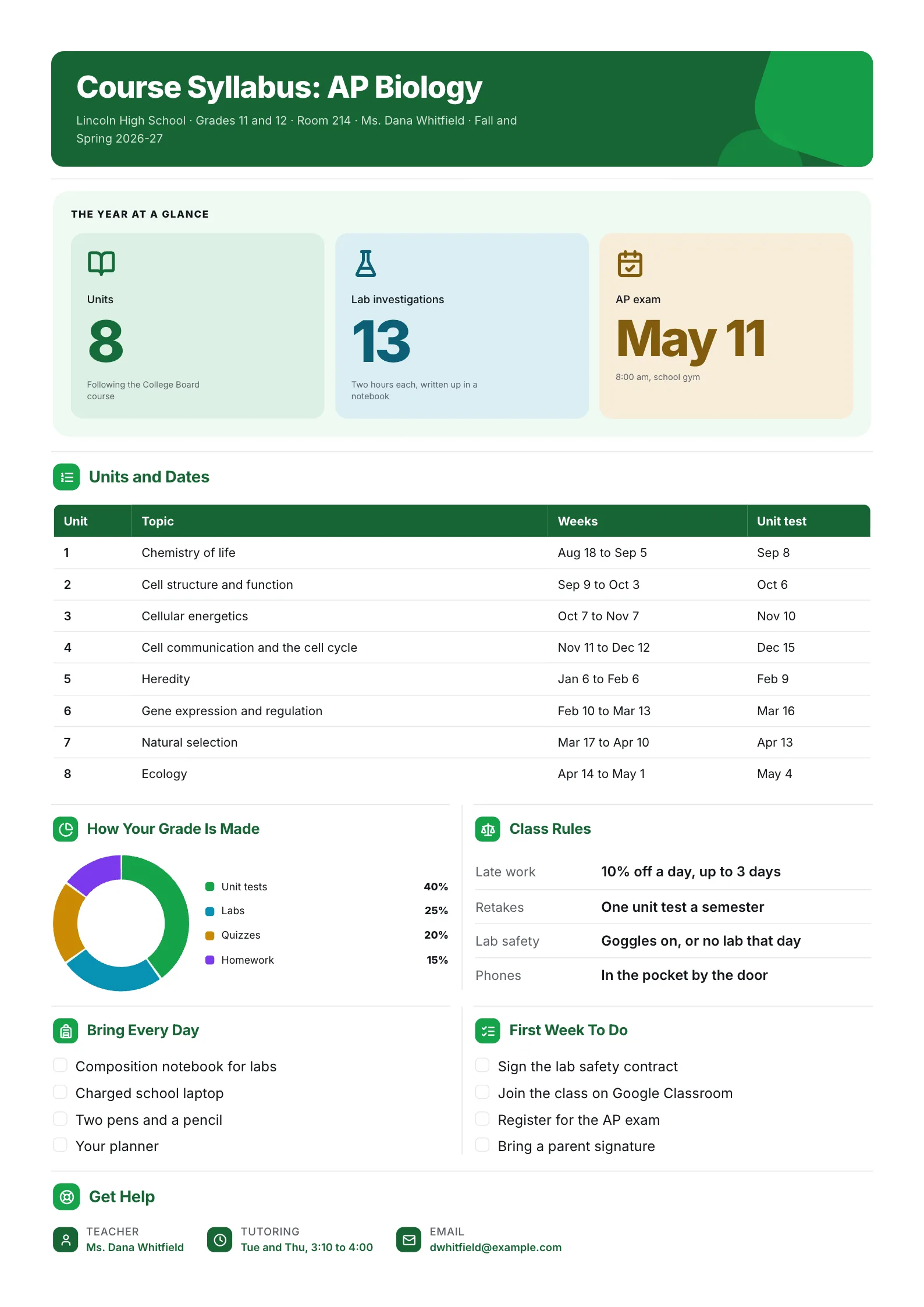 Course Syllabus: High School AP BiologyEdit for free(opens in a new tab)
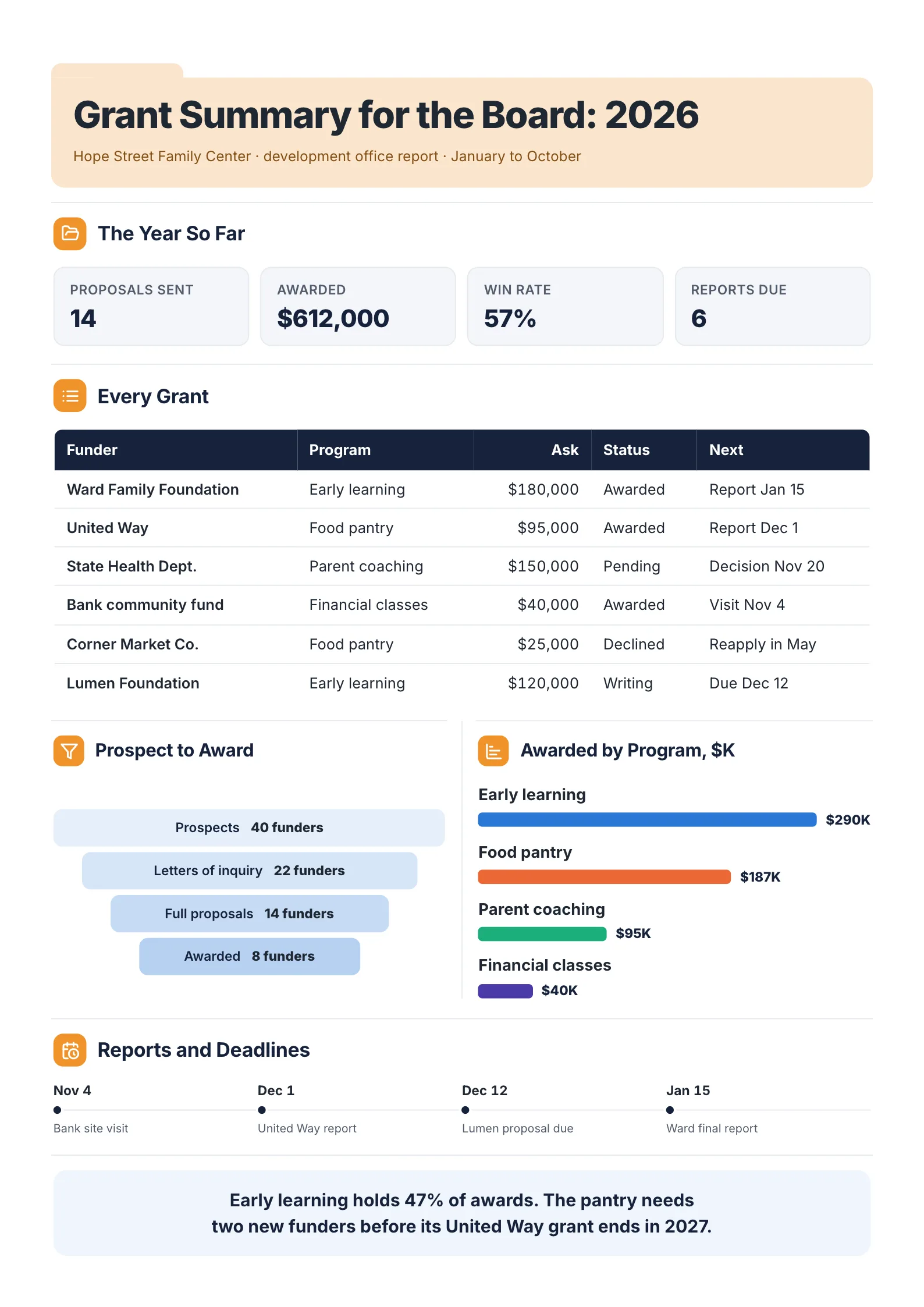 Grant Summary: Annual Grants PortfolioEdit for free(opens in a new tab)
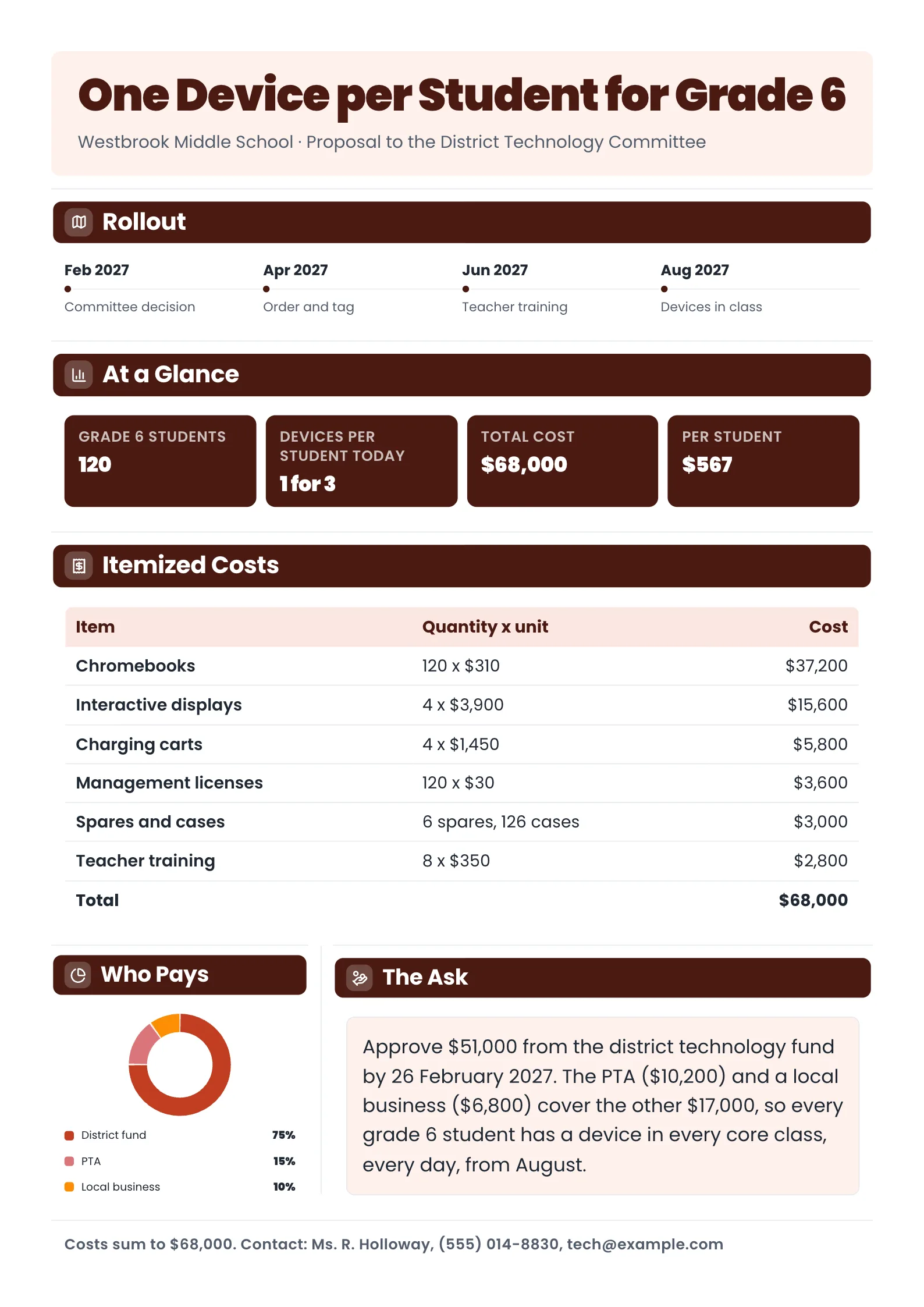 Classroom Technology ProposalEdit for free(opens in a new tab)
So the format that matters is the order of your sections. Below you'll find the five guides, the order each one asks for, a layout you can copy and five samples built the same way.
The five guides we read
- A Guide to Writing 1-pagers, a 17-slide deck by two National Science Foundation program directors, September 13, 2023. It's for researchers who email an idea before they apply.
- Creating an Issue Brief or One-Pager about Your Research, 5 pages from the University of Michigan's Institute for Healthcare Policy and Innovation, updated May 2025.
- How to Create a One-Pager for Policymakers, 5 pages from ISTE's advocacy toolkit for educators.
- Creating a One Pager: Tips for Grantees, a 25-slide training that Virginia Commonwealth University's Center for Public Policy made for the Virginia Department of Criminal Justice Services.
- MMS One-pager Instructions, a 1-page sheet from the Montana Department of Commerce for towns in its Main Street program.
Then we lined them up against 13 format rules, from section names to margins. The table below shows how many of the five set each rule.
How strict each guide is
| What the guide sets | Guides that set it |
|---|---|
| Named sections or an outline to follow | 5 of 5 |
| Charts, photos or other visuals | 3 of 5 |
| Bullets in place of long paragraphs | 3 of 5 |
| Contact details | 3 of 5 |
| Room to run past one page | 3 of 5 |
| A clear ask or next step | 2 of 5 |
| Sources or references | 2 of 5 |
| Quotes or testimonials | 2 of 5 |
| A word or character limit | 2 of 5 |
| Shared or filled in as a PDF | 2 of 5 |
| A date | 1 of 5 |
| A font size in points | 1 of 5 |
| Margins or paper size | 0 of 5 |
Source: MakeOnepagers.com read of 5 one-pager guides (NSF 2023, University of Michigan IHPI 2025, ISTE, Virginia DCJS and VCU, Montana Main Street), October 28, 2026.
Every guide tells you what goes on the page and in what order. Very few tell you how the page should measure. So when a funder or an office asks for its one-pager format, ask for its section list first.
The only numbers any guide gives
Michigan's guide is the one with a ruler. Your body text should be 11 point or larger, and footers and references no smaller than 8 point. It also gives word ranges for each section: 200 to 250 words of background, 200 to 400 of key takeaways and 350 at most on what the findings mean. That's up to 1,000 words, and its own example runs front and back.
Montana counts characters instead, because towns fill its PDF form in Acrobat. Your mission gets 180 characters, the testimonial 210 and each top win 120. The header photo is cropped to 8.5 by 2.5 inches, which tells you the sheet is US Letter.
NSF only warns you off small type. Its list of don'ts says not to make the font too small, then adds that it's OK if your 1-pager goes a bit over. Virginia's training agrees that a one-pager doesn't always have to stop at one page.
Pick a readable size first and fit the words to it. Paper sizes, margins and pixel sizes for screens are in the One-Pager dimensions chart.
The order each guide asks for
| Guide | Its sections, in the order it lists them |
|---|---|
| ISTE | Recommendation, introduction, background, analysis, conclusion with an ask |
| University of Michigan | Title, background and context, key takeaways, implications, references, authors and contact |
| NSF | Your name and email, target program, brief overview, intellectual merit, broader impacts |
| Virginia | Header, background, goal or mission, impact with data, visuals, contact |
| Montana | Mission, who we are, testimonials, top wins, reinvestment impact |
ISTE opens on the point. Your recommendation comes before any background, and the sheet ends on an ask such as "please vote for". NSF opens on you, with your contact block and target program at the very top, so a program director can see who you are before reading a word of science.
The other three open on background or a mission and save the result for the middle. Michigan asks you to keep that background to what a decision maker needs. NSF goes further and tells you to keep background to a minimum and spend most of the page on your hypotheses and approach.
Virginia's training adds a useful twist. It changes what you highlight to suit your goal. To secure funding, lead with budget needs, return on investment and success stories. To engage policymakers, lead with impact, policy asks and partnerships.
One layout built from all five guides
This layout takes the rule each guide sets most firmly.
| Row | What to write | From |
|---|---|---|
| Title and who it's from | A plain title, your name and the date (Michigan asks for month and year) | NSF, Michigan |
| The point | Your recommendation or headline result in one or two lines | ISTE |
| Context | Only what your reader needs to follow the rest | Michigan, NSF |
| Evidence | Three or four numbers, a chart or a short table | Virginia, Michigan |
| What it means | The ask, the next step or what to consider | ISTE, Virginia |
| Contact | A name and an email | Michigan, NSF |
Set the body at 11 point or larger and keep footnotes at 8 point or more. Use bullets wherever a paragraph would list things. Export a PDF before it goes out, as Michigan advises, so the layout holds on every screen.
Five samples built in that format
This legislative brief follows ISTE's order. The ask is the headline, the case comes in a six-year chart and a costed table, and "Our Ask" closes the sheet above a named contact with a phone and email.
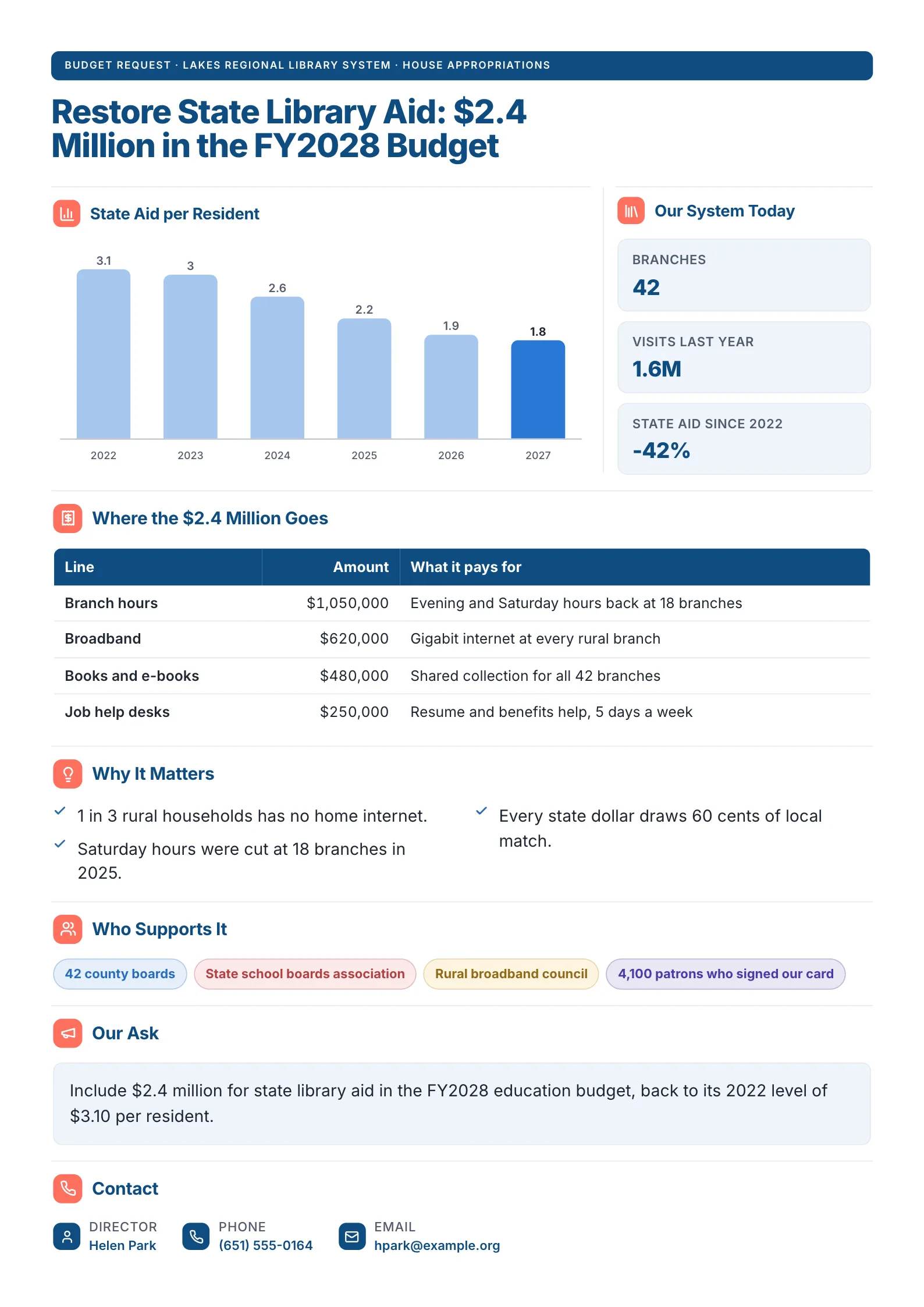 Edit this template
Put your own budget line and ask in the free legislative brief template.
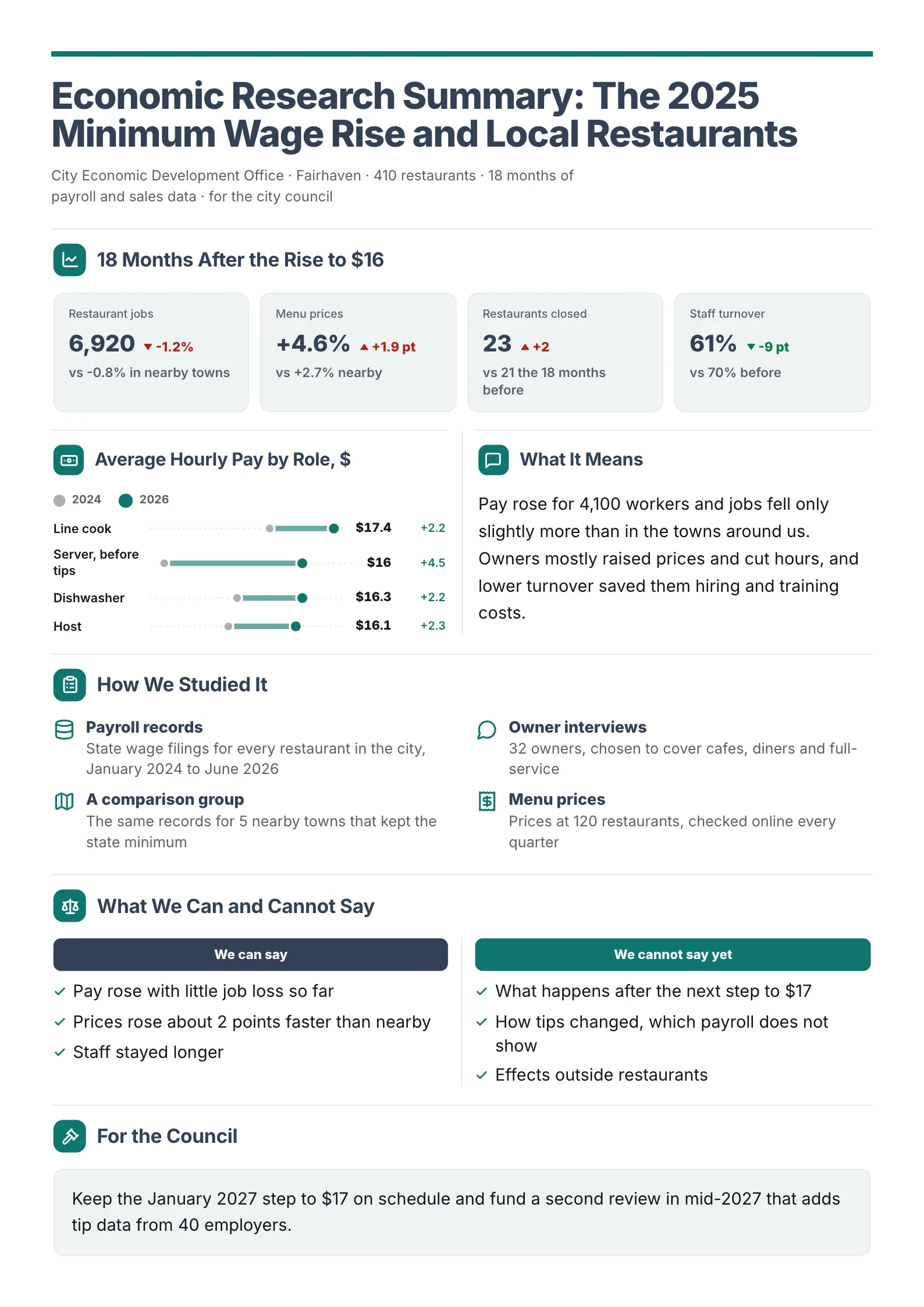
For research, this summary is built the way Michigan asks. It gives the context in four numbers, the key result in a chart, a short note on method and a recommendation for the city council.
 Edit this template
Drop your own study into the economic research summary template.
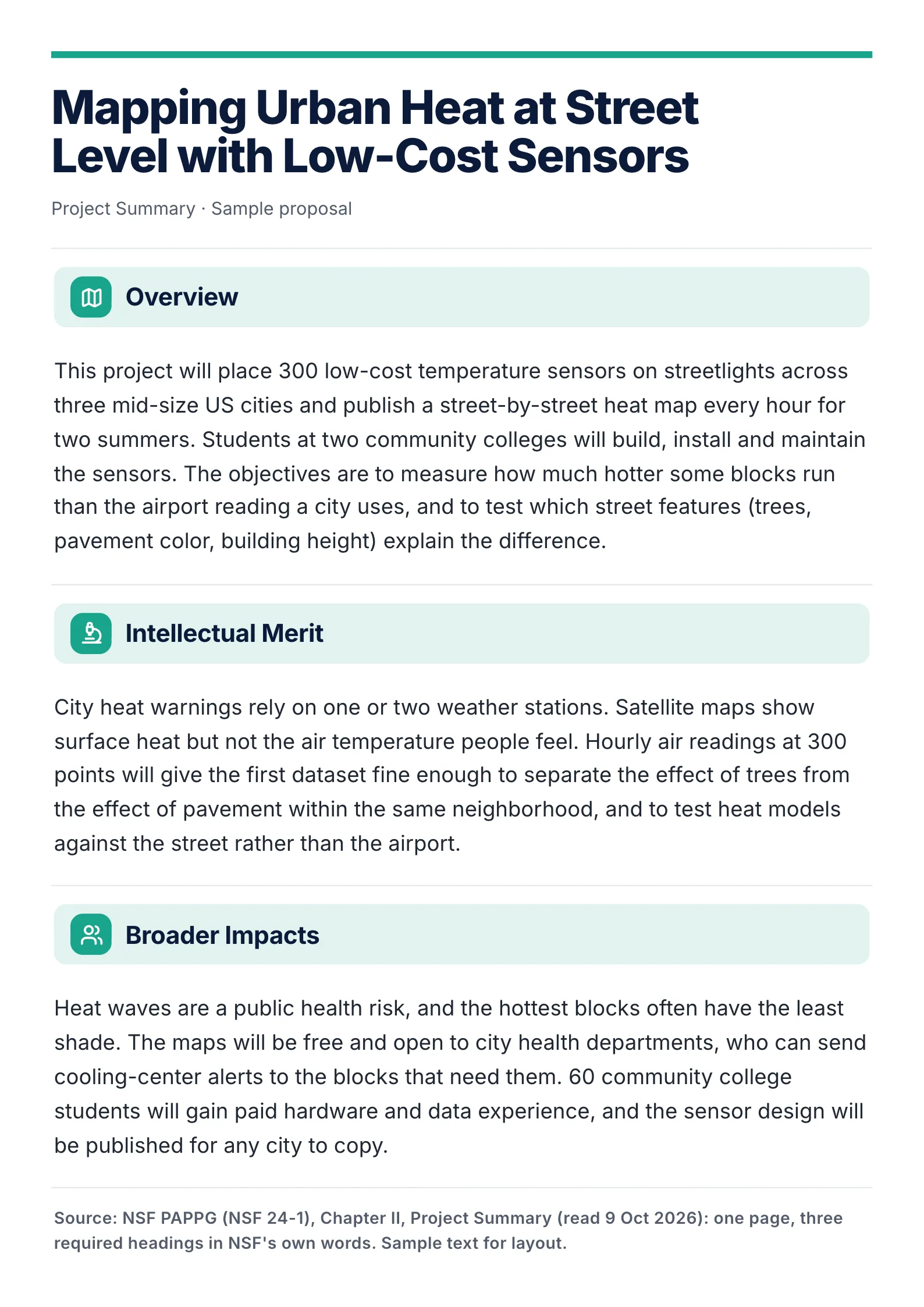
NSF's format is the strictest of the five on headings. This sample uses the three it names, in its order: an overview, then intellectual merit, then broader impacts. Add your name, email and target program above the title before you send it.
 Edit this template
The research project summary template keeps NSF's three headings in place for your idea.
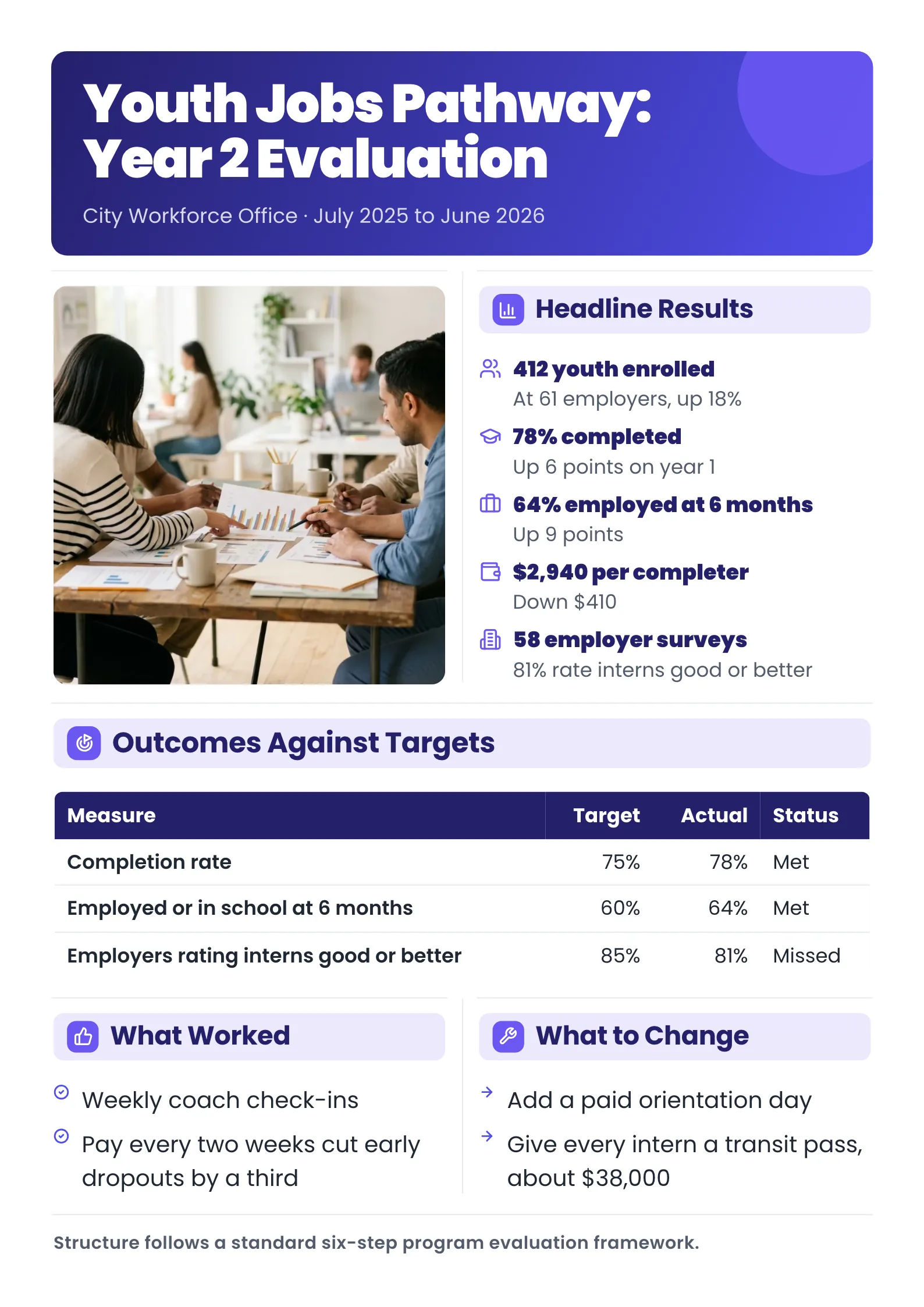
Virginia tells grantees to report outcomes clearly and back them with data. This evaluation does that with five headline results and a table of each target against the actual result.
 Edit this template
Swap in your own targets and results on the program evaluation summary template.
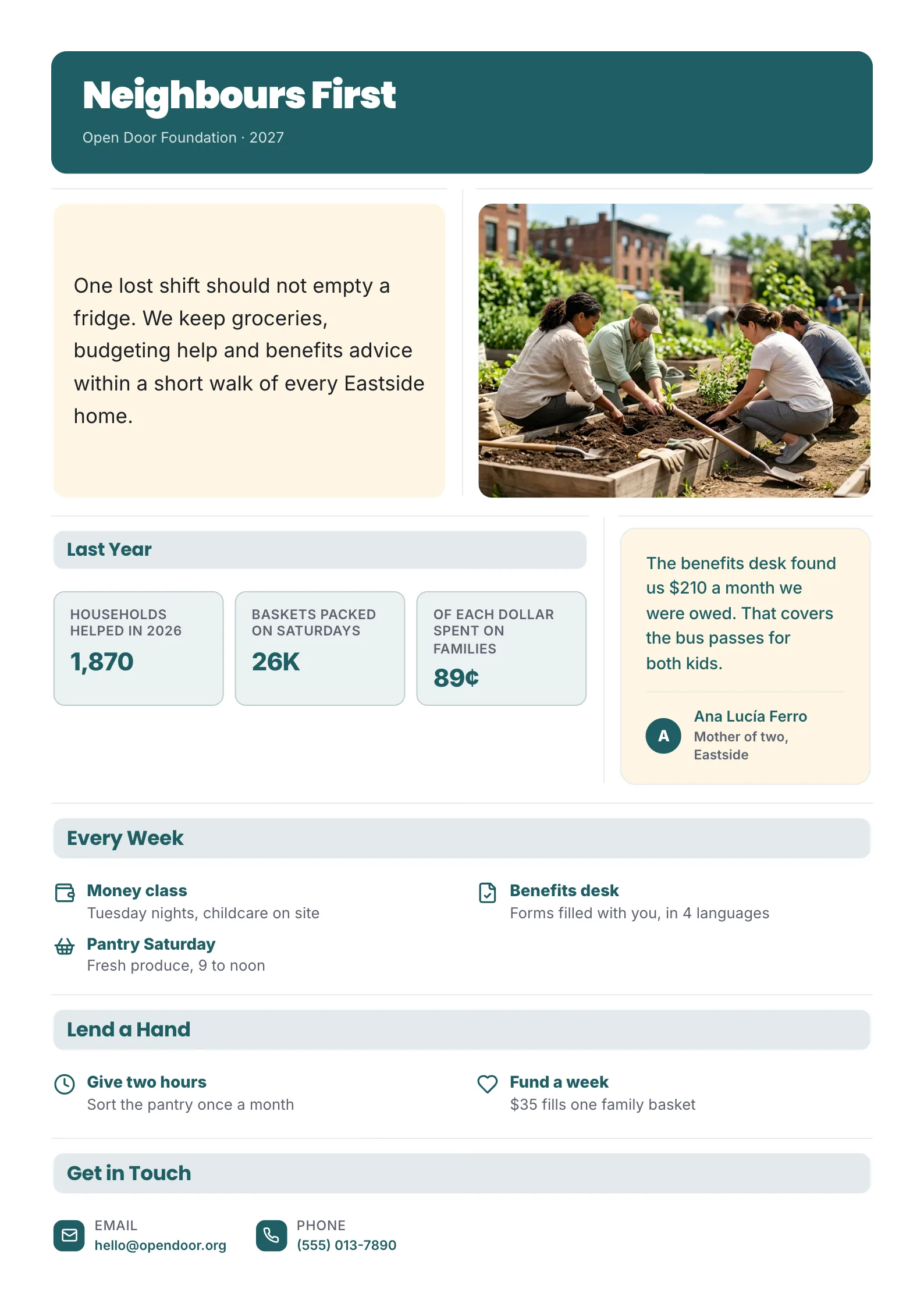
Montana's boxes suit any group telling its town what it does. This outreach sample opens on a one-line mission, then last year's wins in four numbers, what the group does, how to join in and a contact strip.
 Edit this template
Your group's mission and numbers go straight into the community outreach program template.
All five are free to edit in MakeOnepagers. Move the headings into the order your reader's guide asks for before you send it.
Questions people ask about the one pager format
What is the standard one pager format?
There's no single standard, but every guide we read agrees on named sections in a set order. Open on your point or a short context line, give the evidence, say what it means and end with a contact. None of the five sets a paper size, though Montana's 8.5-inch-wide header photo assumes a US Letter sheet.
What font size should a one-pager use?
The University of Michigan sets body text at 11 point or larger and footers at 8 point or larger. It was the only one of the five guides to give a number. NSF simply warns against small type.
Can a one-pager be two pages?
Three of the five guides allow it. NSF says it's OK to go a bit over, Virginia says a one-pager doesn't always stop at one page, and Michigan's own example runs front and back. If you need two sides, put the point and the contact on the front.
What sections does a one-pager have?
It depends on the reader. For a lawmaker, ISTE uses recommendation, introduction, background, analysis and an ask. For a research funder, NSF wants an overview first, then intellectual merit, then broader impacts. Pick the guide closest to your reader and follow its order.
Should a one-pager be a PDF?
Michigan tells its researchers to save the file as a PDF so the formatting holds, and Montana's form is a PDF you fill in. A PDF keeps your fonts and layout the same on any screen or printer.
Pick your reader's guide, then fill the sections
Find the guide above closest to your reader and copy its section order. Then open a sample in MakeOnepagers, set the body to 11 point and send it as a PDF.




