Investor Update Format: What Netflix Repeats From One Letter to the Next
An investor update format from Netflix's October 2026 shareholder letter: the verdict first, one fixed table, a forecast you check later, misses said plainly.

The first thing an investor looks for in your update is last period's promise and how it turned out. A good investor update format puts that answer in the first line, then proves it with the same numbers in the same place, every time. Start from a free one pager template.
One‑Pager examples
Real One-Pagers made with MakeOnepagers. Open any one to edit it as your own.
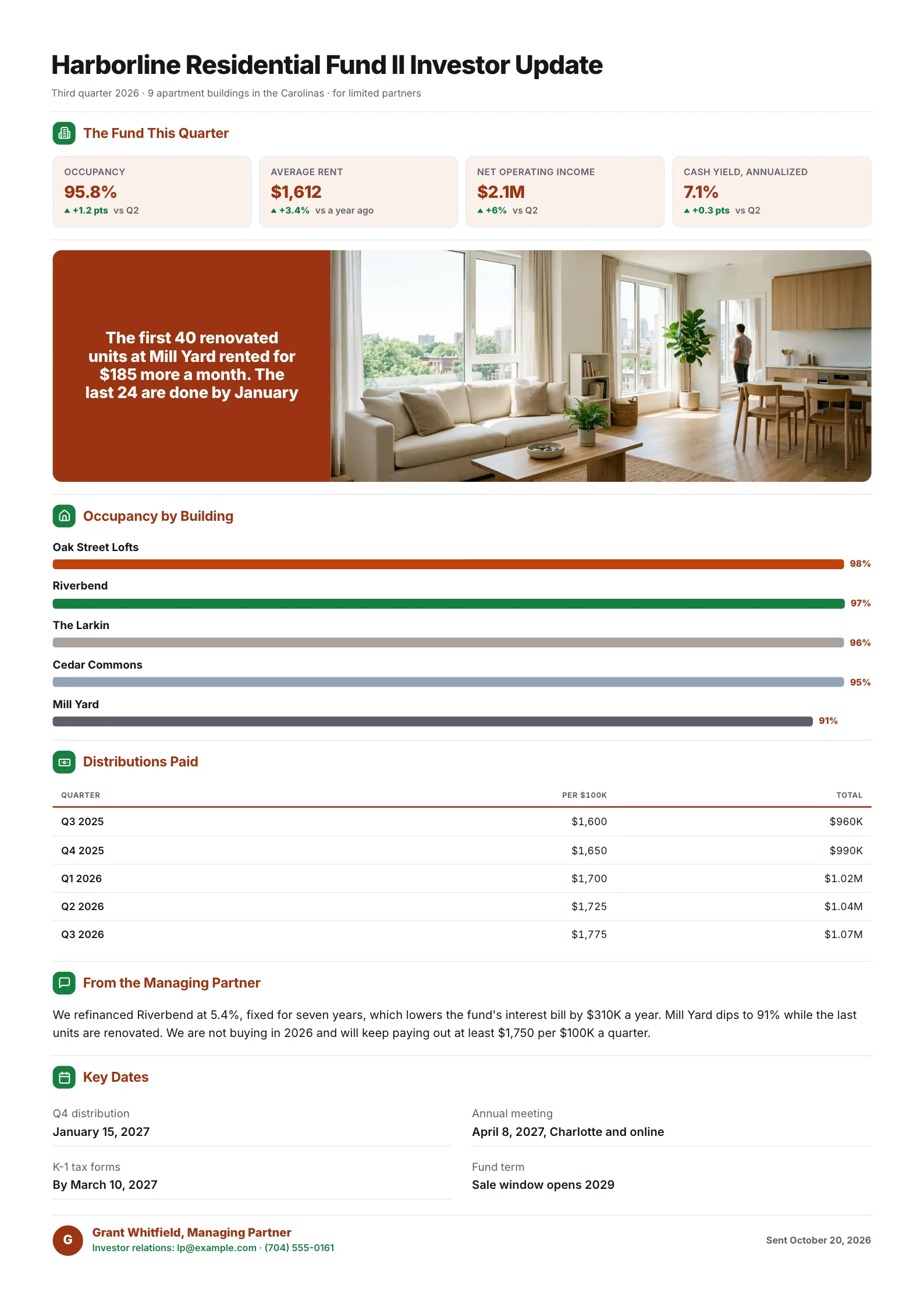 Investor Update: Real Estate FundEdit for free(opens in a new tab)
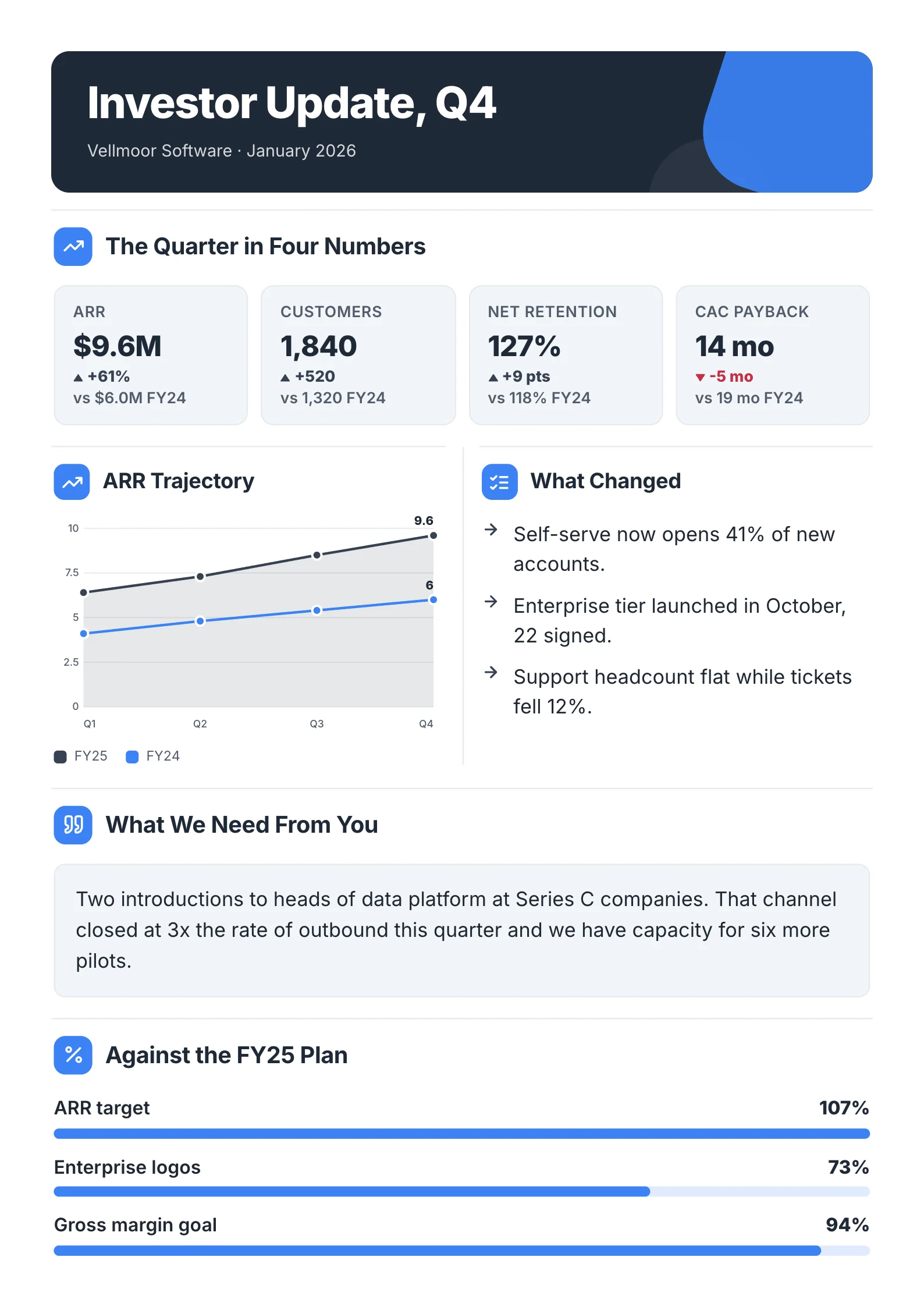 Investor UpdateEdit for free(opens in a new tab)
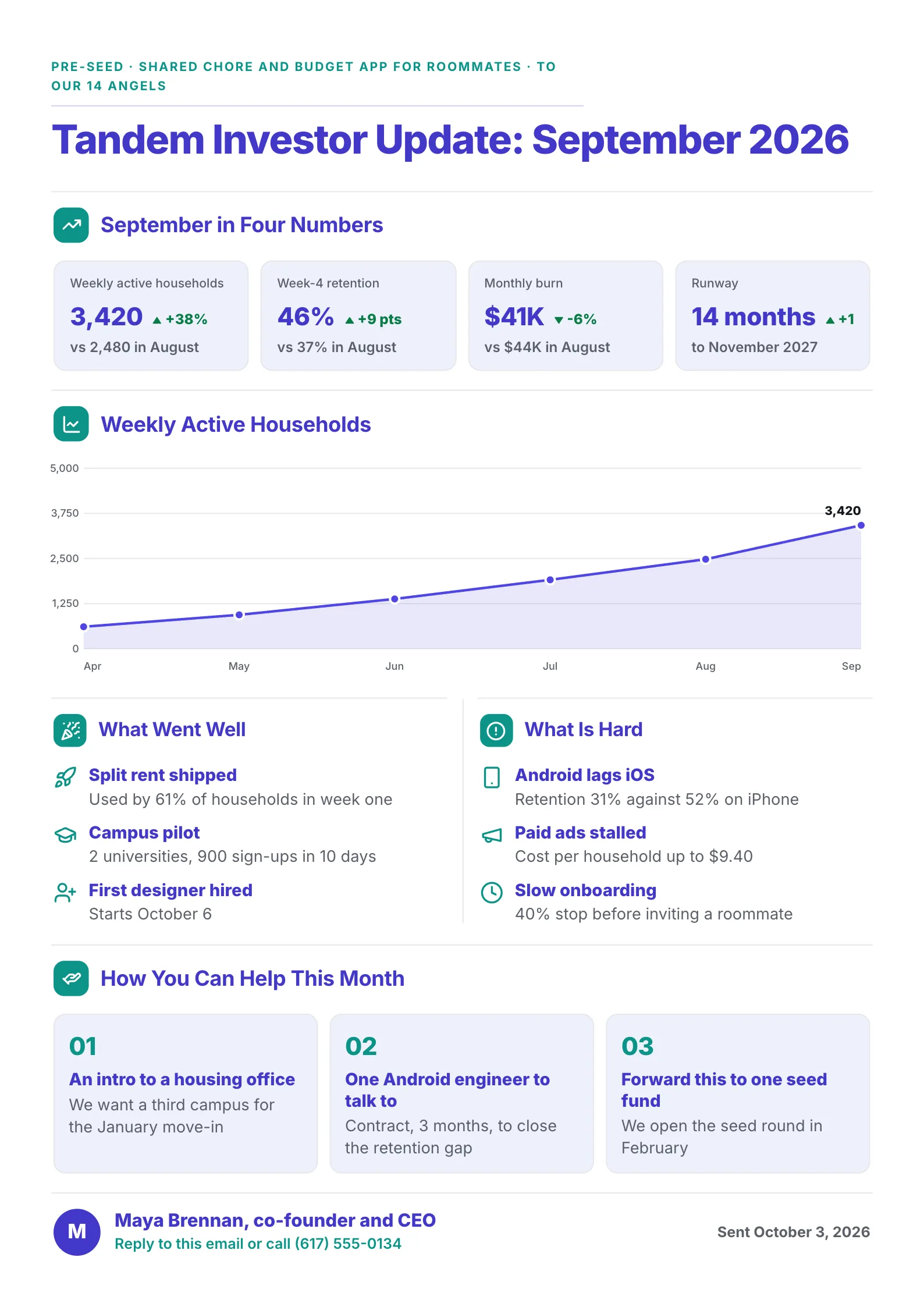 Investor Update: Pre-Seed MonthlyEdit for free(opens in a new tab)
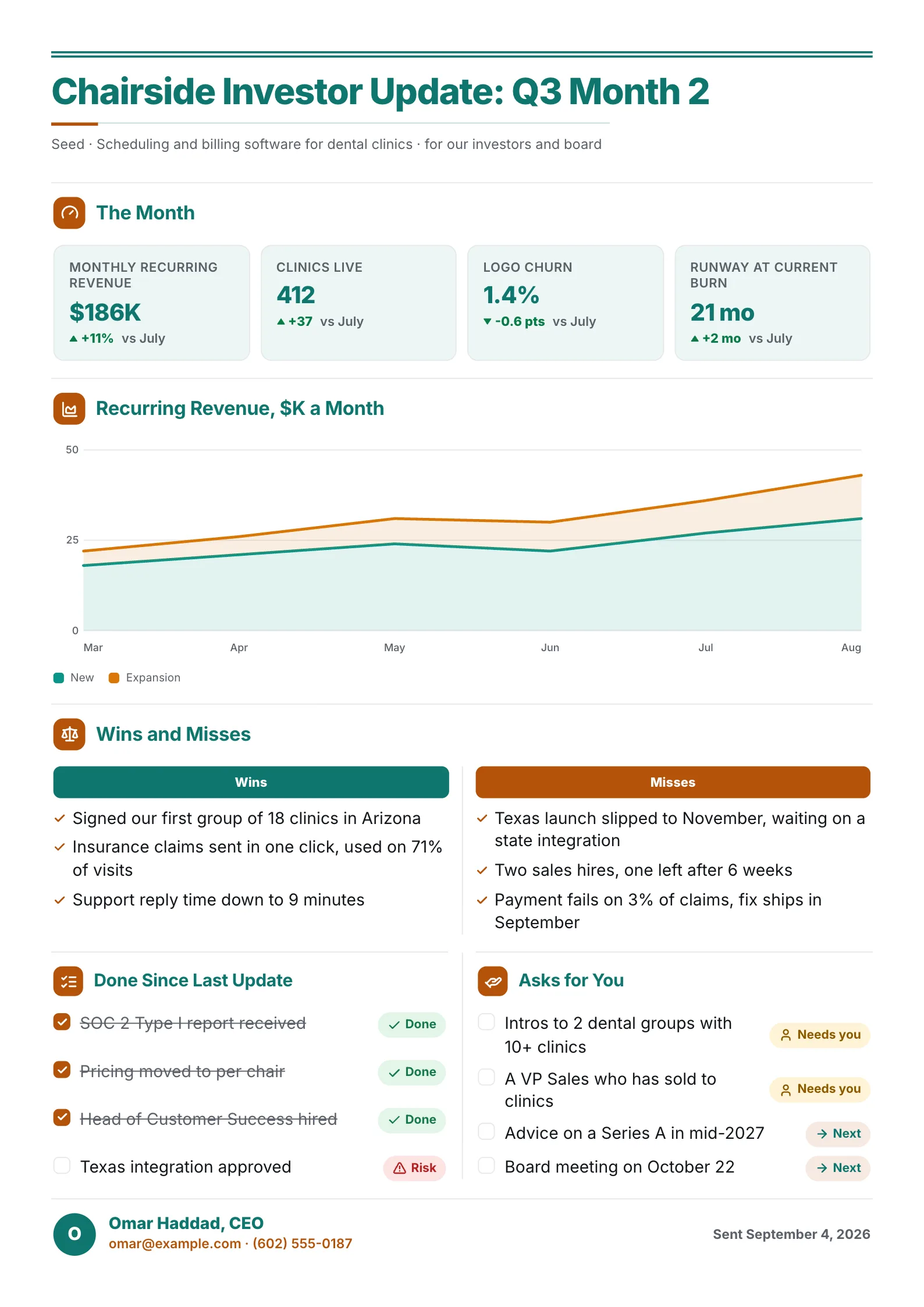 Investor Update: SaaS MonthlyEdit for free(opens in a new tab)
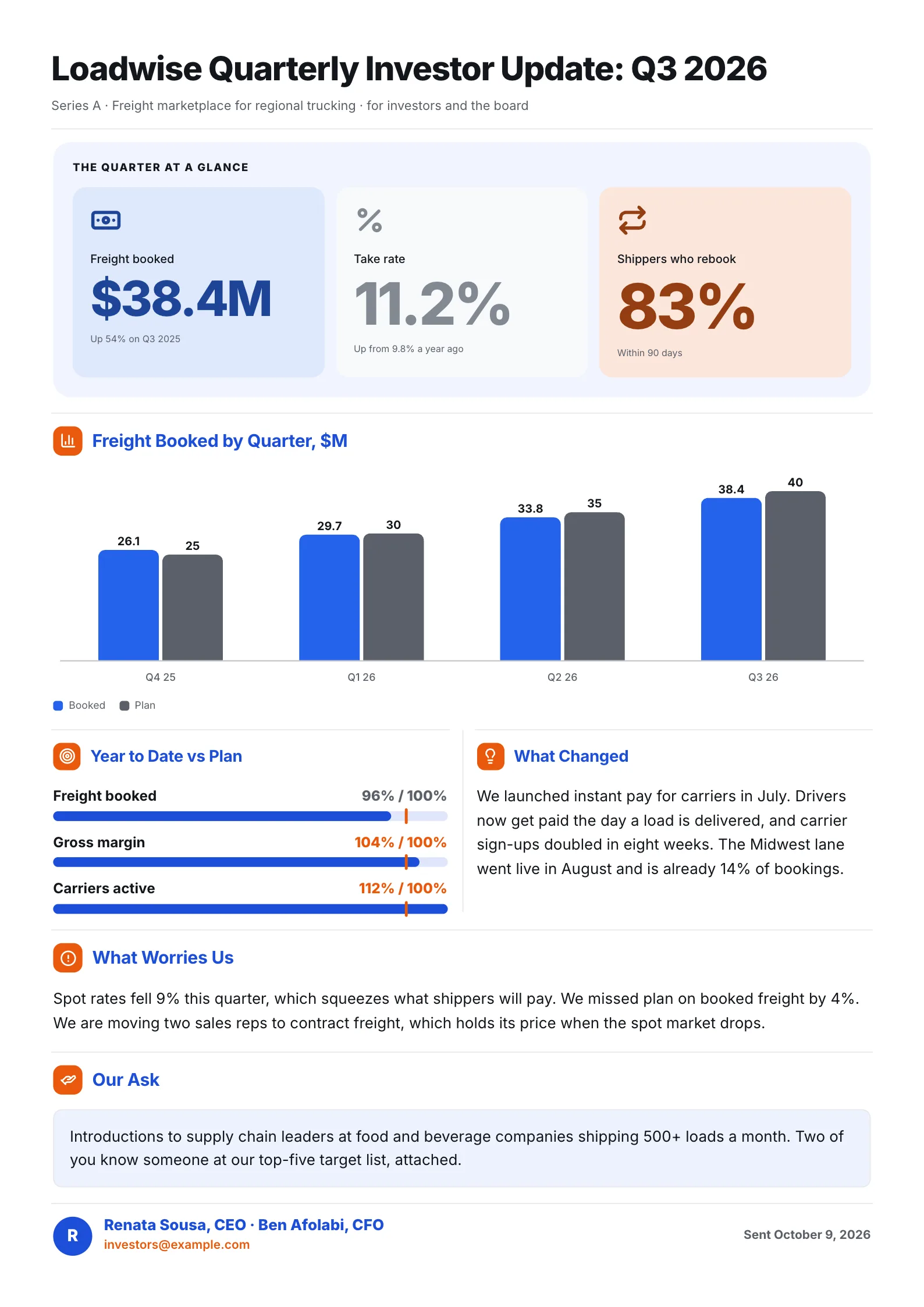 Investor Update: Series A QuarterlyEdit for free(opens in a new tab)
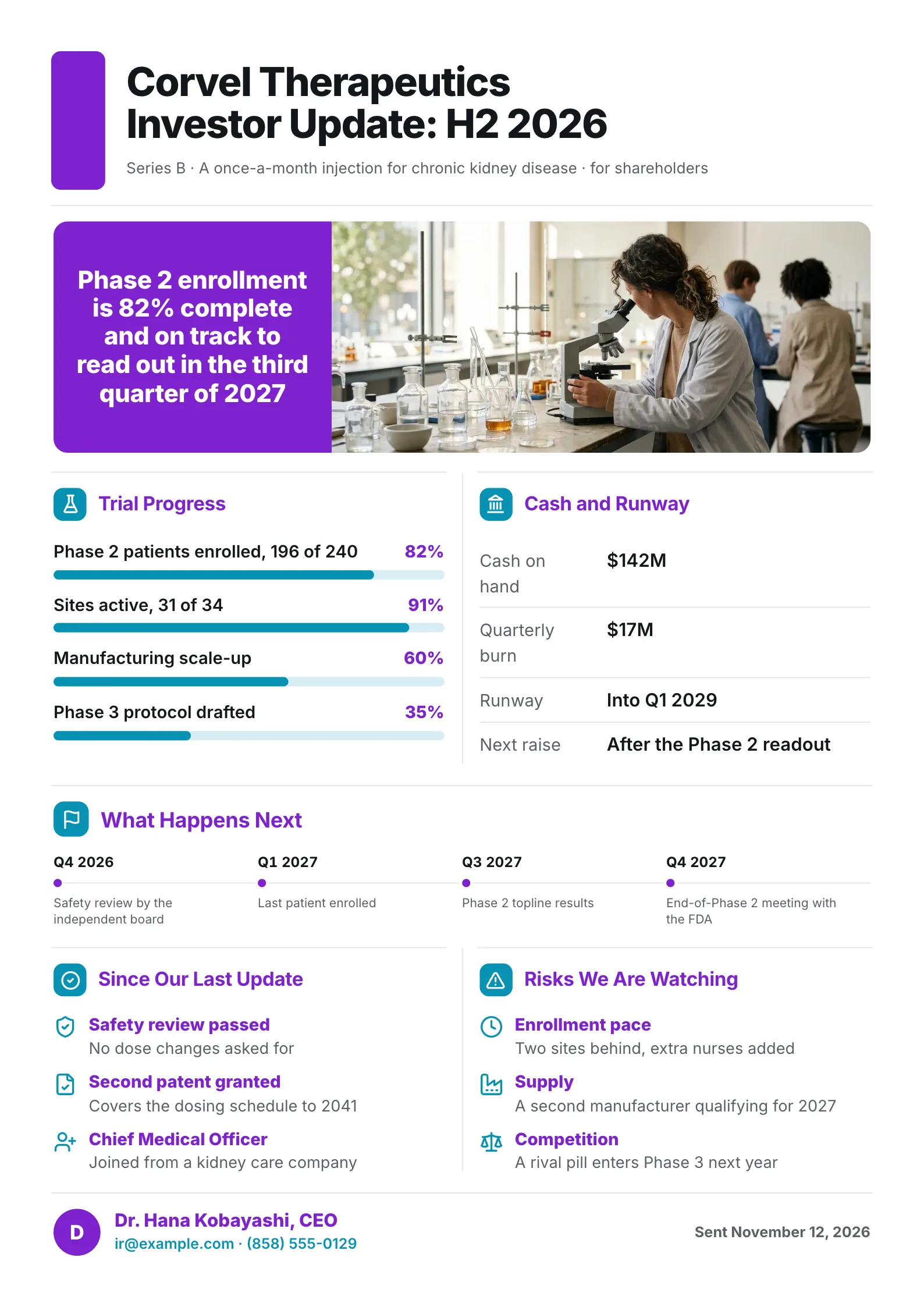 Investor Update: Biotech ShareholdersEdit for free(opens in a new tab)
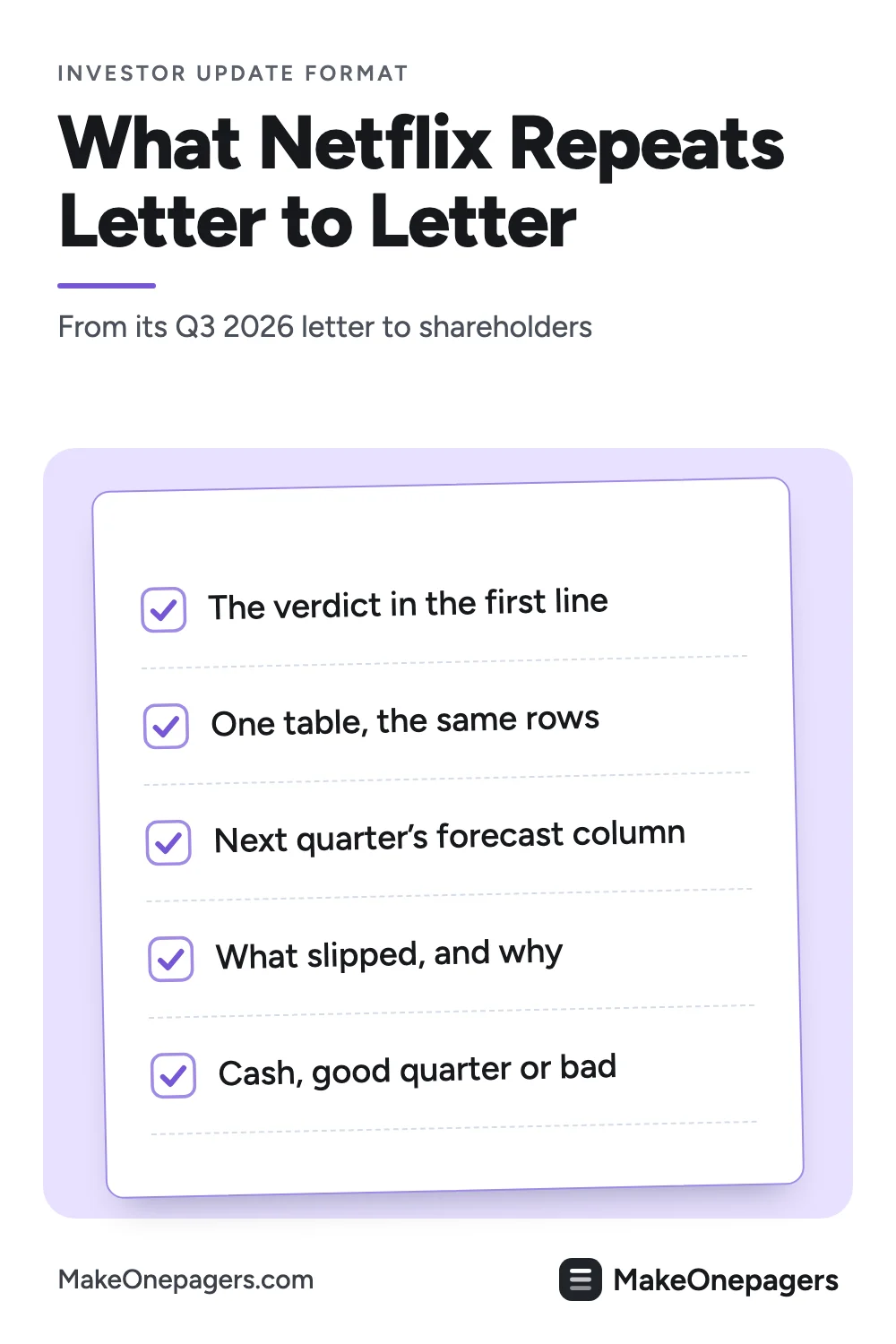
Netflix builds its shareholder letters this way. We read its letter to shareholders for the third quarter of 2026, filed with the SEC on October 20, 2026, and held it beside the letter from the quarter before. A public company writes for millions of owners while you may write for twelve, yet the habits carry over. After the letter, you'll see them on one page, using MakeOnepagers samples with fictional companies and figures.
How the Netflix letter is built
The letter runs 14 pages, and the financial statements fill the last 6. It opens with "Fellow shareholders," and five bullets, then a summary table, then the same run of sections the Q2 letter used.
| Part | What it holds | What you can copy |
|---|---|---|
| Opening bullets | "We delivered our Q3 forecast and expect to deliver on our full year 2026 guidance." | Your verdict in the first sentence |
| Summary table | Revenue, growth, operating income, margin, net income, earnings per share, cash flow and shares for five quarters, plus a Q4 forecast column | One table with the same rows each time |
| Results and Forecast | Q3 revenue of $12.9B, up 12%, a margin of 34.6%, and Q4 expected at $13.4B and 26.0% | What happened, then what you expect next |
| Our Focus | Three priorities and the quarter's hit titles | A short note on what you're working on |
| Cash Flow and Capital Structure | $4.8B spent buying back 63.9 million shares, $15.3B gross debt and $8.2B in cash | Cash every time, good quarter or bad |
| Reference pages | Regional numbers, definitions, the earnings interview and the full statements | Detail at the back for the few who want it |
The Q2 letter had forecast Q3 revenue of $12,860 million. The Q3 letter reports $12,874 million in the very same row. You can grade Netflix without opening a spreadsheet, and that's the point of the layout.
The bad news sits in the same paragraphs as the good. Netflix now expects about $2.7B in 2026 ad revenue, down from about $3B, and it lowered its free cash flow forecast to about $12.0B from $12.5B mainly because of a real estate deal. It even names a worry outright: "We know there's some investor concern about our view hours growth."
The same habits on one page
You don't need 14 pages for a seed round. Here are the same habits, one block at a time.
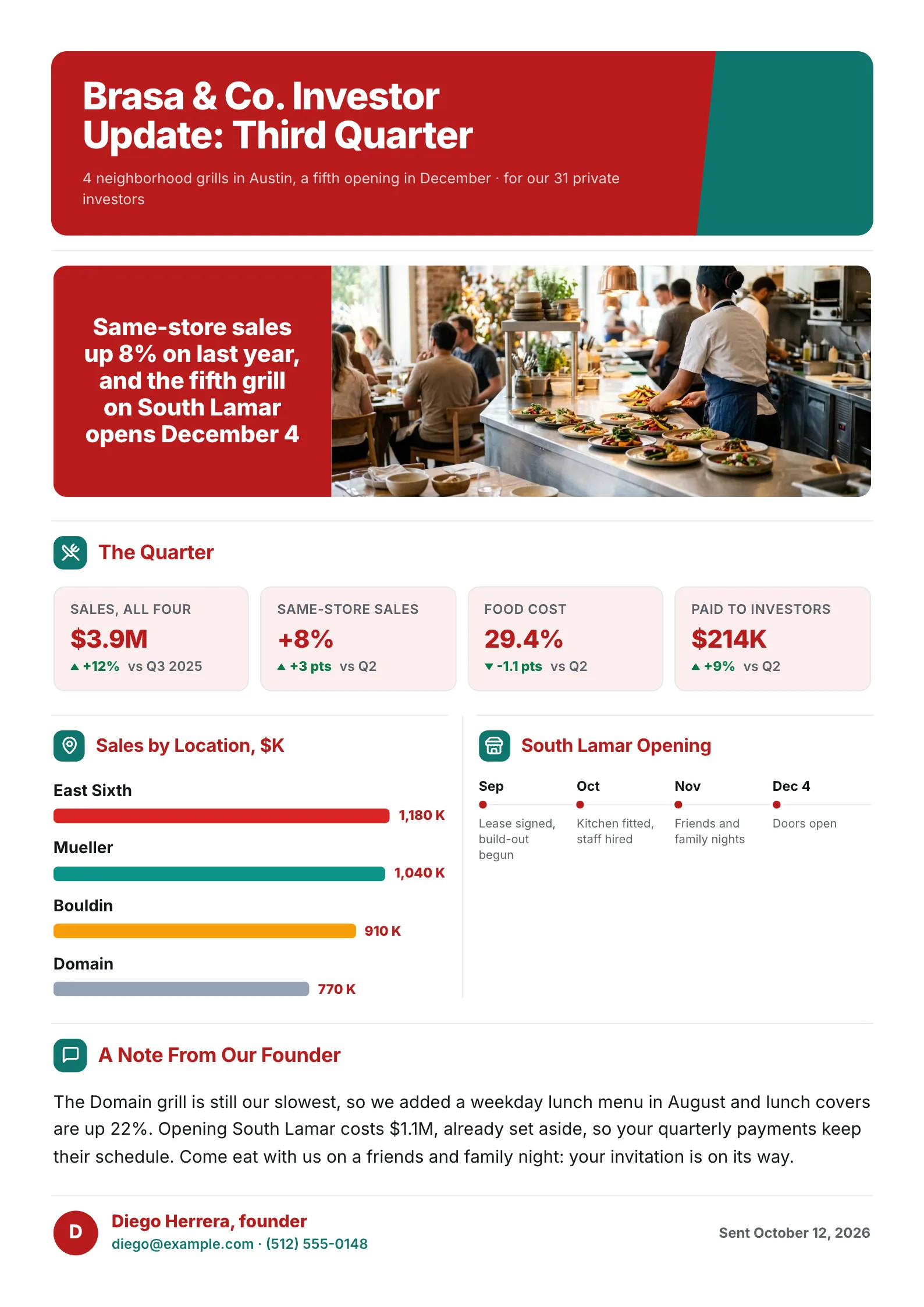
Block 1: The verdict on last period
Start with one line that says if you hit your plan. Then give the two or three numbers that prove it.
 Edit this template
The restaurant group template puts "$214K paid to investors" up top, so your owners see their own money before anything else.
Block 2: The same table every time
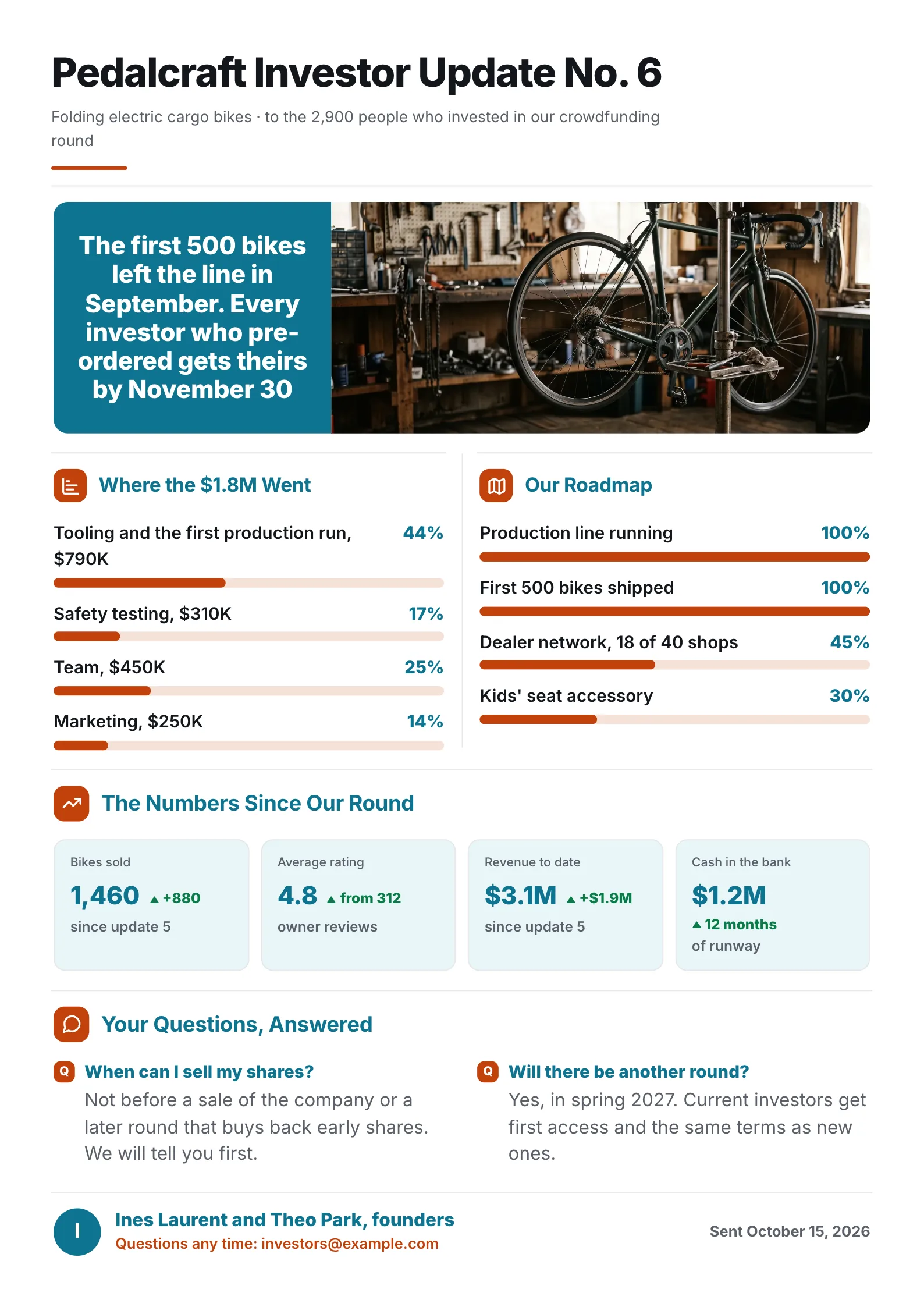
Netflix's rows didn't move between its Q2 and Q3 letters. Pick your five or six numbers once, then keep them in that order and compare each with your last update.
 Edit this template
Every row of the crowdfunding template shows its change since update 5, so an investor who skipped one letter can catch up.
Block 3: A forecast you can be held to
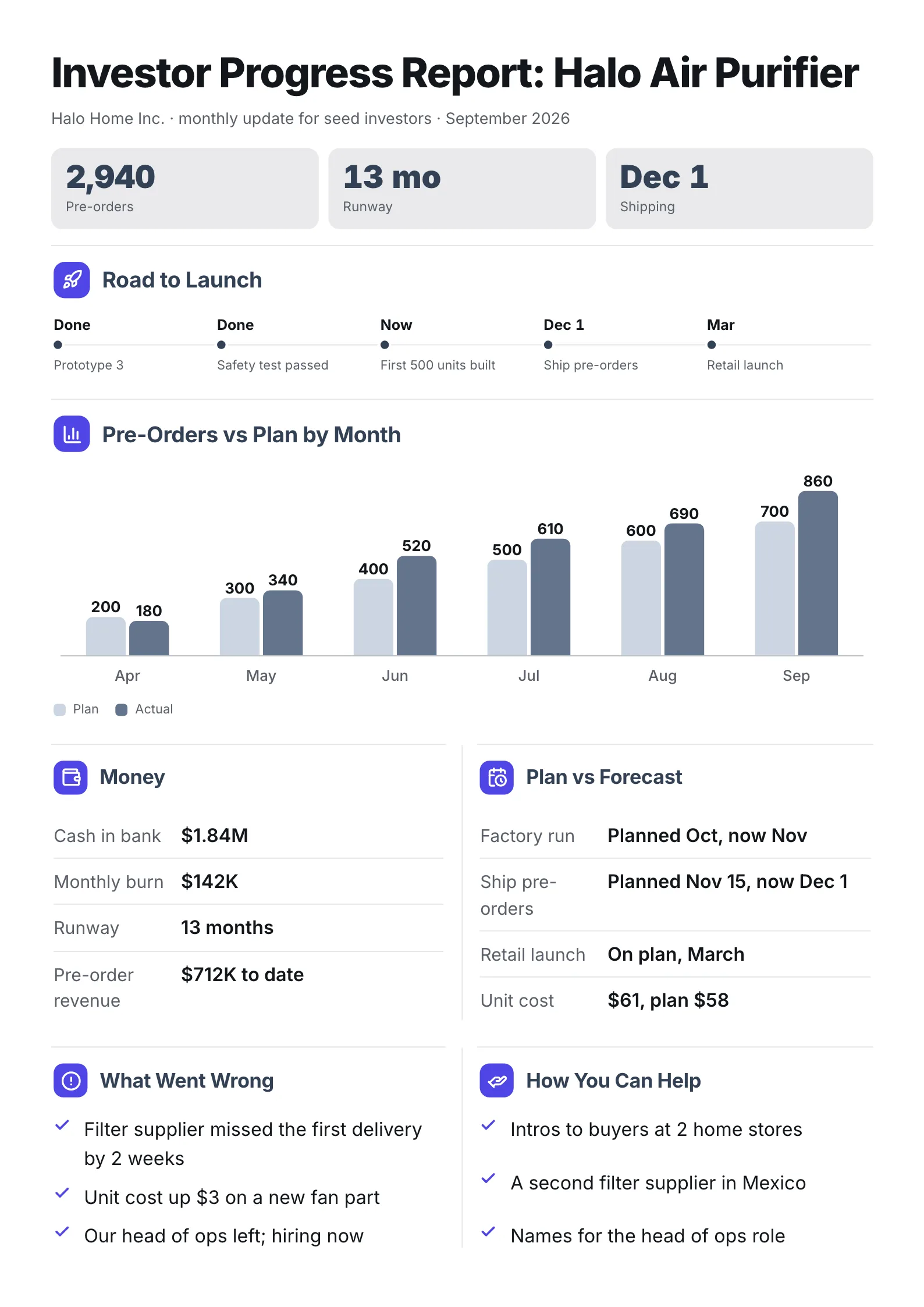
Netflix calls its guidance "our actual internal forecast." Write yours down too, with dates, and the next update will show how close you came.
 Edit this template
In the seed progress report, the plan against forecast table puts the old date and the new one in the same row, so a slip is plain to see.
Block 4: What slipped, why, and the fix
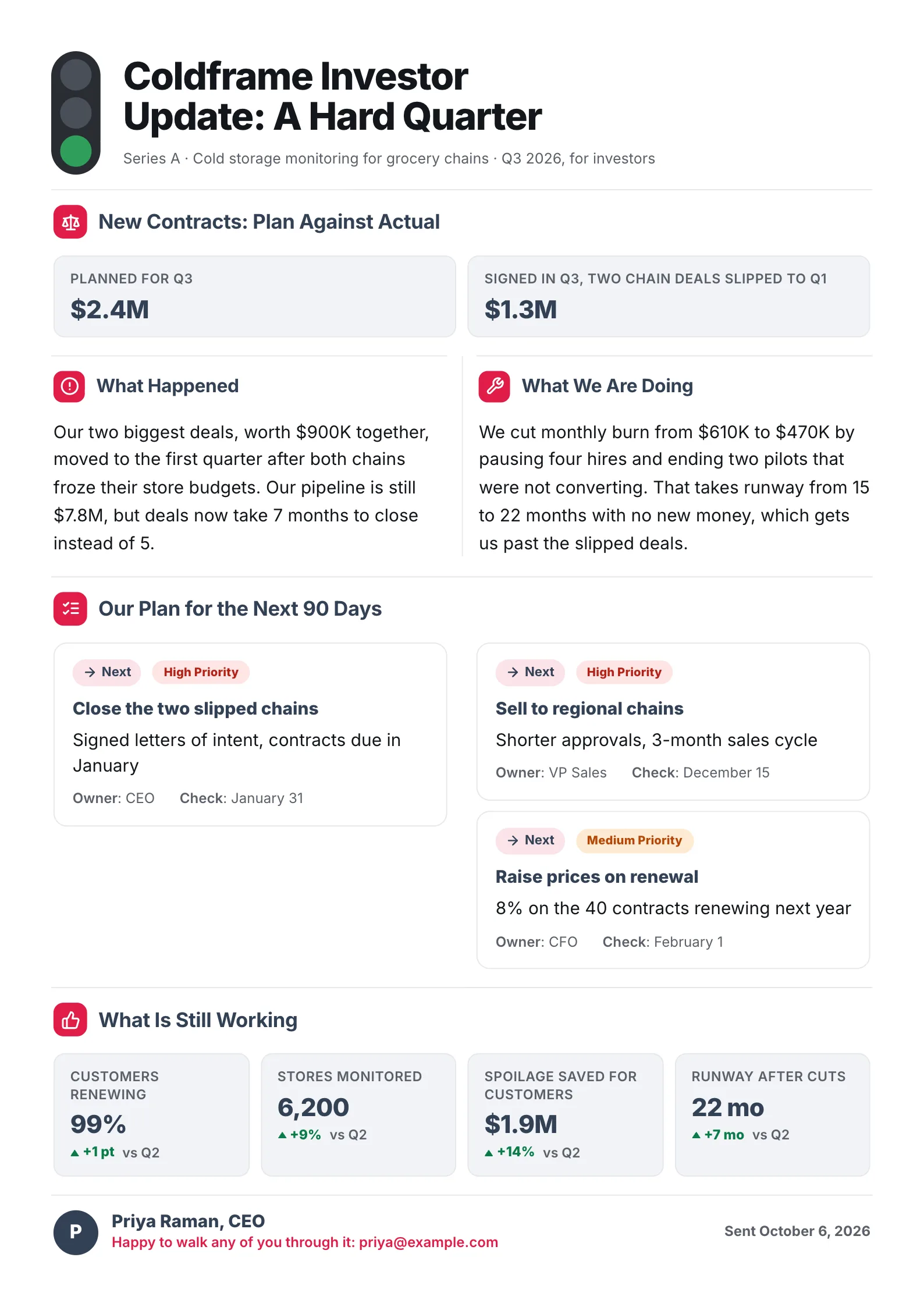
A miss your investors hear from you first costs you far less trust than one they find later. Give the gap in numbers, the cause in a sentence and the plan with a name beside it.
 Edit this template
On the down quarter template, runway grows from 17 to 22 months on the same page as the miss, which tells investors the cut is already done.
Block 5: Cash, and what it bought
Netflix closes its main sections on cash, debt and buybacks. Close yours on cash in the bank and what the money you raised has paid for.
 Edit this template
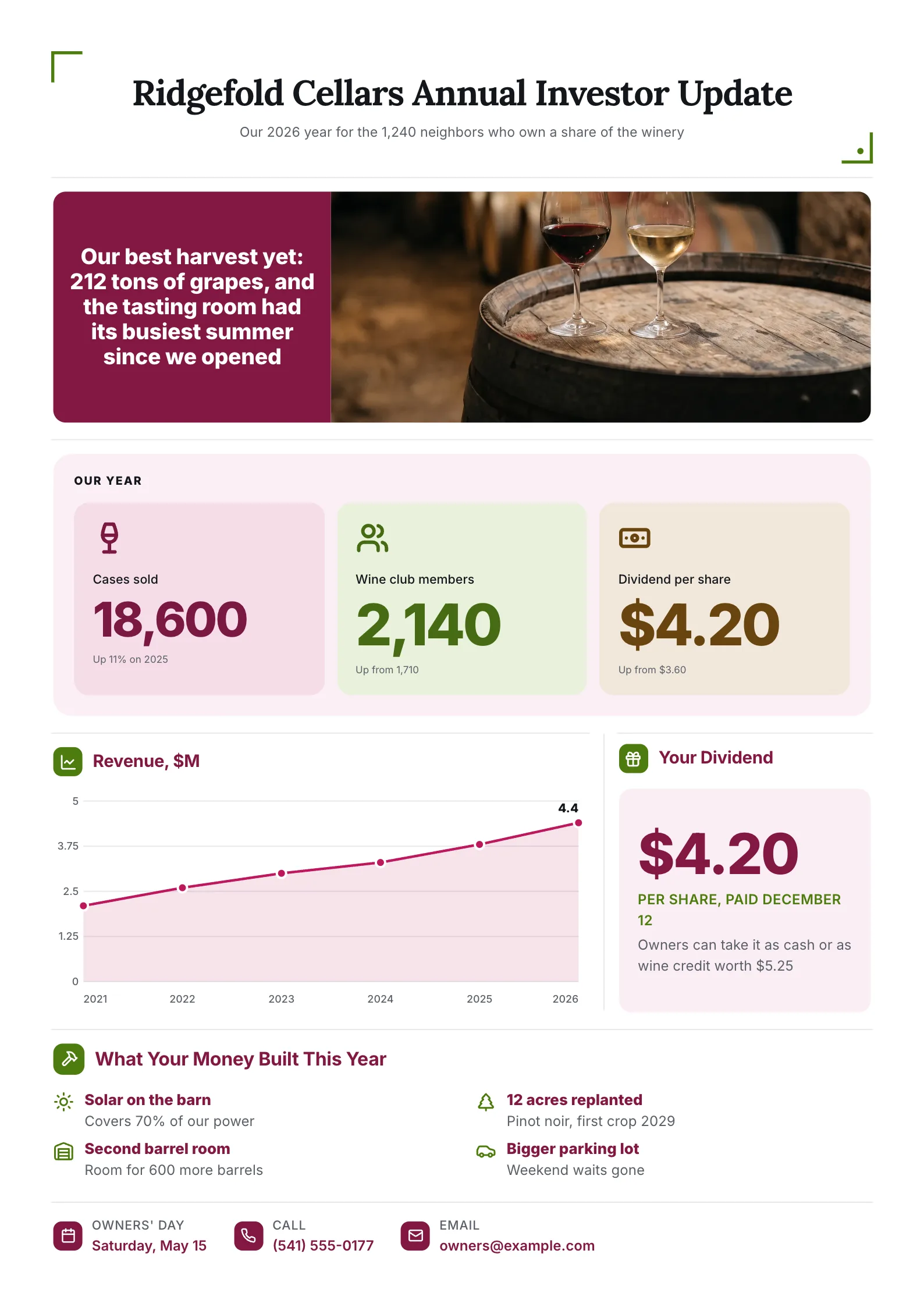
The annual shareholder template lists solar panels, a barrel room and 12 replanted acres under "What Your Money Built," so owners can picture their stake.
Small rules that keep each update comparable
- Send it on the same day each month or quarter.
- Keep last period's forecast in view when you report this period's result.
- Change a row only with a note saying what changed.
- Write the cash number the same way every time, cash in the bank or months of runway.
- Keep anything long, like full statements, on a second page or an attachment.
Build your next update
Start from one of the investor templates, or give your numbers to the AI One-Pager generator and adjust its draft. Our investor letter examples set four companies beside real shareholder letters, and the investor template guide shows finished pages you can copy.
Frequently asked questions
What order should an investor update follow?
Verdict, table, results against forecast, what you're working on, then cash. Netflix's Q2 and Q3 letters use the same section names in the same order, so investors know where to look.
Should an investor update include a forecast?
Yes, if you can stand behind it. A forecast turns your next update into a check, as Netflix's Q2 letter did when it called Q3 revenue at $12,860 million and the Q3 letter reported $12,874 million.
What if your last forecast turns out wrong?
Say so in the same spot you made it. Netflix's Q2 letter narrowed its 2026 revenue range to $51.0B to $51.4B. The Q3 letter now expects $51.1B and says plainly that it's 0.2% below the mid-point.
Should an investor update be an email or a PDF?
Put the verdict and the three biggest numbers in the email itself, since many investors read on a phone. Attach the one-page PDF so the layout holds and they can file it.
What is the difference between a shareholder letter and an investor update?
A shareholder letter usually comes from a public company and sits beside its official filings. An investor update goes to the few people who own part of a private company. The building blocks are the same.




