Investor Update Example: 5 Samples by Stage, Next to 3 Real Letters
Investor update examples for a pre-seed app, a seed SaaS, a Series A marketplace and a winery, read beside the 2025-26 letters of Berkshire, Amazon and Duolingo.

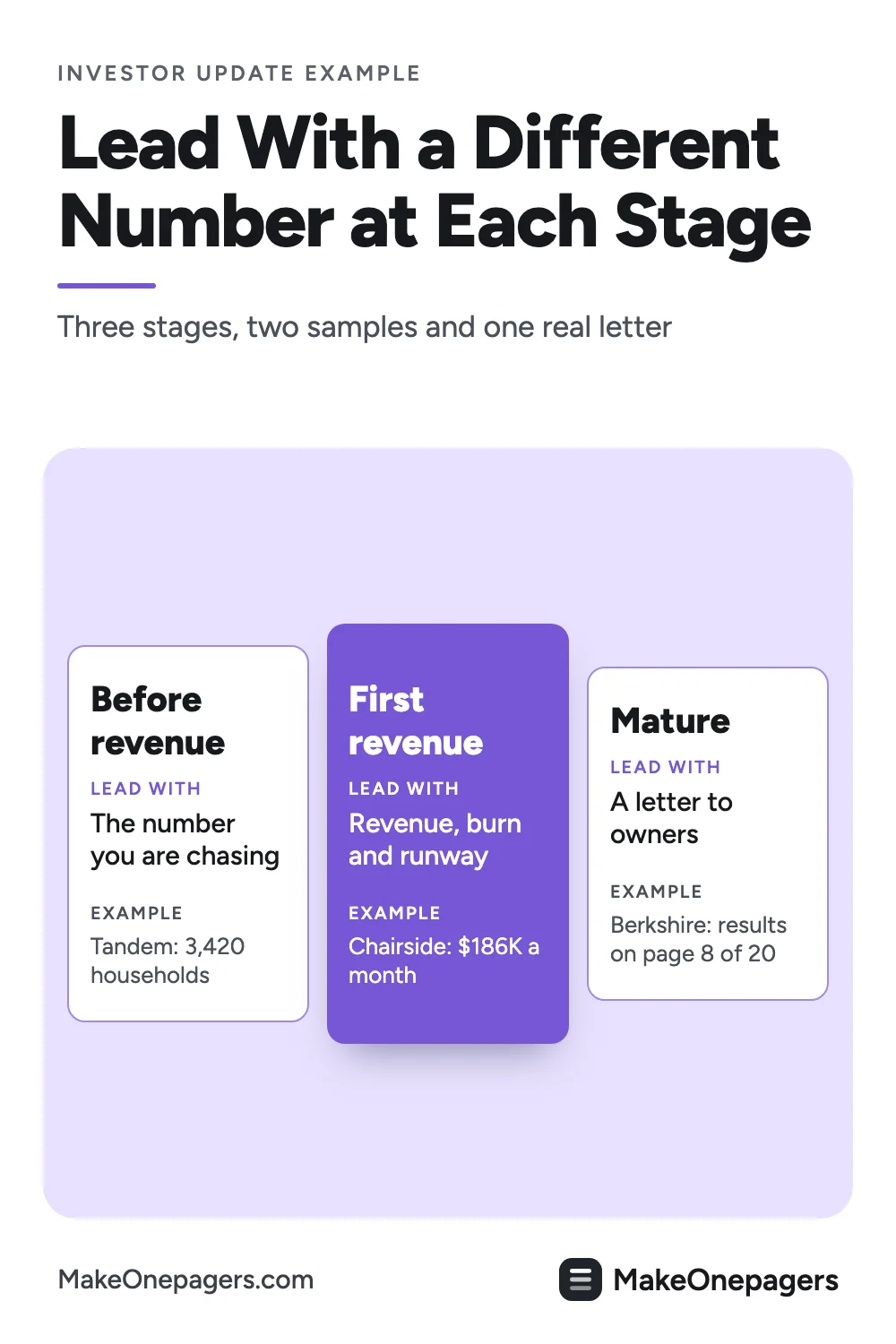
An investor update example looks different at each stage of a company. A two-person app with no revenue shows users and runway. A company with revenue puts revenue, burn and runway on top. A large company writes a letter to its owners. At every stage, the update says what went wrong and asks for something specific. Start from a free one pager template.
One‑Pager examples
Real One-Pagers made with MakeOnepagers. Open any one to edit it as your own.
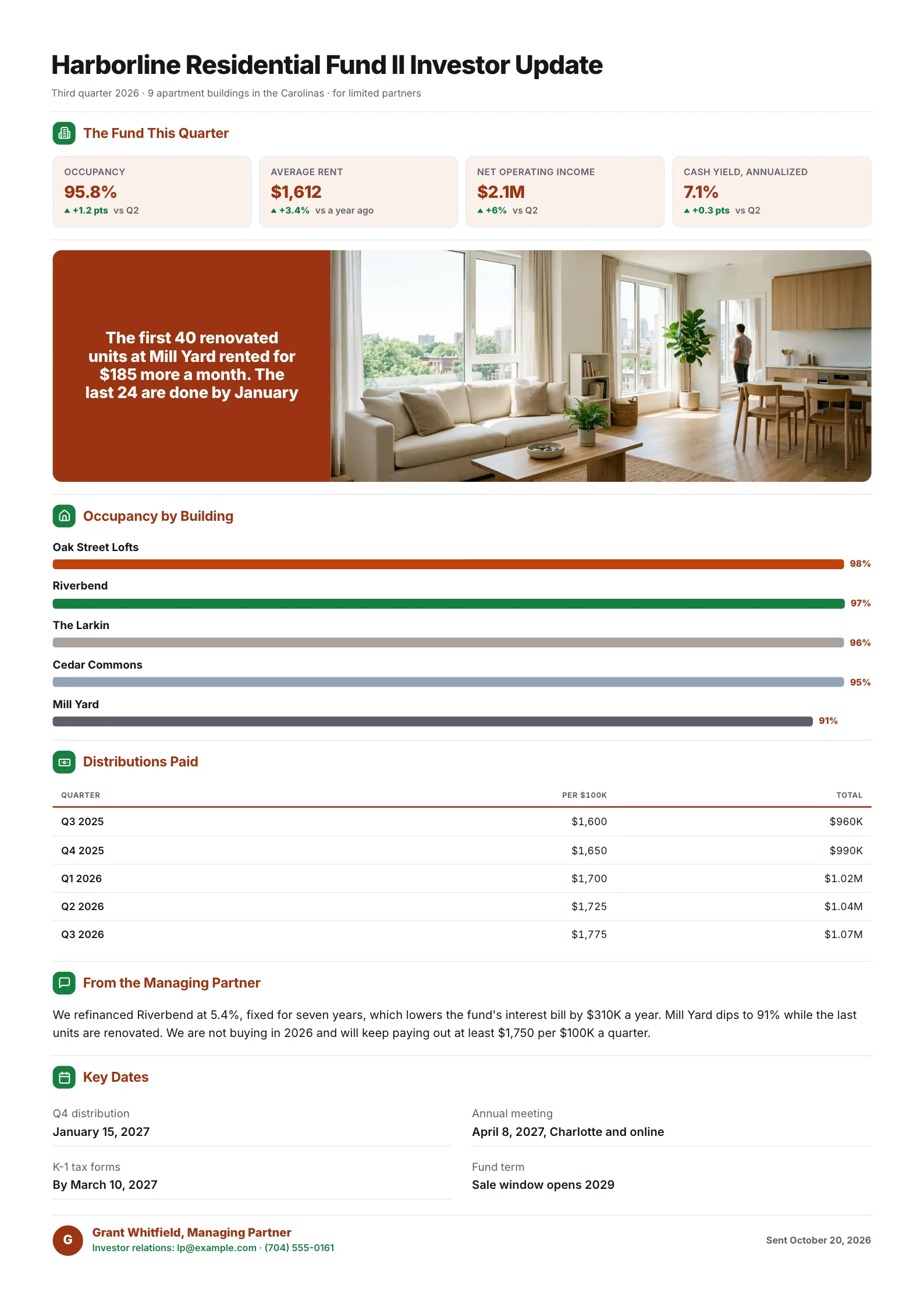 Investor Update: Real Estate FundEdit for free(opens in a new tab)
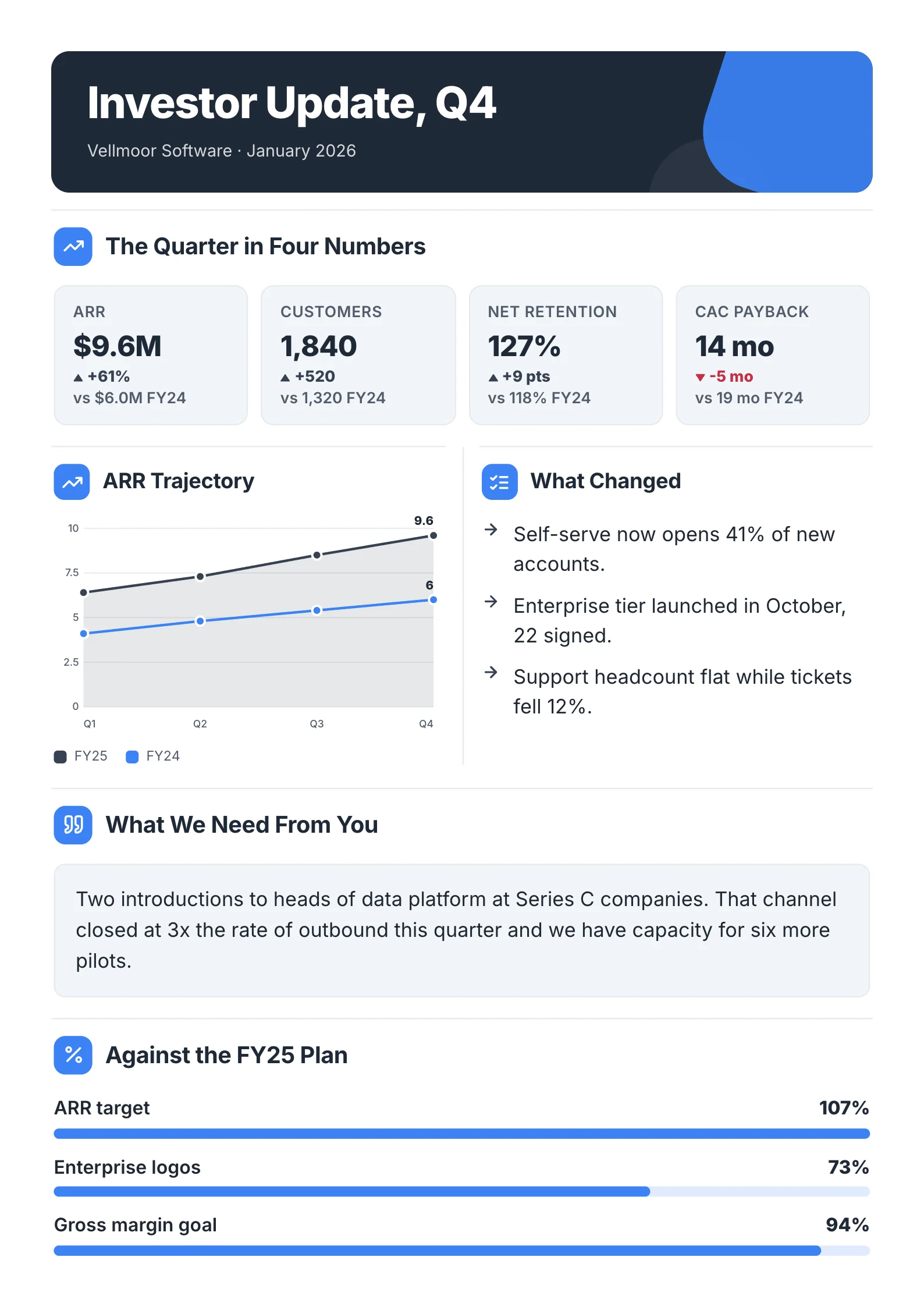 Investor UpdateEdit for free(opens in a new tab)
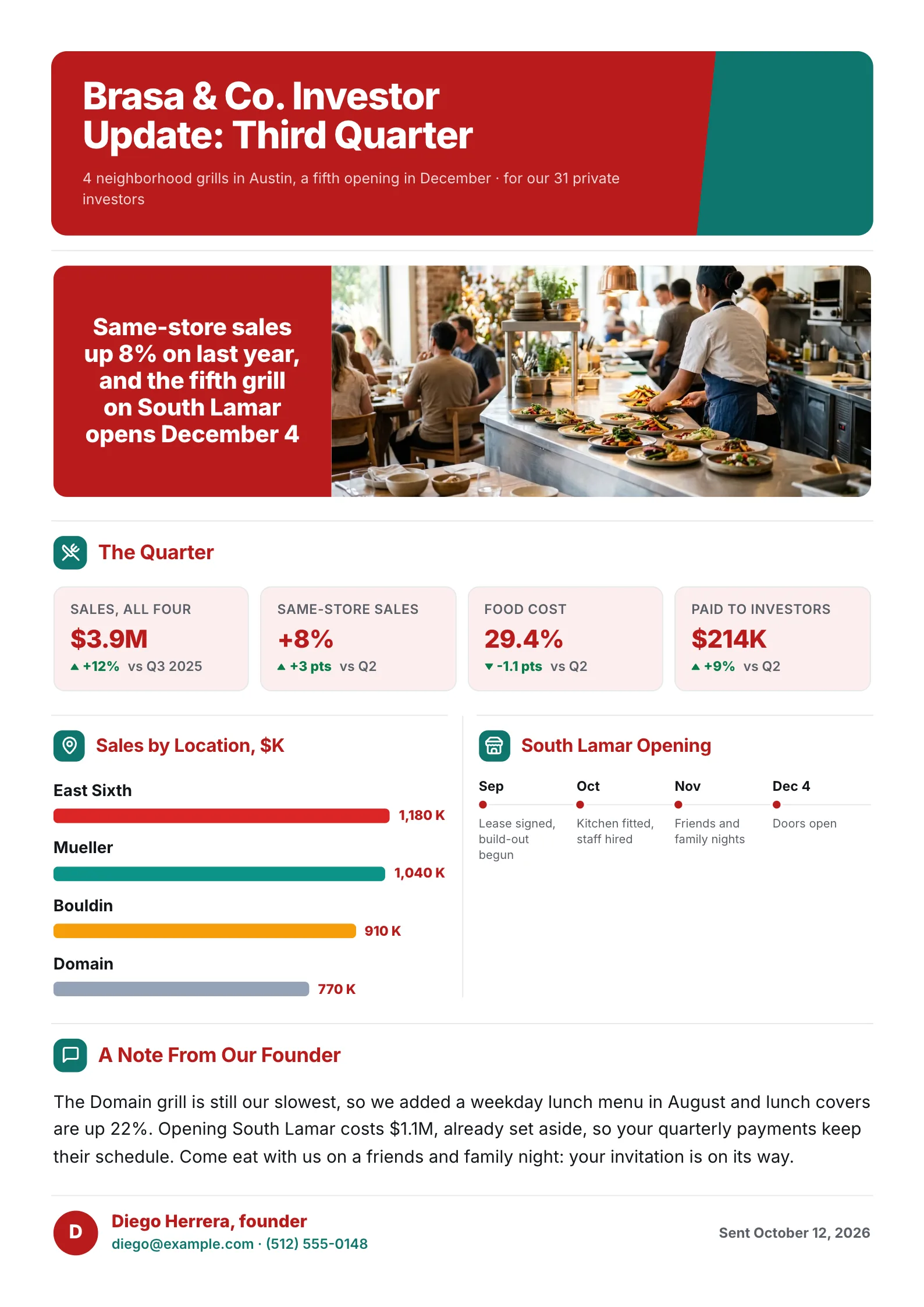 Investor Update: Restaurant GroupEdit for free(opens in a new tab)
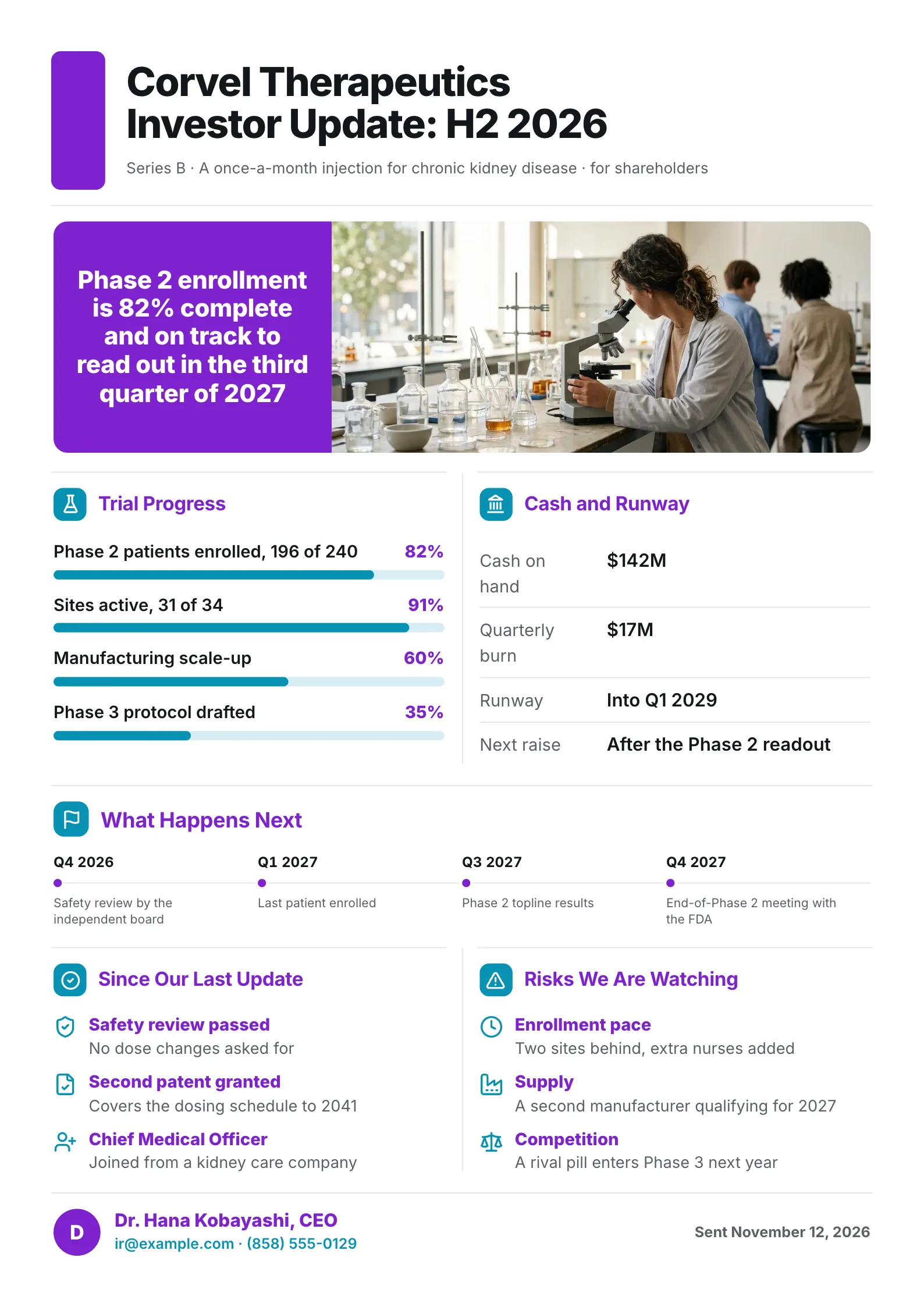 Investor Update: Biotech ShareholdersEdit for free(opens in a new tab)
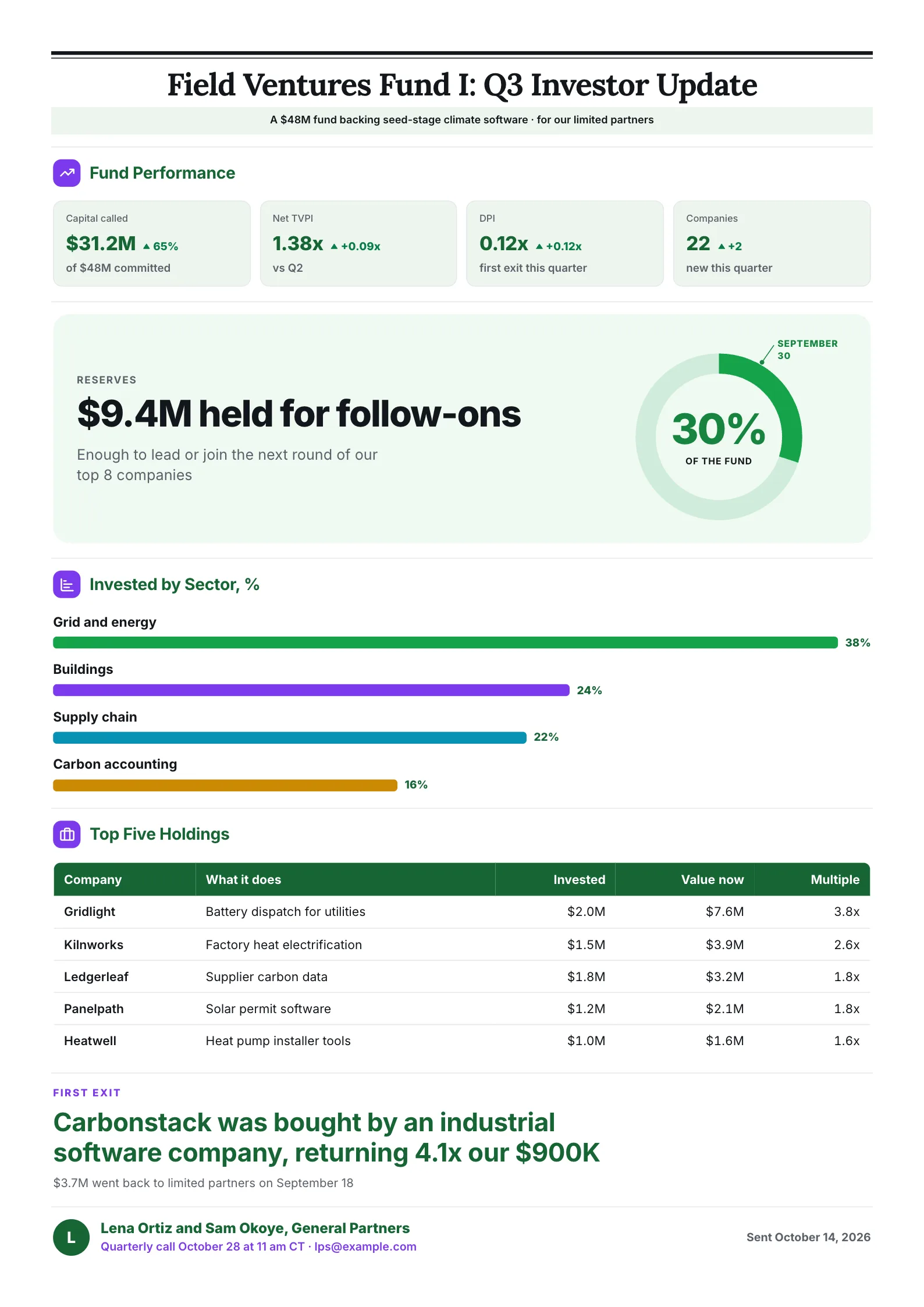 Investor Update: Venture Fund LPsEdit for free(opens in a new tab)
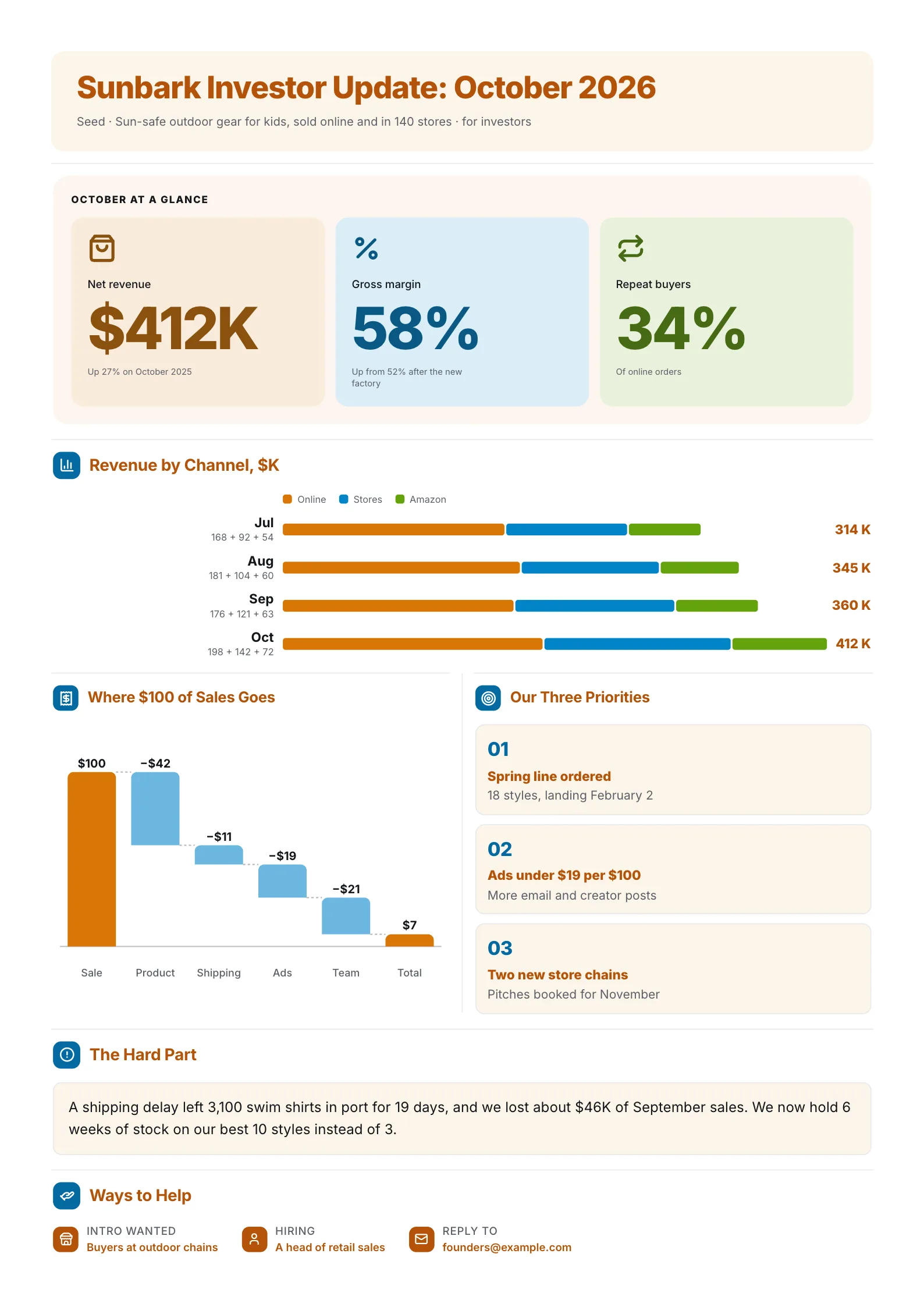 Investor Update: E-commerce BrandEdit for free(opens in a new tab)
We wanted to see how real companies do it, so we read three investor letters published in 2026. Berkshire Hathaway's 2025 letter runs 20 pages. Amazon's runs 7. Duolingo's Q2 2026 letter opens with a table of numbers. All three print a number that went down that year. Four sample updates from MakeOnepagers cover one stage each, a fifth covers a hard quarter, and each sits next to what a real letter at that stage does.
The three letters, side by side
| Letter | Published | Length | Where the year's results sit | A number that went down |
|---|---|---|---|---|
| Berkshire Hathaway 2025 letter | February 28, 2026 | 20 pages | Page 8 of 20 | Operating earnings, from $47.4 billion to $44.5 billion |
| Amazon 2025 letter | April 9, 2026 (annual report filed with the SEC) | 7 pages | The last page, under "Parting thoughts" | Free cash flow, from $38 billion to $11 billion |
| Duolingo Q2 2026 letter | August 5, 2026 | 23 pages with tables | Page 2, before the letter starts | Net income, from $44.8 million to $33.2 million |
Source: our read of each letter, October 30, 2026.
The two annual letters hold their numbers back and open with a story. The quarterly letter puts its numbers first. The split matches who reads them. Owners who hear from you once a year want your thinking, and investors who hear from you every month or quarter want your numbers fast.
Before revenue, lead with the number you're chasing
When you have no revenue yet, your update still needs a main number at the top. Pick the one that shows people want what you're building, and keep it in the same spot every month. Before anyone has invested, the page you send is an investor one pager, and the update takes over once they have.
 Edit this template
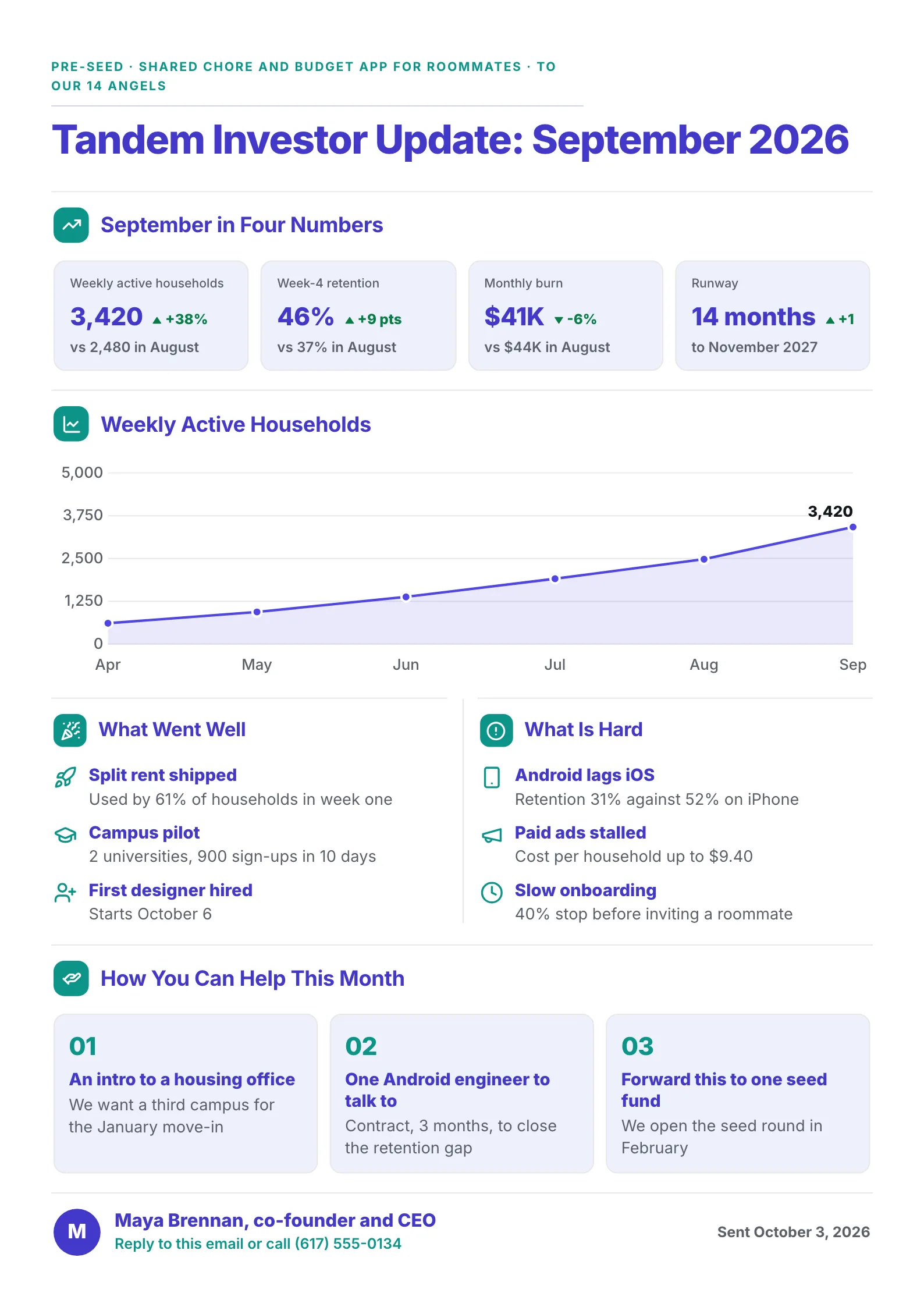
Tandem writes to its 14 angels with households, retention, burn and runway in the top row.
Tandem's September update is what this looks like for a team writing to its 14 angels. Its four numbers are weekly active households (3,420, up from 2,480), week-4 retention (46%, up from 37%), monthly burn ($41K) and runway (14 months, to November 2027). Each one shows last month beside it, so you see the direction without doing math.
Your angels will read the "What Is Hard" box first. Android retention sits at 31% against 52% on iPhone. Paid ads now cost $9.40 a household. And 40% of people stop before inviting a roommate. Those three lines say exactly where their help would land, and the asks below them match. Tandem wants an intro to a campus housing office and an Android engineer for a 3-month contract. It also asks investors to forward the update to one seed fund, since the round opens in February.
YC partner Tom Blomfield tells a story about this stage in his Key Startup Metrics talk. One founder he worked with sent ten monthly updates in a row with zero as the main number at the top. Putting a zero at the top every month is hard to read, and it keeps you honest about what you still have to fix.
First revenue, put revenue, burn and runway on top
Once money comes in, Blomfield's advice is specific. Revenue, burn rate and runway belong at the top of every investor update. His runway math is simple too. A million dollars in the bank with a $100,000 monthly burn is ten months.
 Edit this template
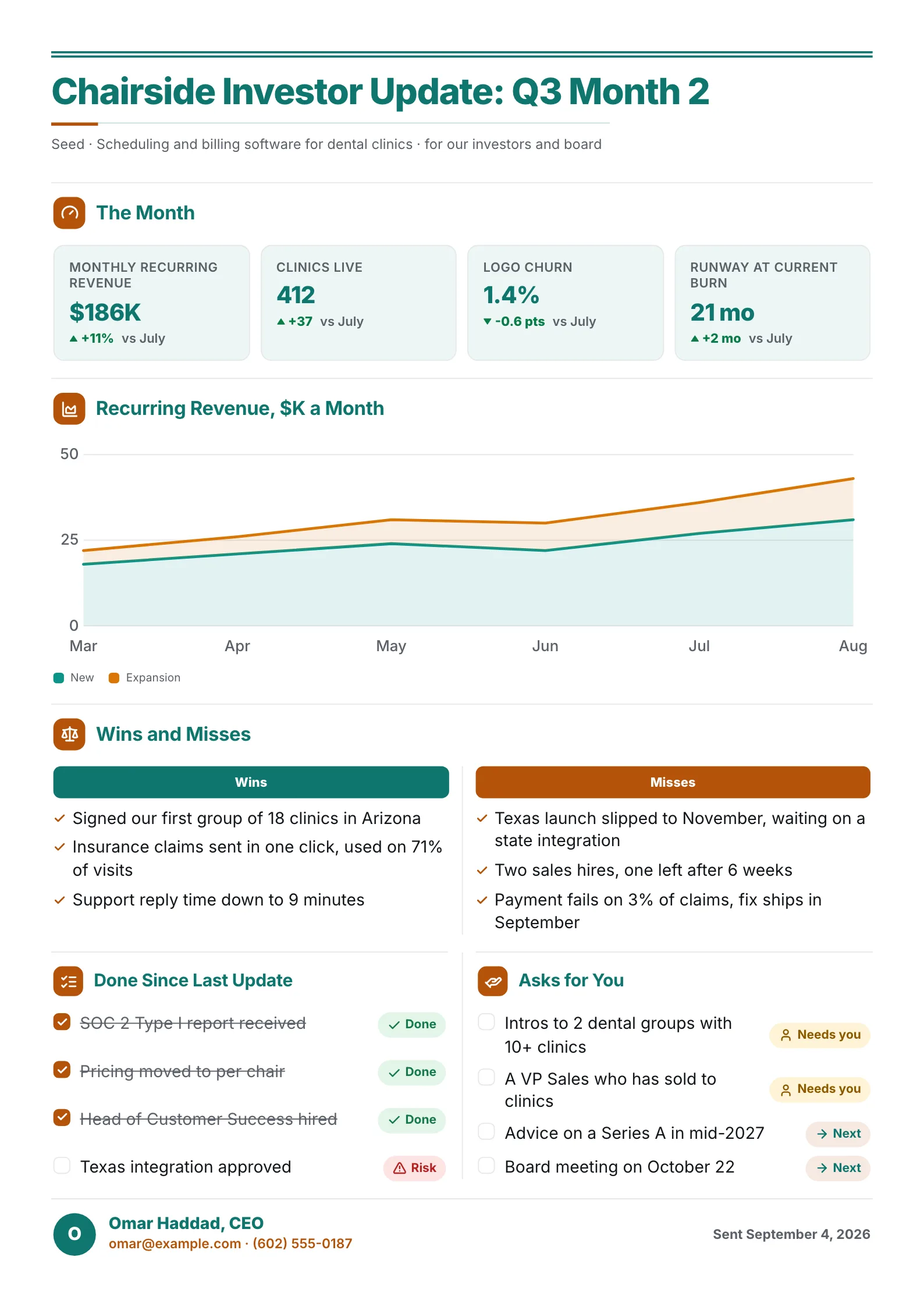
Chairside's August update splits revenue into new and expansion, so you can see where growth comes from.
If you run a SaaS company, start with Chairside. It sells scheduling and billing software to dental clinics. Its top row reads $186K of monthly recurring revenue, up 11% on July, with 412 clinics live and 1.4% logo churn. Runway is 21 months at current burn. The chart below splits each month's growth into new revenue and expansion, and expansion revenue went from $4K to $12K a month in six months.
Look at how the misses are written, because this is the part you'll be tempted to soften. The Texas launch slipped to November while it waits on a state integration. One of two sales hires left after 6 weeks. Payments fail on 3% of claims, with a fix due in September. Each miss names what happened and what's being done, in one line, so your investors never read a problem without its fix. The asks are just as concrete: intros to 2 dental groups with 10+ clinics, a VP Sales who has sold to clinics, and advice on a Series A in mid-2027.
Growing, show the plan beside the actual
By Series A, your investors have seen a plan, and they want to know how you're tracking against it. This is where a chart with two lines earns its space on your page.
 Edit this template
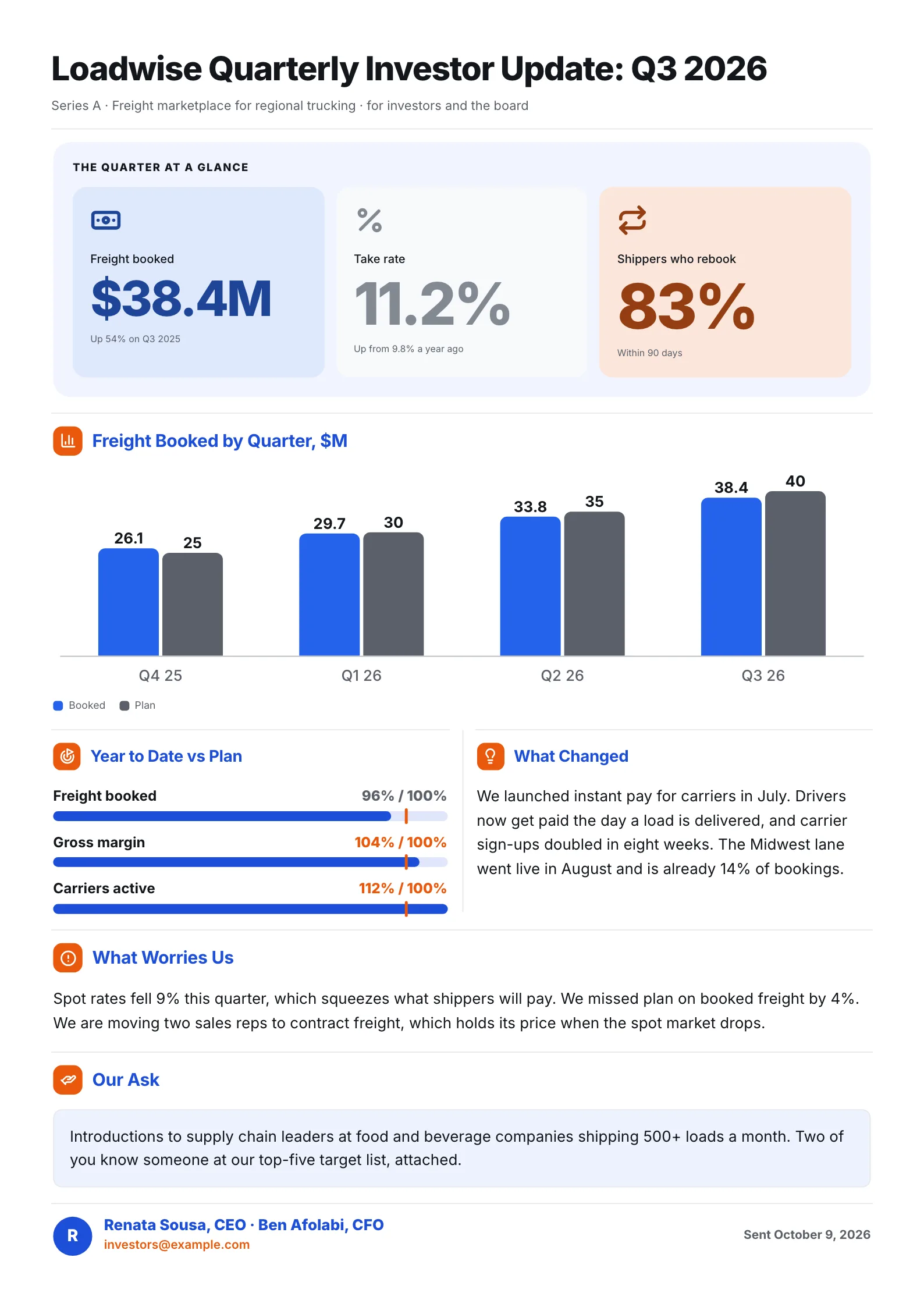
Loadwise's Q3 update plots each quarter's freight booked against its plan.
Loadwise booked $38.4M of freight in Q3, up 54% on a year earlier. Its chart shows four quarters of booked freight against plan: 26.1 against 25, then 29.7 against 30, 33.8 against 35 and 38.4 against 40. Year to date, freight booked sits at 96% of plan while gross margin is at 104% and active carriers at 112%. The "What Worries Us" box says it straight. Spot rates fell 9%, booked freight missed plan by 4%, and two sales reps are moving to contract freight to hold prices. If you've missed plan for three quarters, as Loadwise has, say so in a box like this before your investors spot it on the chart.
Duolingo's Q2 2026 letter does the same at a larger size. Before "Dear shareholders," page 2 is a table with each number for Q2 2025 and Q2 2026. Daily active users rose from 47.7 million to 58.7 million, up 23%. Revenue went from $252.3 million to $298.5 million. The letter then compares the year with the targets it set earlier in the year, 10 to 12% bookings growth and 15 to 18% revenue growth, and raises its margin outlook to about 26.5%. Once you've shared a plan with your investors, your update should always report against it.
Mature, write a letter to your owners
A business with many small owners has a different job. Your readers aren't deciding whether to fund your next round. They want to know their money is in good hands and what it's earning for them.
 Edit this template
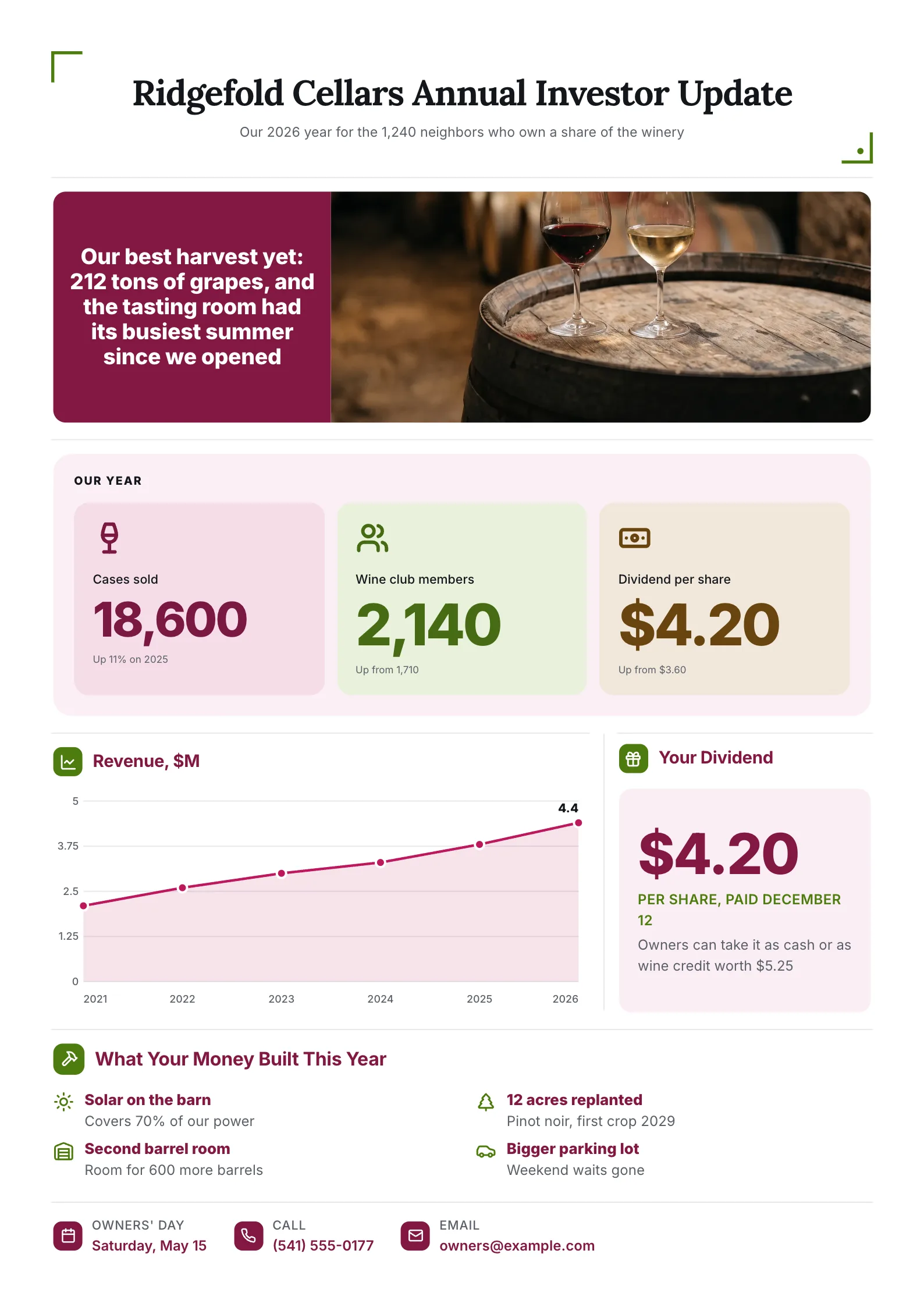
Ridgefold Cellars writes once a year to the 1,240 neighbors who own a share.
Ridgefold's annual update opens with the harvest, 212 tons of grapes. Cases sold reached 18,600, up 11%, and the wine club grew from 1,710 to 2,140 members. The dividend rose from $3.60 to $4.20 a share, paid December 12, and owners can take it as wine credit worth $5.25 instead. Then comes what the money built. Solar on the barn now covers 70% of the winery's power. A second barrel room holds 600 more barrels, and 12 acres are replanted with pinot noir that bears its first crop in 2029. Name what your owners' money built in things they could walk up to, the way Ridgefold names a barrel room and 12 acres of vines.
You can see the same habit in Berkshire's letter on a far bigger scale. It opens "To My Fellow Berkshire Shareholders" and spends its first pages on culture and stewardship before a single result. Operating earnings arrive on page 8. The letter closes by inviting owners to the annual meeting in Omaha on May 2, 2026. Amazon's letter also starts with a story, about Andy Jassy wanting to be a sportscaster after college, and saves its revenue and cash numbers for the last page. Your owners' update can take the same shape on one page. Start with the year in a line, then the numbers and what you built, and end with when they'll see you next.
How the real letters deliver bad news
Every one of the three letters you just met reports a number that fell. None of them hides it in a footnote, and each gives the reason in the next sentence.
- Berkshire names the miss and owns it. Operating earnings of $44.5 billion are reported as "below $47.4 billion in 2024." On Kraft Heinz, the letter says the investment "has been disappointing." Back on page 4, the letter promises, "When we fail, we will say so."
- Amazon gives the cause and the size. Free cash flow fell from $38 billion to $11 billion. The next words explain it: a $50.7 billion rise in spending on property and equipment, mostly for AI.
- Duolingo ties the drop to a choice. Net income fell from $44.8 million to $33.2 million, and adjusted EBITDA margin from 31.2% to 25.9%. The letter calls that margin a "deliberate choice to invest in user growth" and says the decline is within its expectations.
Each one follows the same order. They give the number, then the reason, then what happens next. In your update, give the reason in the sentence right after the number.
 Edit this template
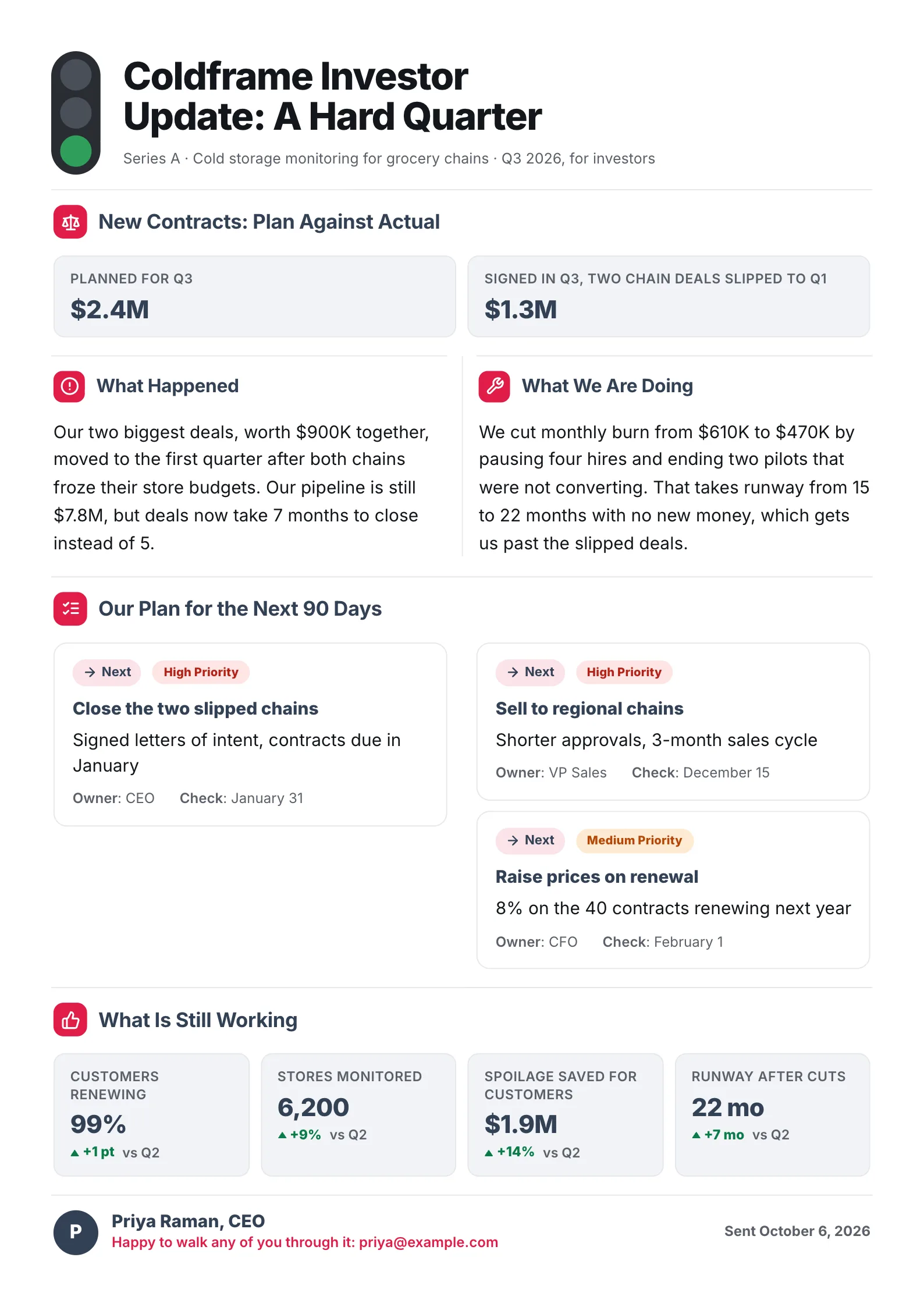
Coldframe's hard quarter puts the miss in the top box and the fix right under it.
If you're writing after a bad quarter, start from Coldframe. Its update is titled "A Hard Quarter," and its first box shows $1.3M of new contracts against a $2.4M plan. The next box explains it. Its two biggest deals, worth $900K together, moved to the first quarter after both grocery chains froze their store budgets. The third box covers what the team did about it. Monthly burn dropped from $610K to $470K, enough to carry the company past the two slipped deals with no new money. The 90-day plan gives each fix an owner and a check date. At the bottom, a row of numbers shows what's still working, with 99% of customers renewing. Your investors will read a hard quarter calmly when they can see the plan on the same page.
Questions founders ask about investor updates
How often should I send an investor update?
Monthly while you're at pre-seed or seed, and quarterly once you've raised a Series A. Tandem and Chairside write every month. Loadwise writes every quarter, and so does Duolingo, on a much larger scale.
How long should an investor update be?
For a startup, one page. Your investors get dozens of these, and the ones they finish are short enough to read before their next meeting. The 20-page Berkshire letter works because it comes once a year to owners who look forward to it. A monthly update can't ask for that much time. Our one-page investor template post breaks that page into its six parts, ready to copy.
Should I send an update when nothing changed?
Yes. Blomfield's founder with ten months of zero shows that a flat month is still worth sending. Keep your numbers in the same order, so a flat line is easy for you to see and for them to help with.
What should the ask in an investor update be?
Something one reader can do this week. Chairside asks for intros to 2 dental groups with 10 or more clinics. Loadwise asks for supply chain leaders at food and beverage companies shipping 500+ loads a month. A named type of person beats "any help is welcome."
Put the send date on your calendar
Blomfield's founder sent ten monthly updates in a row. Give yours a fixed day, say the fifth, and block an hour for it now.
Put the month in your subject line, as in "Tandem update, September 2026," so your investors can find any past update in one search.




