How to Write an Executive Brief That Gets a Decision
We read 6 two-page briefs that the Congressional Research Service wrote for Congress. All are dated and name their authors, and none makes a recommendation.

An executive brief gives a leader what they need to decide in a few minutes. You say what the issue is, why it matters now, the action you're asking for and the few facts that back it. Then you stop. Most of the work is deciding how much to leave out. Start from a free one pager template.
One‑Pager examples
Real One-Pagers made with MakeOnepagers. Open any one to edit it as your own.
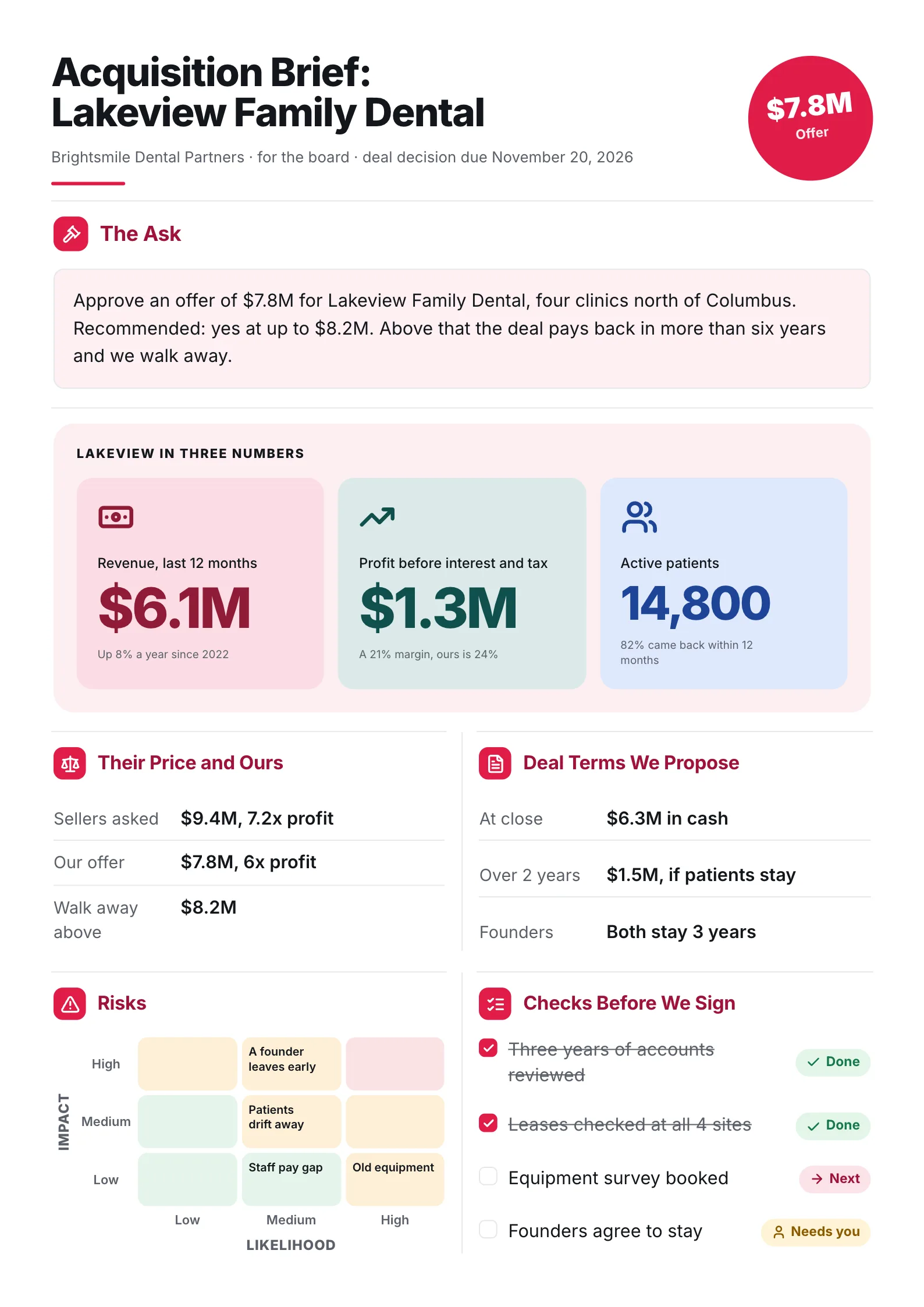 Executive Brief: Acquisition DecisionEdit for free(opens in a new tab)
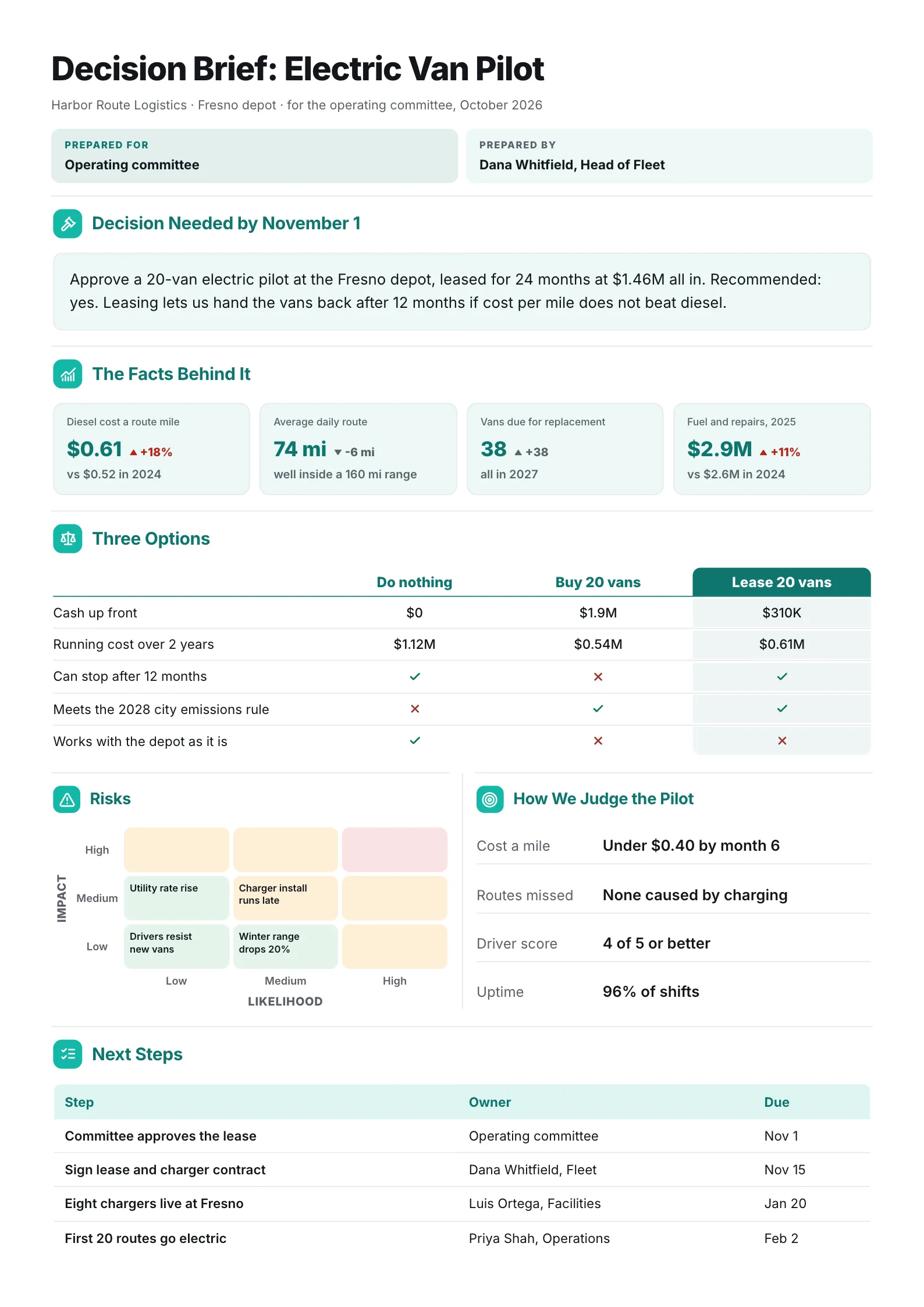 Executive Brief: Fleet Pilot DecisionEdit for free(opens in a new tab)
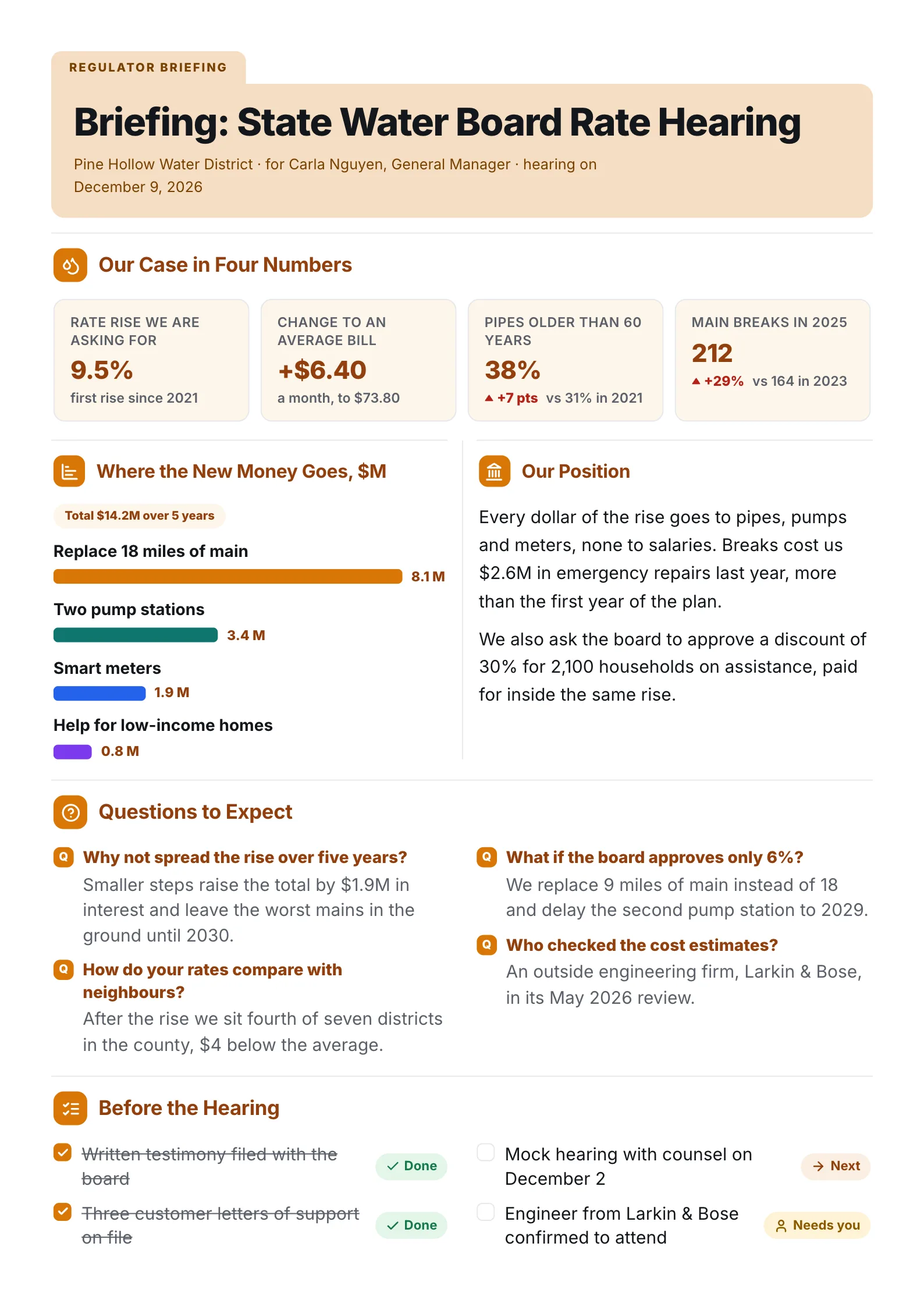 Executive Brief: Regulator HearingEdit for free(opens in a new tab)
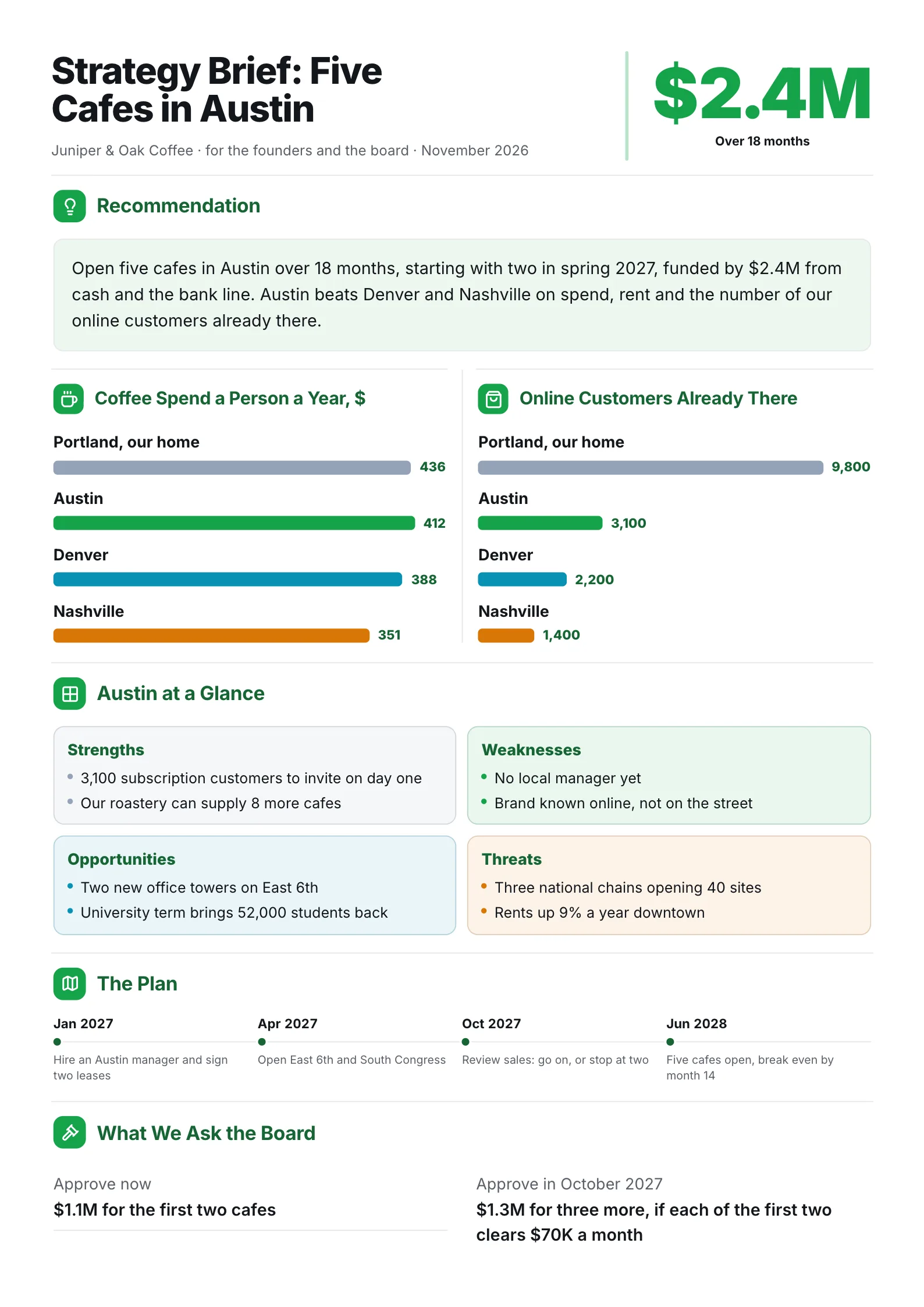 Executive Brief: Market Entry StrategyEdit for free(opens in a new tab)
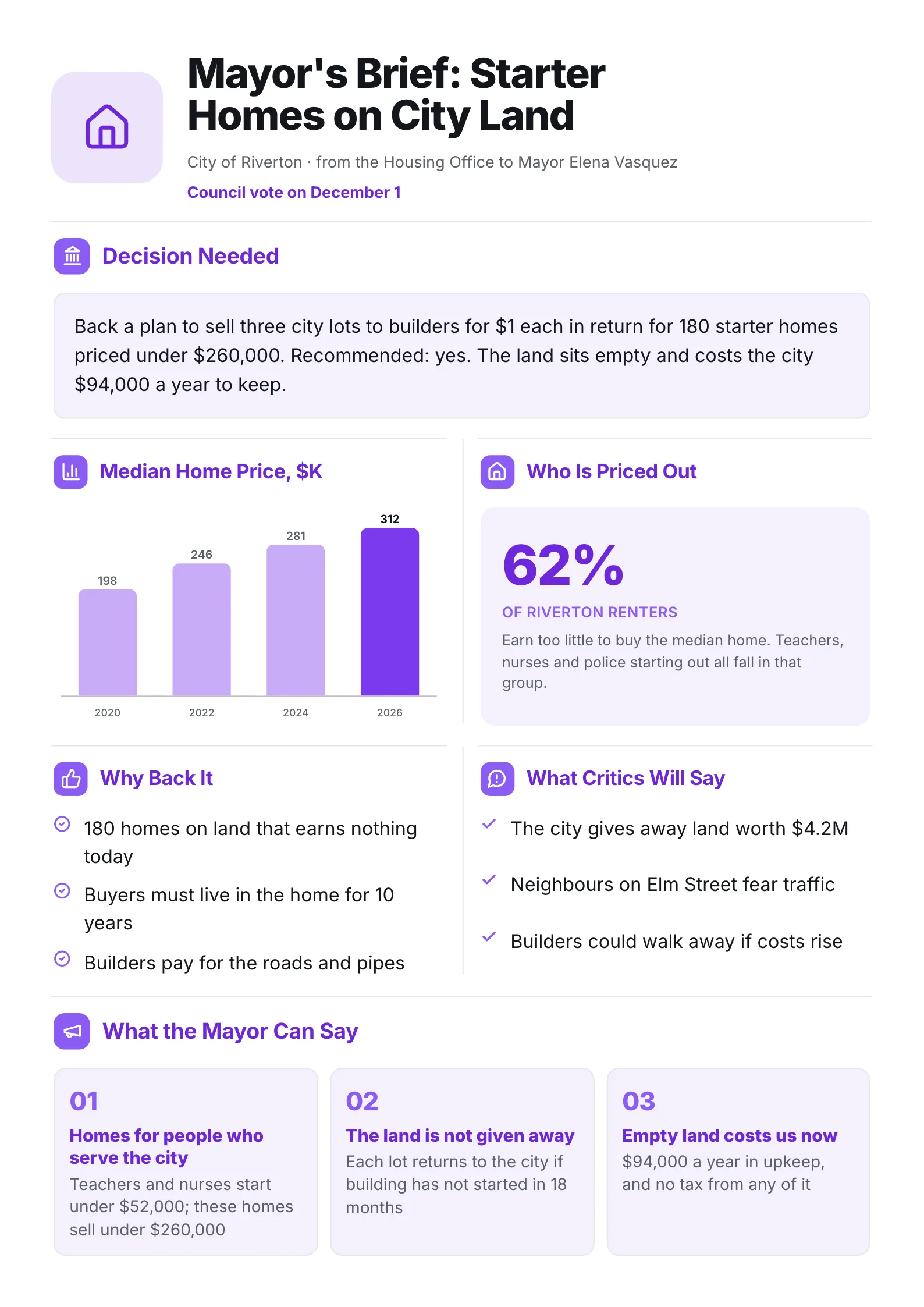 Executive Brief: Mayor Policy DecisionEdit for free(opens in a new tab)
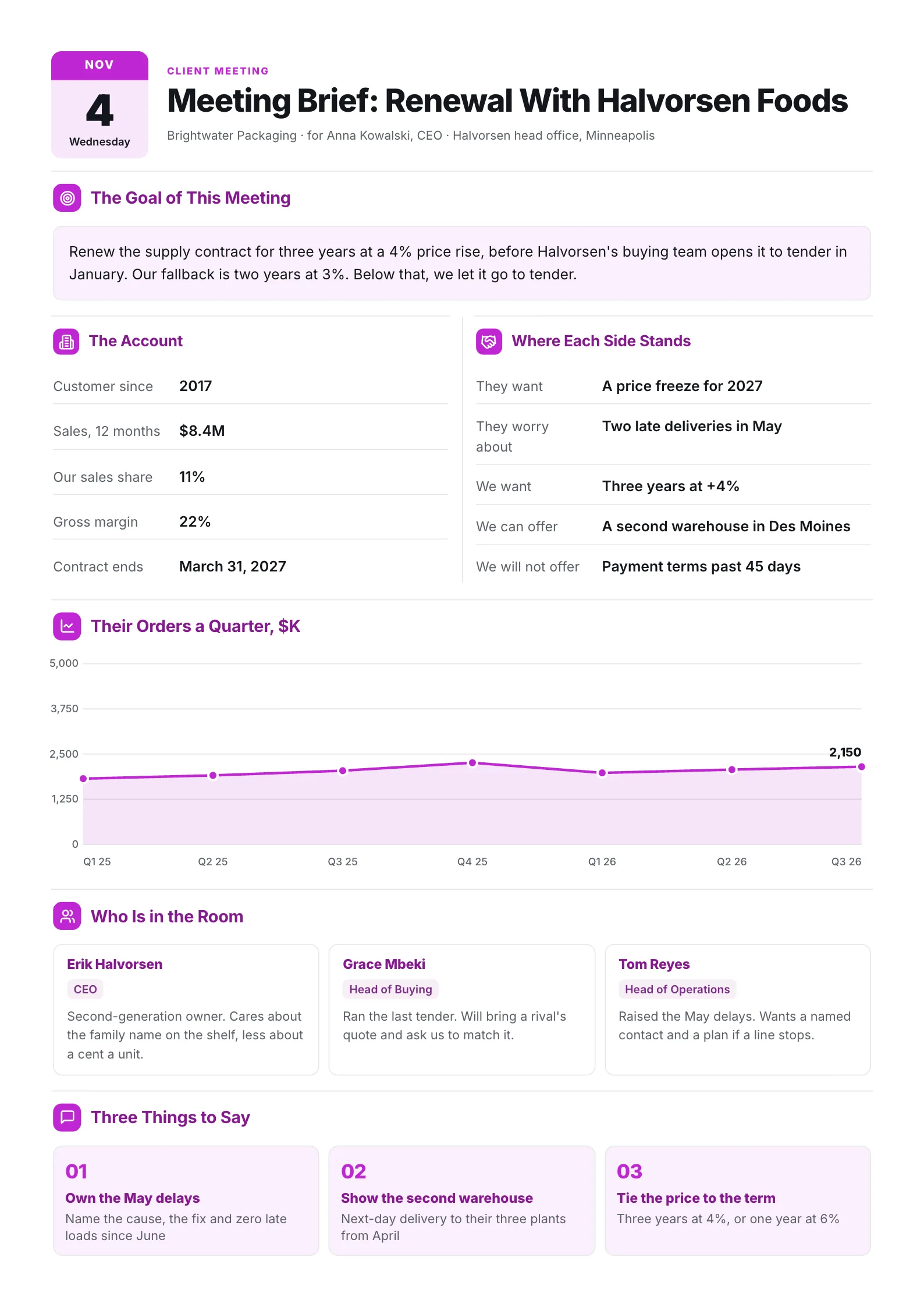 Executive Brief: Client MeetingEdit for free(opens in a new tab)
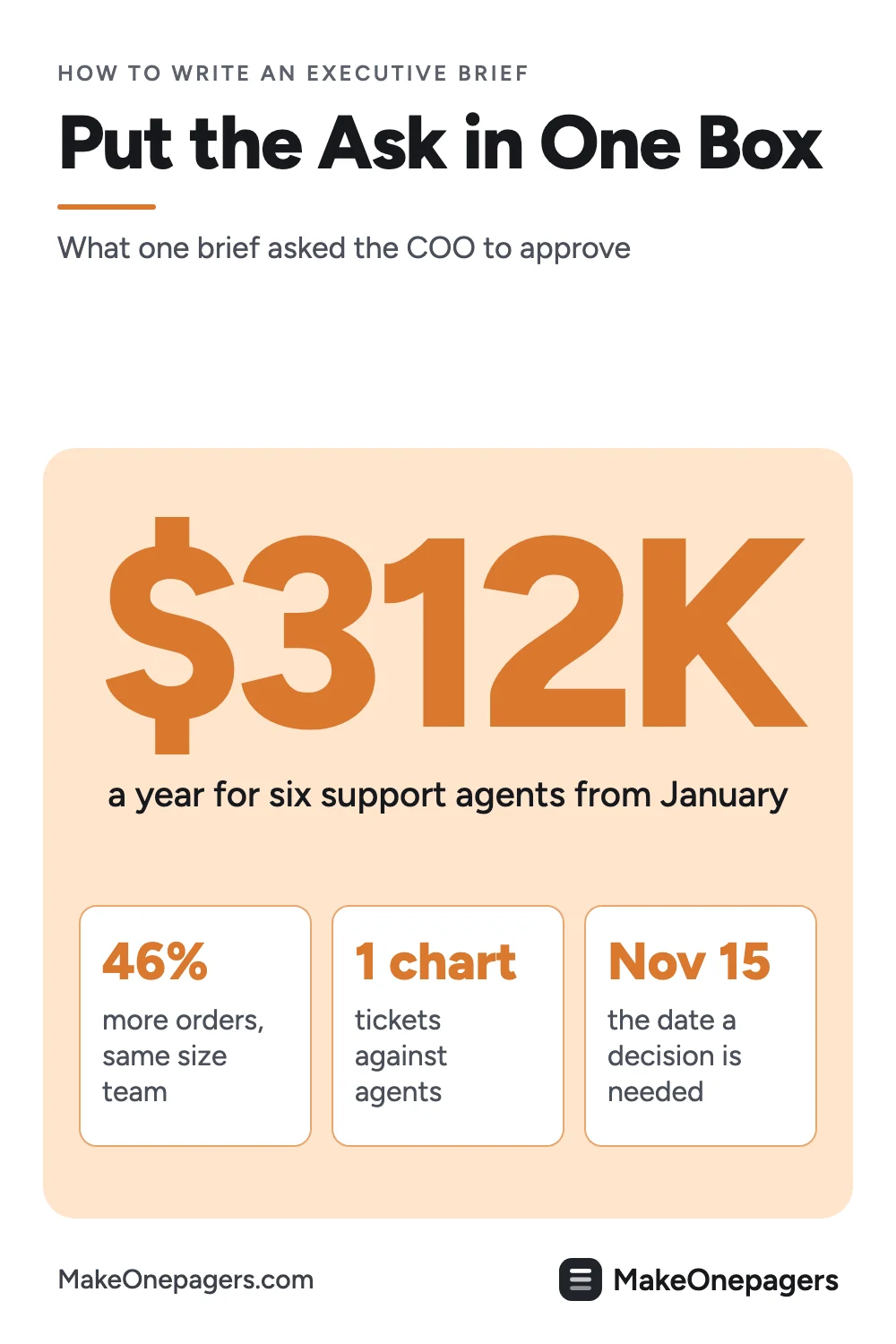
We read 6 In Focus briefs from the Congressional Research Service, the research office that writes for members of Congress. They cover topics from space launch contracts to a Treasury emergency fund. All 6 run two pages of text. All 6 carry a date and the authors' names and titles. All 6 open by saying what the subject is. None of them recommends a choice, which makes sense for a research office. For your executive brief, that missing part is the one your reader most needs.
The header: date, sender and reader
Every brief we read opens with a date. Every one names its authors with their titles, like "Analyst in Environmental Policy" or "Specialist in Health Policy." Your reader will want to know how fresh the facts are and who to call with a question.
So start your executive brief with three lines. The date, who it's from and who it's for. Add the meeting or deadline it's meant for if there is one. "From the CFO to the CEO, for the December 3 budget meeting" tells your reader when they'll need to decide.
The issue, and why it matters now
All six briefs open by defining the subject. The one on Treasury's Exchange Stabilization Fund starts by saying it's an emergency reserve fund created by Congress in 1934. The one on EPA water programs opens with the concern about aging water systems, then gives EPA's estimate. Wastewater and stormwater systems need $630.1 billion over 20 years.
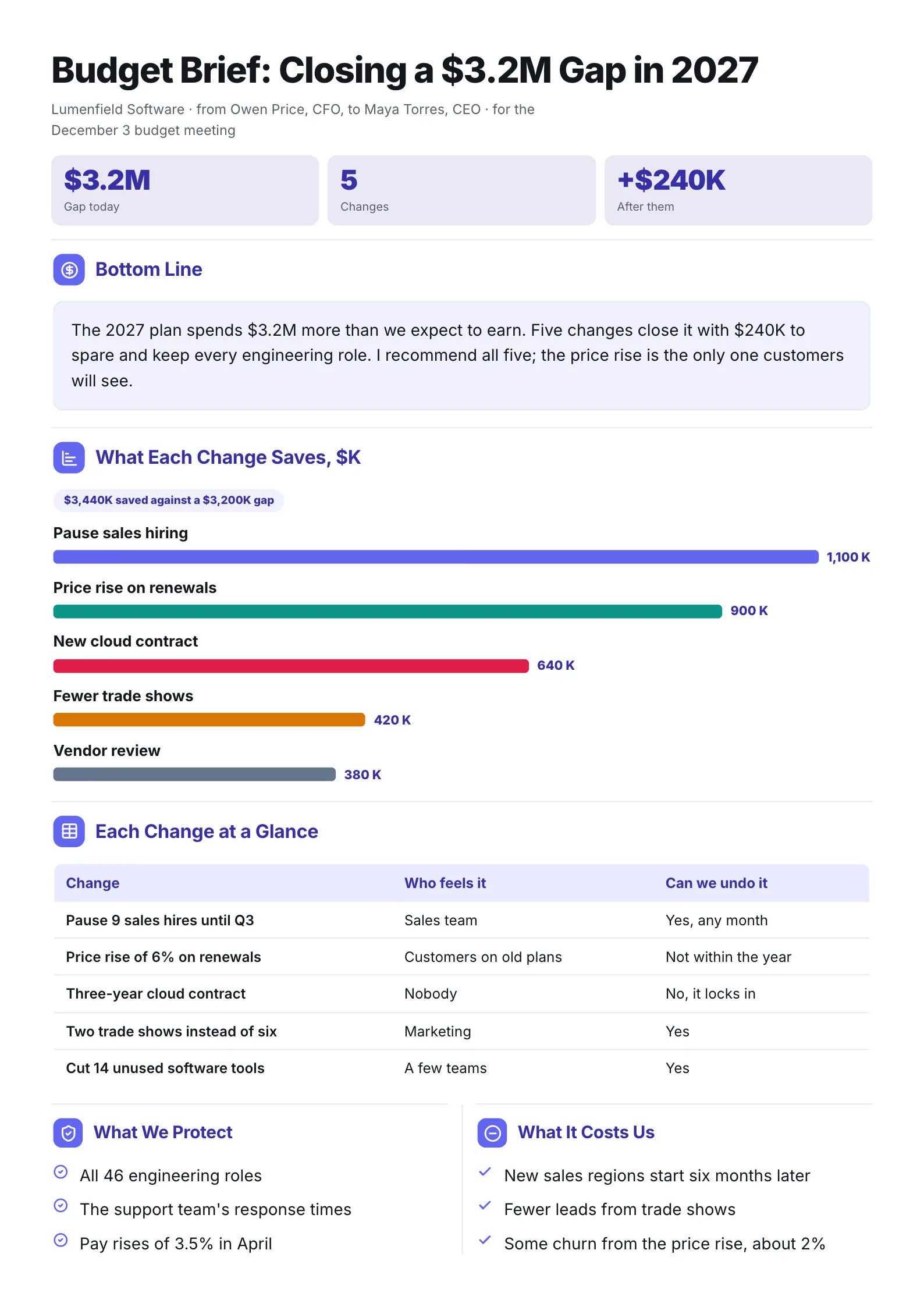
Do the same in two or three sentences. Name the issue and give the one number that makes it urgent. A line like "The 2027 plan spends $3.2M more than we expect to earn" is enough. If your reader stops after this, they should still know why the brief exists.
 Edit this template
Sample names and figures. The bottom line names the gap, the fix and the recommendation in three sentences.
The ask, in one box
The congressional briefs have no ask, because they're written to inform. Your reader is a decision maker, so give them a decision. Write it as one or two sentences in a box near the top. Say what you want approved, how much it costs and what it gets.
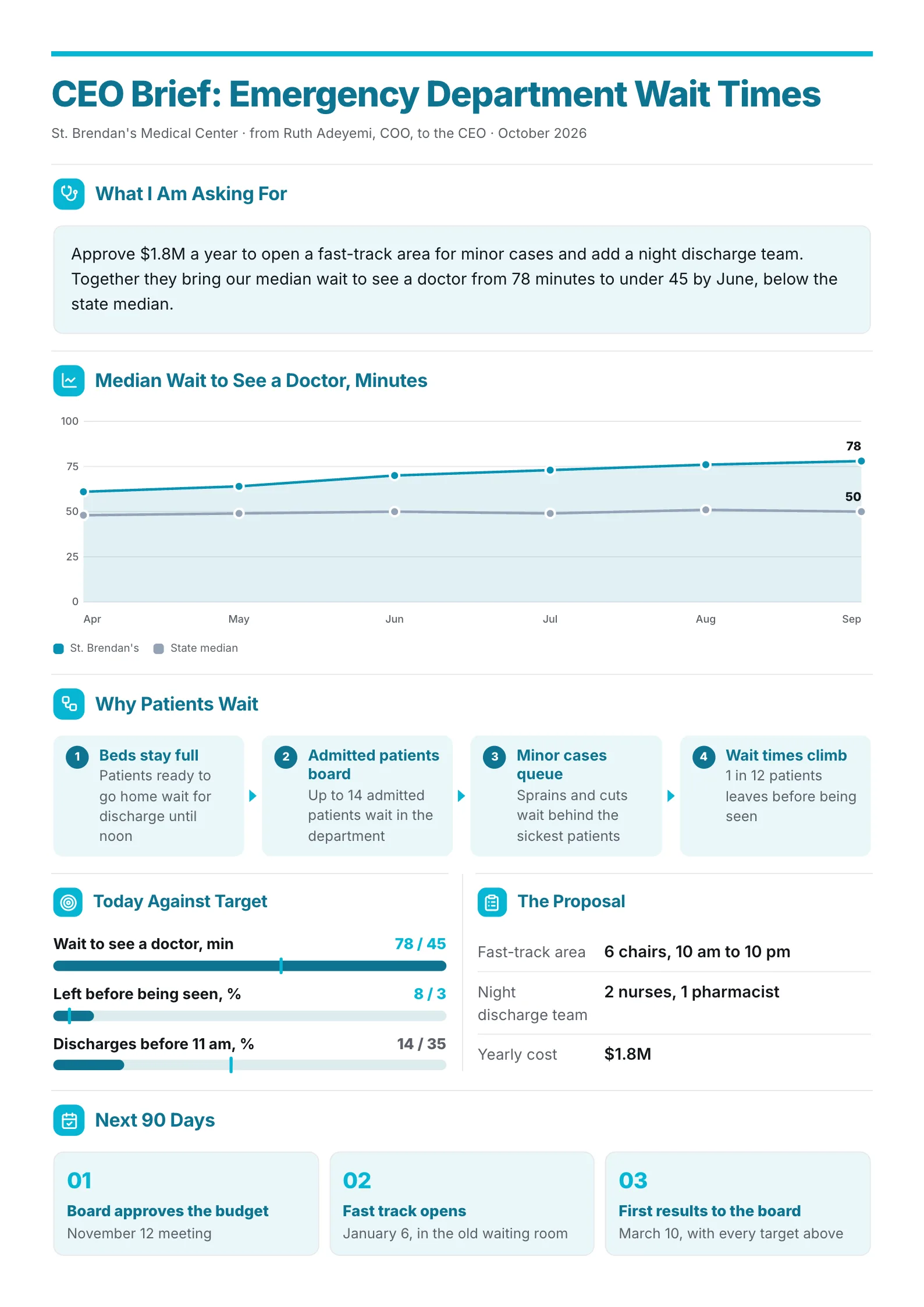
"Approve $1.8M a year to open a fast-track area and a night discharge team, bringing the median wait from 78 minutes to under 45 by June." That one sentence carries the ask, the cost and the result. Any condition you attach goes in the next line.
 Edit this template
Sample names and figures. The ask sits in the first box with its price and its target, before any background.
 Edit this template
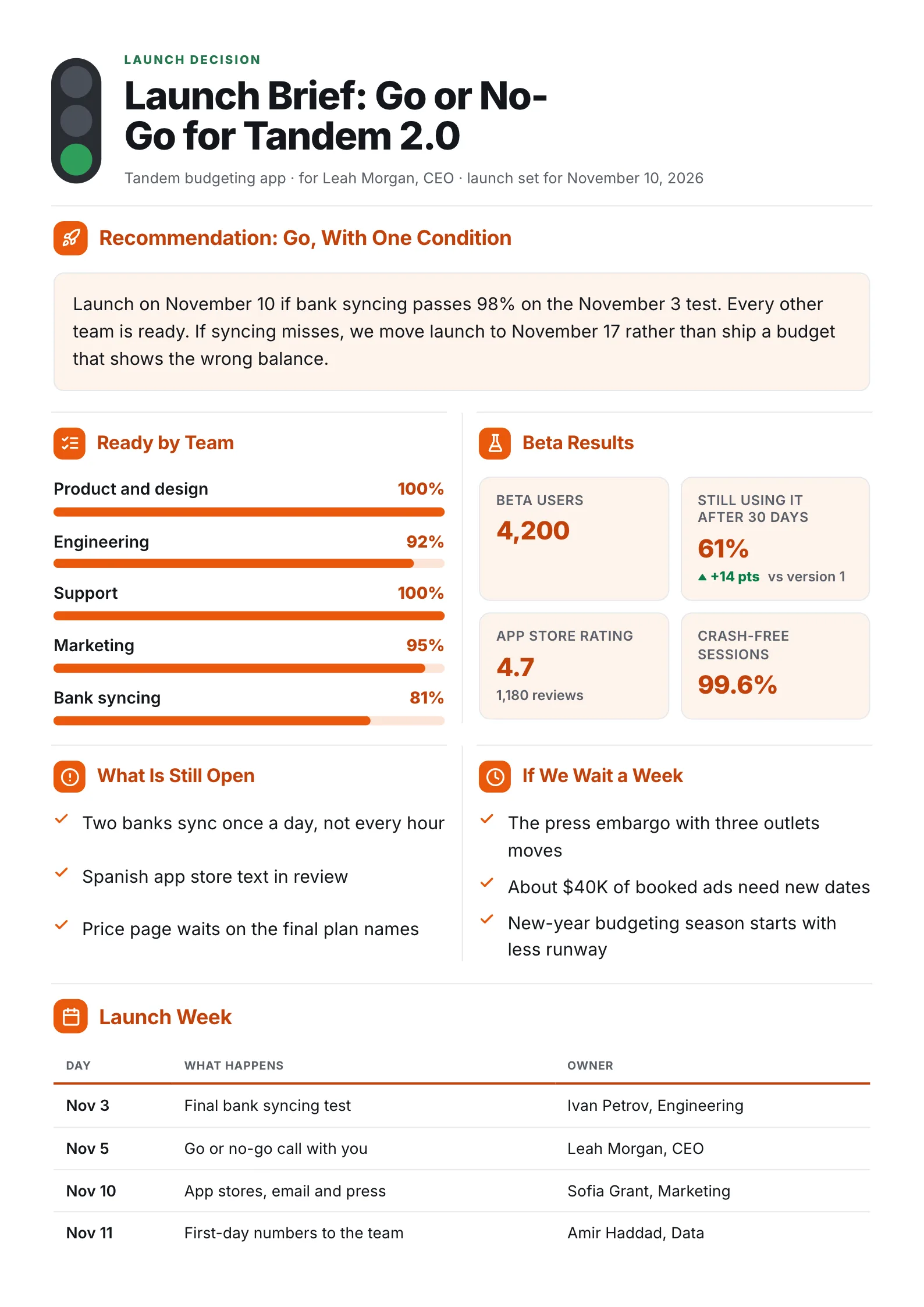
Sample names and figures. The recommendation names its one condition and the fallback date, so the CEO decides once.
Background under plain headings
The congressional briefs use short headings to split the background. The space launch brief moves from how the program evolved to the issues for Congress. The South Korea brief covers the history of the agreements, then the legal questions. Each section is a few short paragraphs.
Pick two or three headings your reader would ask about. "What happened," "What we've done" and "What it costs" cover most briefs. Keep each to three or four sentences. If a fact doesn't support your ask or explain a risk, leave it for an appendix.
 Edit this template
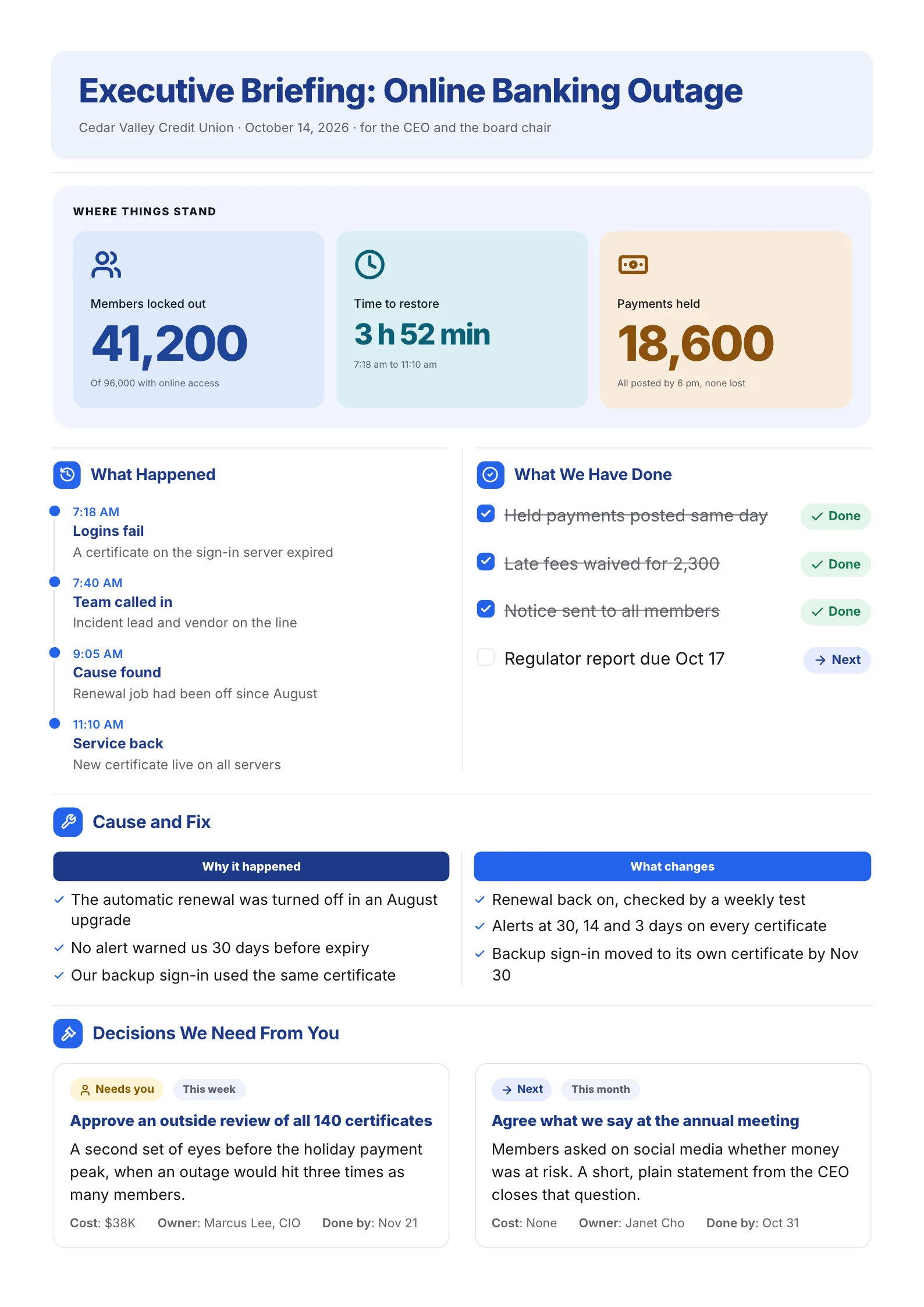
Sample names and figures. Three numbers answer the board's first questions before the timeline explains the cause.
One chart or table
Five of the six briefs include one table, figure or map, and none has more than one.
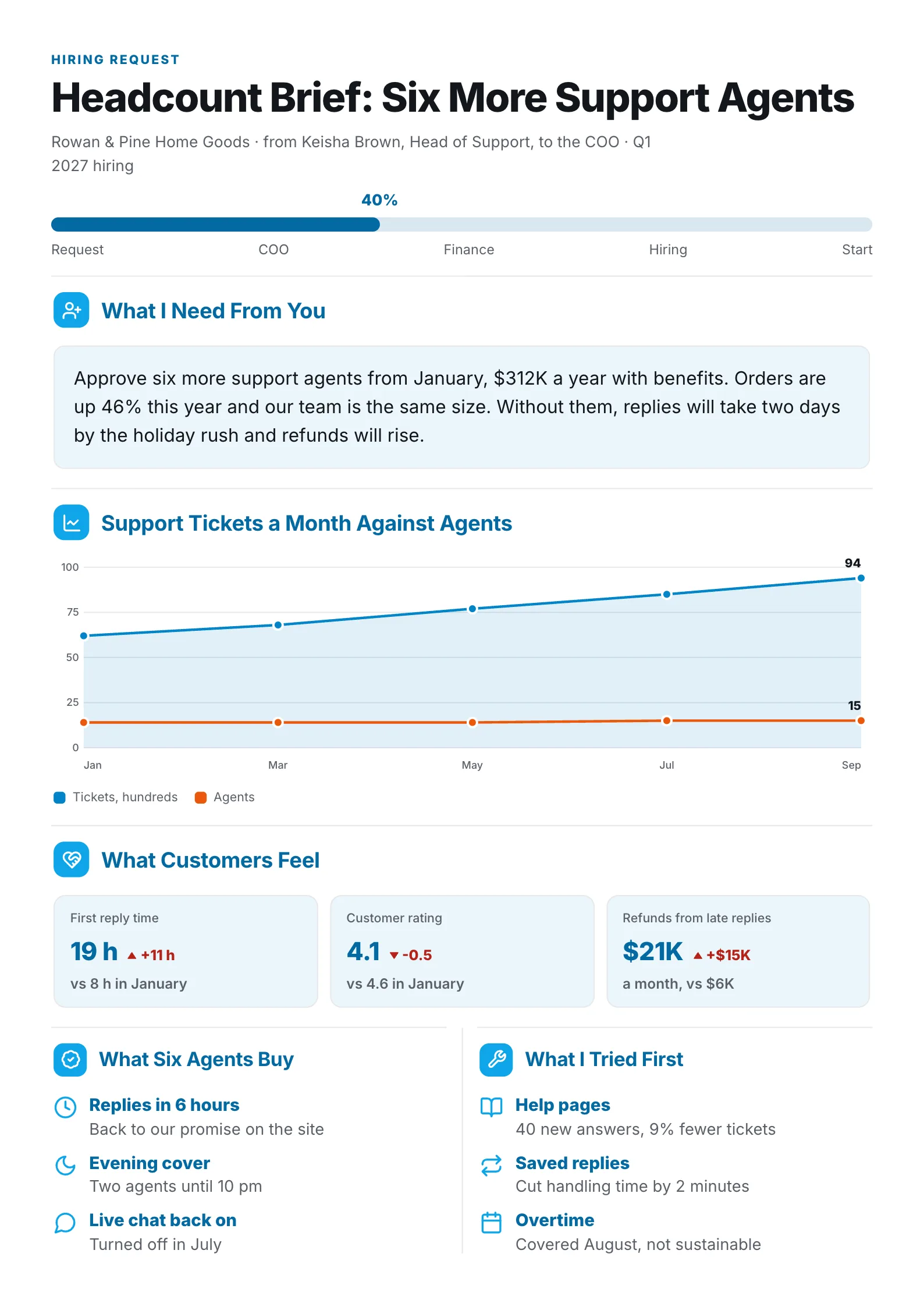
Pick the one picture that makes your case. A trend line for a growing problem, a bar chart of what each option saves or a small table of options. Label it with a plain title that says what to see, like "Support tickets a month against agents." Your reader should get the point from the title alone.
 Edit this template
Sample names and figures. One chart shows tickets rising while agents stay flat, which is the whole argument.
Here's that headcount request written two ways, as a first draft and as a version ready for the COO. The figures are made up.
| Part of the brief | First draft | Sent to the COO |
|---|---|---|
| Header | Support staffing update | Q1 hiring, from head of support to COO, October 30 |
| Opening | Support has been very busy | Orders are up 46% and the team is the same size |
| Ask | We may need more people | Approve six agents from January, $312K a year |
| Proof | Several paragraphs | One chart of tickets against agents |
| Close | Happy to discuss | Decision needed by November 15 |
The COO can say yes or no to the second version in one meeting, because the cost, the reason and the deadline are all on the page.
One page, two at most
All six congressional briefs fit their text on two pages. Three close with a section on issues or considerations for Congress, the questions a member might act on.
For an executive brief, aim for one page and use two only if you must. End with the next step and its date, like "Decision needed by December 3." Then read it as your boss would, in two minutes. If they'd have to ask what you want, move the ask higher.
Here is everything the six briefs share, and the one row where yours should differ.
| What the brief does | Briefs that do |
|---|---|
| Dated at the top | 6 of 6 |
| Named authors with their job titles | 6 of 6 |
| Opens by defining the subject or the problem | 6 of 6 |
| Two pages of text or less | 6 of 6 |
| A table, figure or map | 5 of 6 |
| A closing section on issues for the reader | 3 of 6 |
| A recommendation | 0 of 6 |
Source: MakeOnepagers read of 6 Congressional Research Service In Focus briefs, October 30, 2026. Each one is linked further down.
So keep the habits all six share, and add the one part a decision maker needs from you, the ask.
A fill-in outline for your next brief
If you're starting from a blank page, copy these six lines and fill them in order.
- Header: the date, from you, to your reader, for which meeting.
- Issue: what's happening, in one sentence with one number.
- Ask: what you want approved, what it costs and what it gets.
- Background: two or three short sections under plain headings.
- Proof: one chart or table with a title that states the point.
- Next step: the decision you need and the date you need it by.
Most briefs need nothing more than those six lines and the one chart. If a fact won't fit under any of them, it probably belongs in an appendix.
The congressional briefs prove you can cover a complex subject in two pages. Most business decisions fit in one. Put the header and the ask at the top, the background in two or three short sections, one chart and the next step at the bottom.
Every executive brief design in MakeOnepagers opens with a bottom-line box for your ask, then a chart and short labeled sections for the background. Pick a starting layout from our executive brief template post. The policy brief template post handles the format for a brief you send to an elected official or a public board.
Read the 6 congressional briefs
| Brief | Date | Authors' role |
|---|---|---|
| Defense Primer: National Security Space Launch | February 5, 2025 | Analysts in science and technology policy and in defense policy |
| EPA Water Infrastructure Programs and FY2025 Appropriations | March 27, 2025 | Analyst and specialist in environmental policy |
| India-Pakistan Conflict in Spring 2025 | May 13, 2025 | Specialist in South Asian affairs |
| U.S.-South Korea Special Measures Agreements | July 1, 2025 | Analyst in foreign affairs and a legislative attorney |
| The United States Preventive Services Task Force | September 12, 2025 | Specialist and analyst in health policy |
| Treasury's Exchange Stabilization Fund | April 9, 2026 | Specialists in macroeconomic policy and in international trade and finance |
All six come from the Congressional Research Service, and each PDF runs three pages, two of text and one of standard notices. We downloaded and read them on October 30, 2026.
Send the brief the day before you need a yes
Write the date, your name and the reader at the top. Say what the issue is with one number, then put your ask in a box. Add two short sections, one chart and the decision date. In MakeOnepagers, type the ask into the top box before anything else, then send the page the day before the meeting.
Frequently asked questions
What is an executive brief?
It's a short document built so a leader can make one decision. It names the issue, states the ask and gives just enough evidence to support it. Most fit on one page.
How long should an executive brief be?
One page is best and two is the most. The six congressional briefs we read cover complex topics in two pages of text.
What's the difference between an executive brief and an executive summary?
An executive summary is a shorter version of a longer report. An executive brief has no report behind it and exists to get a decision, so you can send it on its own.
Should an executive brief include a recommendation?
Yes, if you want a decision. The congressional briefs leave it out because they're written to inform. Your reader is waiting for your view, so put it near the top.




