How to Write a Project Summary: What 7 Funders' Rules Agree On
How to write a project summary, from 7 funders' own rules: every one caps the length, 6 ask how the work gets done, and only 1 asks what it costs.

One sentence carries most of a project summary, the one that says who will do what, how, and why it matters. Then you write the goal, the work, the result and who gains from it, and stop at a set length. We checked that recipe against the people who read the most project summaries of anyone: grant makers. Start from a free one pager template.
One‑Pager examples
Real One-Pagers made with MakeOnepagers. Open any one to edit it as your own.
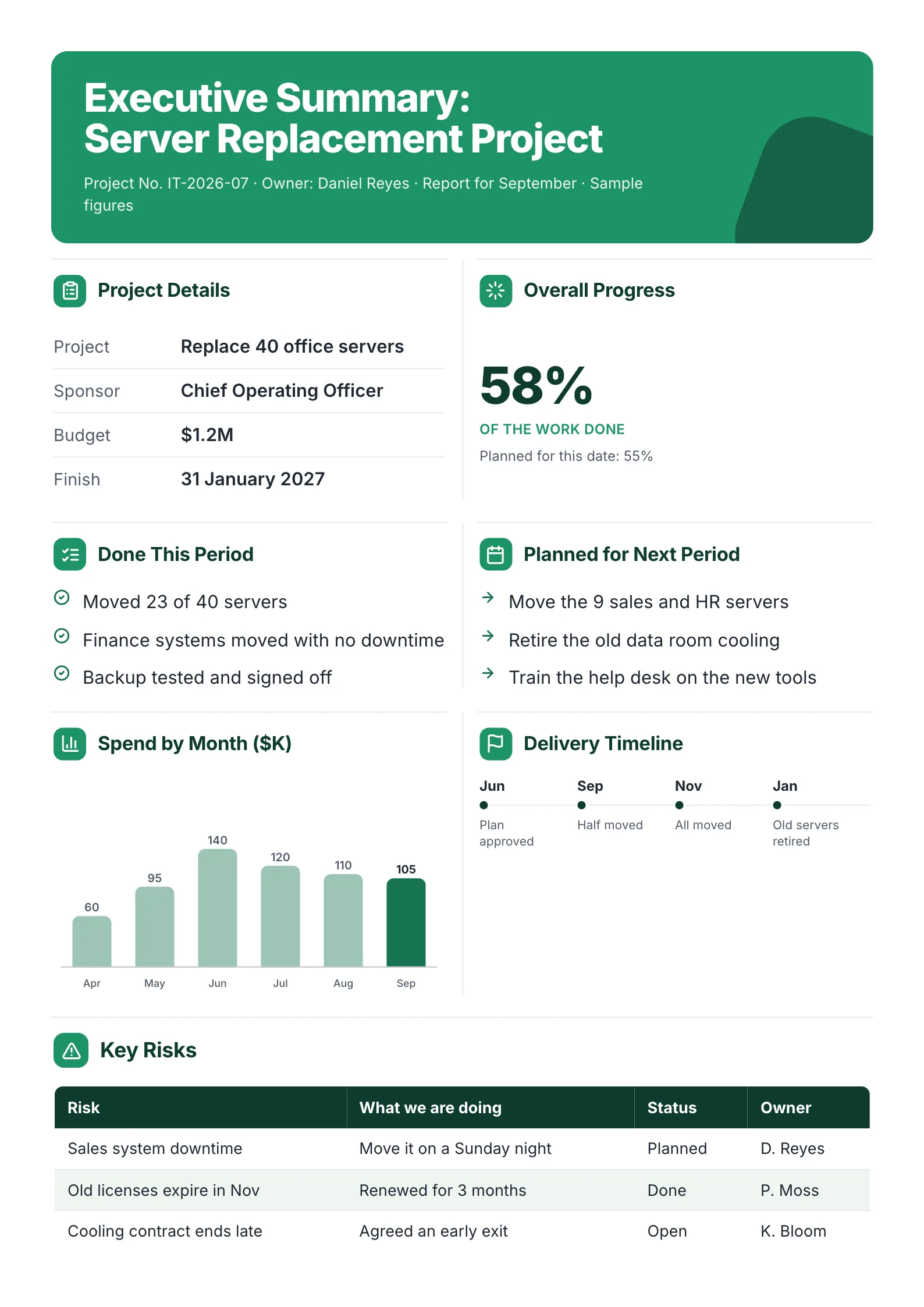 Executive Summary of a Project ReportEdit for free(opens in a new tab)
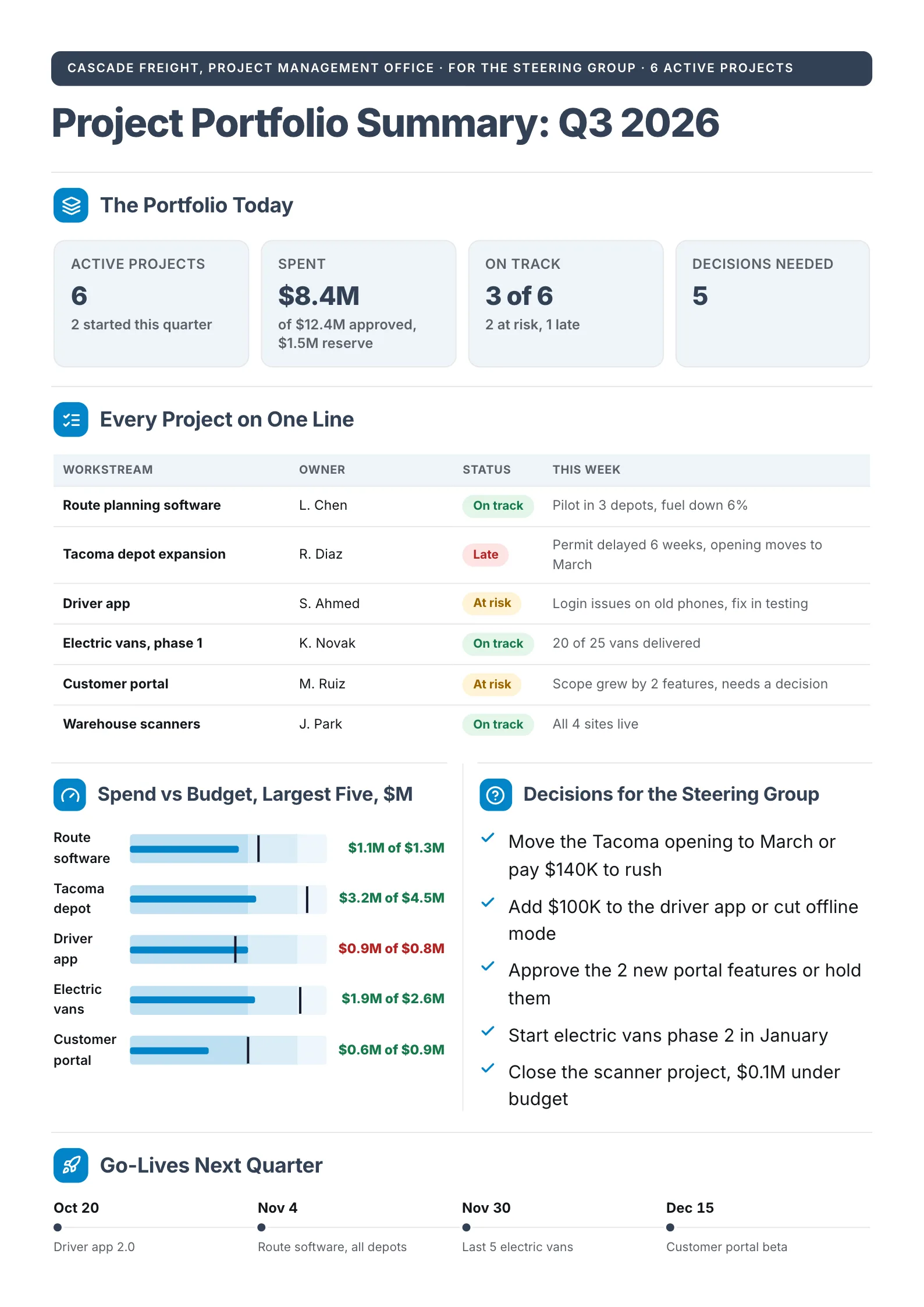 Project Summary: PortfolioEdit for free(opens in a new tab)
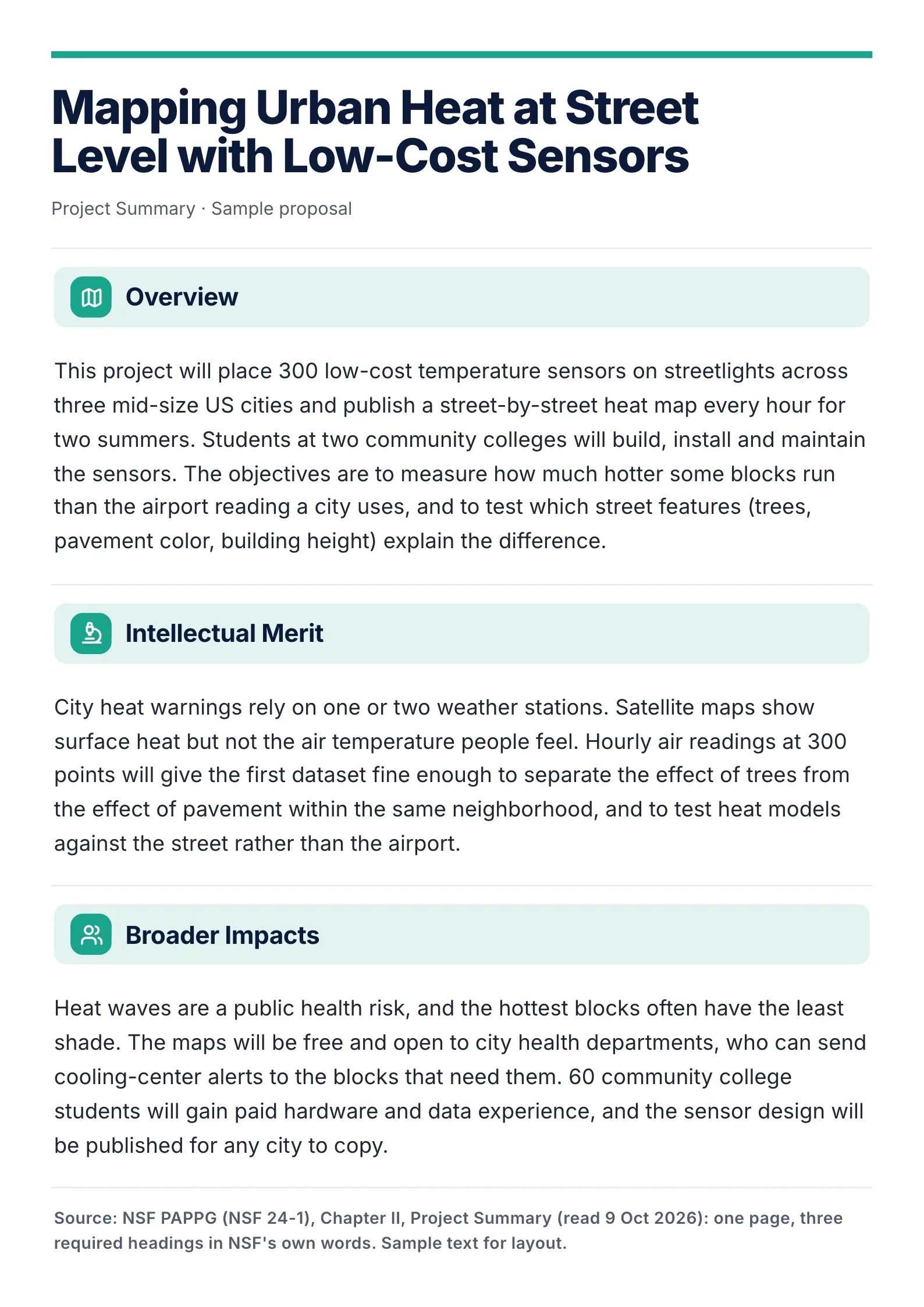 Research Project SummaryEdit for free(opens in a new tab)
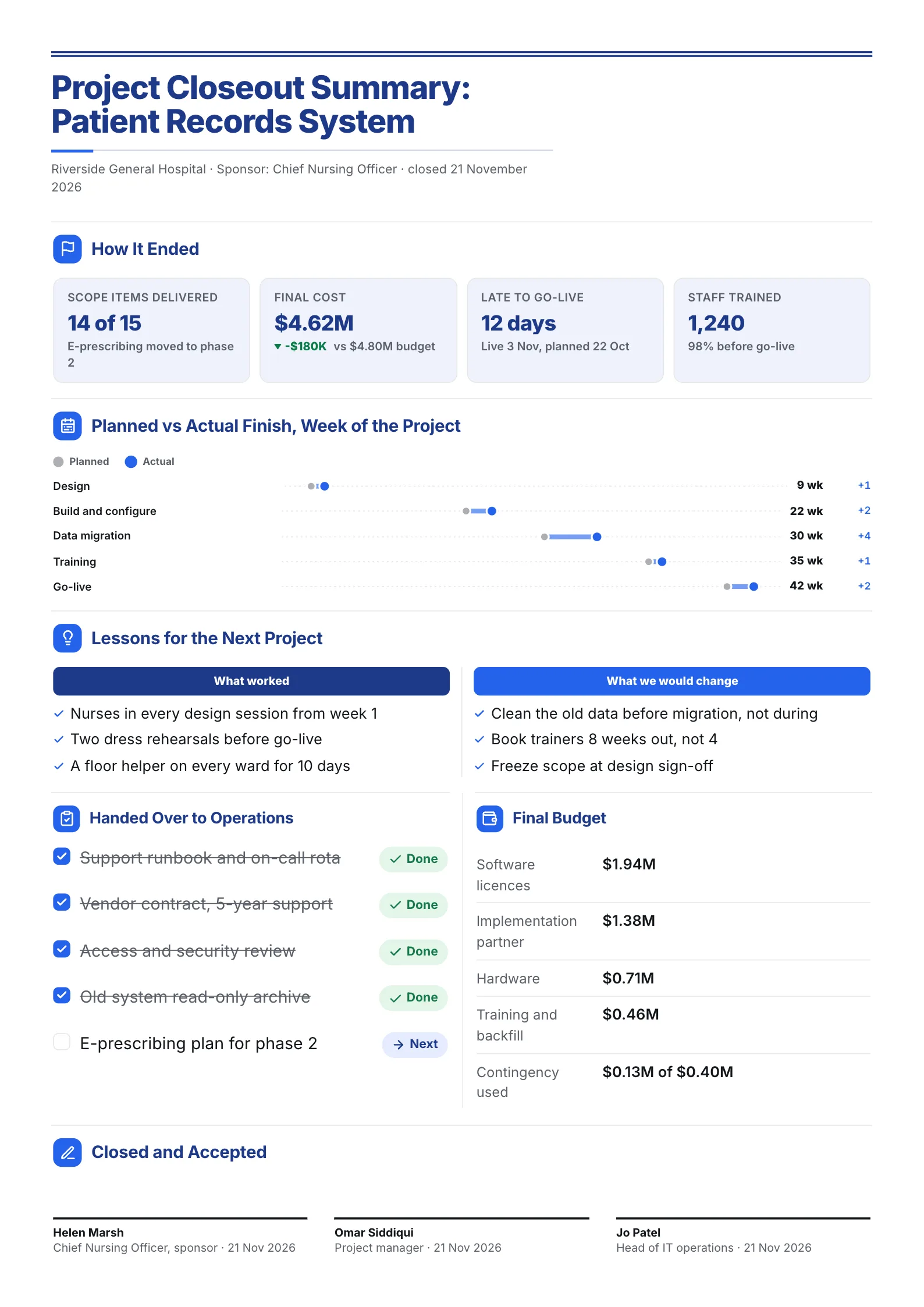 Project Summary: CloseoutEdit for free(opens in a new tab)
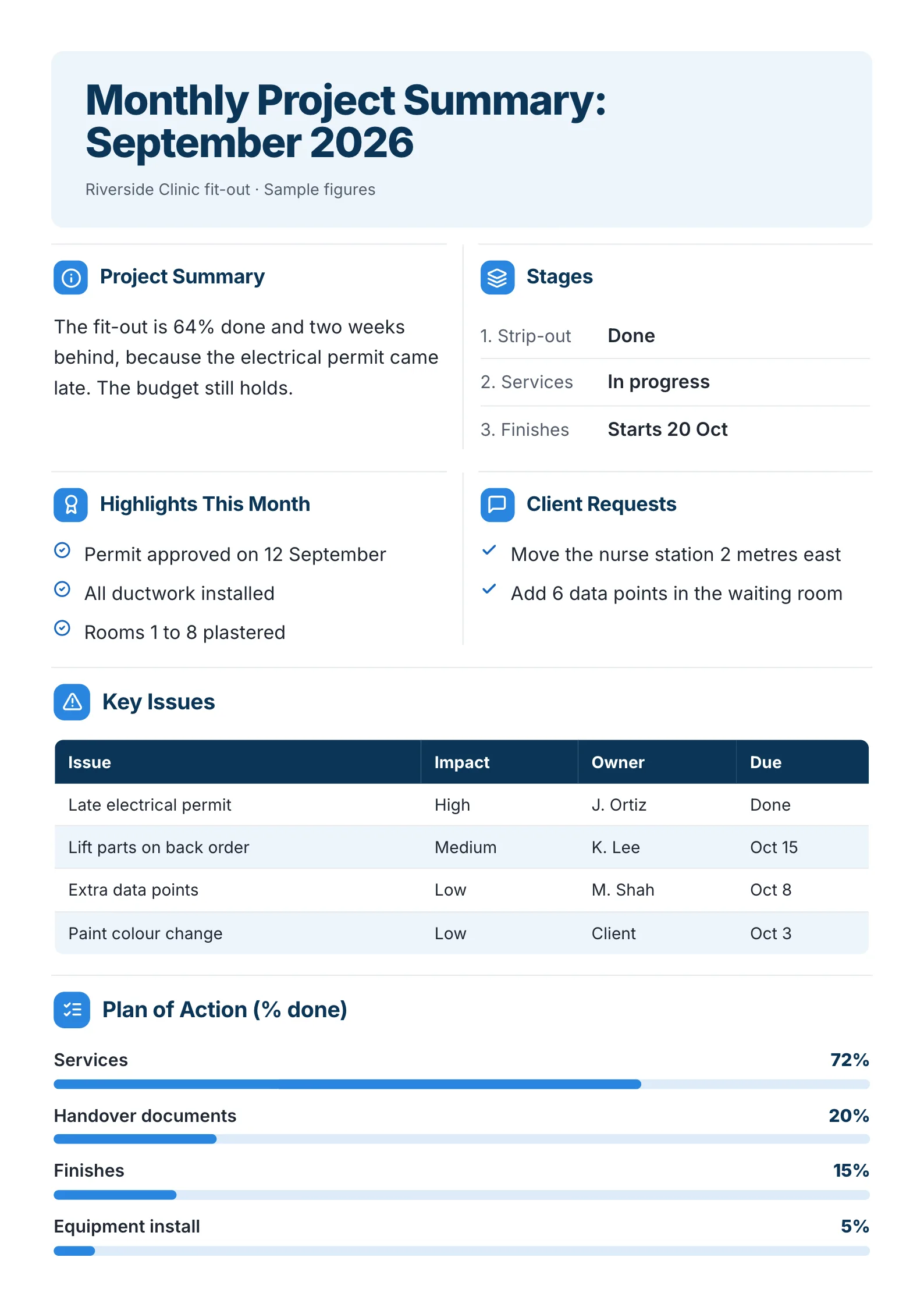 Monthly Project SummaryEdit for free(opens in a new tab)
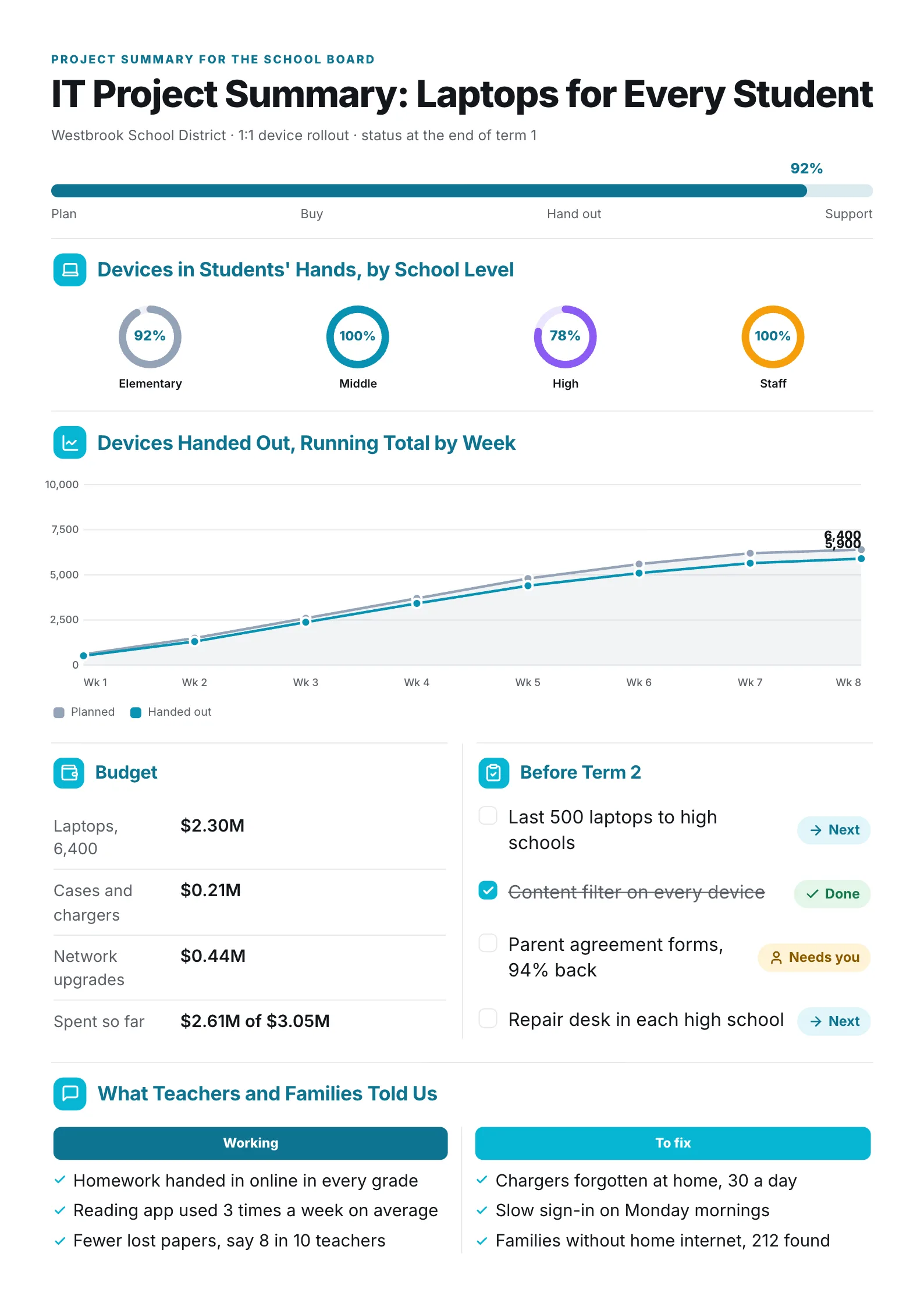 Project Summary: IT RolloutEdit for free(opens in a new tab)
The project summary rules of 7 funders and public bodies, read on October 30, 2026, all cap the length, and the caps run from 50 words to one page. Most ask the same four things. Only 2 ask you to name who benefits, and only 1 asks what the project costs. Below is what they agree on, how to write each part, and one summary grown from 50 words to a full page.
What 7 funders ask a project summary to include
| What the rules ask for | Funders that ask |
|---|---|
| A length limit | 7 of 7 |
| The goal or purpose | 7 of 7 |
| The result or benefit | 7 of 7 |
| How the work gets done | 6 of 7 |
| That the summary will be made public | 4 of 7 |
| Who benefits, by name or number | 2 of 7 |
| That it stands alone, without the full proposal | 2 of 7 |
| No confidential information | 2 of 7 |
| Third person, or no first person | 2 of 7 |
| Start and end dates on the same form | 2 of 7 |
| The total cost on the same form | 1 of 7 |
Source: our read of 7 funders' project summary rules, October 30, 2026. Every rule set is linked at the end.
Your project summary may be for a client, a steering group or your own boss. The rules still help, because funders write down what every reader wants and rarely says. They want something short that makes sense on its own, with a goal, a plan and a payoff they can check.
Pick your length before you write a word
Settle your word limit before you start, because every funder does. The limits we found sit on a ladder:
| Funder | The limit |
|---|---|
| UK Environment Agency | 50 words or 350 characters |
| USDA specialty crop grants | 250 words, one sentence if possible |
| NIH | 30 lines of text |
| US Department of the Interior | 4,000 characters |
| NSF, NOAA | One page |
| Montgomery County, Ohio | A summary box, then one page to describe the project |
The Environment Agency explains its own tiny limit plainly. The summary has to fit in a tracker, so directors can tell one flood project from another. That's the real job of your short summary. It helps a busy reader sort your project from the others on their list.
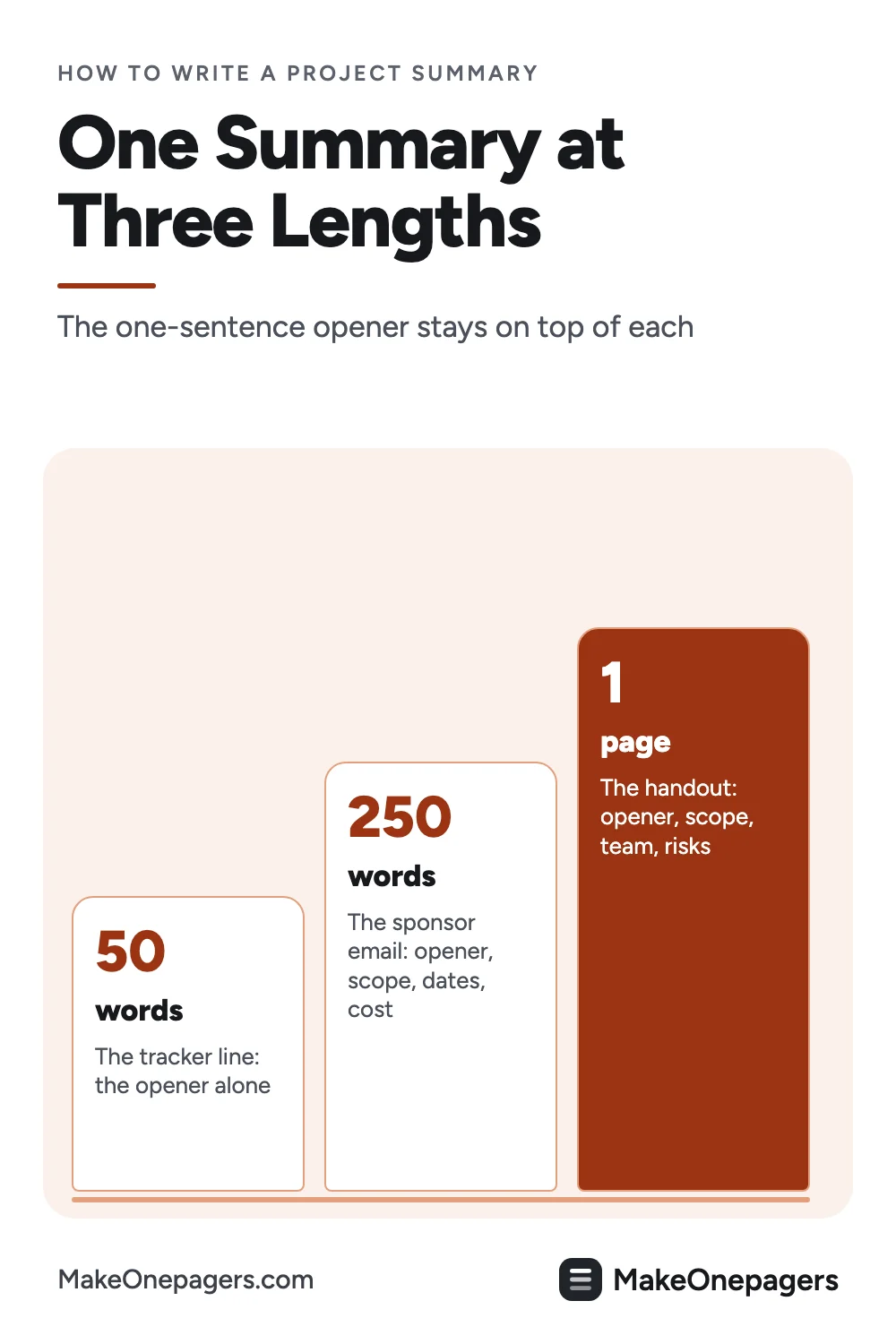
Match your length to how the summary will be used. A line in a portfolio list gets 50 words. An email to a sponsor gets about 250. A sheet handed out before a meeting gets one page. If you're not sure, write the 50-word version first, then grow it.
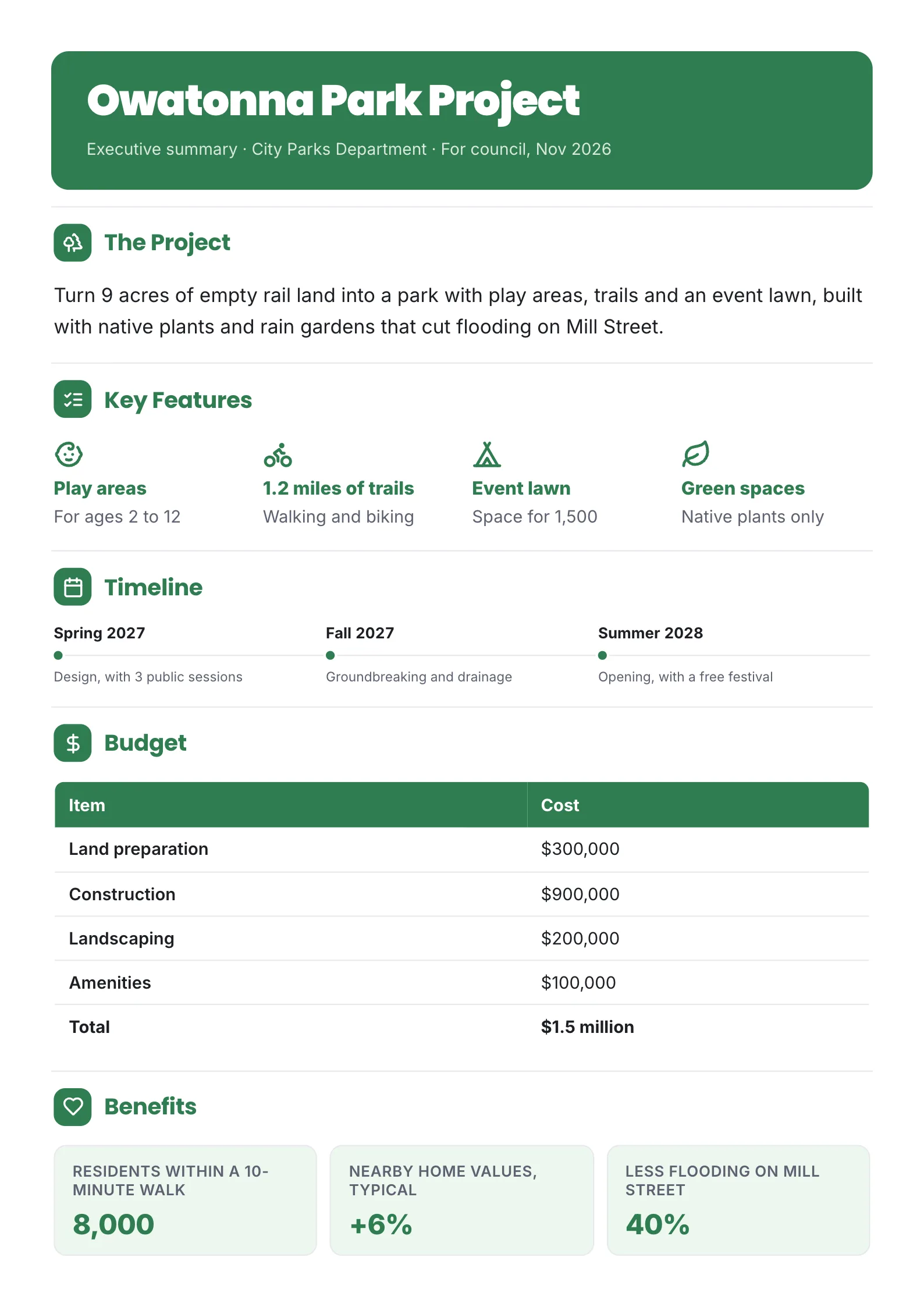 Edit this template
Sample names and figures. The Project section is one sentence, and the rest of the sheet backs it up with features, dates, costs and benefits.
Write the one sentence first
Your opening sentence should say who will do what, and why. The USDA template asks for exactly that, and gives this model: "The ABC University will mitigate the spread of citrus greening (Huanglongbing) by developing scientifically-based practical measures to implement in a quarantine area and disseminating results to stakeholders through grower meetings and field days." It names the lead, the action, the method and the audience in one line.
Here is a simple pattern you can copy. Name your team, the verb, the thing you'll make or change, and the result you expect. "The parks team will turn 9 acres of empty rail land into a park by summer 2028, cutting flooding on Mill Street." If a reader stops after that sentence, they still know what your project is.
Test it by reading it aloud to someone outside your team. If they ask "so what does it do?", the sentence names an activity and skips the result. Add the result.
Say the goal and the work in plain words
Seven of 7 funders ask for the goal, and 6 of 7 ask how the work will get done. NSF calls these "a statement of objectives and methods." The Interior Department asks for the purpose and the activities, in plain language the public can follow.
For your summary, give the goal as a result with a number and a date. Then list your work as two to four steps, in the order they happen. Leave out tools, vendors and internal team names unless your reader needs them.
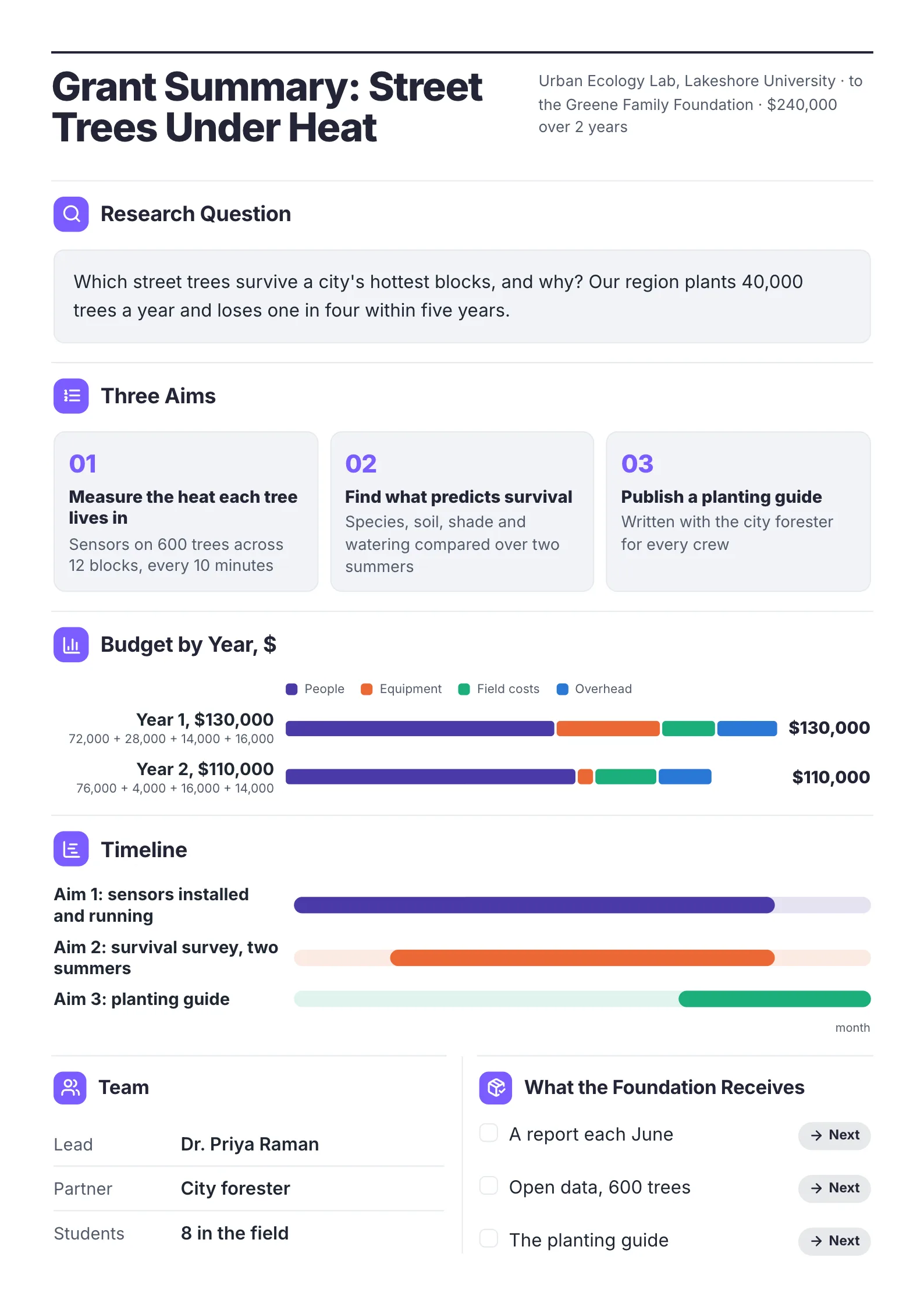 Edit this template
Sample names and figures. The research question carries the problem's number, and the three aims list the work in the order it happens.
Show the result, and who gets it
All 7 rule sets ask you for the result. NIH wants the project tied to the agency's mission. NSF wants "broader impacts," meaning what society gains. The Environment Agency is the strictest about wording. It asks every benefit to start with a change word like increased, more or higher, and warns against "better," because better in what way?
Only 2 of the 7 ask you to name who benefits. The Interior form asks for the intended beneficiaries. Montgomery County goes further and asks how many people or households will benefit, and how you got that number. That's the most useful question on any of the 7 forms, and you should answer it even when nobody asks.
So write your result as a change with a number, then add who gets it. "Wait times drop from 40 minutes to 15 for the clinic's 3,000 weekly patients." That beats "improves the patient experience" every time.
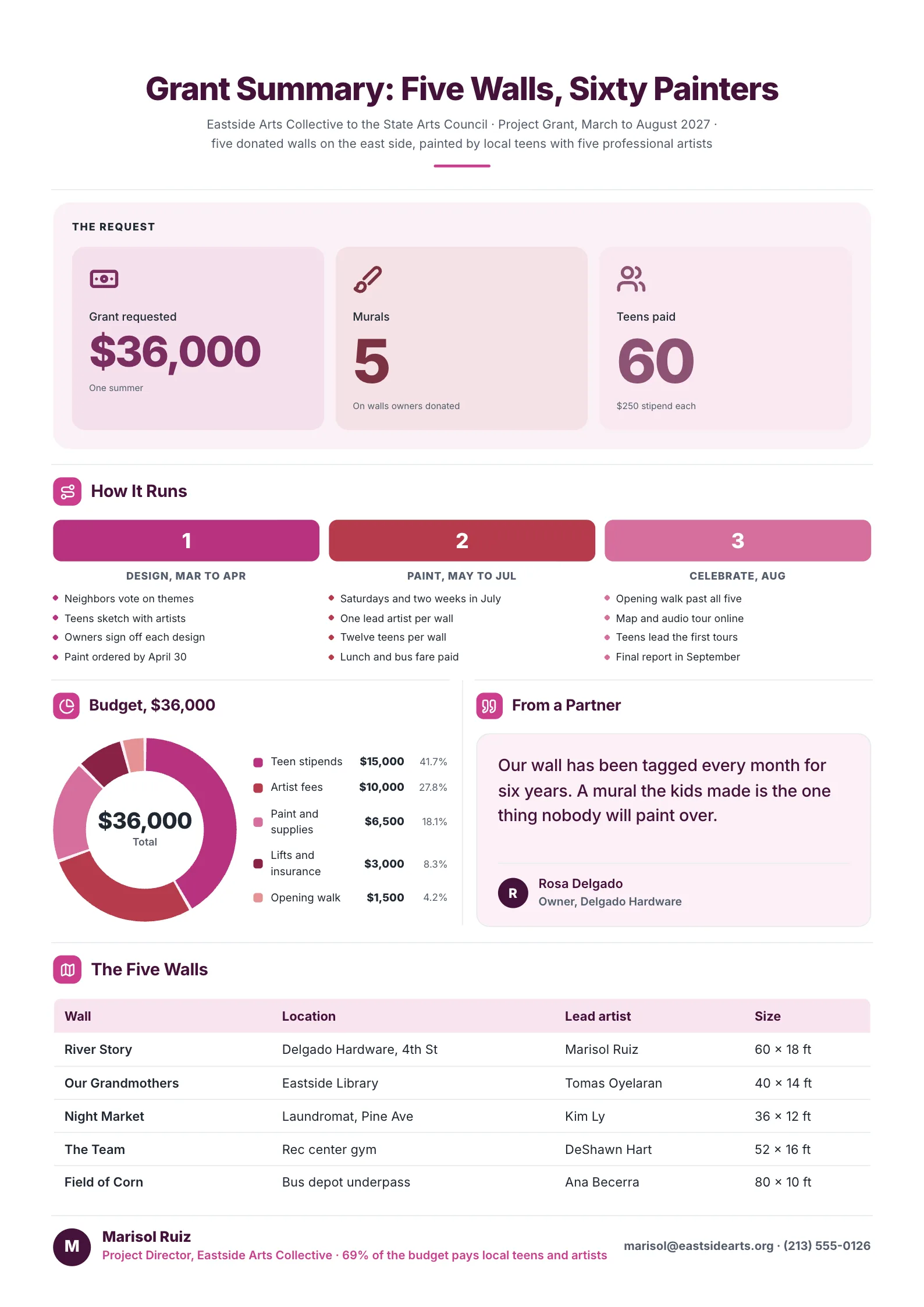 Edit this template
Sample names and figures. The request names who benefits as a number, 60 paid teens, right beside the $36,000 asked for.
Make it stand on its own
Your summary often travels without the document behind it. NIH says the summary "should be able to stand on its own." The Interior form says the public must understand it without viewing the full application.
Four of the 7 funders also say the summary will be made public. NIH posts it on its RePORT database, and the Interior Department sends it to USAspending.gov. NOAA reminds you that grant files fall under public records law. That's why 2 of the 7 ban confidential information outright.
Your summary may never go public, yet it will get forwarded. Write it for the person who receives it third-hand. Spell out every acronym, skip internal code names, and keep anything you wouldn't want quoted out of it. NOAA asks for the third person ("The team will..."), and NIH steers you away from the first person, which helps when other people paste your summary into their own reports.
Add the two things funders rarely ask for
Most funders get the cost and the dates on other forms, so the summaries you send them leave those out. Your reader may not have those other forms. Of the 7 rule sets, only Montgomery County puts the total project cost on the same page as the summary. Just 2 put dates there.
For a project summary inside a business, the cost and the dates are often the first thing your reader looks for. Add one line for each. Give the total cost and where the money comes from. Give the start date, the end date and one or two dates in between that matter.
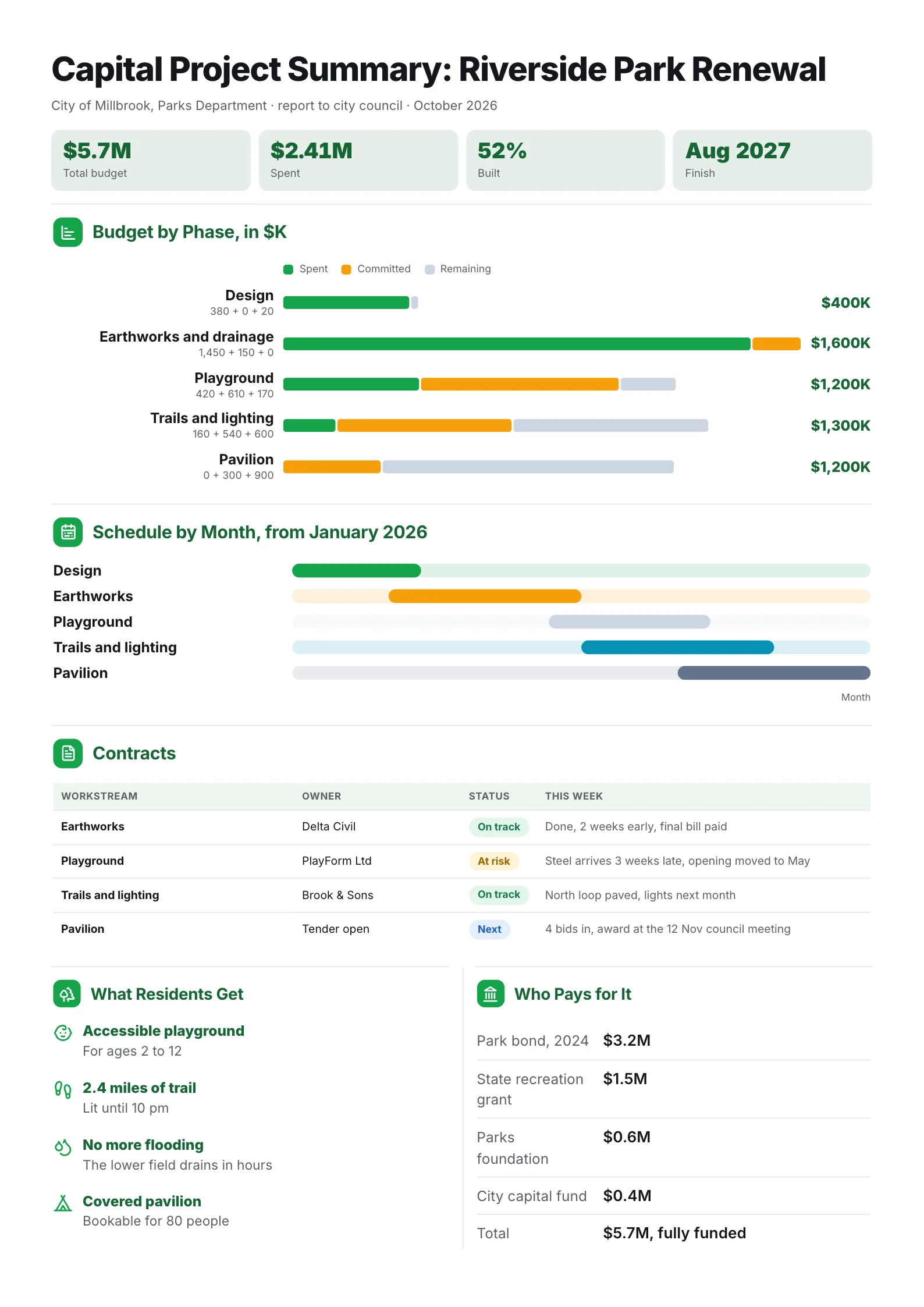 Edit this template
Sample names and figures. Four numbers across the top answer the cost and date questions before your reader reaches the details.
One project summary, grown from 50 words to one page
Here is one sample project at the three lengths you'll need most. The 50-word and 250-word versions are written out in full, and the kickoff sample below shows the full page. Each longer version keeps your opener and adds parts below it.
50 words (the tracker line)
The Harbor Museum of Art will open Color in Motion on May 15, 2027, with 64 loaned paintings from 9 museums, to bring 60,000 visitors in its first year. The show costs $1.35M. School groups get a free visit kit and audio guide.
250 words (the sponsor email)
The Harbor Museum of Art will open Color in Motion on May 15, 2027, with 64 loaned paintings from 9 museums, to bring 60,000 visitors in its first year. The show costs $1.35M. School groups get a free visit kit and audio guide.
Our last major show drew 41,000 visitors in its first year, so the goal is a big step up. The 64 paintings, the audio guide and the school visit kit are in scope. A touring version, a printed catalog and a new gift shop are out.
The work runs on four dates. We confirm every loan by January 15, start the gallery build on March 1, receive the paintings on April 20 and open on May 15. Ken, our project manager, runs a weekly check-in with the vendors from kickoff to opening day.
Shipping and insurance for the loans take $520K of the budget, the largest single cost. The gallery build takes $280K, design $210K and install $190K. We've kept $150K for surprises, because loan delays and climate control are the two risks that could hurt us most.
Visitors gain first, and about 120 school groups get a free visit kit and an audio guide from Theo, our education lead.
We need two answers from you by November 30. Which of the 2 shortlisted art shippers do we hire, and who sponsors opening week?
One page (the meeting handout)
Keep the opener and the numbers above, then lay them out as a scope list of what's in and out, a short team list with one line each, the top risks, and the decisions you need by a date. That's the layout of the kickoff sample below.
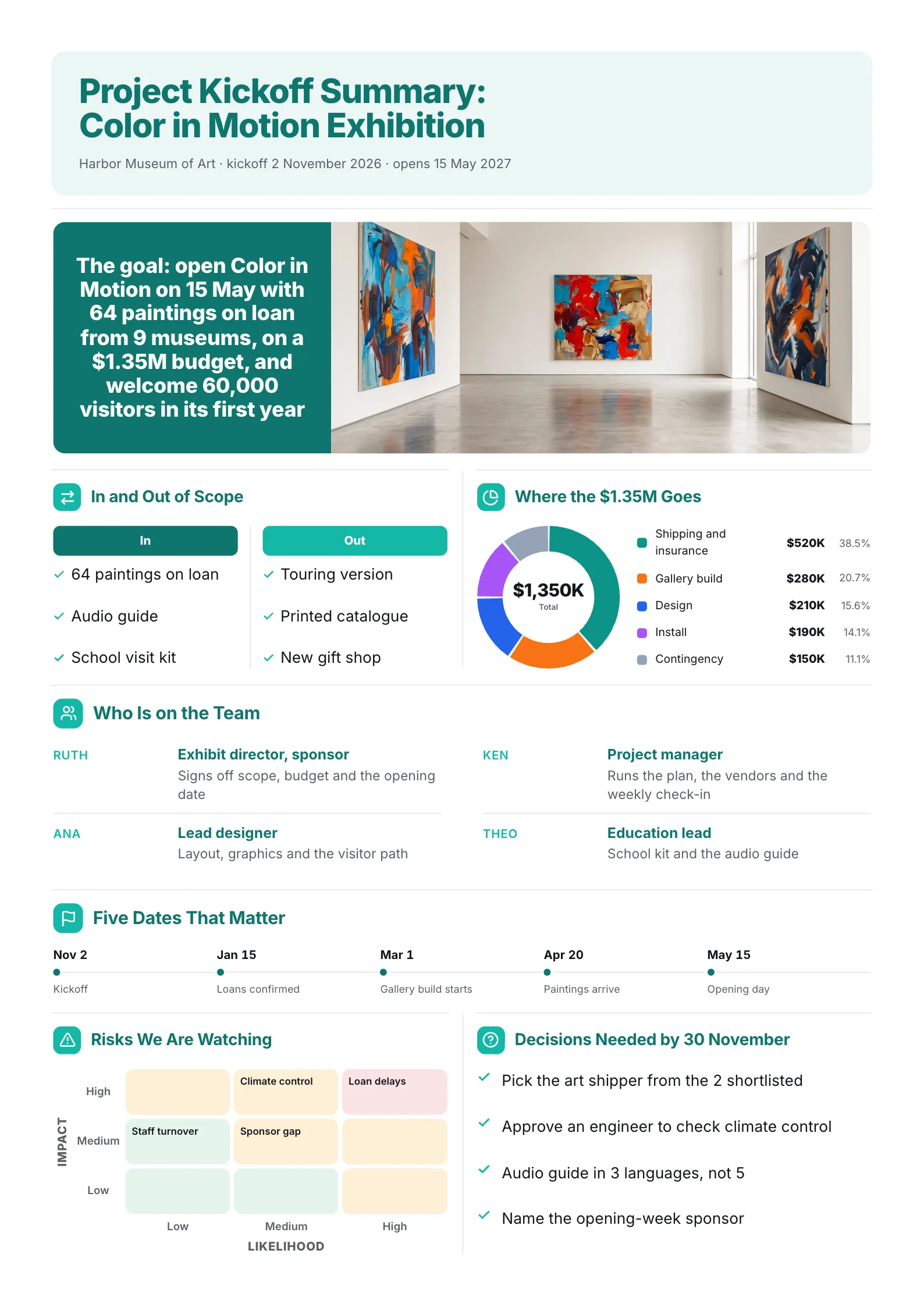 Edit this template
Sample names and figures. The one-page version keeps the goal sentence on top and adds scope, team, dates, risks and decisions underneath.
A checklist built from the 7 rule sets
Run down this list before the summary goes out:
- One sentence first. It names who will do what, and why.
- A length you chose on purpose. 50 words, 250 words or one page.
- The goal, with a number and a date.
- The work, in two to four steps.
- The result as a change word. Increased, more, fewer or faster, followed by a number.
- Who benefits, counted. And how you counted them.
- The cost and the dates, even if your template has no box for them.
- It stands alone. No acronyms left unexplained, nothing confidential.
Our project summary templates already have a one-line goal at the top and boxes for the budget, dates and benefits. You replace the sample text with yours. More one-page layouts sit in our project summary template post, and if you're applying for an NSF grant, our NSF project summary example walks through that format's three parts.
The 7 rule sets, with links
| Funder | Document | Limit |
|---|---|---|
| National Science Foundation | PAPPG 24-1, Project Summary | 1 page |
| National Institutes of Health | Project Summary/Abstract | 30 lines |
| NOAA National Ocean Service | Project Summary form | 1 page |
| US Department of the Interior | Project Abstract Summary | 4,000 characters |
| USDA Agricultural Marketing Service | Specialty crop project profile | 250 words |
| Montgomery County, Ohio | FY 2026 community development application | 1 page |
| UK Environment Agency | Flood project benefit profile | 50 words |
We read each document in full on October 30, 2026. The counts are in our research file, one row per funder.
Write the 50-word version today
Take your project and write it in 50 words, with the who-does-what sentence first. If you can't fit it, the project's goal probably isn't settled yet, and that's worth knowing before you build a full page. Once it fits, open a project summary design in MakeOnepagers and grow those 50 words into the one-page version.
Frequently asked questions
What should a project summary include?
The goal, the work to reach it, the result and who benefits from it. Every one of the 7 funders we read asks for the goal and the result. For a business reader, add the total cost and the key dates too.
How long should a project summary be?
You can pick from three common sizes. 50 words fits a list or tracker, about 250 words fits an email, and one page fits a handout. The funders we read set limits from 50 words up to one page, and none allowed more.
Should a project summary be written in first or third person?
Third person is the safer choice, and two funders say so: NIH wants no first person, and NOAA asks for the third person outright. "The team will build..." also reads well when someone copies your summary into their own report.
What is the difference between a project summary and a project proposal?
A proposal makes the full case, with methods, budget detail and backup. The summary is the short version that travels on its own, often to people who will never open the proposal. Write the summary last, once the proposal's numbers are final.




