How to Write a Consulting Proposal: What 8 Real RFPs Ask You For
How to write a consulting proposal, from 8 real RFPs. All 8 want references, 7 your team by name, and price counts for only 15% to 20% of the score.

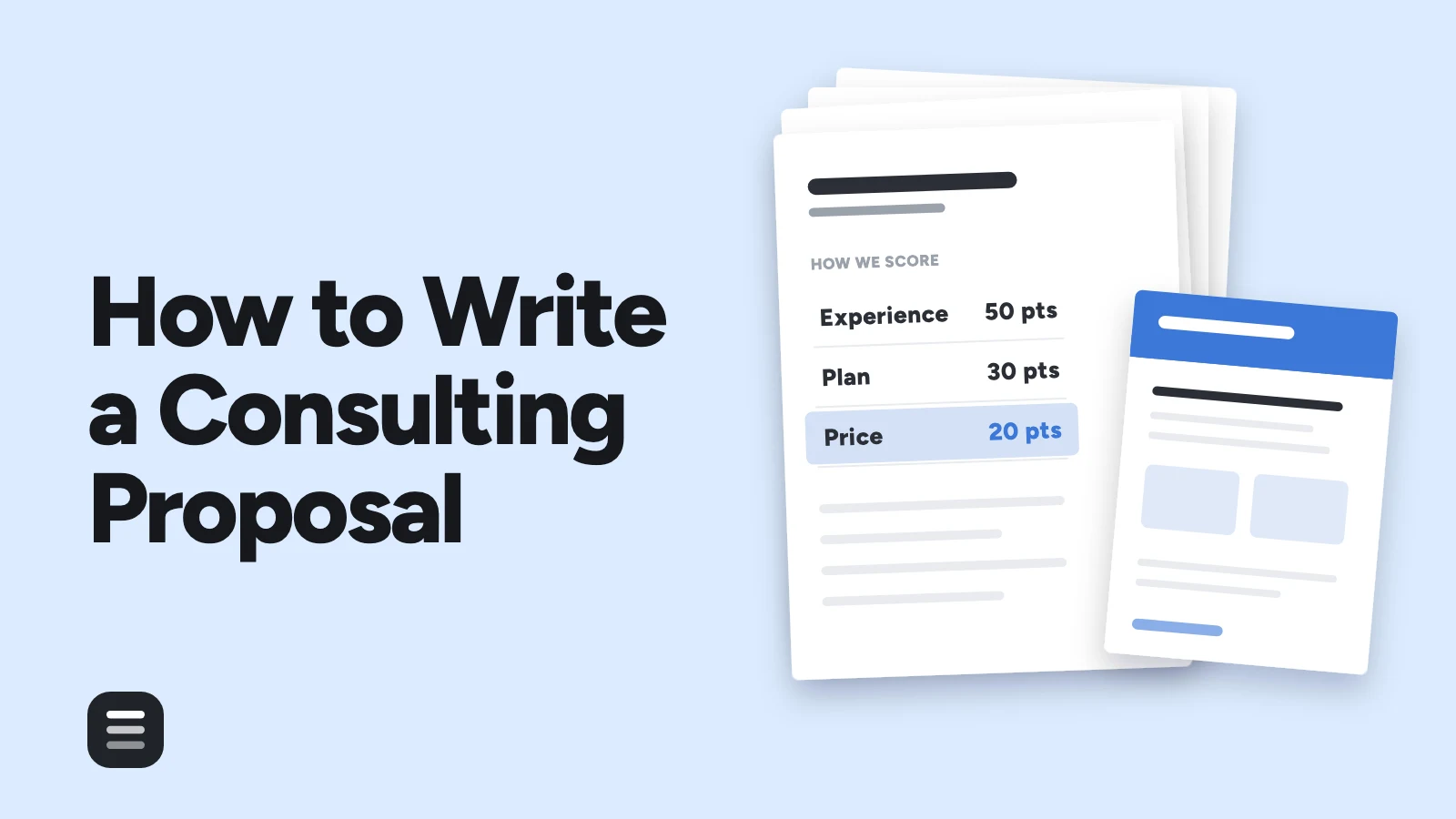
A consulting proposal wins on the client's problem, in their own numbers, so write that part first. Then lay out how you'll do the work and when, the people doing it, references from similar jobs, the fee and the decision you need from them. If the client sent a request for proposals, follow its order exactly. Start from a free one pager template.
One‑Pager examples
Real One-Pagers made with MakeOnepagers. Open any one to edit it as your own.
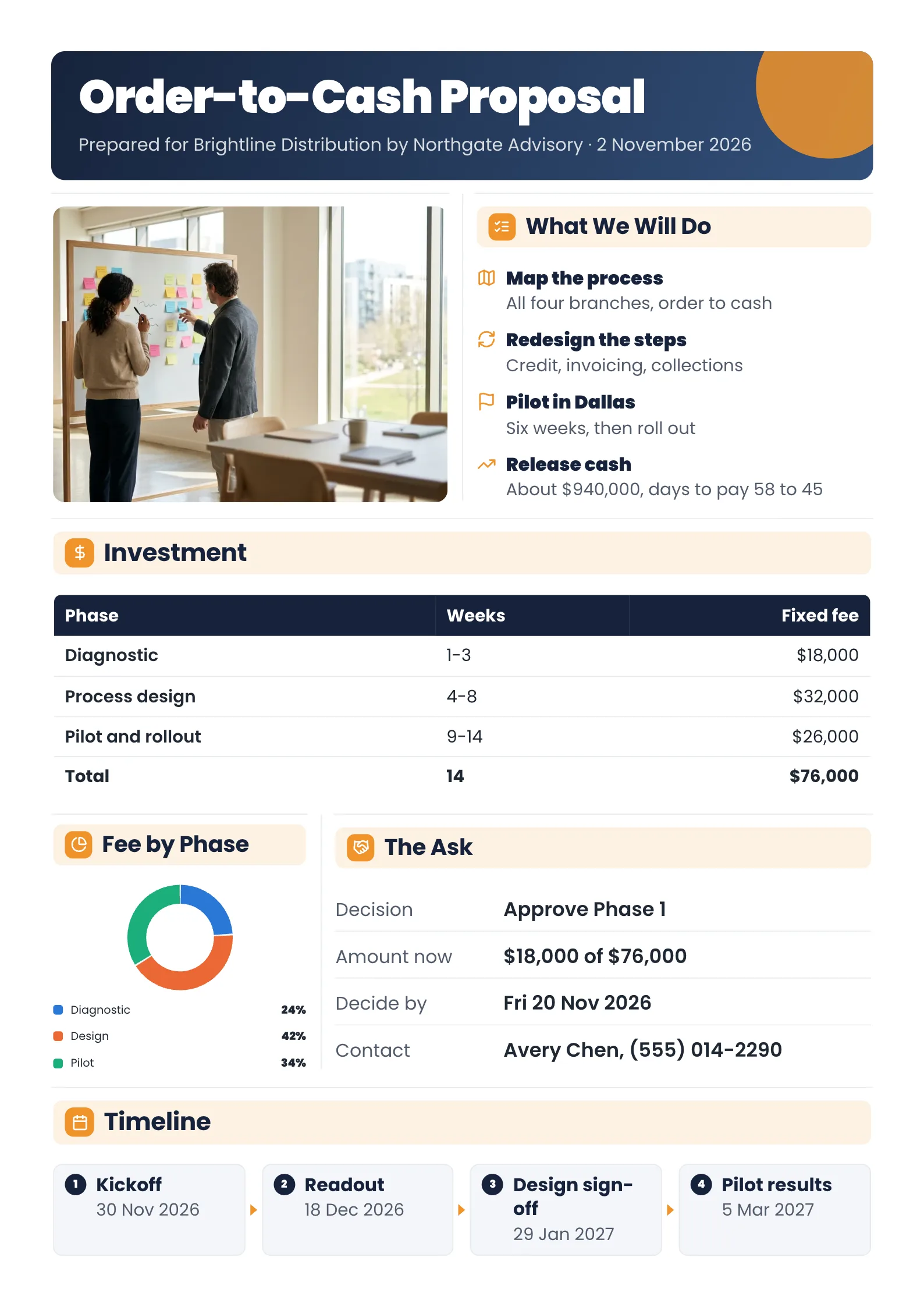 Consulting ProposalEdit for free(opens in a new tab)
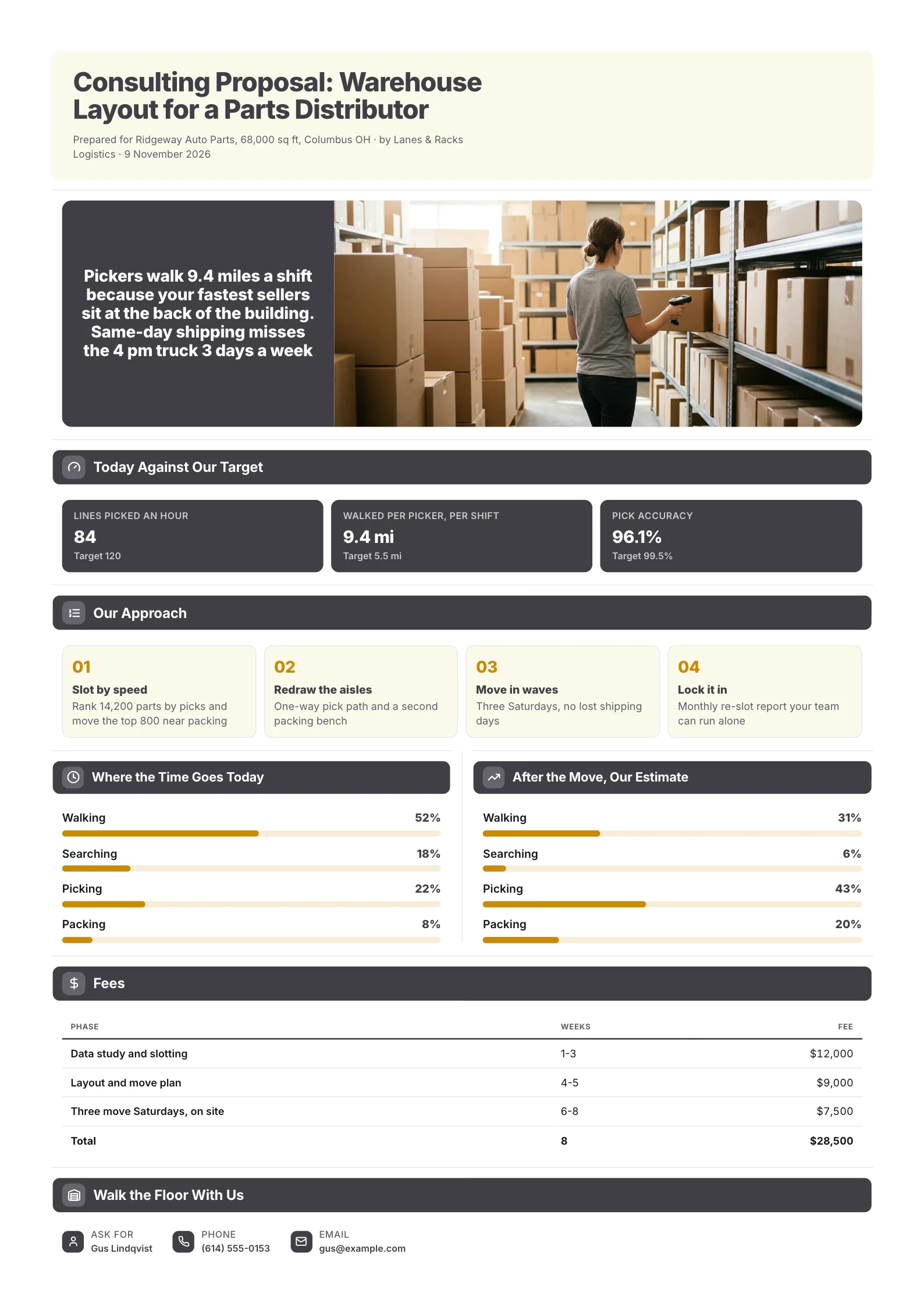 Consulting Proposal: Warehouse Layout for a Parts DistributorEdit for free(opens in a new tab)
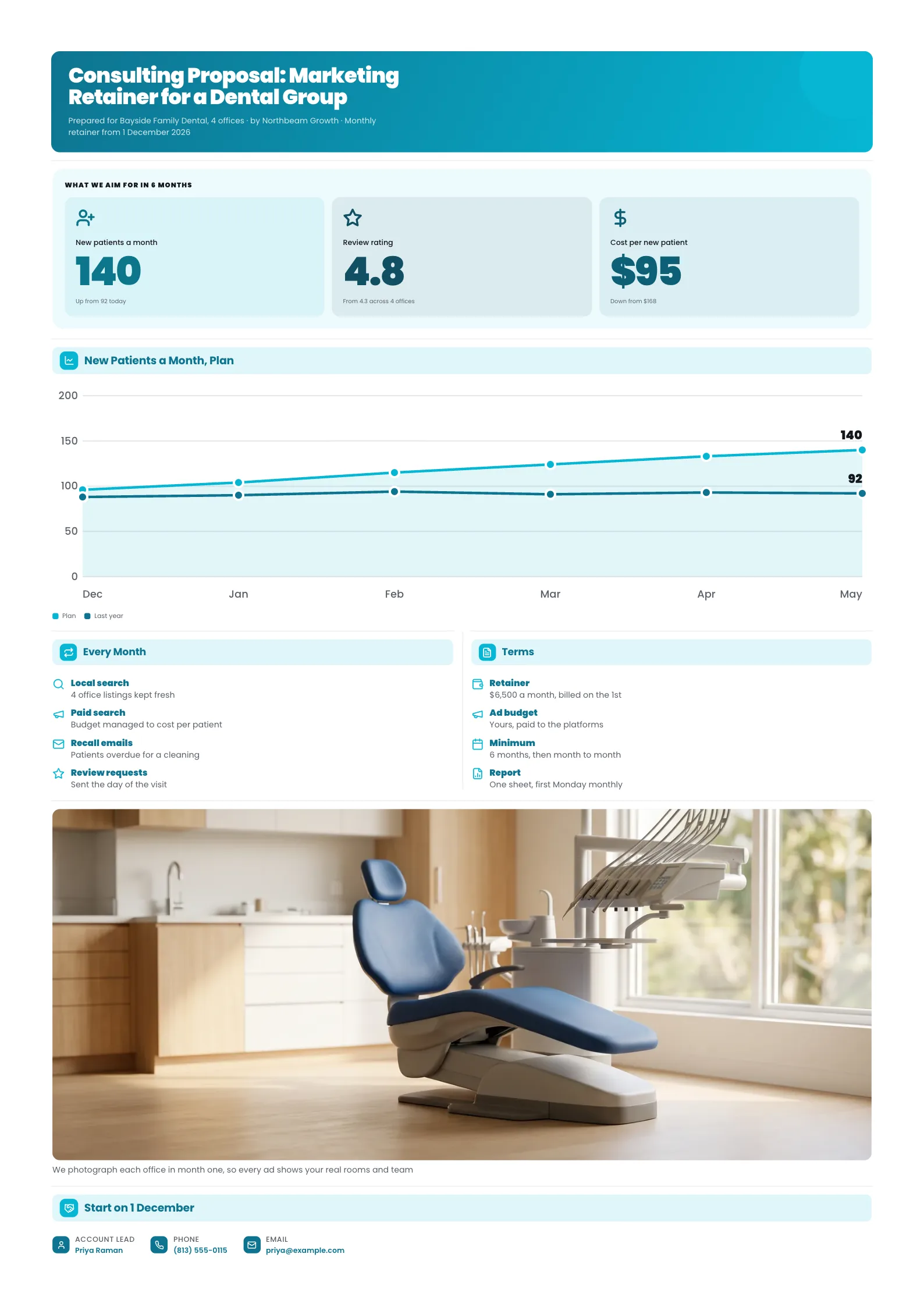 Consulting Proposal: Marketing Retainer for a Dental GroupEdit for free(opens in a new tab)
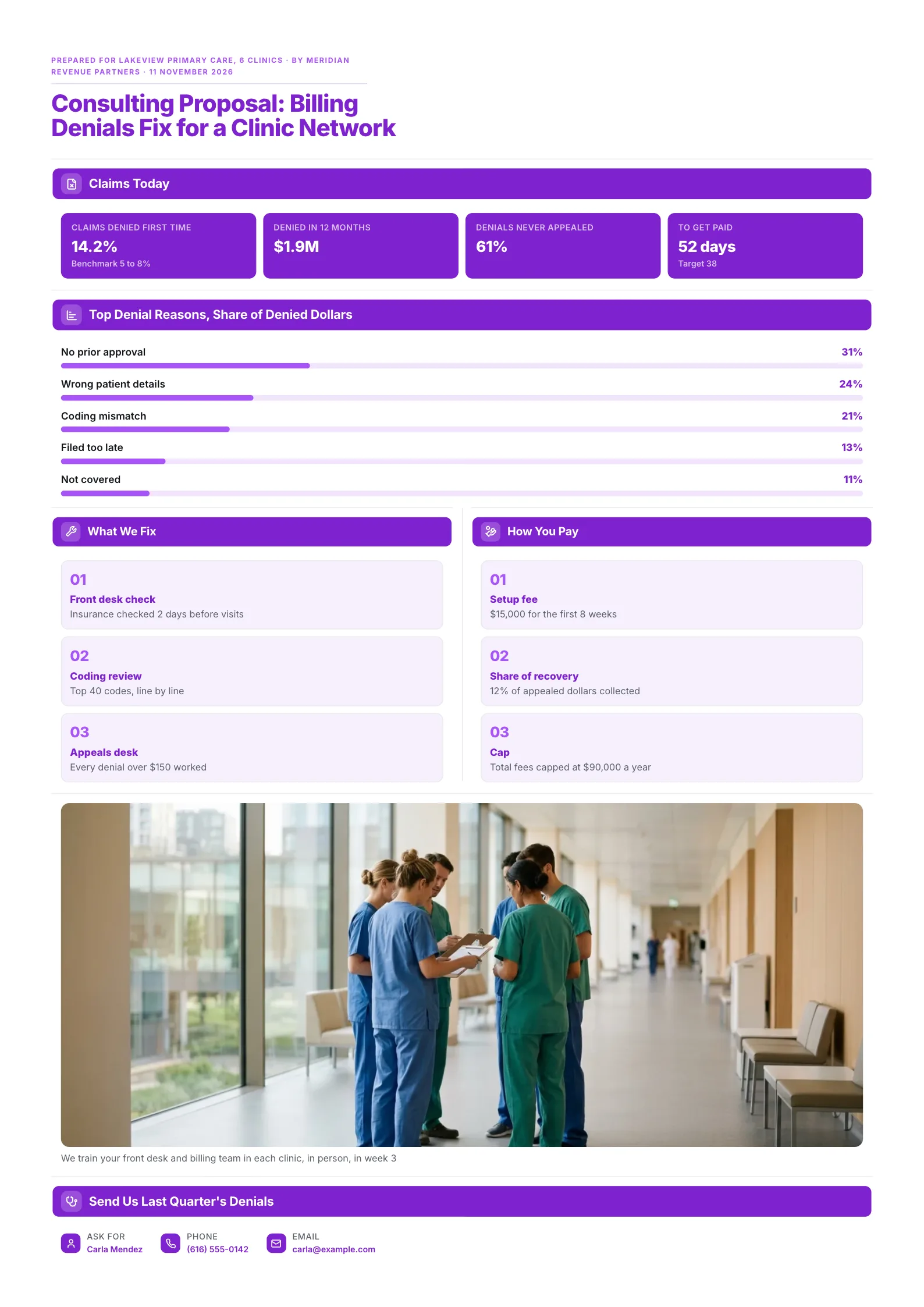 Consulting Proposal: Billing Denials Fix for a Clinic NetworkEdit for free(opens in a new tab)
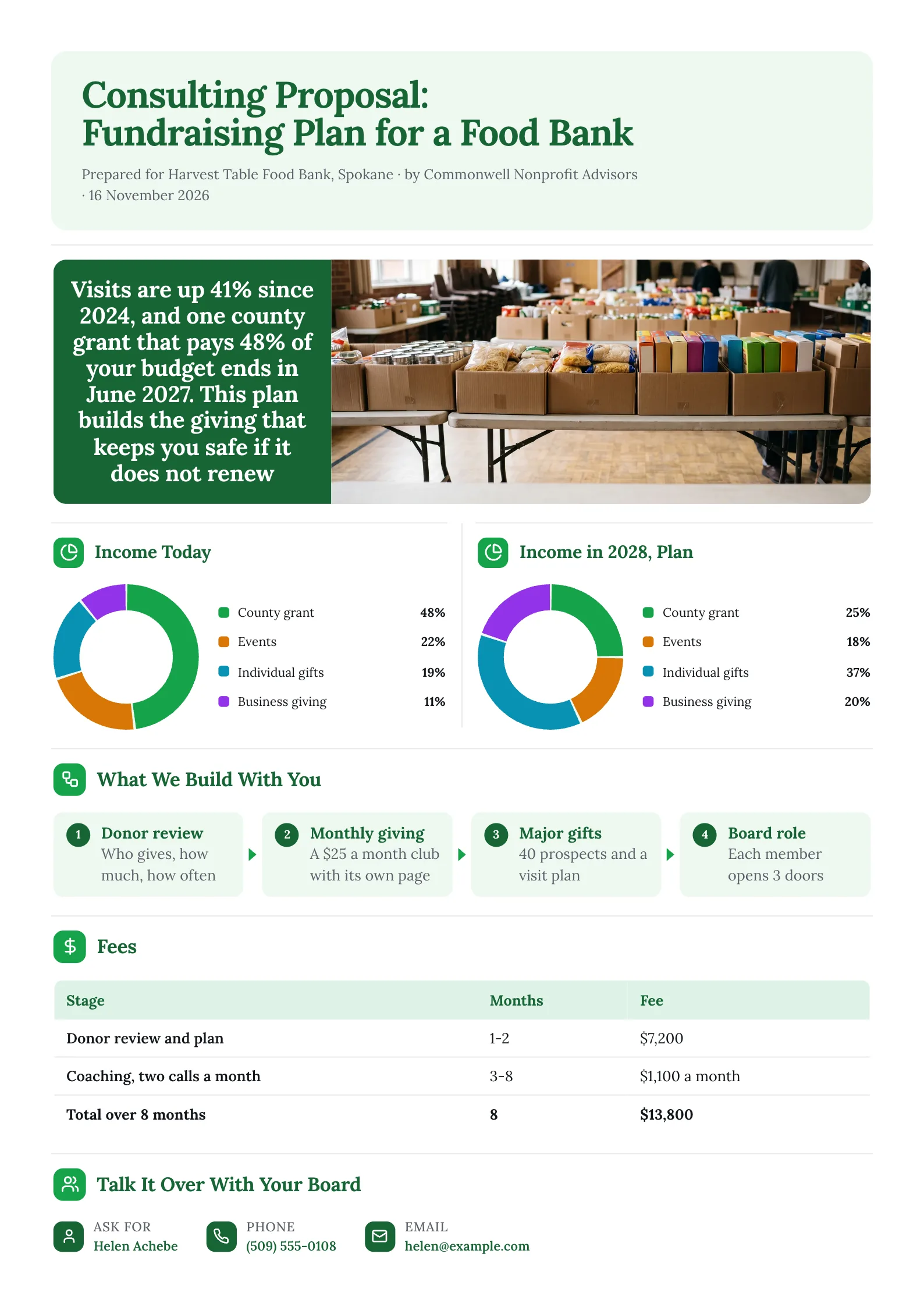 Consulting Proposal: Fundraising Plan for a Food BankEdit for free(opens in a new tab)
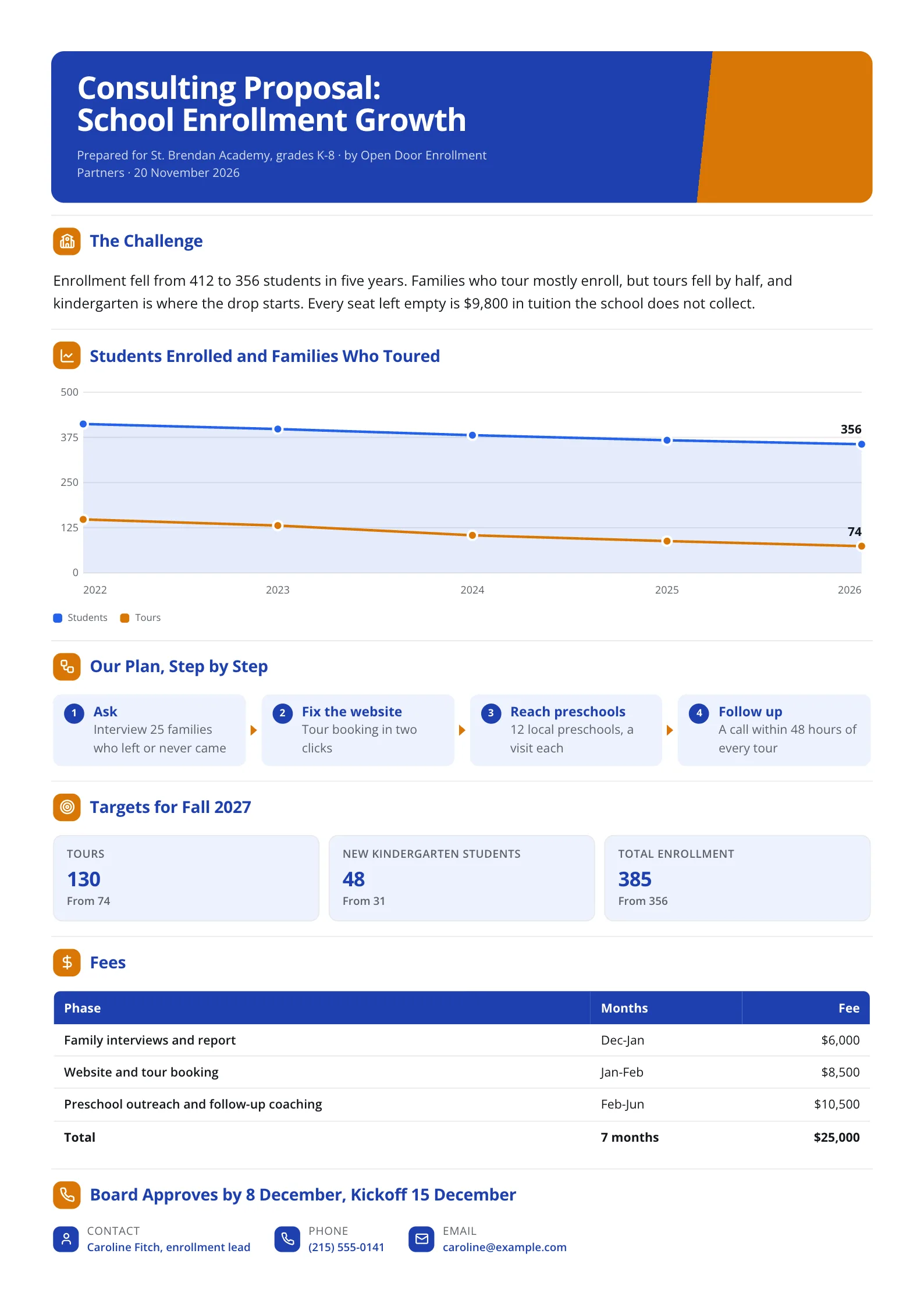 Consulting Proposal: School Enrollment GrowthEdit for free(opens in a new tab)
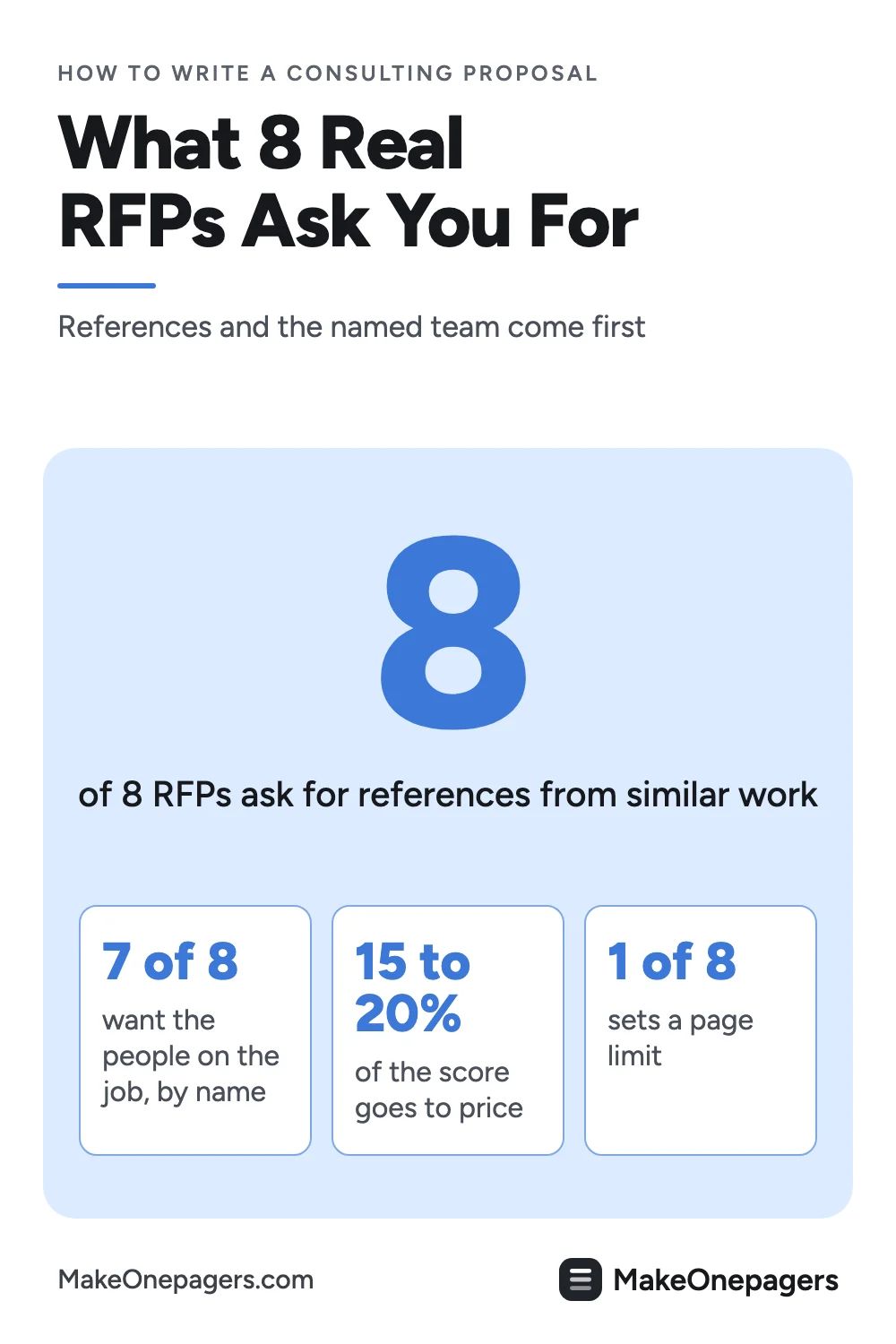
Clients put what they want in writing when they send a request for proposals (RFP). We read 8 of them for consulting work, from three cities, a college, a county pension fund, a water utility and two nonprofits. All 8 ask for references. Seven want the people on the job named. And in the 3 that publish how they score, price is worth only 15% to 20% of the total. Most of the score goes to your experience and your plan.
What 8 requests for proposals ask you to send
| What the RFP asks for | RFPs that do |
|---|---|
| References from similar work | 8 of 8 |
| The people on the job, by name | 7 of 8 |
| Your price | 7 of 8 |
| Your approach or work plan | 6 of 8 |
| A timeline | 6 of 8 |
| An interview or presentation | 6 of 8 |
| Samples of past work | 4 of 8 |
| Your understanding of their needs | 3 of 8 |
| The price in a separate file | 2 of 8 |
| The client's budget, stated | 2 of 8 |
| A page limit | 1 of 8 |
Source: our read of 8 public US requests for proposals for consulting services, October 30, 2026. Each one is linked at the end.
Notice what sits at the top. Before a client reads your method, they want to know who has trusted you before and who exactly will show up.
How clients score a consulting proposal
Three of the RFPs publish their scoring, and all three put price near the bottom.
| Client | Experience and references | Plan and understanding | Price |
|---|---|---|---|
| ICMA | 50% | 30% | 20% |
| City of Ann Arbor | 50 of 100 points | 30 of 100 points | 20 of 100 points |
| WaterOne | 30% | 35%, plus 20% for timing | 15% |
Ann Arbor goes further. Its fee proposal arrives in a separate sealed envelope, and the city opens only the fee envelopes of its top proposals. WaterOne also asks for pricing to be sent apart from the rest. At Ann Arbor, your proposal has to win on everything else before anyone sees your number.
This changes where you spend your time. Write the experience and plan sections first and best. Then set a fair price, and know that being cheapest rarely saves a weak plan.
Open with their problem, in their numbers
Only 3 of the 8 RFPs ask for your understanding of the client's needs outright. Port Townsend asks for a statement of the consultant's understanding of the services required. WaterOne asks you to describe the scope of work as you understand it. The Campaign Legal Center scores how well you know its mission and values.
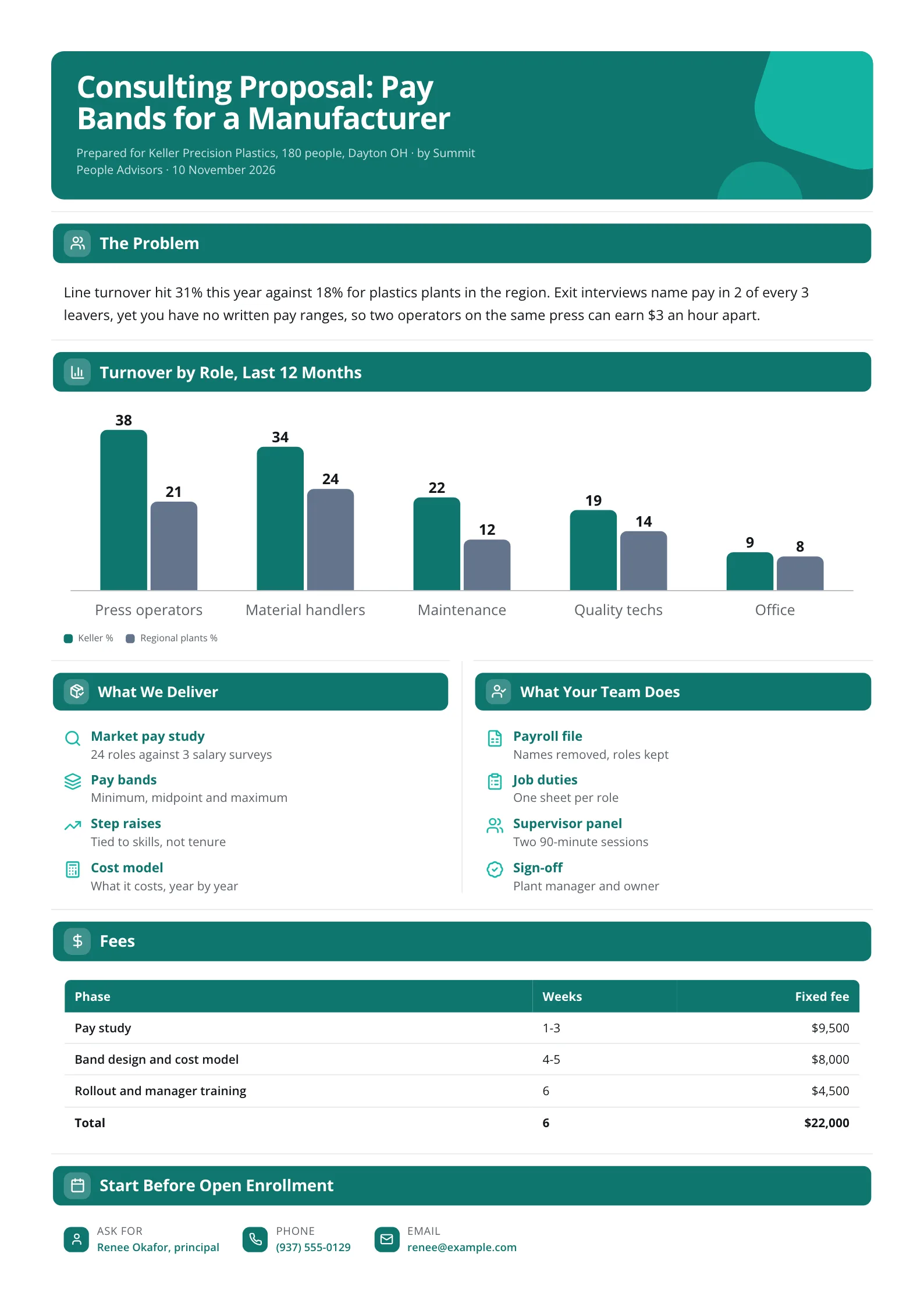
The other five still reward it, because every reviewer wants proof that you read their request. So open with two or three sentences in the client's own numbers. Name the problem, how big it is and what happens if nothing changes. If you only have their RFP to go on, quote its numbers back to them, like Parkland College's roughly 420 full-time employees and a pay system more than two decades old. If the client asks for an executive summary, these opening sentences are it.
 Edit this template
Sample names and figures. The problem opens with the client's own numbers, 31% turnover against 18% for the region, before any mention of the consultant.
Show your approach as phases with dates
Six of the 8 ask for your approach, and six ask for a timeline. Ann Arbor scores the work plan at 30 of 100 points and wants to know how the project will be managed and scheduled. ICMA asks for a timeline with key milestones and deliverables.
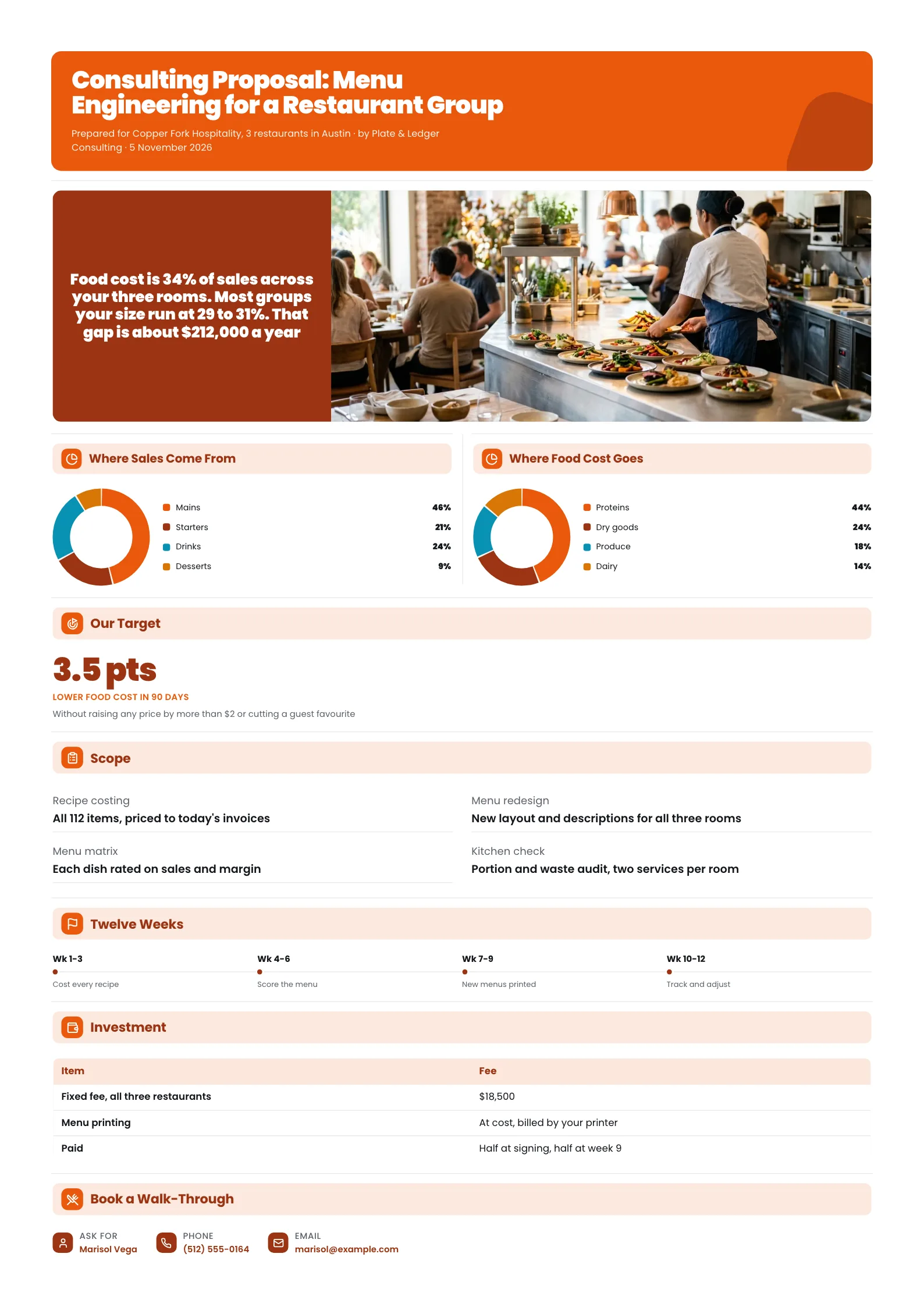
Write your approach as three to five phases. For each phase, give what you'll do, what the client gets at the end and how many weeks it takes. Put the deliverable in plain words, like a ranked list of fixes or a board-ready plan, so the client can picture it.
Then add one line on how you'll keep them informed. ICMA asks how you'll communicate throughout the review. A weekly 30-minute check-in and a written update every two weeks is an answer they can hold you to.
 Edit this template
Sample names and figures. Twelve weeks run in four three-week phases, from costing every recipe to printing the new menus and tracking the results.
Name who will do the work
Seven of the 8 RFPs want the team by name, and several want more than a name. ICMA asks how much time each person will devote to the contract. Ann Arbor asks you to identify only the people who will really do the work, with resumes for everyone, subcontractors included. OCERS, a county pension fund, says that if the project lead becomes unavailable, the replacement has to be agreed by both sides.
So list the lead, plus anyone who'll spend real hours on the job. Give each one a line on the similar work they've done and the share of their week this project gets. The firm's whole bench belongs in an appendix, if anywhere.
Prove it with references and a sample
Every one of the 8 asks for references. Six of them set a number, usually at least three, and Farmington asks for three government references plus three client references. Four ask for samples of past work. OCERS wants a sample report from a similar study, and WaterOne asks for sample reports.
Pick references whose projects look like this one in size and type. ICMA prefers nonprofits and associations of a similar size, and WaterOne asks how many employees each reference project covered. Then tell your references they may get a call, since at least four of the RFPs say they'll check.
 Edit this template
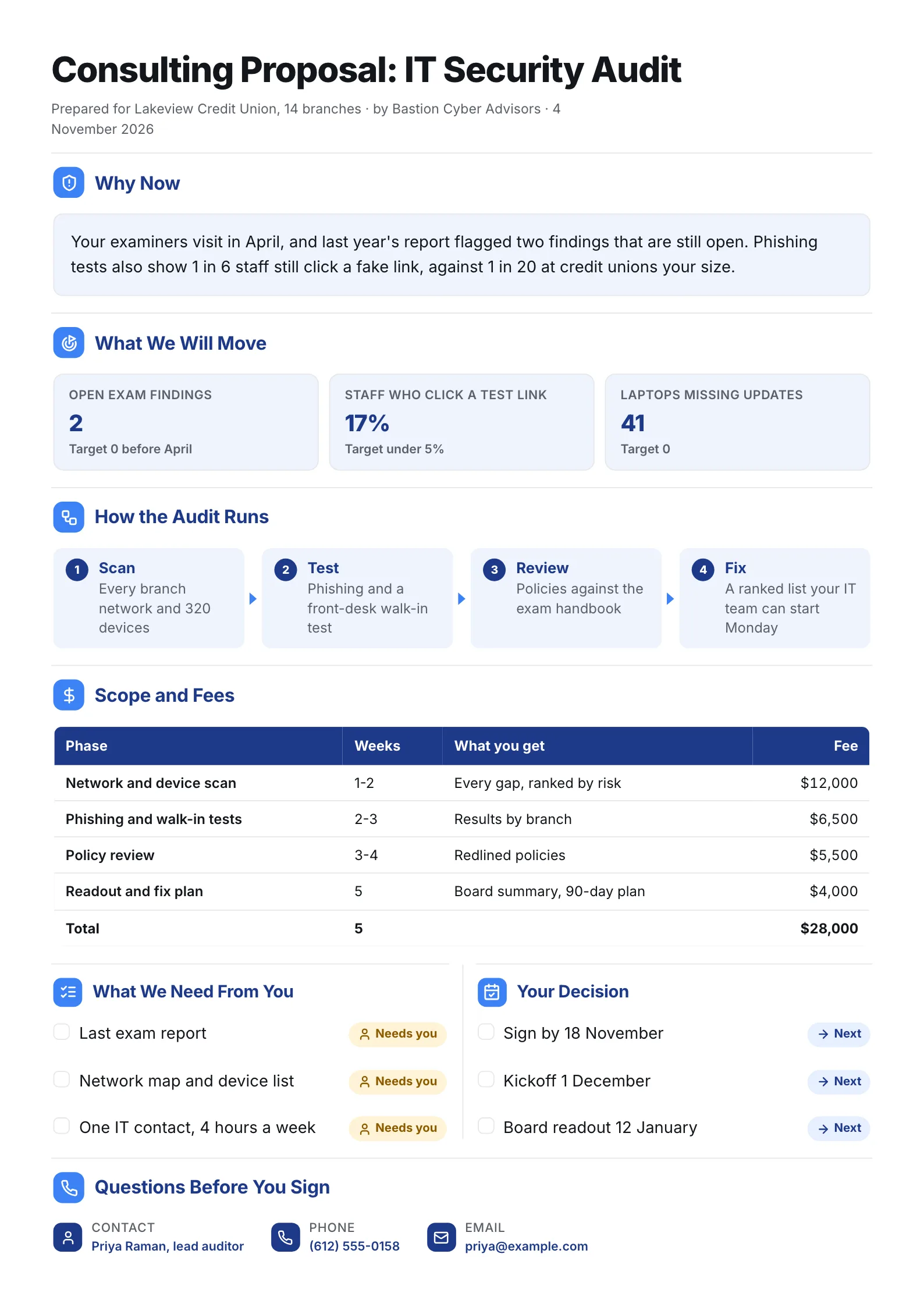
Sample names and figures. Each phase in the fee table says what the client gets, like every gap ranked by risk, beside its price.
Price it the way they asked
Seven of the 8 ask for a price, and they ask in different ways. Parkland wants a detailed cost breakdown, expenses included. Port Townsend wants an estimated cost plus billing rates for everyone involved. ICMA will take a fixed fee, a fee per deliverable or a rate with a not-to-exceed cap. Ann Arbor wants names, titles, hourly rates and overhead factors.
Two of them told bidders the budget up front. Port Townsend set aside $3,000 to facilitate a city manager's evaluation. The Campaign Legal Center budgeted $30,000 to $40,000 for its compensation review. If the client gives you a number, price inside it or explain plainly why you can't.
If you're setting hourly rates, it helps to see what the market charges. Here are the ceiling rates that firms on the federal GSA schedule list for four common consulting titles.
| Title contains | Rates listed | Median per hour, about |
|---|---|---|
| Principal Consultant | 490 | $227 |
| Senior Consultant | 1,214 | $187 |
| Management Consultant | 1,559 | $164 |
| Business Analyst | 5,865 | $122 |
Source: GSA CALC+ ceiling rates, read October 30, 2026. These are the most each firm may bill the federal government, so treat them as a market reference for your own rates.
For most private clients, a fixed fee per phase reads best. It tells the client what each step costs, and it lets them approve the first phase alone.
 Edit this template
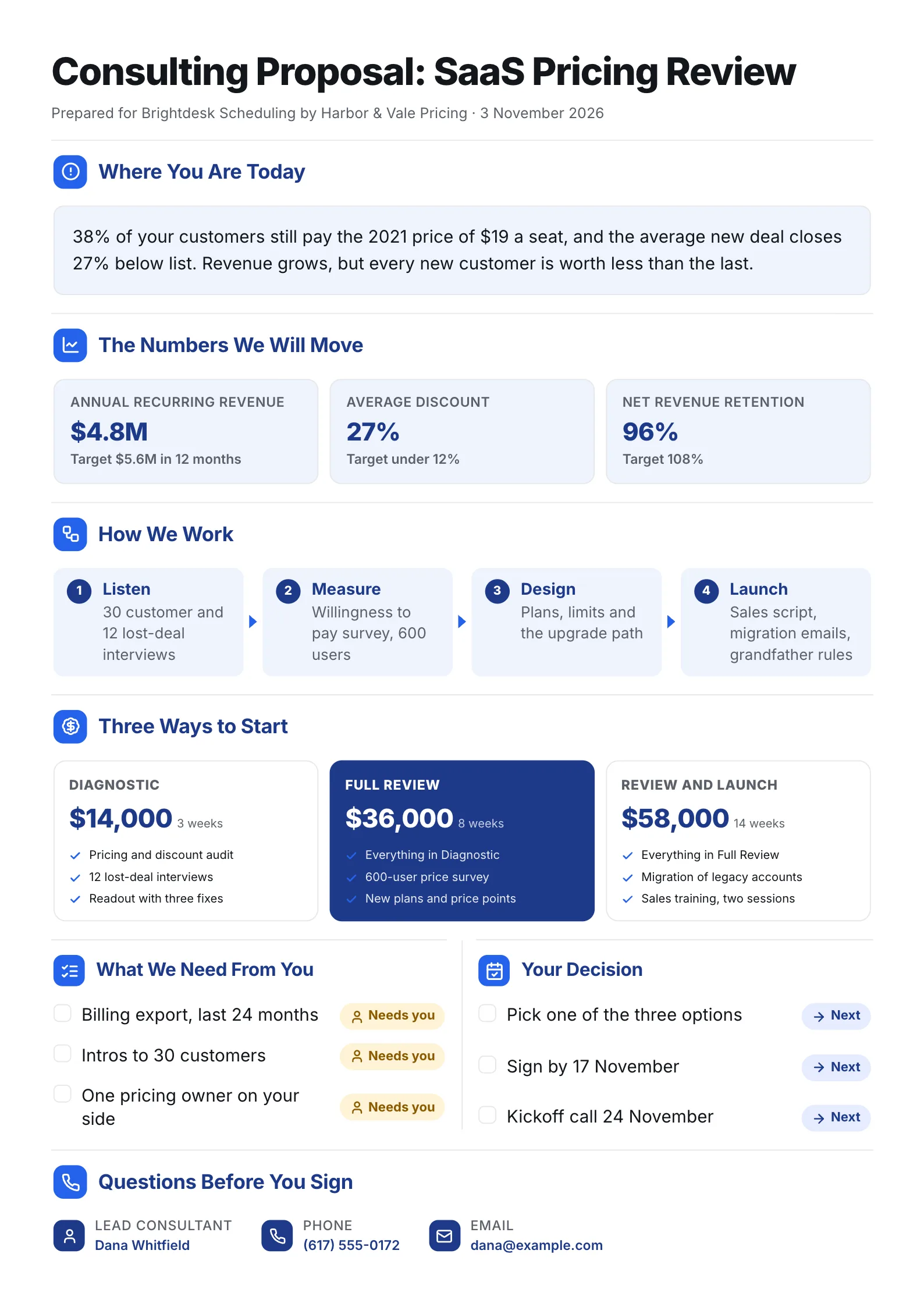
Sample names and figures. Three priced options, from a 3-week diagnostic to a 14-week review and launch, let the client choose the size of the first step.
End with what you need and the next date
Close with two short lists. The first is what you need from the client, like data, an internal owner and a few hours of their team's time. The second is the decision you're asking for, with a date.
Six of the 8 RFPs mention interviews or presentations, from Parkland's on-campus sessions to Ann Arbor's right to interview your key personnel. Treat the proposal as the thing that earns you that meeting. Your last line should make the next step easy to say yes to.
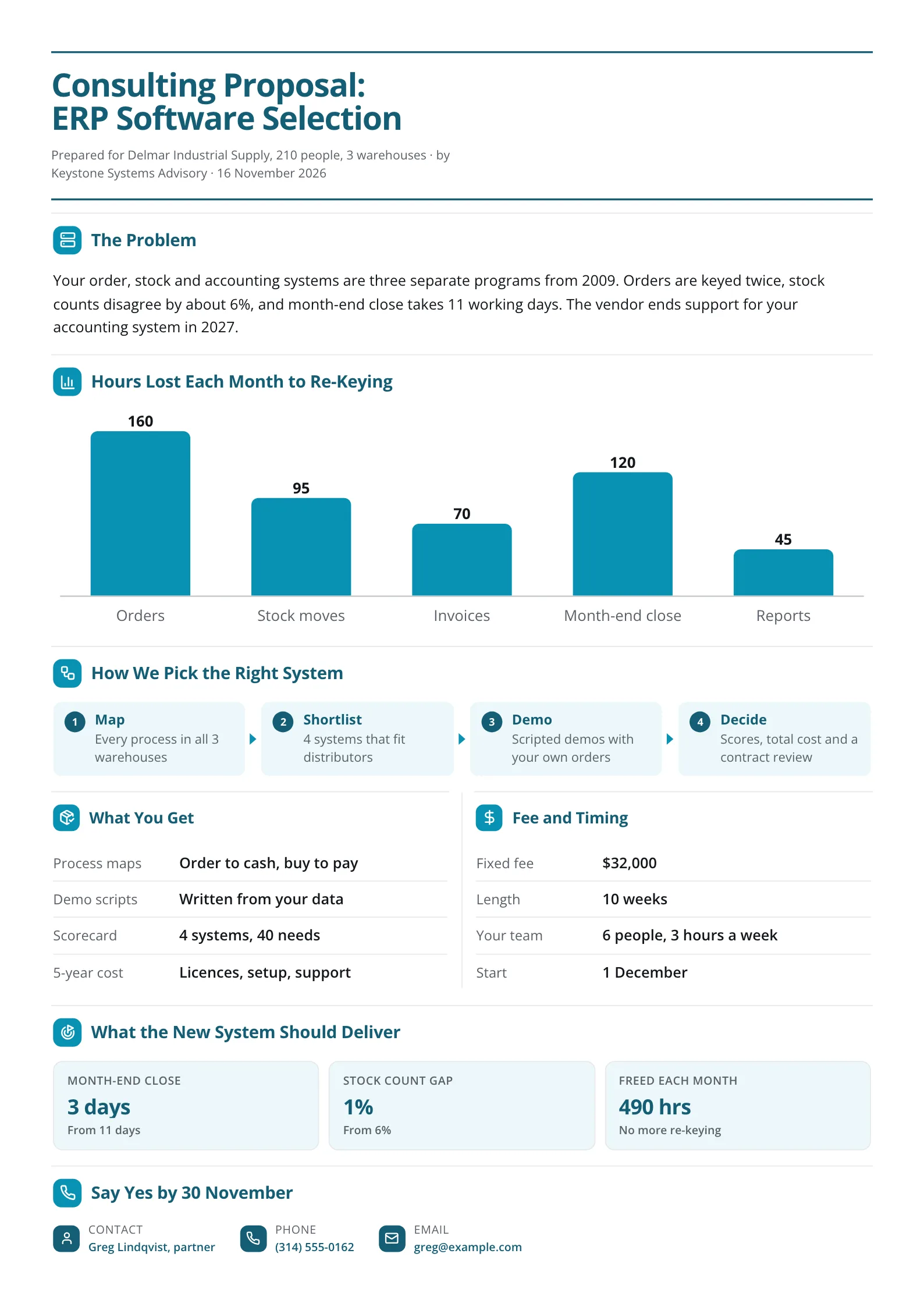 Edit this template
Sample names and figures. Fee and Timing fits in four lines, a $32,000 fixed fee, 10 weeks, 6 people for 3 hours a week and a start date.
How a proposal gets set aside before anyone scores it
Some proposals never reach the scoring table. The RFPs spell out the reasons, and every one of them is easy to avoid.
| What went wrong | What the RFP says |
|---|---|
| Sections in your own order | ICMA and WaterOne may reject a proposal that doesn't follow their format |
| Price mixed into the narrative | WaterOne may reject it, and Ann Arbor wants the fee in its own sealed envelope |
| Sent after the deadline | Farmington won't accept late submissions, and ICMA rejects them |
| No signature from someone who can commit | ICMA wants a letter signed by an officer, WaterOne by the principal consultant |
| Over the page limit | ICMA caps the package at 30 pages |
So before you send, reread the submission section with your draft open beside it. Match their section names word for word, even if yours sound better. Check the deadline's time zone, since Farmington's is 4:00 PM Central. Then make a short list of every form they asked for and tick each one off.
One opening paragraph, before and after
The first paragraph is where most proposals talk about the consultant. Here's a sample opening for a compensation study, rewritten to lead with the client.
| Before | After |
|---|---|
| Founded in 2009, our firm has completed more than 200 compensation studies for clients across the country. | Your pay plan for 420 full-time staff is more than 20 years old, and you've told us it's hurting hiring and retention. |
| We use a proven, data-driven methodology. | We'll compare 60 of your roles against similar colleges in your region and show the cost of closing each gap. |
| We look forward to partnering with you. | You'll have draft pay ranges in 8 weeks, in time for your board's spring budget vote. |
The right column uses the client's own facts, from the RFP, and puts a number and a date in every line. The firm's history still belongs in the proposal, just in the experience section.
When there's no RFP
Most private clients won't send you a formal request. Write the same sections anyway, in the same order, and keep it short. One or two pages after a good discovery call is usually enough, since the client already knows you.
Read the RFP column above as a checklist. If your proposal covers the top six rows, it already answers what most formal buyers ask. For a ready layout with the phases and fee table set, see our consulting proposal template post. To introduce your firm before there's a project, our consulting One-Pager post covers the capability sheet.
The 8 RFPs, with links
| Request for proposals | Issued by | Pages |
|---|---|---|
| Compensation Study Services, 2025 | Parkland College, Illinois | 5 |
| Compensation Review Consultant, 2025 | Campaign Legal Center | 3 |
| Classification and Compensation Study, 2026 | City of Farmington, Arkansas | 4 |
| Comprehensive Compensation Study, 2026 | ICMA | 8 |
| City Manager evaluation facilitator, 2023 | City of Port Townsend, Washington | 10 |
| RFP 26-34, Comprehensive Fee Analysis, 2026 | City of Ann Arbor, Michigan | 34 |
| Compensation Study, 2026 | OCERS, Orange County, California | 43 |
| Compensation and Benefits Consulting Services, 2025 | WaterOne, Kansas | 23 |
Every RFP above was read cover to cover on October 30, 2026. Six are for pay and compensation studies, so weigh them alongside the RFPs in your own field. The page counts include contract forms, which is why the longest run past 30 pages.
Start with the section that scores most
Write your experience and approach before you touch the price, since that's where most of the points are. Then fill in the team, the references and a fee per phase. Open a consulting proposal design in MakeOnepagers, set your phases and fees in its table and end on the one decision you need.
Frequently asked questions
How long should a consulting proposal be?
As long as the client asks for, and no longer. ICMA caps the whole package at 30 pages, not counting resumes, and limits the company profile to two. For a private client without an RFP, one or two pages usually does the job.
Should I give one price or several options?
Give what the client asked for. If they didn't say, offer one fixed fee per phase so they can approve the first phase alone. Three options can work when the client is unsure how much help they need.
What's the difference between a proposal and a statement of work?
The proposal is your pitch to win the job, with your understanding, approach, team and price. The statement of work comes after you win, and it becomes part of the contract with exact deliverables and dates.
Do I need references if I'm new?
Yes, if the client asks for them, and all 8 of these did. Use clients from a previous job, a pilot you ran at a discount or people who saw your work firsthand. Say plainly what each reference can speak to.




