Consulting One Pager: What 7 Real Capability Statements Show
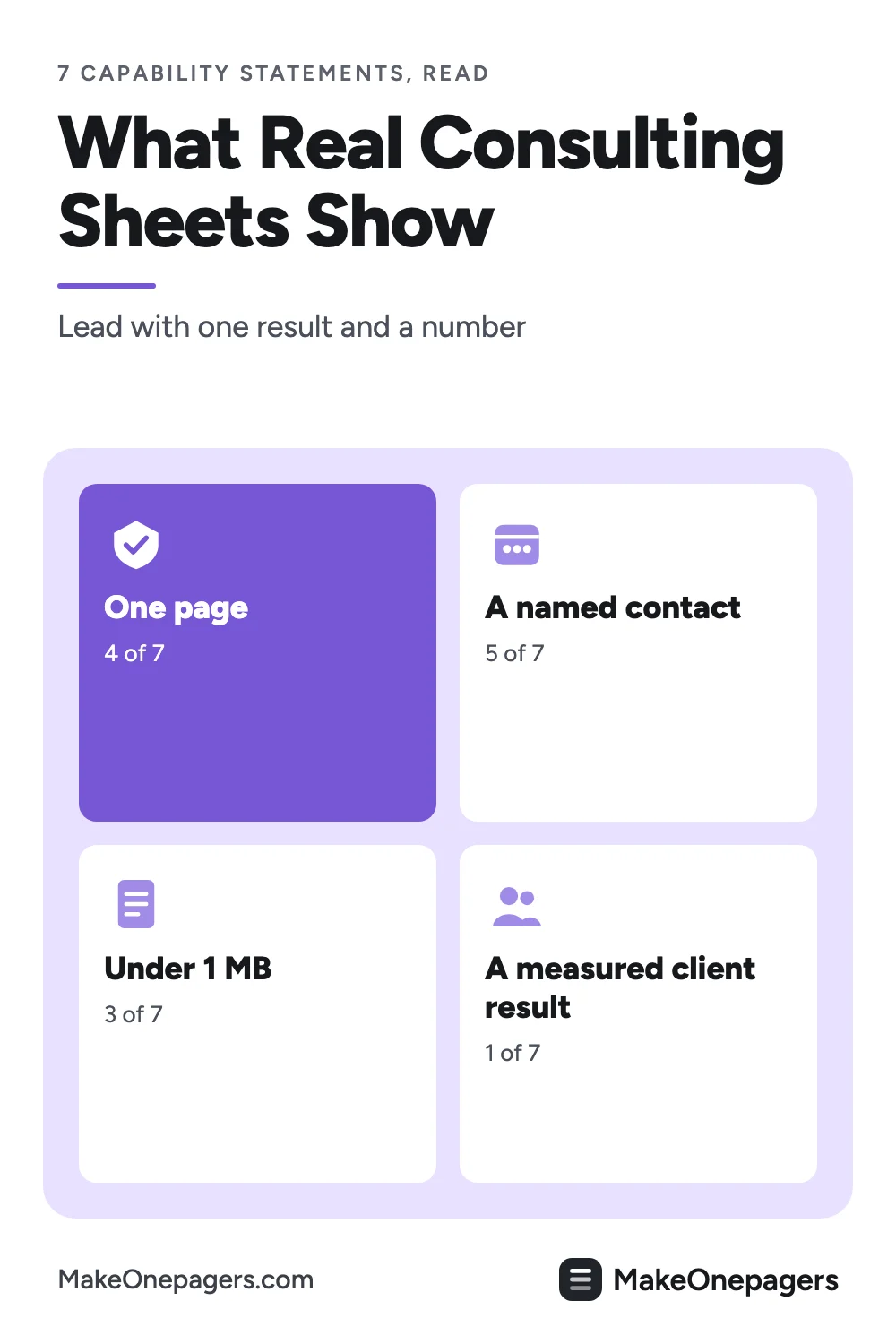
How to write a consulting one pager, from 7 real capability statements and the NIH buyer's guide. Only 1 of the 7 showed a measured client result.


A consulting one pager is the sheet a buyer reads before deciding whether to call you. To see what works, we read 7 real capability statements from firms that list NAICS 541611, the federal code for management consulting. Government buyers ask for this exact document, so these firms have had to fit their pitch on one sheet. Only 4 of the 7 actually fit on one page, and only 1 shows a measured result for a client. Below is what the 7 do, what the buyer's own guide asks for, and how to write yours so it beats them. Start from a free one pager template.
One‑Pager examples
Real One-Pagers made with MakeOnepagers. Open any one to edit it as your own.
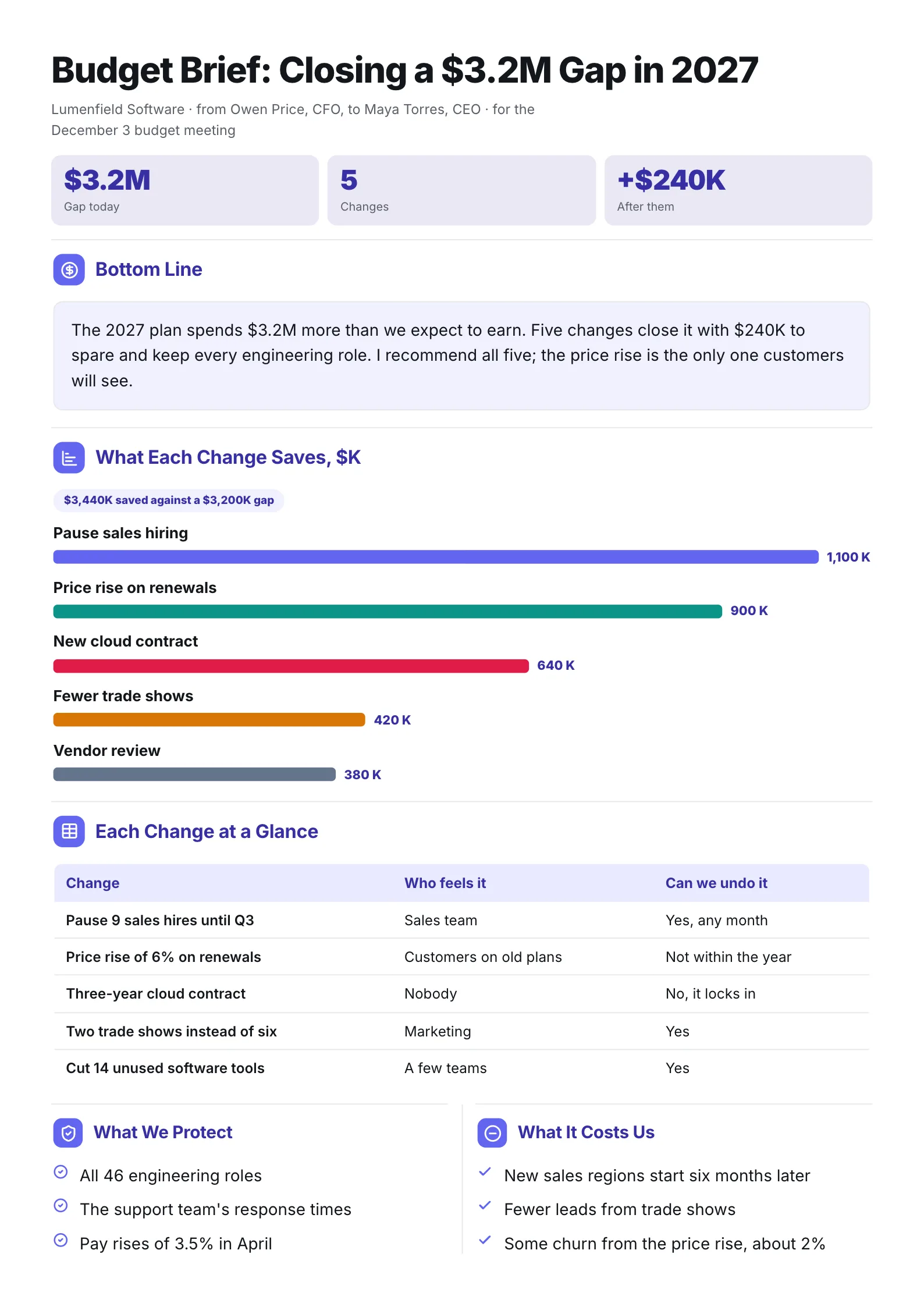 Executive Brief: Budget Gap for the CEOEdit for free(opens in a new tab)
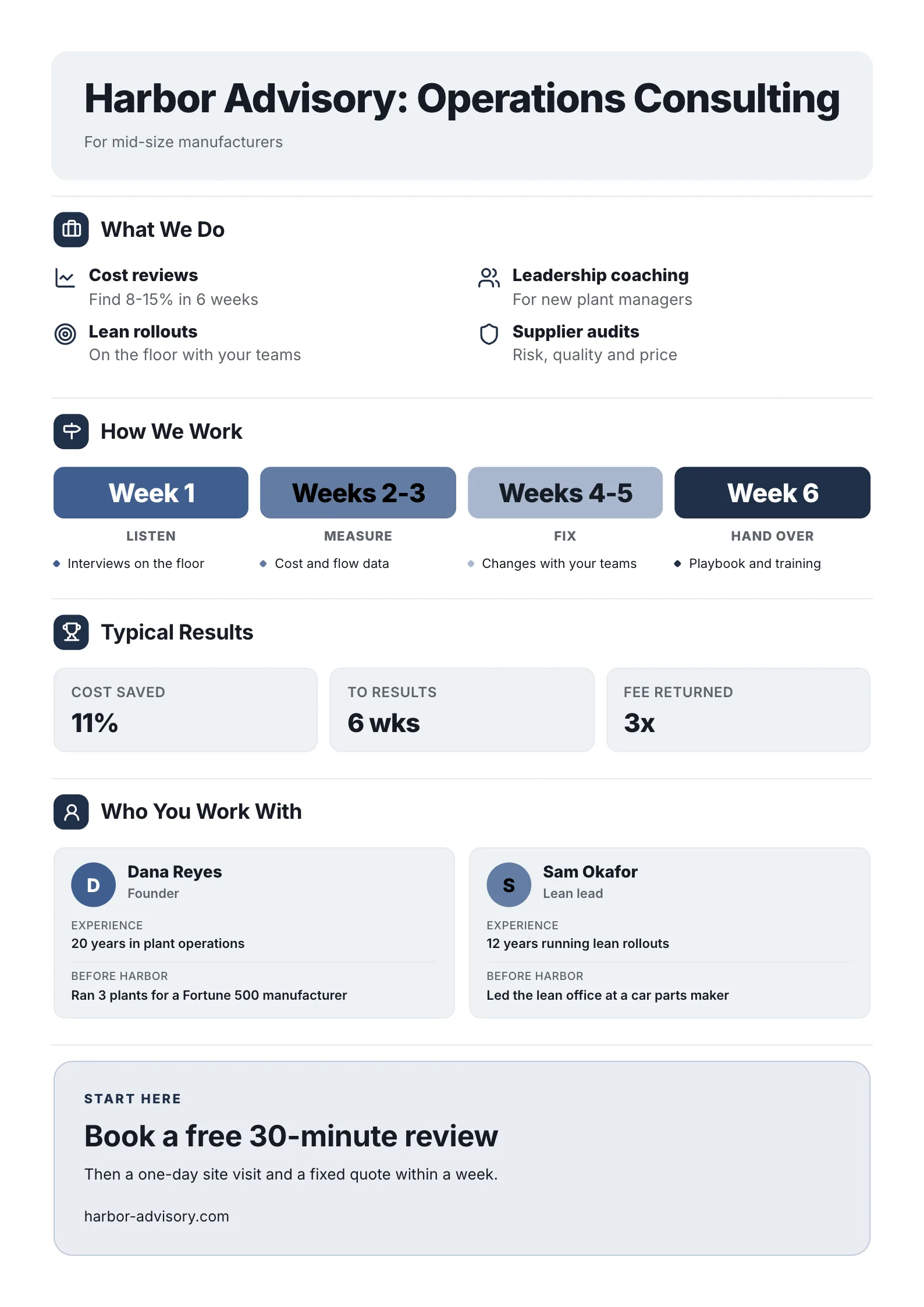 Consulting Services SheetEdit for free(opens in a new tab)
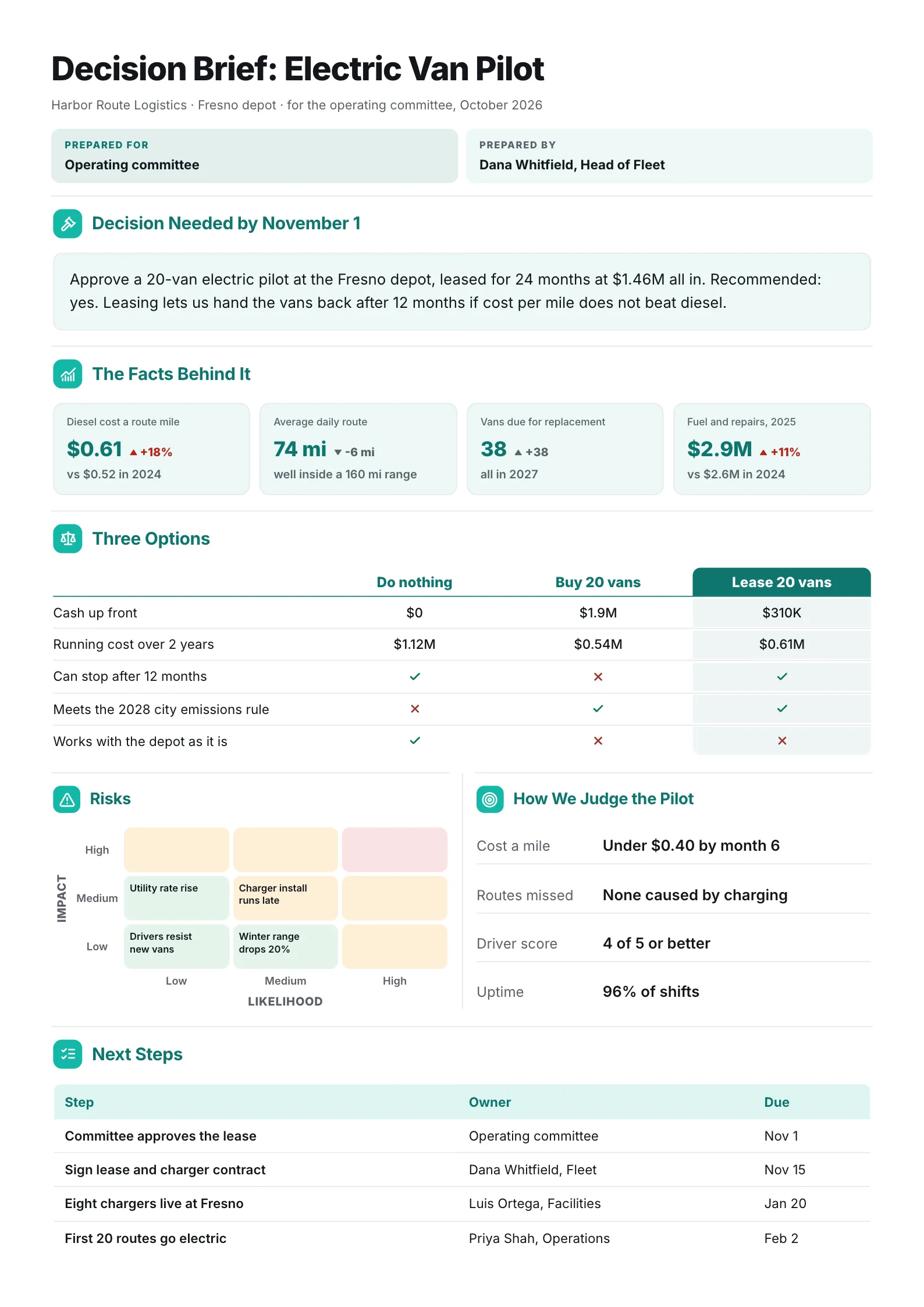 Executive Brief: Fleet Pilot DecisionEdit for free(opens in a new tab)
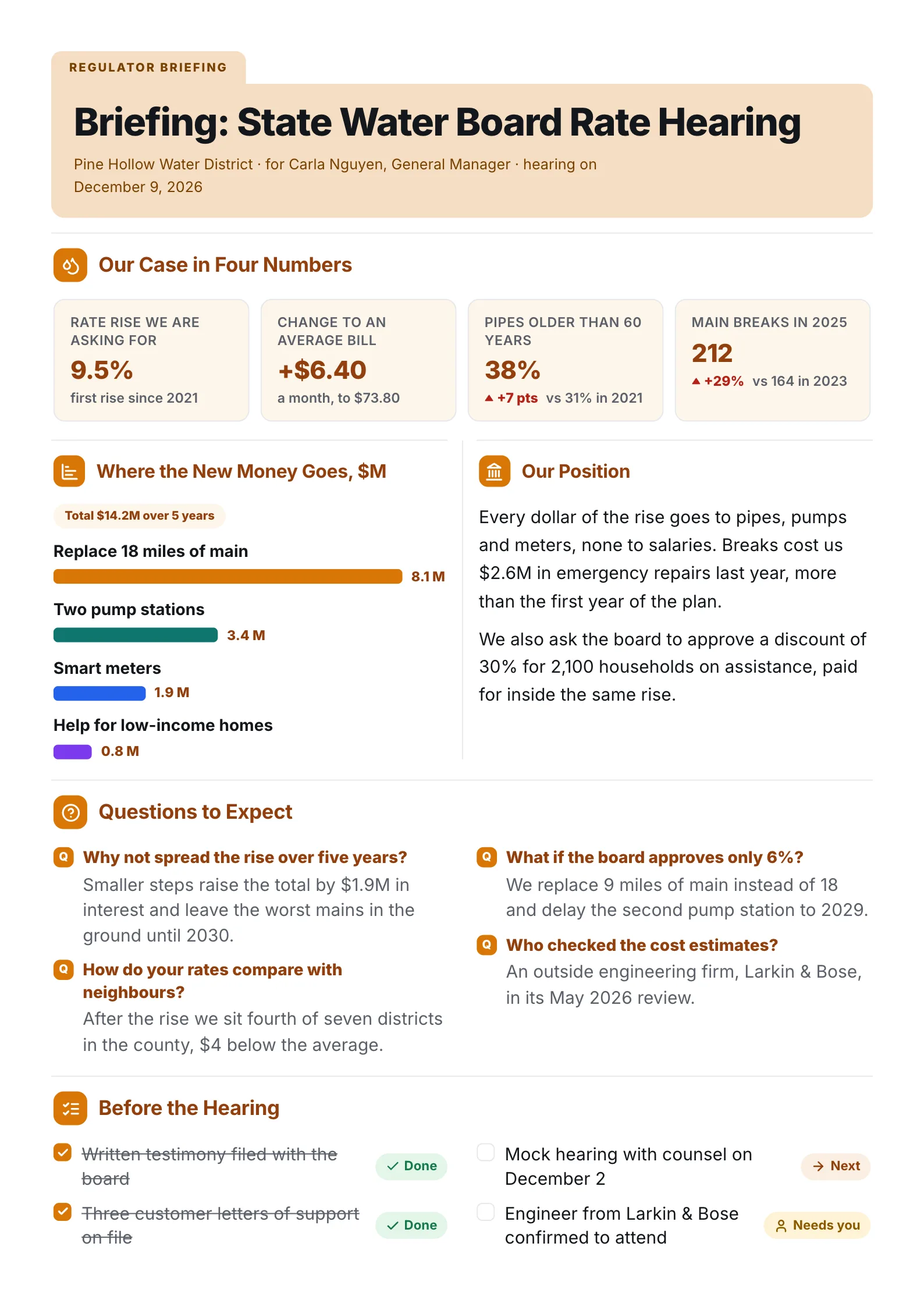 Executive Brief: Regulator HearingEdit for free(opens in a new tab)
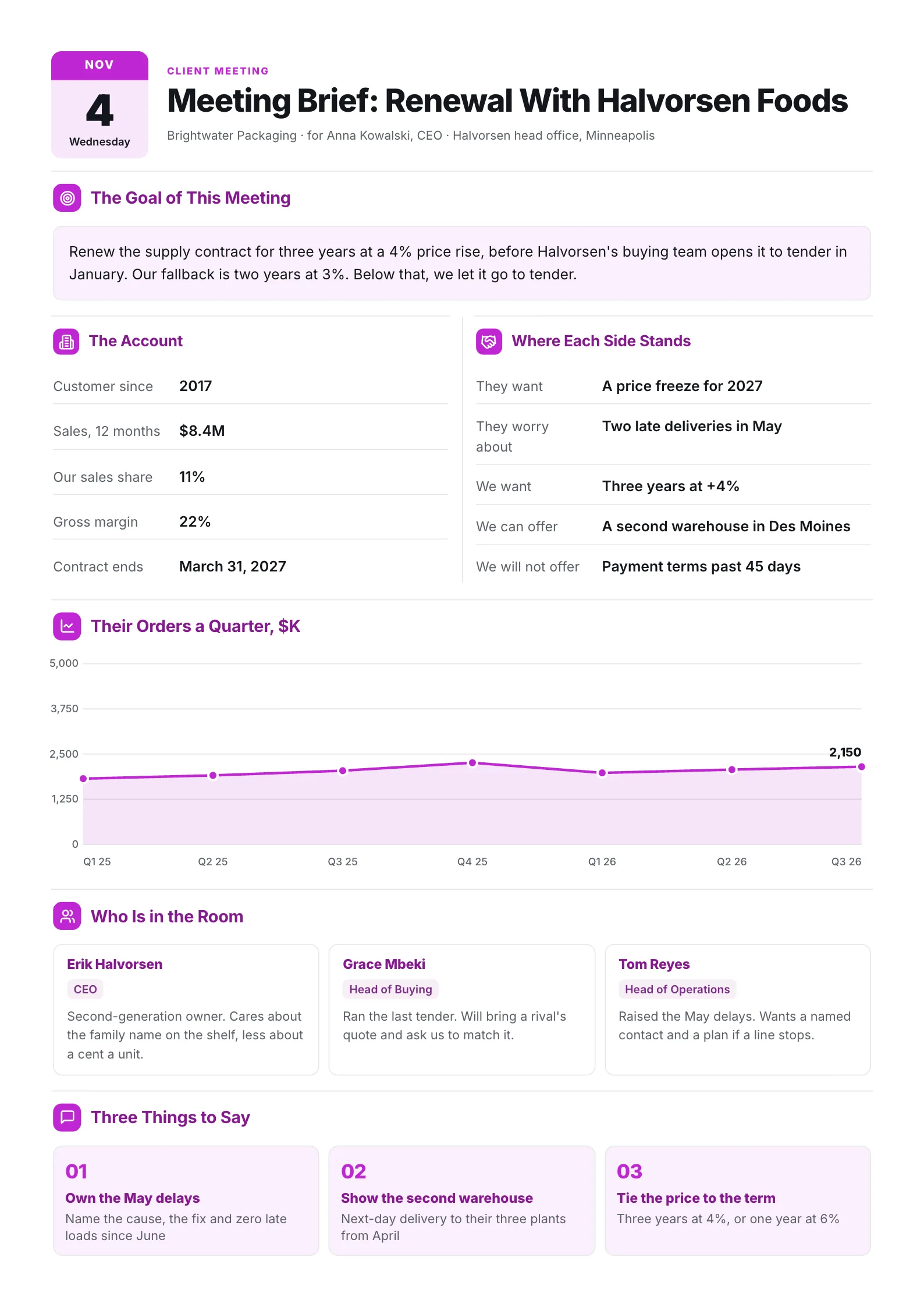 Executive Brief: Client MeetingEdit for free(opens in a new tab)
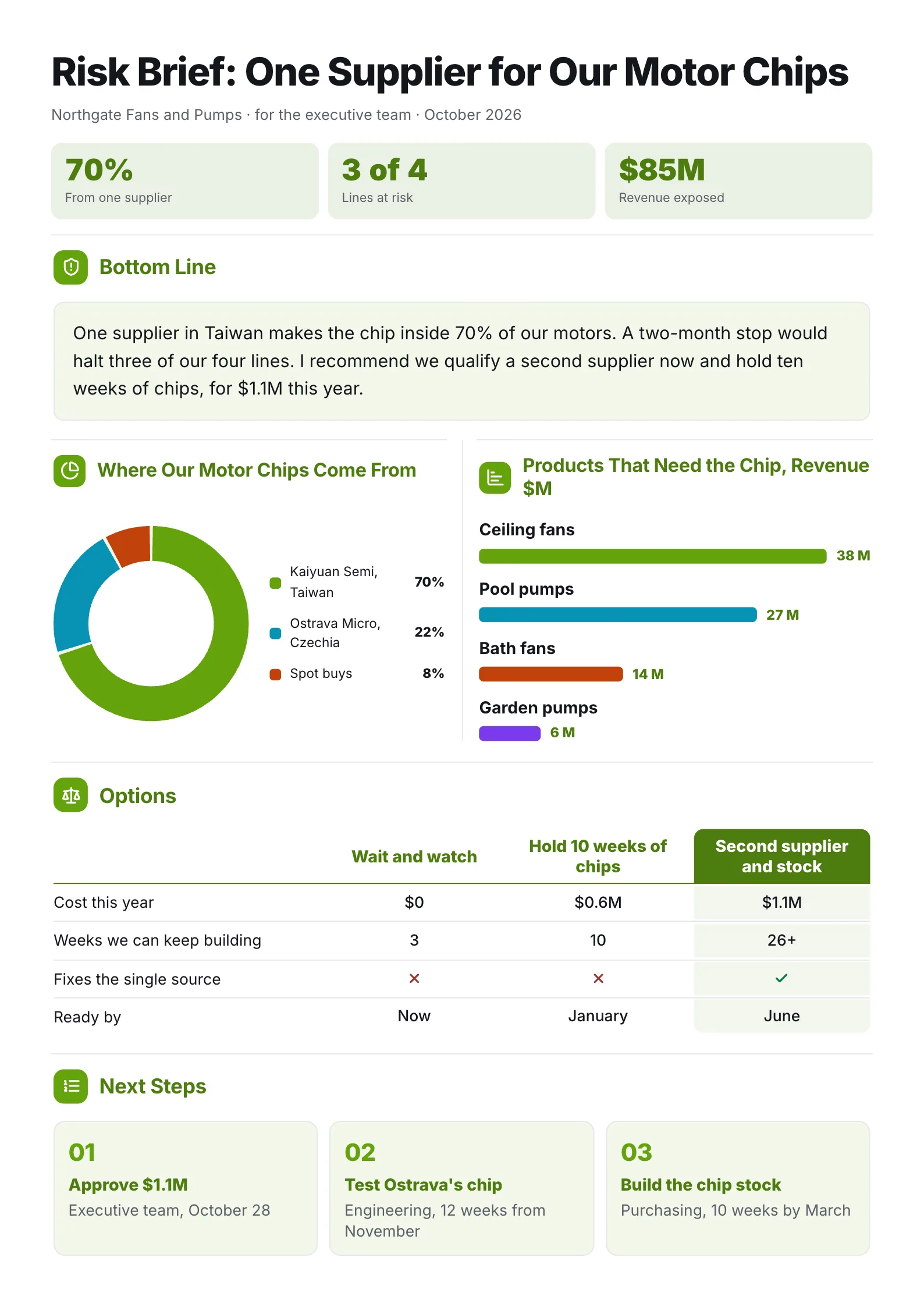 Executive Brief: Supplier RiskEdit for free(opens in a new tab)
The 7 statements we read
On October 26, 2026, we searched the web for public capability statement PDFs that list NAICS 541611 and downloaded 7 of them. They date from 2016 (edo) to 2025 (CPMC). All 7 list the consulting code, but not all of them sell only consulting. Pana describes its work as investing services, GMC calls itself a project management company, and LR Associates lists logistics, facilities and security work beside its consulting code. We counted the pages and words, the file size, the NAICS codes listed, whether a named person is the contact, and whether any client result carries a number.
| Firm | Pages | Words | File size | NAICS codes | Named contact | Measured client result |
|---|---|---|---|---|---|---|
| Pana Consulting | 1 | 231 | 160 KB | 1 | Yes | No |
| Arlo Solutions | 1 | 253 | 167 KB | 3 | Yes, 4 people | No |
| LR Associates | 2 | 492 | 3,038 KB | 10 | No, an info@ address | No |
| CPMC | 2 | 793 | 10,263 KB | 9 | Yes | No |
| edo consulting | 2 | 524 | 752 KB | 5 | Yes | No |
| GMC Consultants | 1 | 383 | 1,409 KB | 7 | No, phone and web only | No |
| IMS | 1 | 608 | 1,209 KB | 8 | Yes | Yes, $20 million saved |
The yardstick is the NIH Office of Acquisition guide to capability statements, which tells firms what a federal buyer wants on one.
What the buyer's guide asks for
The NIH guide is short and specific. It says the statement is "preferably" one page, one side, and to "go to two sides only if absolutely necessary." It asks you to "save and distribute as a PDF" and to "keep the file format small, definitely under 1MB." It wants a "reasonable number" of NAICS codes, "fewer than 10," and a specific person's name, phone and email. And it says to "create a new document for each agency."
Its sections are core competencies, past performance with reference contacts, differentiators and company data. Those four map straight onto a private consulting one pager: what you do, proof you've done it, why you and not the next firm, and how to reach you.
Lesson 1: Fit it on one side
4 of the 7 fit on one page: Pana, Arlo, GMC and IMS. The other three run to two. The two shortest sheets, Pana at 231 words and Arlo at 253, use less than a third of CPMC's 793 words over two pages.
You don't need more words to look bigger. Cut each service to one line that says what the client gets, and move the long history to your website.
Lesson 2: Show one result with a number
This is the biggest gap. Only IMS gives a measured result for a client: a cost-benefit study that "helped the client save a total of $20 million." The others describe work and size instead. CPMC has a "proven track record managing programs exceeding $1 billion," which tells you how big the programs were. It doesn't say what changed for the client. edo lists "over a 100 successful projects." Pana puts a dollar figure on each past contract ($400,000 for Lazard Asset Management, $700,000 for Bloomberg), which shows what clients paid. It doesn't show what they got back.
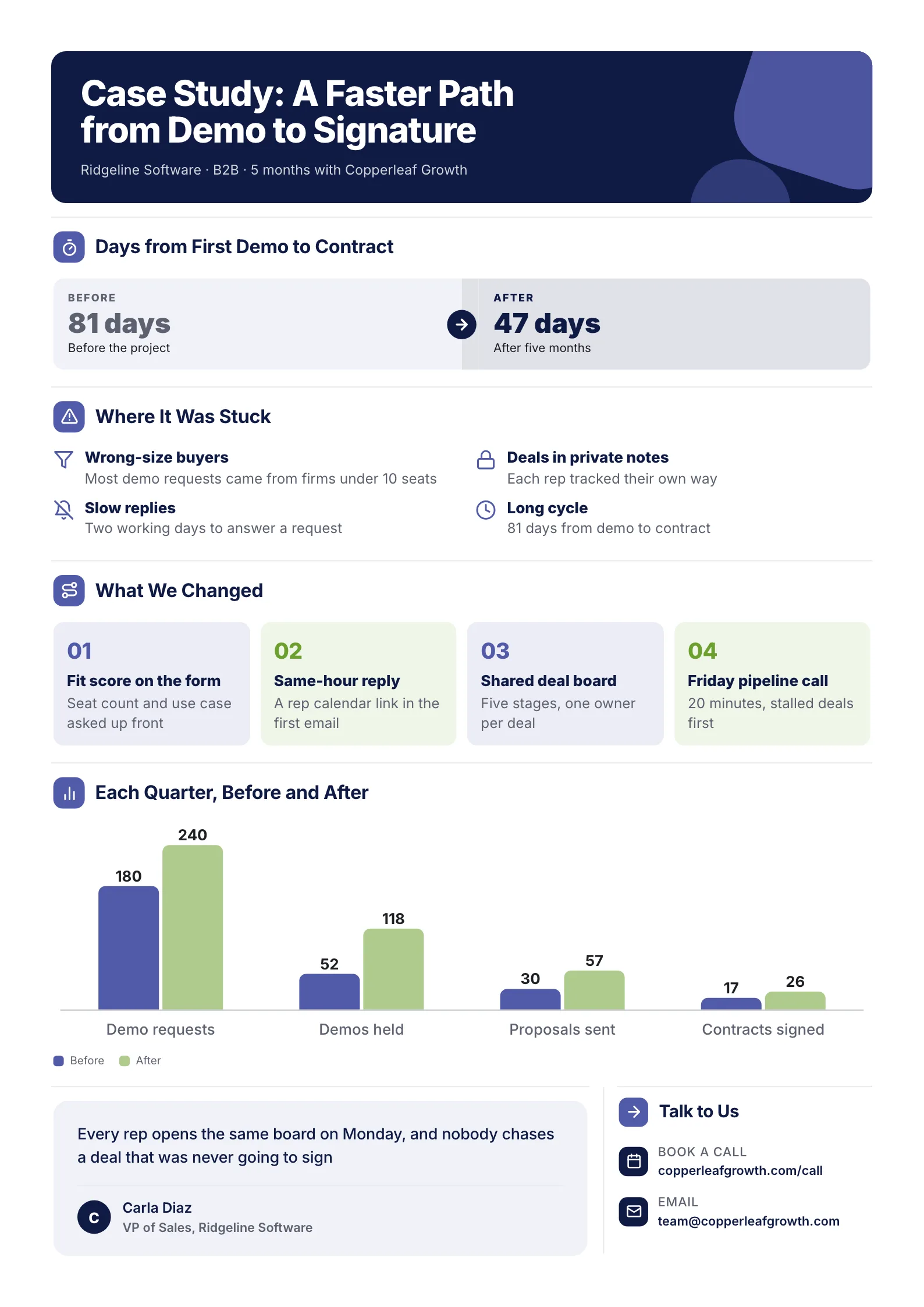
Put one line on your sheet that says what changed for a client, with a number and a time: cost cut by 11% in six weeks, a sales cycle down from 74 days to 50. If a client let you name them, name them. If not, describe them ("a 200-person distributor").
 Edit this template
Sample firm and numbers. The result leads the sheet, before and after, with the time it took. That's the line only 1 of the 7 real statements had.
Lesson 3: Put a person's name on it
5 of the 7 name a person to contact, and the guide asks for one. LR Associates gives only an info@ address, and GMC gives a phone number and a website with no name at all. When a buyer wants to ask one question, a name gets the call. A shared inbox gets forwarded.
Close your sheet with your name, your direct phone and your email, and one clear first step, such as a free 30-minute review.
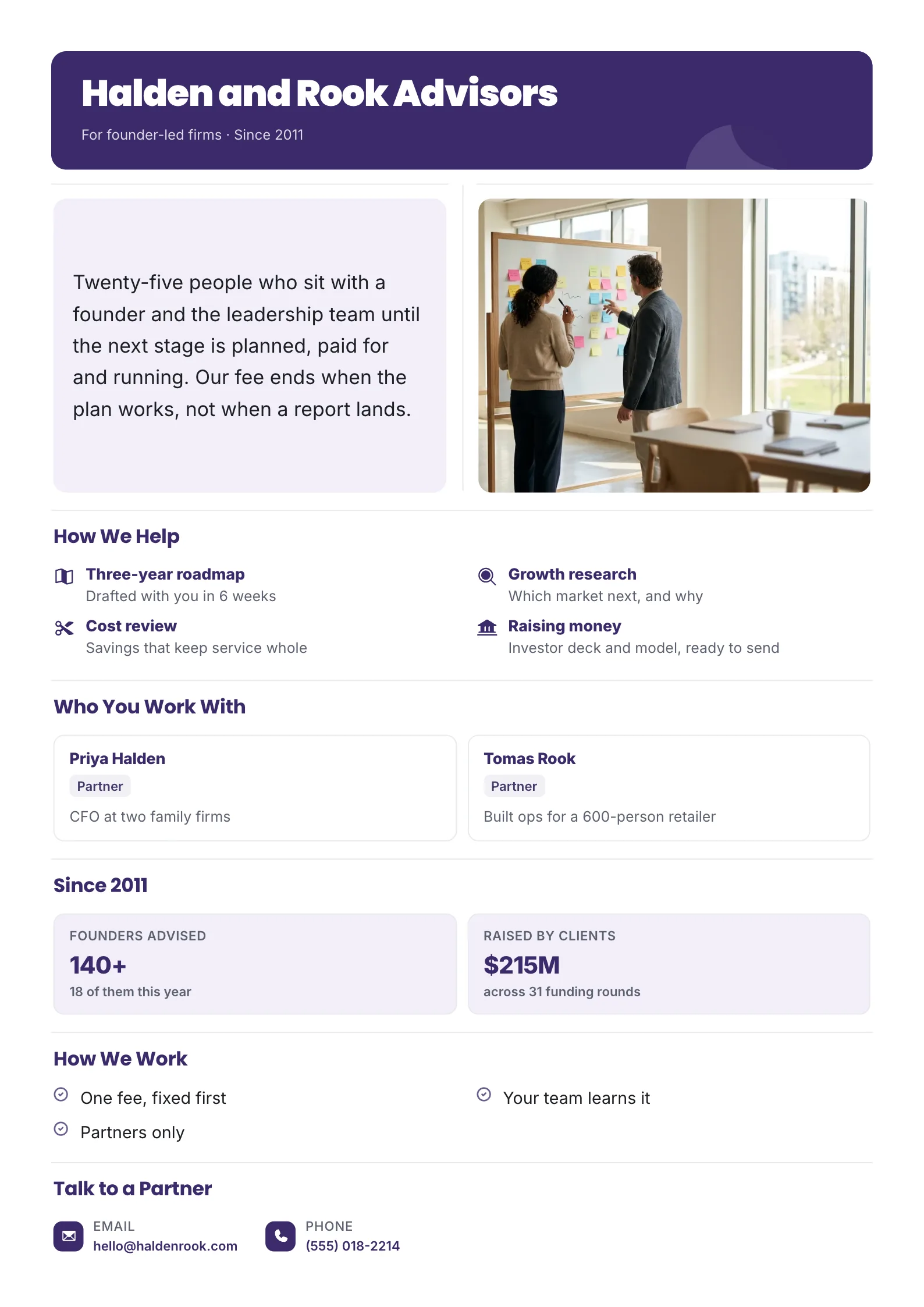 Edit this template
Sample names and figures. Both partners are named with what they did before, and the sheet closes on an email and a phone. The services read as outcomes too, like a three-year roadmap drafted with you in 6 weeks.
Lesson 4: Make your differentiators impossible to copy
Pana's differentiators include "Strong industry reputation" and "Long-term clientele." Any firm could print those words. Its list also has lines only Pana can claim, like "In business since 2011" and its focus on private investments, and those are the ones that do the work.
Test each line on your sheet: could your closest rival print it unchanged? If so, swap it for a fact only you have, such as a niche you serve, a number of years, a method with a name, or a client type you know better than anyone.
Lesson 5: Keep the file small and the codes few
Only 3 of the 7 come in under the guide's 1 MB: Pana, Arlo and edo. CPMC's file is over 10 MB, which can bounce off an email gateway or sit loading on a phone. 6 of the 7 list fewer than 10 NAICS codes; LR Associates lists exactly 10.
Export your sheet as a PDF and check the size before you send it. If it's over 1 MB, the photos are usually the cause, so shrink them first.
Lesson 6: Write a new one for each client
Near the top of its tips, the guide says to "create a new document for each agency, prime or teaming opportunity" and to tailor each one to the agency's mission. For private work that means a new sheet for each prospect, or at least for each industry. Swap the result, the services you lead with and the first step so they match what this buyer said on your first call.
What to put on your consulting one pager
| Section | What to write | Taken from |
|---|---|---|
| Name and line | Your firm and who you serve, in one line | Every statement opens this way |
| The problem you solve | The client's problem in their own words, in one or two lines | What the client told you on your first call |
| What you do | 3 to 5 services, each with what the client gets | NIH "core competencies" |
| Proof | One measured client result, with a number and a time | IMS, the only one of 7 that does it |
| How you work | 3 or 4 steps, so the work feels concrete | The Copperleaf case study above |
| Why you | 2 or 3 facts a rival couldn't print | NIH "differentiators" |
| Who to call | A named person, direct phone, email and a first step | NIH, and 5 of the 7 |
Federal work adds the company data block: your UEI, CAGE code, NAICS codes and certifications. Private clients rarely need it, so leave it off unless you're bidding on public contracts.
If you mean a one pager inside a consulting firm
Inside a consulting firm, "one pager" usually means a different sheet: one page that answers one question for a client, a partner or a board. Deckary's guide to one-pager templates, the top Google result for this phrase on October 26, 2026, sorts them into five kinds and says "the best one-pagers lead with the conclusion." Here are four jobs like these, each shown as a sample made with MakeOnepagers, with the parts that do the work.
The recommendation brief
Use it when a client asks what they should do. Put your recommendation at the top in two or three sentences. Then show the evidence that picked it, usually one or two charts, the options you weighed, a plan with dates, and exactly what you ask the reader to approve.
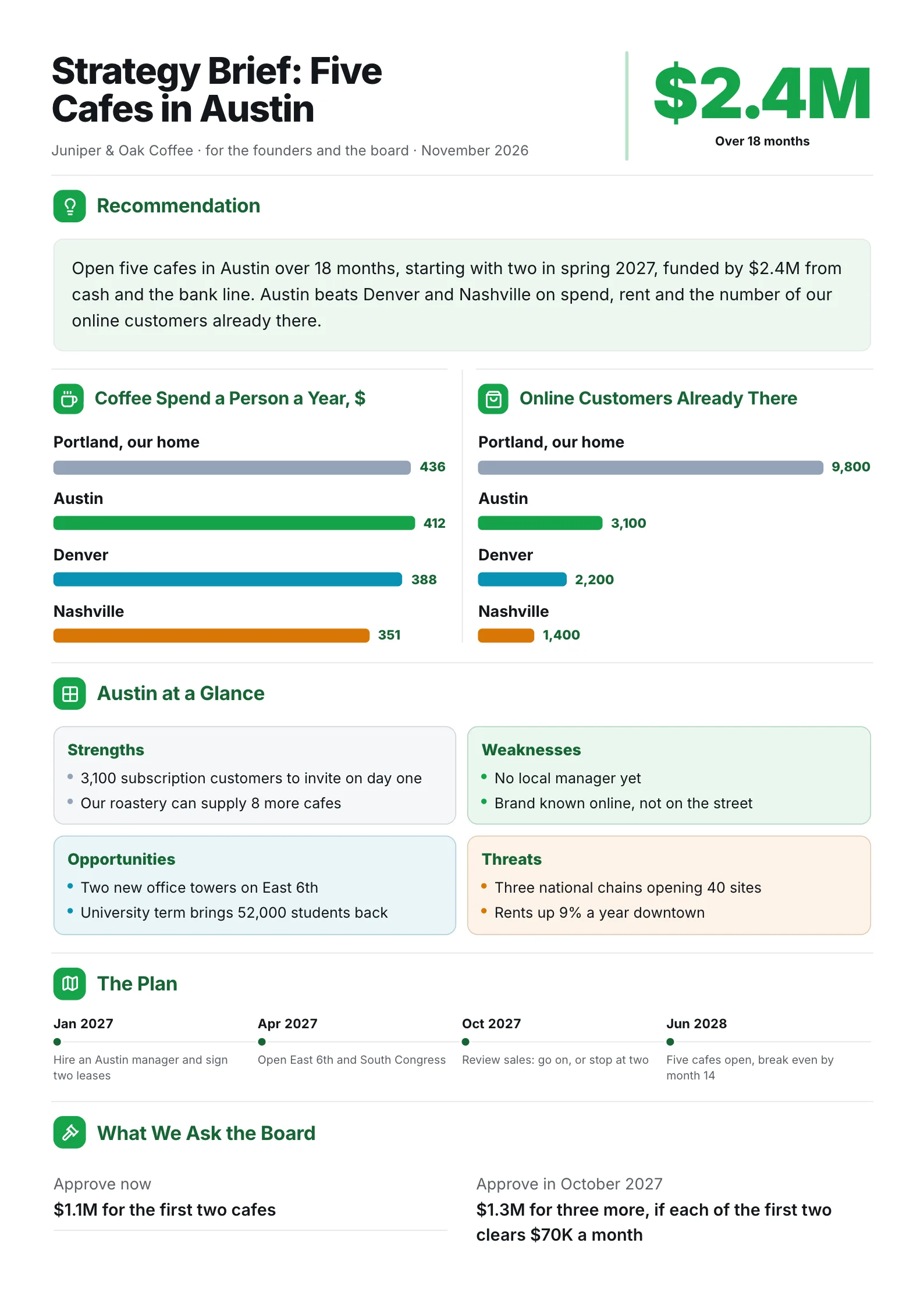 Edit this template
Sample names and figures. The answer sits in the first box. The last box splits the ask in two: $1.1M now, and $1.3M more only if the first two cafes each clear $70K a month.
The deal brief
Use it before a board votes on buying a company or making an investment. Lead with the ask and your top price. Then give the target in three numbers, their price beside yours, the terms you propose, the risks and the checks left before anyone signs.
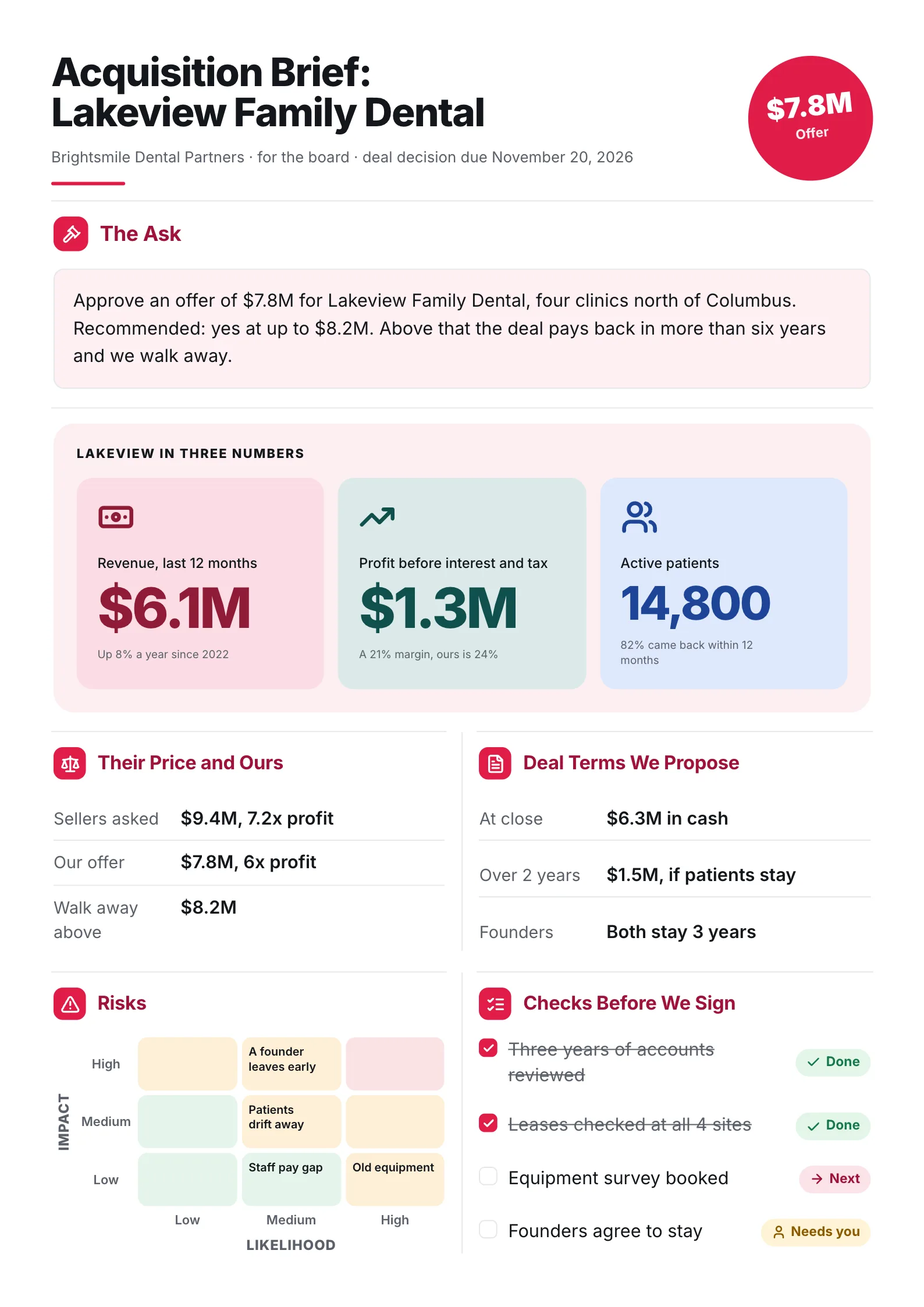 Edit this template
Sample names and figures. The first paragraph names the walk-away price, $8.2M, so the board knows the limit before it reads a single number.
The go or no-go brief
Use it when a launch, a project phase or a pilot needs a yes. Give the call first, with any condition on it. Then show readiness by team, the results so far, what's still open, what waiting would cost and the dated steps.
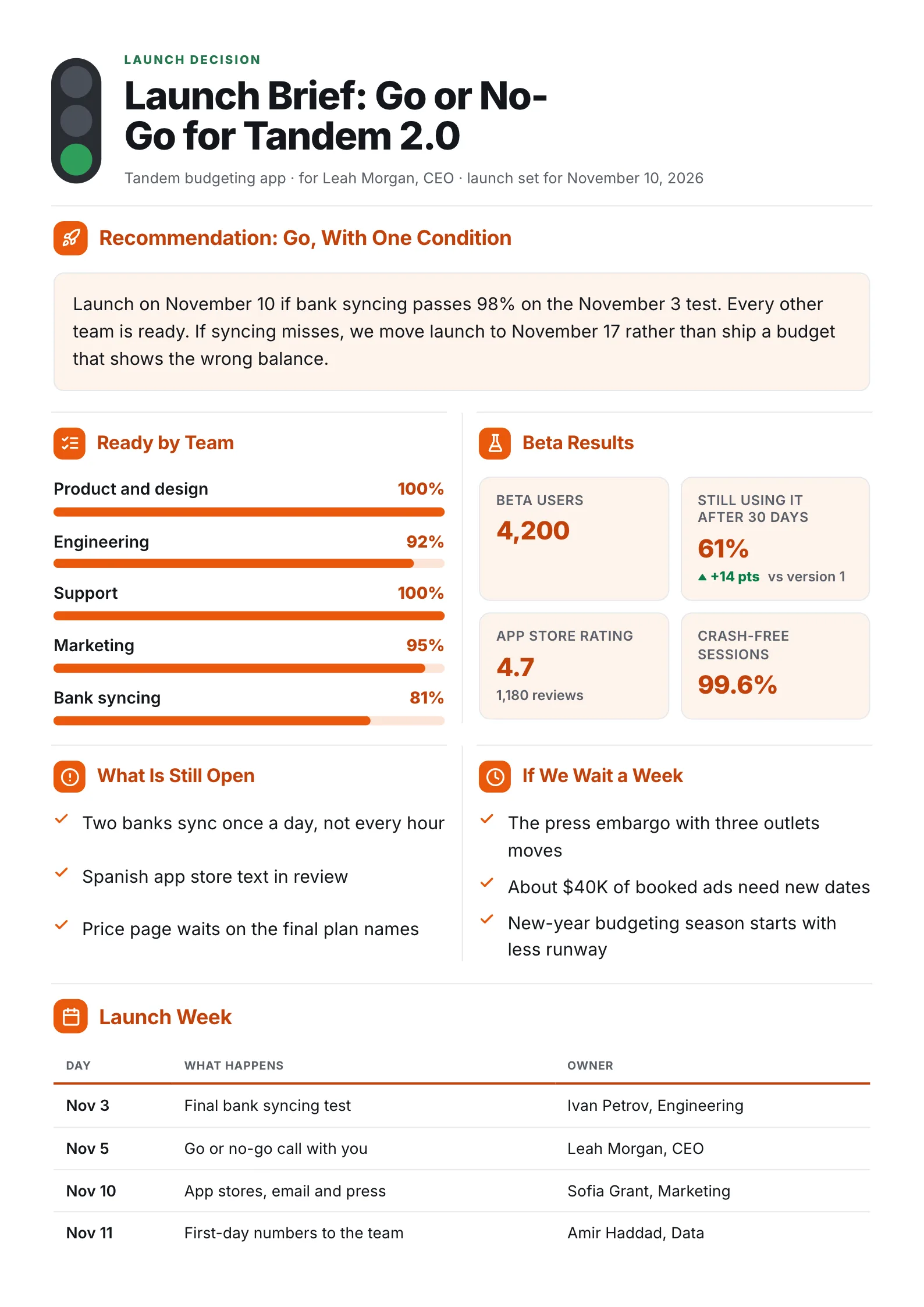 Edit this template
Sample names and figures. The call carries its condition: launch on November 10 if bank syncing passes 98% on the November 3 test. "If We Wait a Week" puts a price on saying no.
The business case for one request
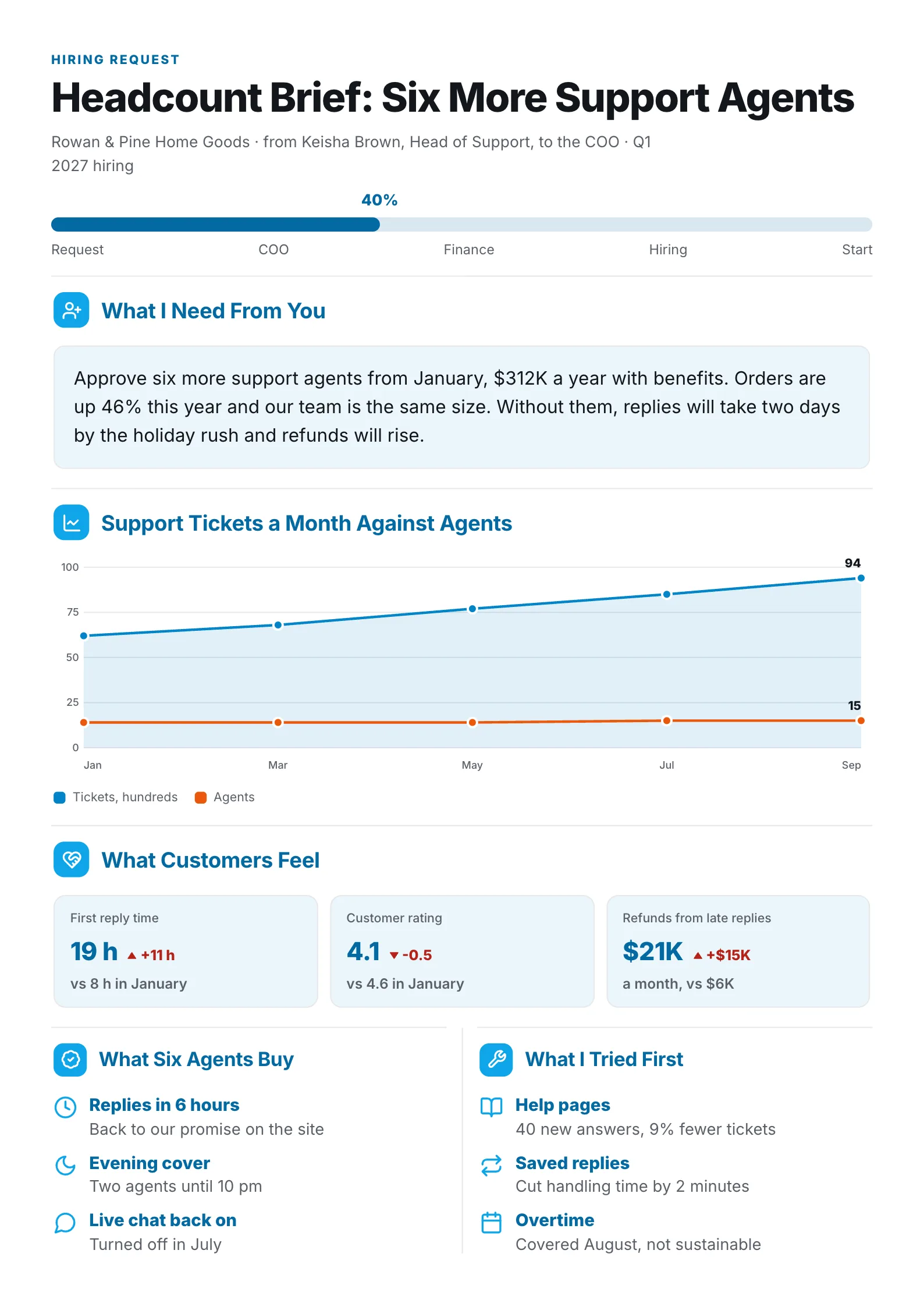
Use it to ask for money, people or time. Say what you need and why in one paragraph. Then show the trend that proves it, what the problem costs today, what the money buys and what you already tried.
 Edit this template
Sample names and figures. "What I Tried First" answers the reader's first question before they ask it: help pages cut tickets by 9%, and overtime covered August but can't go on.
Write the headline as the answer
Every one of these sheets turns on its headline. Deckary's rule is that headlines "should state conclusions, not topics." Compare the two kinds:
| Topic headline | Answer headline |
|---|---|
| Warehouse review | Moving the Dallas warehouse to Fort Worth saves $2.1 million a year |
| Office lease | Sharing one floor with the Denver team saves $380K a year |
| Supplier update | One chip supplier puts 3 of our 4 product lines at risk |
| Hiring plan | Six more support agents bring replies back under 6 hours |
Here's the first one as a full executive summary, with made-up figures:
| Part | What it says |
|---|---|
| Headline | Moving the Dallas warehouse to Fort Worth saves $2.1 million a year |
| Situation | Rent in Dallas rises 38% when the lease renews in June 2027 |
| Point 1 | Fort Worth rent is $1.4 million a year lower for the same floor space |
| Point 2 | Trucks reach 92% of today's customers within the same delivery day |
| Point 3 | The move costs $1.8 million once, so it pays back in 10 months |
| Risk | 6 of 41 staff live more than an hour from the new site |
| Decision | Approve the move by January 15 so the new lease can be signed in March |
A partner who reads only the headline still knows the answer.
Build one in six steps
- Write the question your reader needs answered, in one line.
- Write your answer to it as the headline.
- Pick 3 to 5 facts that prove it, each with a number.
- Show the options you weighed, and why you dropped the others.
- Name the biggest risk and what you'll do about it.
- End on the decision you need, with a date and an owner.
The same habit helps your sales sheet. Lead with the result a client gets, then prove it.
Questions people ask about consulting one pagers
What is the difference between a consulting one pager and a capability statement?
A capability statement is the version federal and state buyers ask for. It adds company data such as NAICS codes and certifications. A consulting one pager for private clients keeps the same core (what you do, proof, why you, who to call) and drops the government codes.
Should I put prices on a consulting one pager?
Usually not. None of the 7 statements we read lists a price for new work. Pana shows what two past clients paid, and that's as close as any of them gets. Name the first step instead, such as a free review or a fixed-price diagnostic, and send prices in the proposal.
How long should a consulting one pager be?
One side. 4 of the 7 statements fit on one page, and the NIH guide says to go to two sides only if absolutely necessary. The two shortest we read ran 231 and 253 words.
What results should a consultant show?
A change the client can measure, with a number and a time: money saved, days cut, revenue gained. Only 1 of the 7 statements we read did this, so a single solid result already sets your sheet apart from those 7.
Make your consulting one pager
Open a consulting design and put your one measured result at the top, where a client looks first. Then fill in your services and your method, and sign it with your name. Browse the consulting designs in MakeOnepagers, see how to pitch a full engagement on our consulting proposal template page, or turn your notes into a first draft with our One-Pager maker (free for 7 days).




