How to Make a Study Guide: What AP Exam Readers Say Students Miss
How to make a study guide that targets the mistakes AP exam readers flagged in 6 of College Board's 2025 Chief Reader Reports.

Learning how to make a study guide starts with the test itself. Write down its date and format, turn each topic into a question, and list the traps that cost points on this kind of test. Then finish with practice questions and a plan for each day before the test. To find those traps, we read 6 of College Board's 2025 Chief Reader Reports. In them, the teachers and professors who score AP exams describe what students got wrong on 35 free-response questions. One mistake shows up in all 6: a claim with no reason behind it. Start from a free one pager template.
One‑Pager examples
Real One-Pagers made with MakeOnepagers. Open any one to edit it as your own.
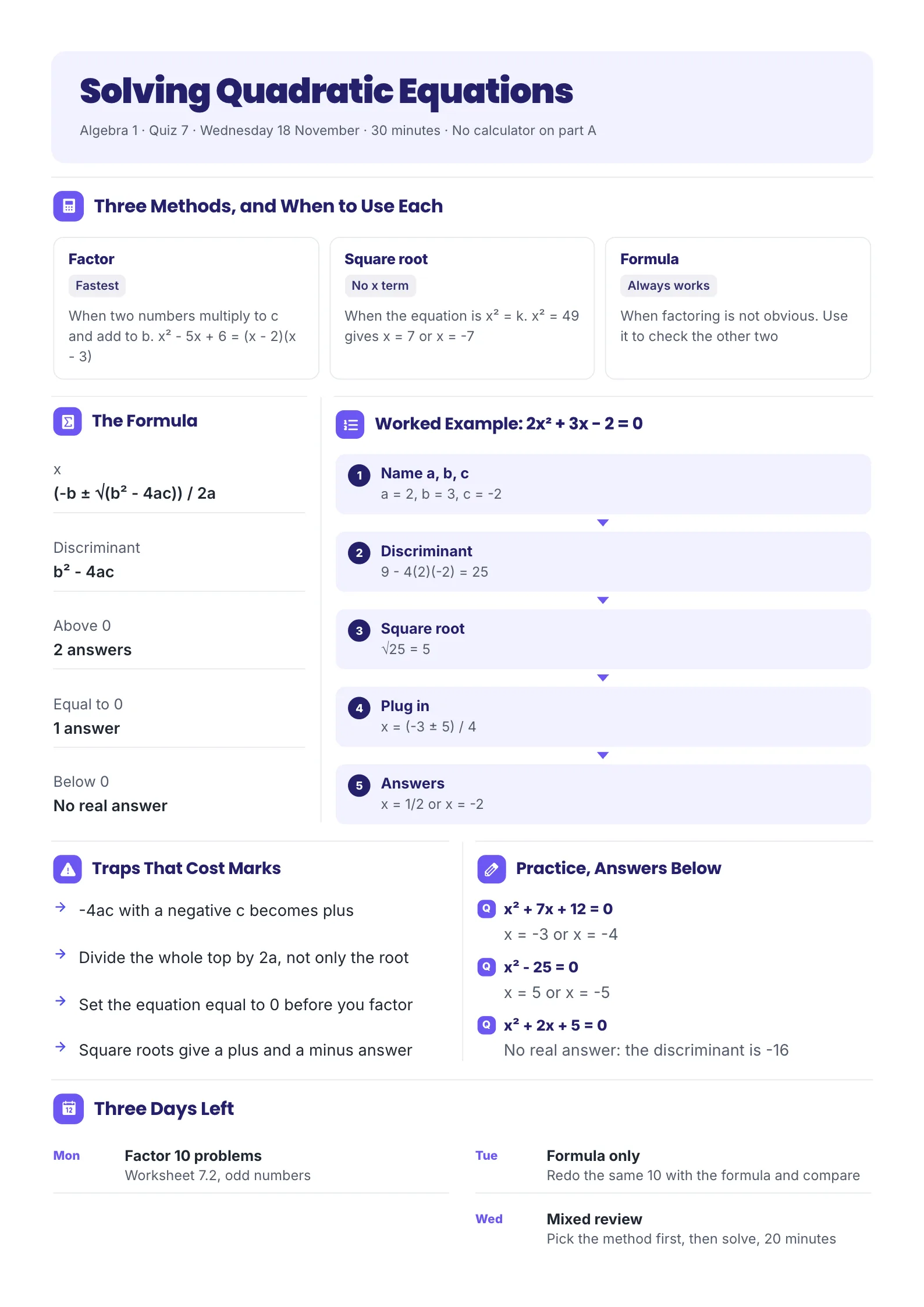 Study Guide: Algebra, Quadratic EquationsEdit for free(opens in a new tab)
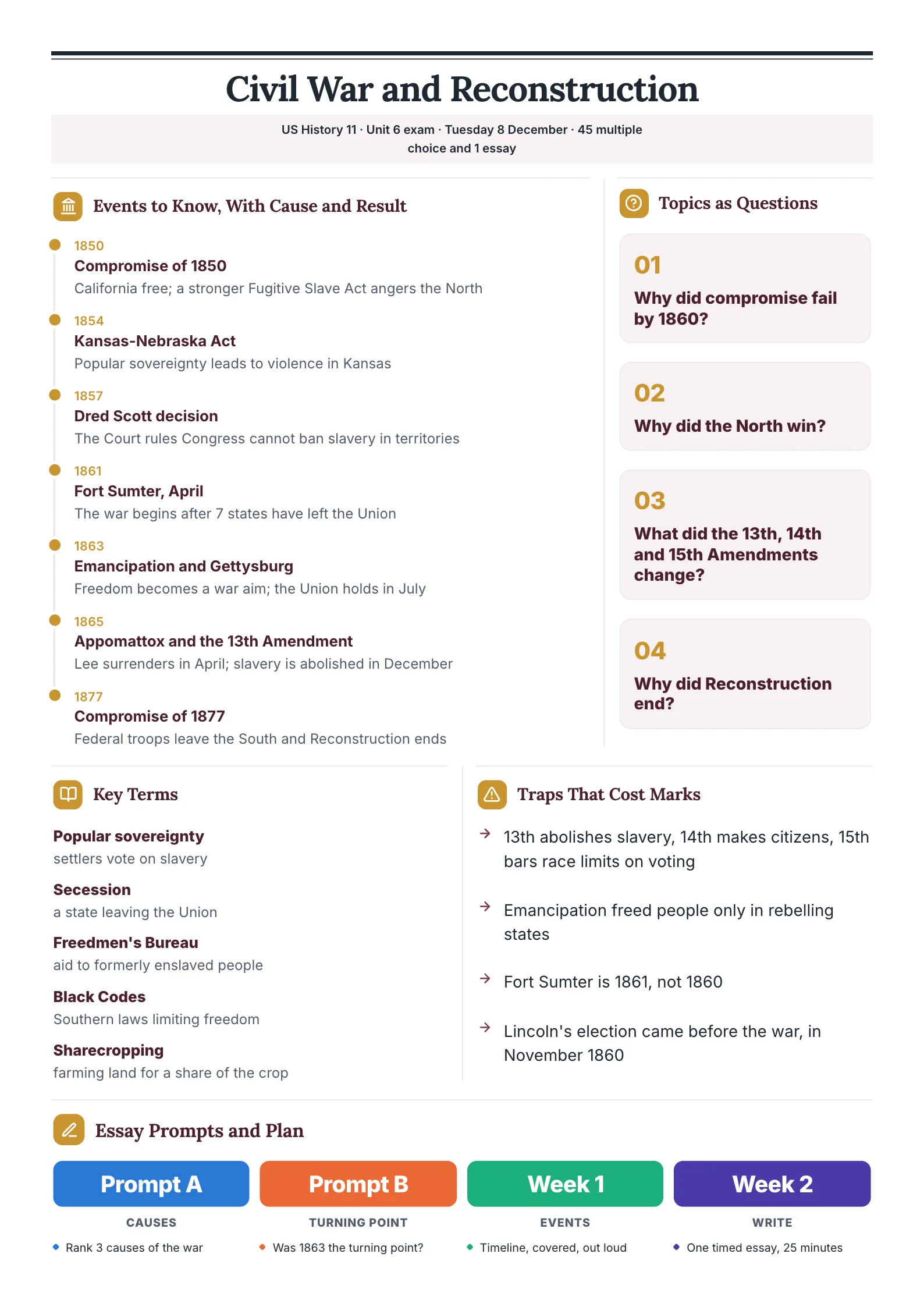 Study Guide: US History, Civil War and ReconstructionEdit for free(opens in a new tab)
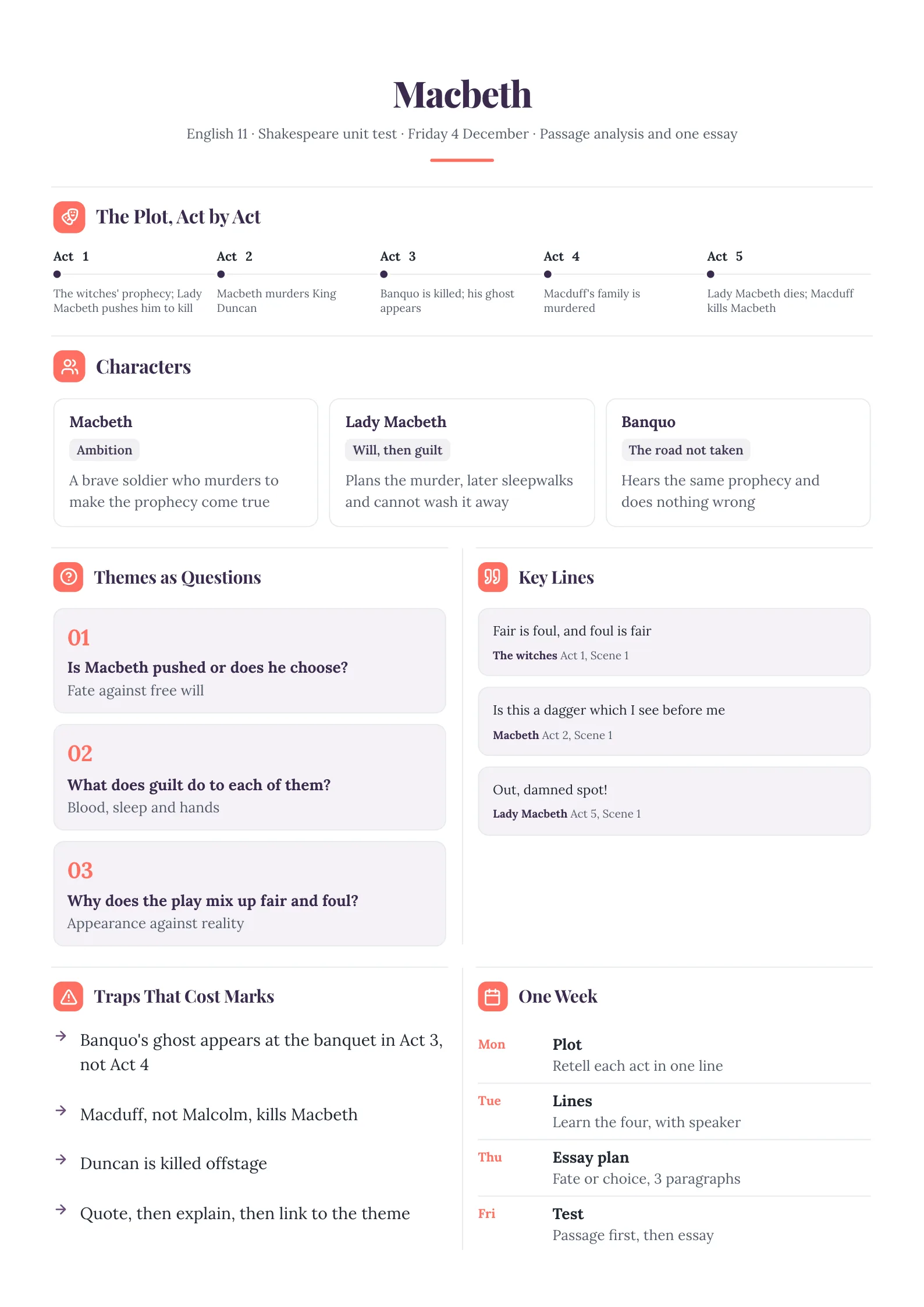 Study Guide: MacbethEdit for free(opens in a new tab)
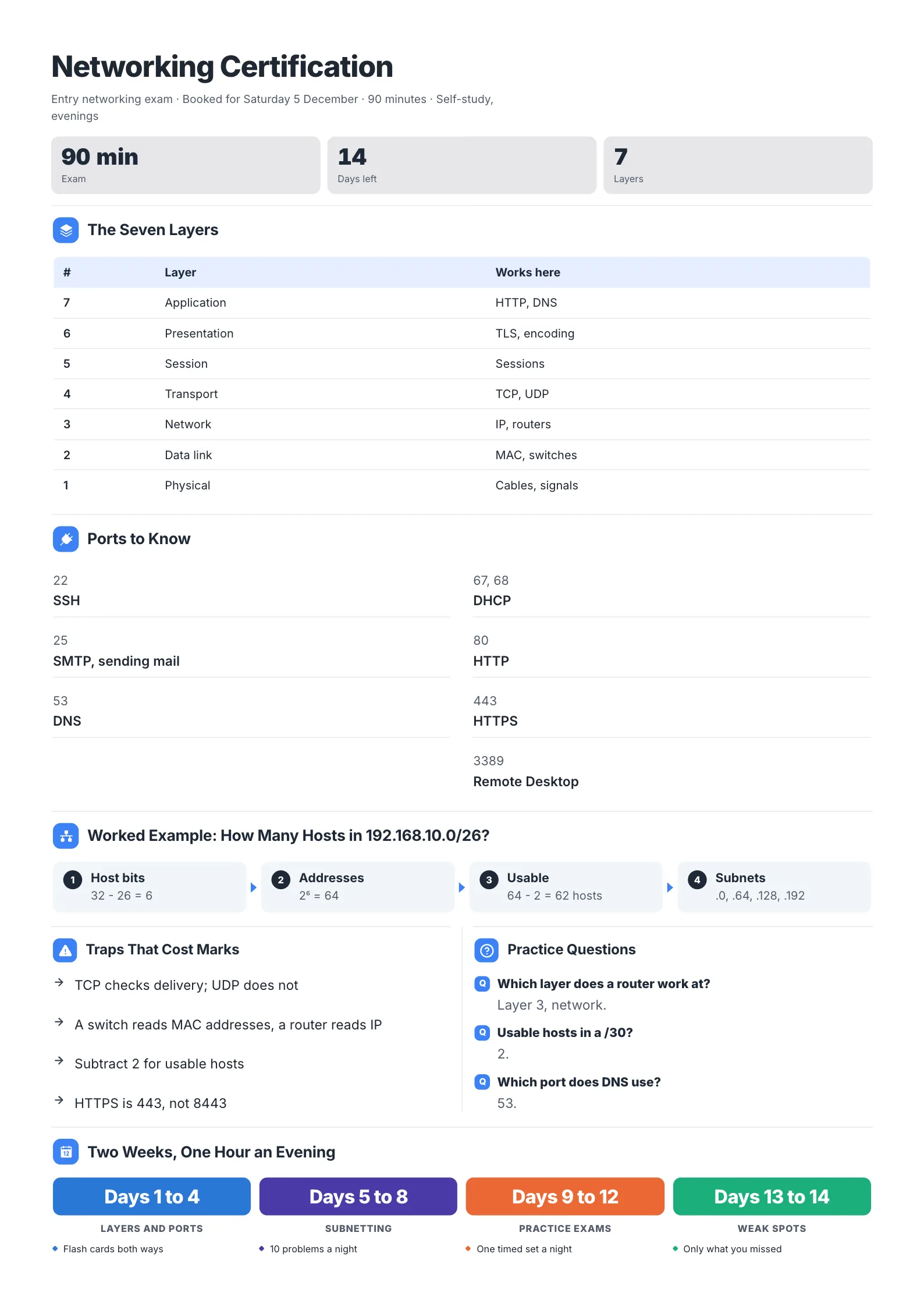 Study Guide: Networking CertificationEdit for free(opens in a new tab)
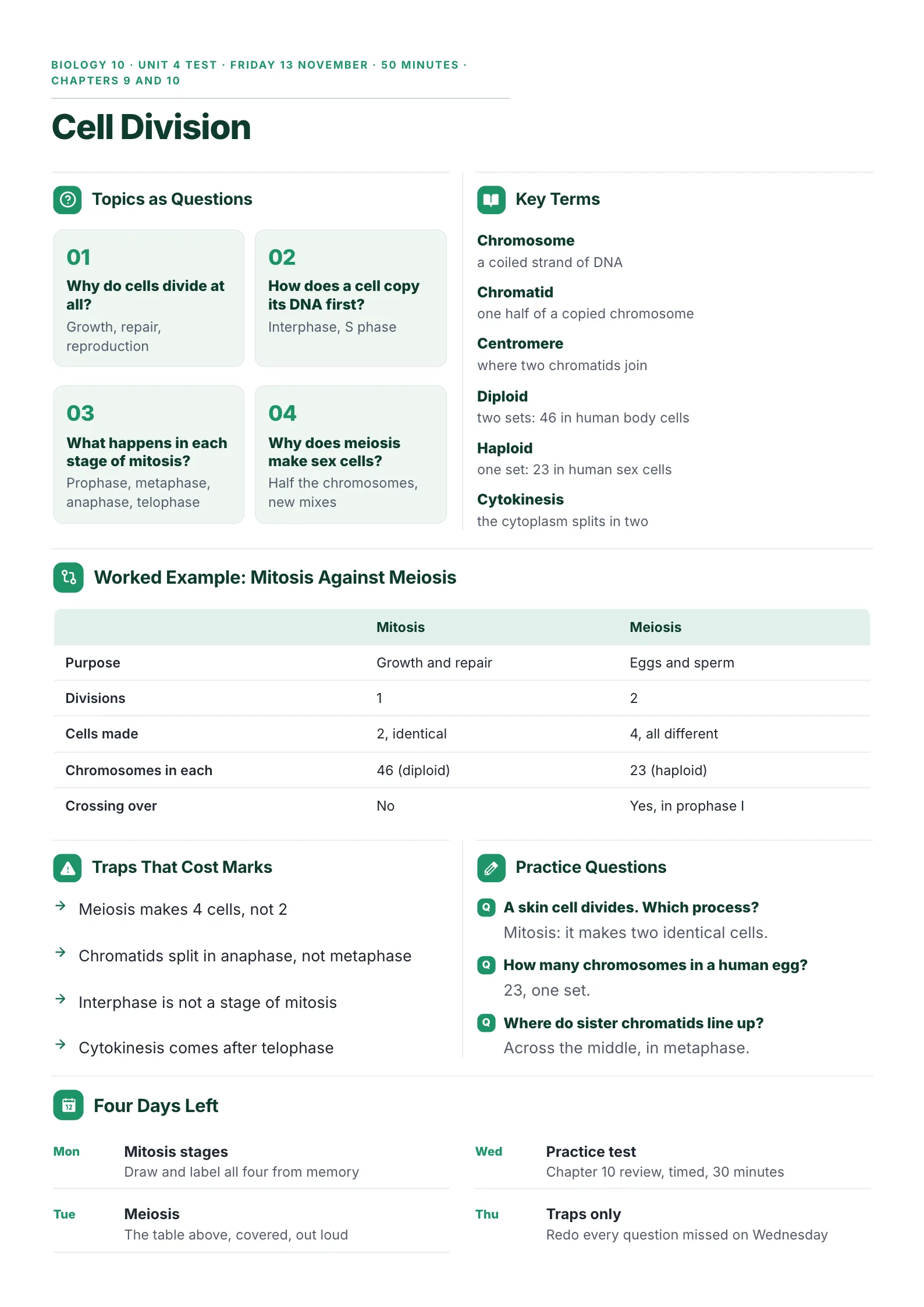 Study Guide: Cell DivisionEdit for free(opens in a new tab)
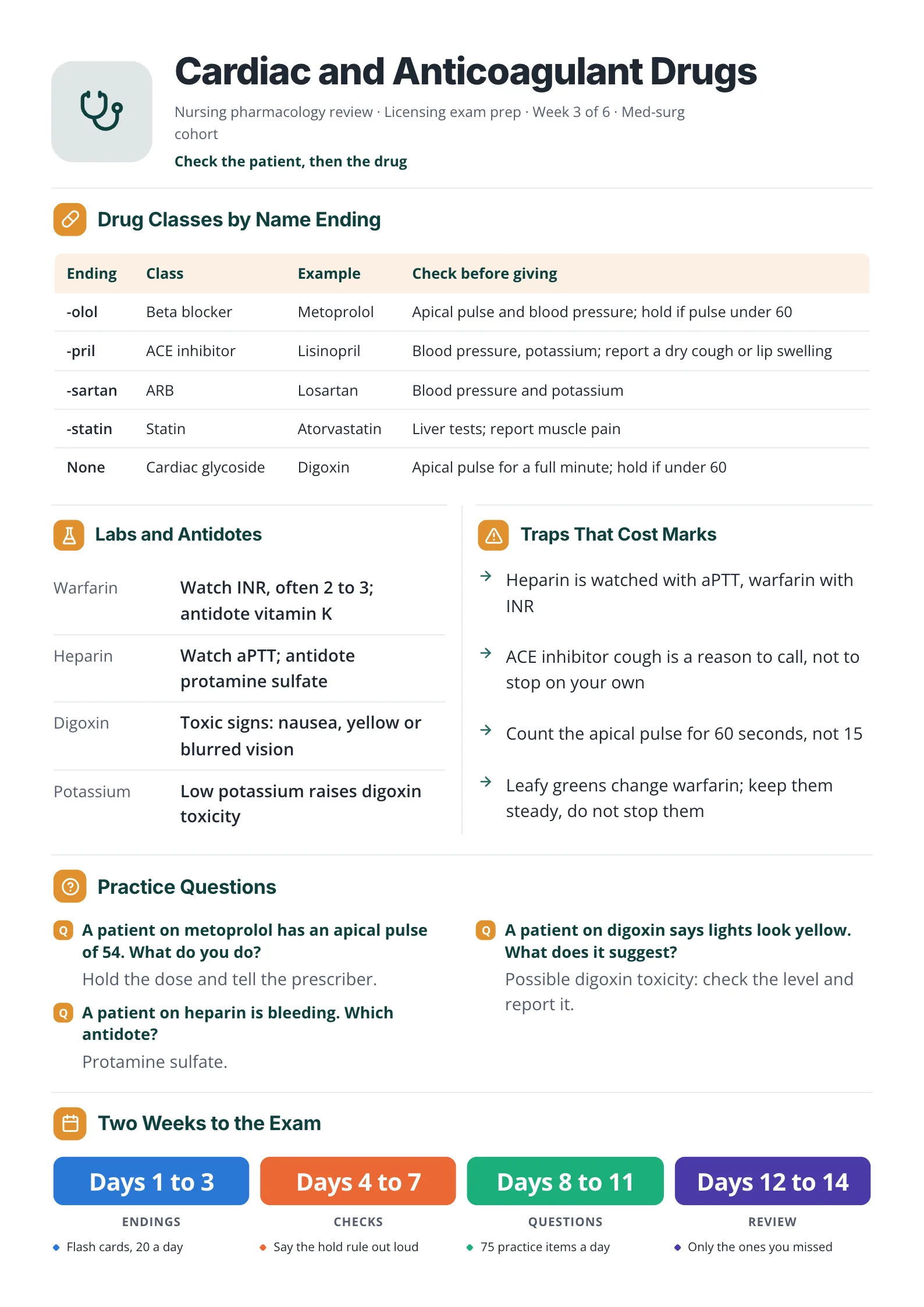 Study Guide: Nursing PharmacologyEdit for free(opens in a new tab)
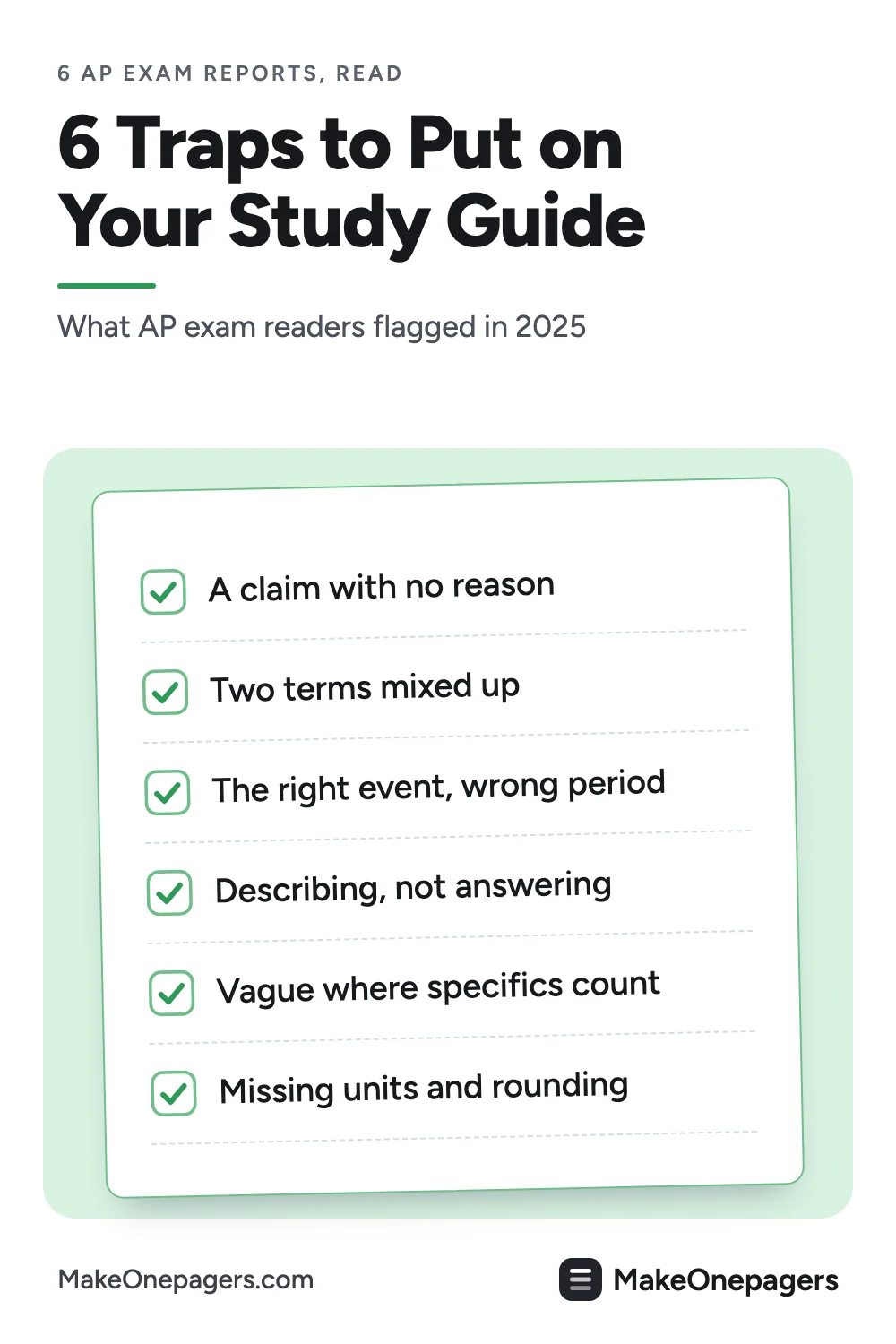
Most study guides are a summary of notes. The reports show why that isn't enough. Students who lost points usually knew the topic. They mixed up two terms, put an event in the wrong decade, or stopped before the "because". Below are the reports, the six traps they describe, and how to build a guide that catches each one.
The 6 reports we read
College Board publishes a Chief Reader Report for each AP exam with free-response questions, written by the head of the scoring team. On October 26, 2026, we read the 2025 reports for six subjects that cover science, math, history, social science and writing. Where College Board posts two question sets for an exam, we read set 1.
| Report | Questions | One trap the readers name |
|---|---|---|
| AP Biology | 6 | Treating a control group as the controlled variables |
| AP Chemistry | 7 | Wrong units, or none at all |
| AP Calculus AB and BC | 9 | Stating a result "without justification" |
| AP US History, set 1 | 8 | Using Populists and Progressives interchangeably |
| AP Psychology, set 1 | 2 | Reporting the study's numbers without saying what they mean |
| AP English Language, set 1 | 3 | General claims with no specific evidence |
Each report walks through every question, lists "common student misconceptions or gaps in knowledge," and gives advice to teachers. We read those sections for all 35 questions and grouped what the readers described.
Trap 1: A claim with no reason
This is the one all 6 reports flag. In Biology, students were asked to predict what an invasive grass would do, and "most responses restated the stimulus and did not use knowledge of biological concepts to explain why the expected change will occur." In Chemistry, writing that magnesium is +2 and sodium is +1 "fails to explain why one ion is more strongly hydrated than the other." In Calculus, "some responses simply stated that R was continuous without justification." English Language readers saw essays that "struggled to build a line of reasoning."
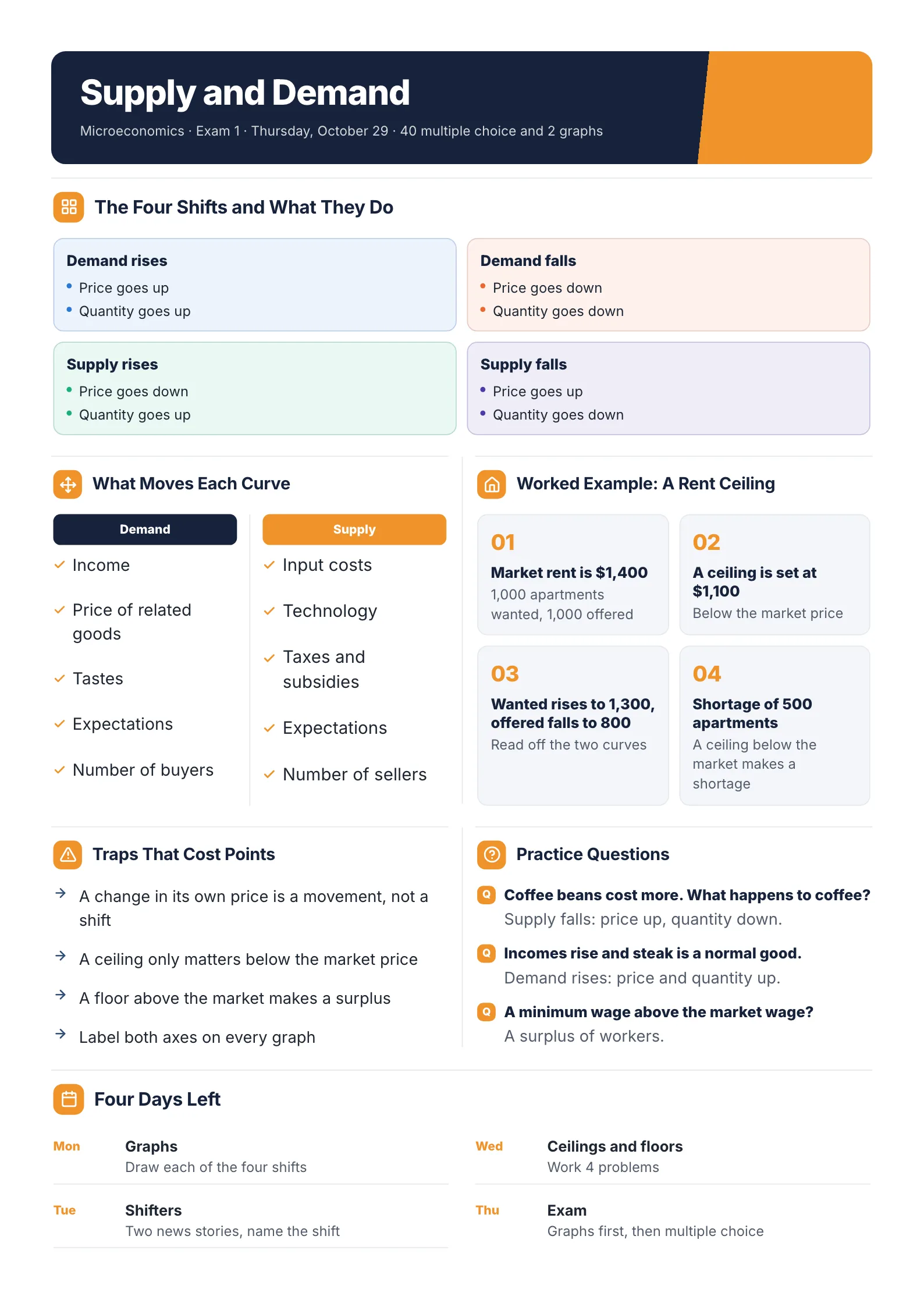
On your guide, write every key idea as a claim and its reason on the same line, joined by "because". "The North won because..." is a study line you can test yourself on. "The North won" is only a fact.
 Edit this template
Sample class and dates. Two of the three practice answers name the shift before the result, as in "Supply falls: price up, quantity down", so your reason sits on the same line as your claim.
Trap 2: Two terms mixed up
Students often knew both words and swapped them. US History readers wrote that "student responses often used Populists and Progressives interchangeably." Biology readers saw a control group confused with the controlled variables, and population and community used as if they meant the same thing. In Psychology, students named the wrong research method, such as correlation, for an experiment.
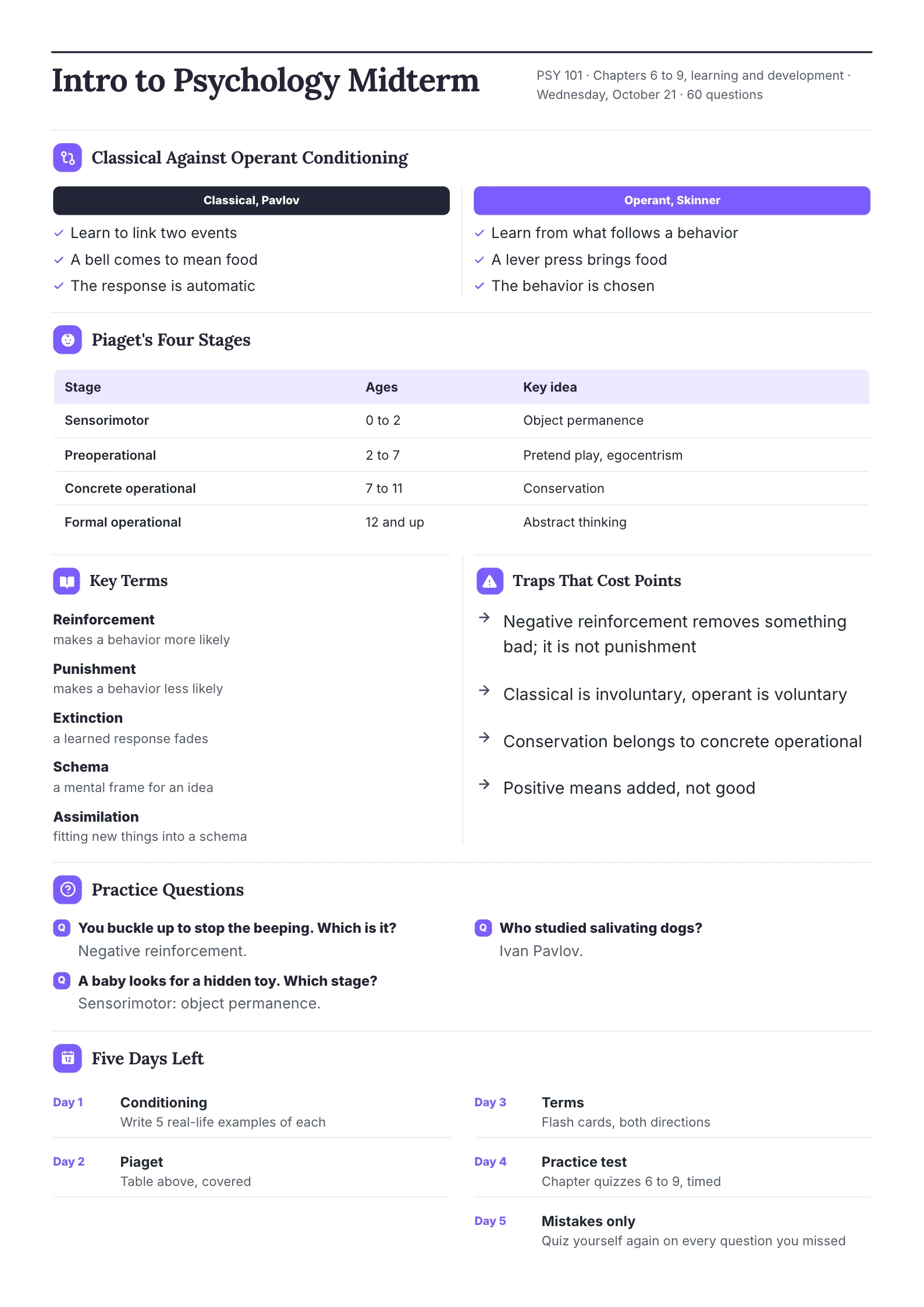
On your guide, add a small comparison chart for every pair you tend to confuse. Utah State University's Academic Support guide recommends the comparison chart for exactly this, "when you need to be able to understand the differences or similarities among facts, theories, theorists, processes."
 Edit this template
Sample class and dates. Classical and operant conditioning get one column each, and two of the traps are look-alike pairs: negative reinforcement against punishment, and positive meaning added rather than good.
Trap 3: The right event in the wrong period
History questions ask about a set span of years, and US History readers flagged answers outside it on at least 5 of the 8 questions. In one, students "referenced events that occurred between 1754 and 1783 as a response for the 1607 to 1753 time frame." In another, "many responses correctly identified United States intervention in the First World War but mistakenly described events from the Second World War."
On your guide, draw a short timeline with the year beside every event, plus its cause and its result. If your teacher names the periods you'll be tested on, write those year spans at the top.
Trap 4: Describing when the question asks for something else
Some answers were accurate and still earned nothing, because they answered a different question. In US History, "many responses described the nature of world events rather than how policies responded to those events." In Psychology, responses that missed a point "merely reported the means or the mean difference as reported in the study" instead of saying what the numbers showed.
On your guide, write each topic as the question you expect, in the test's own verbs, such as explain, compare or justify. Then practice answering that verb, out loud or on paper.
Trap 5: Vague where the reader wanted specifics
US History readers saw "vague references to helping African Americans or rebuilding the South" where the question asked for a political development, and answers that failed to name a specific group. English Language readers flagged evidence that was "mostly general." Psychology readers took points off for evidence "that was not specific and relevant."
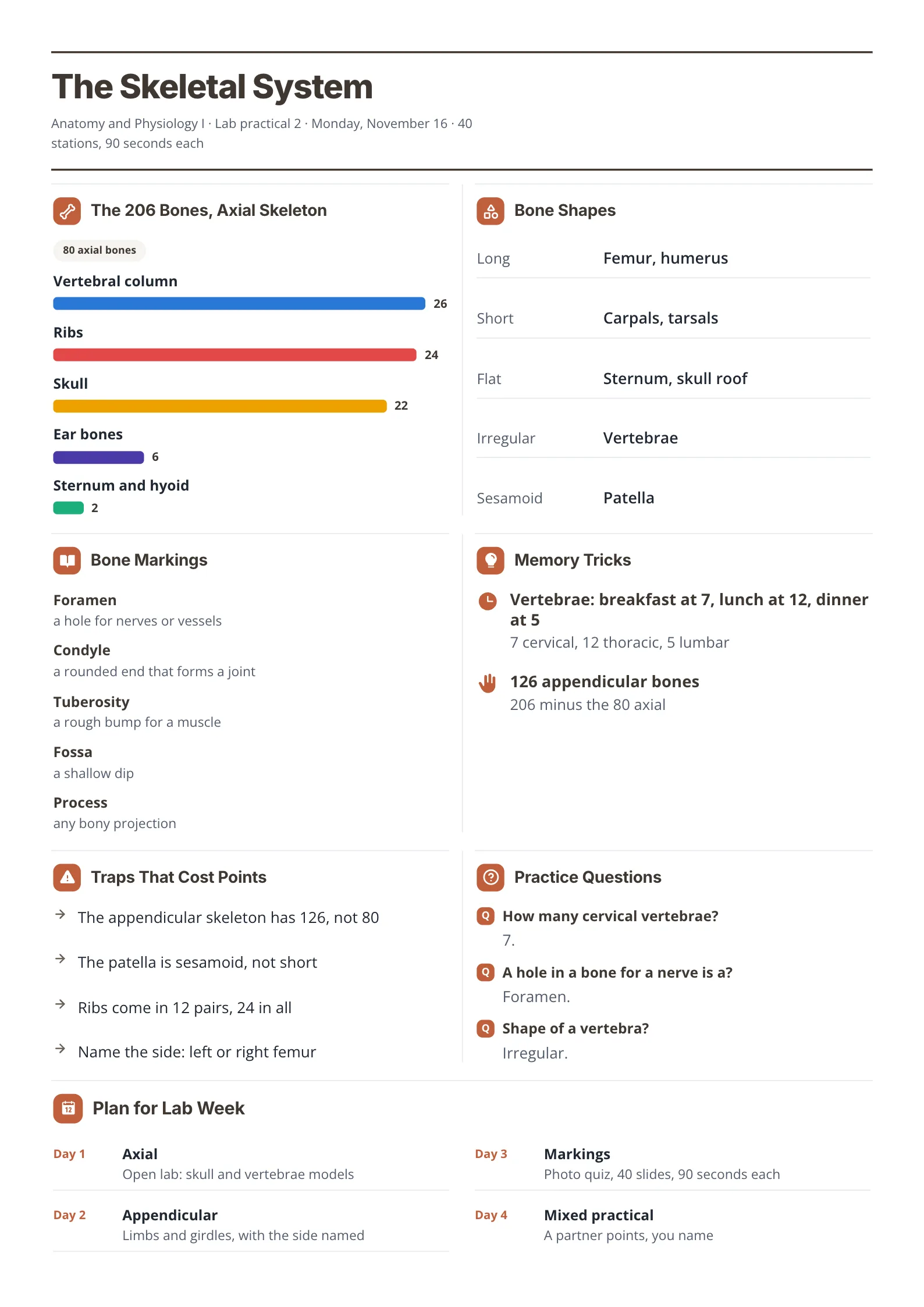
On your guide, put the specifics you'd forget. Next to each idea, list one person, law, date or quote you could use as your evidence.
 Edit this template
Sample class and dates. The guide writes out the exact counts, 7 cervical, 12 thoracic and 5 lumbar vertebrae, and one trap reminds you to name the side, left or right femur.
Trap 6: Units and rounding
The math and science reports add one more. Chemistry readers listed "reporting the incorrect units, such as M/s, or omitting units altogether." A Calculus answer of 5.1 or 5.13 lost a point because the exam asks for three decimal places.
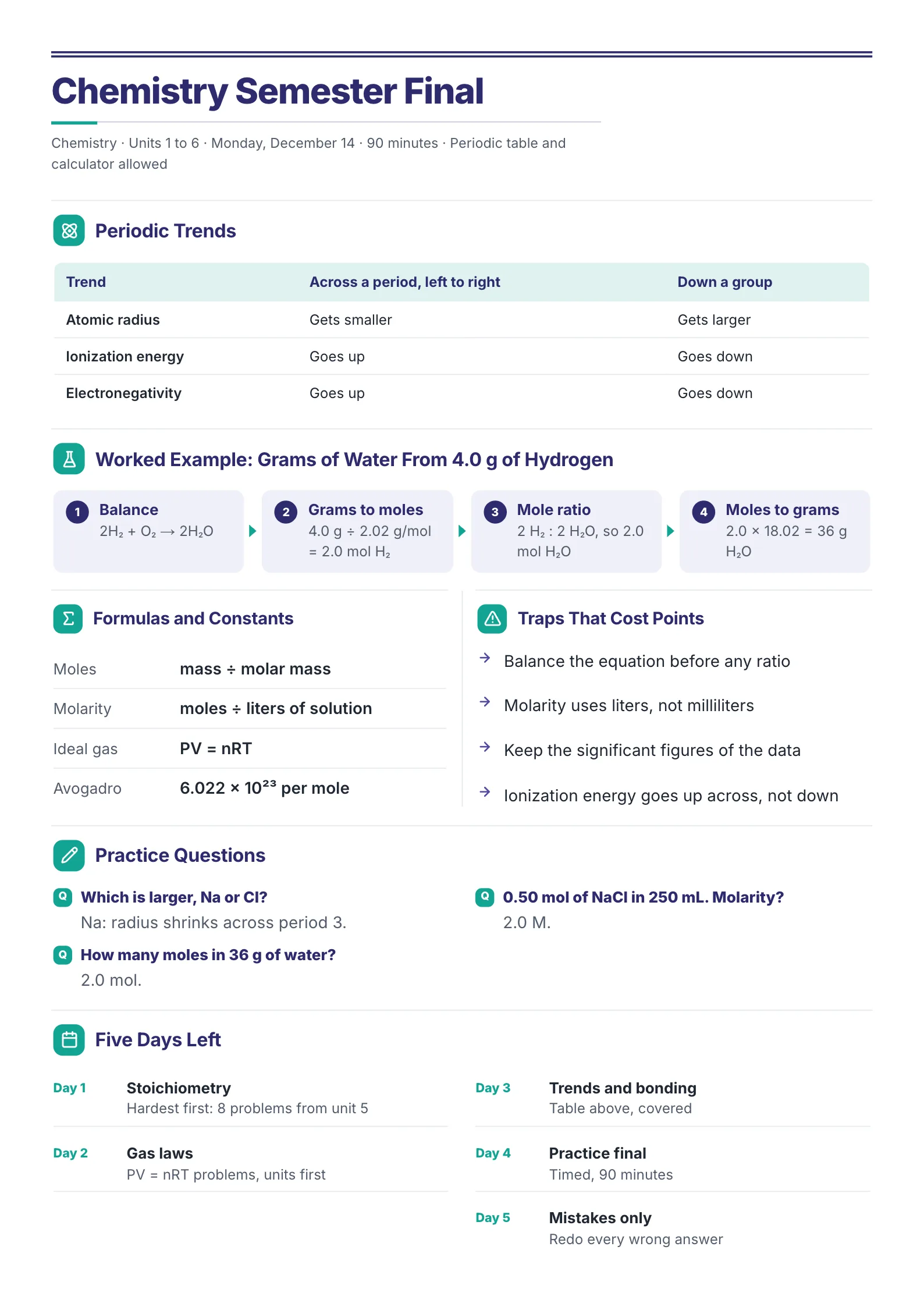
On your guide, write the unit next to every formula and put your test's rounding rule at the top.
 Edit this template
Sample class and dates. The worked example keeps its unit at every step, from g to g/mol to mol, and two of the traps are about units and figures: molarity uses liters, and answers keep the significant figures of the data.
Pick a format for each kind of material
Utah State's guide describes five formats: a concept map, a comparison chart, concept cards, a diagram and a time line. Each fits different material. Use a concept map for ideas that connect, from general to specific, and a time line for dates (Trap 3). Use a comparison chart for look-alike terms (Trap 2). Use concept cards, which it calls "flash cards on steroids," for terms you need to recall, with the key idea and its source on the front and what matters about it on the back.
You can mix them on one sheet. A timeline for dates, a chart for pairs and a short list of traps fit on one sheet for most unit tests.
Use the guide to test yourself
How you use the guide matters as much as what's on it. In a review of 10 study techniques, psychologist John Dunlosky and colleagues rated practice testing and distributed practice as "high utility," meaning they help across many ages, subjects and kinds of tests. They rated highlighting, rereading and summarization as "low utility."
So cover the answers on your guide and quiz yourself, then do it again on a later day. That's why a good guide ends with practice questions and a day-by-day plan.
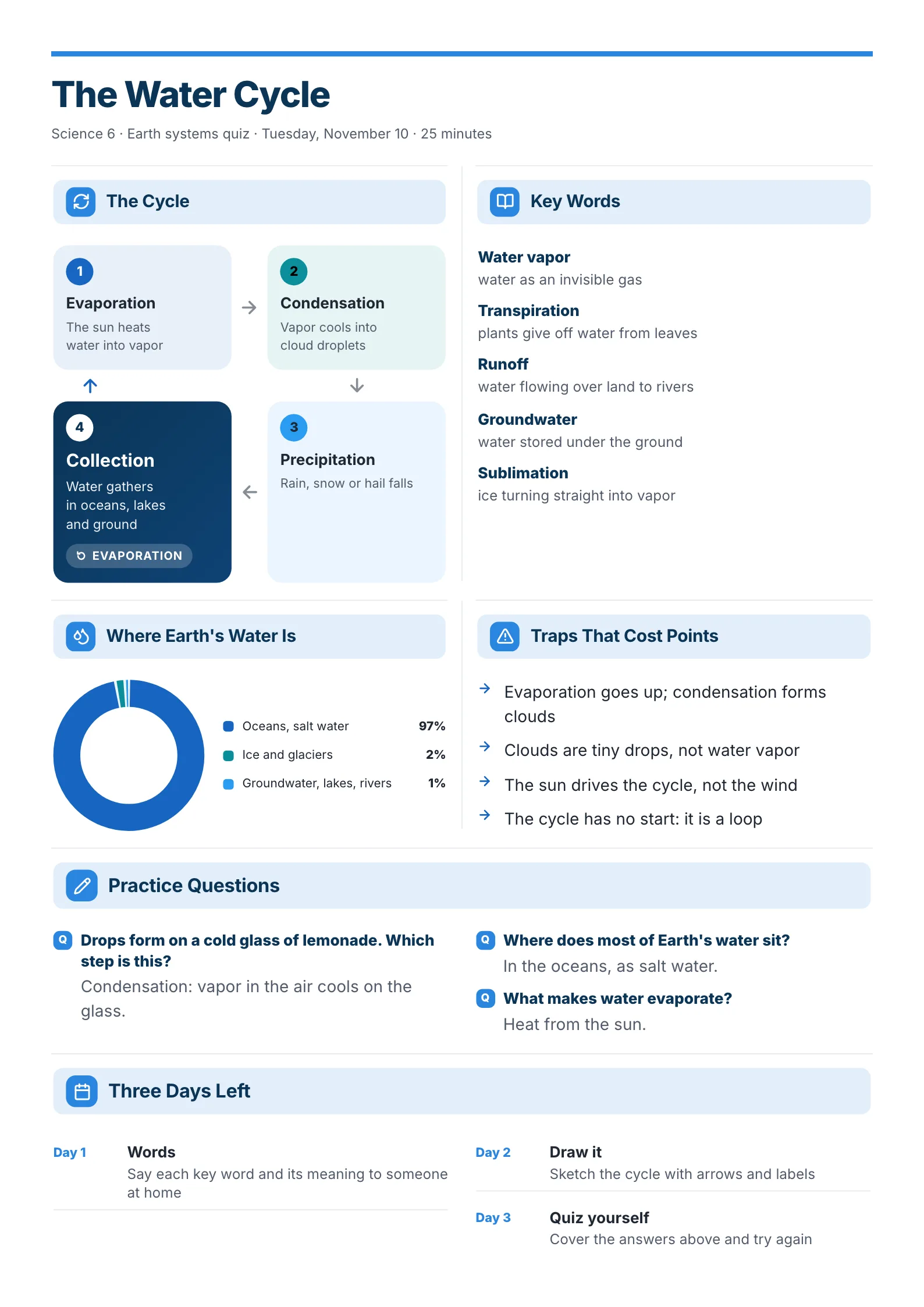 Edit this template
Sample class and dates. The last day of the plan is a self-test, where you cover the answers and try again.
Make your study guide, step by step
- Write the test date, format and topics at the top. Multiple choice, essays, problems or a mix.
- Turn each topic into a question that uses the test's verbs.
- Write each answer as a claim plus "because".
- Add a comparison chart for every pair of terms that look alike.
- Add a timeline with years if dates matter, and units with every formula if math does.
- List three to five traps for this test, from old quizzes, your teacher's comments or the published reports for your exam.
- Add practice questions with the answers hidden or on the back.
- Plan the days before the test, with a practice test at least two days out.
Questions people ask about making study guides
How long should a study guide be?
One sheet per unit is a good target. The guide should hold the questions, the traps and the specifics you'd forget. Your notes and textbook still hold everything else.
How do I make a study guide in Google Docs?
Use a two-column table: questions on the left, answers on the right, so you can cover one column and quiz yourself. Add a second table for look-alike terms. For a designed version, open a study guide in MakeOnepagers, edit it in your browser and print it.
Where do I find the mistakes students make on my test?
Ask your teacher which mistakes they see most, and keep your graded quizzes. For an AP exam, open the Chief Reader Report for your subject on College Board's AP Central, which lists the common errors for every free-response question.
Are flash cards better than a study guide?
They do different jobs. Flash cards are good for recall of single terms. A study guide shows how topics connect and where the traps are. Utah State's concept cards combine both, and quizzing yourself with either one is the high-utility part.
Make your study guide
Every one of the 6 AP reports flagged answers that made a claim with no reason behind it. So for each topic on your guide, write the claim and then the because. Open a study guide design in MakeOnepagers and fill in your test date first. Our study guide template page has more layouts, and our One-Pager maker (free for 7 days) can turn your class notes into a first draft.




