Study Guide Template: Free One-Page Study Guide, With Example
A free study guide template that fits a whole unit on one sheet: the 7 parts that help you remember, a worked six-week exam example and a last-week plan.

A study guide template gives you one sheet to fill in before a test: what the exam covers, the question each topic answers, the terms you must know, one worked example per topic and a plan for the days you have left. Filling it in is half the revision. Below are the seven parts of a good study guide, a free template you can copy, five study guide examples and the mistakes that make a guide look busy without helping you remember anything. Start from a free one pager template.
One‑Pager examples
Real One-Pagers made with MakeOnepagers. Open any one to edit it as your own.
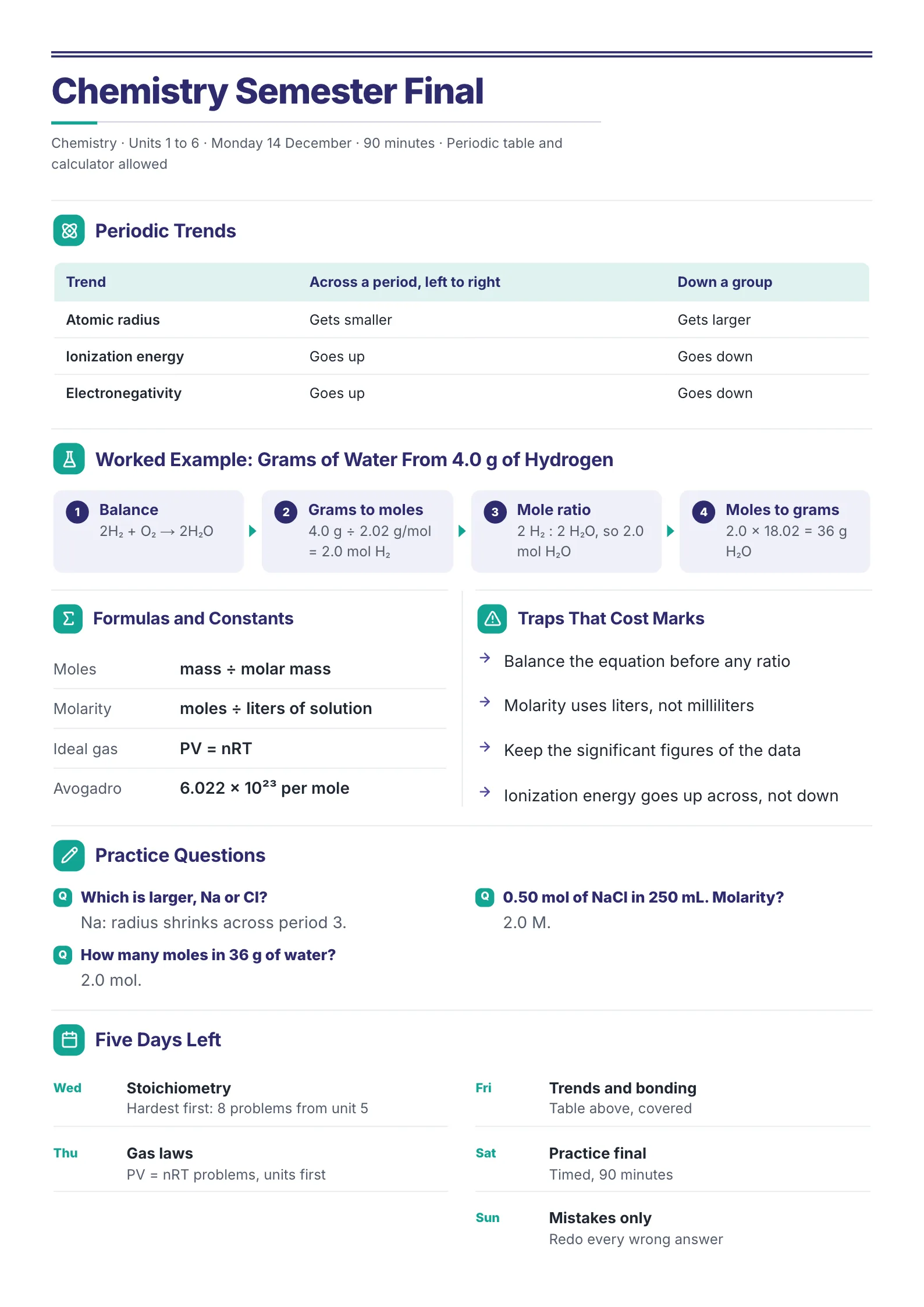 Study Guide: Chemistry FinalEdit for free(opens in a new tab)
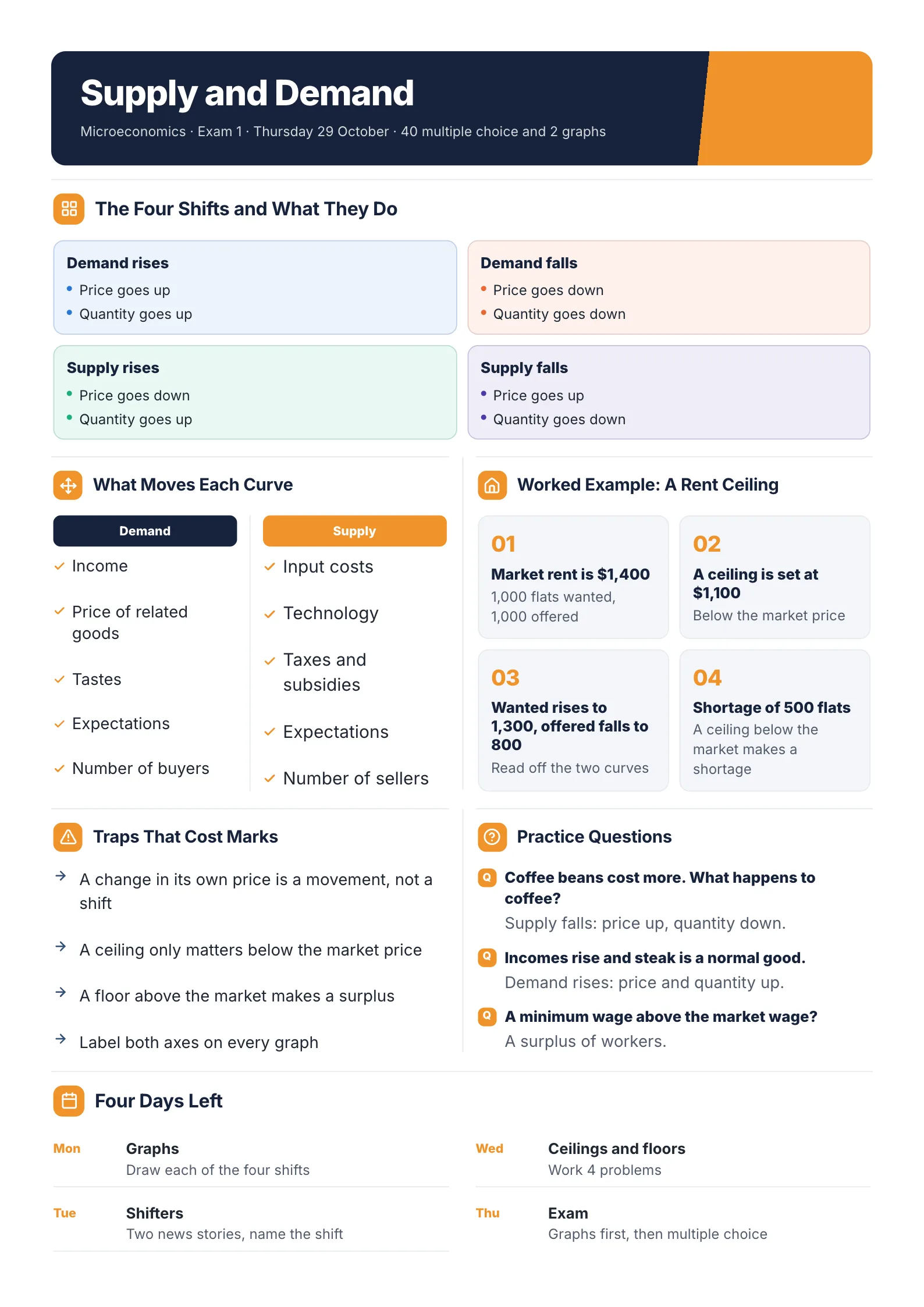 Study Guide: Economics, Supply and DemandEdit for free(opens in a new tab)
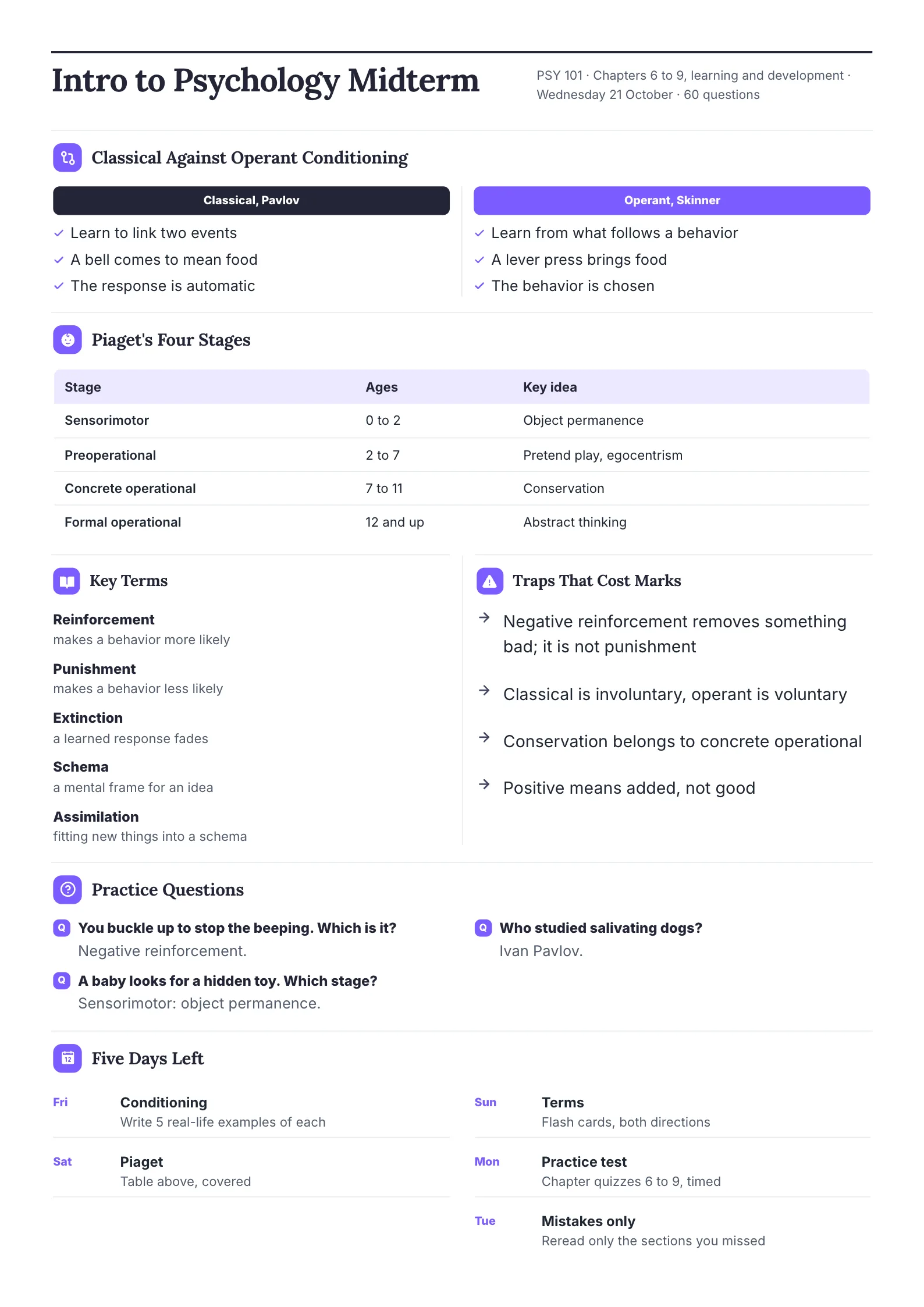 Study Guide: Psychology MidtermEdit for free(opens in a new tab)
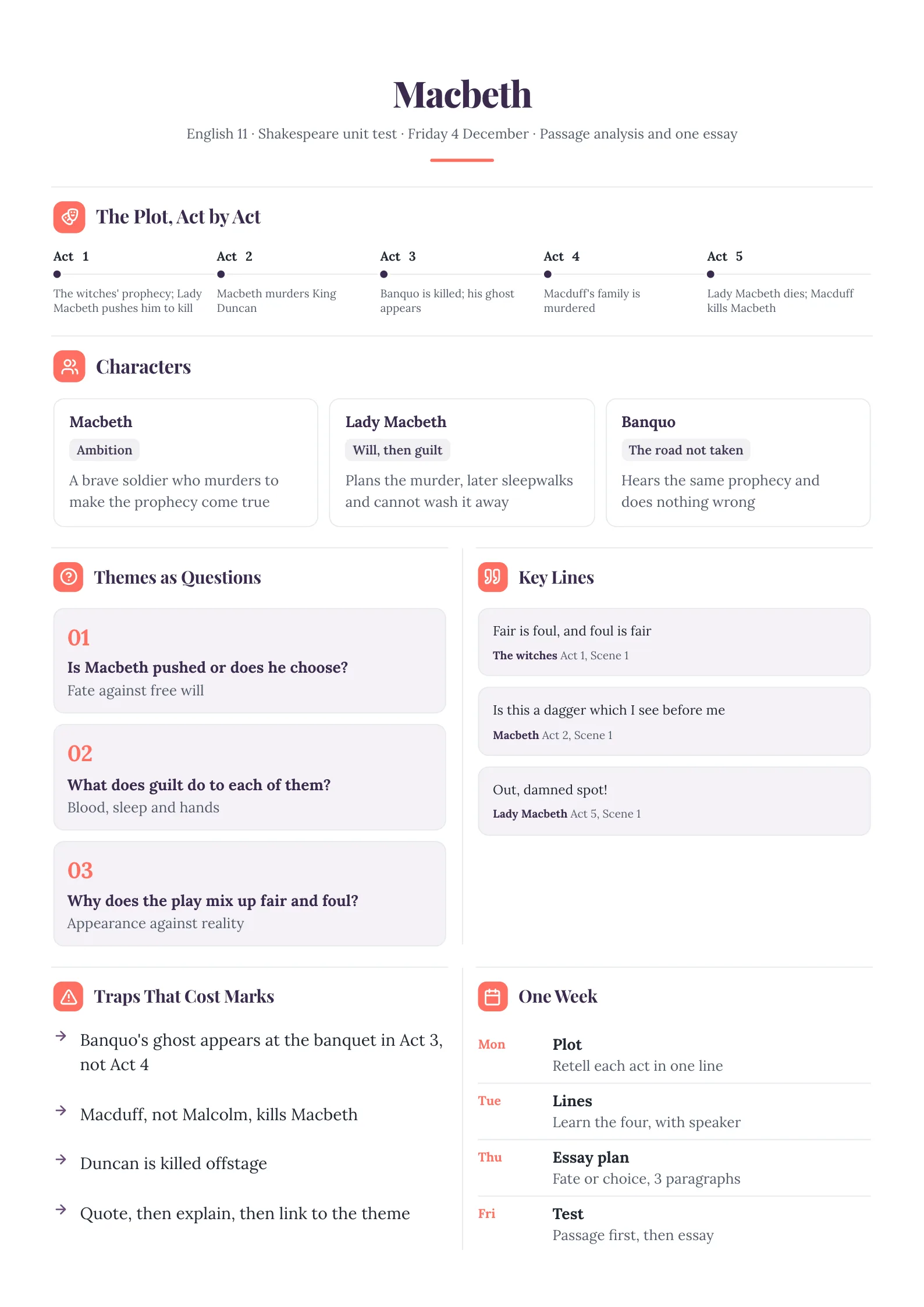 Study Guide: MacbethEdit for free(opens in a new tab)
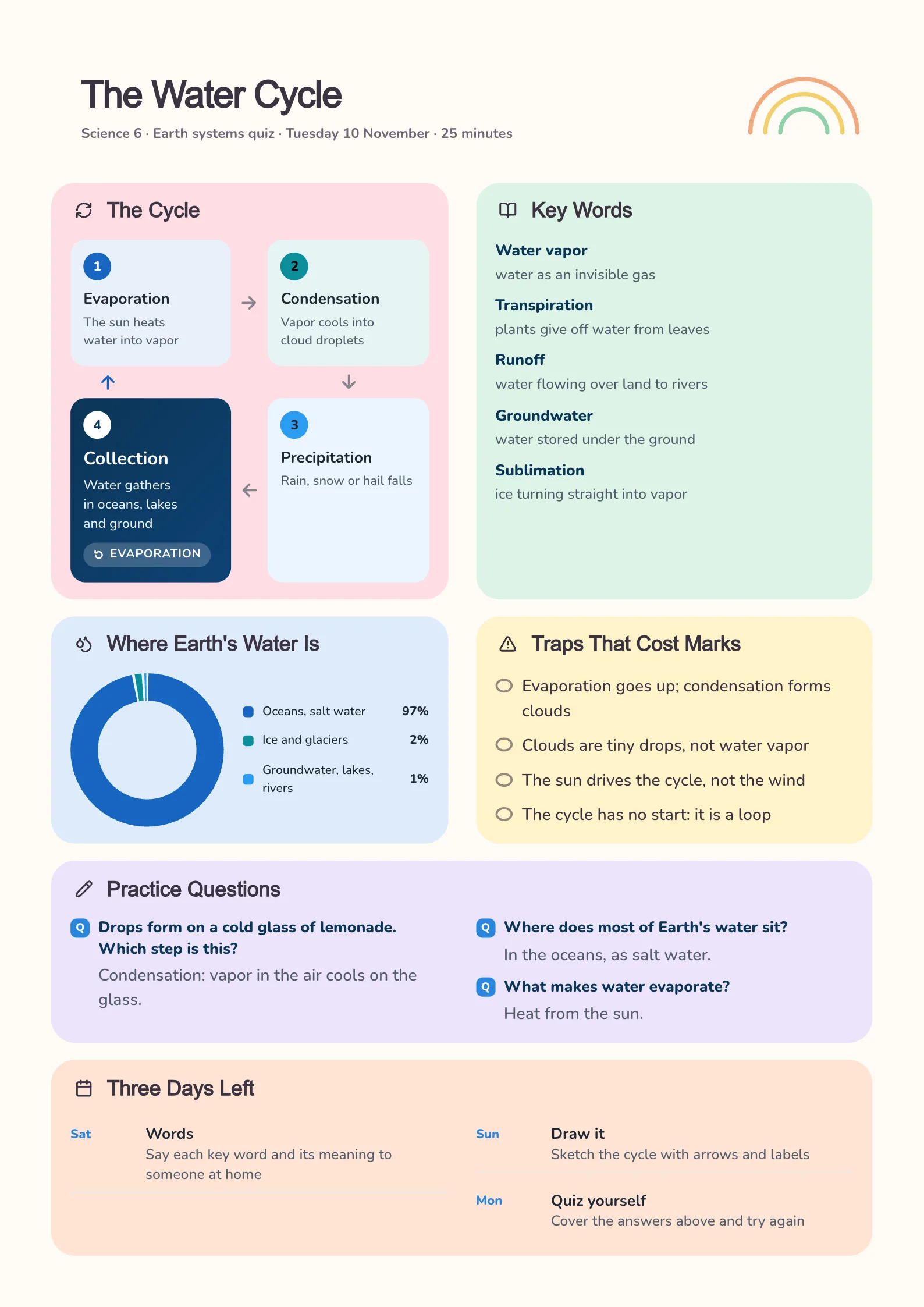 Study Guide: Water CycleEdit for free(opens in a new tab)
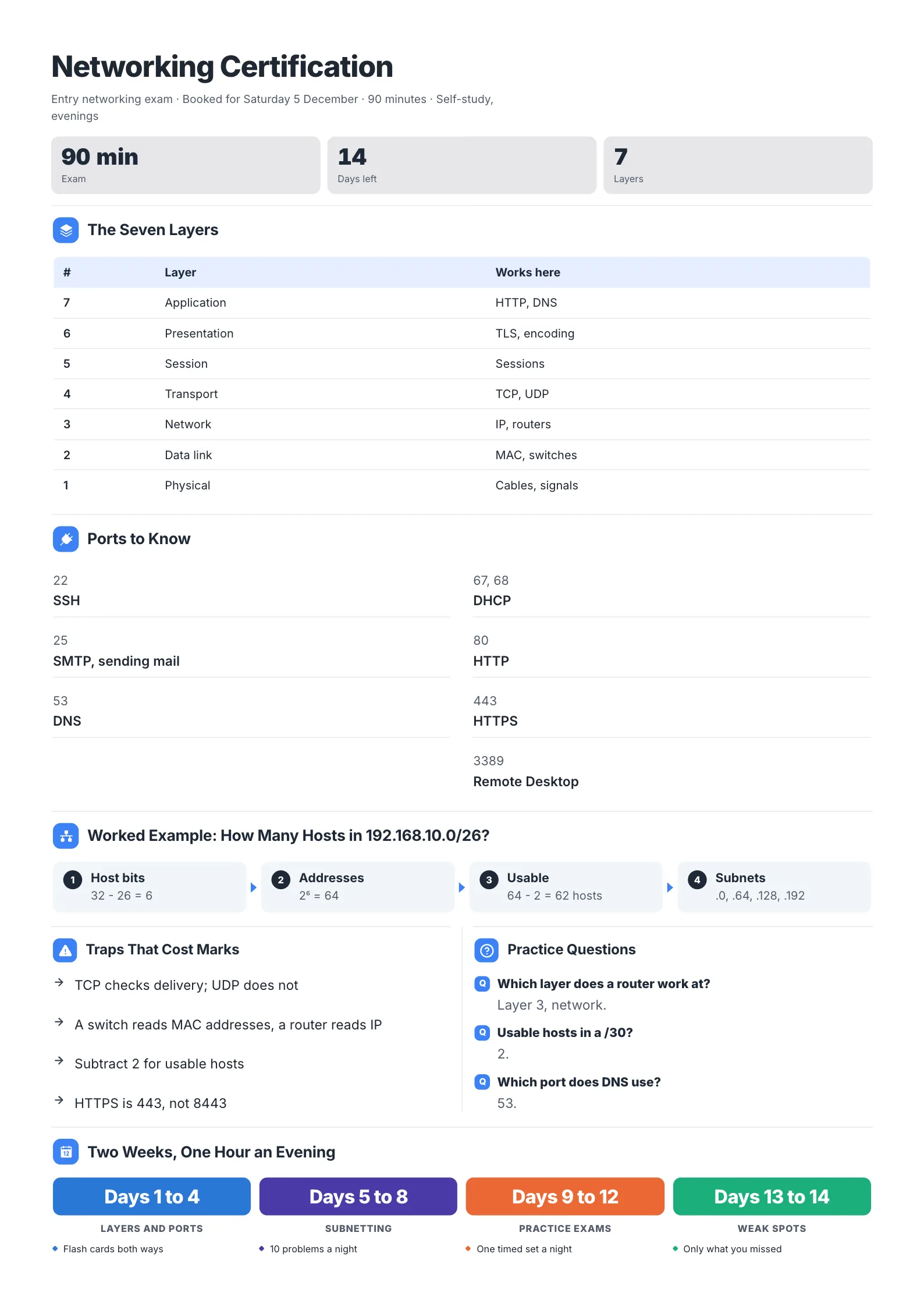 Study Guide: Networking CertificationEdit for free(opens in a new tab)
Every example here was made with MakeOnepagers, and each one opens as a template you can edit for free.
What is a study guide?
A study guide is a short summary of what you need to know for a test, written in a form you can quiz yourself with. It is not your notes copied out neatly. Notes record what was said in class. A study guide sorts that material into what will be tested, what you already know and what you still get wrong.
Teachers sometimes hand one out. The guide you make yourself is usually better, because choosing what goes on it forces you to decide what matters. That deciding is the learning.
There are three common shapes:
- A unit guide: one topic, such as cell division or the causes of the First World War, for a quiz or a unit test.
- An exam guide: a whole course boiled down for a final or a certification exam.
- A group guide: a plan shared by a study group, with who covers what and when.
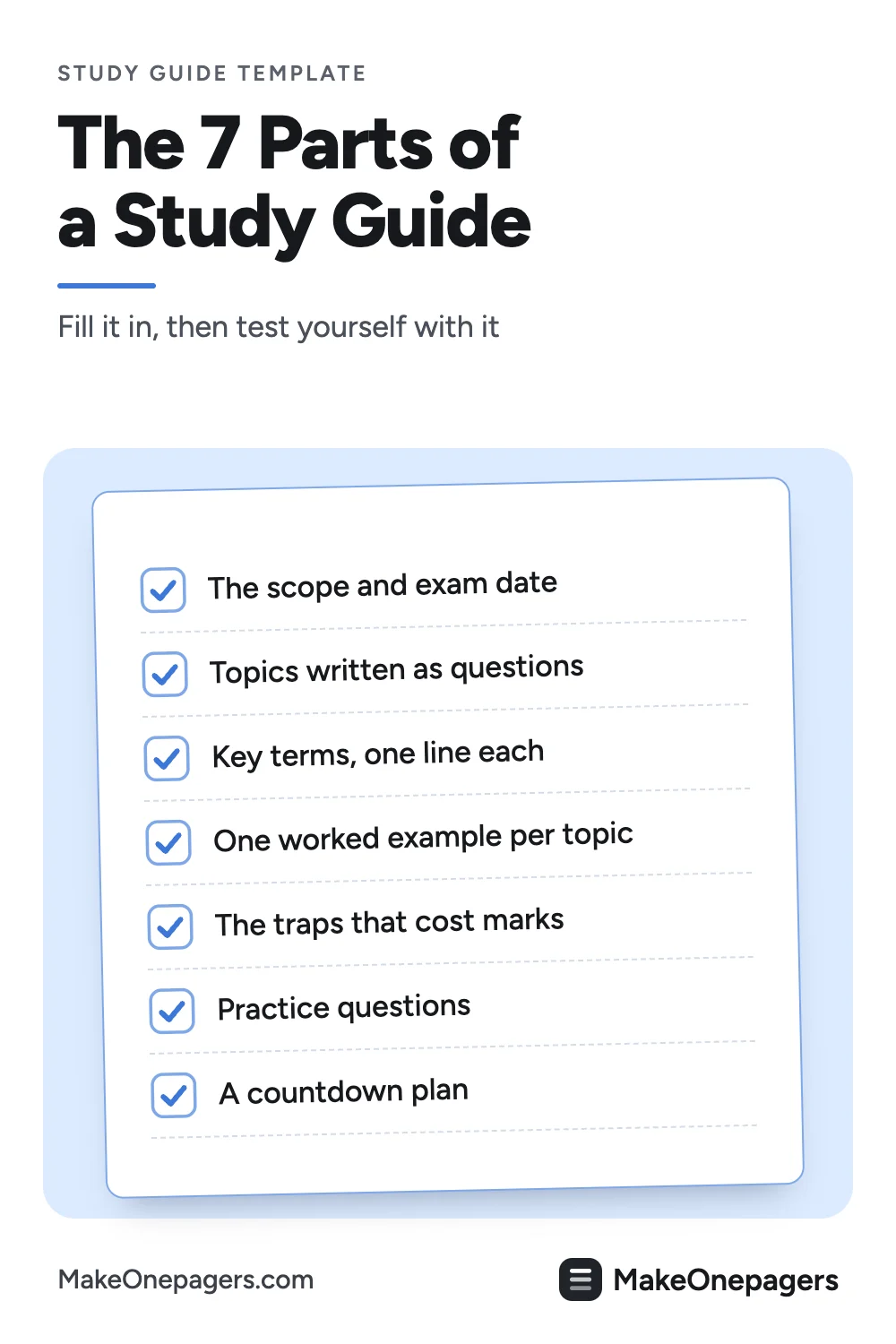
The 7 parts of a study guide
- The scope. The exam name, the date, how long it lasts and what it covers. "Final exam, 12 December, 90 minutes, chapters 2 to 8."
- The topics, each written as a question. Not "Photosynthesis" but "Where does the energy in glucose come from?" A question is something you can answer or fail to answer.
- Key terms with short definitions. Five to ten per unit, each in your own words and one line long.
- One worked example per topic. A solved problem, a dated event with its cause and result, or a labelled diagram.
- The traps. The mistakes that cost marks: the formula people mix up, the date that is off by a year, the question that asks for the best answer rather than the only right one.
- Practice questions. Three to five, with answers on the back or at the bottom, so you can test rather than reread.
- A countdown plan. What you will cover on each day left before the test, with the hardest topic first.
A free study guide template
Copy this into a document, or open one of the examples below and replace the words with your own subject.
| Part | What to write, with an example |
|---|---|
| Title | Subject, exam and date. Biology unit 3 test, Friday 14 November |
| Scope | What is in and out. Chapters 5 to 7. Not the lab on enzymes |
| Topics as questions | 4 to 6. How does a cell copy its DNA before it divides? |
| Key terms | 5 to 10, one line each. Mitosis: one cell splits into two identical cells |
| Worked example | One per topic. A labelled drawing of the four stages of mitosis |
| Traps | 3 or 4. Meiosis makes four cells, not two |
| Practice questions | 3 to 5, answers hidden. Why do skin cells divide by mitosis? |
| Countdown | Day by day. Mon: meiosis. Tue: practice test. Wed: traps only |
If your class works in Google Docs or Word, the same table works there. Just keep the parts in this order, whatever tool you use.
5 study guide examples
Five classes, five tests. Each guide keeps the seven parts above: the scope, topics as questions, key terms, a worked example, traps, practice questions and a countdown.
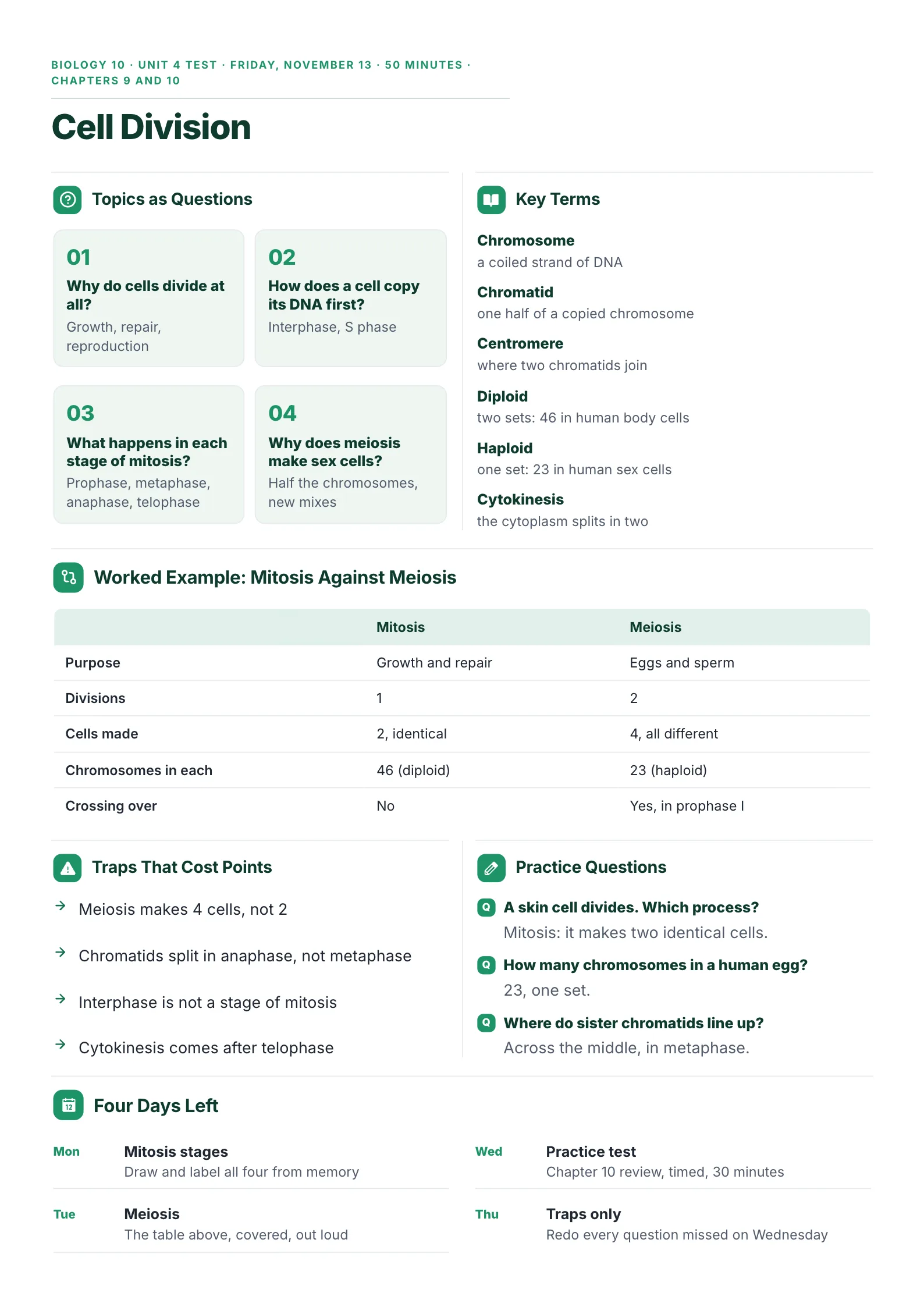
1. Biology study guide: cell division
 Edit this template
This guide fits a whole unit test on one sheet. Its comparison table does the work of a worked example.
What to copy:
- The worked example as a table. Mitosis against meiosis, row by row: purpose, divisions, cells made, chromosomes. Two processes students mix up, side by side.
- Traps written as corrections. "Meiosis makes 4 cells, not 2" fixes the mistake in the same line that names it.
- A plan with a job per day, ending with the questions missed on the practice test.
You can edit this biology study guide template for free.
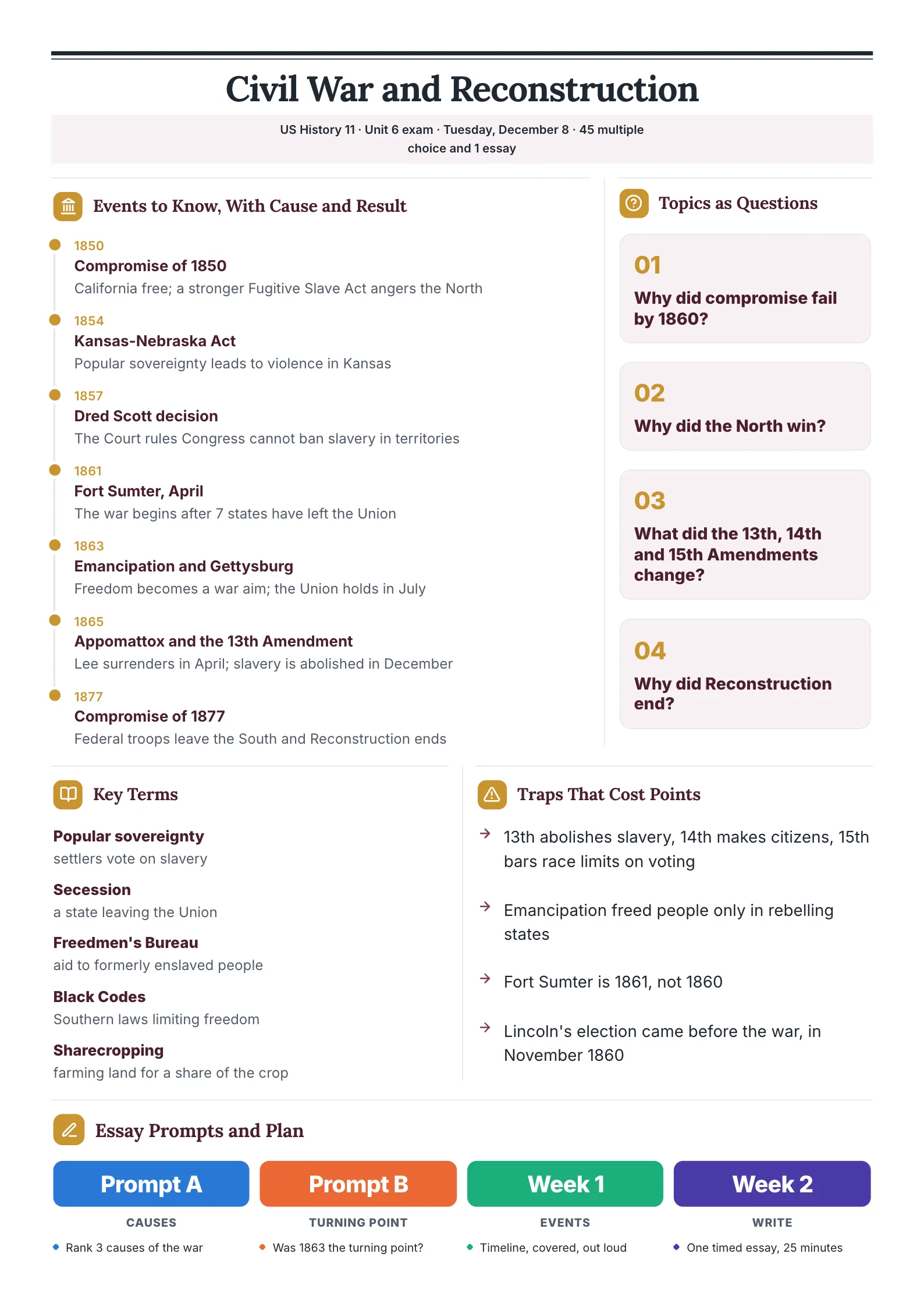
2. History study guide: the Civil War and Reconstruction
 Edit this template
In history the worked example is a dated event with its cause and its result.
What to copy:
- Every date carries a consequence. "1857, Dred Scott decision: the Court rules Congress cannot ban slavery in territories." A date alone is trivia.
- The amendments in one trap line. 13th abolishes slavery, 14th makes citizens, 15th bars race limits on voting. The most mixed-up three facts in the unit.
- The essay prompts on the sheet, so the last week is spent writing, not rereading.
Make it yours with this free history study guide template.
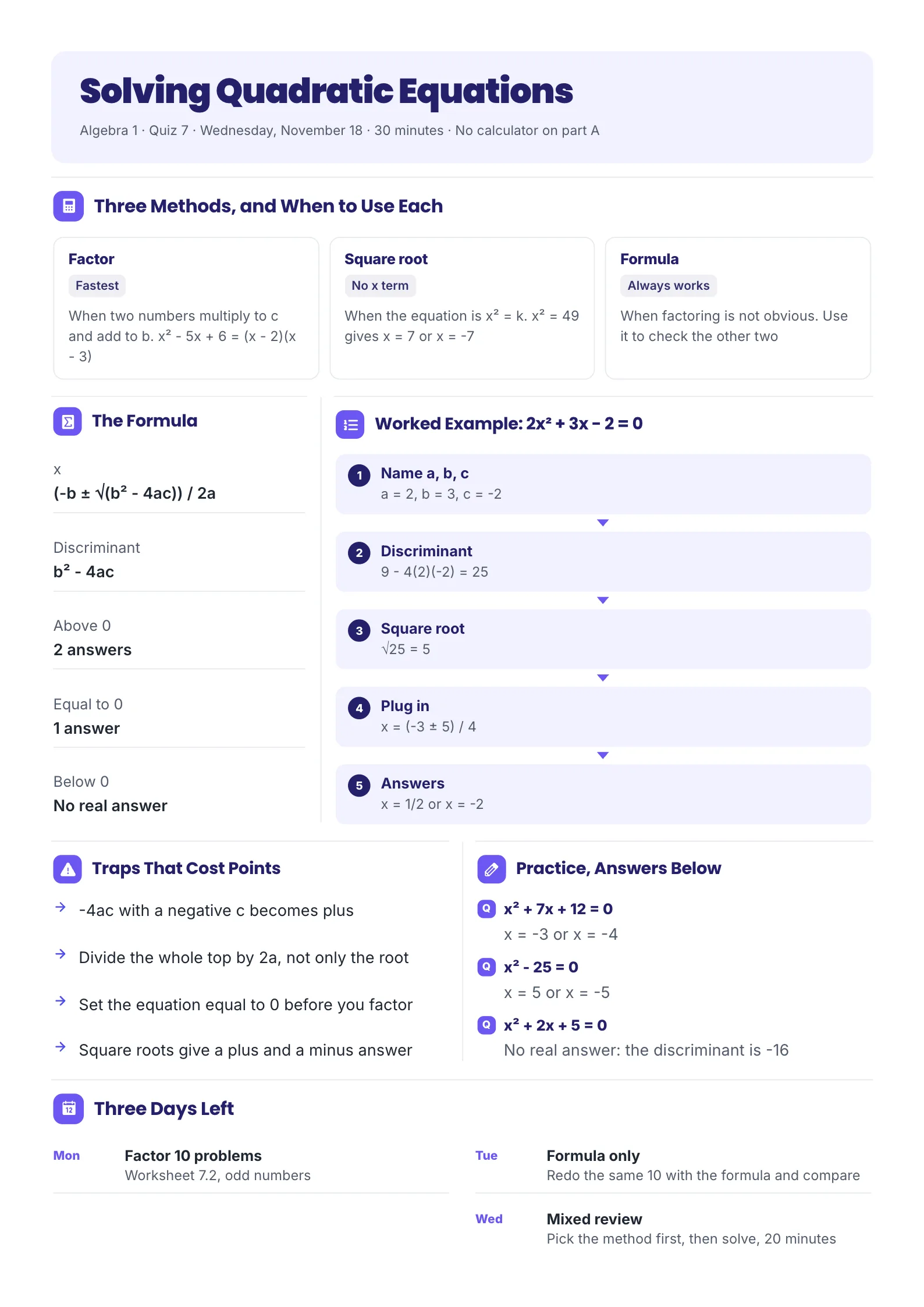
3. Math study guide: quadratic equations
 Edit this template
A math guide is mostly worked examples. You show one problem and every step it takes.
What to copy:
- When to use each method, not only how. Factor when it is fast, the formula when it is not, and the formula to check both.
- One problem worked in five steps, from naming a, b and c to the two answers.
- Practice with the answers under each question, so you can check yourself straight away.
You can edit this math study guide template for free.
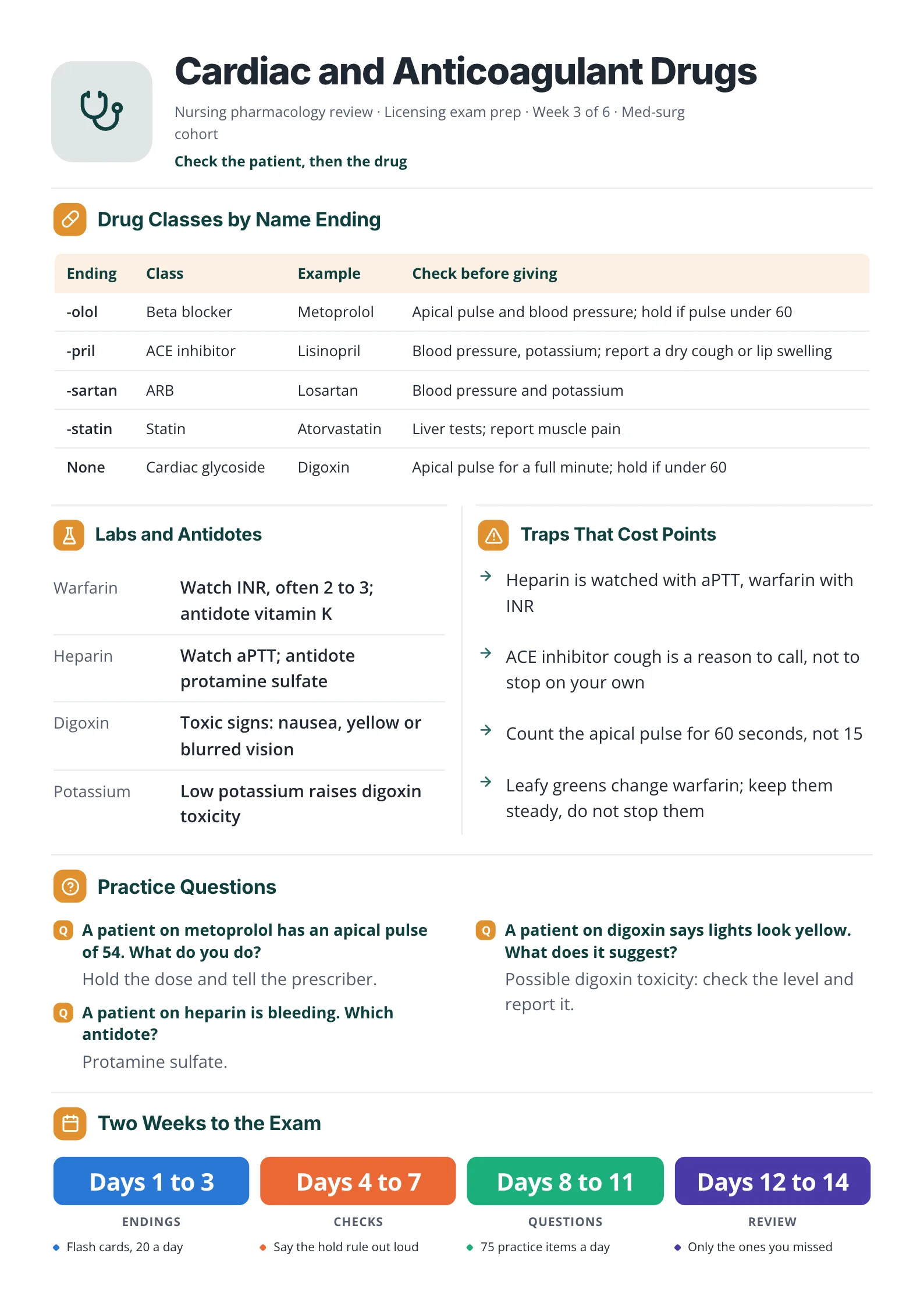
4. Nursing study guide: pharmacology
 Edit this template
For a nursing exam, the guide is sorted by what the nurse checks before giving the drug.
What to copy:
- Drug classes sorted by name ending. -olol, -pril, -sartan, -statin: learn the ending and you know the class of a drug you have never seen.
- The check before giving, in the same row. "Hold if pulse under 60" is the line exam questions are built on.
- Antidotes and labs paired. Heparin with aPTT and protamine, warfarin with INR and vitamin K.
Start from this free nursing study guide template and add the drugs on your exam.
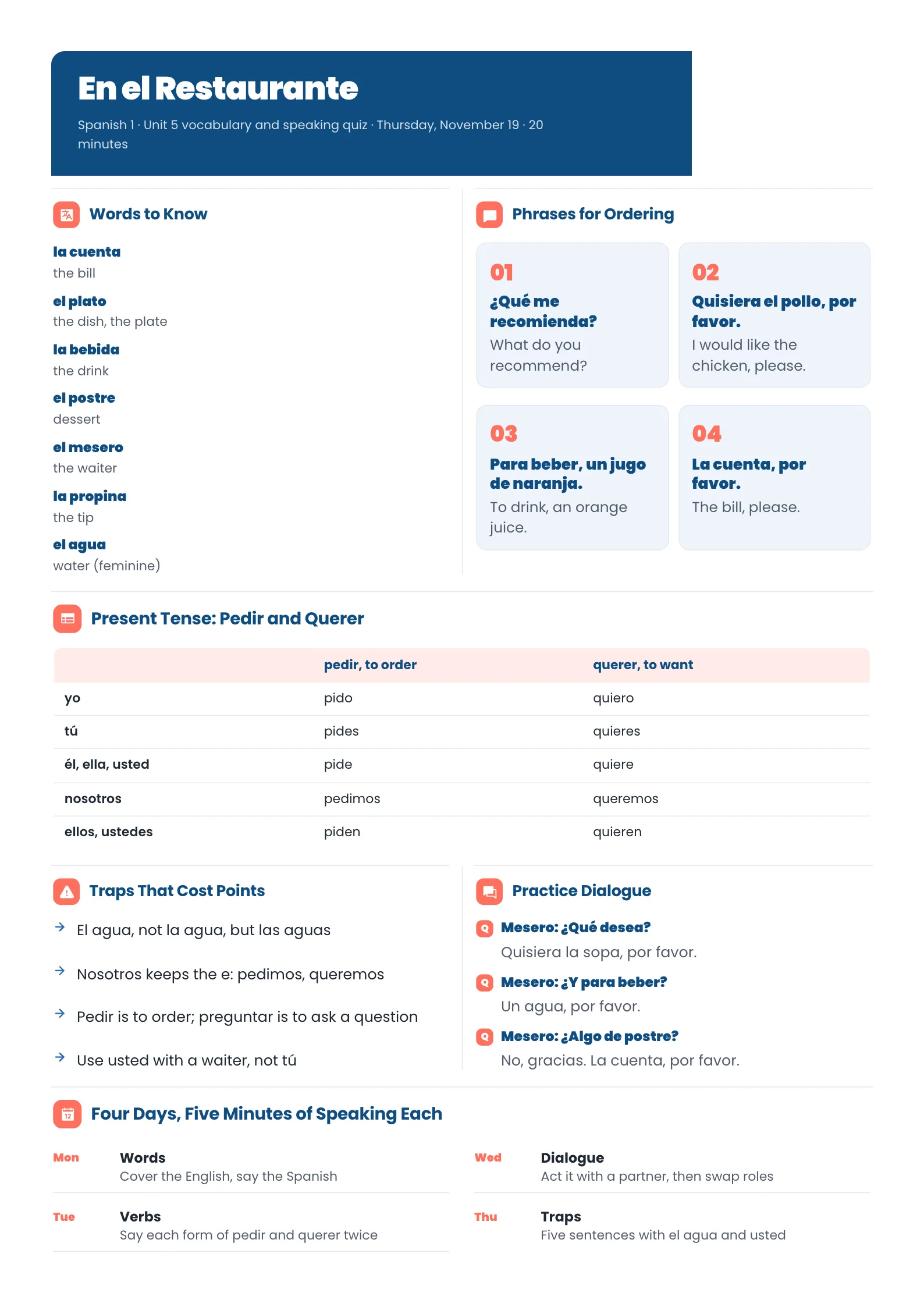
5. Language study guide: Spanish vocabulary
 Edit this template
For a language quiz, the worked example is a conversation you can say out loud.
What to copy:
- Words grouped by the situation, not by alphabet: what you need to order, pay and tip.
- The two verbs you will use most, in one table. Pedir and querer, every form.
- Five minutes of speaking a day. A speaking quiz is passed out loud, not on paper.
You can edit this Spanish study guide template for free.
A study group plan for a longer exam
For a certification or a final that needs weeks, a group plan spreads the topics out. It still writes every topic as a question.
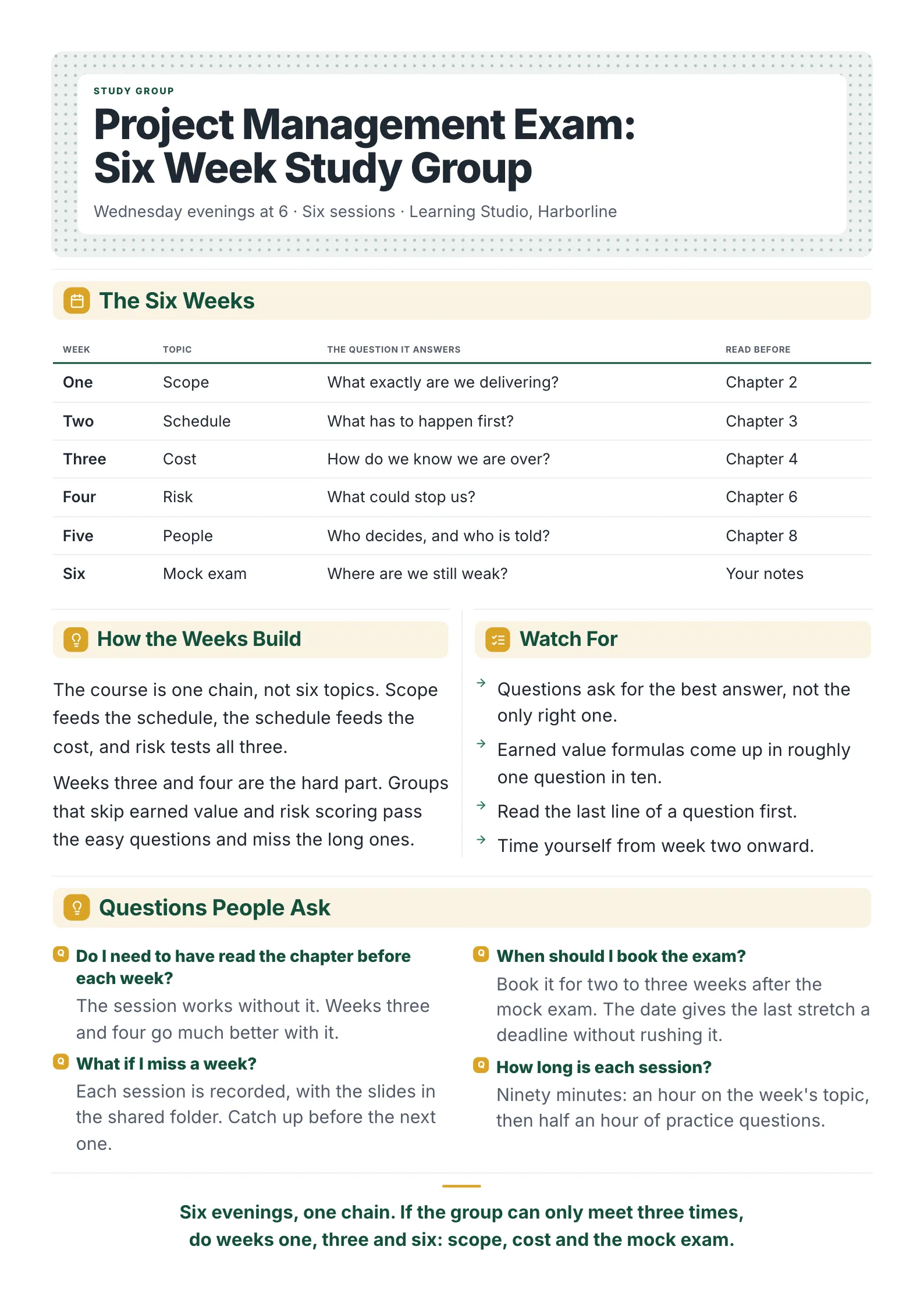
Example: a six-week exam study group
 Edit this template
An example study guide shared by a group preparing for a professional exam together.
What to copy:
- Every week is a topic and a question. Week three is Cost, and the question is "How do we know we are over?" Anyone in the group can check whether they can answer it.
- The chapter to read before each session: chapter 2, then 3, then 4, then 6 and 8. Nobody arrives unsure what to prepare.
- A short paragraph on how the topics connect. "Scope feeds the schedule, the schedule feeds the cost, and risk tests all three." Seeing the chain helps the long questions, which mix topics.
- A "Watch for" list of four traps, such as reading the last line of a question first and timing yourself from week two.
- A fallback in the closing line: if the group can meet only three times, do weeks one, three and six.
Your group can edit this study group plan template for free.
Worked example: turning a chapter into a study guide
Here is how one student might turn a 30-page textbook chapter into a guide in about 40 minutes. Your own times will vary, so treat these numbers as a rough guide.
| Step | Time | What comes out |
|---|---|---|
| Skim the headings and the end-of-chapter questions | 5 min | 5 topics |
| Rewrite each heading as a question | 5 min | 5 questions |
| Pull 8 terms from bold words and the glossary | 10 min | 8 one-line definitions |
| Work one example per topic from the exercises | 15 min | 5 worked examples |
| Write 3 traps from marked homework | 5 min | 3 traps |
That leaves the chapter on one sheet: five questions, eight terms, five examples and three traps. Thirty pages of reading become something you can test yourself on in ten minutes.
How to use a study guide in the last week
A guide only helps if you use it to test yourself. Reading it over and over feels productive and teaches very little.
- Cover the answers and say them out loud. Put a sheet of paper over each answer and try to say it before you look.
- Mark each topic as red, amber or green. Red is "I could not answer". Amber is "I answered slowly". Green is "I answered fast and right".
- Spend most of your time on red. Green topics need one check a day, not an hour.
- Spread the sessions out. Three 30-minute sessions on three days beat one 90-minute session the night before.
- Do one timed practice test two or three days before the exam, then update the traps list with whatever you got wrong.
Study guide mistakes
- Copying the notes out again. If the guide is as long as the notes, nothing was chosen. Aim for one side of one sheet per unit.
- Headings instead of questions. "The Treaty of Versailles" is a reminder. "Why did Germany resent the Treaty of Versailles?" is a test.
- Definitions copied from the book. Write them in your own words, or you will recognize them without being able to say them.
- No examples. Most exam marks are for using an idea, not naming it. One worked example per topic shows you can do that.
- No date. A countdown with no exam date never starts.
Study guide for a whole class
Teachers can use the same structure as a handout. Two changes help:
- Leave the answers blank. Students fill in the definitions and worked examples themselves, and the gaps show you who is stuck.
- Add a "how this is marked" line: how many questions, which ones carry the most points and how long to spend on each.
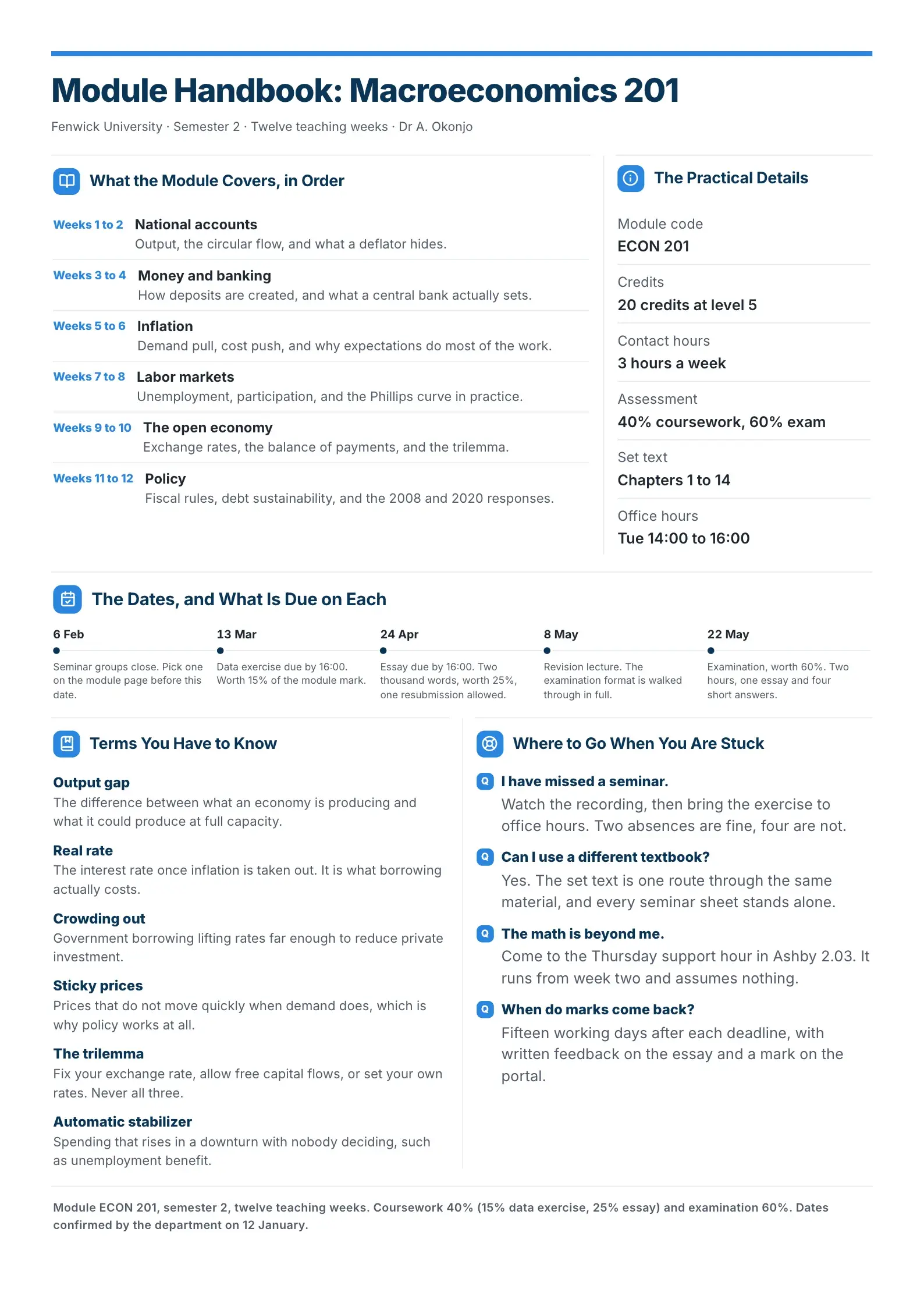
For a full course rather than one test, a course syllabus lists every topic and deadline for the term, and the study guide picks up the last two weeks before each exam.
 Edit this template
Make your study guide
Open a free study guide template and put in your own topics, or drop your class notes or a chapter PDF into the free AI One-Pager generator and get a finished study guide back to edit.
Frequently asked questions
What should a study guide include?
The scope of the exam, each topic written as a question, key terms with one-line definitions, one worked example per topic, the common traps, a few practice questions and a day-by-day plan up to the exam.
How long should a study guide be?
One side of one sheet per unit is a good limit. A whole course can fit on one sheet too if each topic gets one question, one term list and one example. Anything longer is usually notes.
Is there a study guide template in Google Docs?
Yes, Google Docs and Word both have simple layouts you can use. The structure above works in either. If you want it designed and ready to print, open the biology study guide template and edit it in your browser.
Should I make my own study guide or use the teacher's?
Use the teacher's to see what is in scope, then make your own. Choosing what to keep and rewriting it as questions is what moves the material into memory.




