Employee Handbook vs Policy Manual: One Town Publishes Both
Employee handbook vs policy manual, read from one Massachusetts town that publishes both: a 15-page handbook that points to a 33-page plan only a town vote can change.

Do you need an employee handbook, a policy manual, or both? The employee handbook vs policy manual question has a short answer. An employee handbook is written for your staff. It welcomes them and explains pay, benefits, conduct and who to ask, in plain words. A policy manual is written for the people who run things. It holds the full rules, the definitions and the steps a manager follows when something goes wrong. Start from a free one pager template.
One‑Pager examples
Real One-Pagers made with MakeOnepagers. Open any one to edit it as your own.
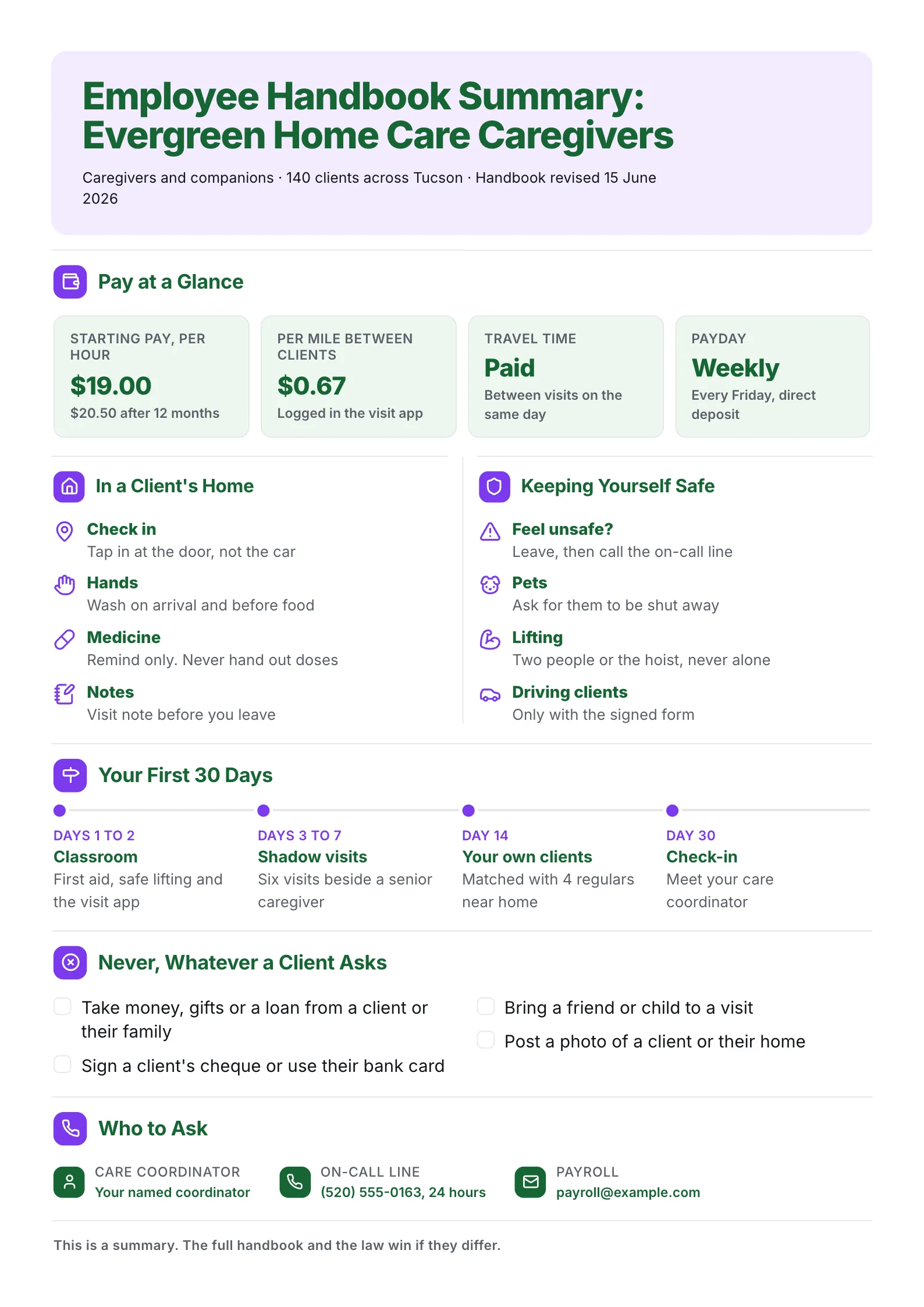 Employee Handbook Summary: Home Care CaregiversEdit for free(opens in a new tab)
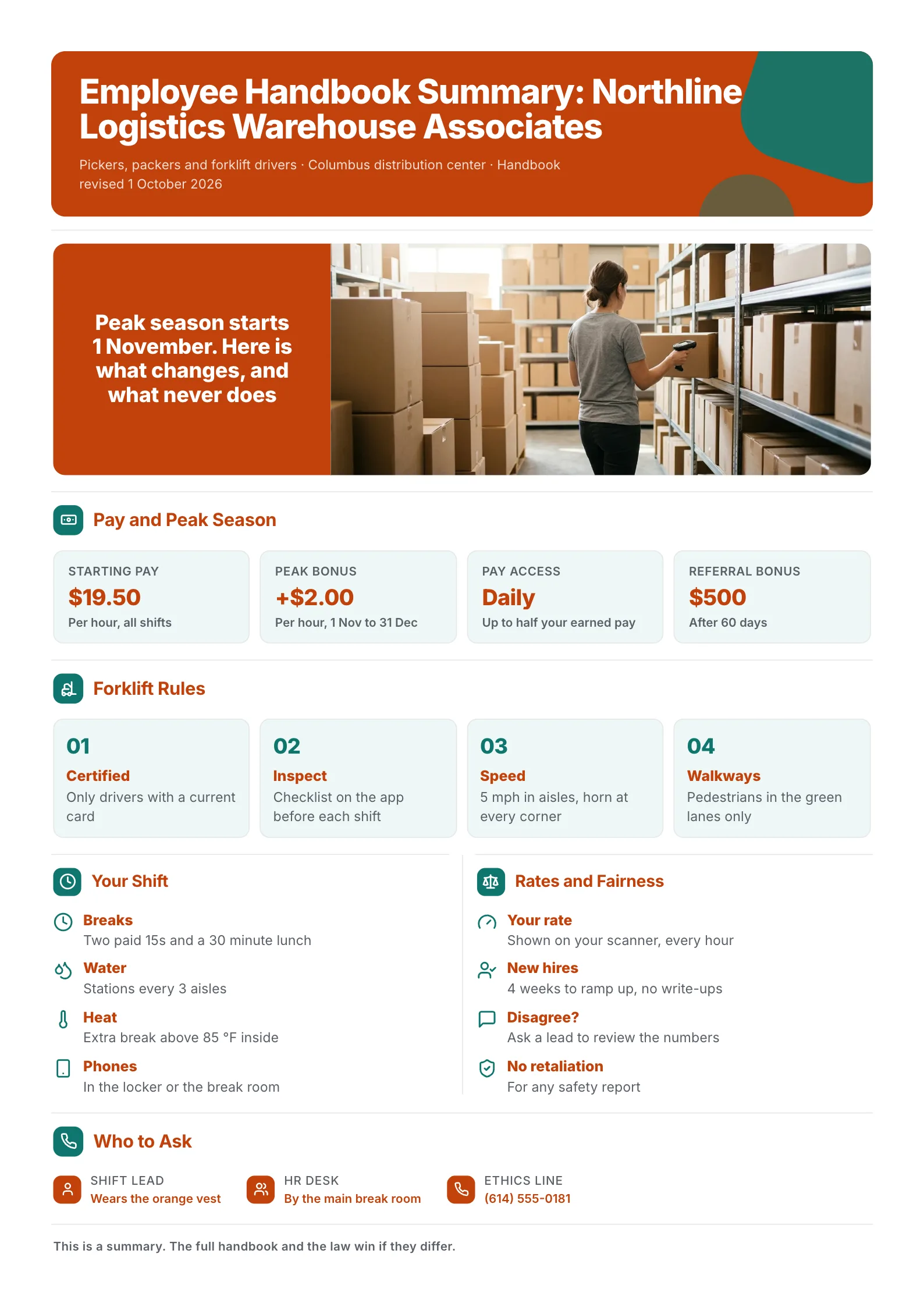 Employee Handbook Summary: Warehouse AssociatesEdit for free(opens in a new tab)
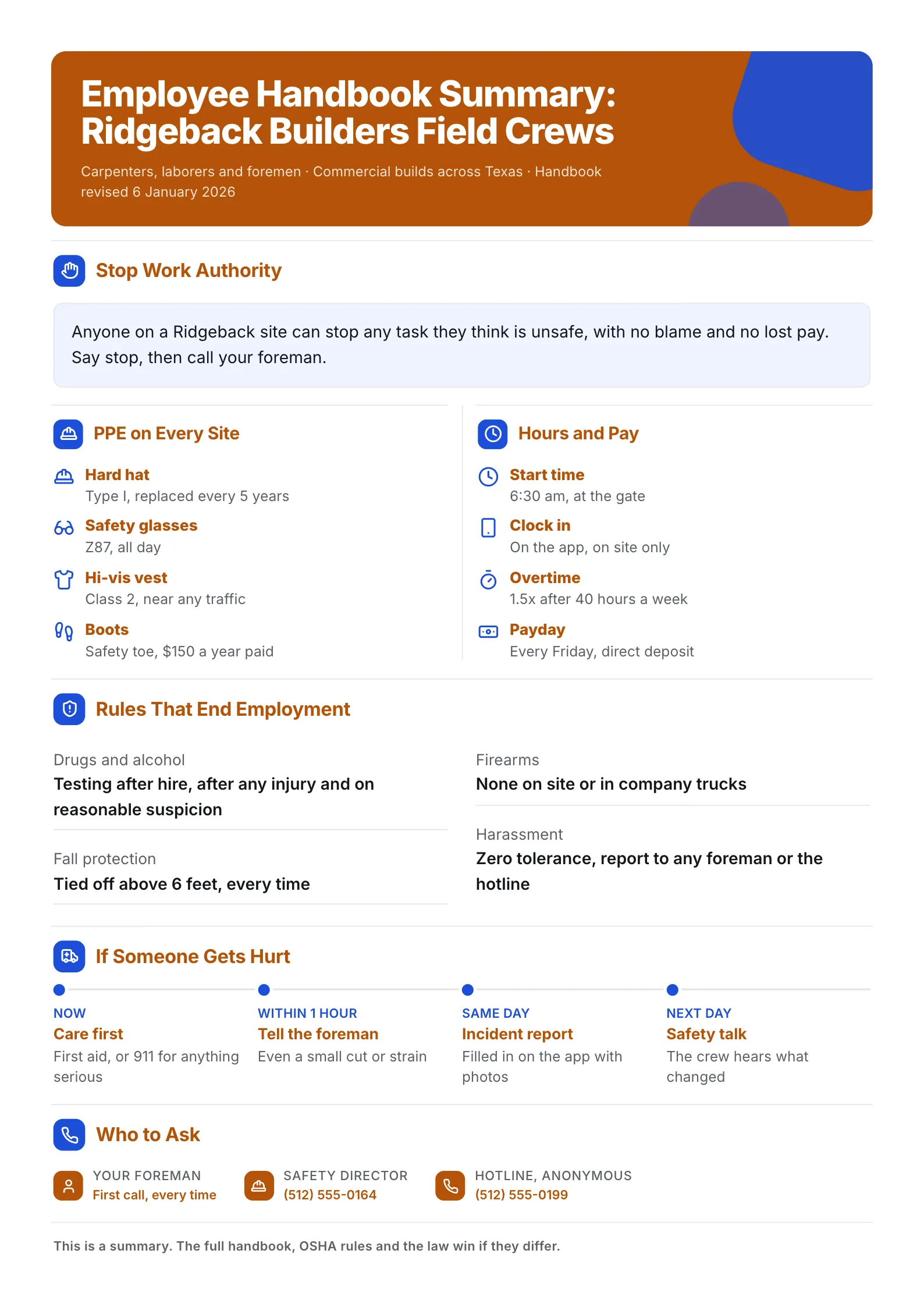 Employee Handbook Summary: Construction Field CrewsEdit for free(opens in a new tab)
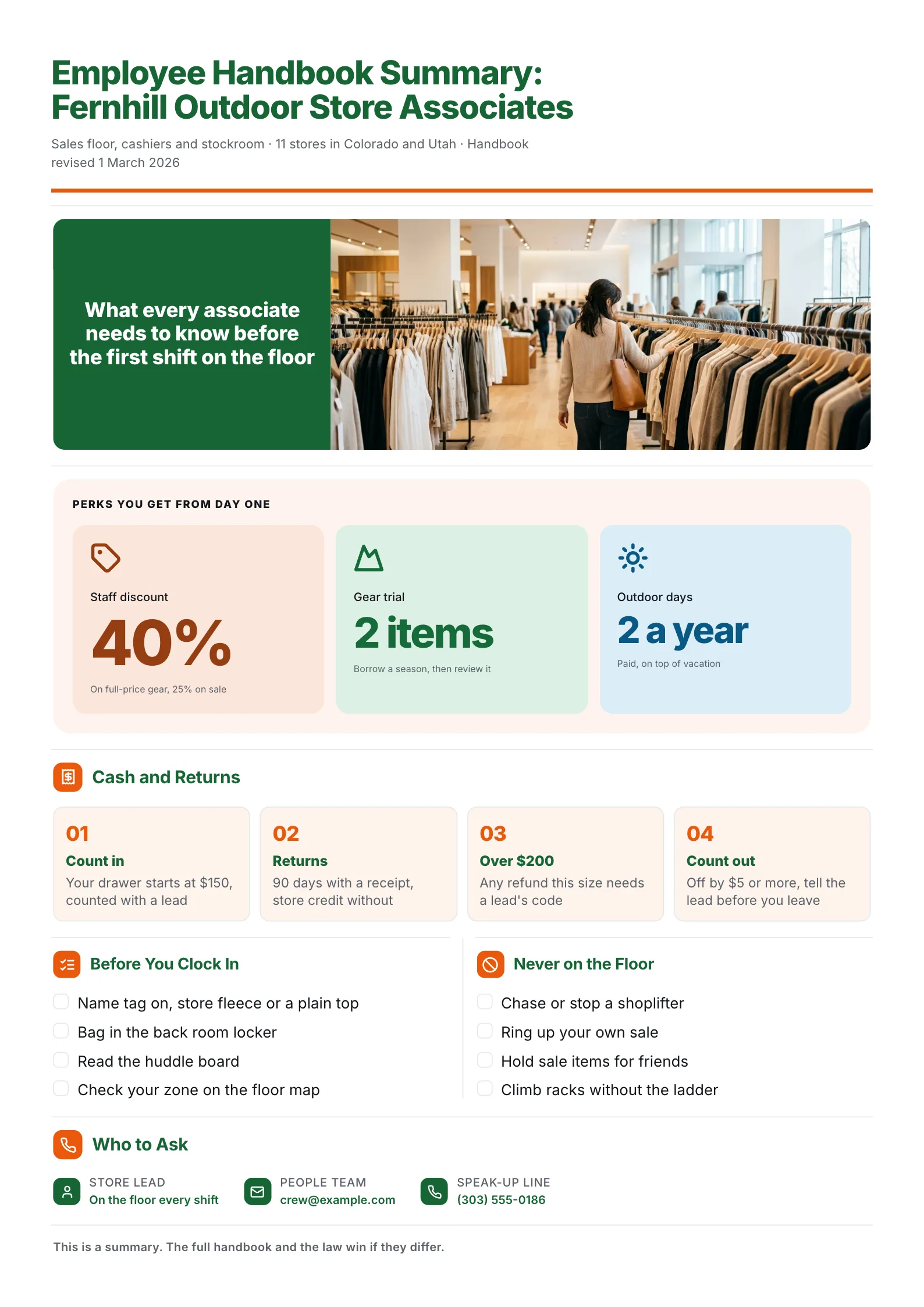 Employee Handbook Summary: Retail Store AssociatesEdit for free(opens in a new tab)
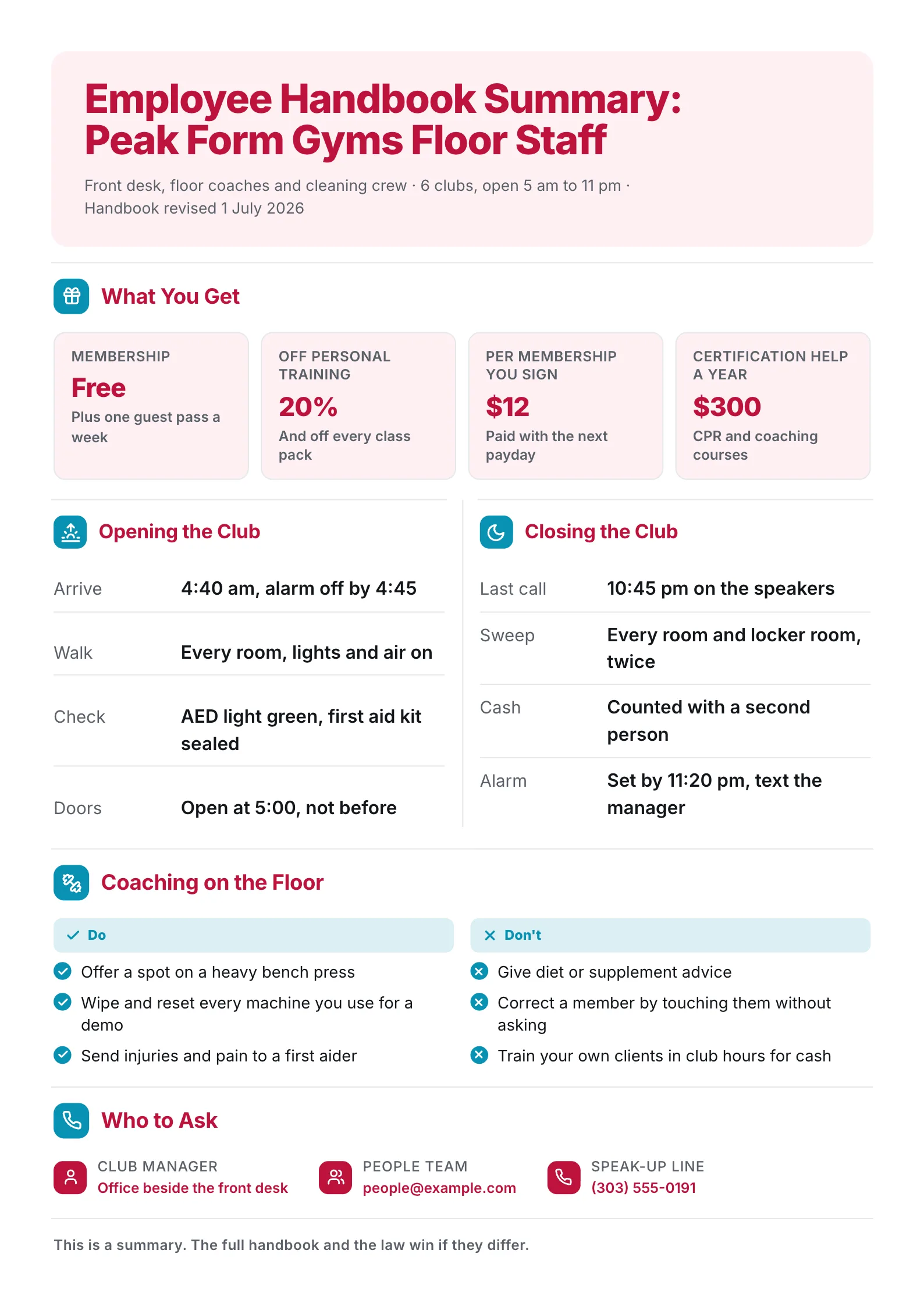 Employee Handbook Summary: Gym Floor StaffEdit for free(opens in a new tab)
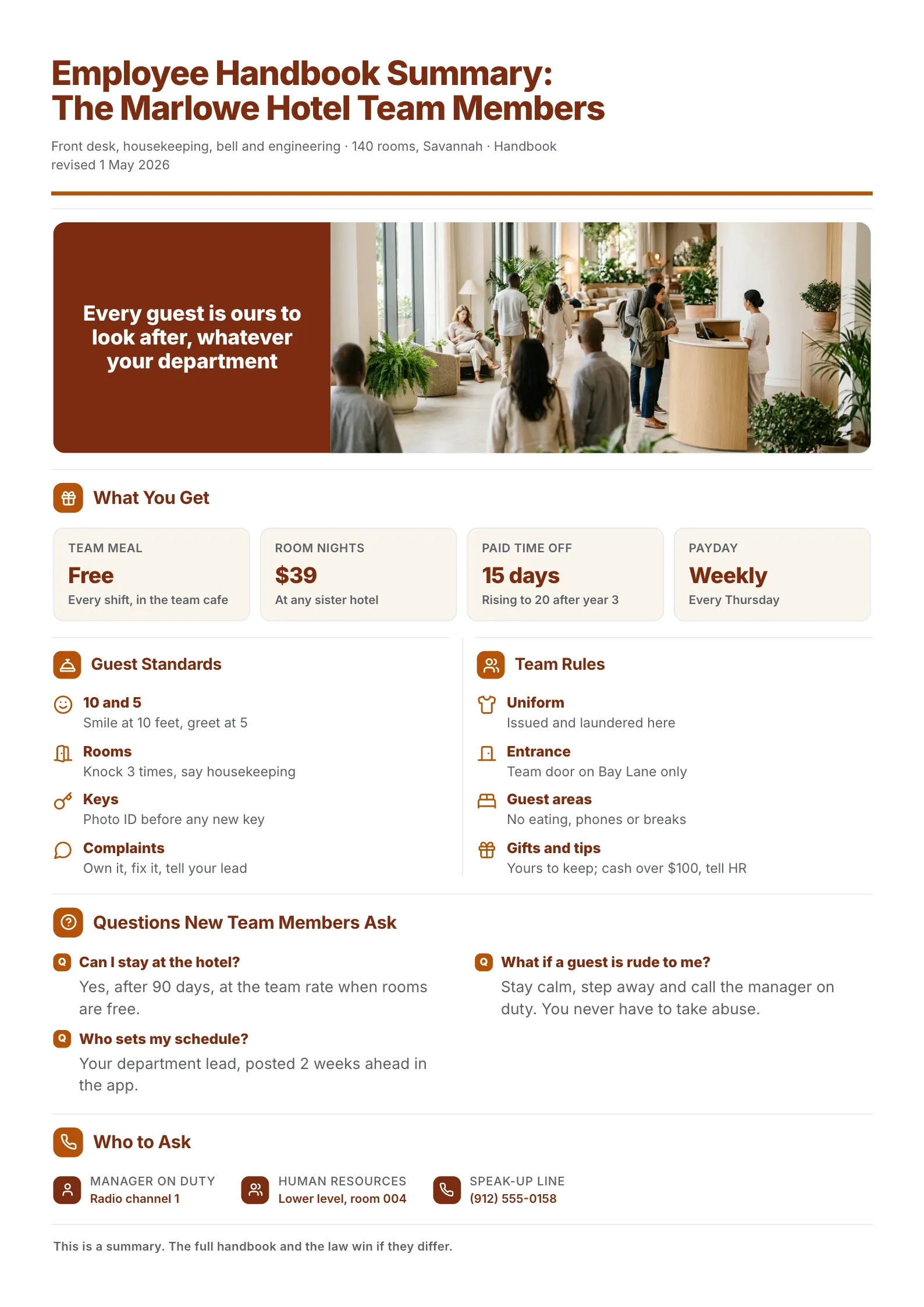 Employee Handbook Summary: Hotel Team MembersEdit for free(opens in a new tab)
Many small companies fold both into one handbook, and that's fine at first. Once you have unions, a board or a few hundred people, the two usually split. The handbook stays brief and welcoming, and the manual grows as detailed as it needs to be.
| Employee handbook | Policy manual | |
|---|---|---|
| Written for | Every employee | Managers, HR and leaders |
| Tone | Friendly and plain | Formal and exact |
| Length | Short; Boxborough's is 15 pages | As long as the rules need; Boxborough's is 33 |
| What it holds | Pay, benefits, conduct, contacts, a welcome | Definitions, procedures, pay scales, grievance steps |
| Who signs it | Each employee, on an acknowledgement form | Usually no one, though leaders approve it |
| How it changes | Often, and without a vote | Through a formal approval |
Boxborough's handbook and its rulebook
Few employers publish both online. The Town of Boxborough, Massachusetts, a town of about 5,500 people, posts its handbook and its policy manual side by side. Better still, the handbook says exactly how it relates to the plan.
The handbook: 15 pages, written for staff
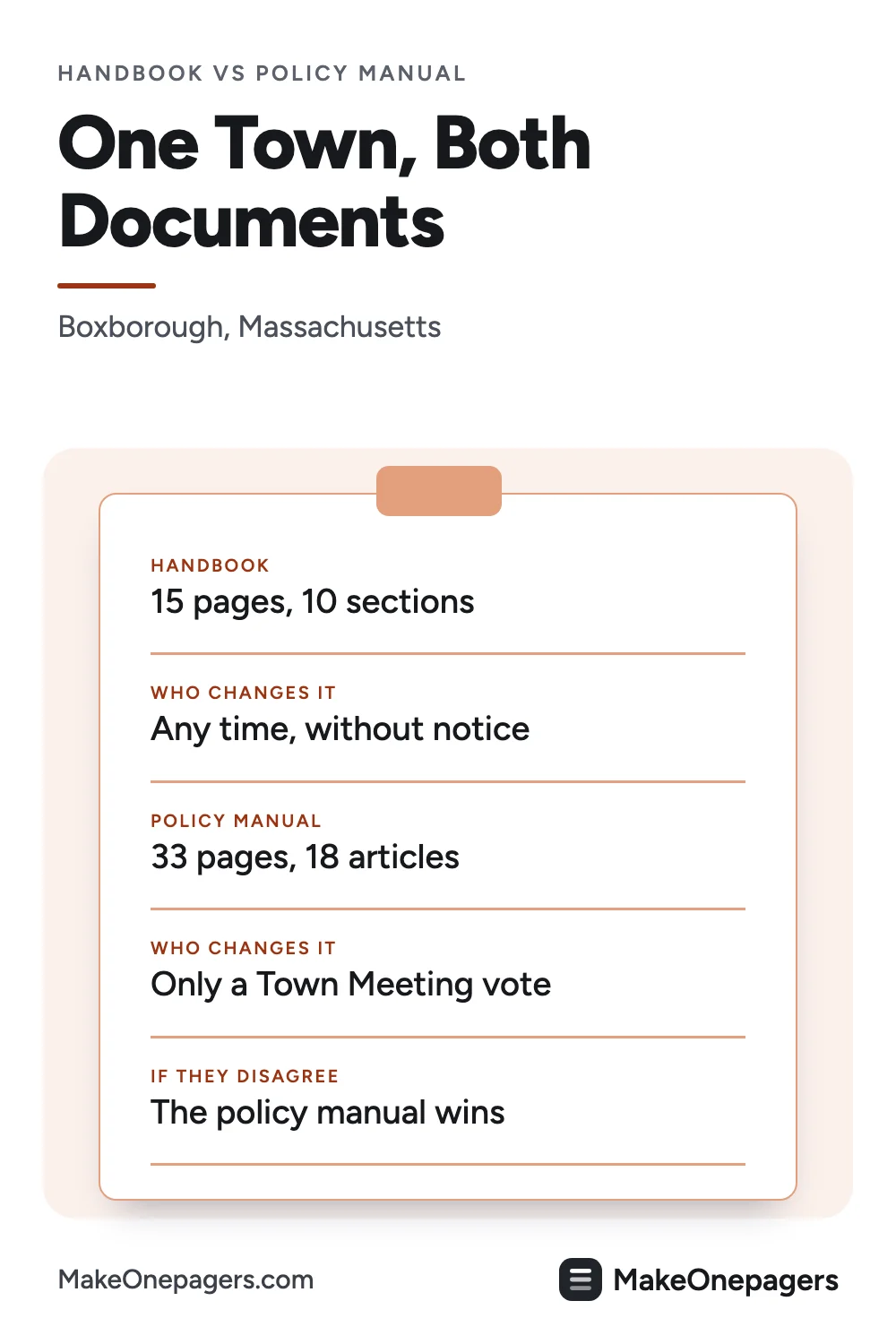
The Employee Handbook runs 15 pages, and its footer says "Updated October 2025." It's "written for employees of the Town," and it calls itself "a summary." It has 10 sections, from a Welcome and a Community Profile through benefits and conduct to an acknowledgement form you sign.
The numbers in it are the ones you'd ask about on your first day. The town pays 75% of your health premium. You enroll within 30 days of starting. You report an injury within 24 hours, and you give two weeks' written notice when you leave.
Just as useful is what the handbook leaves out. It lists 16 topics, such as the pay plan, holidays, layoffs and the complaint steps, that live in the policy manual or a union contract and "are not repeated here." It also points to 15 standalone policies and guides, like social media and workplace violence.
The policy manual: 33 pages, approved by vote
The town's policy manual is called the Personnel Administration Plan. It runs 33 pages in 18 articles, and every page carries the same footer: "Approved by Town Meeting May 19, 2026." It covers "all employees of the Town, except positions filled by popular election."
This is where the detail lives. The handbook mentions vacation. The plan gives you the hours: 96 hours a year for full-time staff after one year, 136 after five and 176 after ten. It names 12 paid holidays and says work on one pays 1.5 times the hourly rate on top of holiday pay. It sets out a grievance process with an informal step and 2 written steps, each running on 14 calendar days.
We counted 119 "Amended" notes in its margins, from 1980 to 2026. Each one marks a change voted at Town Meeting. That's the biggest difference you'll see between the two documents. The handbook says it "may change at any time, with or without notice." The plan changes only when the town votes.
| Count | Employee Handbook | Personnel Administration Plan |
|---|---|---|
| Pages | 15 | 33 |
| Sections | 10 | 18 articles |
| Last updated | October 2025 | May 19, 2026 |
| Who changes it | No one is named; it "may change at any time" | Town Meeting, by vote |
| Vacation | Mentioned, then pointed to the plan | 96 to 176 hours a year, by years served |
| Grievances | Pointed to the plan | 3 steps, 14 days each |
| Signed by staff | Yes, an acknowledgement form | Not itself, but the same form confirms it was read |
Which one wins when they disagree
The handbook answers this itself. If it ever conflicts with the plan or a union contract, "the latter will take precedence." If it conflicts with the law, the law wins. It also says plainly that it "is a companion document to the Personnel Administration Plan."
Both documents add one more line you should copy into your own. The handbook "is not intended to create a contract," and the plan "does not create a contract." Its acknowledgement form says the same: these documents "do not constitute employment contracts." That way, a friendly summary can't be read later as a promise you didn't mean to make.
Is a handbook required at all? We found no federal rule that says so. One federal rule does name handbooks: the FMLA notice rule. If FMLA covers you and you have a handbook, the FMLA general notice goes in it.
Five handbook summaries that point to the full rules
Each of these MakeOnepagers samples is a handbook summary for an invented employer. Each one shows a different way a short page can hand off to a longer rulebook, as Boxborough's handbook does.
A summary that says where the full handbook lives
 Edit this template
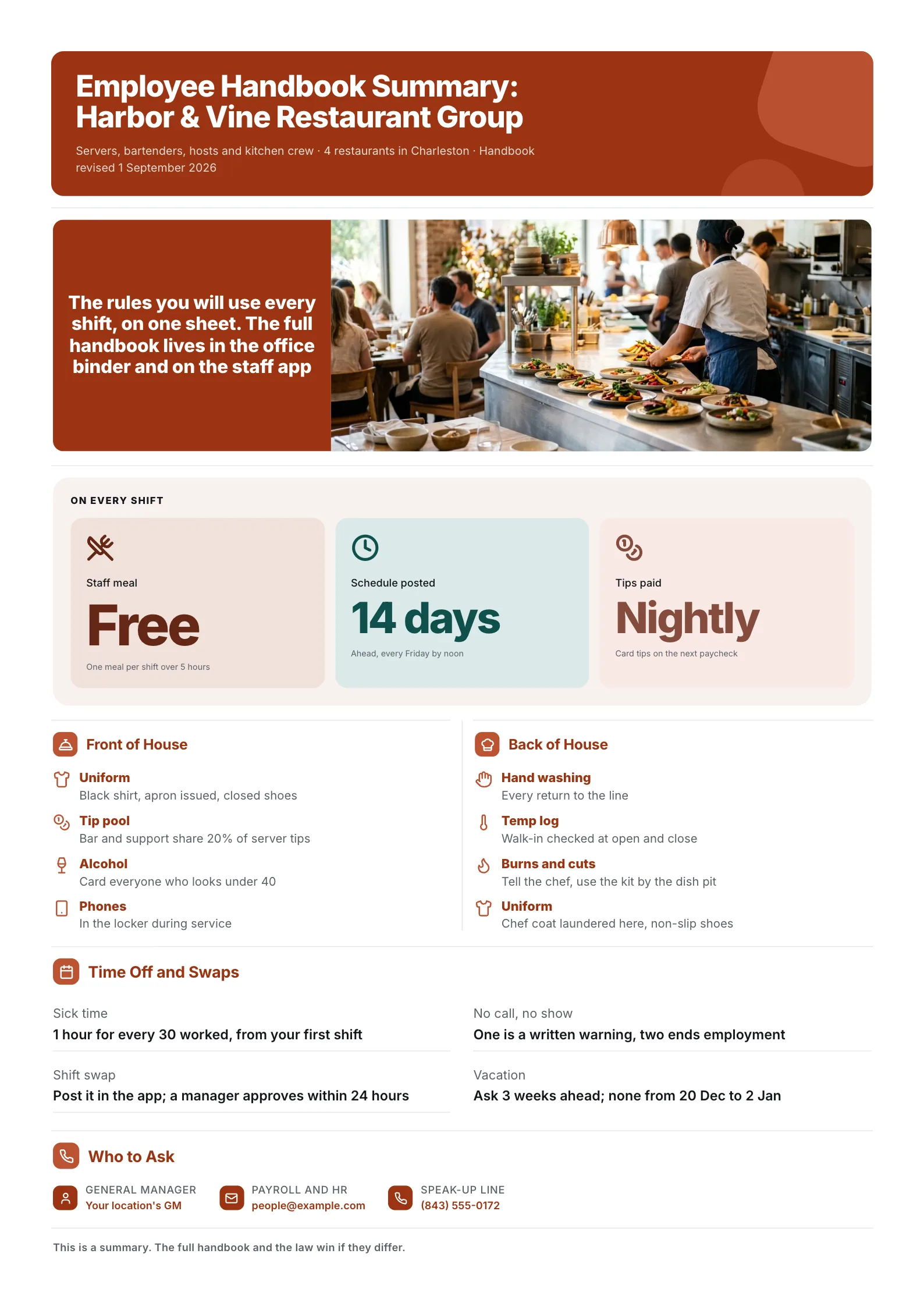
This restaurant handbook summary opens by saying it holds "the rules you will use every shift." The full handbook, it adds, "lives in the office binder and on the staff app." That's the handbook and manual split at small scale. Your servers get the 14-day schedule notice and the 20% tip pool share on one sheet, and the binder holds the rest.
Highlights with a line on which document wins
 Edit this template
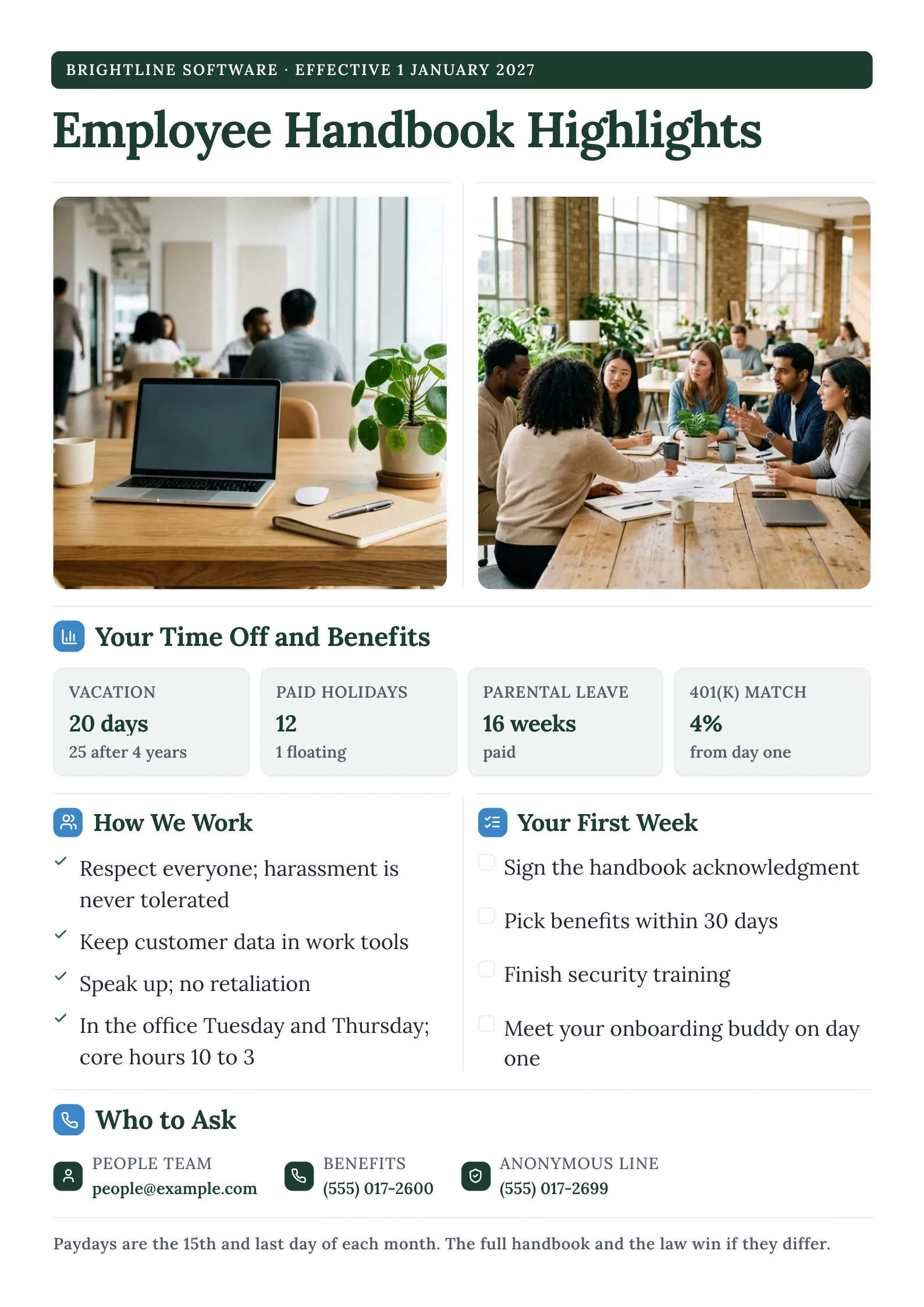
The employee handbook highlights page gives a new hire four numbers: 20 vacation days, 12 paid holidays, 16 weeks of paid parental leave and a 4% 401(k) match. Its last line does what Boxborough's handbook does: "The full handbook and the law win if they differ." Keep a line like that on any summary you hand out.
A public employer, like Boxborough
 Edit this template
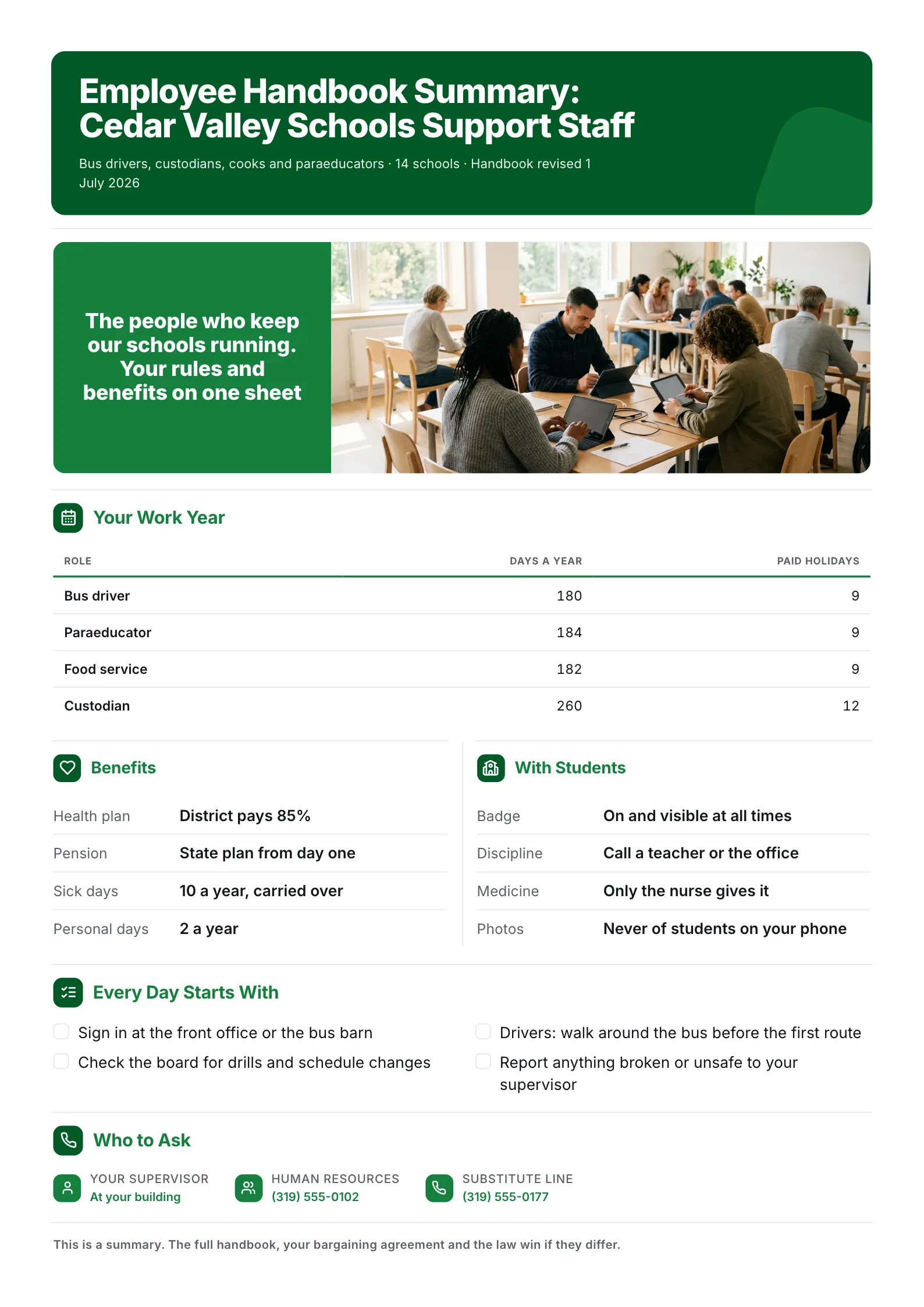
A school district is a public employer too. This school support staff summary shows each role's work year in a table, from 180 days for bus drivers to 260 for custodians. The district pays 85% of the health plan. If this district worked like Boxborough, its pay scales and grievance steps would sit in a longer plan or the union contract.
A rule that needs the manual behind it
 Edit this template
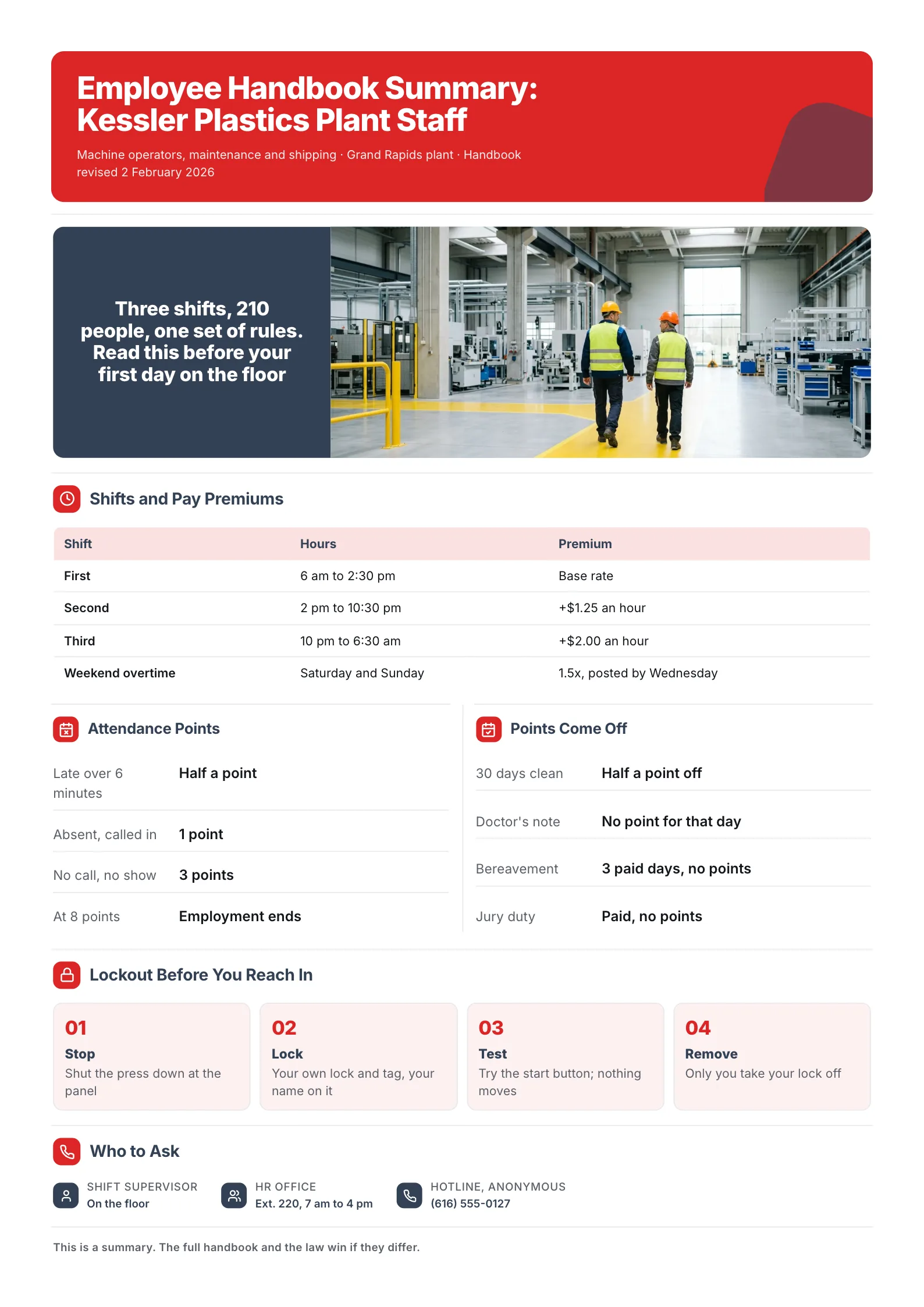
The manufacturing handbook summary shows attendance points in a small table. A no call, no show is 3 points, and at 8 points employment ends. Your operators need exactly that much. Your supervisors need more, such as how a disputed point is reviewed, and that belongs in the policy manual.
A scorecard staff read every day
 Edit this template
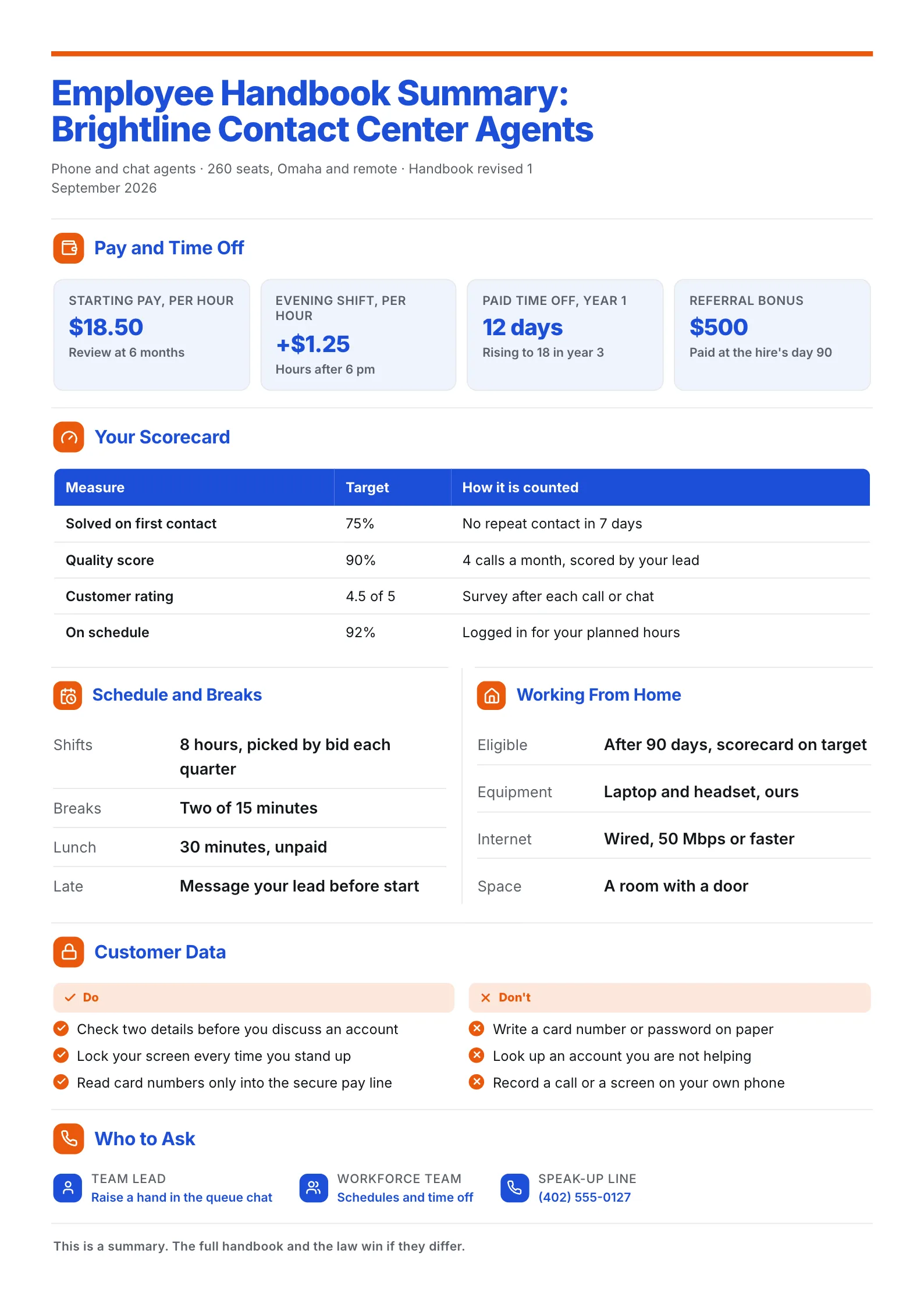
This contact center handbook summary puts the scorecard right in the handbook, with 75% solved on first contact and a 90% quality score as targets. Each measure says how it's counted, so your agents know the rules of the game. The detailed scoring guide your leads use can stay in the manual.
Do you need both?
Start with one handbook, then split it when any of these is true:
- Your handbook is too long to read in one sitting. Move the procedures out, and keep the welcome and the basics.
- Managers keep asking HR the same "how do I" questions. Those answers belong in a manual.
- A union contract or board sets some of your rules. Point to them, as Boxborough does, and don't repeat them.
- Your rules change by vote or by a formal sign-off. Keep them in a document with a change log.
- You have staff in several states. One handbook with state pages is easier than one long manual for everyone.
Whichever way you go, keep a one-page summary on top. It's the part people actually read.
Make your handbook summary
Open the MakeOnepagers handbook summary that fits your kind of crew, then type in your own pay, perks and rules. Have a long handbook already? Copy its sections into the free AI One-Pager generator, and keep only what someone needs on their first week. To write the full version, read how to write an employee handbook. Our employee handbook summary post shows more short versions, each built for a different kind of workplace.
Frequently asked questions
Is an employee handbook the same as a policy manual?
No. A handbook is a plain guide for staff. A policy manual holds the full rules and procedures for managers. Small companies often combine them, and larger ones usually split them.
Which comes first if the handbook and the manual disagree?
Say so in writing. Boxborough's handbook says the policy manual or a union contract "will take precedence," and the law beats both.
Do employees sign the policy manual?
Usually not. They sign an acknowledgement that they received the handbook. Boxborough's form also asks them to confirm they've read the standalone policies and the plan.
Is a handbook a contract?
It shouldn't be. Boxborough's says it "is not intended to create a contract." Put a line like that near the front of your own and on your acknowledgement form.
How often should a policy manual be updated?
Whenever a rule changes, with the date noted. Boxborough's plan carries 119 amendment notes in its margins, from 1980 to 2026, so anyone can see when each rule last changed.




