Creative Brief Examples, and the 3 Lines Government RFPs Add
Five creative brief examples for video, print, social, a rebrand and an event, plus the budget, approver and access lines public RFPs add.

Most creative briefs tell your team what to make and who it's for. When a state or a city asks for the same work in public, it often adds three more lines: what the job may cost, who signs off and who must be able to read or watch the result. We read 10 of those public requests for creative work and set them beside five creative brief examples from MakeOnepagers, one each for a video, a print run, a social campaign, a rebrand and an event.
One‑Pager examples
Real One-Pagers made with MakeOnepagers. Open any one to edit it as your own.
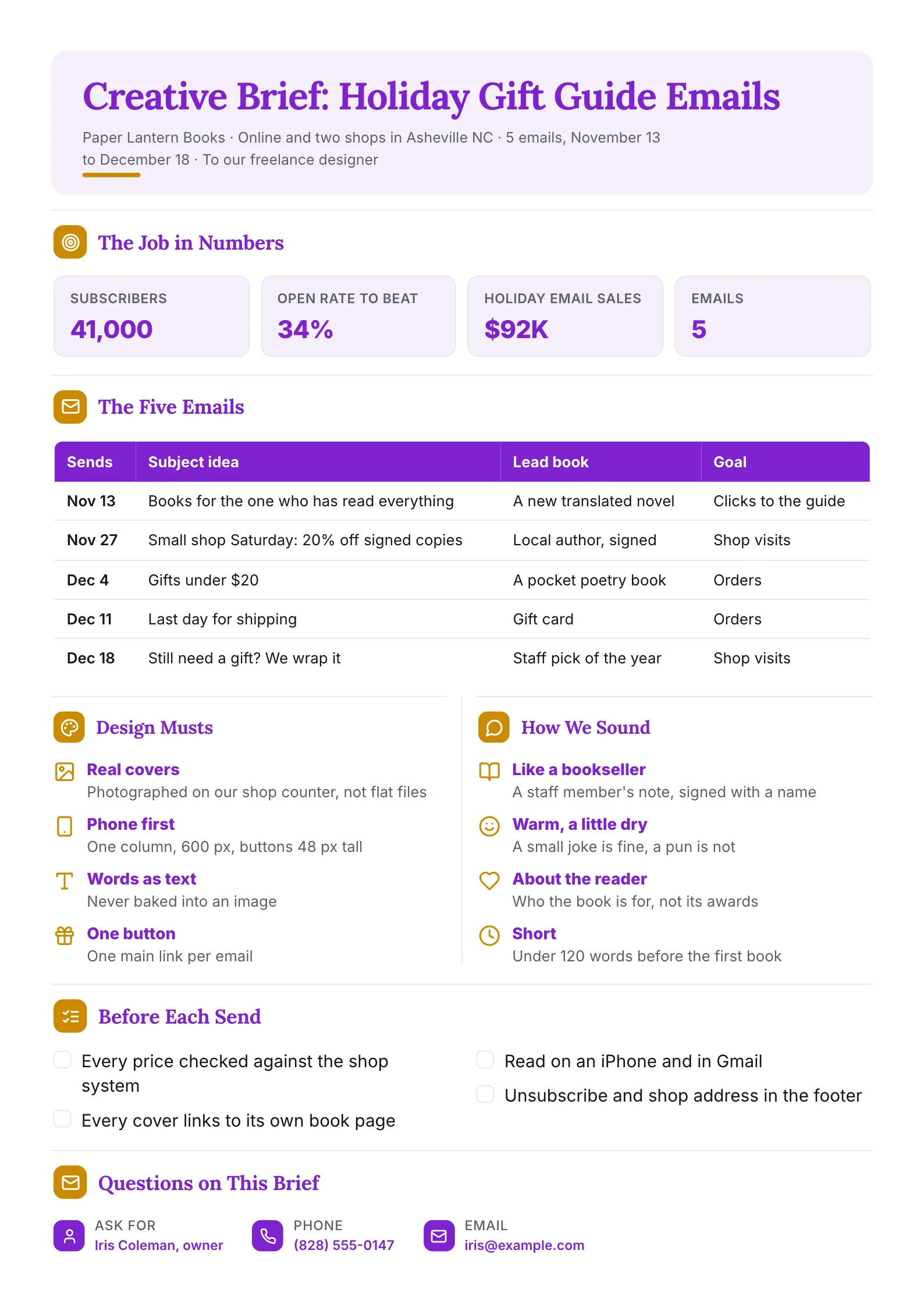 Creative Brief: Email CampaignEdit for free(opens in a new tab)
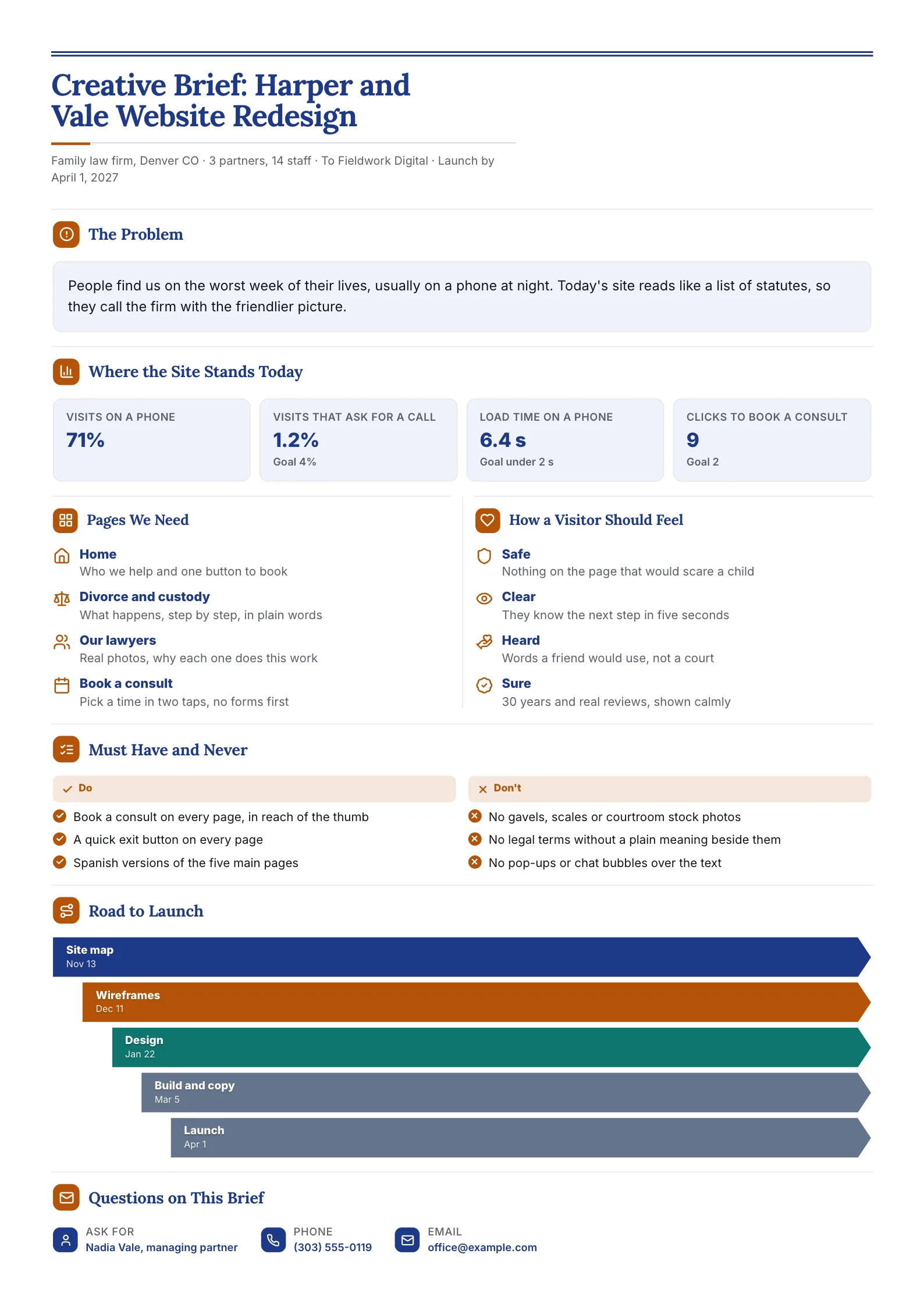 Creative Brief: Website RedesignEdit for free(opens in a new tab)
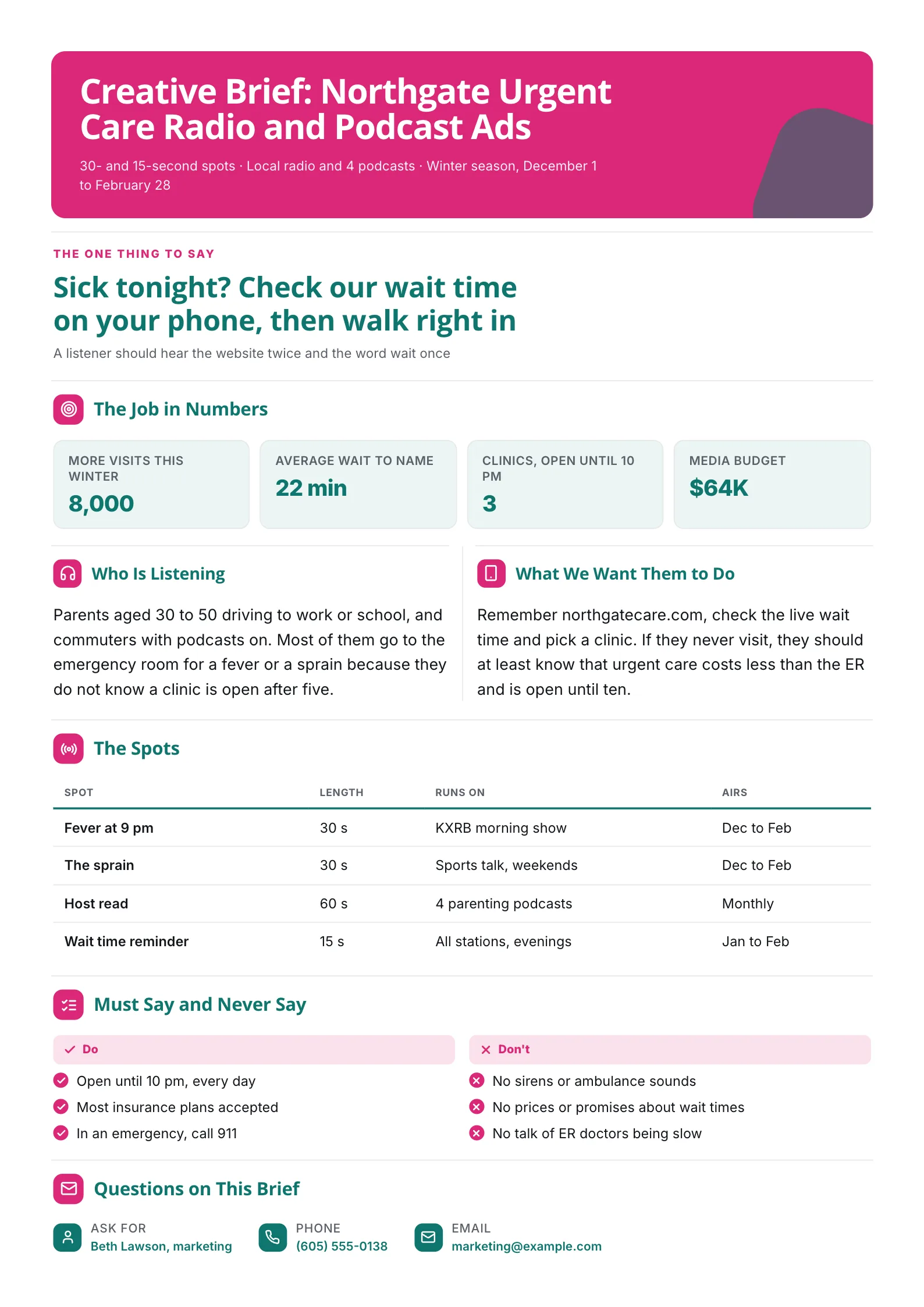 Creative Brief: Radio and Podcast AdsEdit for free(opens in a new tab)
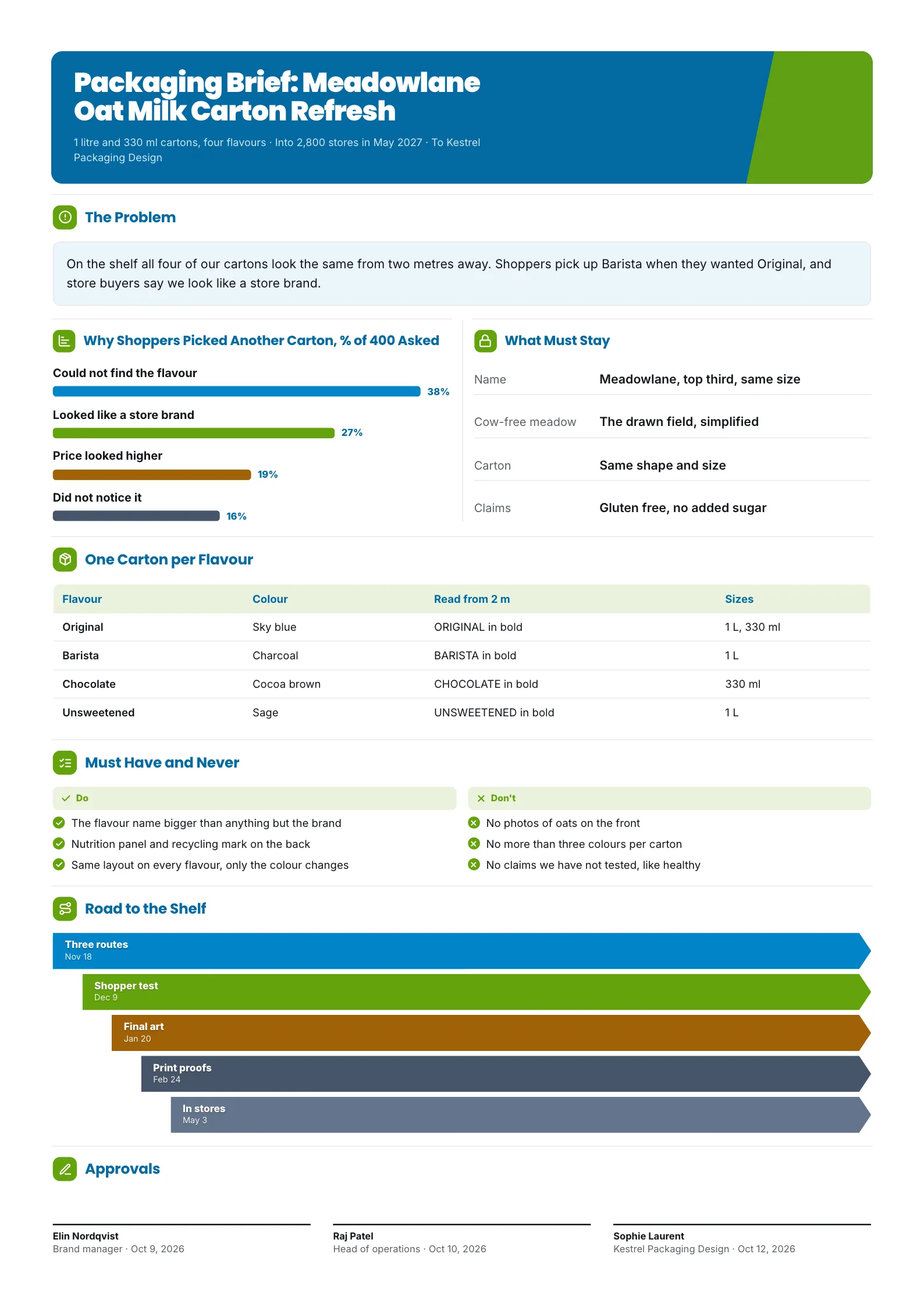 Creative Brief: Packaging DesignEdit for free(opens in a new tab)
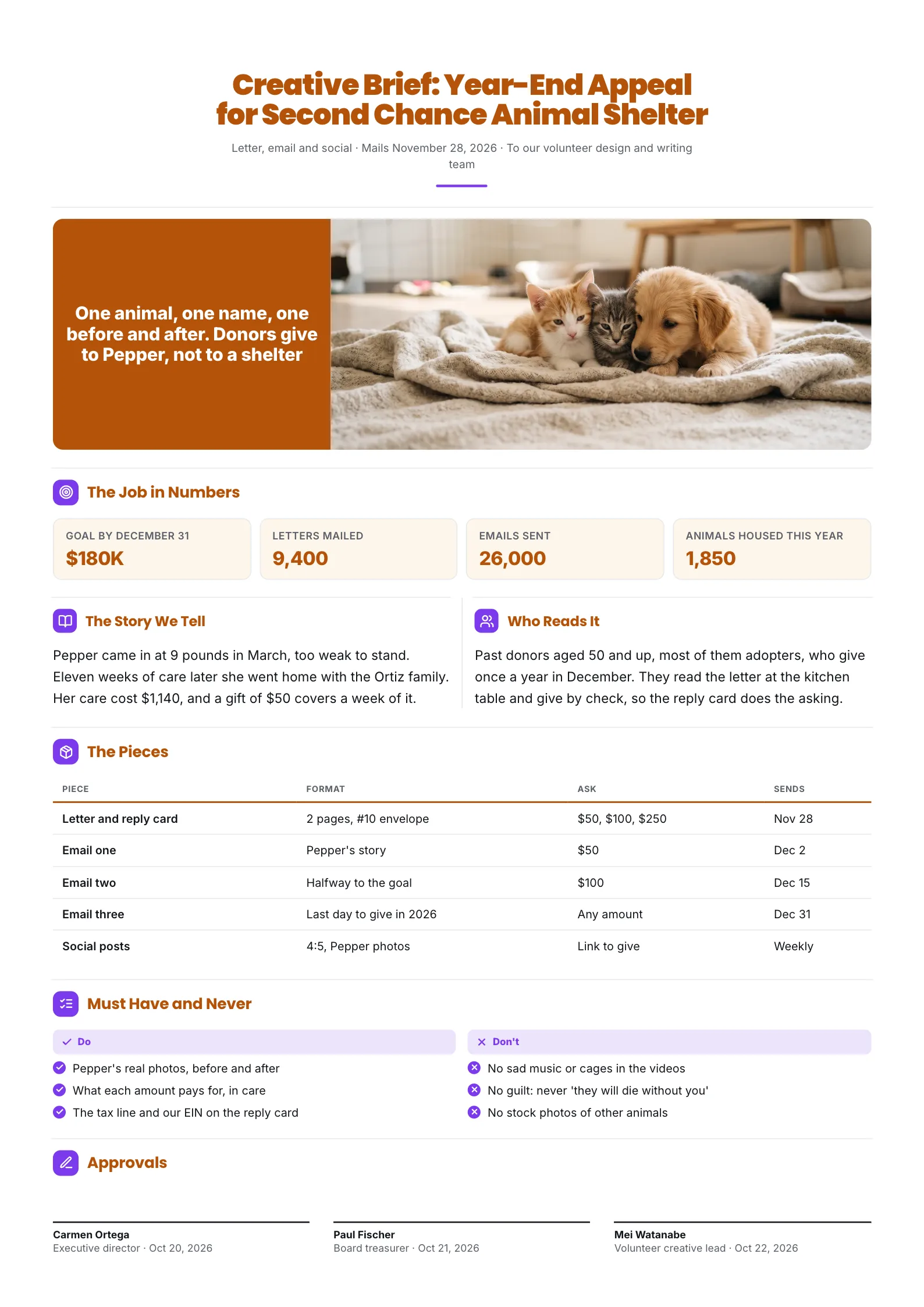 Creative Brief: Fundraising AppealEdit for free(opens in a new tab)
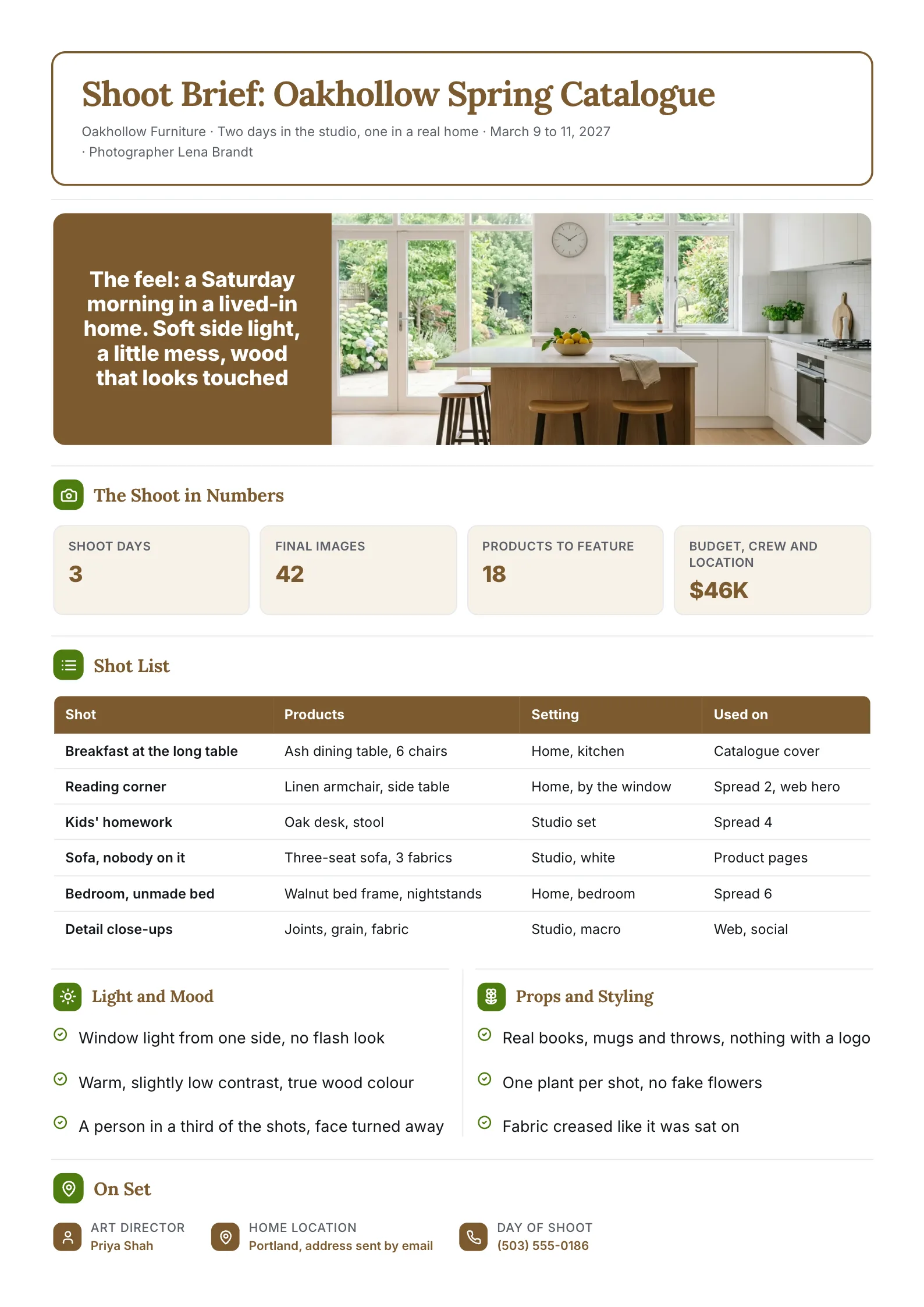 Creative Brief: Photo ShootEdit for free(opens in a new tab)
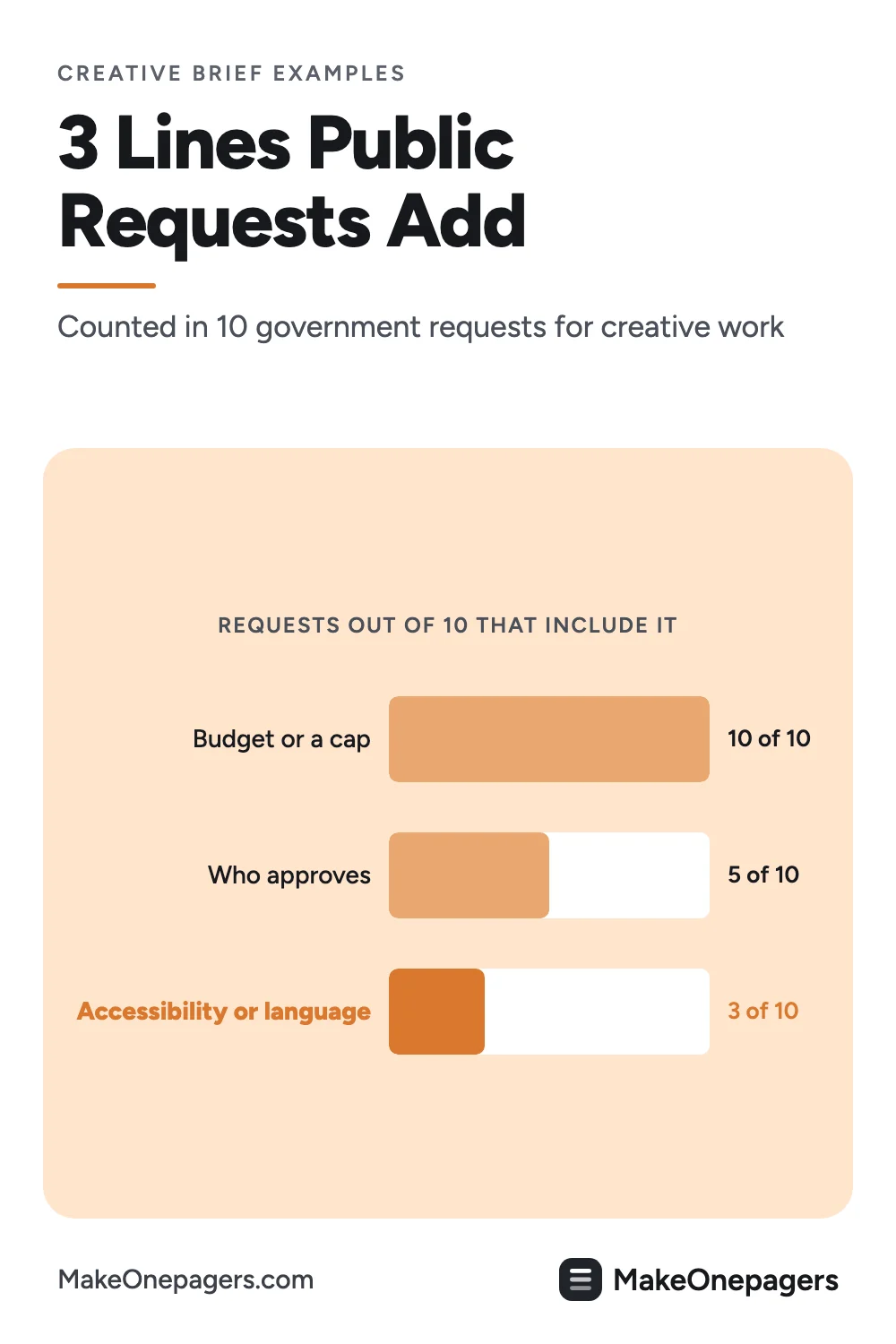
Every one of the 10 requests asked bidders to price the work. Half named who approves it, and 3 set a rule for accessibility or language. Our five sample briefs did well on the first line and were thin on the other two.
The 3 lines public requests add
| Line | The 10 public requests | The 5 sample briefs on this page |
|---|---|---|
| Budget | All 10 ask for a price or set a cap, from $32,000 per health department to $247,893 a year | 4 of 5 give a budget; the transit brief has none |
| Who approves | 5 name an approver, from Travel Oregon's staff to a city council | 2 of 5 name who decides, the video and the logo |
| Accessibility or language | 3 set a rule, from accessible colors and fonts to materials in 9 languages | 1 of 5, the event brief's captions zone and flashing limit |
Source: our count of each document's scope, budget and evaluation sections, October 30, 2026.
A fourth line came up often enough to note. Travel Oregon's 2025 advertising RFP and two other requests below say the government keeps the rights to the finished work, and none of our five briefs tells your team who owns the files. Travel Oregon also shows how much price matters to the people choosing, since budget counts for 25% of the score.
Video: one message, four lengths
 Edit this template
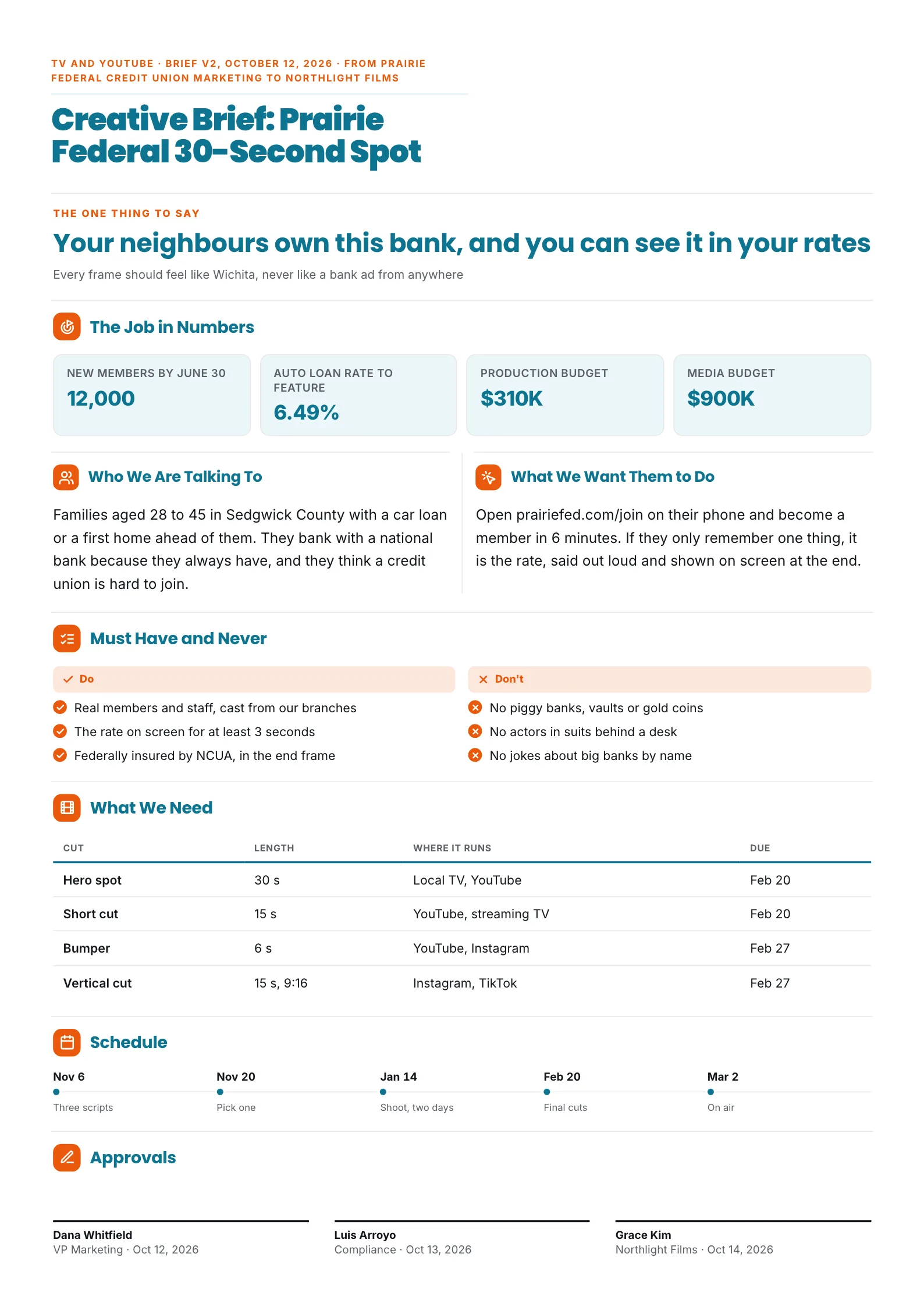
Four cuts of one spot share a single line and a single rate on screen.
Your one line to say is "Your neighbors own this bank, and you can see it in your rates." You're talking to families aged 28 to 45 in Sedgwick County, Kansas, with a car loan or a first home ahead of them. Your crew delivers a 30-second hero spot, a 15-second cut, a 6-second bumper and a 15-second vertical cut for Instagram and TikTok.
This credit union brief gives your film crew a number to chase, 12,000 new members by June 30, and one rule that can't slip. The 6.49% auto loan rate stays on screen for at least 3 seconds. The budget comes as two numbers, $310K for production and $900K for media. Three people sign off, and one of them is from Compliance, so your rate line gets a legal read.
New Hampshire's tourism office counted its video the way your brief should, cut by cut. For each of the four seasons, its 2024 request wants two 30-second TV spots, four to six spots each at 15, 10 and 6 seconds, and two 2-minute b-roll reels for each audience it targets. It plans for 20 shooting days in a year and builds in at least three rounds of edits. San Antonio's health department priced its spots in two languages, two versions each in English and Spanish.
What the credit union brief leaves out is ownership. New Hampshire keeps the footage "in perpetuity" and asks for talent usage of at least five years. Your brief should say who owns the cut and the raw footage, and for how long the faces in it can run.
Print: 7 words for a billboard, 20 for a shelter
 Edit this template
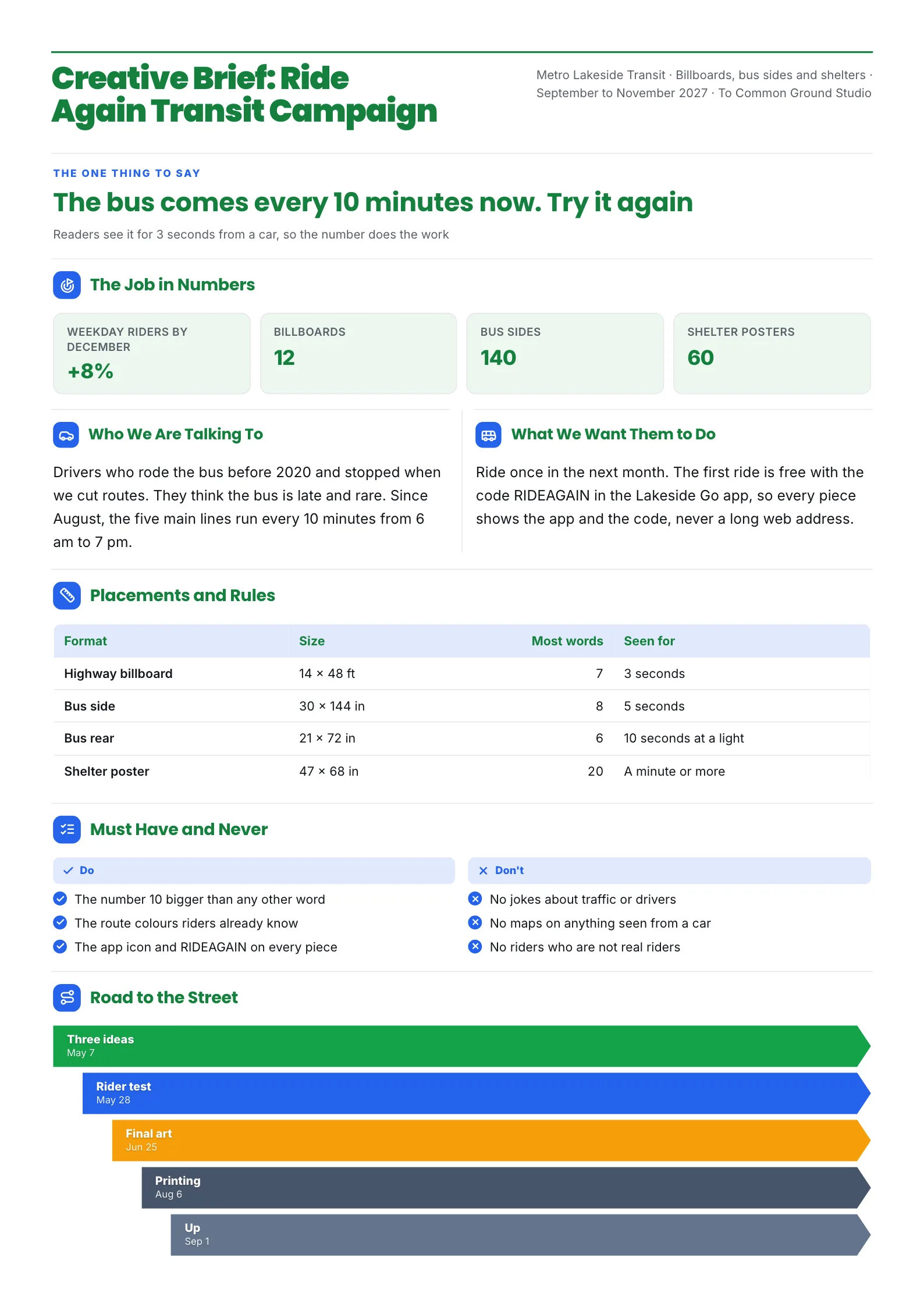
Each placement gets a size, a word limit and the seconds your reader has.
The most useful column in this transit brief is the word limit. Your billboard gets 7 words and 3 seconds of attention from a passing car. A shelter poster can hold 20 words, because someone waiting for a bus reads it for a minute or more. Every one of the 12 billboards, 140 bus sides and 60 shelter posters carries the same line: "The bus comes every 10 minutes now. Try it again." It's aimed at drivers who rode the bus before 2020 and stopped when routes were cut, and the goal is 8% more weekday riders by December.
A St. Louis transit group, Citizens for Modern Transit, posted its December 2023 request for a ridership campaign through Missouri's transportation department, paid with federal funds. It listed 6 pieces to make, from a campaign badge and 2 transit ads to a registration brochure and web graphics, all due by February 1, 2024, in PDF, PNG and JPEG. The group said it "will provide copy," so the designer knew not to write any. When your own team writes the words, your brief can say so just as plainly.
This is the one brief of the five with no budget at all. The St. Louis request asked for a separate price on every item, which lets you drop one piece when money runs short. Add a cost column to your placements table and you get the same choice.
Social: three audiences, 40 posts
 Edit this template
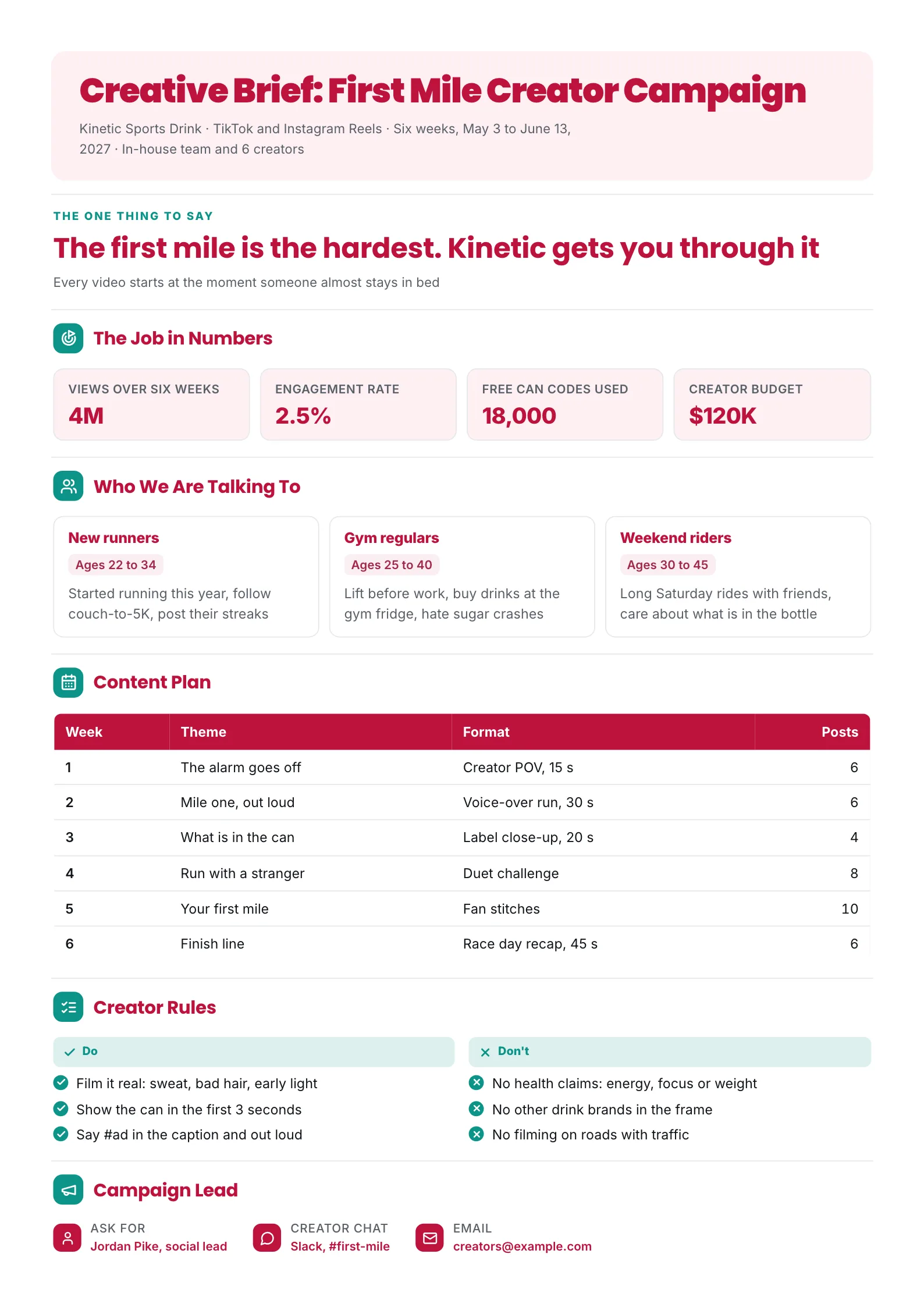
Six weekly themes add up to 40 posts from six creators.
This sports drink brief starts from your people. It names new runners aged 22 to 34, gym regulars aged 25 to 40 and weekend riders aged 30 to 45, and it gives each group a habit to film. All of them hear one line, "The first mile is the hardest. Kinetic gets you through it." You get 40 posts over six weeks on TikTok and Instagram Reels, from 4 in the label week to 10 in the fan stitch week.
Your creators get rules they can follow on a phone screen. The can shows up in the first 3 seconds, and "#ad" goes in the caption and gets said out loud. No one claims the drink adds energy, focus or weight loss. The targets are 4 million views, a 2.5% engagement rate and 18,000 free can codes, with $120K set aside to pay creators.
Rhode Island's 2025 tourism RFP wants the state shown "in an aspirational way" while driving people to its visitor website. It asks for a content calendar for all four seasons, a mix of posts from visitors and the team, and a plan for answering comments and complaints, with a way to escalate the hard ones. And it puts every creative asset the agency makes under the Corporation's approval. All three asks belong in your own social brief, since your creators will meet the same comments.
The sports drink brief names a campaign lead to ask questions, but nobody who approves a post. With six creators filming for six weeks, write down whose yes a video needs before it goes live, and how fast that yes comes back.
Rebrand: a 1979 logo and one owner's yes
 Edit this template
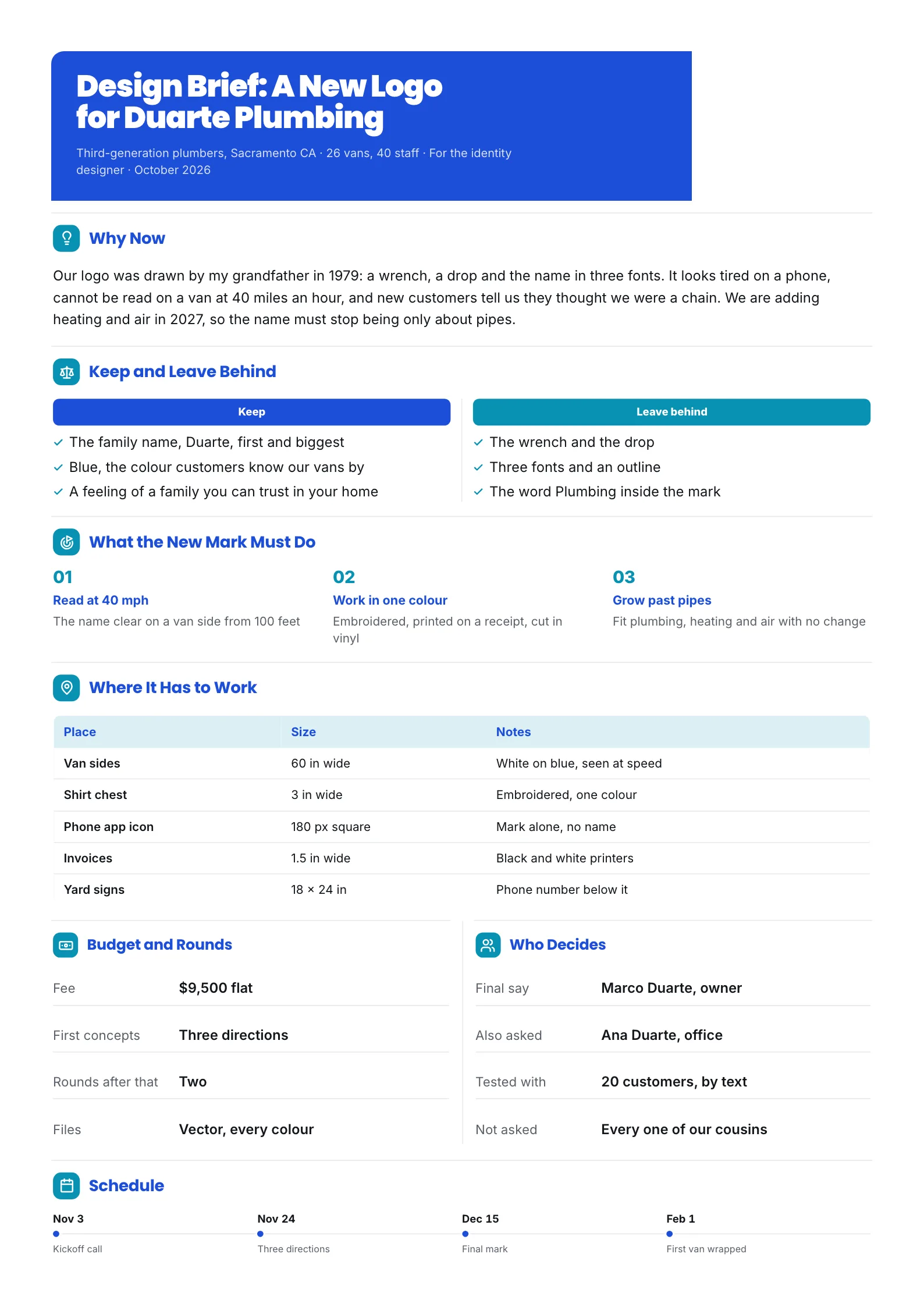
A size table, from a 60-inch van side to a 180-pixel app icon, sets the design limits.
This plumbing company's logo was drawn in 1979, and you can't read it on a van at 40 miles an hour. New customers say it made them think the company was a chain, and the business adds heating and air in 2027. So the brief puts its message in what to keep: a family you can trust in your home, with the Duarte name first and biggest. Your designer delivers three first directions, two rounds after that and vector files in every color, for a flat $9,500. The owner has the final say, and the new mark gets tested with 20 customers by text.
Essex Junction, a Vermont city of 10,590 people, spells out every step of its decision. The designer first shows five logo mock-ups to the City Council, a committee and staff, who narrow them to three. Next, stakeholders give feedback on those three. Then the Council picks the final logo, with up to five revisions across both rounds. The city keeps the copyright to the finished work, and three departments keep their own logos, tied to the new brand without being redrawn. Copy that sequence into your schedule, and your designer can price every round before you sign.
The plumbing brief covers who decides, so its gap is access. Essex Junction wants a color palette with "high-contrast hues" that meets accessibility rules for screens and print, and fonts that are easy to read. Your logo brief can ask for the same before the first direction is drawn, while a color change still costs nothing.
Event: the only brief with an access rule
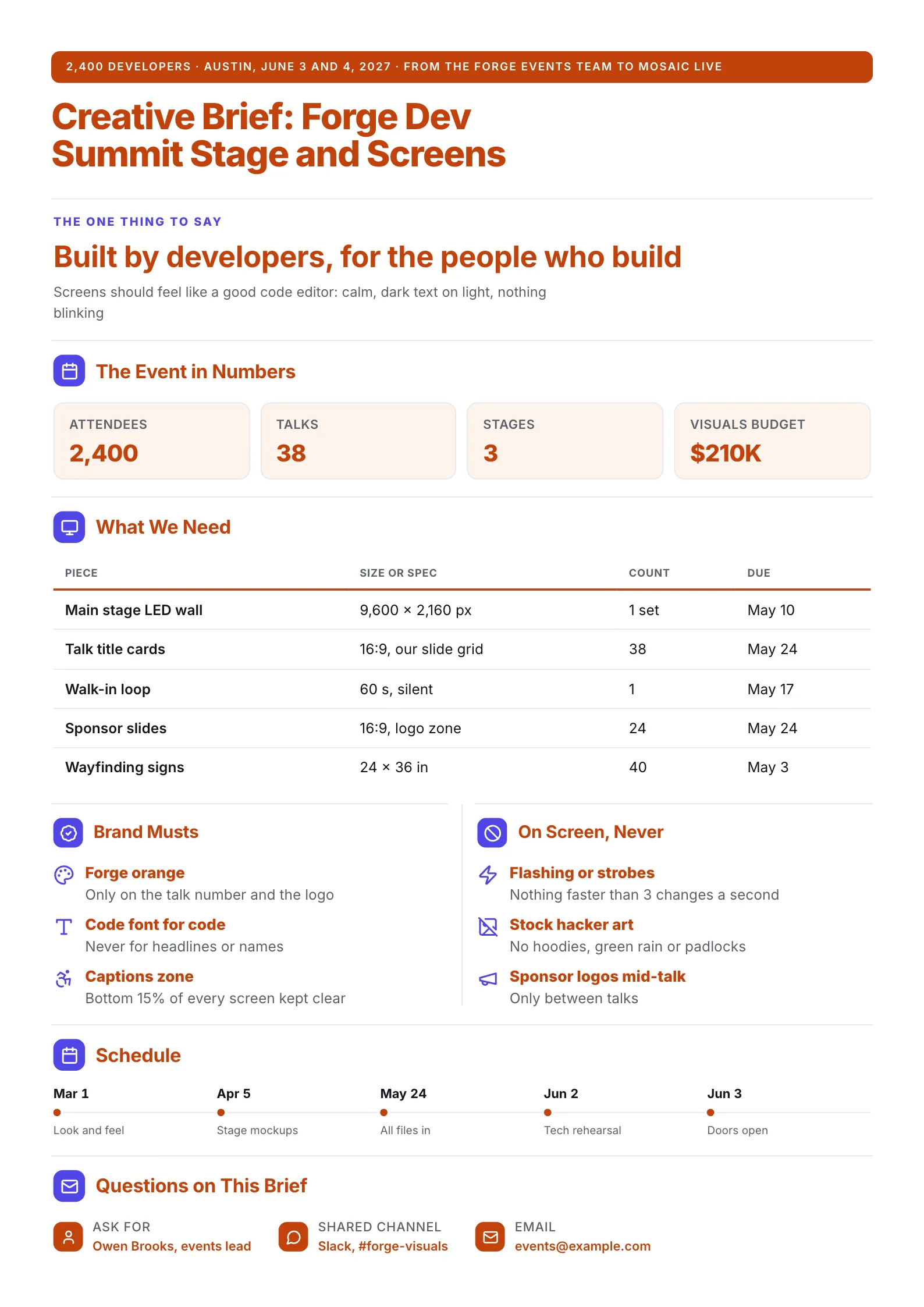 Edit this template
Every screen and sign has a size, a count and a due date.
The bottom 15% of every screen at this developer summit stays clear for captions, and nothing on screen changes faster than 3 times a second. No other brief here has a rule like it, and you can lift it word for word for any event with screens. The line every screen supports is "Built by developers, for the people who build," for 2,400 developers across 38 talks on 3 stages in Austin. Your studio delivers a 9,600 by 2,160 pixel LED wall, 38 talk title cards, a silent 60-second walk-in loop, 24 sponsor slides and 40 wayfinding signs, on a $210K visuals budget.
The City of Umatilla, Oregon, wrote its 2026 request for the Rock the Locks Festival around ticket sales. The festival runs September 25 to 27, 2026, and the city wants buyers from the Tri-Cities area through Pendleton. The firm it hires has to fit sponsors into the campaign and report return on investment after the event. Questions and proposals were both due on February 5, 2026, which left bidders no time to get answers.
The summit brief gives you an events lead for questions but no one who approves a screen, and a stage show has many hands. Umatilla's firm has to work with city staff, the festival promoter and media partners such as KNDU and Stephens Media. When your show has that many people involved, name the one person whose sign-off sends a file to the stage.
What a health department asks before it picks a medium
NACCHO's 2023 call for syphilis campaigns, paid for by the CDC, offered up to $32,000 to as many as 10 local health departments. It asked each one four questions, and they make a strong first draft of any brief you write for a public audience. Who is your priority population? What are your goals? What is the message, and how will it reach people? How will you measure success? It wanted the message "clear and concise" and a call to action that "should be very specific," and NACCHO and the CDC review the materials before they run.
The Boston Public Health Commission asks for health materials in 9 languages, among them Haitian Creole, Somali and Vietnamese, made "in collaboration with community members whenever possible." The Mississippi Department of Mental Health capped its 2021 HIV/AIDS campaign at $70,000 and listed nine audience groups to reach. Those two requests show you the language line and the budget line at their plainest.
For the full list of boxes on one page, start from our creative brief template. A rebrand also needs a brand guidelines template, and work that isn't creative fits a project brief template.
Add the three lines before you send it
Read your brief once more and look for a budget, a named approver and an access or language rule. If one is missing, you can write it in now, while changing it costs your team a sentence instead of a round of edits.
Frequently asked questions
What should a creative brief example include?
One message, the audience and what you want them to do, plus a table of every piece with its size and due date. Then add your budget, who approves the work and any rule for accessibility or language, the three lines the public requests asked for more often than our sample briefs did.
How is a government RFP different from a creative brief?
An RFP asks agencies to compete for the work, so it adds pricing, scoring and contract terms. Travel Oregon's request scores approach at 40% and budget at 25%. A creative brief comes after you hire someone and tells them what to make.
How long should a creative brief be?
One page holds a single campaign, from a four-cut video to a 40-screen summit, so a brief that runs to two pages may mean you're briefing two campaigns. The St. Louis transit request fit all six of its pieces into one short section.




