Course Syllabus Examples for 5 Kinds of Class, Checked Against 4 University Rules
Course syllabus examples for a lab, a seminar, an online course, a high school class and a weekend workshop, checked against 4 university syllabus rules.

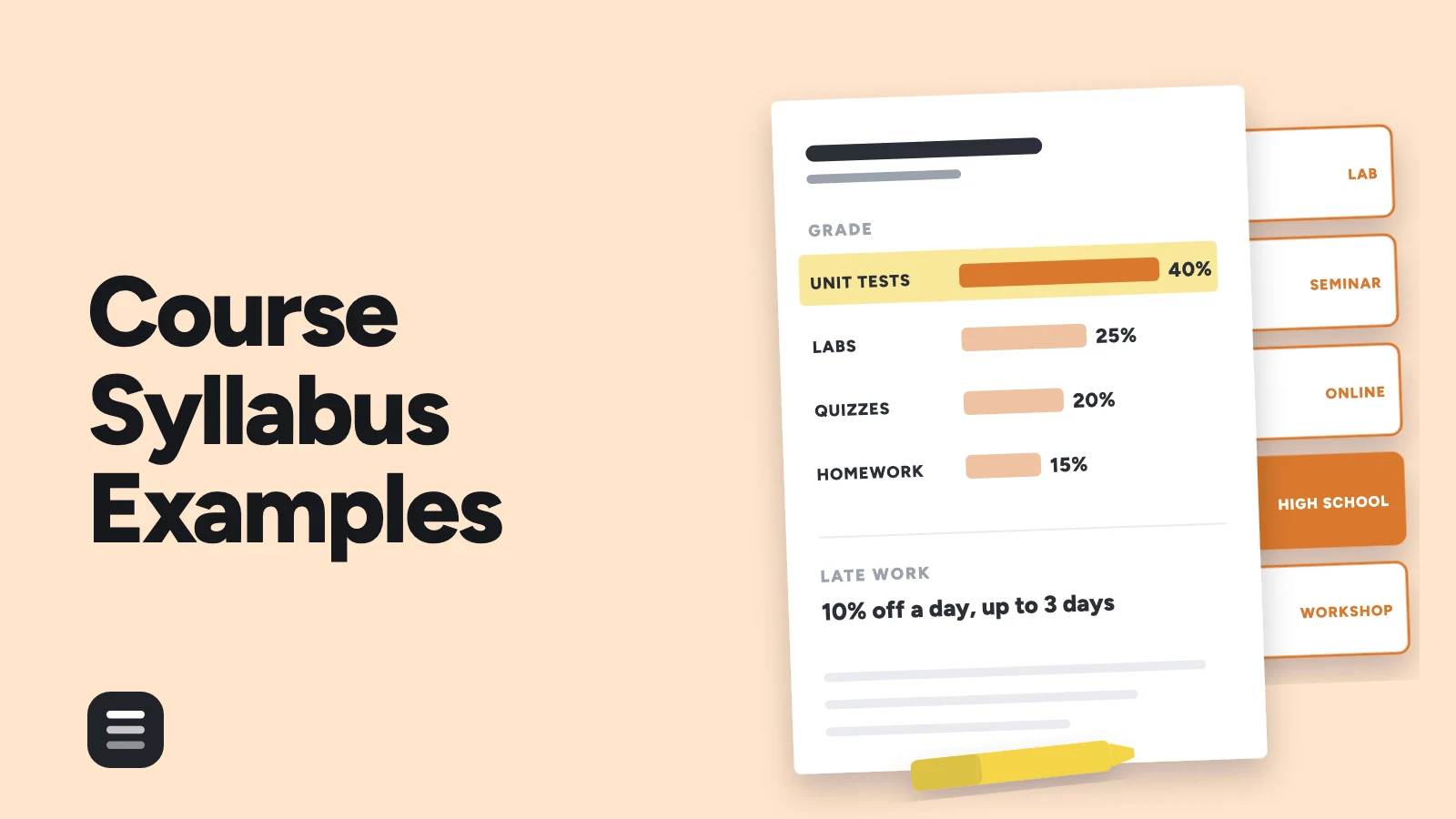
A lab, a graduate seminar, a self-paced online course, a high school AP class and a weekend workshop each need a different syllabus. Our course syllabus examples cover all five, and each one puts the rule your students hunt for near the top. In a lab, the rule is what a late or missing report costs. In a seminar, it's how much of the grade rides on leading a discussion. Online, it's the dates. Start from a free one pager template.
One‑Pager examples
Real One-Pagers made with MakeOnepagers. Open any one to edit it as your own.
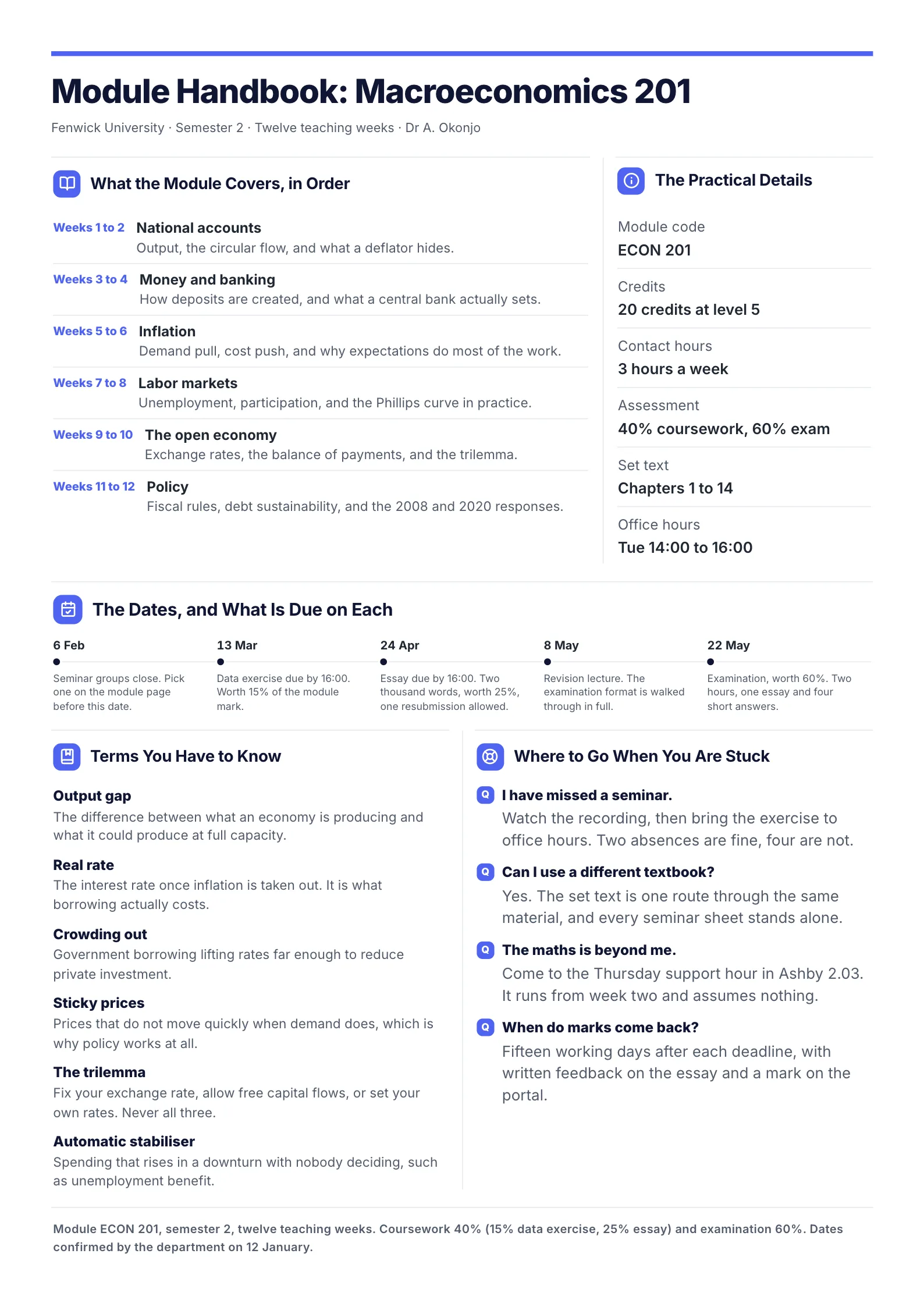 Course SyllabusEdit for free(opens in a new tab)
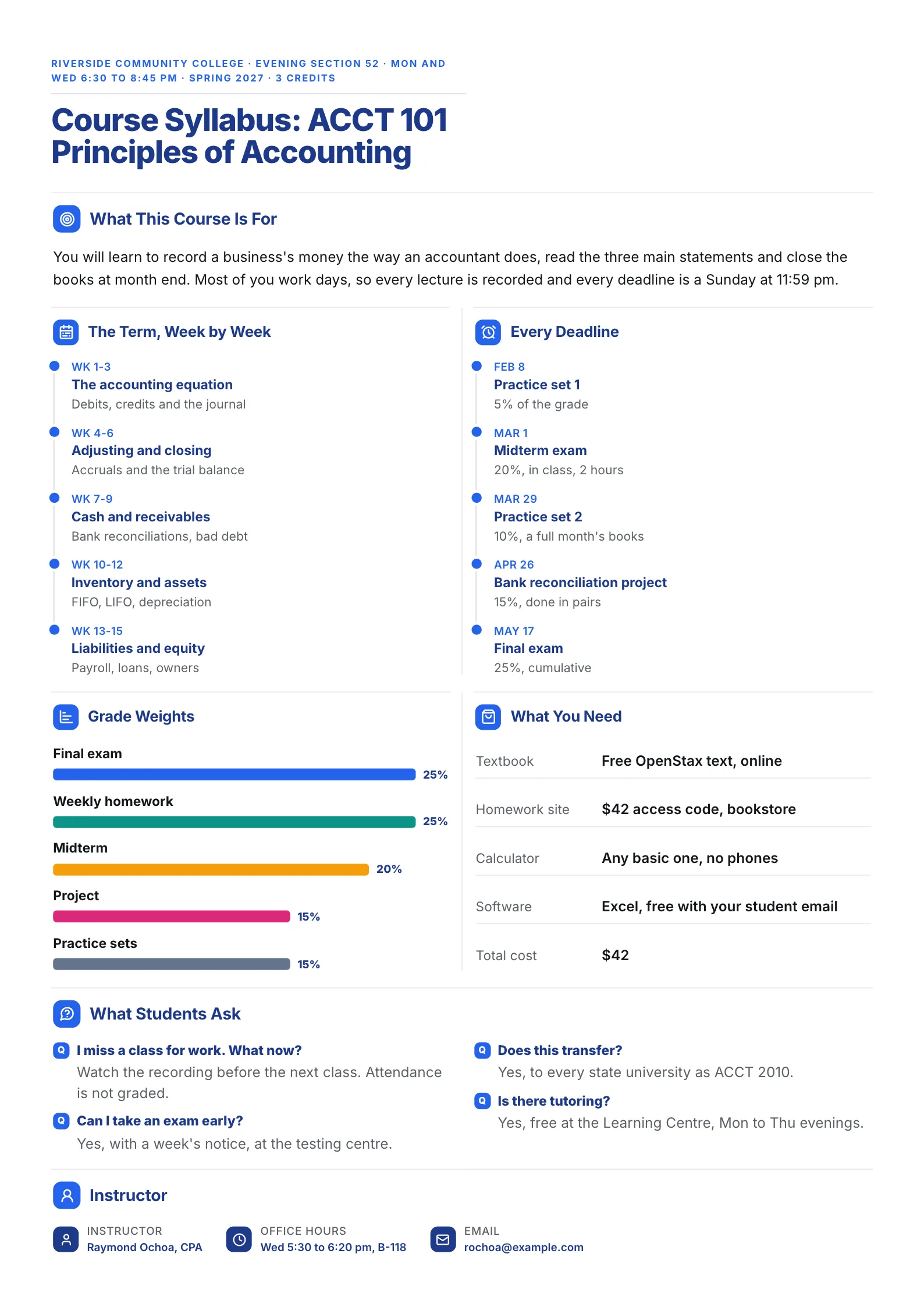 Course Syllabus: Community College AccountingEdit for free(opens in a new tab)
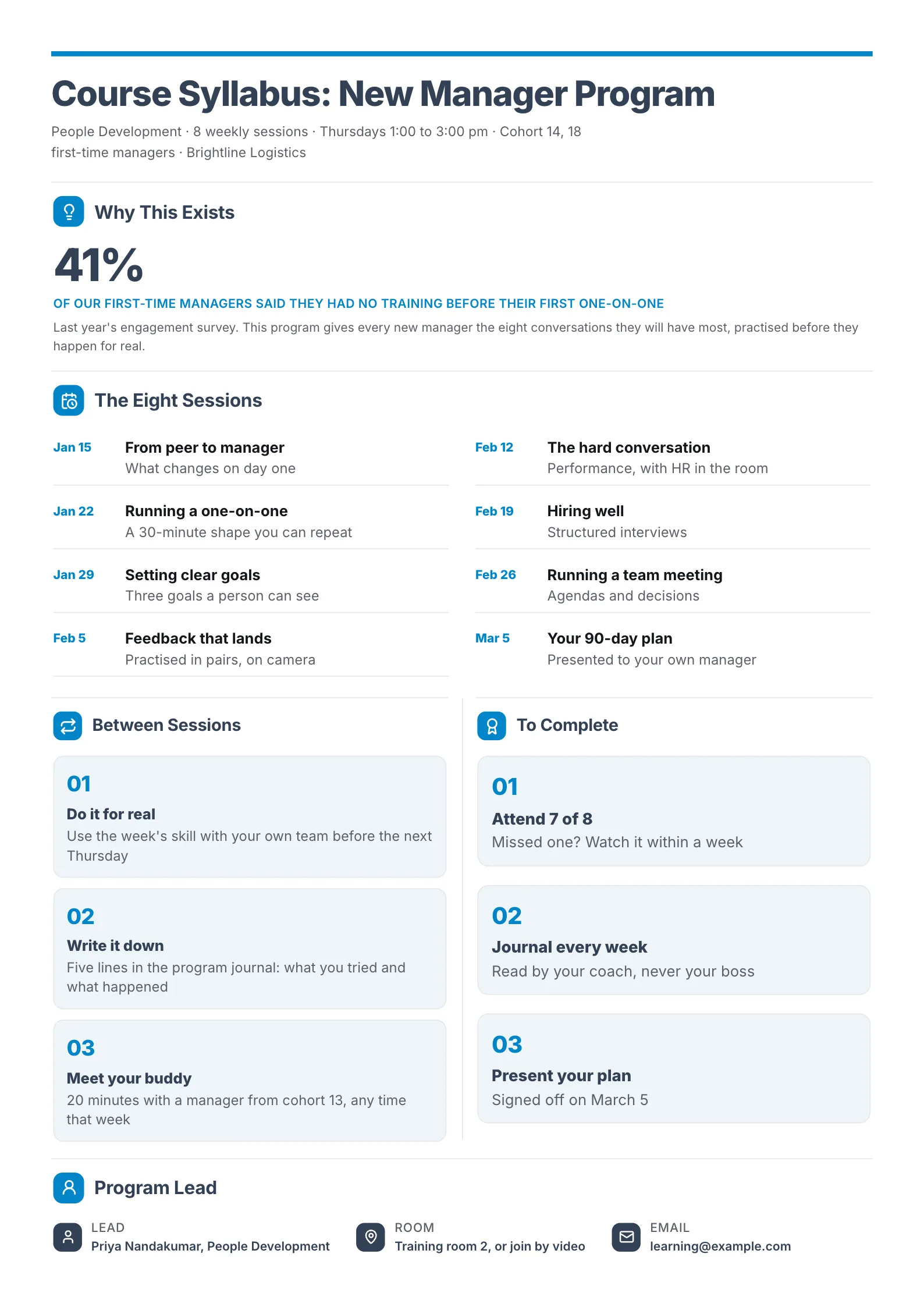 Course Syllabus: Corporate Training ProgramEdit for free(opens in a new tab)
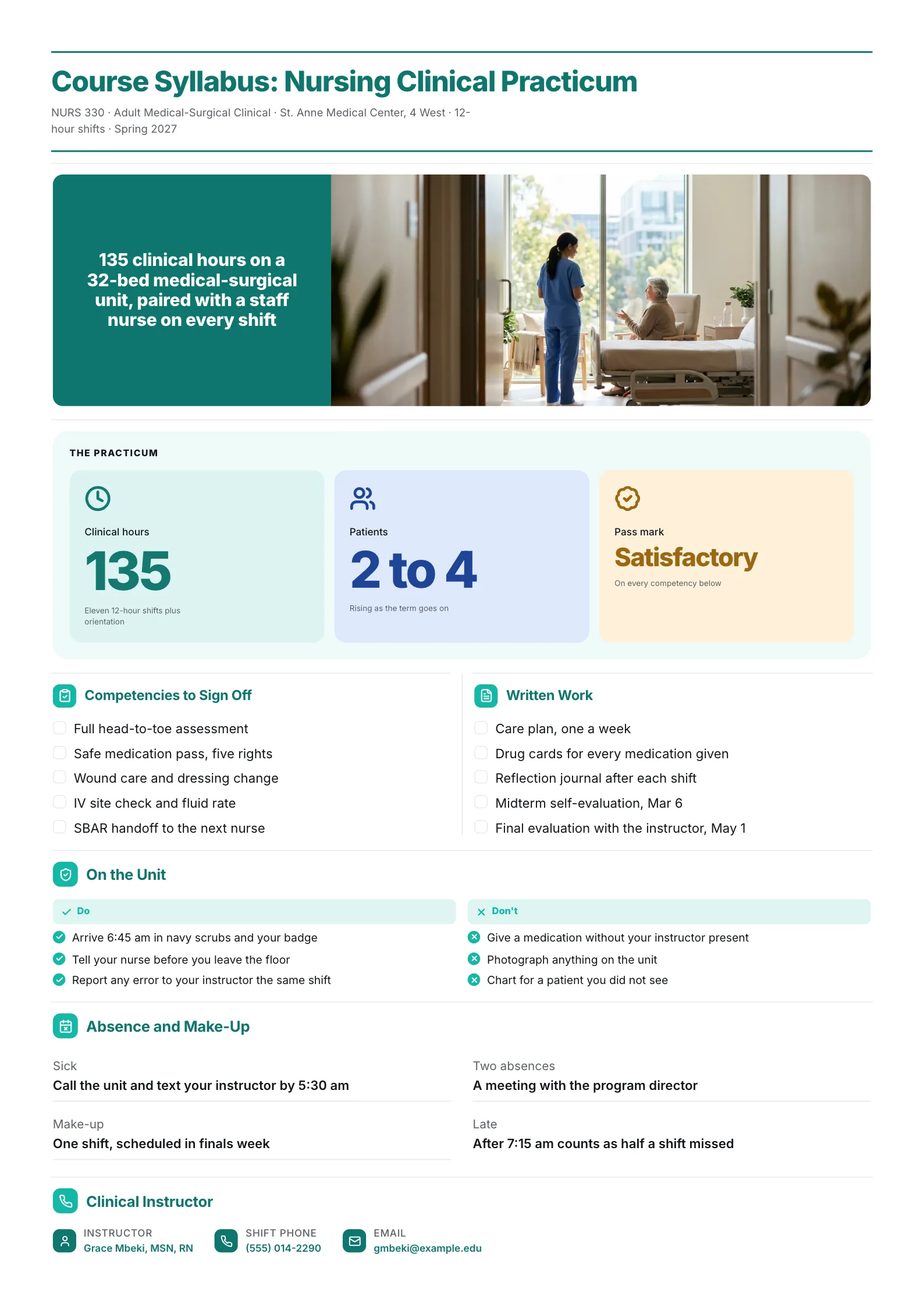 Course Syllabus: Nursing Clinical PracticumEdit for free(opens in a new tab)
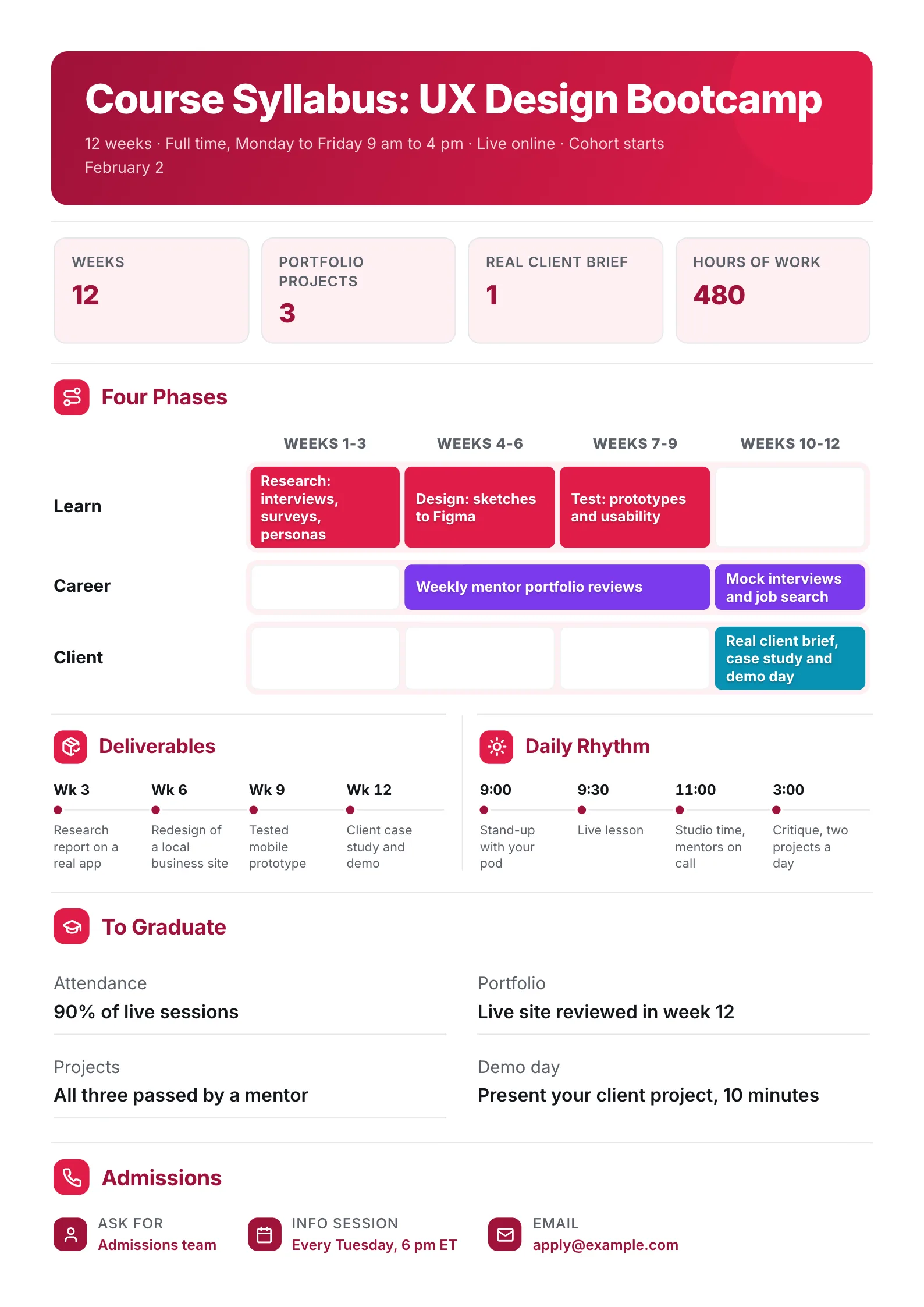 Course Syllabus: Design BootcampEdit for free(opens in a new tab)
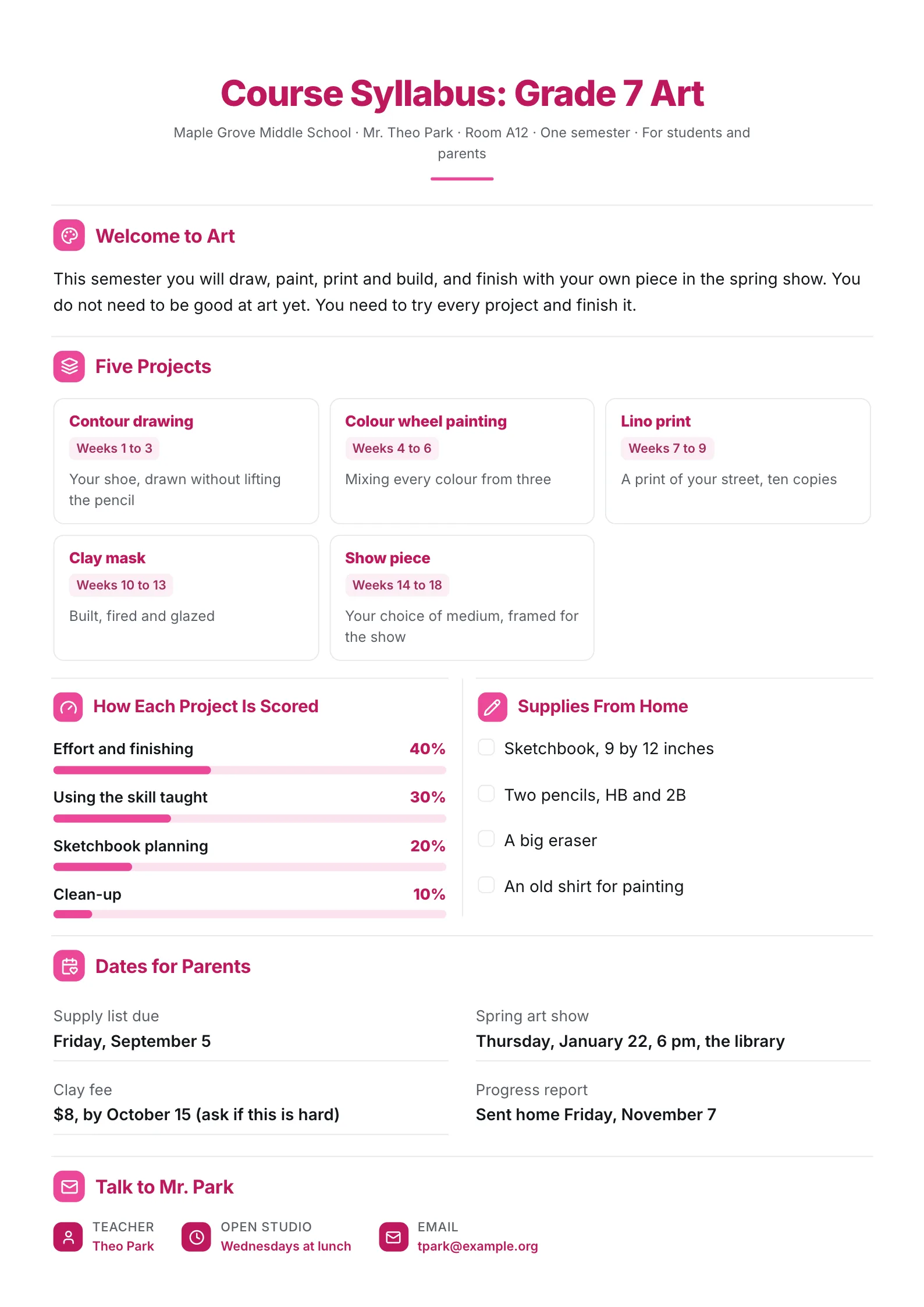 Course Syllabus: Middle School ArtEdit for free(opens in a new tab)
Then we read the syllabus rules of four US universities, and four syllabi real instructors posted, to see whether the rule students hunt for is the one schools require. All four rules ask how the grade is made and name late work. One of the real syllabi skips late work entirely. It's the online one, where your students have no class meeting to ask in.
A lab syllabus: say what a missed report costs
Your lab students want two answers before the first experiment. What happens if my report is late, and what gets me sent home?
 Edit this template
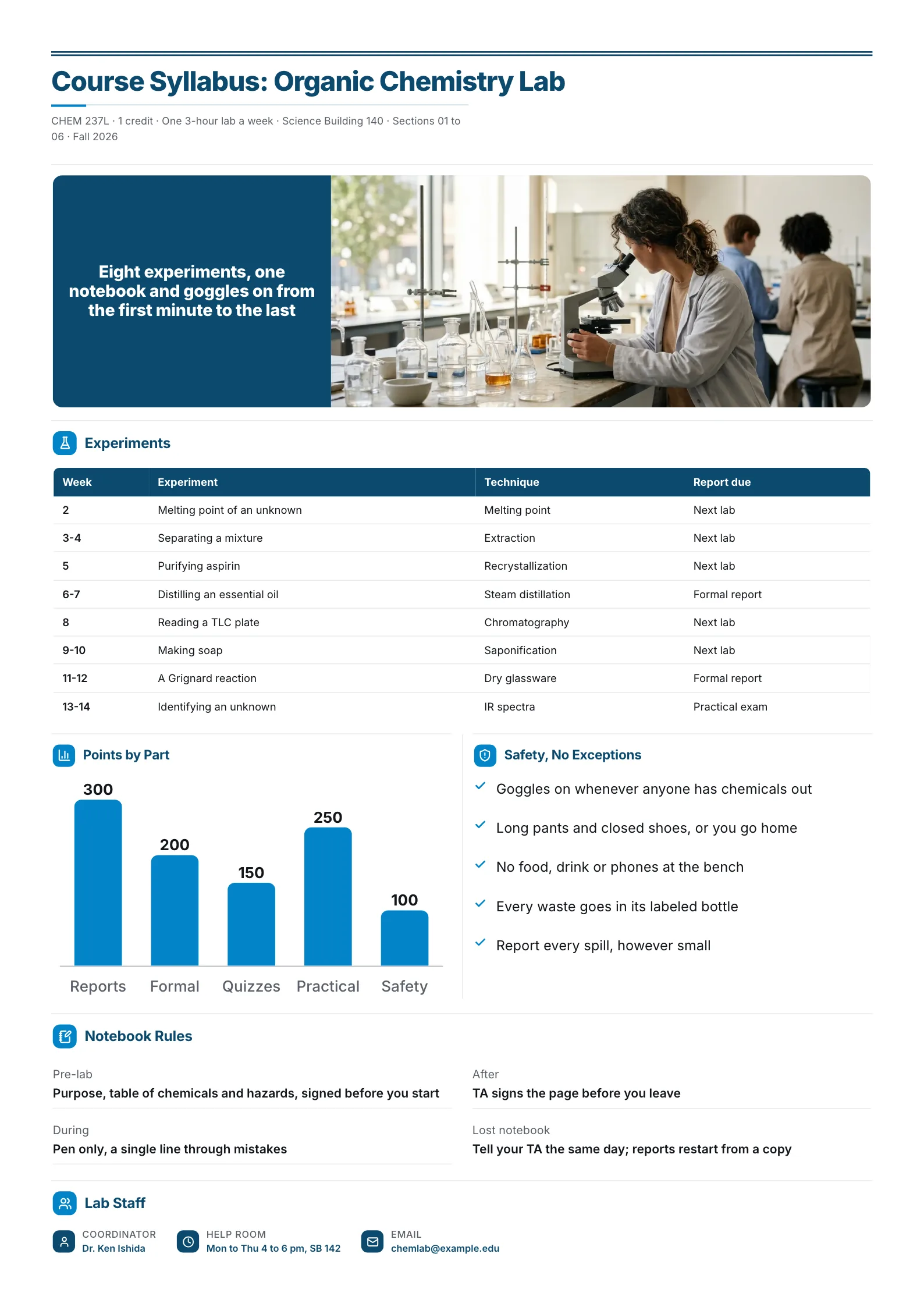
Points by part sit right beside the safety rules, so a student sees that safety carries 100 points before the first lab.
This organic chemistry lab gives safety its own line in the grade, 100 of 1,000 points, next to 300 for reports and 250 for the practical exam. Its notebook rules are just as plain. You use pen only, strike mistakes with a single line, and get the TA's signature before you leave.
The real syllabus we read for a lab is CHEM 272L, Organic Chemistry Laboratory I at the University of Hawaii at Manoa, fall 2024. It answers your late question in one sentence. You can hand in a report up to 3 business days late, at 33% off per business day. Then it states the rule that matters more. Three zeros, from any mix of missed labs and dismissals, and you fail the course. Its grade adds up to 100 points: 30 for quizzes, 60 for reports and prelabs, 10 for the TA's evaluation. Copy that order in your lab syllabus, and a student who reads one short paragraph knows what a late report and a missed lab will cost.
A seminar syllabus: show who leads, and when
In a seminar the reading list is the course, so your students look for two things. Which week do I lead, and how much is that worth?
 Edit this template
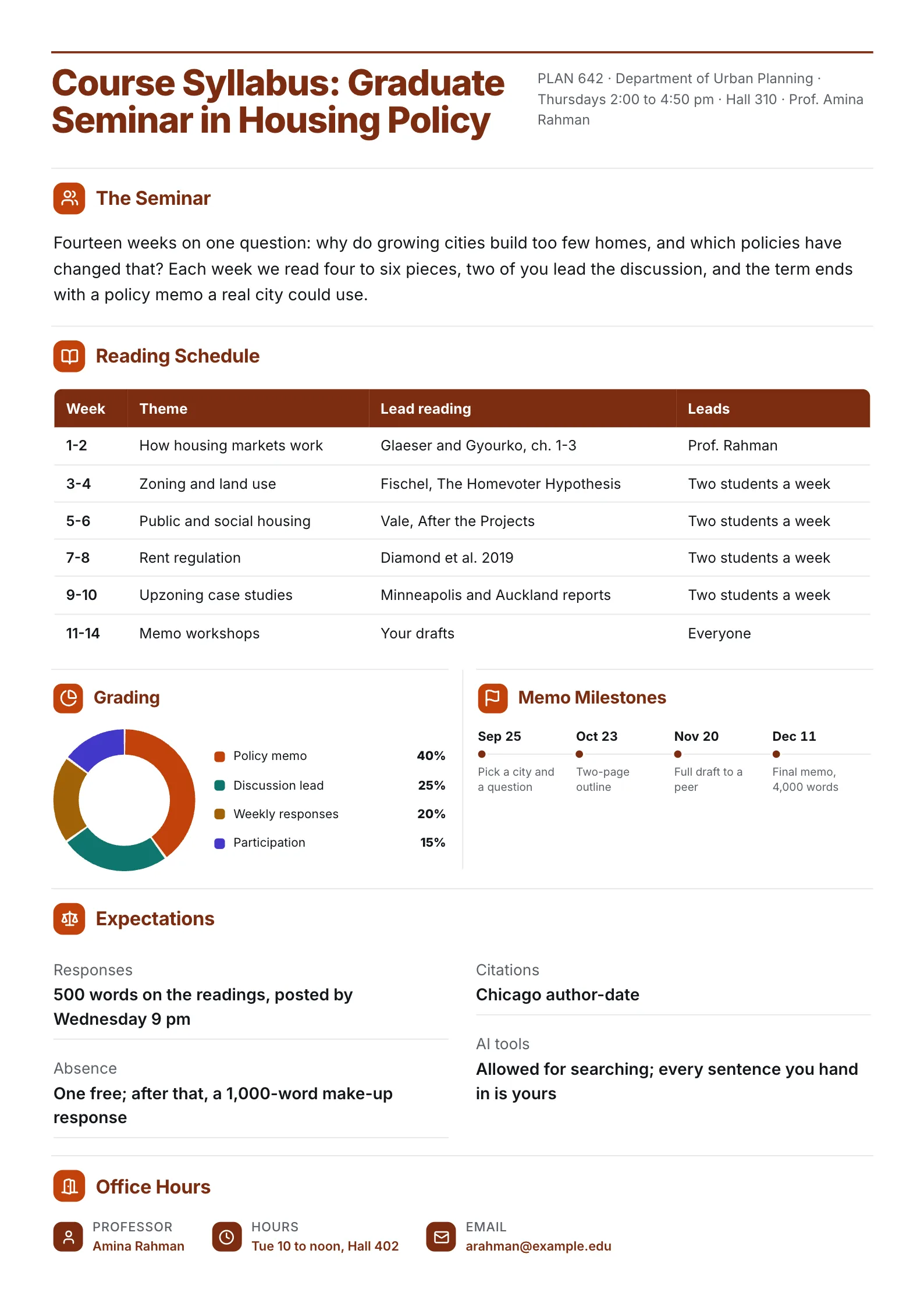
The reading schedule names who leads each pair of weeks, and the memo milestones turn one big paper into four dates.
The housing policy seminar above weights the final memo at 40%, leading discussion at 25%, weekly responses at 20% and participation at 15%. Your responses are 500 words, posted by Wednesday at 9 pm. You get one absence free. After that, each one costs you a 1,000-word make-up response.
The real seminar we read is BIOL 5002, Discussions in Biology, at Midwestern State University in Texas, fall 2026. Your grade there is almost all speaking. Leading discussion is 40%, a seminar presentation is 40%, and participation and attendance are 10% each. There are no exams and no extra credit. You present for 25 minutes on a research article from the last three years, and your classmates get the article a week ahead. Reuse a presentation from another class and the syllabus says you get an automatic F. Midwestern State writes its speaking rules with the care you'd give an exam policy.
An online course syllabus: make every date match
Nobody can raise a hand in an asynchronous course. Your syllabus is the only answer to "when is this due?", so every date in it has to agree.
 Edit this template
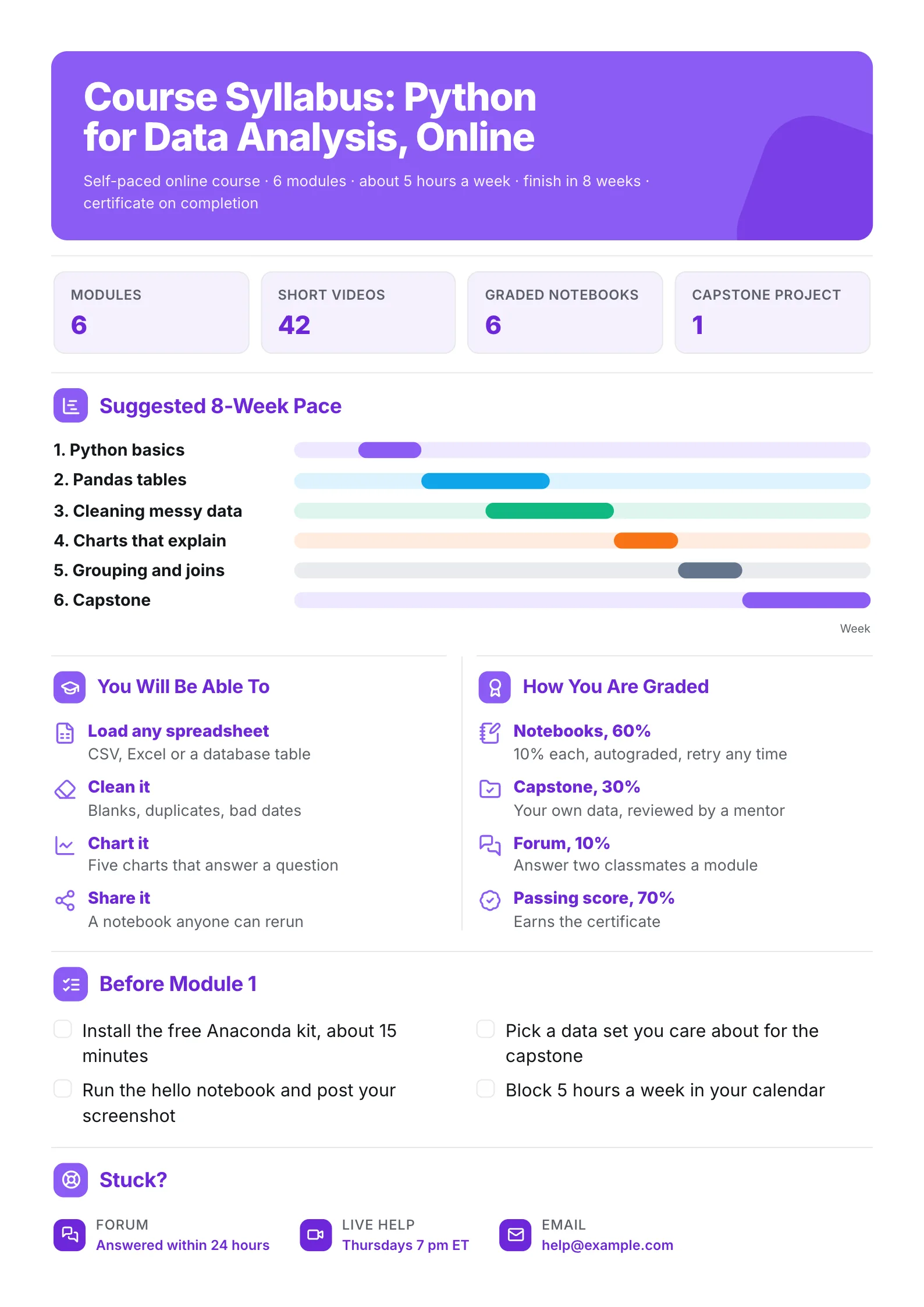
A suggested pace chart gives a self-paced learner a week-by-week plan, and the help box says forum questions are answered within 24 hours.
This self-paced Python course spells out how your grade works. Six notebooks are worth 10% each, autograded, and you can retry any time. The capstone is 30%, reviewed by a mentor, and the forum is 10%. A 70% earns the certificate.
The real online syllabus we read shows why dates matter. ACCA 5301, Accounting Basics, at Sul Ross State University, ran fall 2025 as online asynchronous. Its grade table is clear: 1,000 points, with 350 for weekly discussion posts, three assignments at 150 each and a 200-point final essay exam. But the table lists Assignment 2 as due Sept. 21, 2025, while the schedule on the last page says September 22, 2024. And there's no late-work rule anywhere in the document.
Before you post an online syllabus, read every date in it against every other date. Then add one line on late work, since all four rules below name it, and Sacramento State gives it a line of its own.
A high school syllabus: write the late rule for parents too
Your high school syllabus has two readers, the student and the parent who signs it. Both want the grade categories and the late rule in plain numbers.
 Edit this template
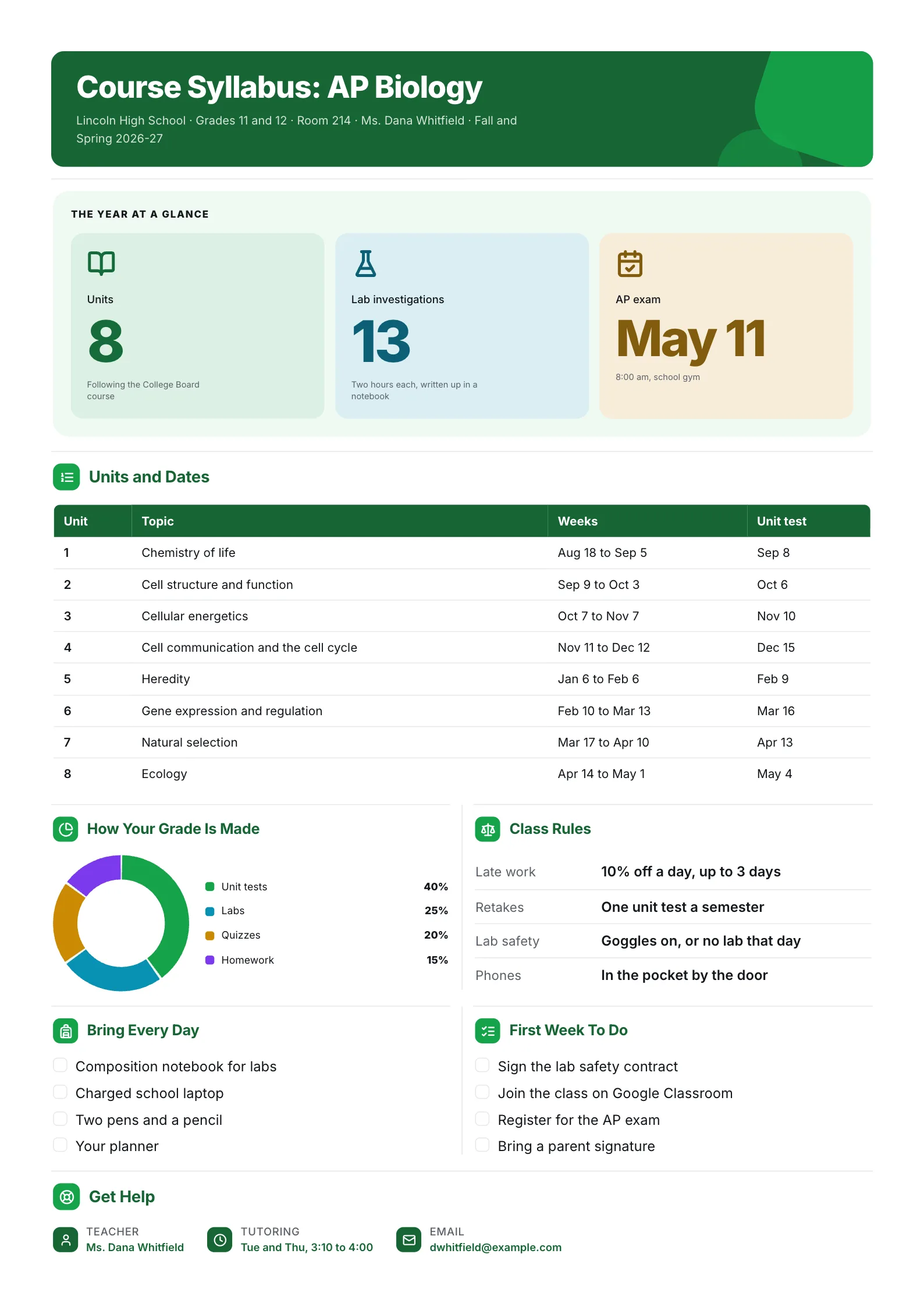
The class rules box answers late work, retakes and phones in four short lines a parent can read at the kitchen table.
The AP Biology page above puts unit tests at 40%, labs at 25%, quizzes at 20% and homework at 15%. Late work loses 10% a day, for up to 3 days, and a student gets one unit test retake a semester. The AP exam date, May 11, sits in the first row of tiles.
The real one we read is the 2025-2026 AP Biology course sheet from Los Altos High School in California. Its weights are 40% tests, 30% labs and activities, 20% homework and classwork, and 10% for the final. The late rule is strict and specific. Homework and classwork are never accepted late. Labs are accepted up to 48 hours late, at 80% of the points earned within 24 hours and 60% after that. A test-correction system called Correct to Learn lets students earn back 40% of the points on missed multiple-choice items, when the teacher offers it, within three weeks of getting the test back. Put your late rule in numbers like these, percentages and hours, so nobody has to email you to ask what "late" means.
A workshop syllabus: put the pass rule and the refund on one page
Your short course for adults gets read once, usually the night before. People want the hours, the cost and what it takes to pass.
 Edit this template
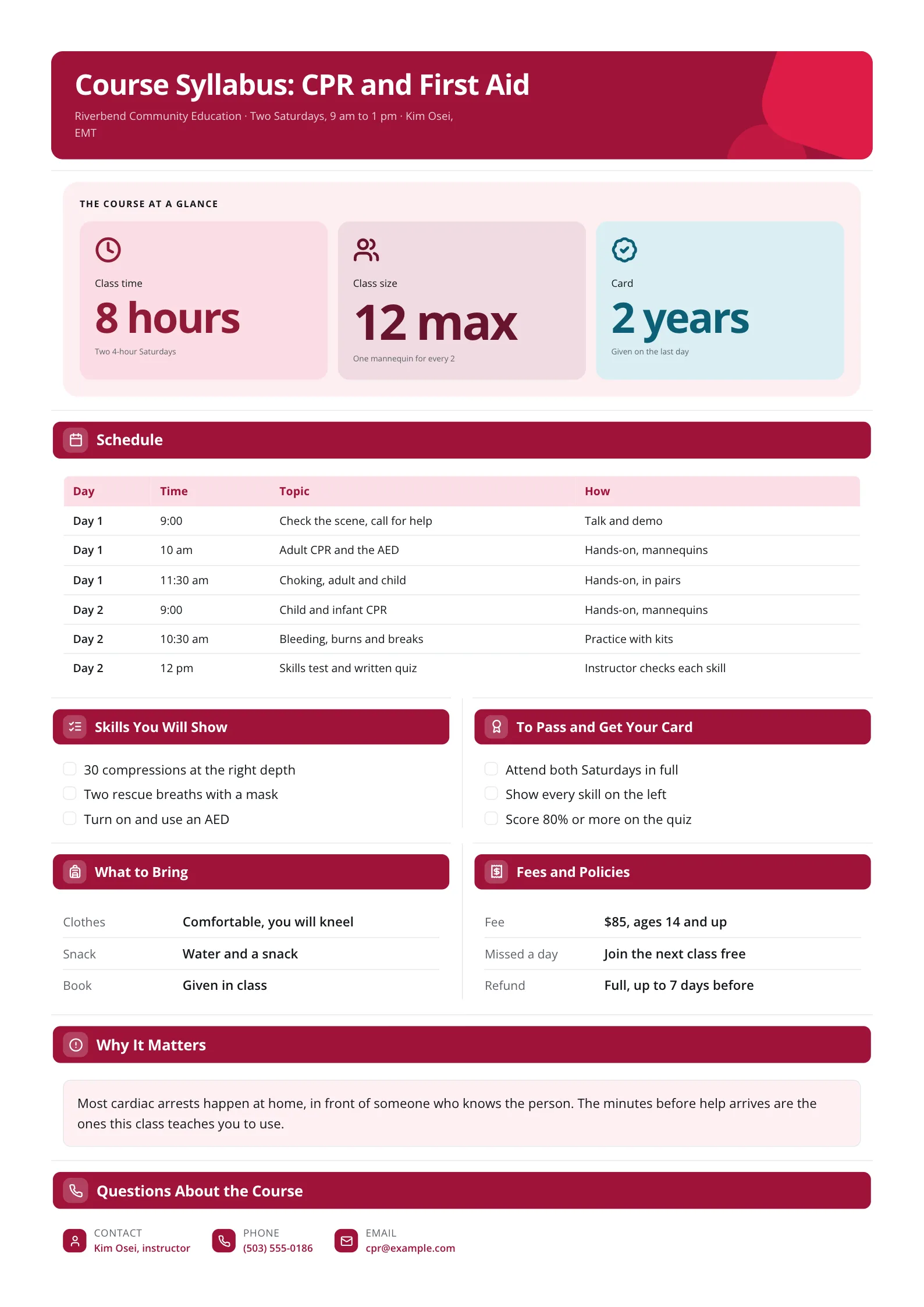
Nobody pays the $85 without first reading what it takes to pass and when the money comes back.
This CPR and First Aid workshop fits in 8 hours over two Saturdays, with 12 students at most and one mannequin for every two. To pass, you attend both days in full, show every skill and score 80% or more on the quiz. The fee is $85, ages 14 and up. Miss a day and you join the next class free. Refunds are full up to 7 days before.
We didn't read an outside workshop syllabus for this one. The university rules below are written for credit courses (CSU Channel Islands' policy applies to "every credit-bearing course"), so treat these lines as your checklist of what an adult learner asks.
What 4 university syllabus rules require
Your university may set a minimum list for every syllabus. We read four of these rules, current as of October 30, 2026.
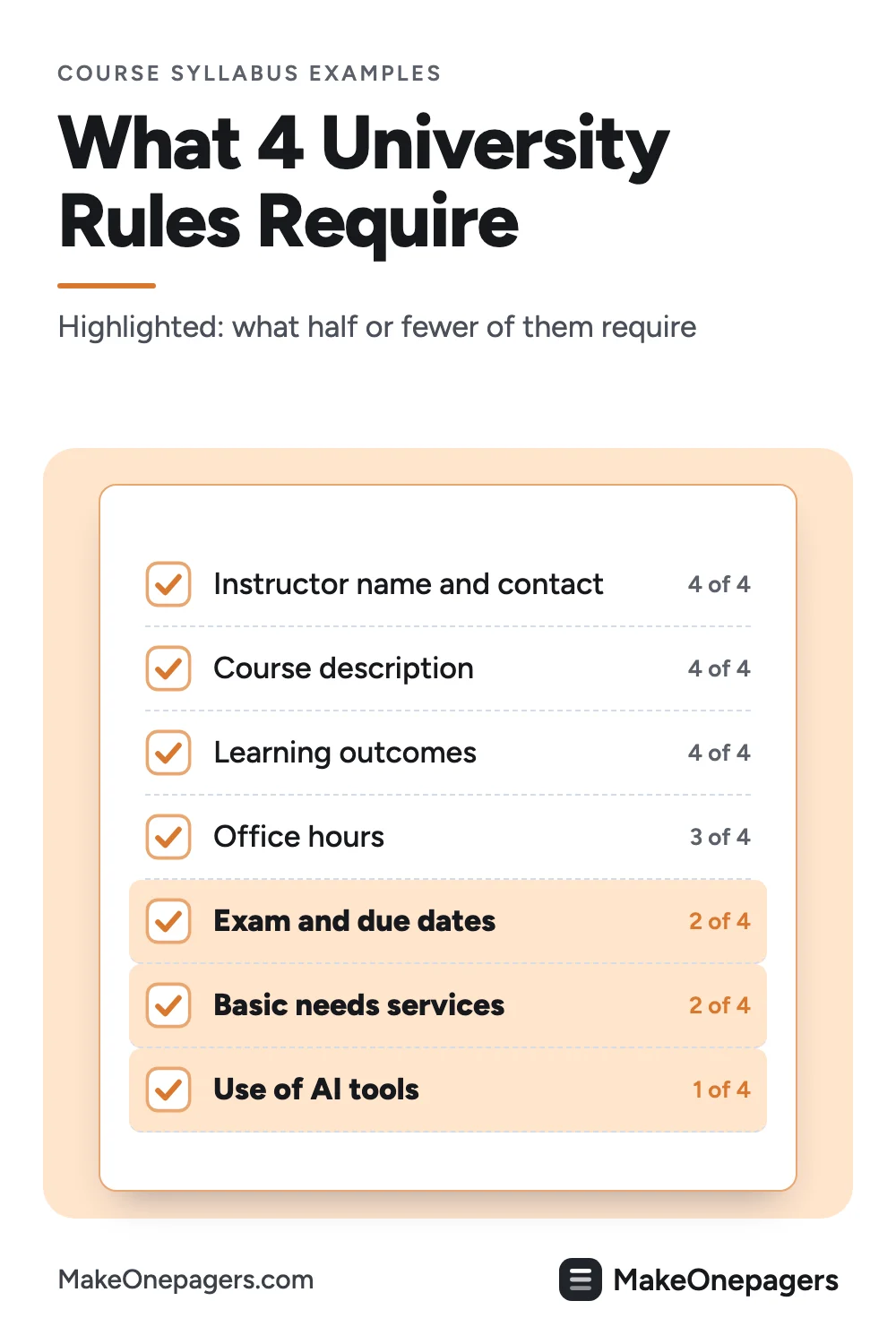
| Required in the syllabus | CSU Channel Islands | Sacramento State | Michigan Tech | George Mason |
|---|---|---|---|---|
| Instructor name and contact | Yes | Yes | Yes | Yes |
| Office hours | Yes | Yes | Yes | No |
| Meeting time and modality | Yes | Yes | No | Yes |
| Course description | Yes | Yes | Yes | Yes |
| Learning outcomes | Yes | Yes | Yes | Yes |
| Exam and due dates | Yes | No | Yes | No |
| Required materials and costs | Yes | Yes | Yes | No |
| Grade weights | Yes | Yes | Named as an example | Yes |
| Late work | Named as an example | Yes | Named as an example | Named as an example |
| Use of AI tools | Named as an example | No | No | Yes |
| Attendance | Yes | Yes | Named as an example | No |
| Academic integrity | Yes | Yes | Yes | Left to a policy addendum |
| Disability access | Yes | Yes | Yes | Left to a policy addendum |
| Basic needs or wellness services | Yes | Yes | No | No |
Source: our read of each policy, October 30, 2026. "Named as an example" means the policy lists it inside a wider required item, such as "specific course policies (e.g., use of AI, automatic drop, late work...)."
A few details stand out once you read them side by side.
- All four ask how the grade is made, and three name the weights outright. Each also wants your contact details, the course description and learning outcomes. George Mason asks for both a grade schema (what counts as an A or a B) and the weights.
- George Mason is the only one that requires an AI statement, "with as much specificity as possible." CSU Channel Islands lists AI use as an example of a course policy.
- Sacramento State wants the late rule written out, as "penalties or allowances for late assignments, if any." It also says your syllabus has to reach students on or by the first day of instruction.
- CSU Channel Islands has the longest list, 17 lettered items, three of them statements copied word for word from campus offices. Its deadline is the end of the first week of classes.
- Michigan Tech's rule dates from 2008, revised in 2012, and it asks for "Projected Due Dates" alongside the exam schedule.
Your own school may have a rule like these. Search your faculty senate site for "syllabus policy" before you build yours.
What instructors ask about syllabi
Where can I find real syllabus examples from my field?
Many universities post them publicly. Texas has required its public universities to put undergraduate course syllabi online since fall 2010, under House Bill 2504, so Texas schools are a good place to look. Search a course name plus "syllabus pdf" and the current year, then check that the term is recent.
Should a syllabus fit on one page?
Your full syllabus usually can't, since universities require statements on disability access, integrity and more. The page that fits is the one you read from on day one, with the grade, the late rule and the dates. Make it in MakeOnepagers and link the full document from it. Every required section is in our guide on how to write a syllabus, and the course syllabus template post has a single starting page for the short one.
What should go at the top of a syllabus?
The grade breakdown, since all four university rules we read ask for it, and the late rule, which all four name. Put both where a student sees them without turning the page.
Do I need an AI policy in my syllabus?
At George Mason, yes. Even where it isn't required, one sentence on what students may and may not do with AI tools saves a long email thread in week 3.
Read the grade and the late rule out loud on day one
On the first day of class, read two lines of your syllabus out loud: how the grade is made and what happens to late work. All four university rules name both. The online syllabus we read left the late one out entirely, and its students had no classroom to ask in. Once you've said both lines in the room, nobody can tell you in week 9 that they never saw them.
Hand out the one-page version the moment you finish reading, with those two lines in the largest type on the sheet.




