How to Write a Syllabus: What 53 MIT Course Syllabi Include
How to write a syllabus, from 53 MIT course syllabi taught 2024 to 2026: what nearly all include, what few do, and the grading, late work and AI rules to add.

Here's how to write a syllabus: start with the course basics and what students need before they join, then say what they will be able to do by the end. Name the texts, and show how the grade adds up. Then add your rules for late work and AI tools, the dated schedule, and where to get help. To see which of those parts real instructors write down, we read the syllabus pages of 53 MIT courses taught from 2024 to 2026. Start from a free one pager template.
One‑Pager examples
Real One-Pagers made with MakeOnepagers. Open any one to edit it as your own.
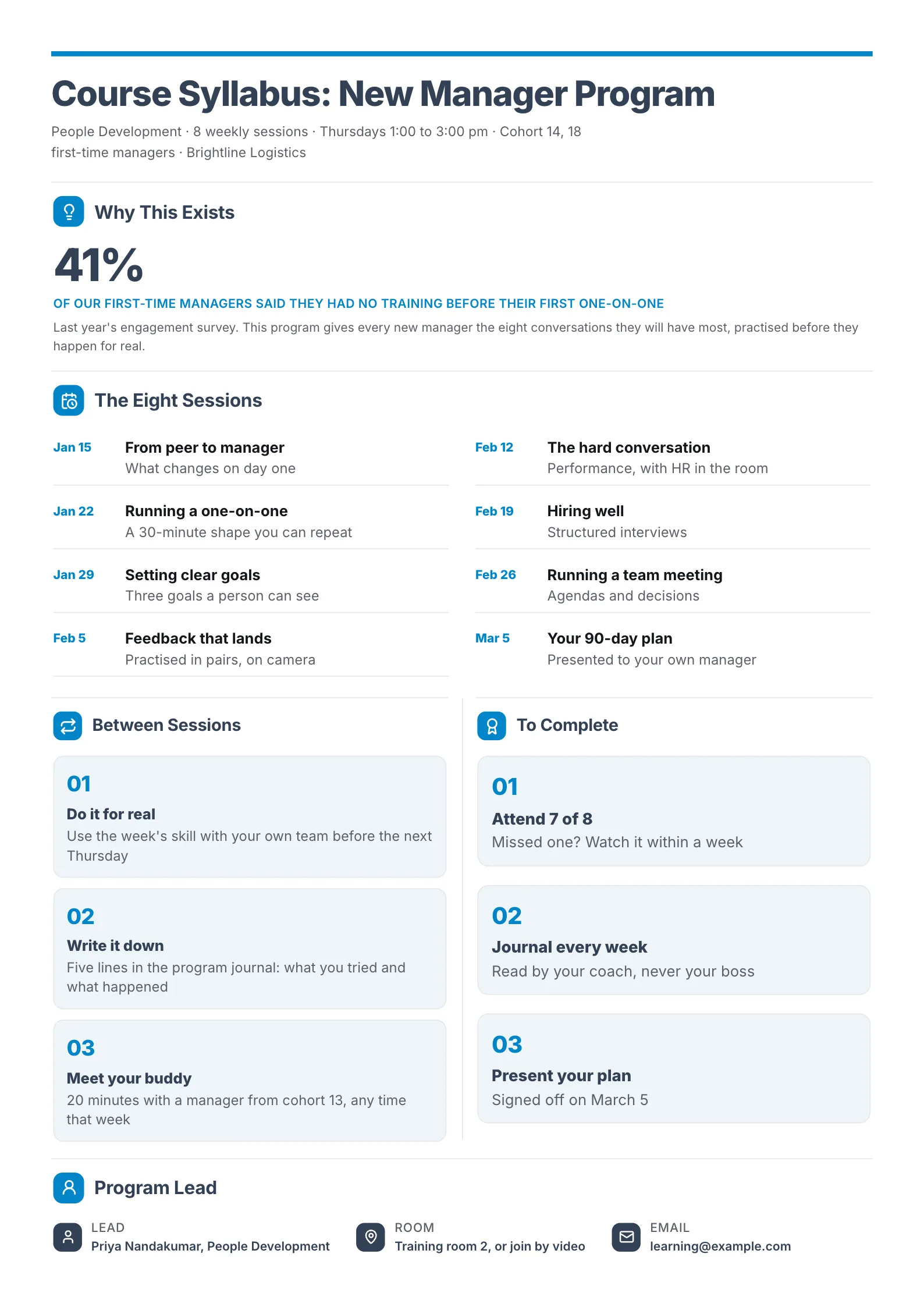 Course Syllabus: Corporate Training ProgramEdit for free(opens in a new tab)
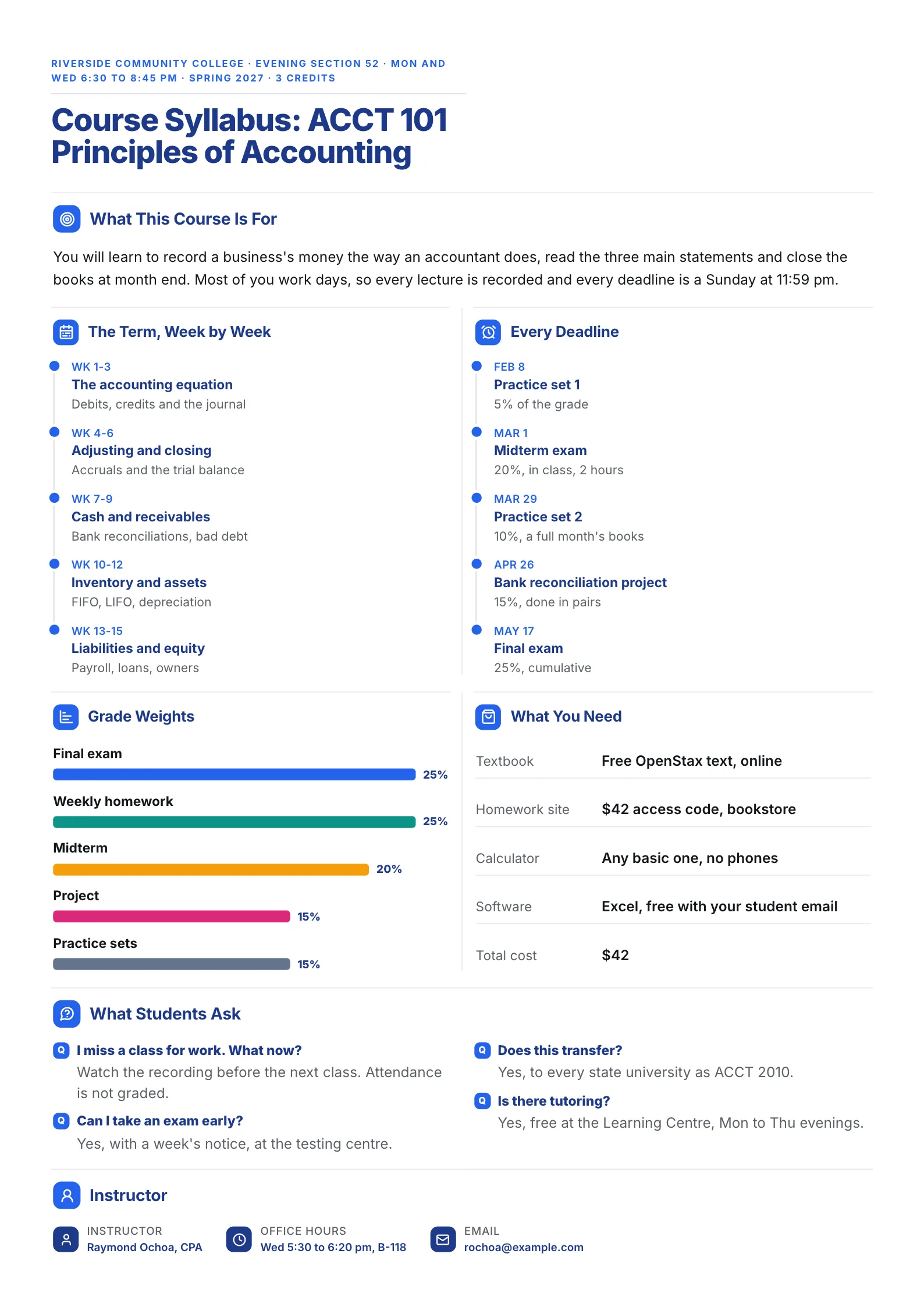 Course Syllabus: Community College AccountingEdit for free(opens in a new tab)
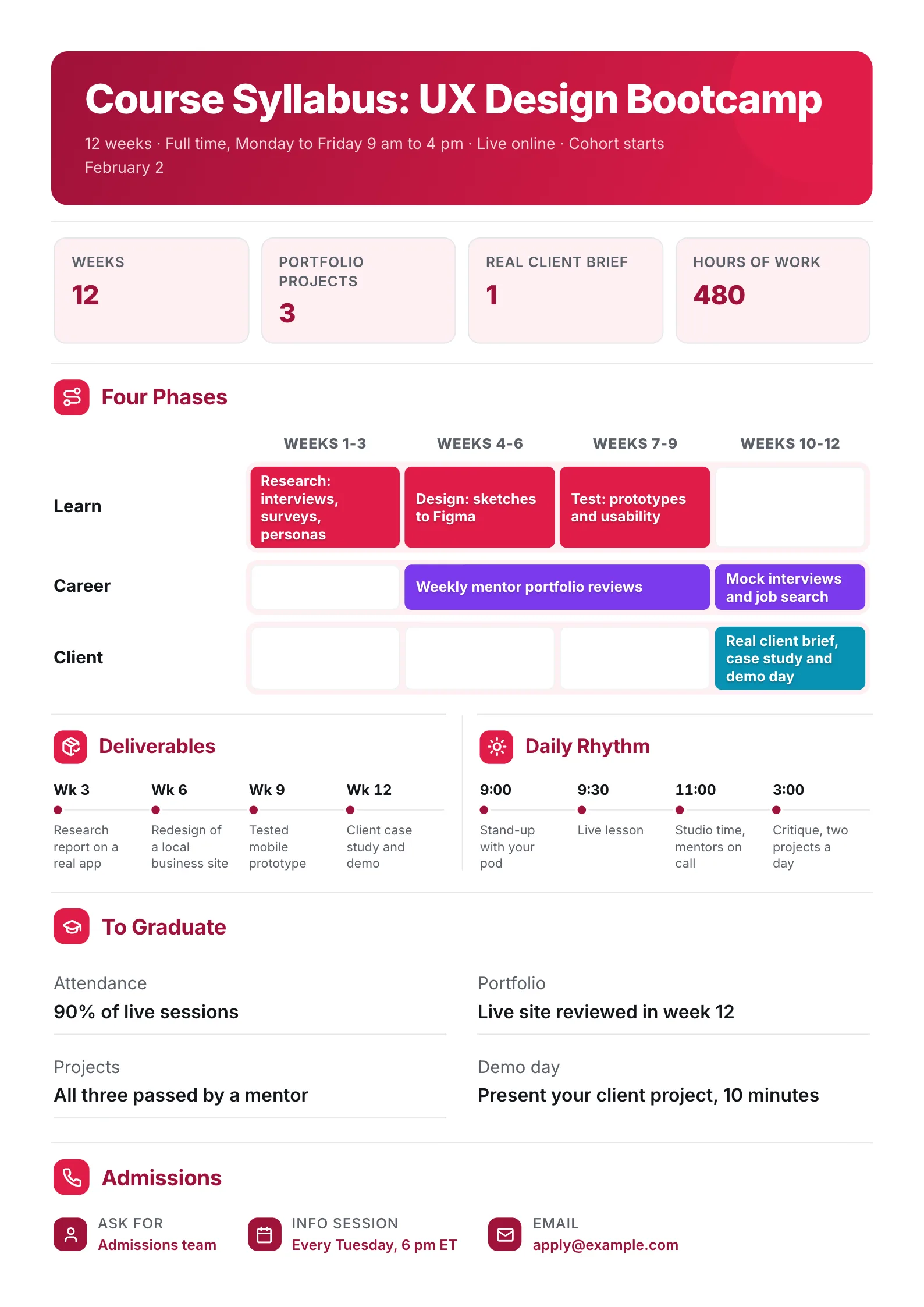 Course Syllabus: Design BootcampEdit for free(opens in a new tab)
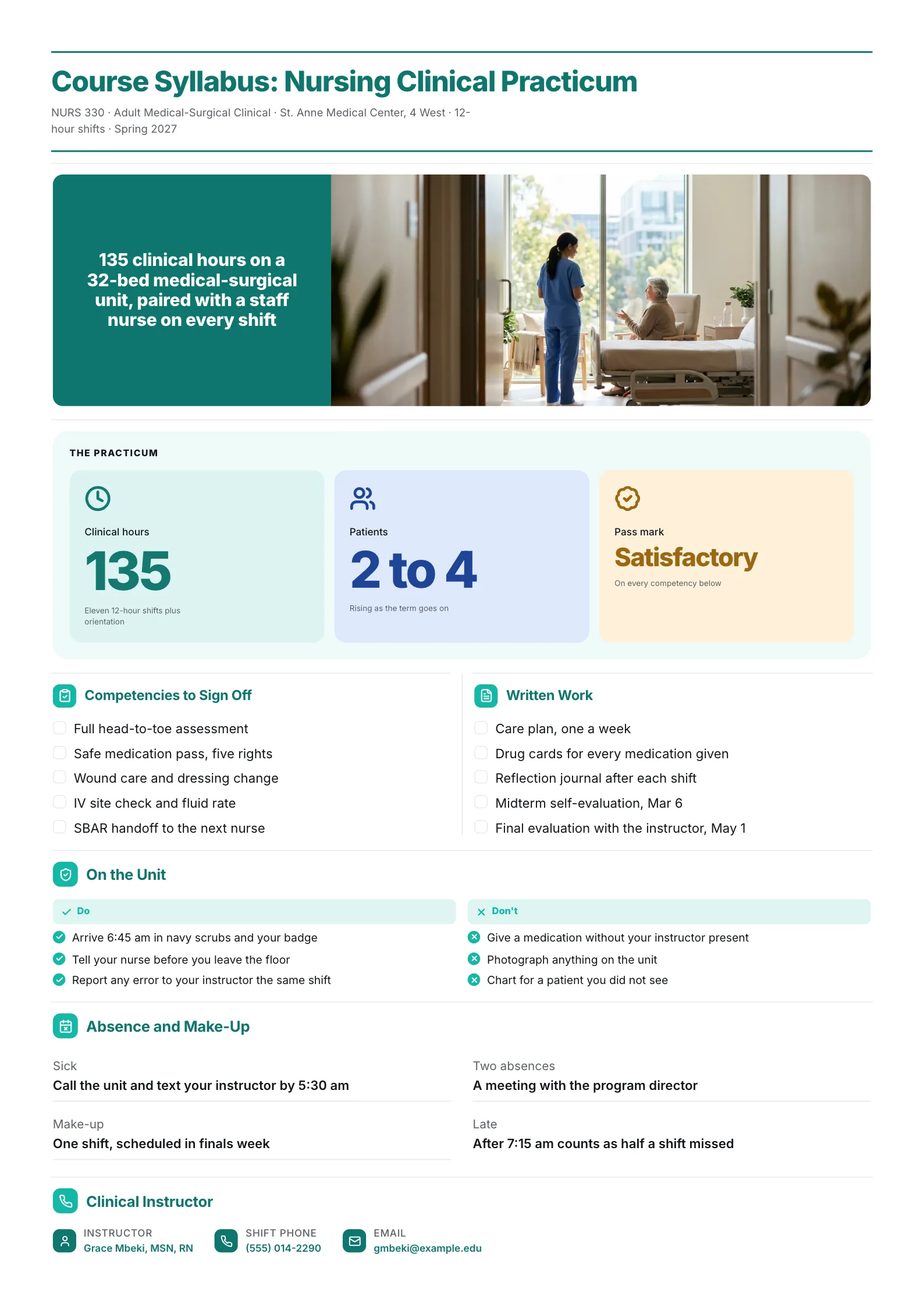 Course Syllabus: Nursing Clinical PracticumEdit for free(opens in a new tab)
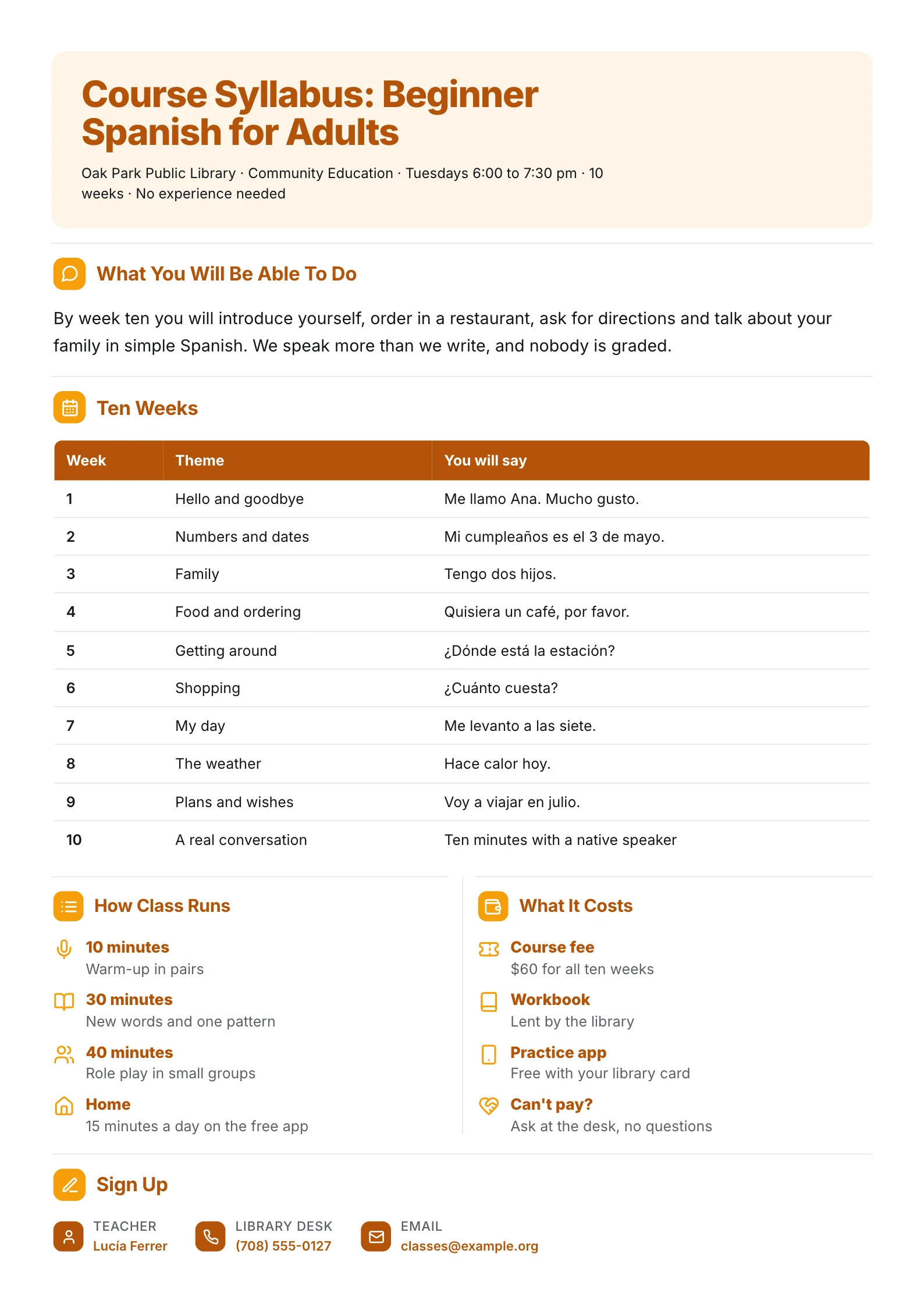 Course Syllabus: Adult Education Language ClassEdit for free(opens in a new tab)
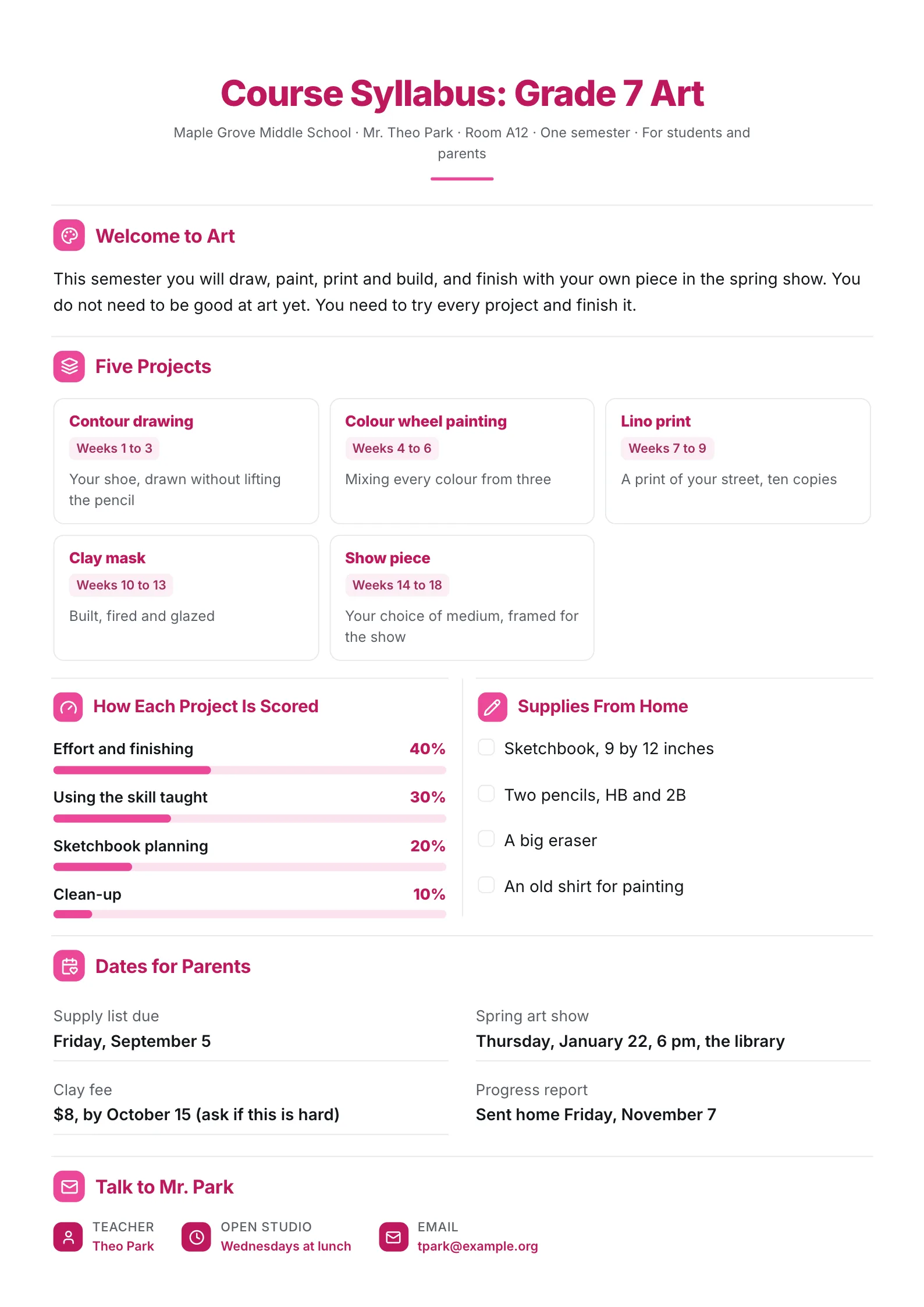 Course Syllabus: Middle School ArtEdit for free(opens in a new tab)
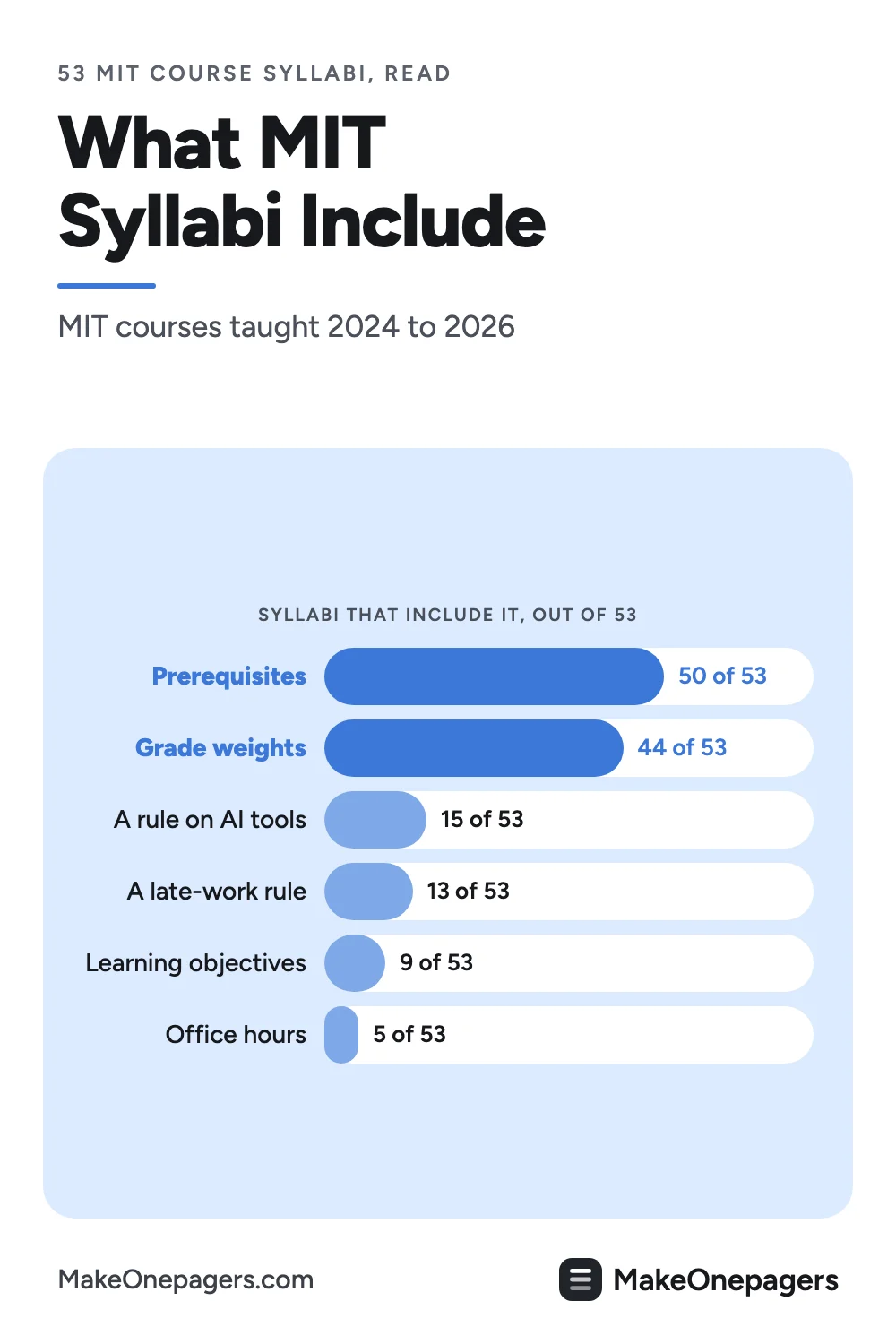
Almost every one names its prerequisites, and most show the grade as percentages. Far fewer answer the questions students ask in week one. Can I hand this in a day late? Can I use ChatGPT? What will I be able to do when this is over? You'll find the counts below, then nine steps, a way to get your students to read the thing, and five examples you can edit.
What a syllabus is for
A syllabus is the first document your students read and the one they come back to all term. MIT's Teaching + Learning Lab notes in its syllabus guide that it "is often perceived as a 'contract' between students and the instructor." Washington University's Center for Teaching and Learning, in its guide to constructing a syllabus, says it works as a "promise" as much as a contract.
Both ideas lead to the same test. When a student has a question about your course, can they find the answer on the syllabus without emailing you? WashU marks seven parts as required for that reason: basic course information, a course description, learning objectives, texts and materials, the schedule, grading and required policies.
What we found in 53 MIT course syllabi
MIT OpenCourseWare publishes the materials of real MIT courses. On October 26, 2026, we took every course in OCW's sitemap taught in 2024, 2025 or 2026. That gave us 90 courses. 55 had a page at the usual syllabus address. Two of those were resource collections rather than courses, which left 53 course syllabi from economics, math, engineering, history, music, linguistics, writing and more.
We read each syllabus page by hand and counted what it includes:
| What the syllabus includes | Syllabi | Share |
|---|---|---|
| Prerequisites (18 of them say there are none) | 50 of 53 | 94% |
| Grade weights as percentages | 44 of 53 | 83% |
| A heading for readings, textbooks or materials | 31 of 53 | 58% |
| A rule on AI tools | 15 of 53 | 28% |
| A rule on late work | 13 of 53 | 25% |
| Learning objectives or outcomes | 9 of 53 | 17% |
| Office hours | 5 of 53 | 9% |
| Disability accommodations | 4 of 53 | 8% |
Here's how we counted the edge cases, so you can check us. A syllabus counts for grade weights when it gives the share of each graded part in percent, in a table or a sentence ("Sixty percent of your grade" counts). Three edge cases don't count: 14.661 grades in points, 24.906J in thirds, and 21W.735 gives only participation, at "about 20%." A late-work rule counts when it says what happens to work handed in late: a penalty, a set of late days, or no late work at all. 14.03 counts, because it grants no extensions. A general line about deadlines, like 14.05's "do not expect any other leniency," doesn't. An AI rule counts when it says what students may or may not do with AI tools, even inside a plagiarism or collaboration policy, as in WGS.110J and 6.1200J. 22.04J only says its homework helps you write better without AI chatbots (LLMs), so it doesn't count. Learning objectives means a section with that name or "outcomes." A single "you will be able to" sentence with no section doesn't count. Four more courses have a "Goals" section instead, and we left those out. "None" for prerequisites includes 18.200 and ES.1803, which say none and then name a course to take at the same time.
The syllabi run from 134 to 1,807 words, and the median is 586. We counted words in each page's main text, without OCW's menus. OCW also gives meeting times their own heading: 46 of the 53 use the exact words "Course Meeting Times," and 3 more use a similar heading, and many courses keep their calendar and readings on separate pages. So we only counted what sits on each syllabus page, and a low count for office hours may partly reflect what OCW leaves out.
How to write a syllabus in 9 steps
1. Put the course basics at the top
Write the course name and number, the term, the meeting days and times, the room or link, and your name and email. One line or a small table is enough.
2. Say what the course is and who it's for
Write two or three sentences on what the course covers and why it matters to your students. Then list the prerequisites. 50 of the 53 MIT syllabi name them, and 18 of those say plainly that there are none. 22.01 says it has none and adds when students usually take it. If none is true for you, write it, so nobody has to ask.
3. Write 4 to 6 learning objectives
WashU suggests "typically 4-6" objectives, written around the student. Only 9 of the 53 MIT syllabi list them. Start each one with a verb you could check, such as explain, build, compare or analyze. Three of those 9 lead in with a version of "by the end of the course, you will be able to."
4. Name the texts and materials
WashU marks texts, materials and supplies as required, with the title, author, edition and where to get each one. 31 of the 53 MIT syllabi have a heading for readings, textbooks or materials. 6.1200J names its one textbook, its three authors and a free PDF. If there's nothing to buy, say that too.
5. Show how the grade adds up
44 of the 53 give grade weights as percentages, which makes them easy to scan. 14.12 Economic Applications of Game Theory lists quizzes 20%, midterm 30% and final 50%. 18.100B Real Analysis gives problem sets 50%, the midterm 20% and the final 30%.
Points work too, as long as you state the total. 14.661 Labor Economics gives 100 regular points, plus 5 for participation. Whichever you pick, add the parts up before you print.
6. Set one rule for late work
Only 13 of the 53 have one, and they range widely. In 22.01, a third of an assignment's value is deducted for each calendar day late. 6.7220J gives you seven late days for the term, "no questions asked." 14.41 accepts no late problem sets at all and counts only your best 5 of 6. Pick the one that fits your course and write it in one or two sentences.
7. Write a rule for AI tools
15 of the 53 syllabi set a rule on AI, and they split three ways. Six allow it, five forbid it and four do something else.
- Allowed. 14.05 Intermediate Macroeconomics "explicitly encourages the use of AI (such as ChatGPT) as a tool to supplement your learning." 6.7960 Deep Learning treats AI assistants the same way it treats human helpers.
- Not allowed. 24.220 Moral Psychology prohibits ChatGPT and other generative AI tools. 21W.735 Writing and Reading the Essay asks you to add a statement to each essay affirming you did not use it.
- Something else. In 21A.525 Oceans and Us, the class discusses AI in its second session and writes its own use agreement.
If you aren't sure where to start, MIT's Teaching + Learning Lab offers sample AI statements in its syllabus guide, from prohibited to permitted with citation.
8. Lay out the schedule with dates
List each week or unit with its topic and the dates of anything graded. Put exam dates where your students will see them first. A table works for a 15-week term, and a timeline works for a short course.
9. Say how to get help
Name your office hours, how fast you answer email and where to find tutoring. Only 5 of the 53 mention office hours, and 4 mention disability accommodations. MIT's Teaching + Learning Lab calls the syllabus "a place where you can make the value of office hours and other learning tools clear to students." Your school may also require a set accommodations statement, so check with your department.
How to get your students to read it
Handing out a syllabus doesn't mean anyone reads it. Jennifer Gonzalez's guide to the course syllabus at Cult of Pedagogy gives a few ways to fix that:
- Give them time in class. She set aside about 5 minutes of the first class for reading, with a highlighter and a pen for questions. Then she answered the questions and walked through the confusing parts.
- Quiz them, or play a game. A short syllabus quiz, a scavenger hunt or a review game checks what stuck.
- Get a signature. In a K-12 class, a parent can sign to say they've read it.
A one-sheet version helps here too. When the dates, the grade and the rules fit on one side, a student can pin it up and find an answer in seconds.
5 syllabus examples
Each of these is a full syllabus on one sheet. We note what each one does well against the MIT numbers, and what you would add.
 Edit this template
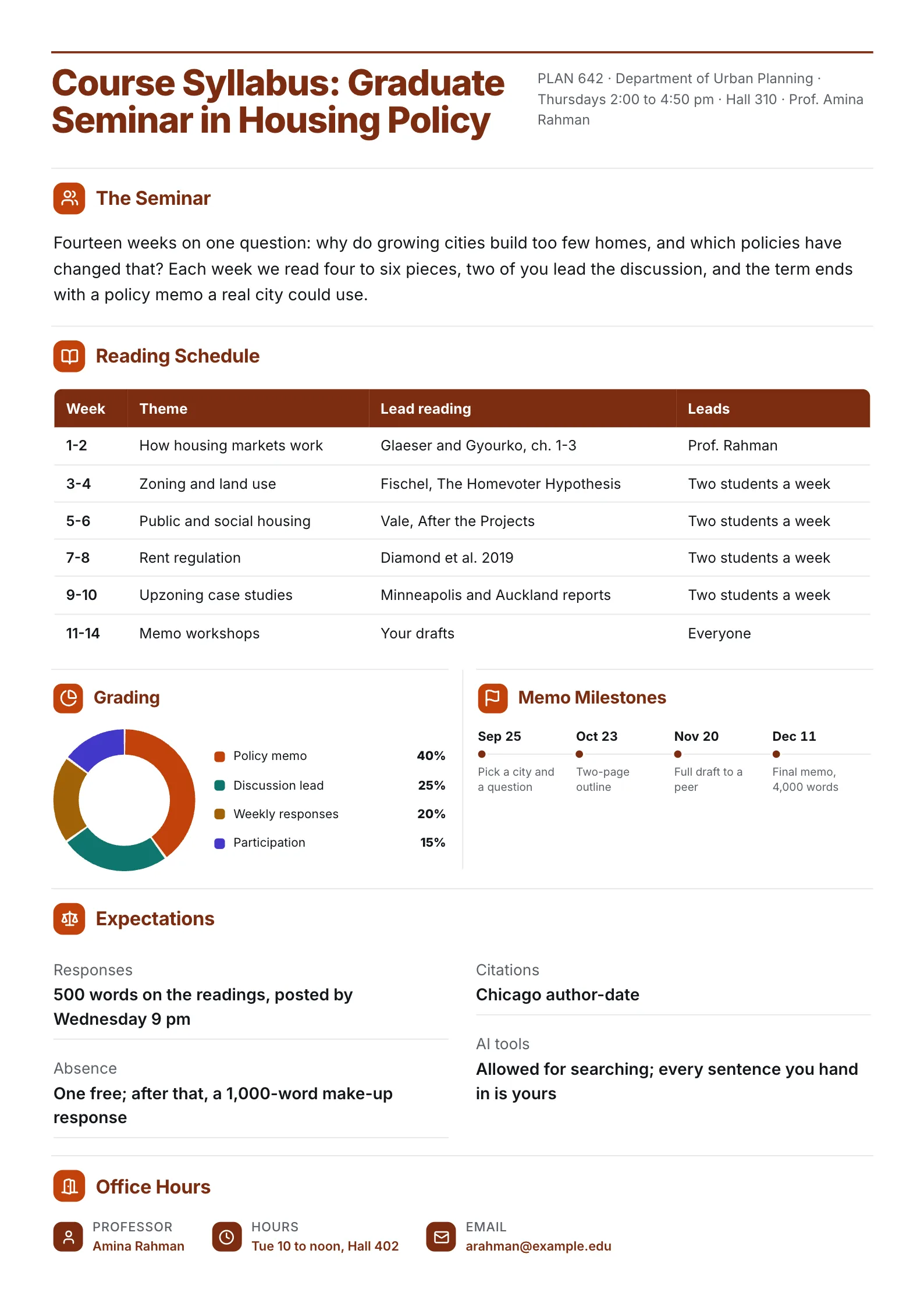
This graduate seminar answers one of the questions the MIT syllabi most often skip: its AI rule fits on one line. AI is allowed for searching, and every sentence you hand in must be your own. It also has an absence rule, with one free absence, then a 1,000-word make-up response. The grade adds to 100 across four parts, and the memo has four dated milestones.
What you would add is a late-work rule, a prerequisites line and four to six learning objectives. You can edit this graduate seminar syllabus template for free.
 Edit this template
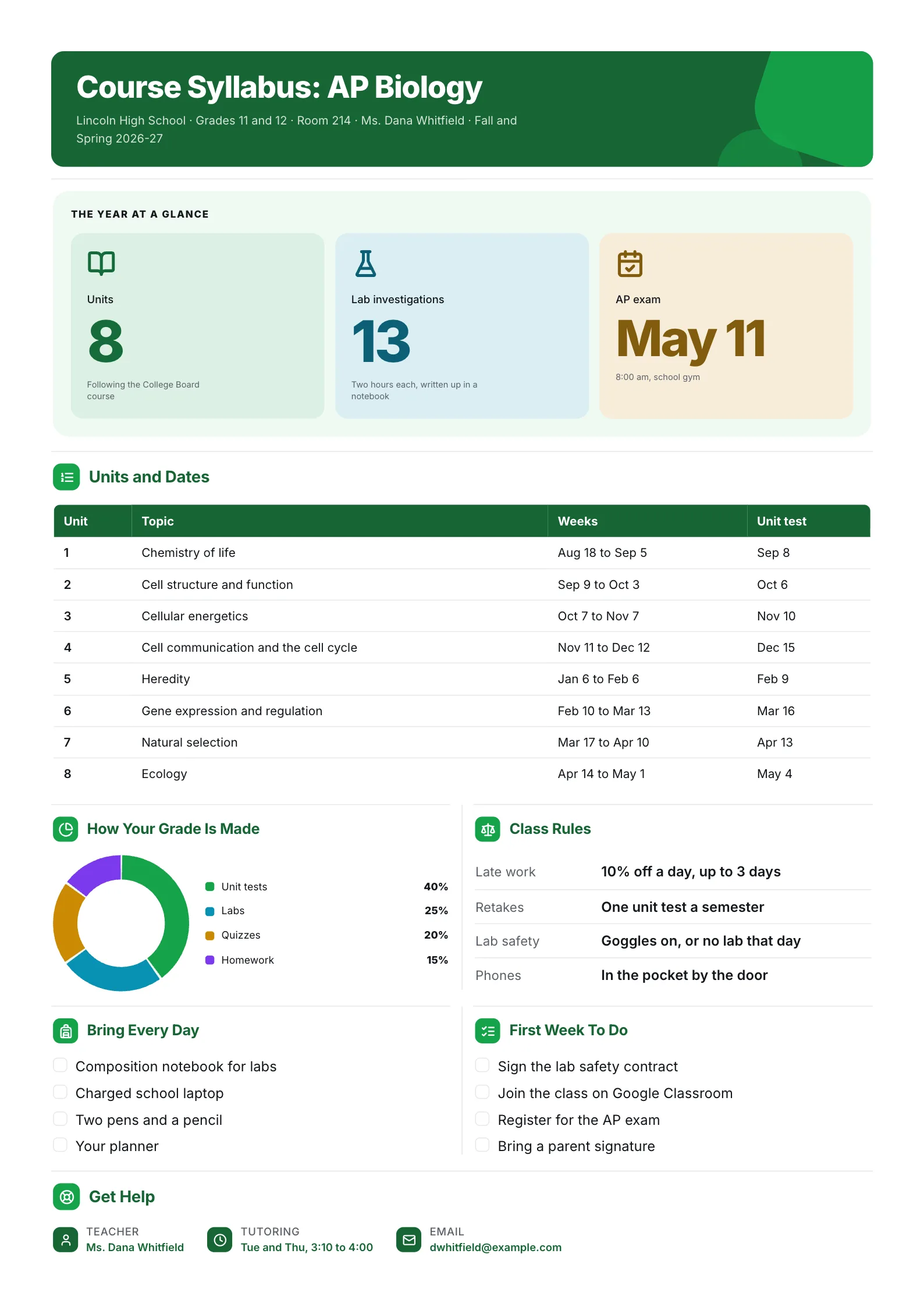
A high school syllabus has two readers, the student and a parent. This one puts the AP exam date in large type and lists every unit test date in a table. Its late-work rule is 10% off a day, for up to 3 days. That's the same kind of rule as 18.200's 10% decrease for work up to 24 hours late.
The "First Week To Do" list asks for a parent signature and AP exam registration, so nothing is missed in week one. You can edit this AP Biology syllabus template for free.
 Edit this template
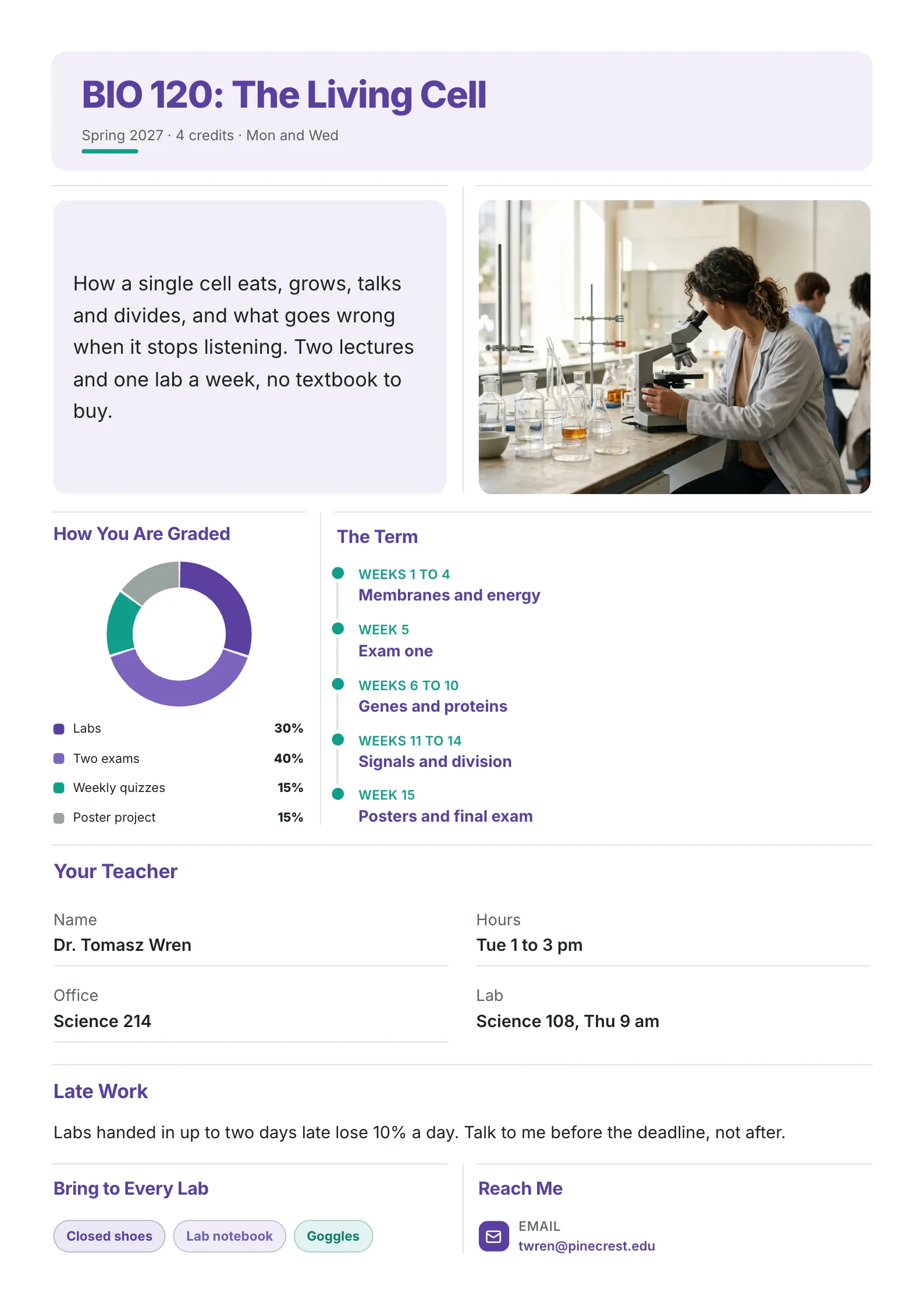
This college course fits a whole term on one sheet. The description says how the week runs (two lectures and one lab) and that there is no textbook to buy. The grade adds to 100, and the late-work rule is one sentence: labs handed in up to two days late lose 10% a day.
The term runs by week with the dates beside each part, so weeks 1 to 4 read Jan 11 to Feb 5, and exam one is on Wednesday, Feb 10. You can edit this college course syllabus template for free.
 Edit this template
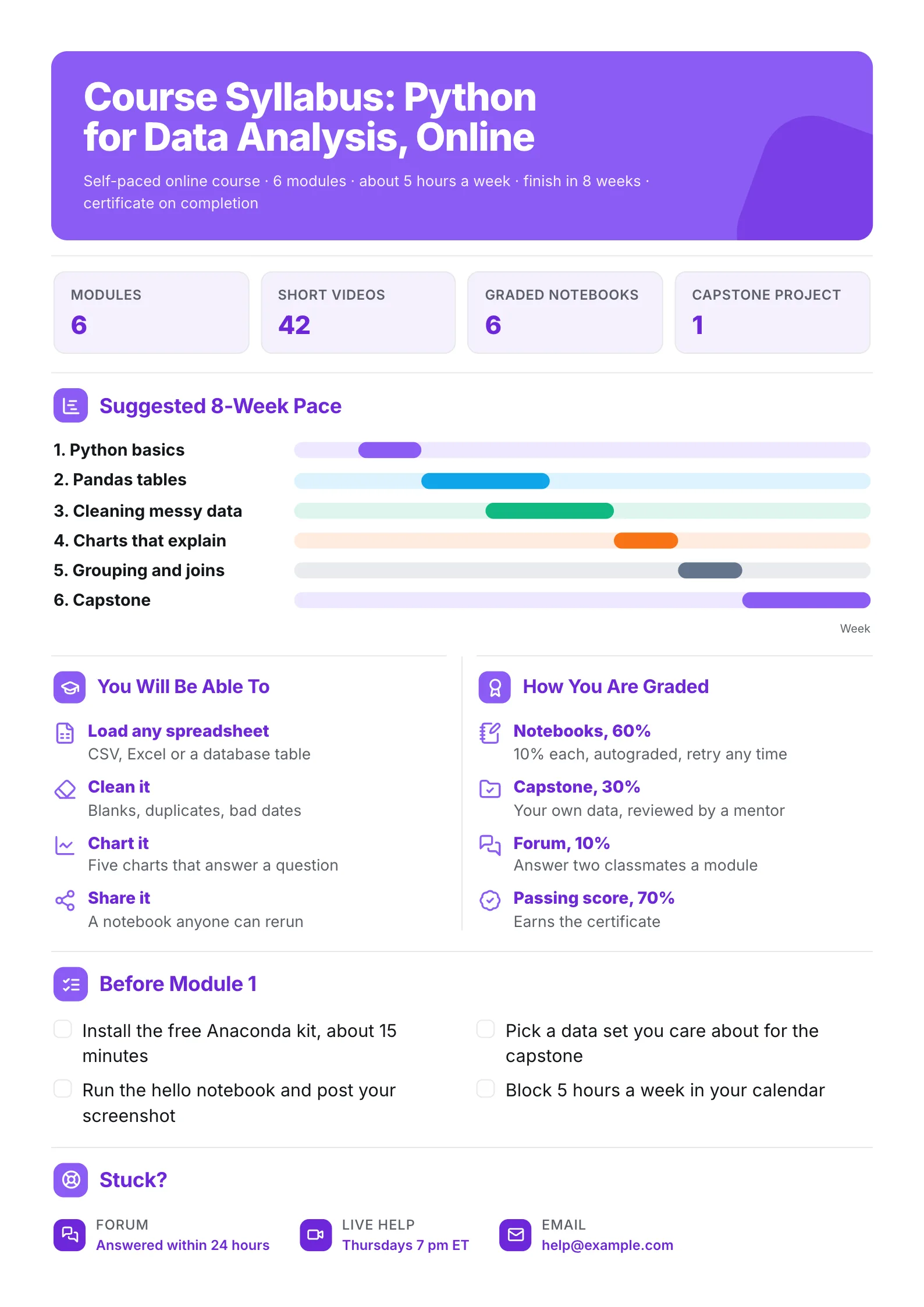
An online course has no first class to explain things in, so its syllabus does more of the work. This one has the learning objectives that 44 of the 53 MIT syllabi leave out. You will be able to load a spreadsheet, clean it, chart it and share it.
The grade is 60% notebooks, 30% capstone and 10% forum, with a passing score of 70% for the certificate. Help is a forum answered within 24 hours and a live session on Thursdays. You can edit this online course syllabus template for free.
 Edit this template
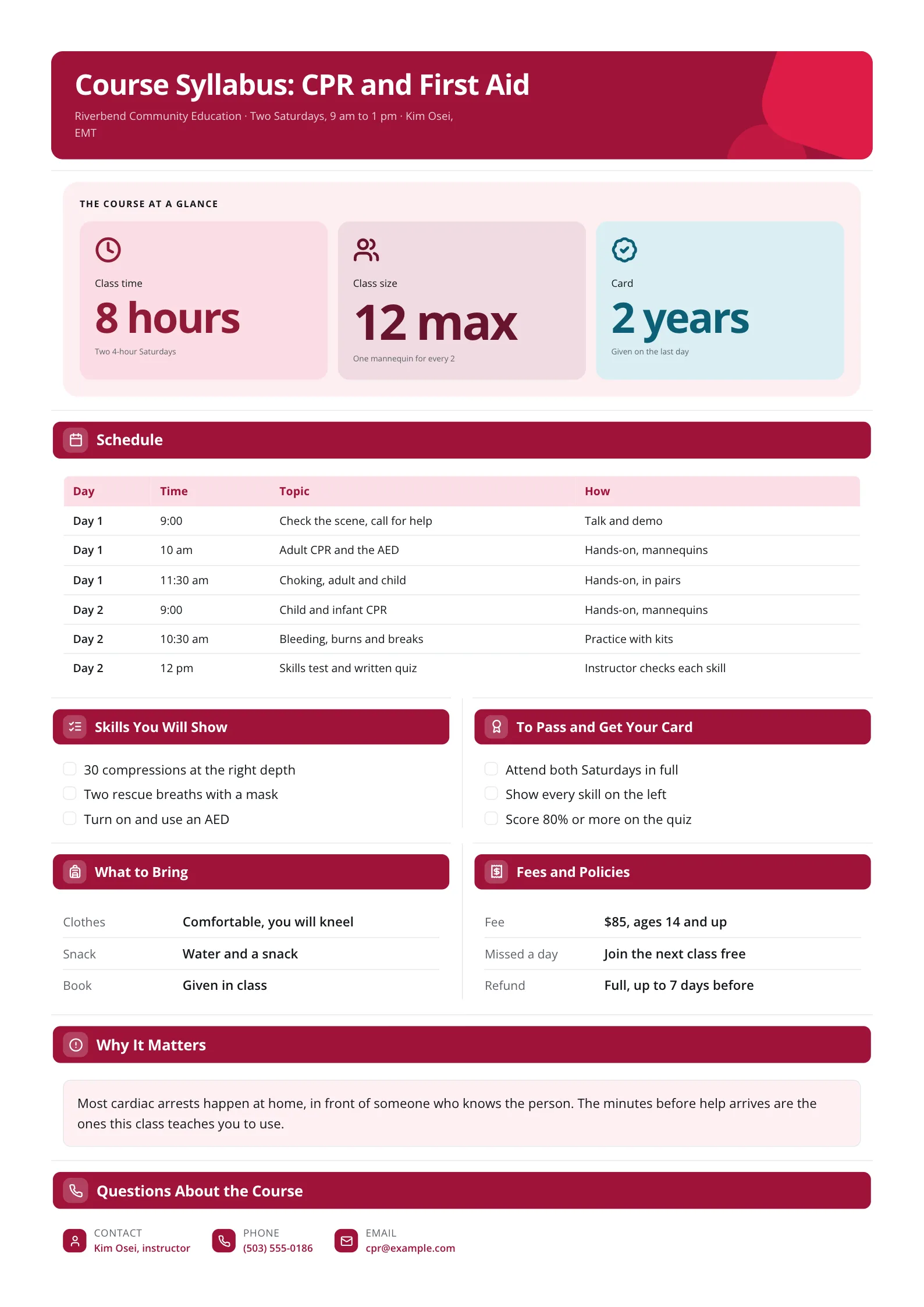
A short course needs the same answers in a smaller space. This two-Saturday class gives its schedule by the hour and lists the three skills you will show. To pass, you attend both days, show every skill and score 80% or more on the quiz.
Its policies cover what a weekend learner asks. If you miss a day, you join the next class free, and you get a full refund up to 7 days before. You can edit this CPR and first aid syllabus template for free.
Questions people ask about writing a syllabus
How do I write a syllabus for a course I've never taught?
Start from the outcomes. Write the 4 to 6 things your students will be able to do, then build the schedule backward from them. Borrow policy wording from a colleague's syllabus or from the MIT courses above, and adjust it to your course.
Should I grade in points or percentages?
Either works if the total is clear. Most of the MIT syllabi use percentages, while Cult of Pedagogy's Jennifer Gonzalez found it simplest to give every assignment points. Percentages show the weight of each part at a glance, and points are easier to add up as the term goes.
Can a syllabus fit on one sheet?
For a short course, a high school class or a quick-reference version, yes. Keep the full policies on your course site and put the dates, grading, rules and contacts on one sheet your students can pin up.
Make your syllabus
Most of the 53 MIT courses we read left out a late-work rule and an AI rule, so write those two first. They're the questions your students will ask in week one. Then open a syllabus design in MakeOnepagers and add your grade weights and dates. Our course syllabus template page has more layouts, and our free AI One-Pager generator can turn your course notes into a first draft.




