5 Communication Plan Examples for Every Stage of a Change, Plus 4 Public Plans
5 communication plan examples sorted by when you need them, from a price change notice to a post-launch survey, plus 4 public plans from state agencies.

Harvest Box tells its customers about a price rise 30 days ahead. Pinecrest Dental calls its insurance carrier the day after it finds a data breach. Westbrook Health is still asking its staff questions a week after its new HR app goes live. Each of these communication plan examples fits a different point on the clock, so they run in the order your change will happen, before it, on the day and after. Start from a free one pager template.
One‑Pager examples
Real One-Pagers made with MakeOnepagers. Open any one to edit it as your own.
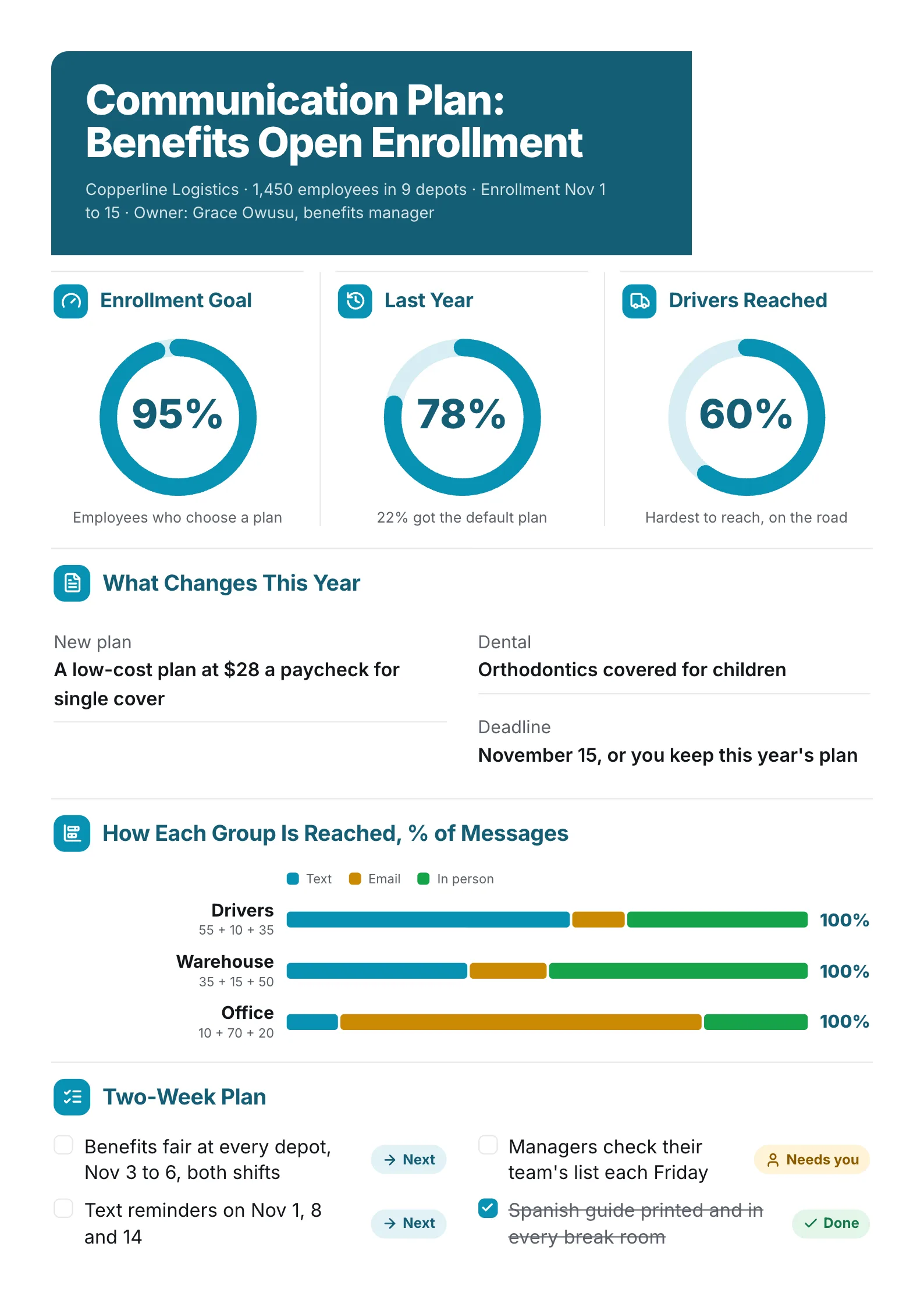 Communication Plan: Benefits EnrollmentEdit for free(opens in a new tab)
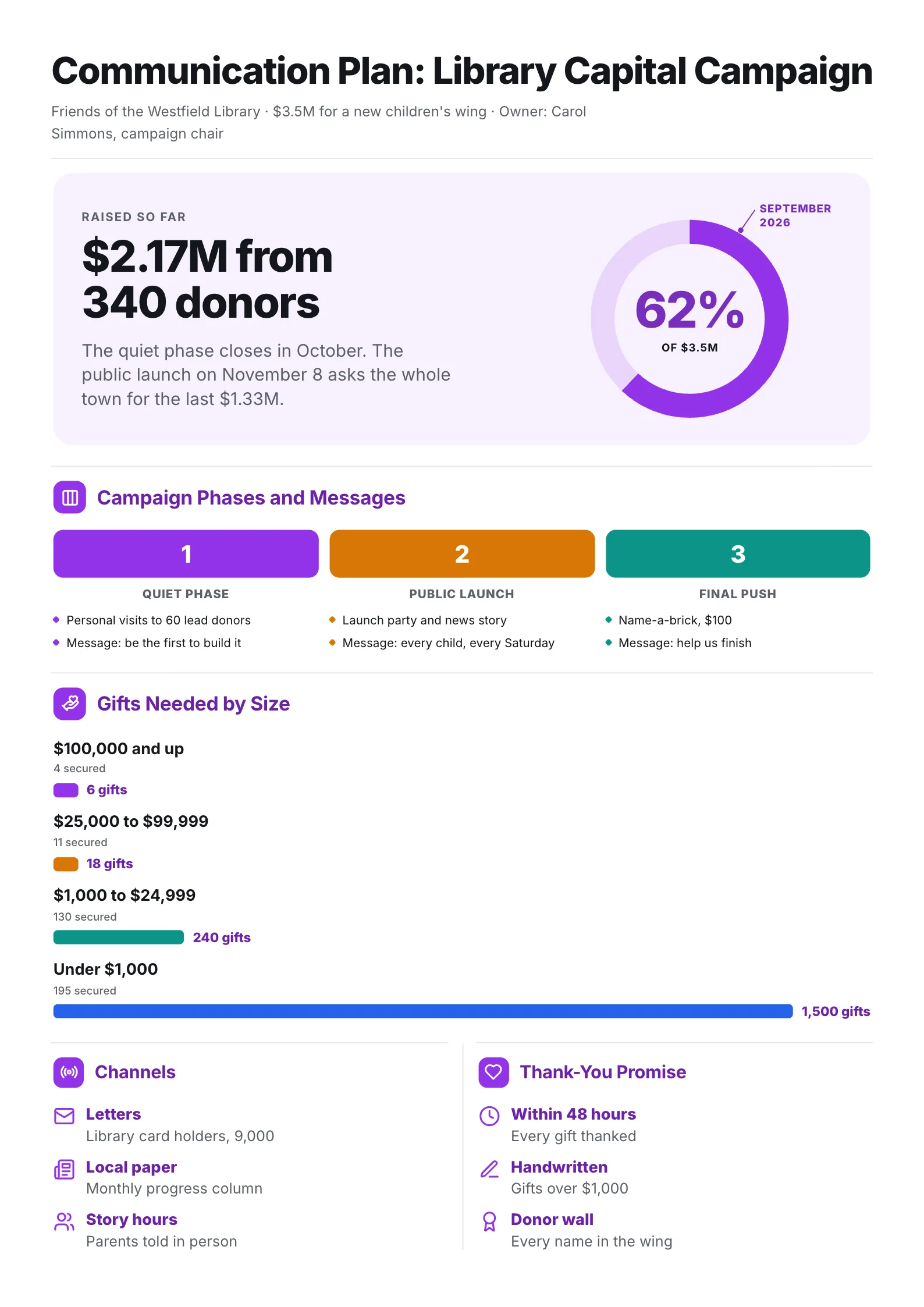 Communication Plan: Fundraising CampaignEdit for free(opens in a new tab)
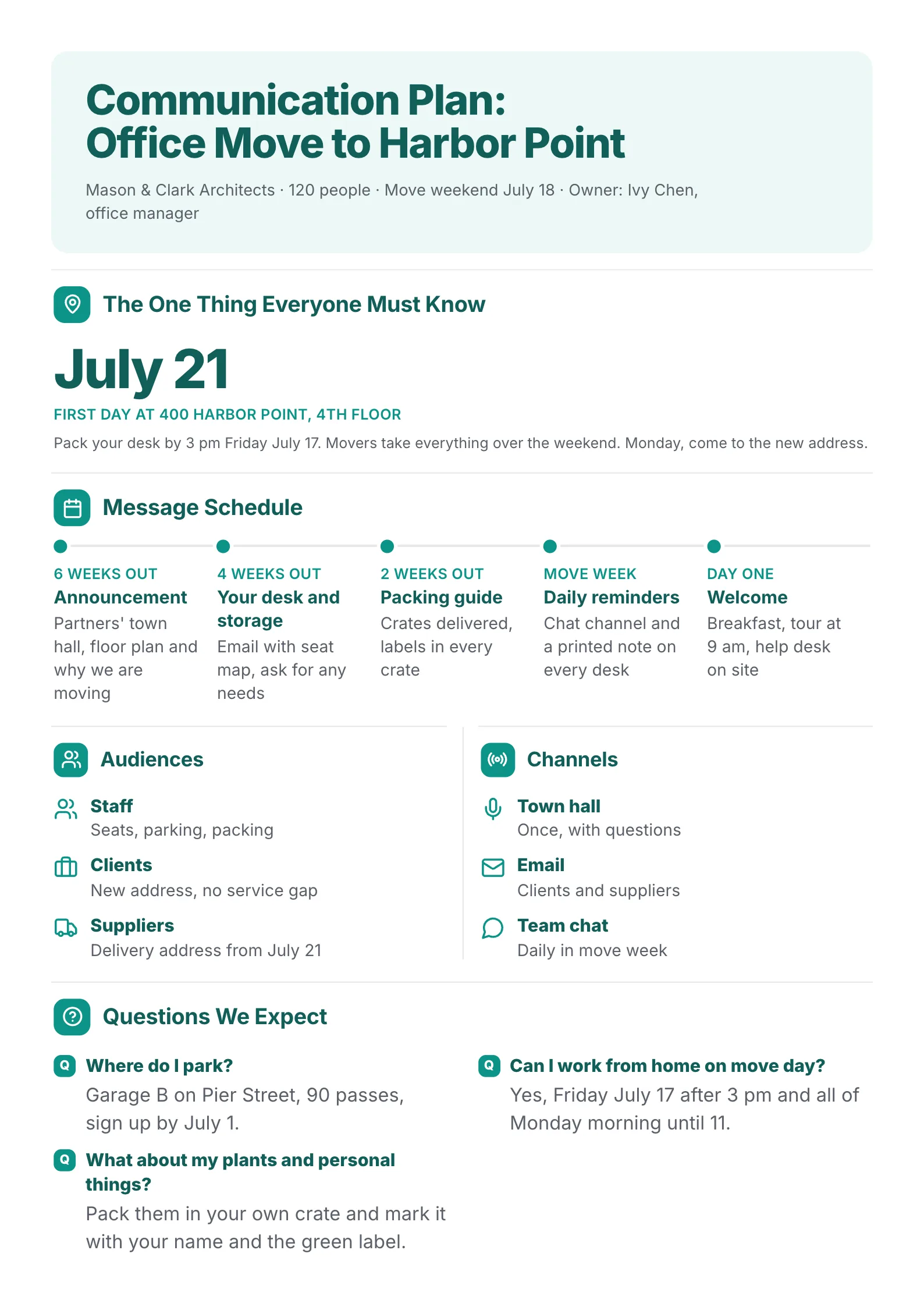 Communication Plan: Office MoveEdit for free(opens in a new tab)
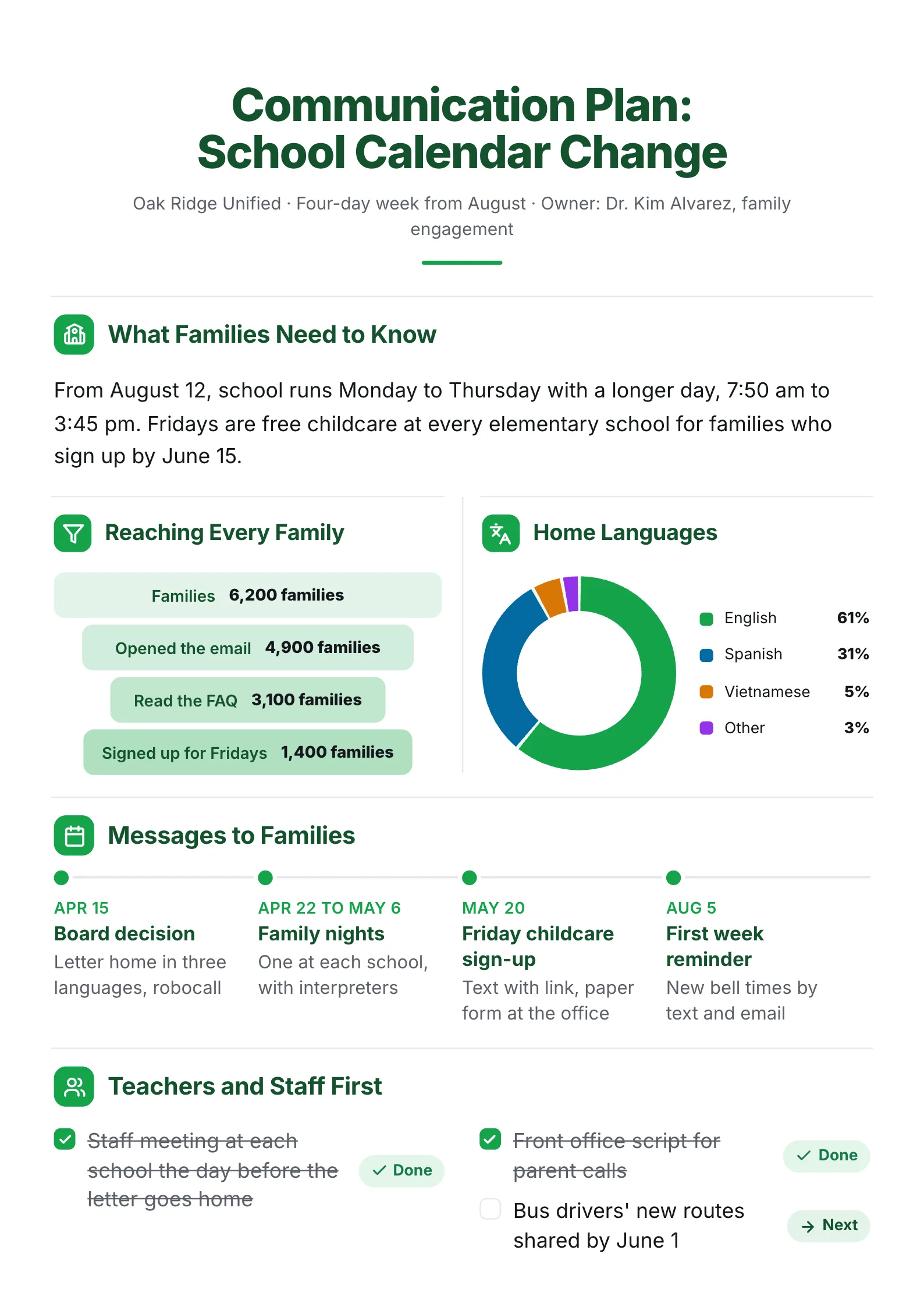 Communication Plan: School FamiliesEdit for free(opens in a new tab)
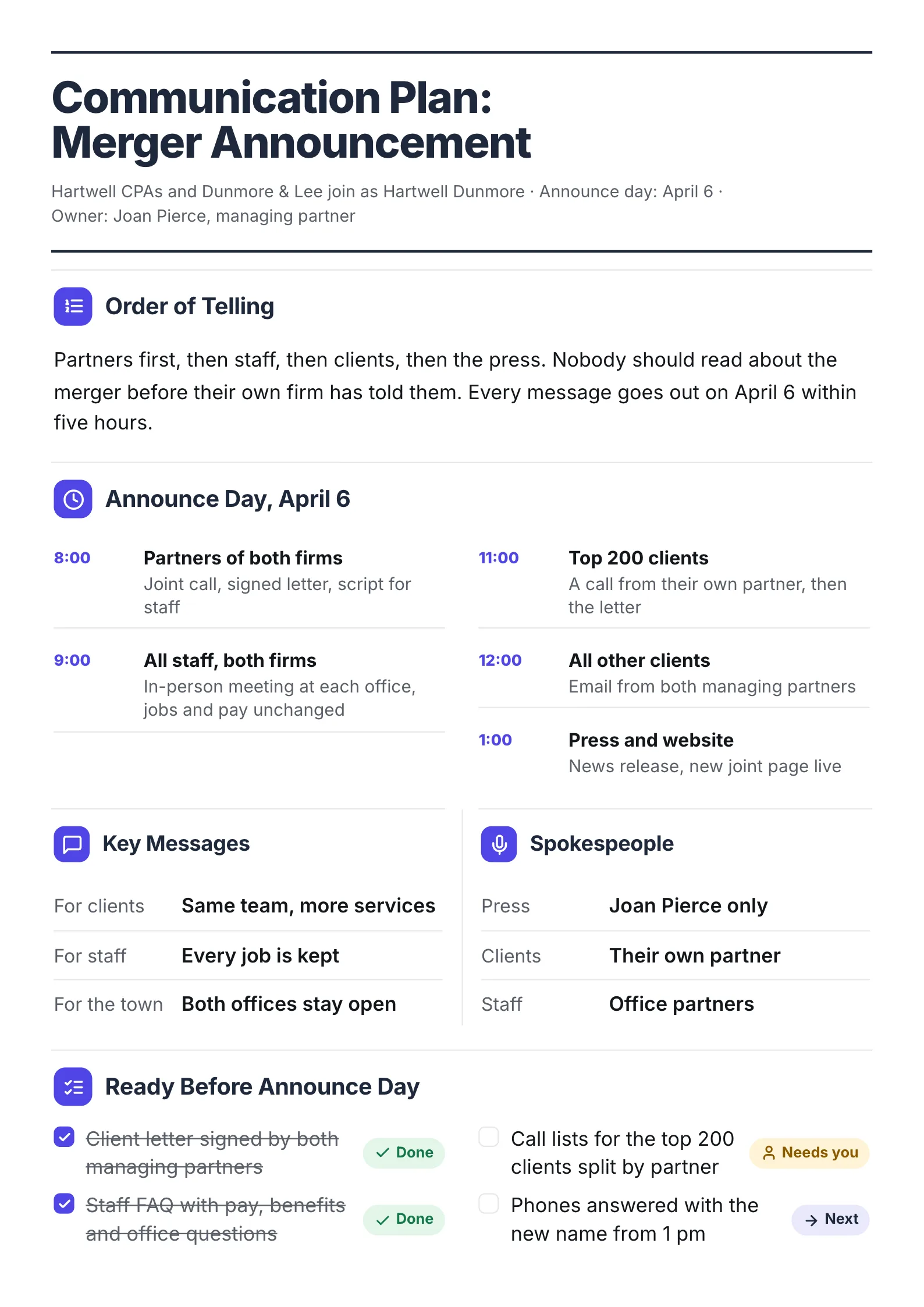 Communication Plan: Merger AnnouncementEdit for free(opens in a new tab)
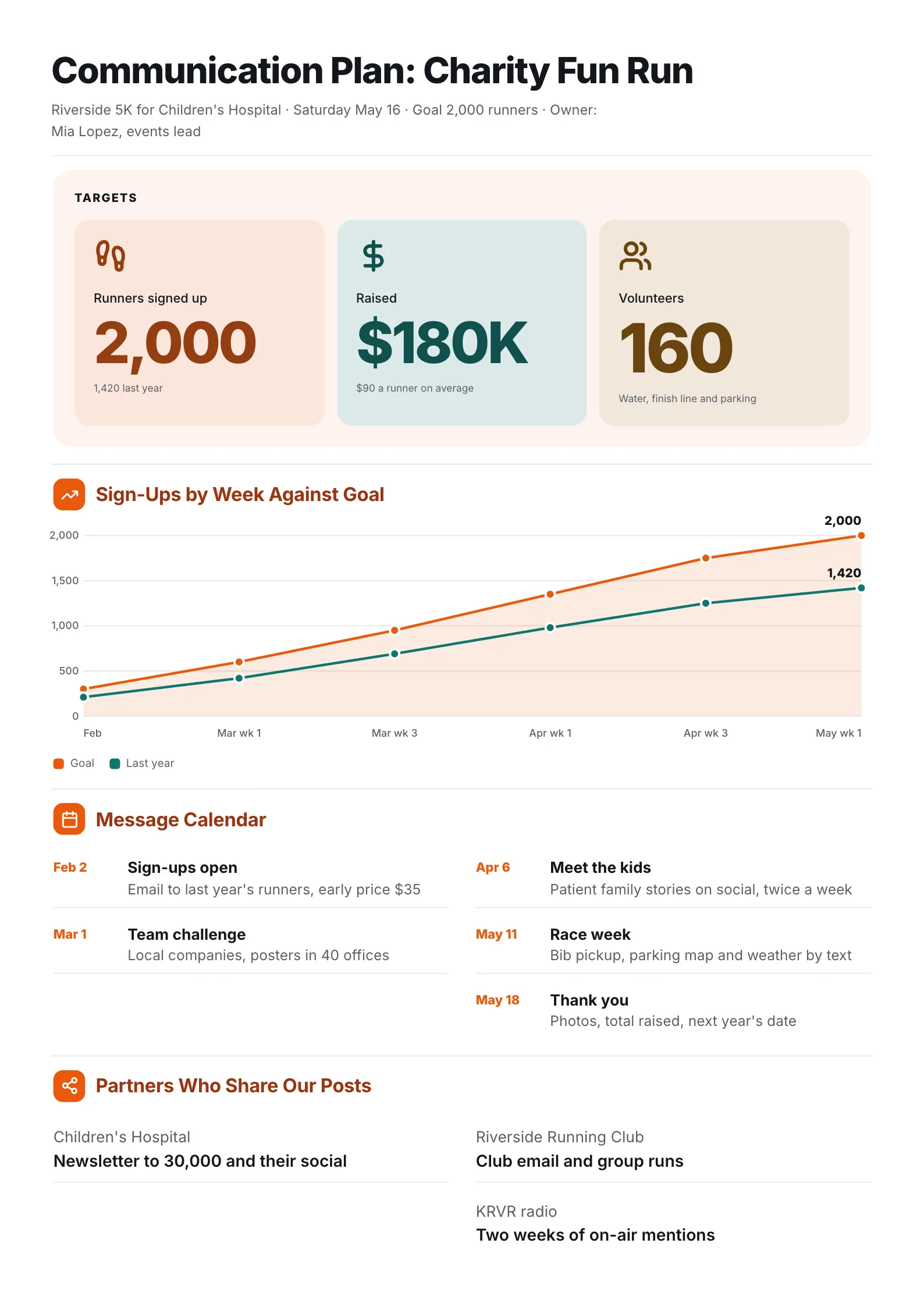 Communication Plan: Charity EventEdit for free(opens in a new tab)
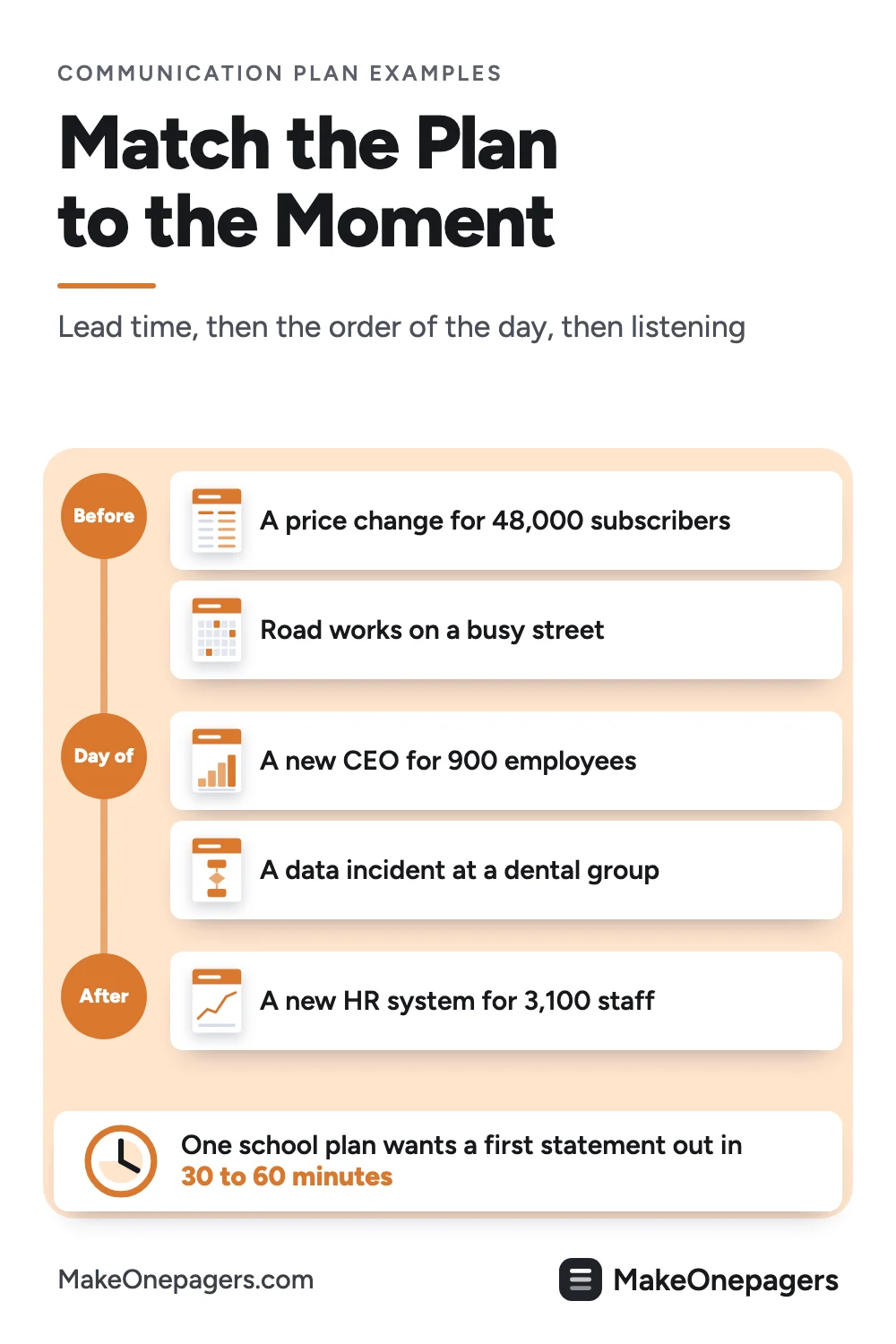
State and regional agencies publish plans of their own, and four of them sit side by side in a table near the end, from a Kentucky bridge study to a Tennessee school crisis framework. Tennessee sets the tightest clock of the four, a district's first statement within 30 to 60 minutes of confirming an incident.
Before the change: give people time
The earlier your people hear about a change, the fewer angry replies land in your inbox the week it happens. These two plans show you how to build around notice periods.
A price change for 48,000 subscribers
 Edit this template
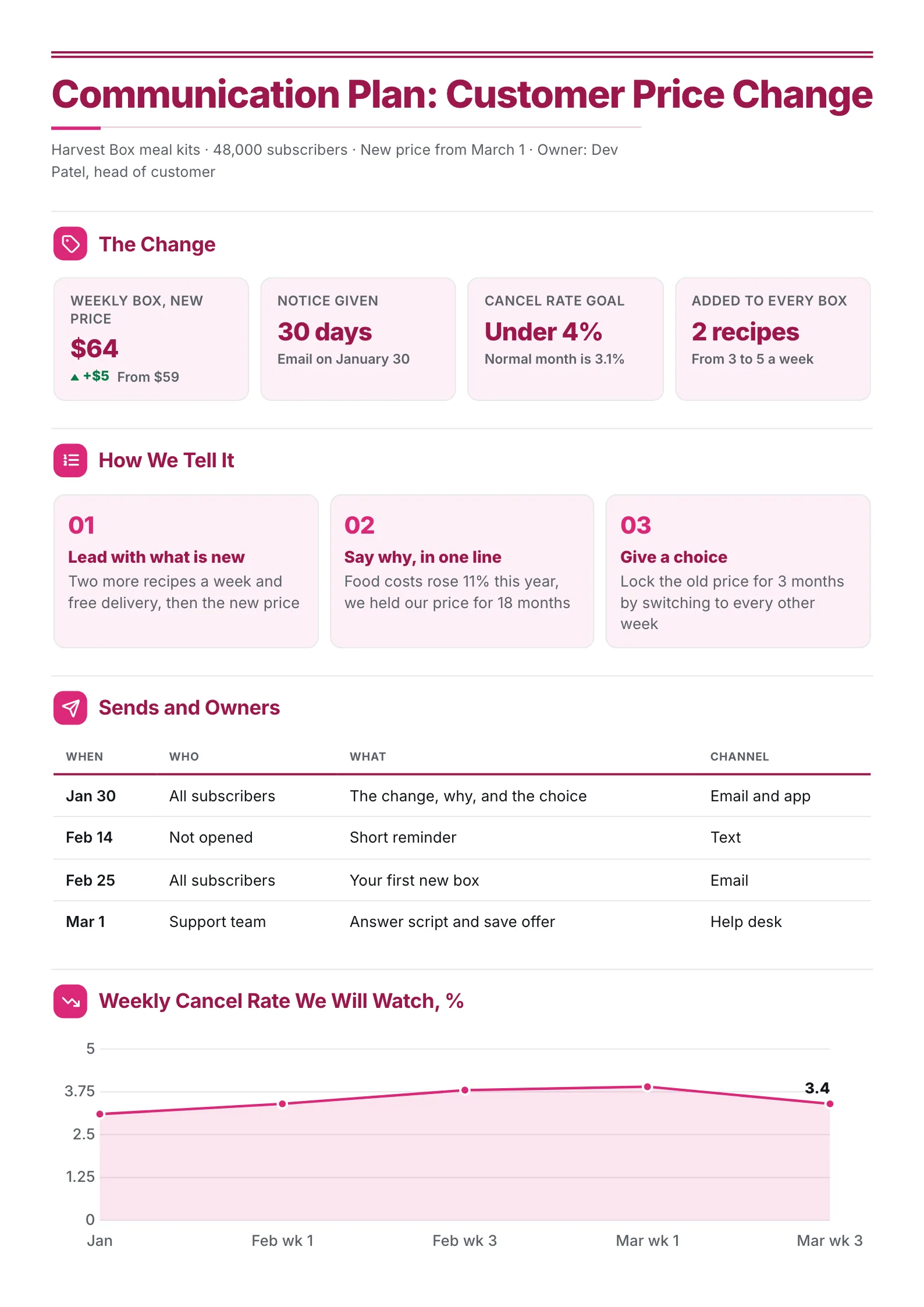
Harvest Box and its numbers are samples. The four sends in the table are the plan you'd copy, start to finish.
Harvest Box is raising its weekly box from $59 to $64, and it gives customers 30 days of notice. The first email goes on January 30. A text follows on February 14, but only to people who didn't open the email. A third message on February 25 shows the first new box, and the support team gets a script on March 1.
What makes it work is the order you tell it in. You lead with what's new, which is two more recipes a week. Then you say why in one line. Food costs rose 11% this year, and the price held for 18 months. Then you give people a choice, so they can lock the old price for 3 months by switching to every other week.
The plan also sets a churn goal of under 4%, against 3.1% in a normal month. Churn is read every week or two from January to March, so you know early whether the message landed.
Road works on a busy street
 Edit this template
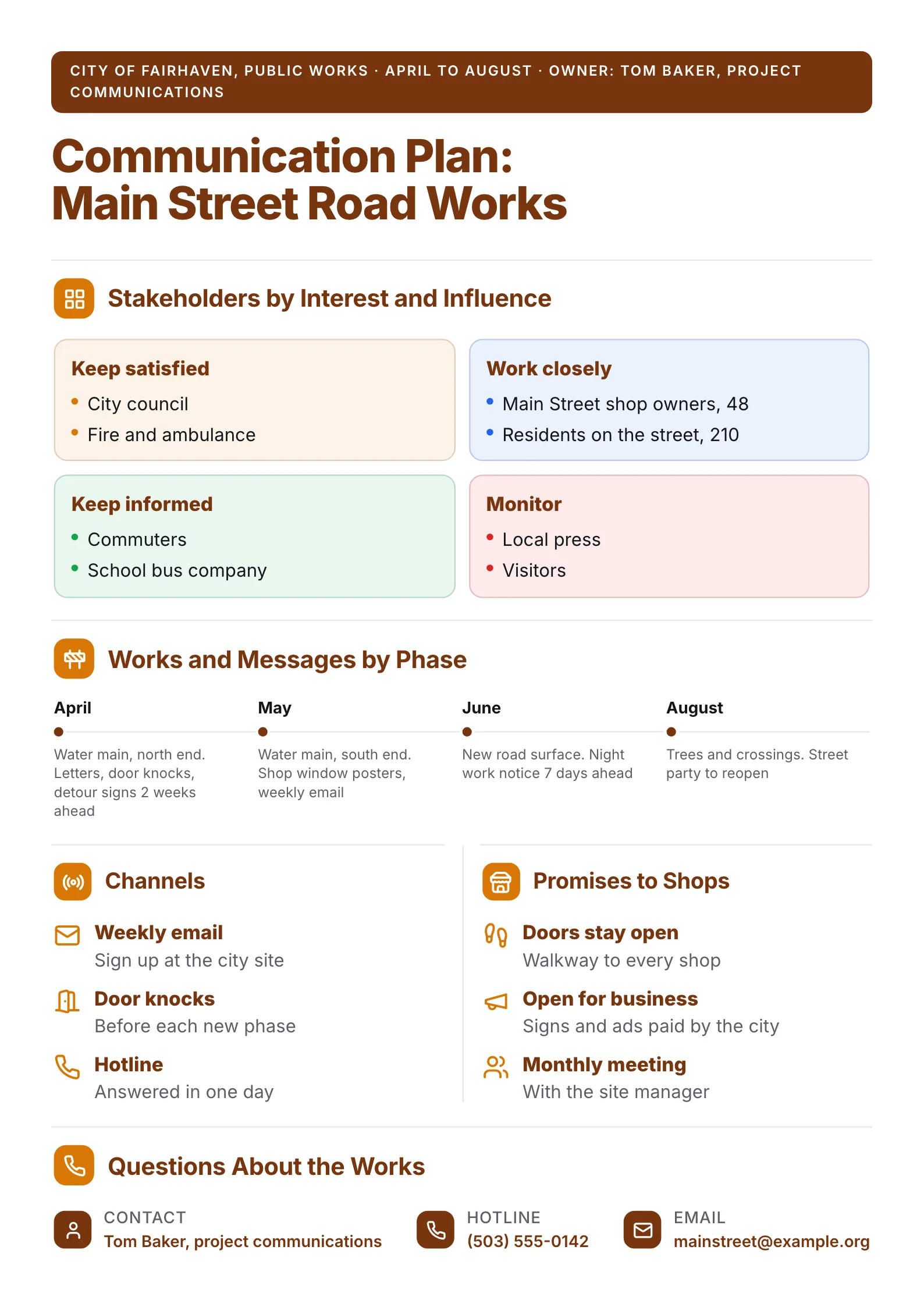
A city and a project that don't exist. See how each month pairs the work with the message about it.
This plan covers five months of road works. You start by sorting people on a four-box map. The 48 shop owners and 210 residents on Main Street sit in the box marked "Work closely." Commuters and the school bus company only need to be kept informed.
Each phase of the work gets its own message and lead time. Detour signs go up 2 weeks before the water main work in April. Night work gets 7 days' notice in June. And the hotline promises an answer in one day.
The shop owners get three promises of their own. Every shop keeps a walkway to its door, the city pays for "open for business" signs, and there's a monthly meeting with the site manager. If your project disrupts a neighborhood, borrow the idea of promises. People forgive a lot when you tell them what won't change.
The day of: who hears it first
On the day itself, plan the order your people hear the news as carefully as the words. Both plans below show you that order as a table with times or dates.
A new CEO for 900 employees and 160 agencies
 Edit this template
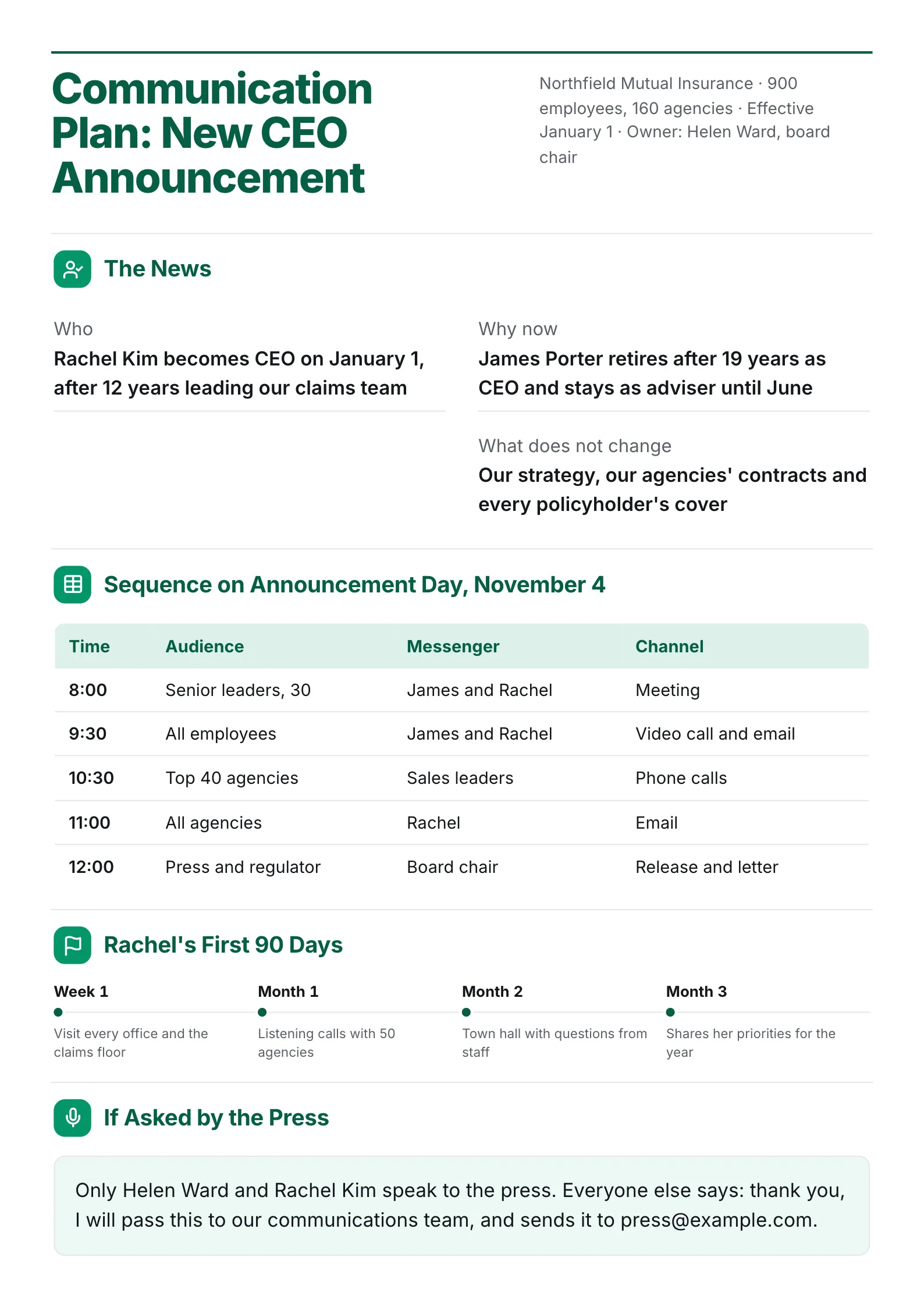
Northfield Mutual is invented. Read the sequence table from top to bottom, since that's the order your people find out.
The heart of this plan is one table for November 4. At 8:00, 30 senior leaders hear it in a meeting. At 9:30, every employee hears it on a video call. At 10:30, sales leaders phone the top 40 agencies, then all agencies get an email at 11. The press and the regulator get the release at noon.
Notice that your closest people hear it from the person making the news. The outgoing and incoming CEOs tell staff together. The plan also says what does not change, which is the strategy, the agency contracts and every policyholder's cover.
One small box covers the press. Only the board chair and the new CEO speak to reporters. Everyone else thanks the caller and passes it on. You can give your own team the same short script.
A data incident at a dental group
 Edit this template
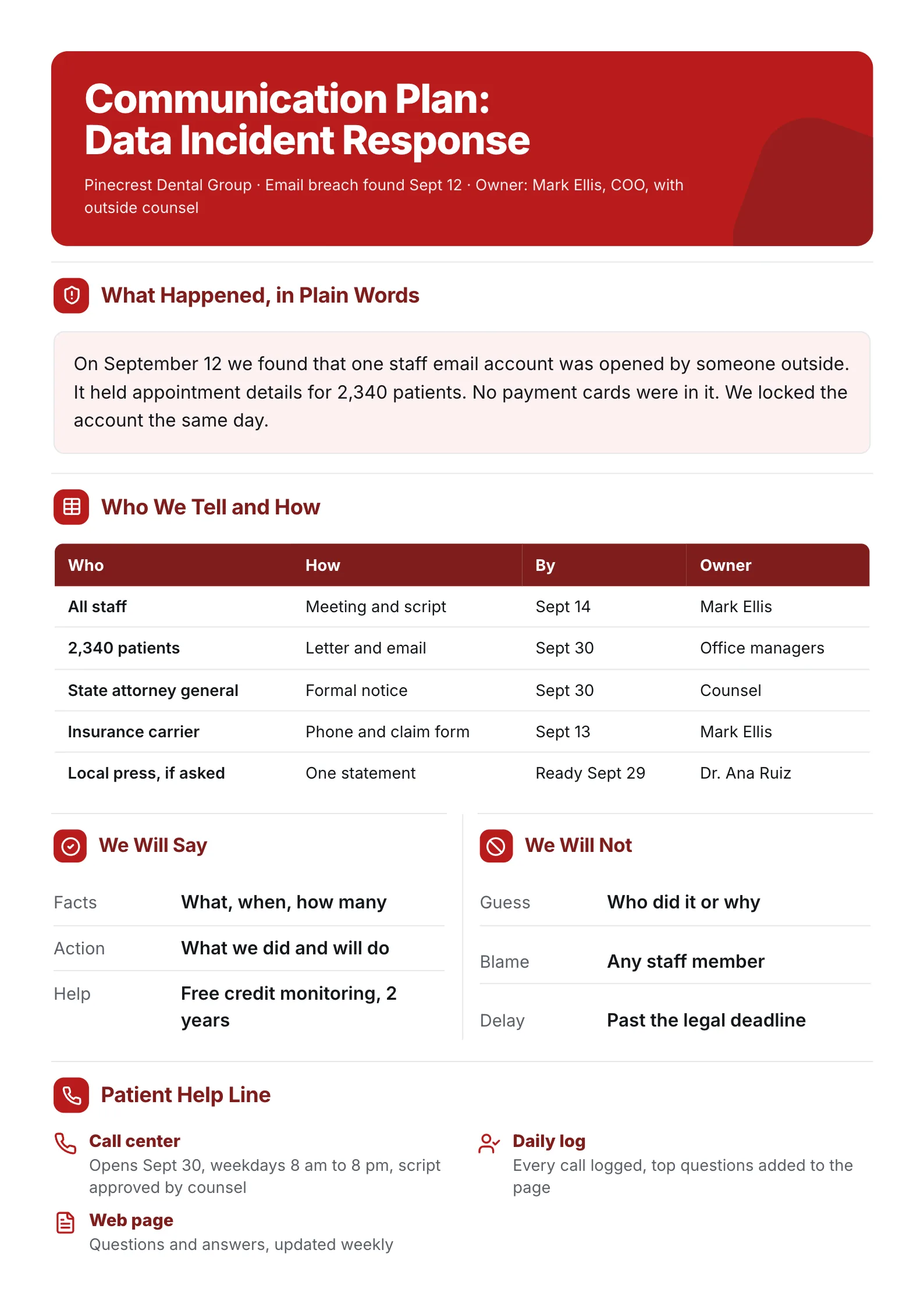
The breach and the patients here are made up. The "We Will Not" list keeps everyone from guessing out loud.
On September 12, Pinecrest found that someone outside had opened one staff email account. It held appointment details for 2,340 patients, and no payment cards. The plan opens with that in plain words.
Then comes a table of who hears and by when. The insurance carrier gets a call on September 13. All staff hear it at a meeting on September 14. Patients get a letter and email by September 30, and the state attorney general gets formal notice the same day.
Two short lists keep your whole team on message. "We will say" covers the facts, what was done, and the help offered, which is free credit monitoring for 2 years. "We will not" means no guessing who did it, no blaming staff and no delay past the legal deadline. A help line opens September 30, and every call is logged so the top questions go onto the web page.
After the change: listen and adjust
A change that asks people to do something new isn't finished on launch day. Keep your plan running until they've done it.
A new HR system for 3,100 staff
 Edit this template
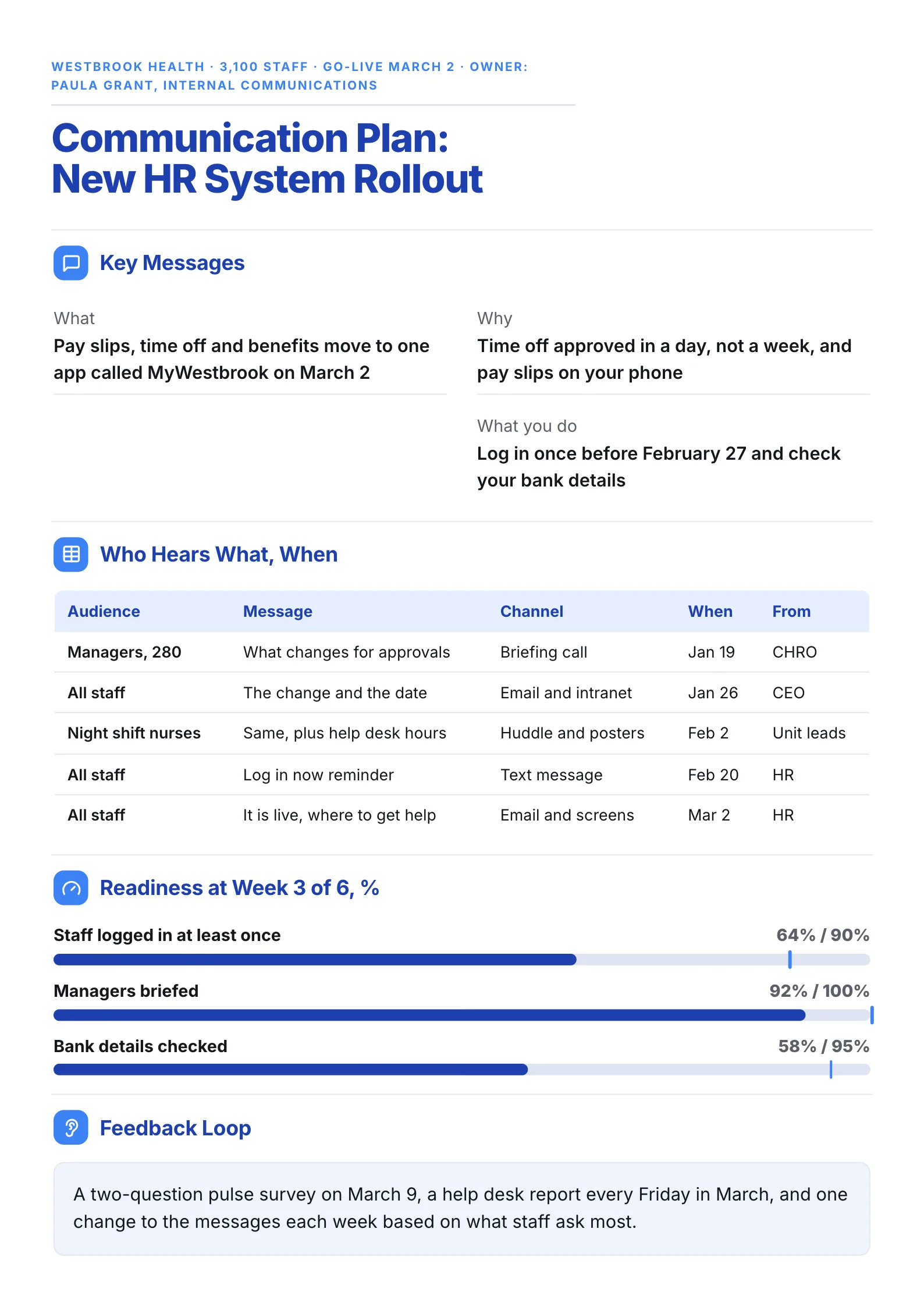
Westbrook Health is a sample. The readiness bars tell you who still needs a nudge.
Westbrook Health is moving pay slips, time off and benefits into one app on March 2. Managers hear first, on January 19, because they'll get the questions. Night shift nurses get their own huddle and posters on February 2, since they miss daytime emails.
The readiness section is what makes this plan useful after the launch. At week 3 of 6, 64% of staff had logged in, against a goal of 90%. Only 58% had checked their bank details, against 95%. Those gaps tell you exactly where to send your next reminder.
After go-live, the plan keeps listening. A two-question survey goes out on March 9, the help desk reports every Friday, and one message changes each week based on what staff ask most.
What a public plan includes
State and regional agencies publish full communication plans for big public projects, and you can borrow their real deadlines. We read these four on October 30, 2026.
| Plan | Who wrote it | Goals | Who it names | Deadlines it sets | How it checks |
|---|---|---|---|---|---|
| I-65 bridges sample plan, 4 pages, 2019 | Kentucky Transportation Cabinet | 1 main goal | Elected officials, local agencies, utilities, trucking firms, event venues | Media notice at least 1 week before lane closures; contractor notice 14 days before, 5 days for ramps | Delay updates when backups pass 5,000 feet |
| I-35 Waco construction plan, 27 pages, 2018 | Texas Department of Transportation | 12 objectives | 3 groups: executive, local, through travel | News releases at least 7 days ahead; follow-up calls within 48 hours | Monthly reports with metrics |
| 91 Express Lanes repaving, 9 slides, 2016 | Orange County Transportation Authority | 7 goals | 4 outreach lanes: government, community, media, partners | Ten 56-hour weekend closures, none on holiday weekends | Ongoing feedback from partners |
| District crisis framework, 6 pages | Tennessee Department of Education | First statement in 30 to 60 minutes | 3 tiers: immediate, secondary, external | Playbook for the first 15 minutes to the first 24 hours | Review within 1 week, with 7 questions |
Every plan sets a clock. Kentucky counts in days, and Tennessee counts in minutes. If your plan has no dates, it's a wish list.
Every plan also names its people in groups. Texas uses three. Tennessee splits them by who must know first, like the superintendent and legal counsel, then the school board, then families and the media.
Only Tennessee builds in a review after the event. Within a week of an incident, the district asks seven questions, such as "Where did communication slow down?" You can copy that for any plan, big or small.
Message lines you can borrow
Write your actual words ahead of time, so you aren't drafting under pressure. Here are lines you can adapt from the public plans and our examples.
- For a delay: "Expect up to 1 hour delay, stop-and-go traffic." Orange County put the size of the problem right in the message.
- For a next step: "Leave early, plan for delays!" The same campaign gives drivers something to do, under the heading "Prepare!"
- For staff during a crisis: "Please direct all media inquiries to the District Communications Office." Tennessee hands every employee one sentence to say.
- For a first statement: "We will provide updates as soon as additional information is confirmed." It's the closing line of Tennessee's sample holding statement.
- For a price rise: "Food costs rose 11% this year, we held our price for 18 months." Harvest Box explains the why in one line.
- For a leadership change: "What does not change: our strategy, our agencies' contracts and every policyholder's cover." Northfield answers the worry before anyone asks.
Texas gives one more reason to say why a change is happening. Its plan says people put up with the inconvenience better when they know what the work is for.
Put your own change on the clock
Put today's date and the day of your change at the top of a page, and count the days between them. That gap tells you which part of this post you're in. With weeks to go, start from the price change or the road works and fill in your sends. With hours to go, start from the CEO announcement or the data incident and write the order people hear it. Once the change is live, start from the HR rollout and plan what you'll ask.
Fill every row with your own groups and owners, send the page to each person named on it, and add one more date at the bottom, a week after the change, for a review like Tennessee's seven questions. Westbrook put that date on its HR rollout plan in MakeOnepagers before launch day, a two-question survey on March 9, one week after go-live.
Frequently asked questions
What should a communication plan include?
At minimum, your plan needs a goal, the groups of people you must reach, the message for each group, the channel, a date and an owner. The four public plans above add deadlines in days or hours. Our communication plan template post goes through each part.
How far ahead should I share a change?
It depends on how much the change asks of people. Harvest Box gives 30 days for a price rise. The Kentucky plan tells the media at least a week before lane closures and puts up message boards 2 weeks ahead. For an emergency, Tennessee's goal is 30 to 60 minutes.
How is a crisis communication plan different?
A crisis plan is written before anything happens. You draft holding statements, name your spokesperson and set the approval path in advance. Tennessee lists 10 kinds of event to draft statements for, from weather to a data breach. When the facts are in, a press release template helps with the public statement, and an incident report template keeps the record.




