Cash Flow Summary Examples Built Around One Number Each
Cash flow summary examples, from a real school district's one-page cash report to a farm, a store and a family, each built around the number its reader checks.

Every cash flow summary you write is really answering one question. Will your money last? The examples worth copying pick one number that answers it for their reader, then put that number where your eye lands first. Start from a free one pager template.
One‑Pager examples
Real One-Pagers made with MakeOnepagers. Open any one to edit it as your own.
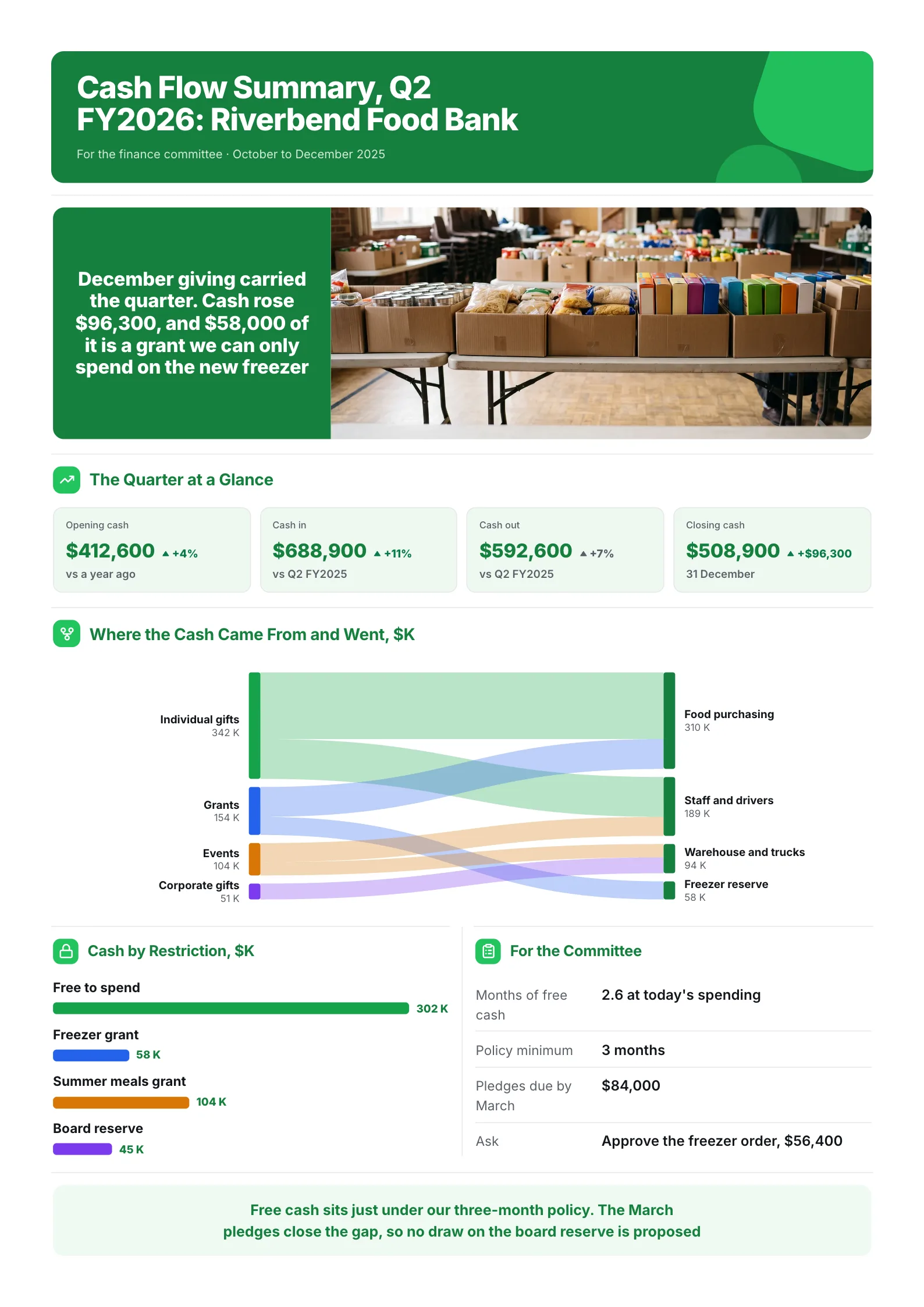 Cash Flow Summary: Food Bank QuarterEdit for free(opens in a new tab)
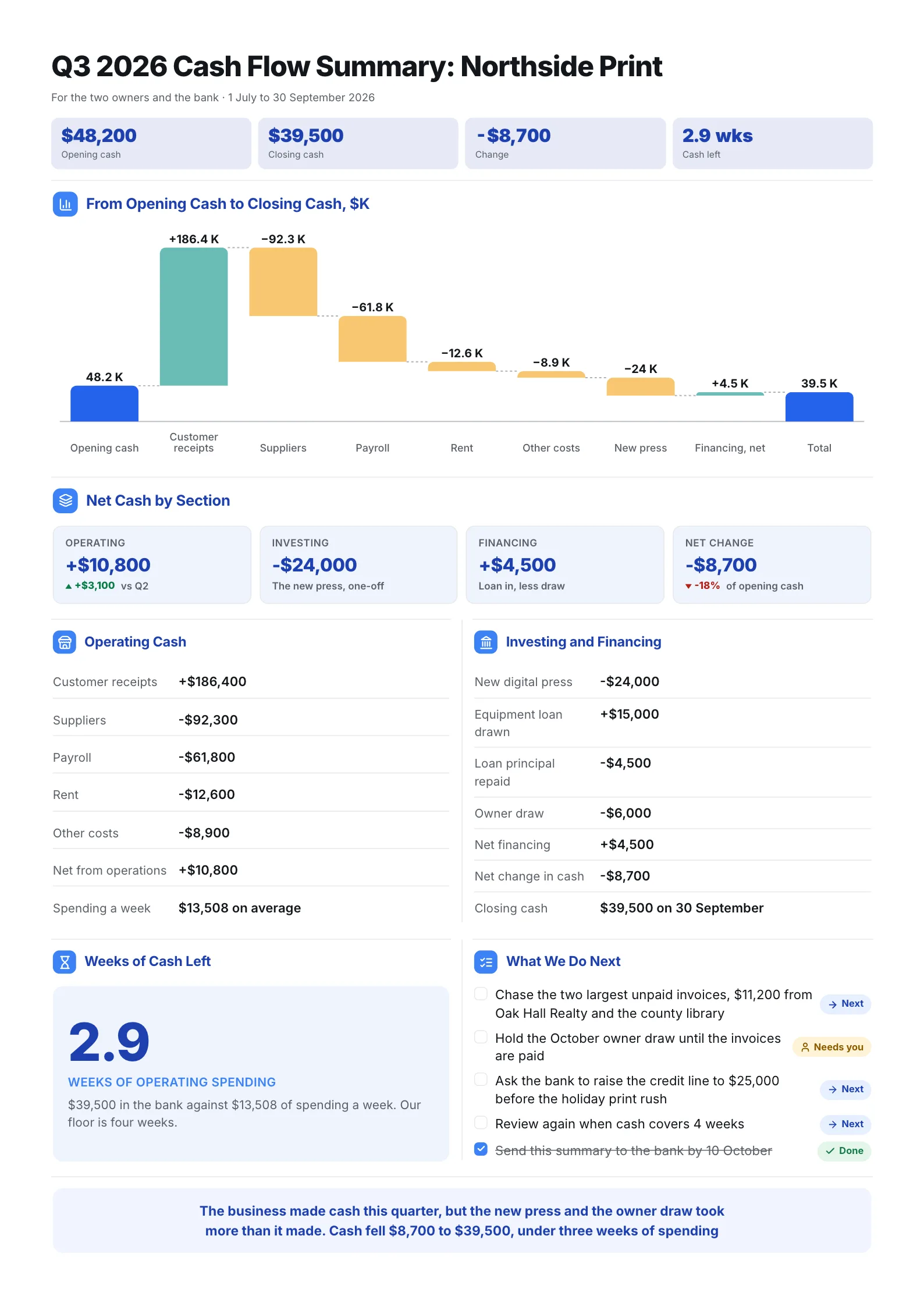 Cash Flow Summary: Print Shop QuarterEdit for free(opens in a new tab)
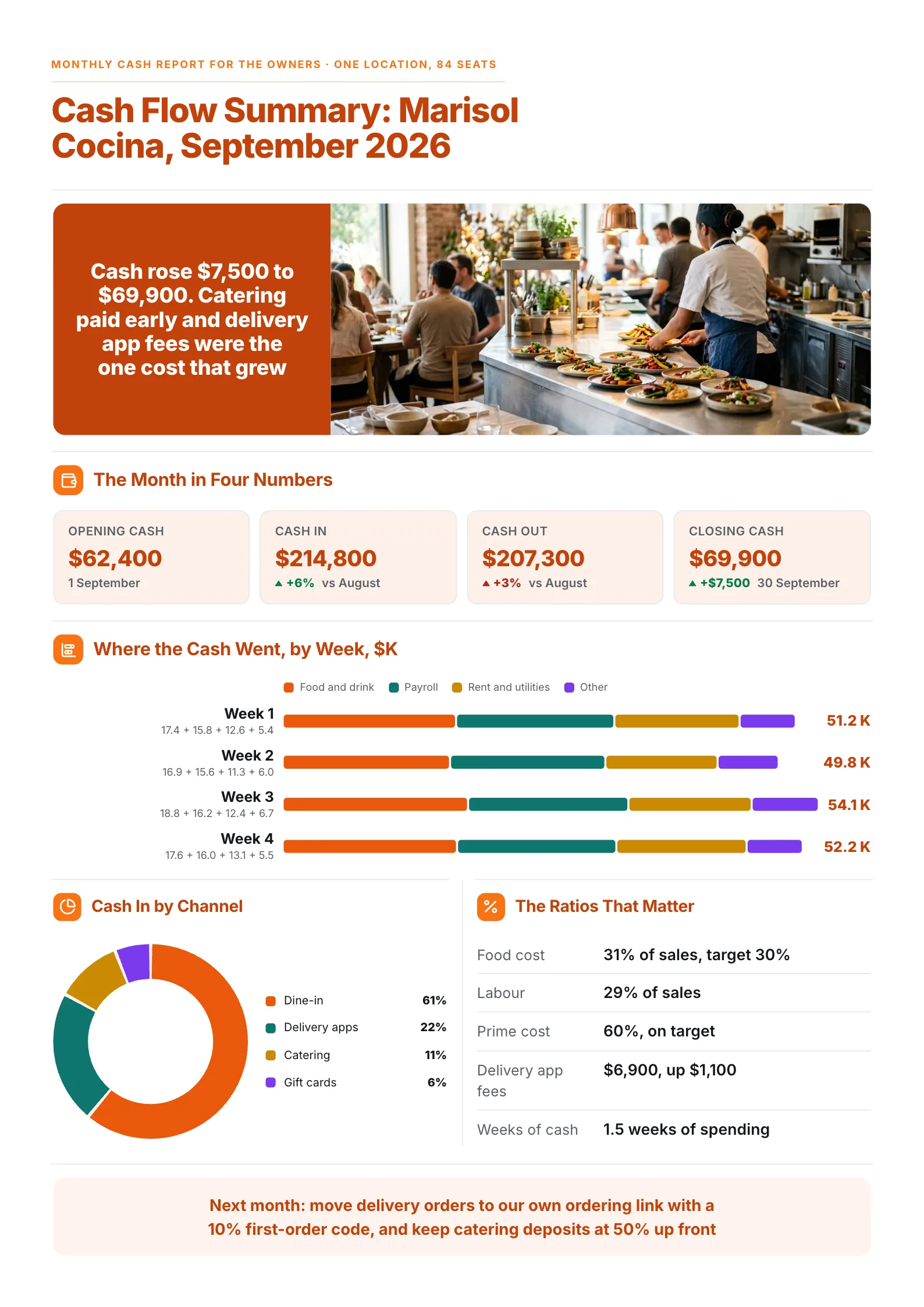 Cash Flow Summary: Restaurant MonthEdit for free(opens in a new tab)
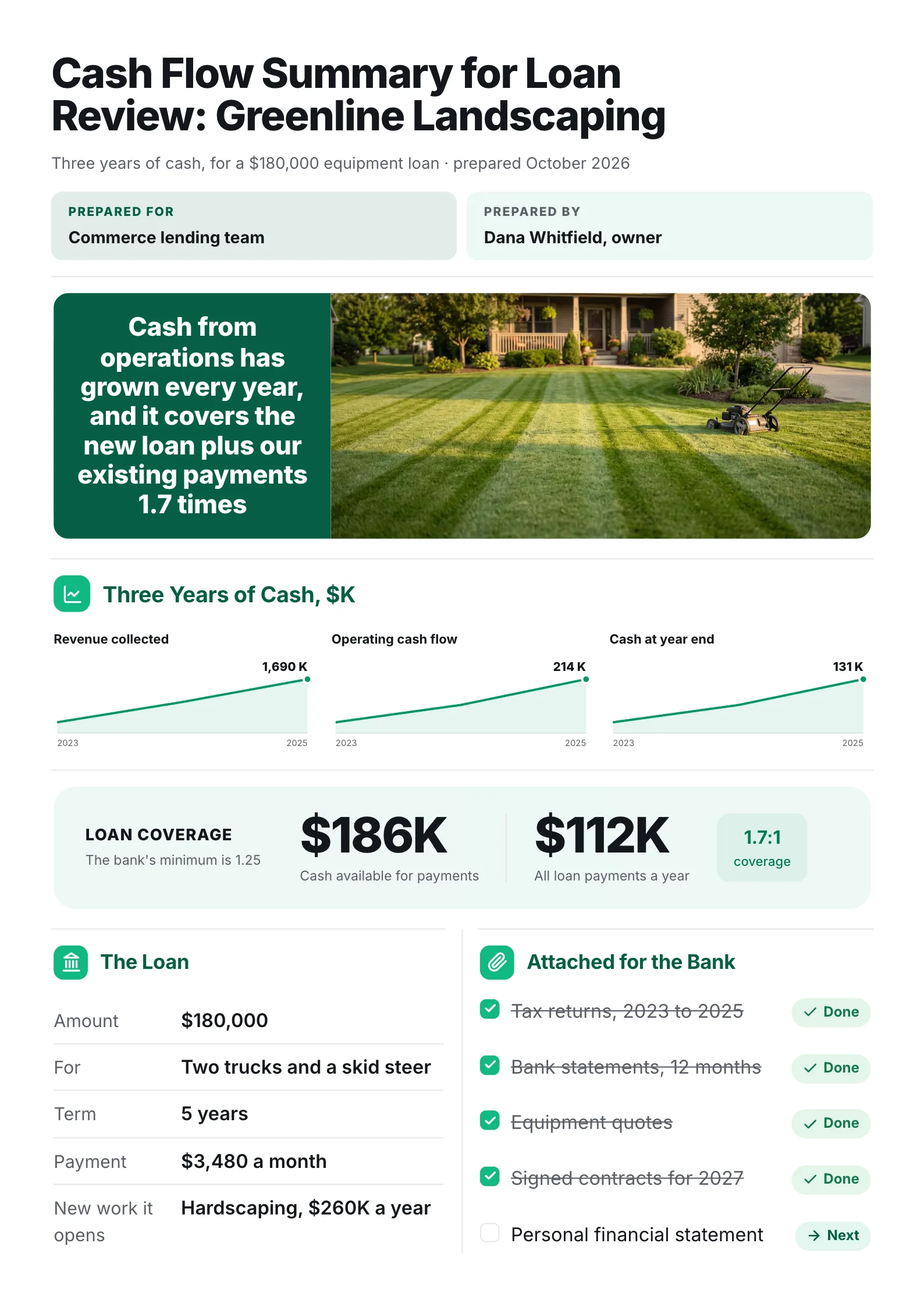 Cash Flow Summary: Loan ApplicationEdit for free(opens in a new tab)
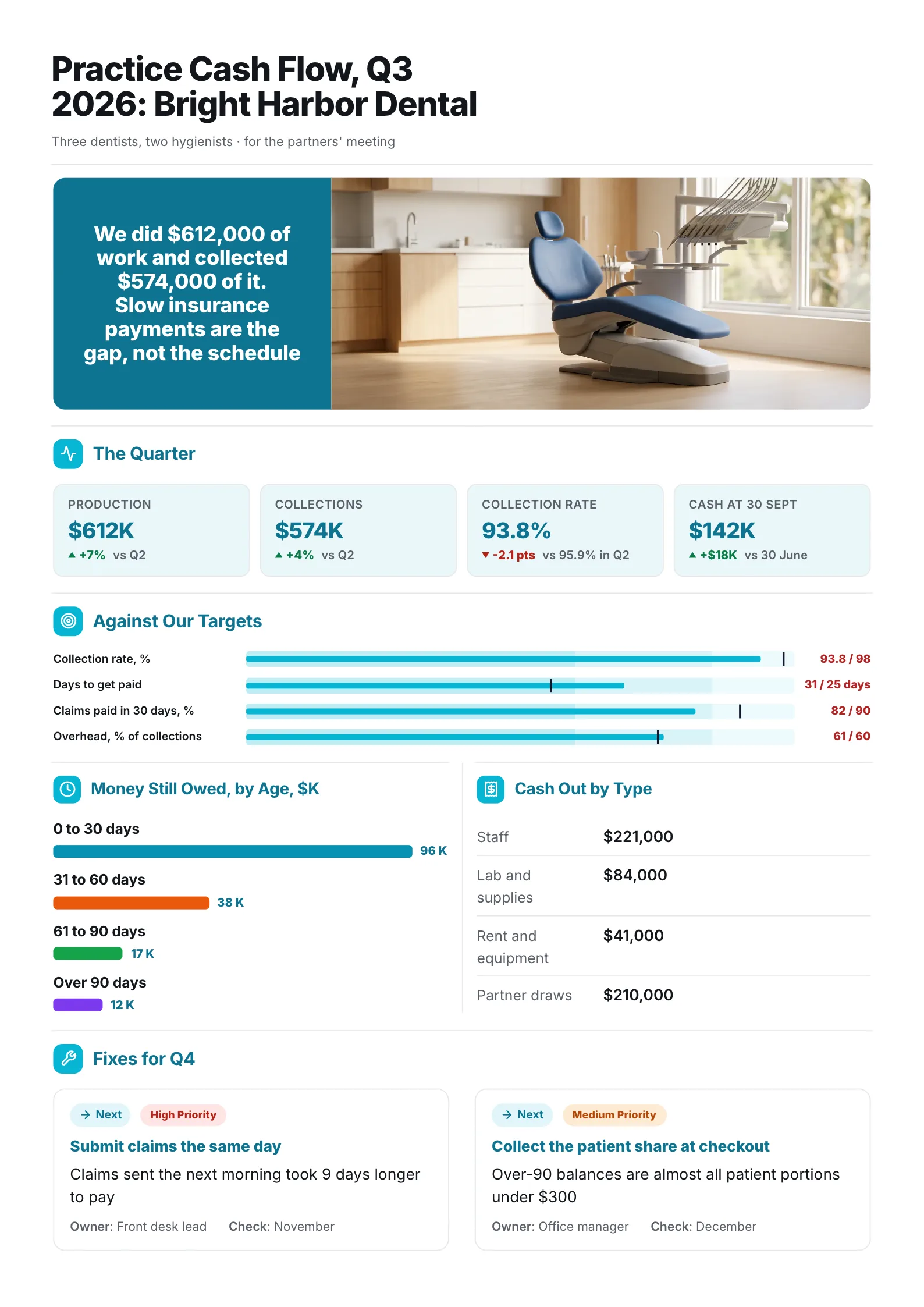 Cash Flow Summary: Dental Practice QuarterEdit for free(opens in a new tab)
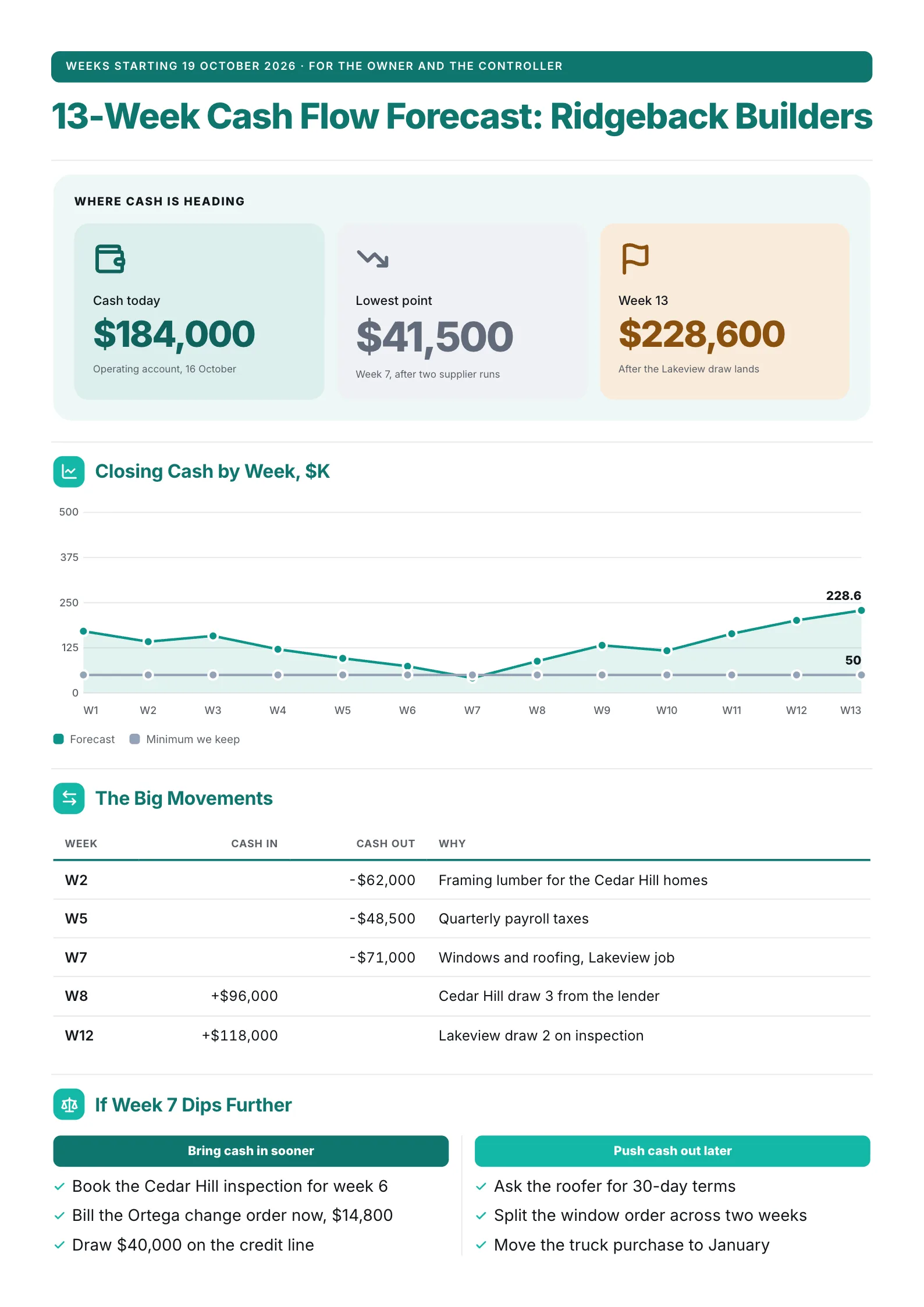 Cash Flow Summary: 13-Week ForecastEdit for free(opens in a new tab)
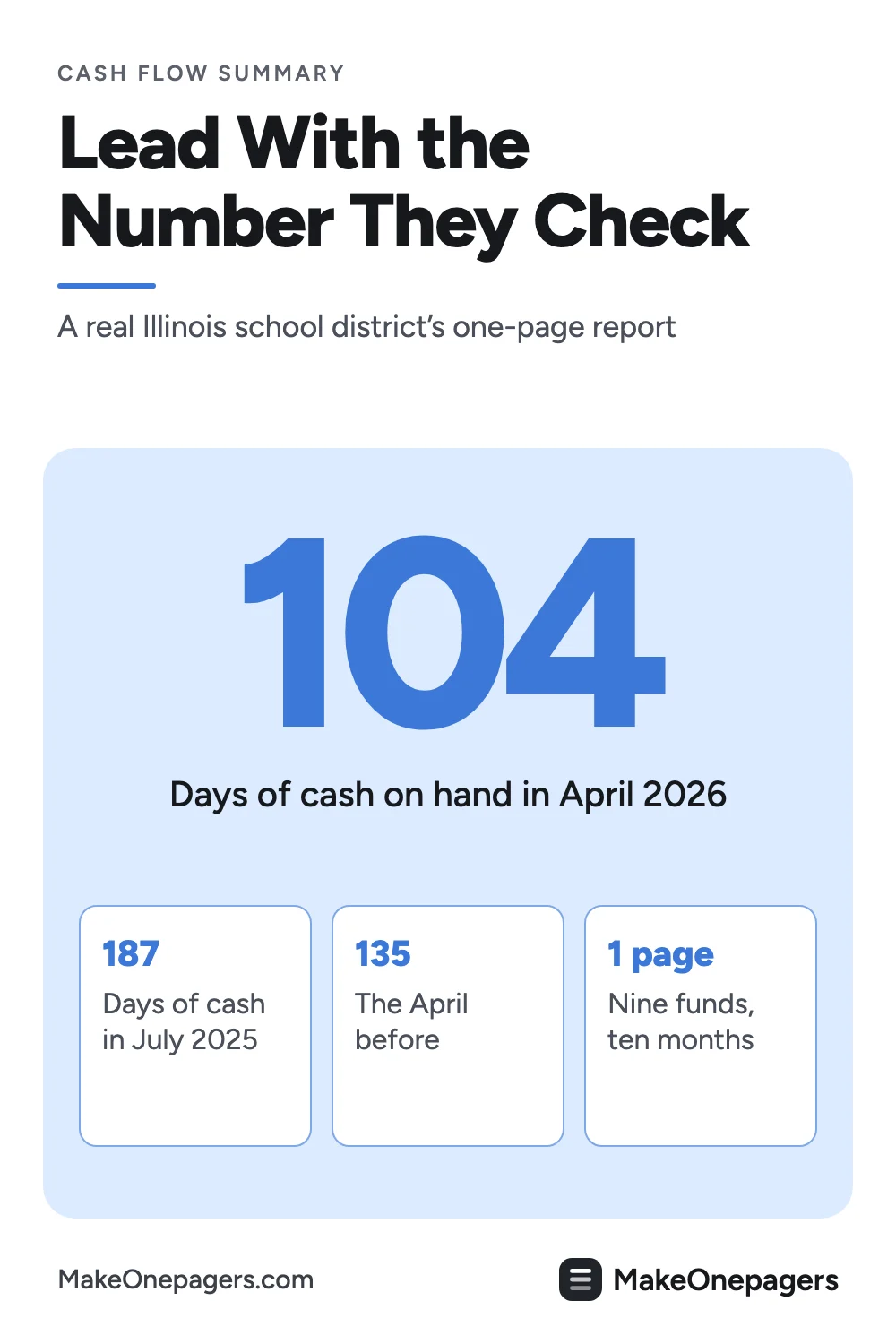
Below is a real one, published by an Illinois school district for its board, followed by five samples made with MakeOnepagers. The samples use invented names and figures, and each is built around a different number.
A real one: a school district's cash on one page
Geneseo Community Unit School District 228 posts a monthly financial report for its board. We read the May 2026 edition, the whole thing, which is one page. The superintendent and the board president approved it on May 14, 2026.
- This month's spending, beside last year's. Board bills of $1,855,608.97 plus payroll of $1,083,879.87 make $2,939,488.84, printed next to $2,836,666.51 from the same meeting a year earlier.
- One plain note. It says the past month's bills "reflect typical expenditures for this time of year."
- Cash at the end of every month. Nine funds, from education to working cash, across ten months from July to April, with a total for each month.
- The answer row. Under the totals sits "Days Cash on Hand": 187 in July 2025, falling to 104 in April 2026.
- Last year underneath. The same table for the year before, so April's 104 sits right above the 135 from the April before.
Your board shouldn't have to read nine funds to know where it stands, and this one doesn't. One row tells them how many days the district could keep paying its bills if no money came in. A heading reading "TAX LEVY REV" also sits over the late summer columns, where September's total jumps from $20.8 million to $27.7 million, so nobody mistakes that jump for a surprise.
The state uses the same measure. The Illinois State Board of Education's 2026 financial profile report takes a year of spending in a district's main operating funds and divides it by 360 to get a day's spending. Then it divides cash and investments in those funds, plus working cash, by that day's figure. 180 days or more earns the lowest-risk category, and the report says bond underwriters and financial advisers recommend 144 to 180 days at year end. We can't tell from the page whether Geneseo's monthly row uses exactly that formula, but your reader gets the idea either way.
Five examples, five numbers
| Example | Who reads it | The number it leads with |
|---|---|---|
| A farm season | The owners and the bank | The lowest balance of the year |
| An online store's holidays | The owner | Days cash is tied up |
| A family's month | Both partners | What was left over |
| A rental building | The owner and the lender | Income against mortgage payments |
| A startup | The board | Months of runway |
A farm season and its lowest balance
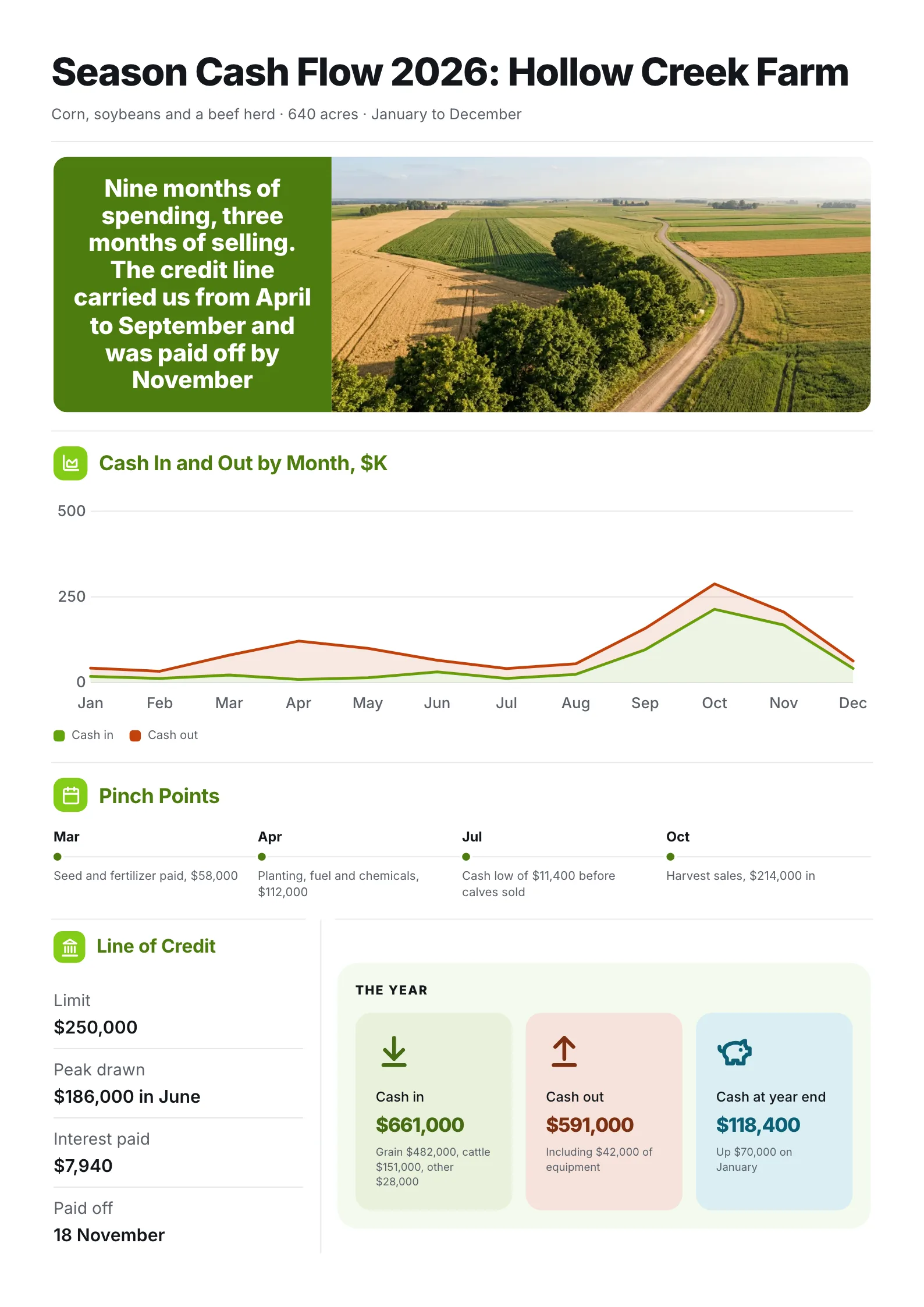
A farm spends for nine months and sells for three, so the year's total tells you little. Your low point decides how much you'll borrow.
 Edit this template
On this farm seasonal cash flow, the pinch points list a cash low of $11,400 in July, before the calves sold. The credit line beside it peaked at $186,000 in June on a $250,000 limit and was paid off November 18. For a farmer, that pair of numbers is the whole conversation with the lender.
An online store and the days its cash is tied up
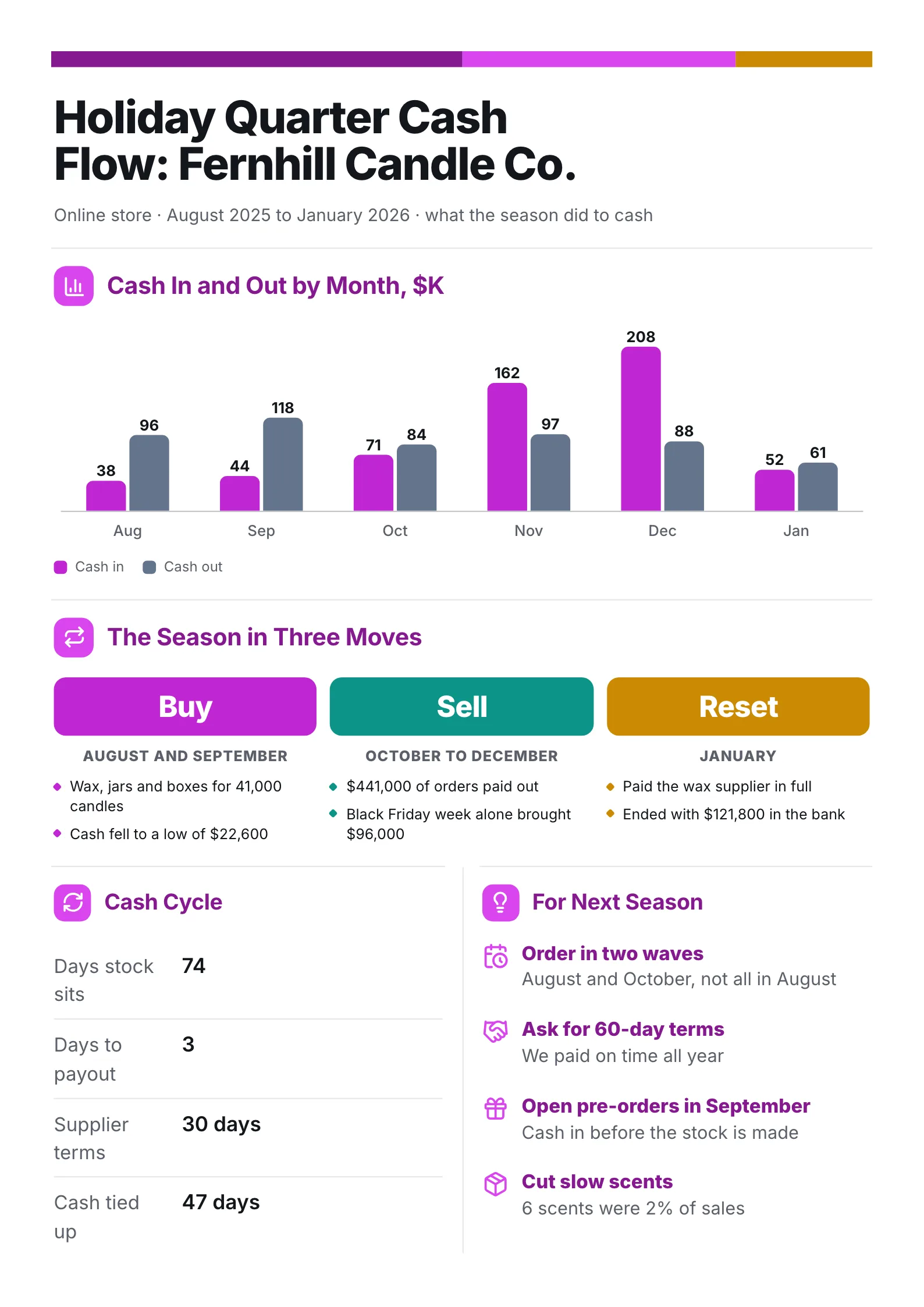
For a store that buys its stock months ahead, the question is how long your money is gone before it comes back.
 Edit this template
The ecommerce seasonal cash flow shows stock sitting for 74 days, plus 3 days to get paid, minus 30 days of supplier terms. That leaves cash tied up for 47 days. Ask for 60-day terms, as the page plans to, and your 47 drops to 17.
A family's month and what was left
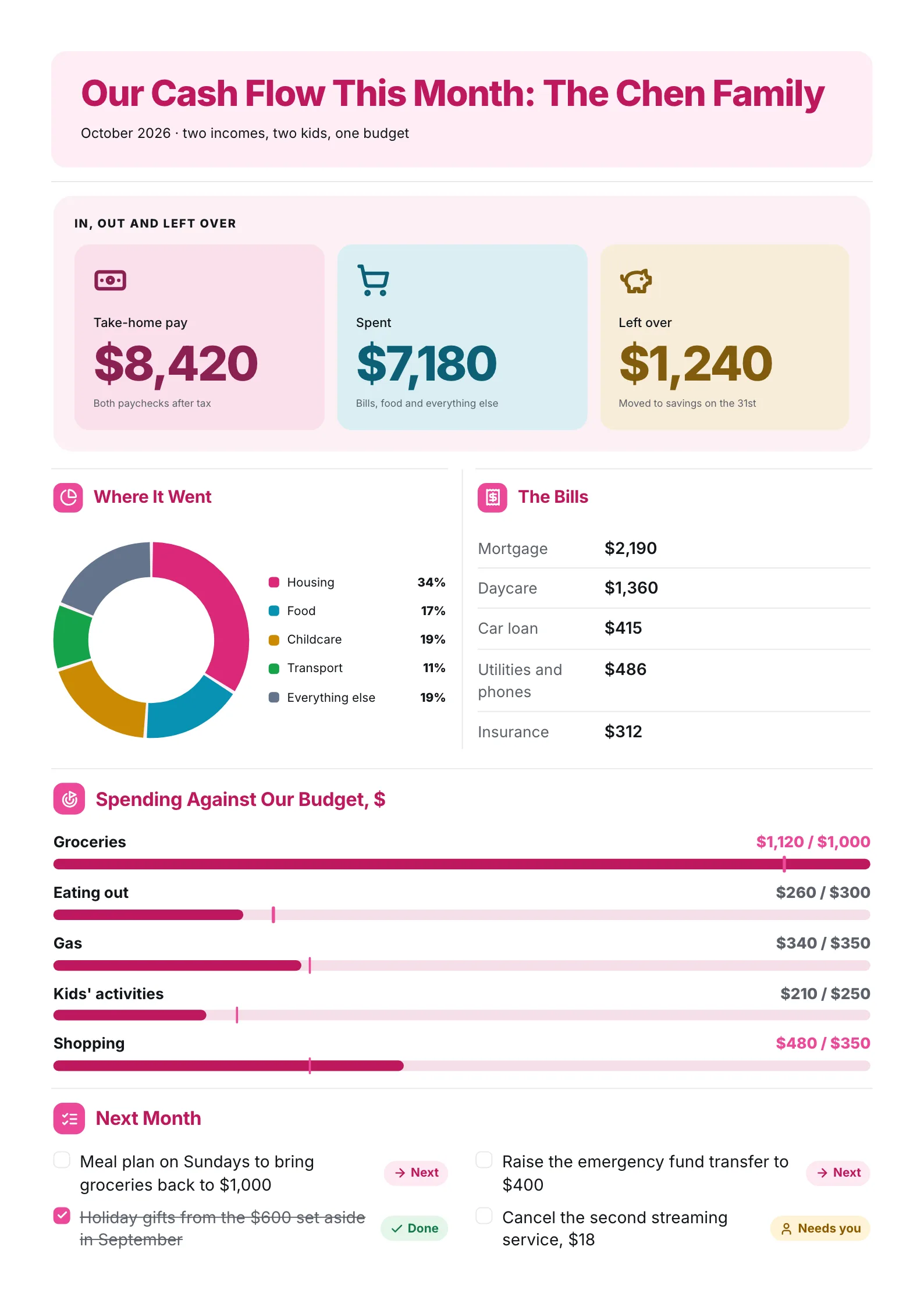
At home, your number is simpler. How much came in, how much went out, and what you have left.
 Edit this template
The household monthly cash flow puts $1,240 left over in the first row, moved to savings on the 31st. Groceries ran $1,120 against a $1,000 budget, so next month's first fix is a weekend meal plan.
A rental building and its loan coverage
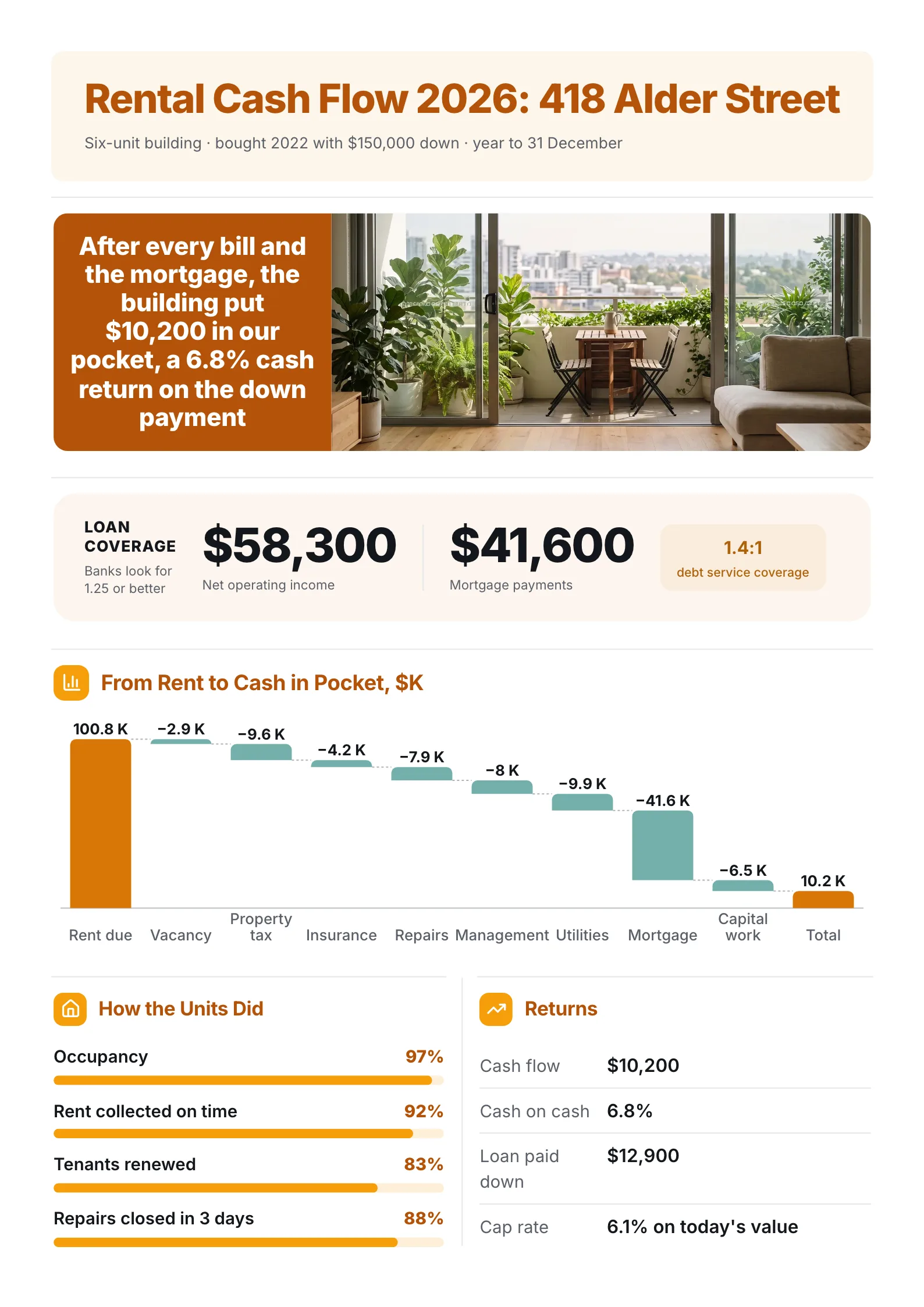
A lender reading your rental summary wants to know whether the building pays its own mortgage.
 Edit this template
On the rental property cash flow, $58,300 of net operating income against $41,600 of mortgage payments gives coverage of 1.40. The waterfall then walks from $100,800 of rent due to $10,200 in your pocket, a 6.8% return on the $150,000 down payment.
A startup and its runway
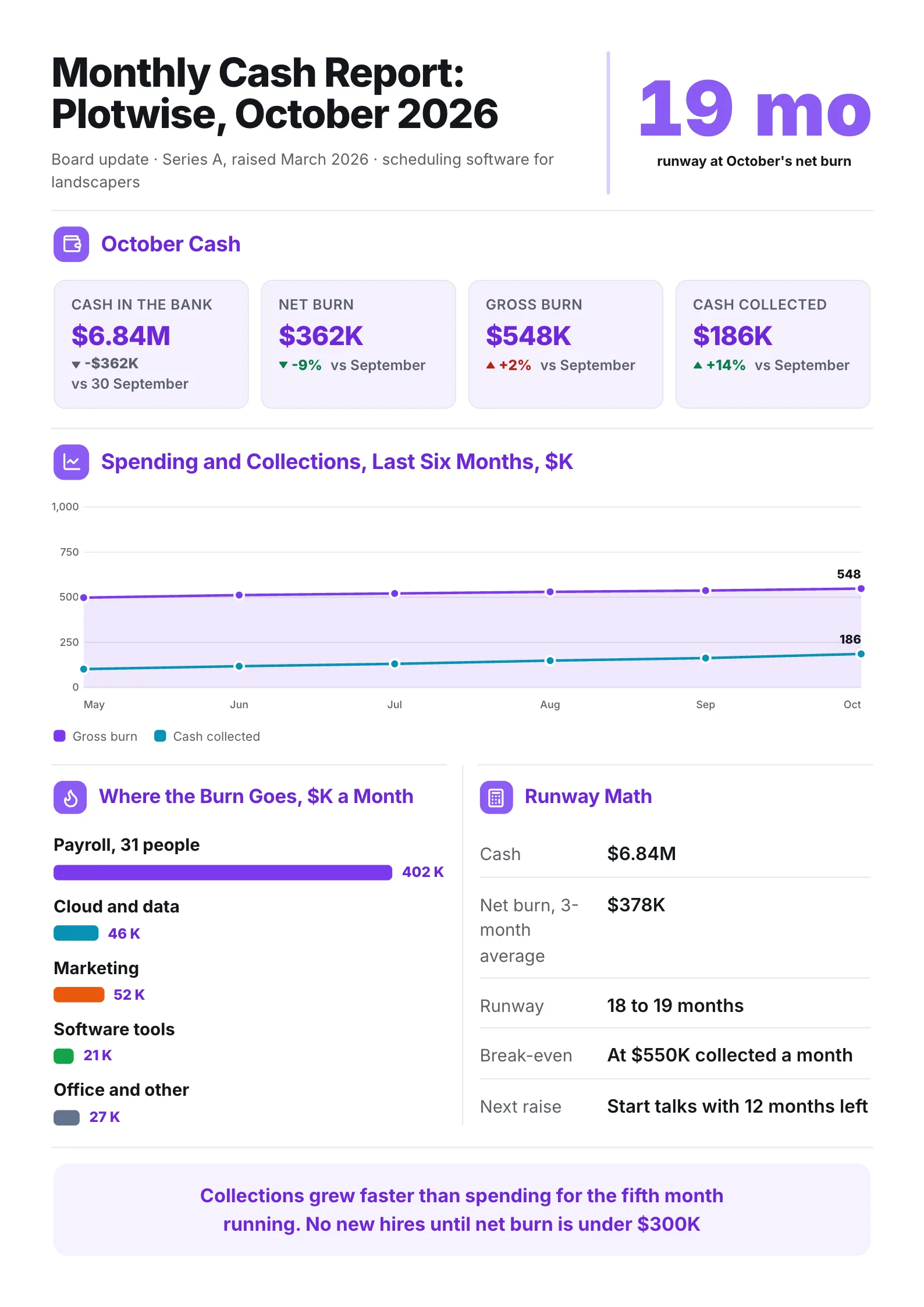
A startup board asks one thing before anything else: how many months until the money runs out?
 Edit this template
The startup burn and runway report divides $6.84 million in the bank by a three-month average net burn of $378,000. That gives 18 to 19 months of runway. The page also says when the burn stops: at $550,000 collected a month.
How to pick your number
Ask what your reader would do if the news were bad. A board would cut spending, so give them days of cash. A lender would call in the loan, so give them coverage. A family would skip a purchase, so give them what's left. Put that number first, then the table that proves it, then last period beside it, the way Geneseo stacks one year over the other.
Want the standard layout behind these pages? The cash flow summary format post reads six audited statements line by line.
Make your cash flow page
Decide who reads your summary and the number they'll check first. Then open a cash flow summary layout in MakeOnepagers and put that number at the top. If you keep your figures in a bank export, drop it into the free AI One-Pager generator and check each line it lays out against your statement.
Frequently asked questions
What is days cash on hand?
The number of days you could keep paying your bills if no new money came in. Illinois computes it as cash and investments divided by a year of operating spending over 360.
How do you work out runway on a cash flow summary?
Divide the cash in the bank by your average monthly net burn. The startup sample uses a three-month average: $6.84 million divided by $378,000 is about 18 months.
Should a cash flow summary show the lowest balance?
Yes, when cash swings during the period. A year that ends up $70,000, like the farm's, can still dip to $11,400 in July.
Can a whole organization's cash fit on one page?
Geneseo fits nine funds, ten months and the prior year on one page. Group small funds into one line if your page gets crowded.




