Book Report One Pager: Free Template, Example and Rubric Tips
How to make a book report one pager: the 8 parts teachers look for, a worked Frankenstein example with themes, quotes and characters, and the rubric traps.

A book report one pager is a single sheet that shows what a book means: its title and author, the themes, a few quotes with where they appear, the main characters and what you think, all arranged so a reader sees the whole book at a glance. Teachers assign it instead of a written report because it forces you to choose the most important ideas and show how they connect. Below are the eight parts teachers look for, a free template, a worked example on Frankenstein, a layout plan and the rubric traps that cost easy points. Start from a free one pager template.
One‑Pager examples
Real One-Pagers made with MakeOnepagers. Open any one to edit it as your own.
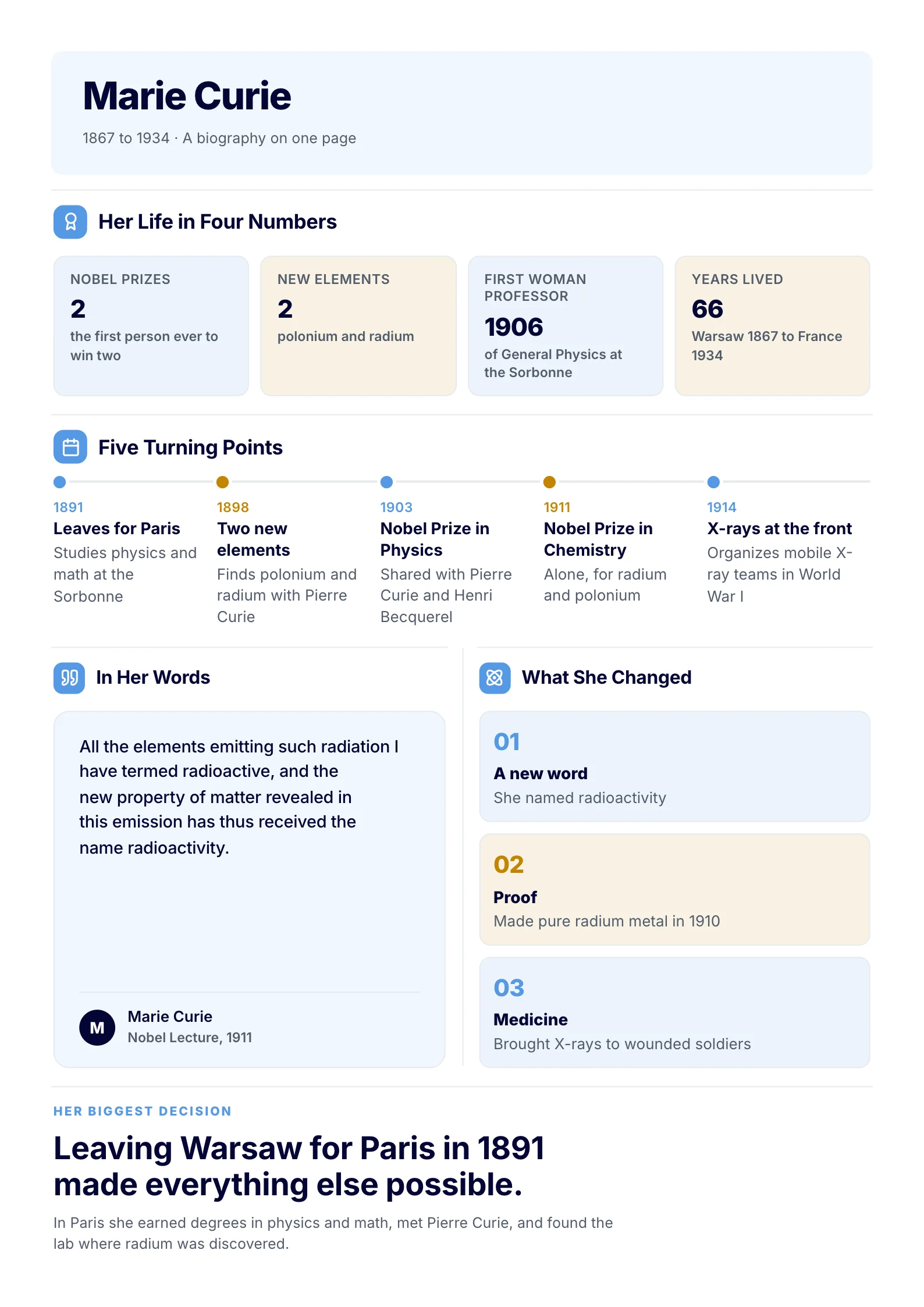 BiographyEdit for free(opens in a new tab)
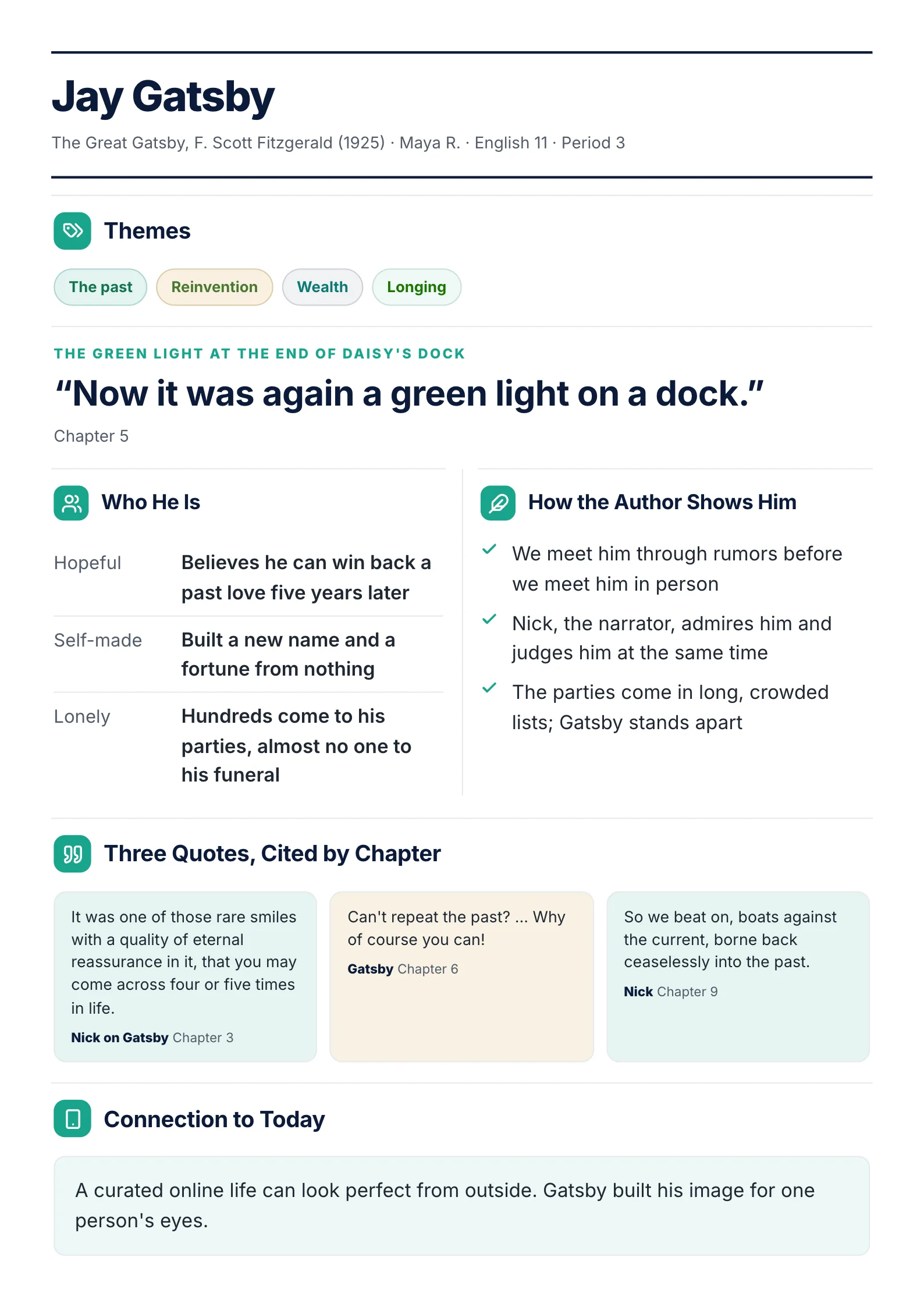 Character One-PagerEdit for free(opens in a new tab)
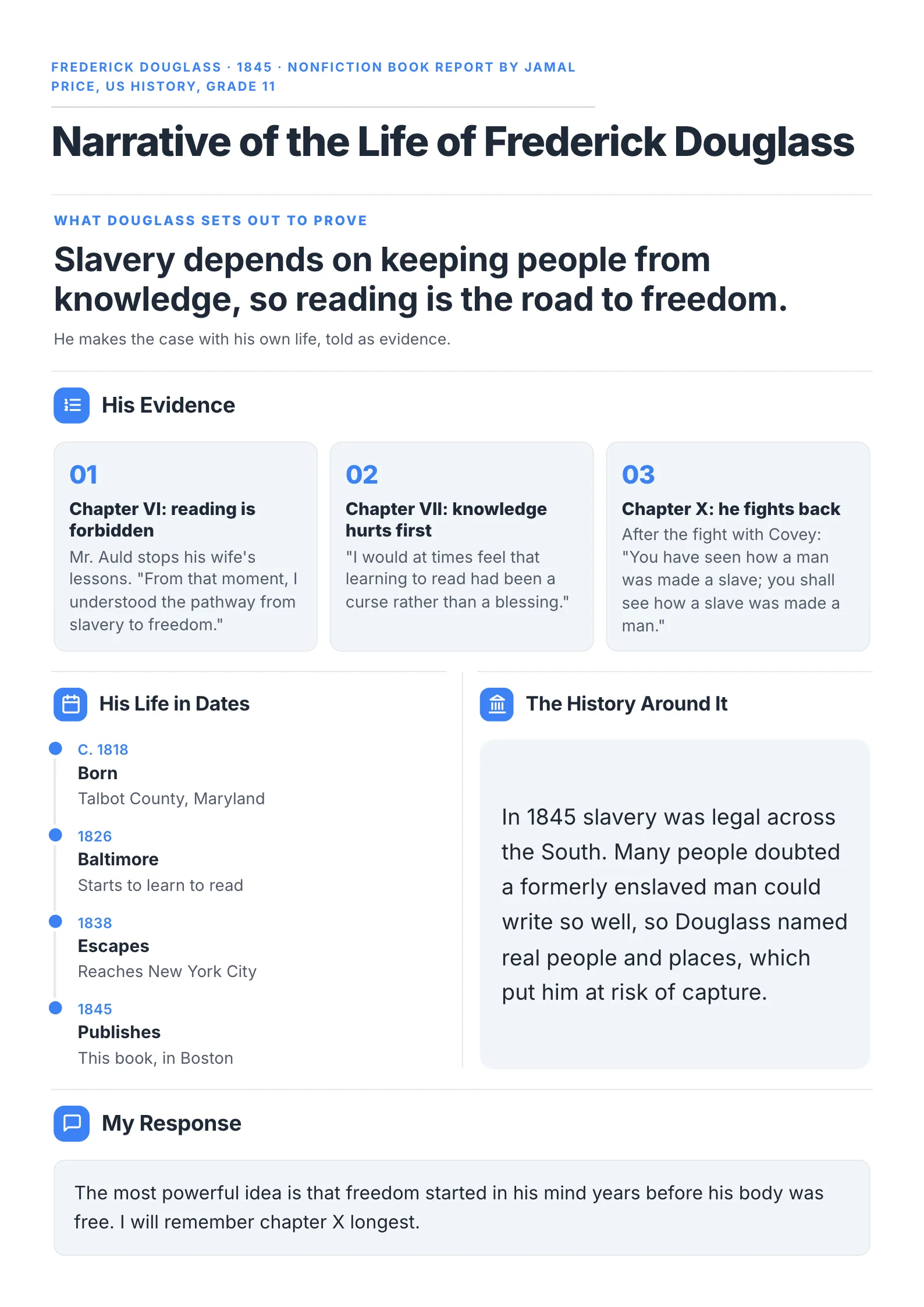 Book Report: Narrative of the Life of Frederick DouglassEdit for free(opens in a new tab)
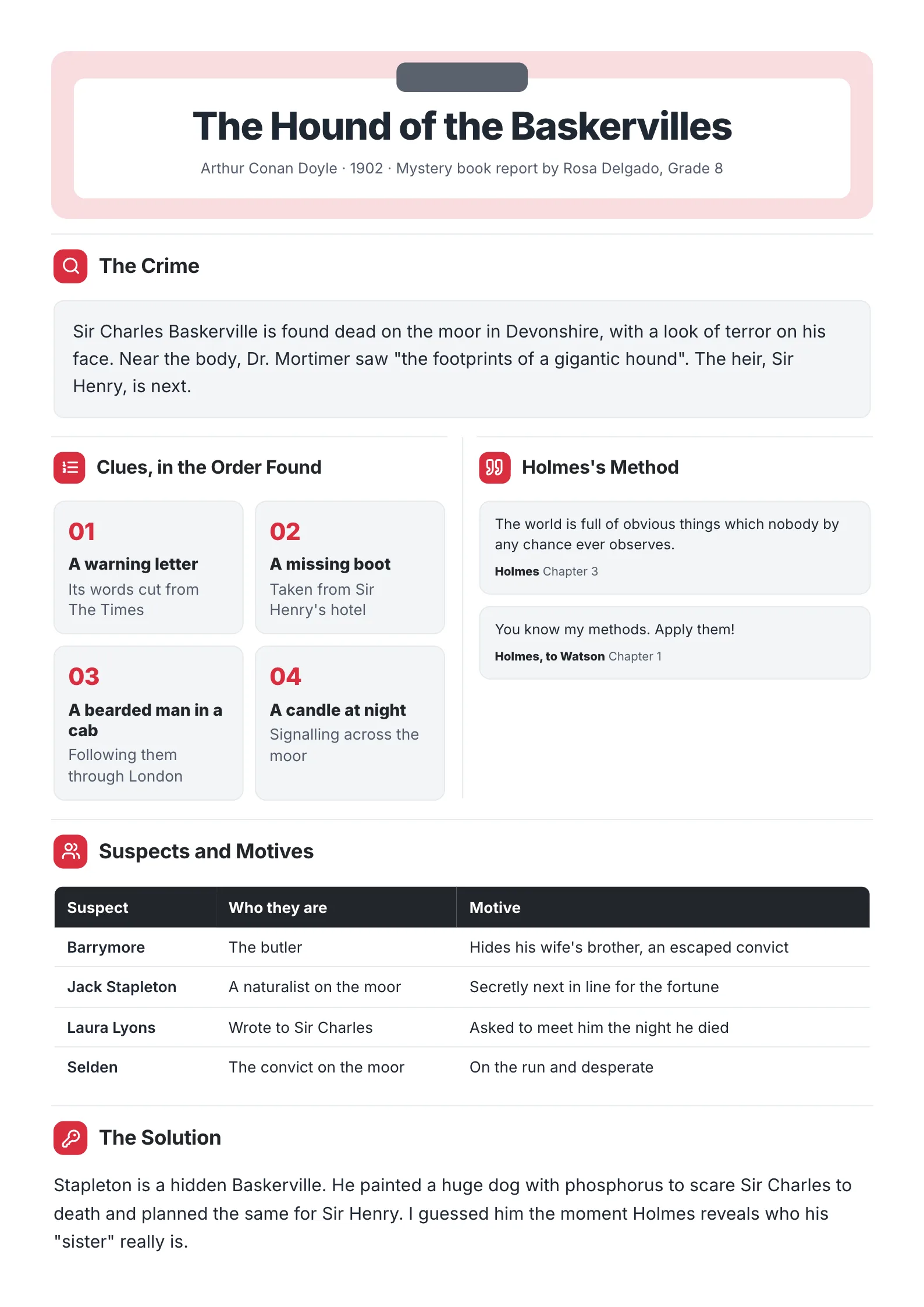 Book Report: The Hound of the BaskervillesEdit for free(opens in a new tab)
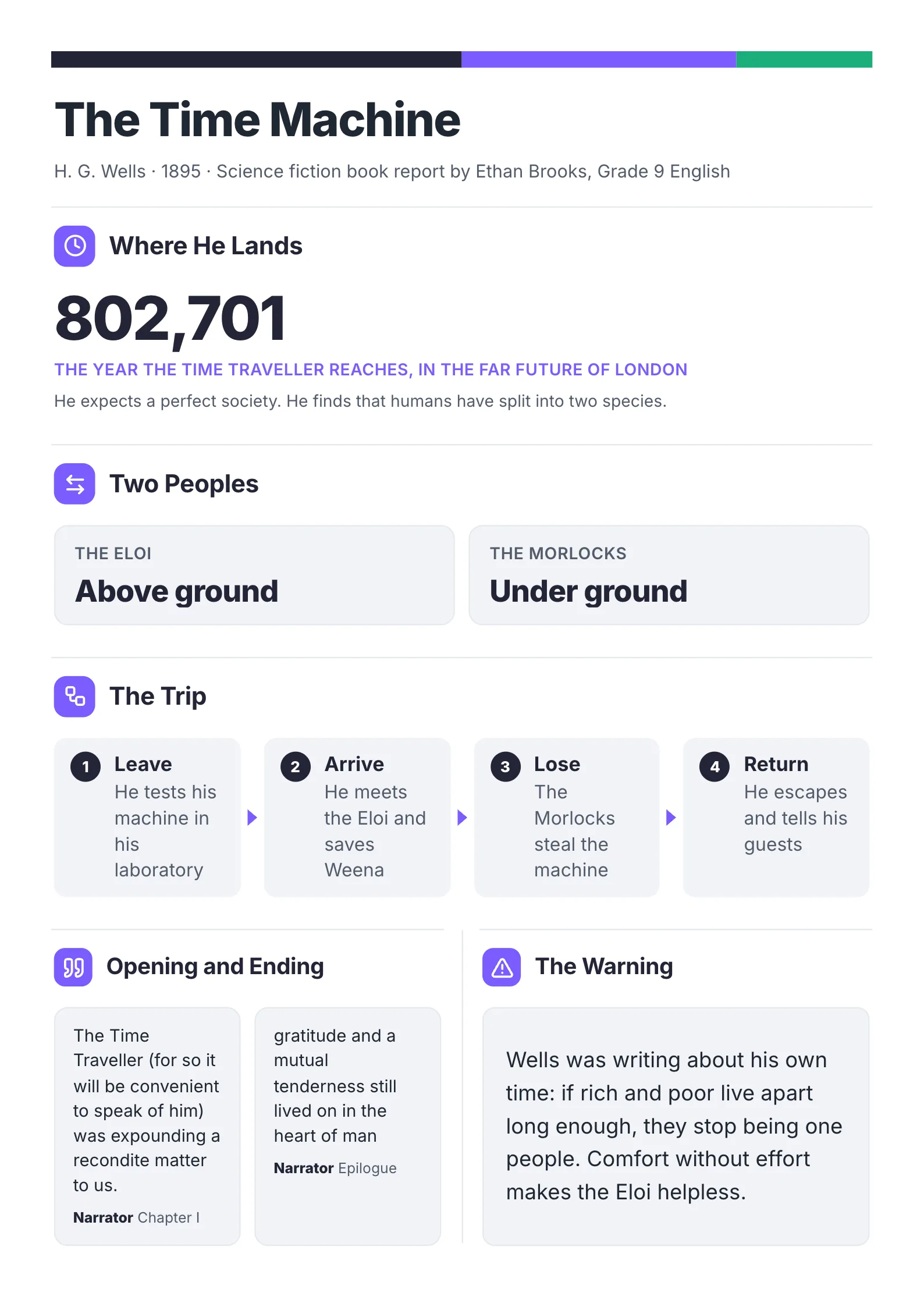 Book Report: The Time MachineEdit for free(opens in a new tab)
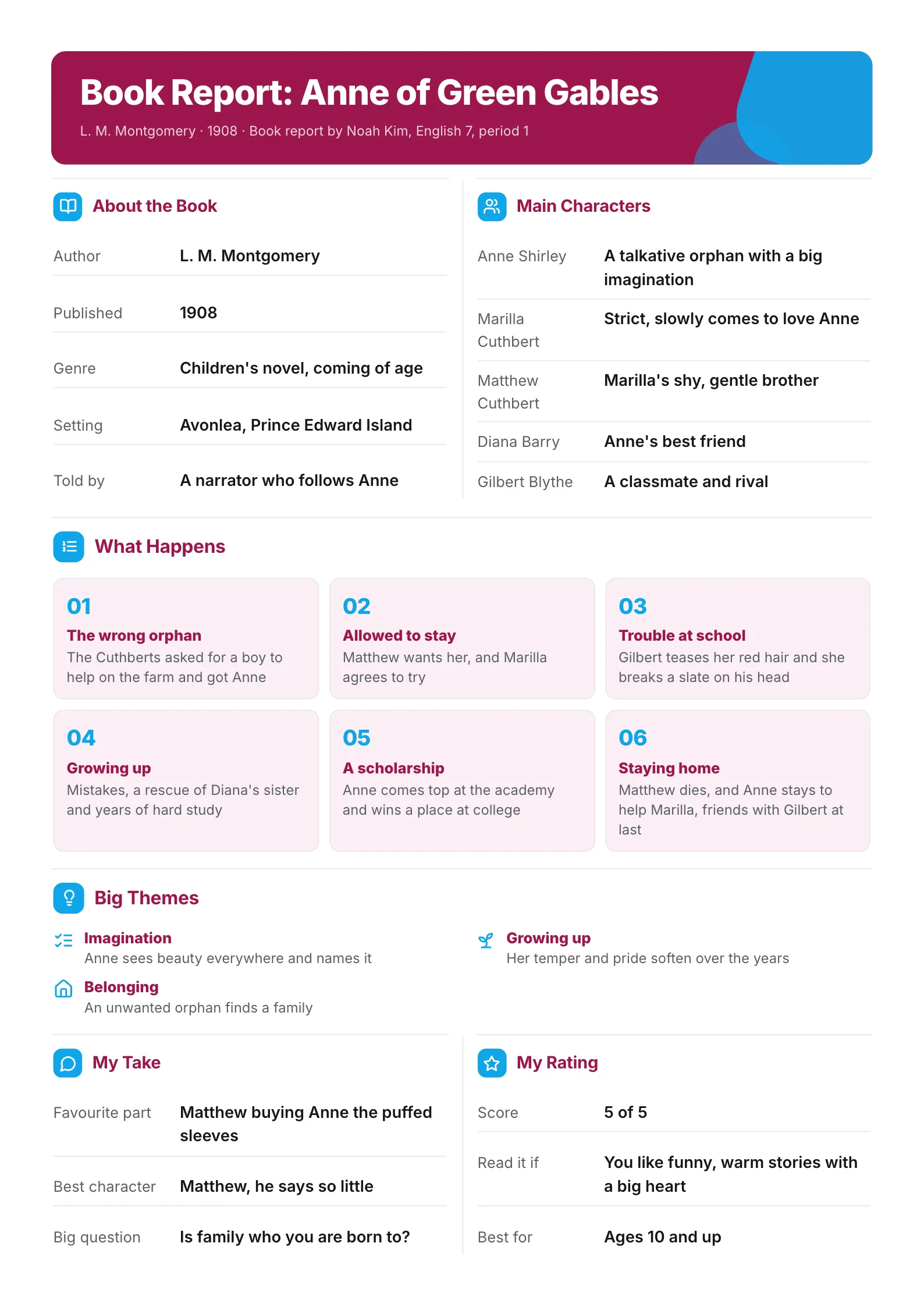 Book Report: Anne of Green GablesEdit for free(opens in a new tab)
Every example was made with MakeOnepagers, and each one opens as a template you can edit for free.
What is a book report one pager?
A one pager is a single-page response to something you have read, mixing short written pieces with visual ones. For a book report, it replaces several pages of writing with one sheet that has to include:
- Facts: the title, author, and often the year or genre.
- Analysis: themes, symbols and what the book is really about.
- Evidence: quotes, usually with page or chapter numbers.
- Your response: an opinion, a question or a connection to your life or the world.
Teachers' instructions vary. Many ask for an unlined 8.5 by 11 inch sheet filled edge to edge, the title shown in a symbolic way and a set number of quotes. Read your own assignment sheet or rubric first, and treat the parts below as the usual list, not the rule.
The 8 parts of a book report one pager
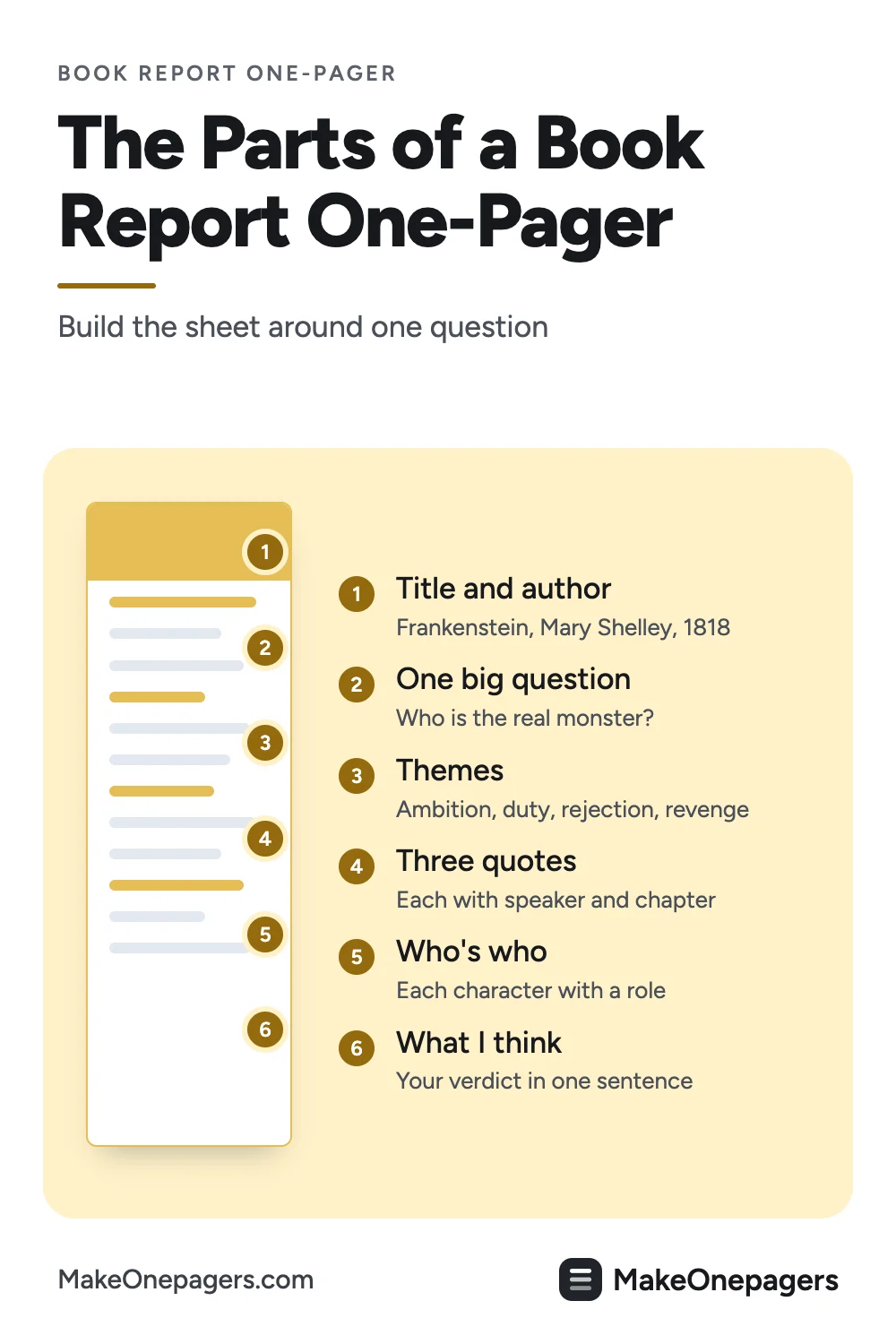
- Title and author, large, often drawn or styled to hint at the book.
- One big question or idea that holds the sheet together. "Who is the real monster?"
- Three or four themes, each a word or short phrase, linked to the big question.
- Three quotes with the speaker and the page or chapter.
- Main characters, two to four, each with their role and one line on what they do.
- A symbol or image that stands for the book, explained in a sentence.
- A short summary, if the rubric asks for one: three sentences, no spoilers unless allowed.
- What I think: your verdict or argument in one strong sentence, plus a line of reasoning.
A free book report one pager template
| Part | What to write, with an example |
|---|---|
| Title and author | Frankenstein, Mary Shelley, 1818 |
| Big question | Who is the real monster? |
| Themes | 3 or 4. Ambition, duty, rejection, revenge |
| Quotes | 3, with speaker and chapter. "I am malicious because I am miserable." The Creature, chapter 17 |
| Characters | 2 to 4, role and one line. Robert Walton, the narrator, whose letters frame the story |
| Symbol | One image and why. Fire: knowledge that warms and burns |
| Summary | 3 sentences, if required |
| What I think | One sentence. The Creature was not born a monster. He was made one |
Book report one pager example: Frankenstein
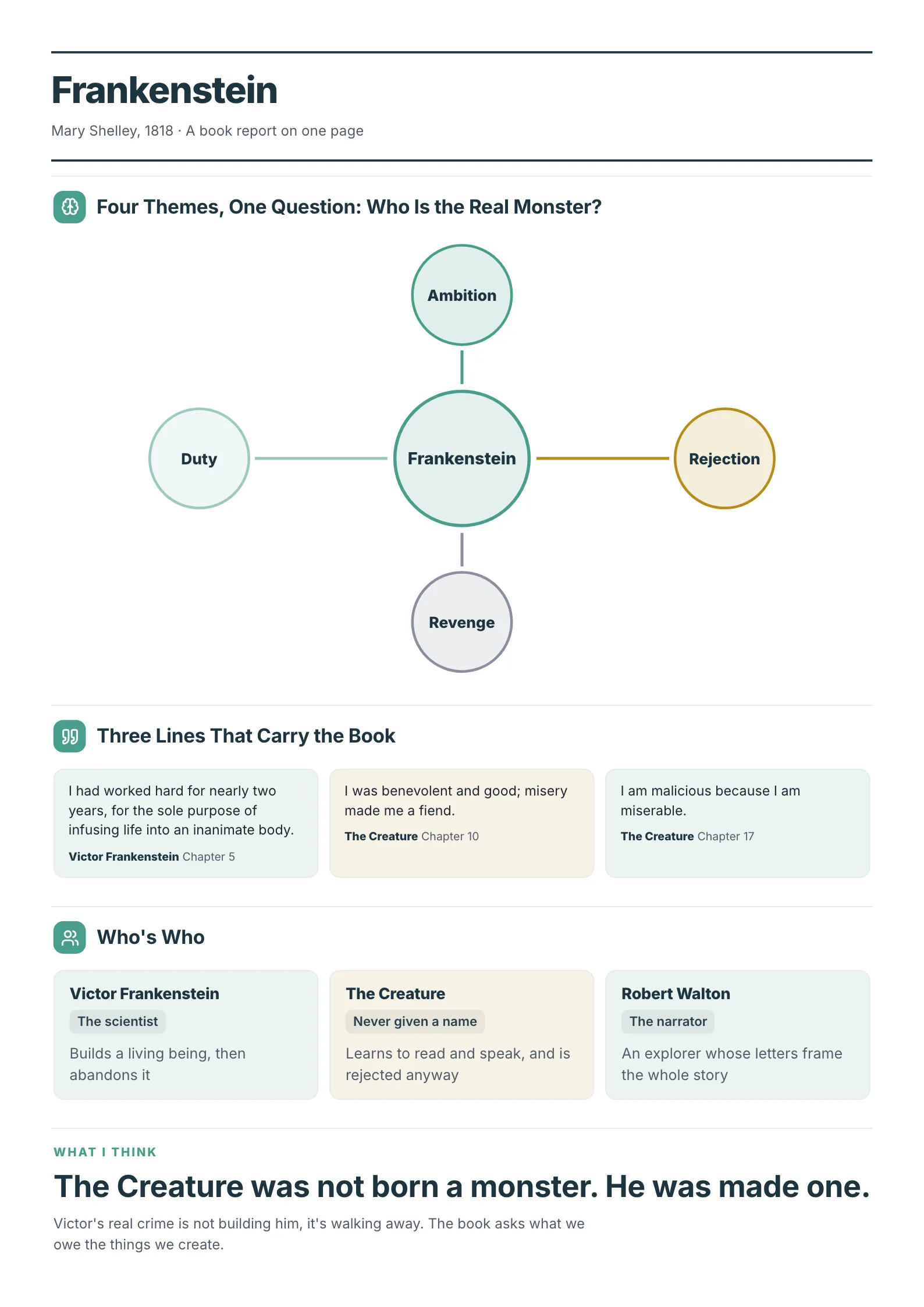 Edit this template
An example book report one pager for a novel often taught in high school.
What to copy:
- A question as the heading of the themes: "Four Themes, One Question: Who Is the Real Monster?" Every theme on the sheet now argues something.
- Themes drawn as a map around the title: ambition, duty, rejection and revenge. The picture shows that the themes connect, which is the analysis.
- Three quotes that trace the argument: Victor's ambition in chapter 5, the Creature's "I was benevolent and good; misery made me a fiend" in chapter 10, and "I am malicious because I am miserable" in chapter 17.
- "Who's Who" with a role tag each: the scientist, never given a name, the narrator. One line of action under each.
- A closing verdict in large type: "The Creature was not born a monster. He was made one." Then one line of reasoning: Victor's real crime is walking away.
Edit for free: book report template.
Worked example: planning the layout before you draw
Most one pagers lose points for running out of room, not for weak ideas. Divide the sheet first. Here is one plan for an 8.5 by 11 inch sheet, by share of the space. The shares are an example.
| Area | Share of the sheet | What goes there |
|---|---|---|
| Title band | 15% | Title, author, year, a small symbol |
| Theme map | 35% | Big question in the middle, 4 themes around it |
| Quotes | 20% | 3 quotes in boxes with speaker and chapter |
| Characters | 20% | 3 characters, role and one line |
| What I think | 10% | One sentence in large type and one line of reasoning |
That adds to 100%. Sketch the five areas lightly in pencil, fill the words first and add color and drawings last.
How to make a book report one pager in 6 steps
- Finish the book and write one question it makes you ask. That question is your center.
- Pick three or four themes that help answer it.
- Find three quotes, one early, one middle and one late, so they show change across the book.
- Choose your characters and write one line on what each one does.
- Plan the layout in pencil using the shares above.
- Write your verdict last, after you have looked at the evidence on the sheet.
Book report one pager mistakes
- No page or chapter numbers on quotes. Most rubrics check for them, and they are easy points.
- A summary that fills half the sheet. Your teacher has read the book. Keep any summary to three sentences.
- Decoration without meaning. A border of skulls is only worth points if a sentence explains why it fits the book.
- Themes as single words with nothing attached. Link each theme to a character, a quote or the big question.
- No opinion. "What I think" is often the highest-scoring box. Take a side and back it.
- Ignoring the rubric. If it asks for an unlined sheet, a border quote or a personal connection, include each one.
Book report one pager ideas
- A theme map around the title, as in the example.
- A timeline of the plot along the bottom edge, with the three quotes placed where they happen.
- A split sheet: one half for the main character at the start, the other at the end.
- A symbol at the center, such as a mask, a key or a ship, with the themes written inside it.
- A conversation: two characters' quotes facing each other across the sheet, with your verdict between them.
For a single character or a poem, the character one pager and poetry one pager use the same idea on a smaller subject.
For other subjects, see these one pager examples for students, from history to math.
Make your book report one pager
Open the free book report template and put in your book, or drop your reading notes into the free AI One-Pager generator and get a finished first draft back to edit and make your own.
Frequently asked questions
What should a book report one pager include?
The title and author, one big question or idea, three or four themes, three quotes with page or chapter numbers, the main characters, a symbol, a short summary if required, and your own opinion in one strong sentence.
How do you make a one pager for a book?
Choose one question the book raises, collect themes, quotes and characters that help answer it, plan the layout in pencil, write the words first, then add drawings and color.
Can I make a book report one pager on a computer?
Yes, unless your teacher asks for a hand-drawn sheet. Open the book report template, change the words to your book and print or submit it as a PDF.
What is the difference between a book report and a book review one pager?
A book report shows that you understood the book: themes, characters, evidence. A book review focuses on your judgment: who should read it and why. Many one pagers combine both in the "What I think" box.




