About Me vs Bio: What 10 Real Pages From 5 Professors Show
About me vs bio: we read 5 professors' university bios beside the About pages on their own sites. Here's what each one holds, and how to write both.

A bio sums you up in the third person, written so someone else can print it in a program, a directory or a press release. An about me speaks to whoever just landed on your page, so it can say "I," tell them how to reach you and answer what they'd ask. To see the difference in real life, we read 5 professors' university faculty pages beside the About text on their own websites. Three of the five university pages had no paragraph at all. Start from a free one pager template.
One‑Pager examples
Real One-Pagers made with MakeOnepagers. Open any one to edit it as your own.
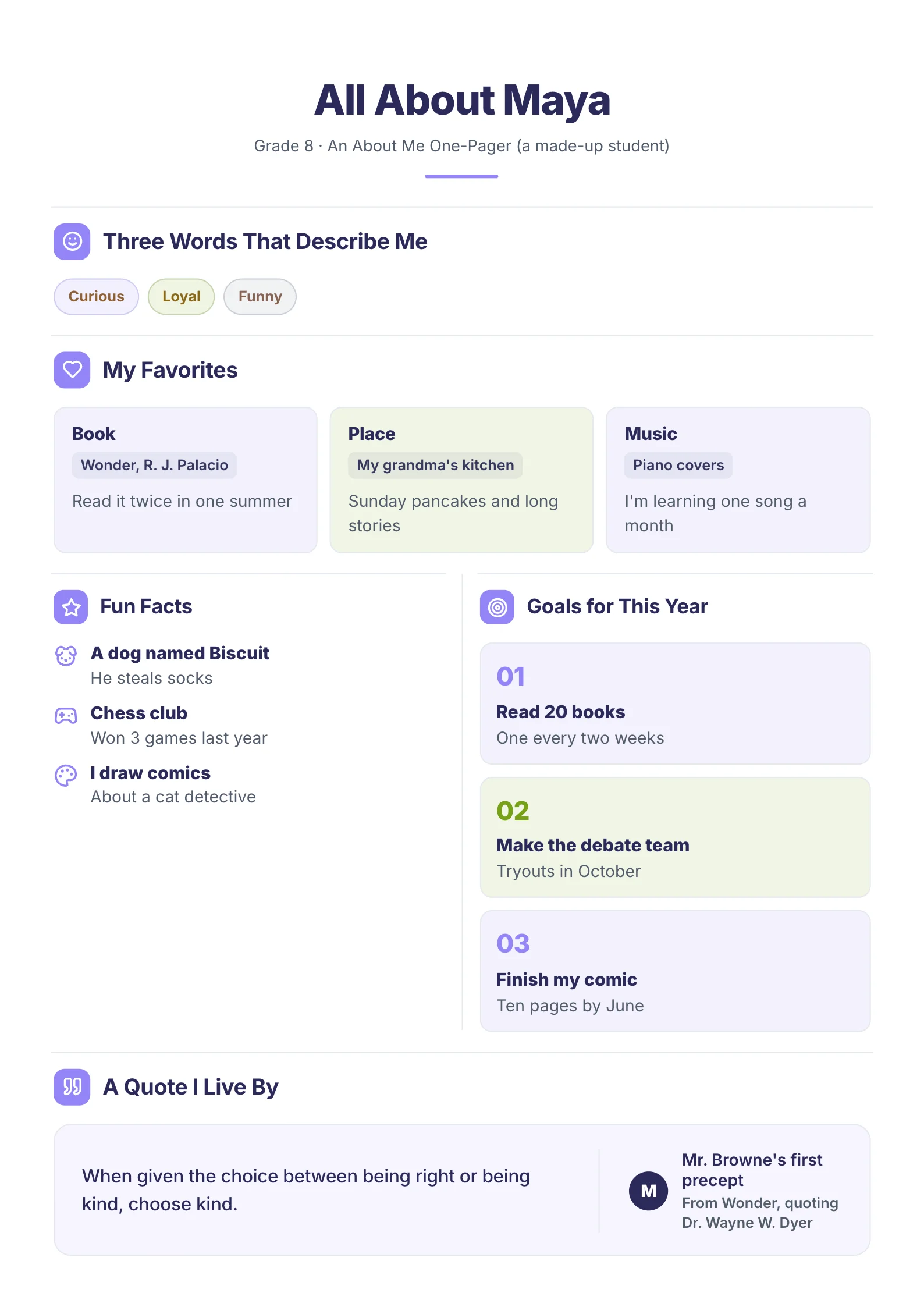 About MeEdit for free(opens in a new tab)
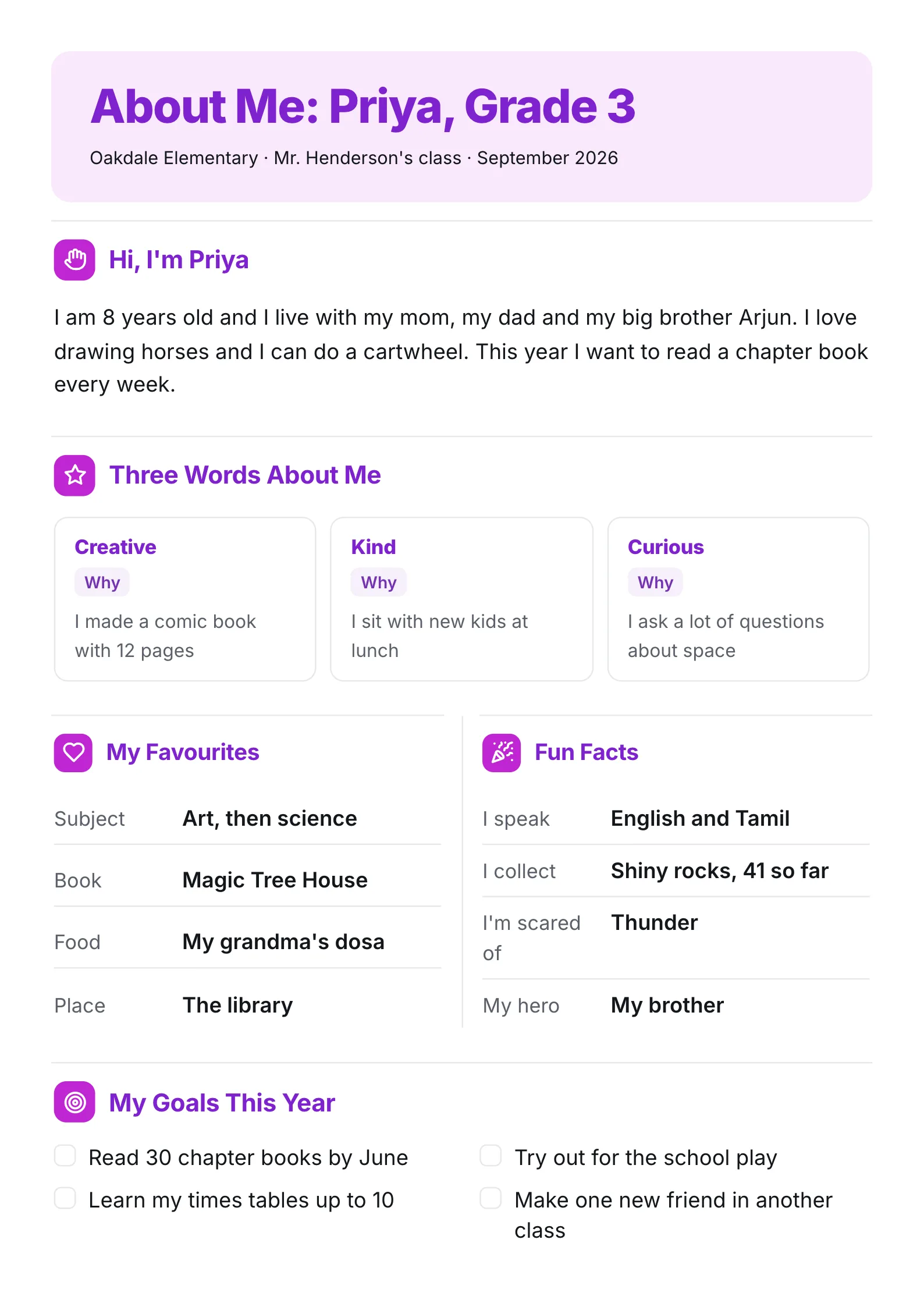 About Me: Elementary StudentEdit for free(opens in a new tab)
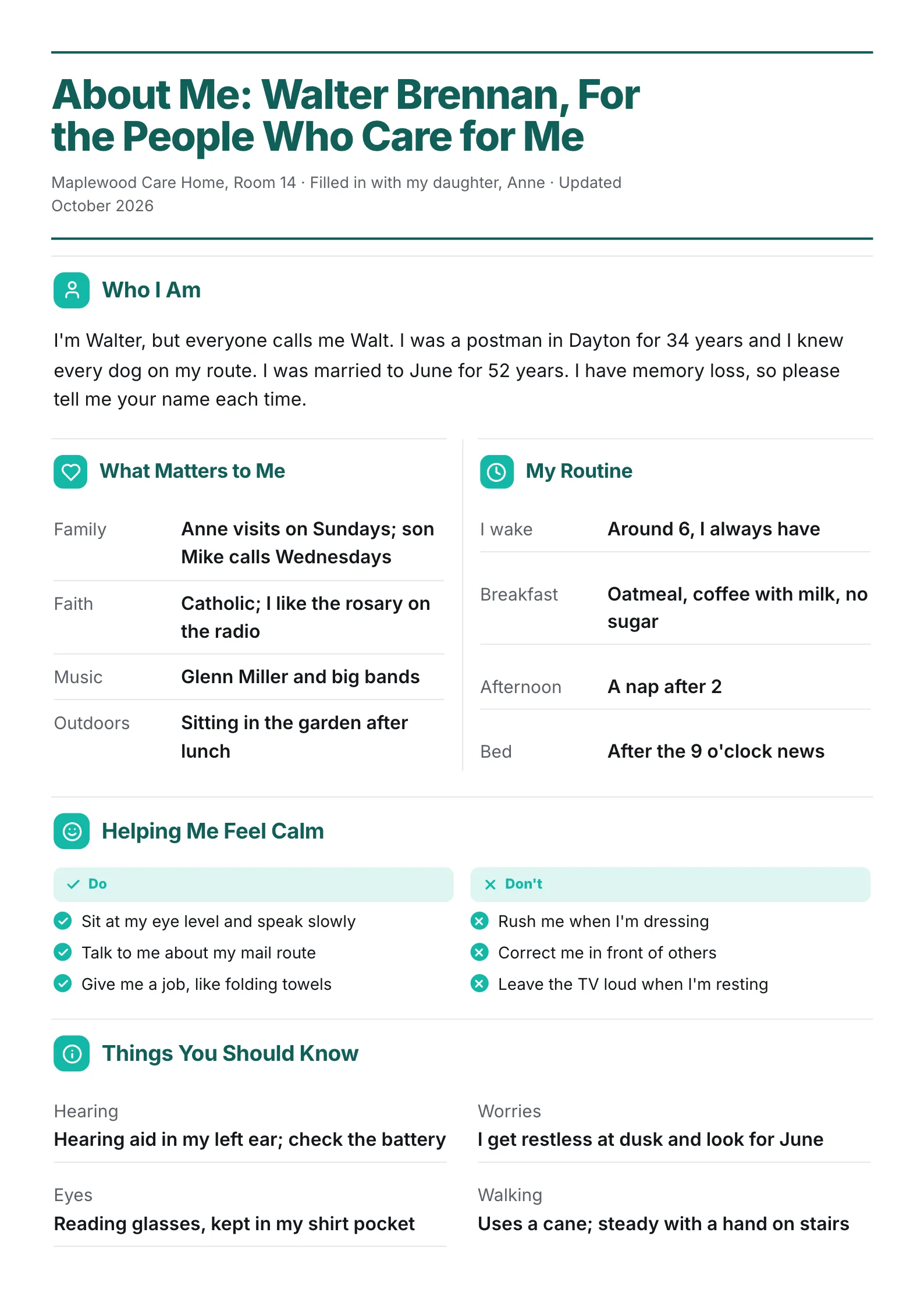 About Me: Care Home Resident ProfileEdit for free(opens in a new tab)
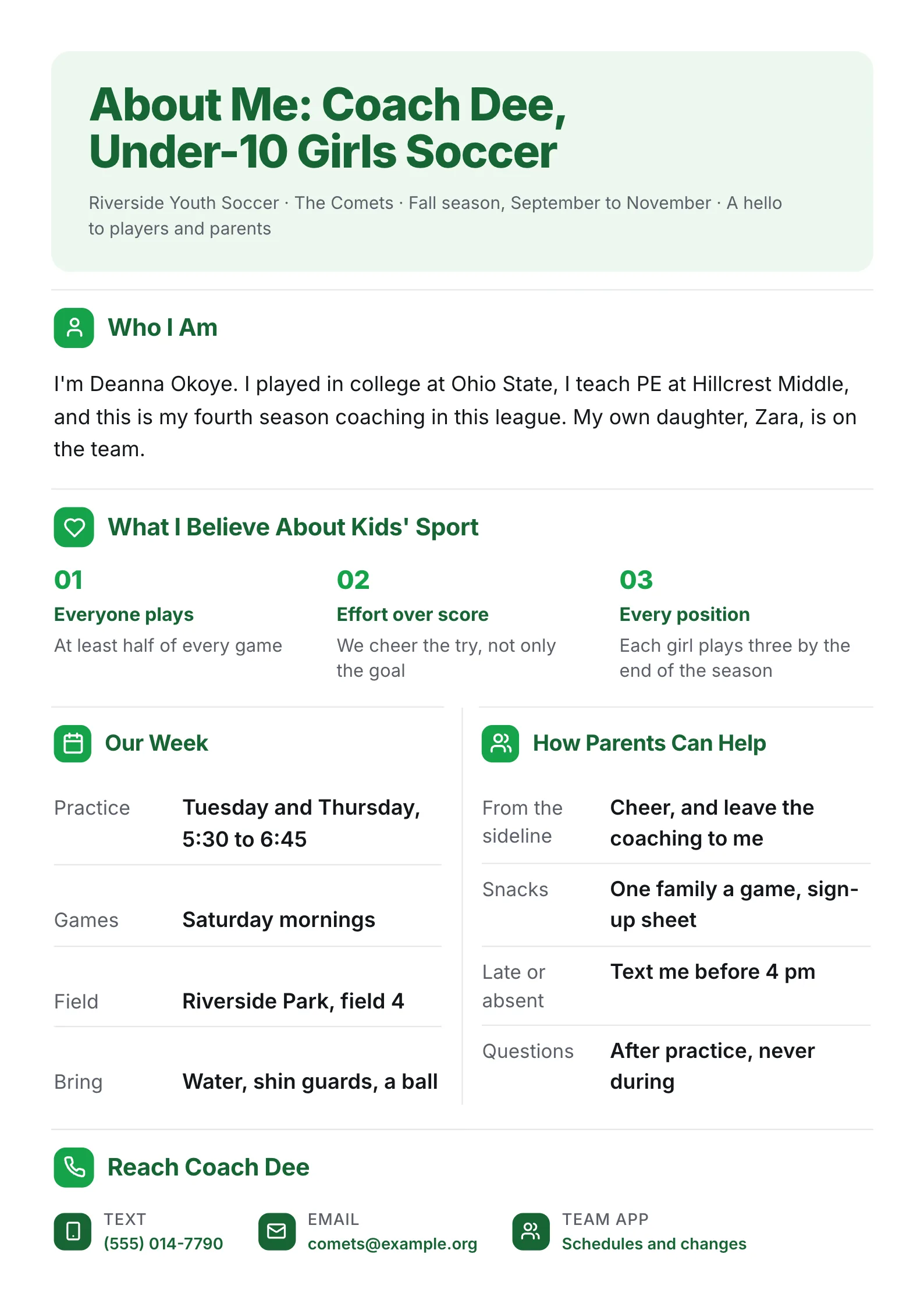 About Me: Youth Sports CoachEdit for free(opens in a new tab)
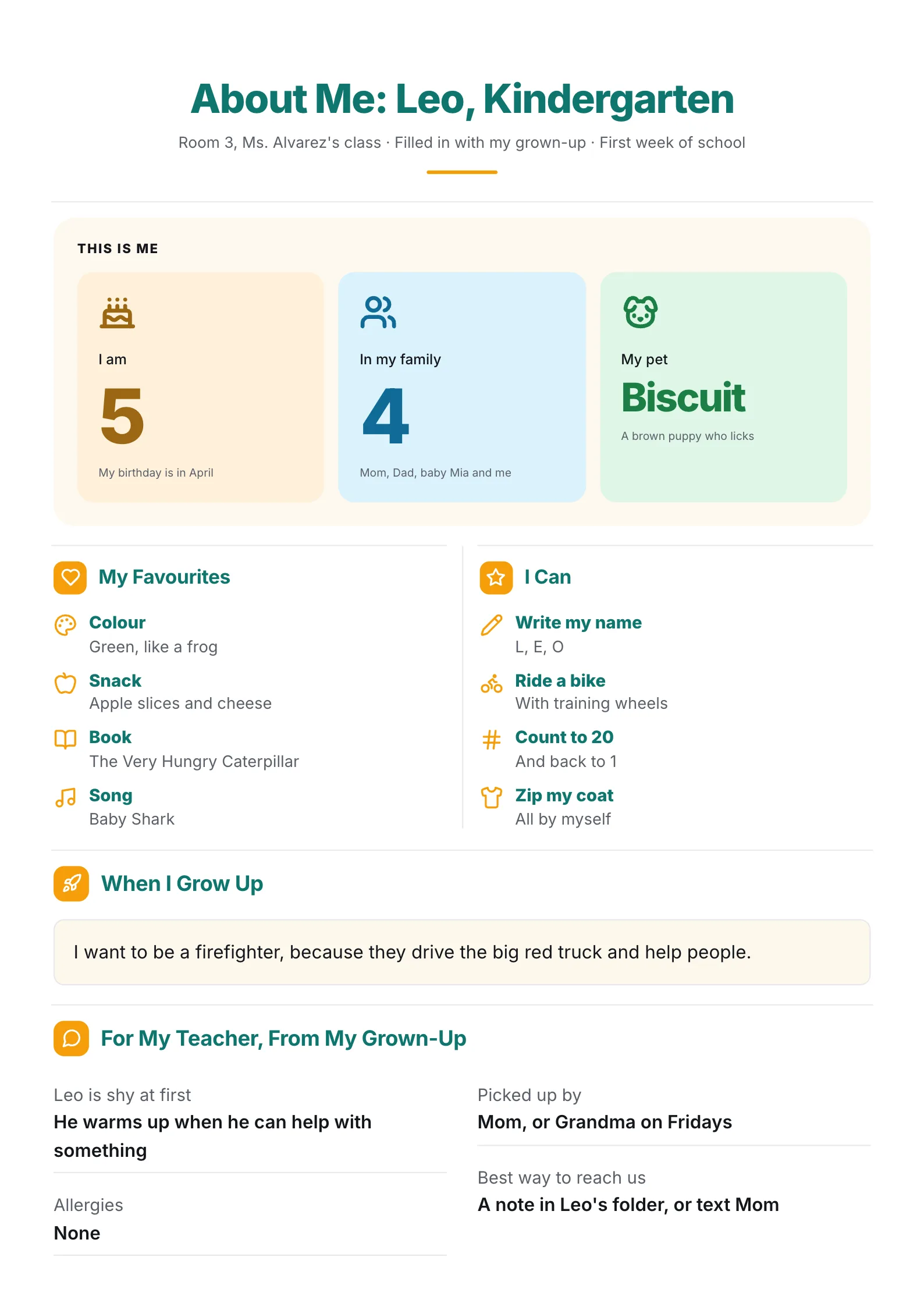 About Me: Kindergarten StudentEdit for free(opens in a new tab)
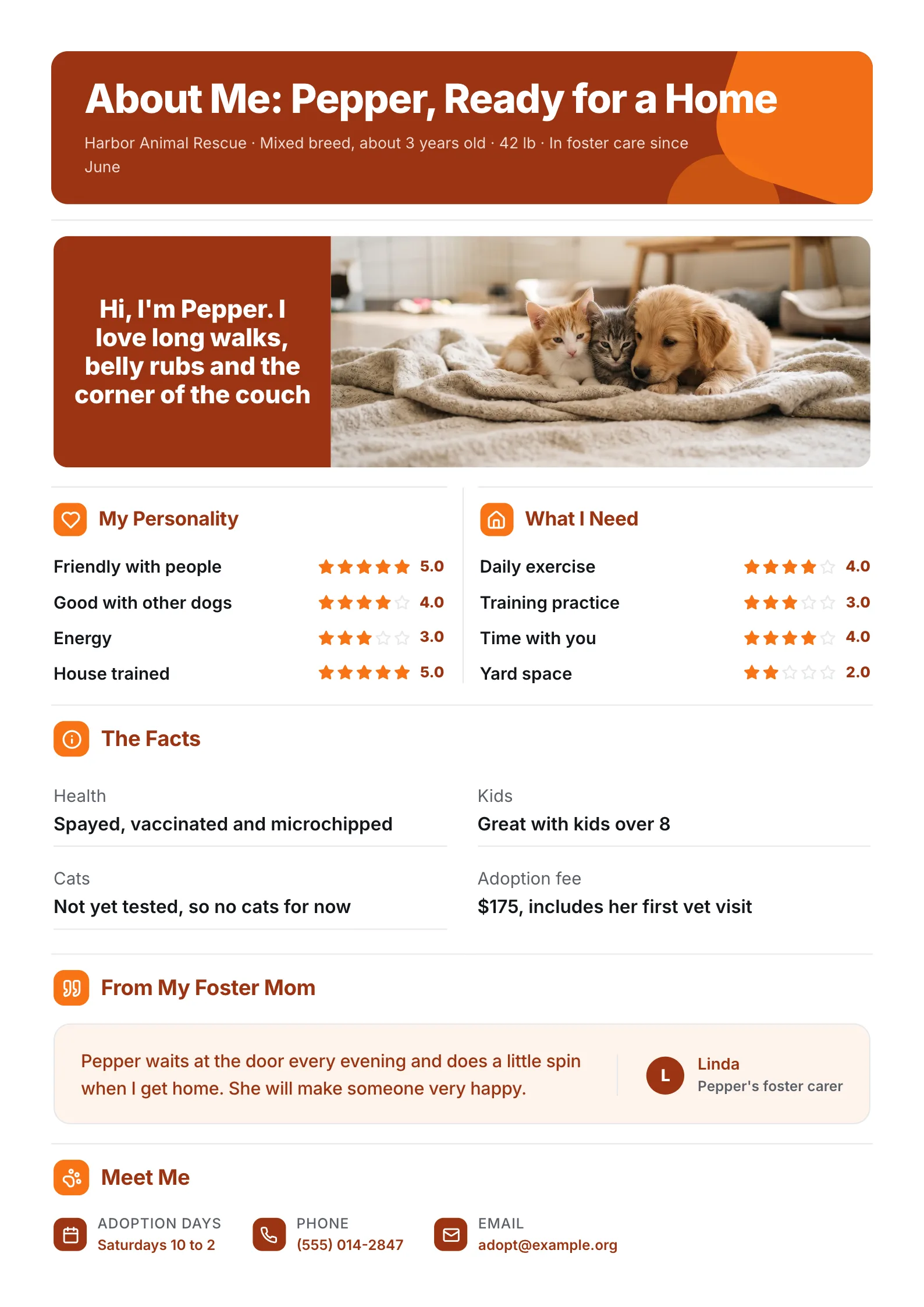 About Me: Rescue Pet Adoption ProfileEdit for free(opens in a new tab)
The personal sites were where the extras showed up: a family line, contact routes, even a first-person FAQ. Here's what each pair holds, what that means for writing your own, and five MakeOnepagers samples that show both shapes.
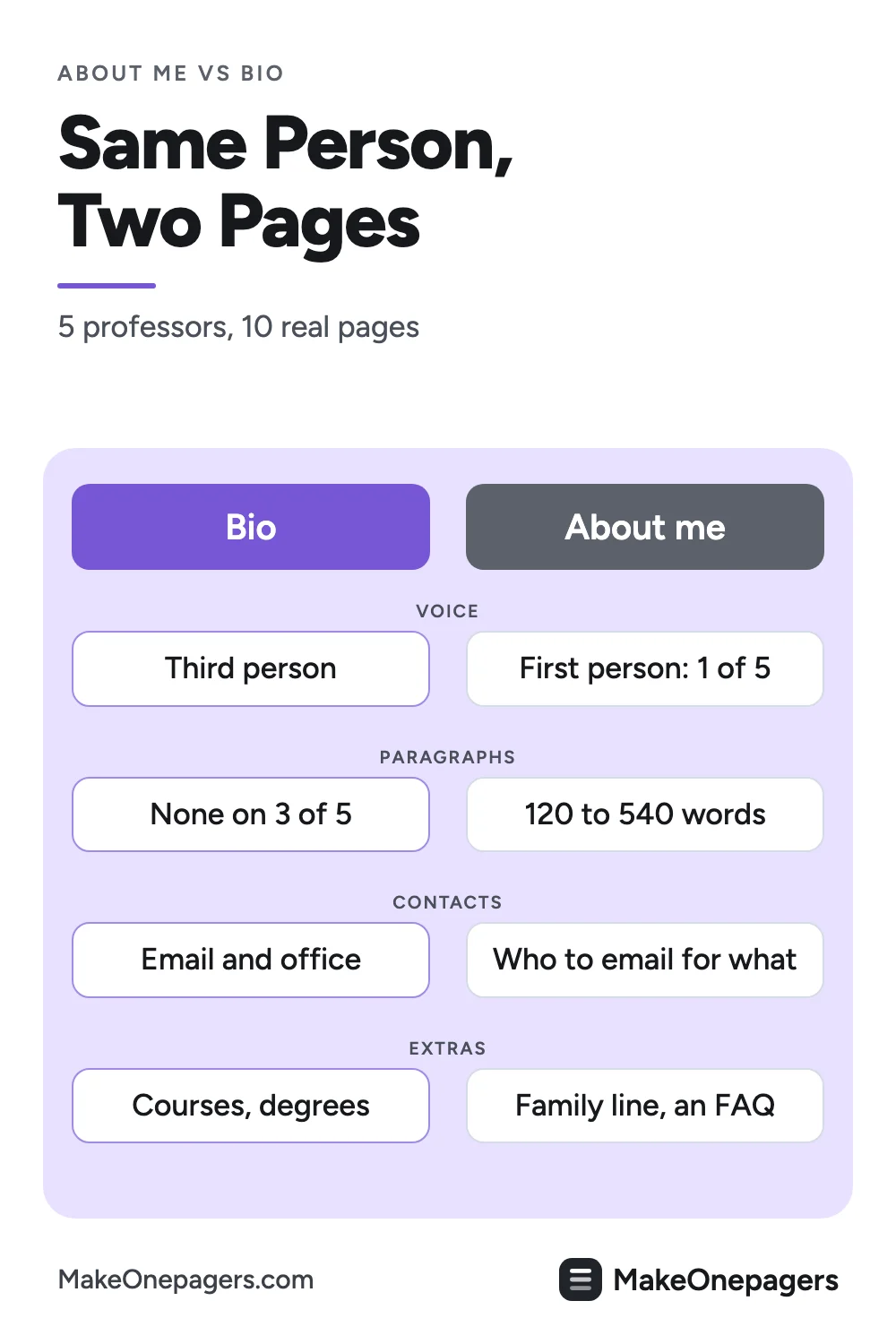
| Bio | About me | |
|---|---|---|
| Written for | Someone who will reuse it: an organizer, an editor, a directory | The visitor reading it right now |
| Voice | Third person | Usually first person, though many keep a bio inside it |
| Where it shows up | Programs, faculty pages, book jackets, speaker intros | Your own website, a portfolio, a class or team handout |
| What's in it | Title, work, best-known results, education | All of that, plus personal lines, contacts and answers to common questions |
| Ends with | The last fact | What to do next: email, book, visit |
The 10 pages we read
We picked five professors who each have a university faculty page and a personal website with About text, and read both on November 5, 2026. Here's what we counted. Open any two pairs side by side and you'll spot the pattern in a minute.
| Professor | University page | Their own site |
|---|---|---|
| Adam Grant | Wharton profile: about 300 words, third person | adamgrant.net: about 540 words, third person |
| Katy Milkman | Wharton profile: 339 words, third person | katymilkman.com: the same 339 words |
| Angela Duckworth | Penn Psychology: no paragraph, labeled facts only | angeladuckworth.com: about 220-word bio, then a first-person FAQ |
| Jeff Huang | Brown CS: no paragraph, labeled facts only | jeffhuang.com: about 120 words, first person |
| Philip Guo | UC San Diego Cognitive Science: one line of research interests | pg.ucsd.edu: about 120 words, third person |
What the university pages kept
A university page is a directory entry first. Three of the five had no sentences at all. Brown's page for Jeff Huang lists his titles, office, phone, research areas ("Human-Computer Interaction, Design, Data Science") and the courses he teaches this year. Penn's page for Angela Duckworth gives her title, research interests, courses and degrees as labeled lines. UC San Diego's page for Philip Guo holds his contact details and one line of research interests.
The two with paragraphs, both at Wharton, are classic bios. They're in the third person, about 300 to 340 words long, and built from the facts a stranger would check. That means title, research, books, awards and degrees. Neither one uses "I" or "my" once.
So the job of a bio is narrow. It tells a stranger who you are in a form they can trust and copy. Write yours the same way: facts a stranger could check, in an order they can scan, and nothing that needs a reply.
What the personal About pages added
You might expect the personal sites to switch to "I." Mostly they didn't. Four of the five still lead with a third-person bio, often the same one. Katy Milkman's About page and her Wharton profile carry the same 339 words, with one word changed: "directs" became "co-directs."
Only Jeff Huang writes in the first person: "I'm an Associate Professor and Associate Chair of Computer Science at Brown University." Then he names his degrees and past jobs in the same voice.
The real difference was what sat around the bio.
- A personal line. Adam Grant's own site adds a sentence his Wharton page doesn't have: "He lives in Philadelphia with his wife Allison (a novelist and poet), two cats (who don't get along), and three children (who mostly do)." Angela Duckworth's About page mentions that she taught math and science in public schools in New York City, San Francisco and Philadelphia. Her Penn page skips that.
- Who to contact for what. Grant's About page ends with four routes: questions, speaking engagements, media inquiries and foreign rights, each with someone to email.
- Answers in first person. Duckworth's bio is third person, but her FAQ below it switches to "I." To the question "Are you taking new PhD students?" she answers, "At present, my lab is full! I am not currently accepting new students."
That FAQ is the clearest picture of an about me. It talks to the reader, answers what they came to ask, and saves both sides an email. Before you write yours, list the three questions people email you most, and answer them on the page.
A bio goes stale where you paste it
One more thing showed up when we laid the pairs side by side. Adam Grant's Wharton profile says he's the author of 5 books translated into 35 languages, with TED talks viewed more than 25 million times. His own site says 6 books, 45 languages and over 35 million views. They can't both be current. His own site has the higher numbers and announces a newer book, Vibe, so the university's copy is the older one.
That's the cost of a bio's main strength. It's written to be copied, so it ends up in places you don't control. Keep one master copy with a date on it. Send the current one to every organizer, and check your old profiles once a year for numbers that have moved.
How to write both from one set of facts
You don't need two separate writing jobs. Write the facts once, then shape them twice.
- List the facts a stranger would check. Your role, where you work, what you're known for, one or two numbers, and your training.
- Write the bio from that list, in third person, as one paragraph. Use the shape the Wharton pages use: title and work first, results next, education last. Leave out anything you wouldn't want printed in a program.
- Write the about me for one visitor. Open in first person with what you do for them. Add one personal line, the kind Grant and Duckworth kept for their own sites.
- Add what that visitor will ask. Prices, hours, availability or how to reach you. Duckworth's FAQ is the model.
- End with one next step, like an email, a booking link or a date.
Five about me pages, and the bio hiding inside each
Every sample below is an about me written in first person for a reader who's about to meet the person. Under each one is a single-sentence bio built only from facts on that page, so you can see the same facts in both shapes. Notice what you lose when you switch to the bio. The people are made up.
A piano teacher who lists prices and recital dates
 Edit this template
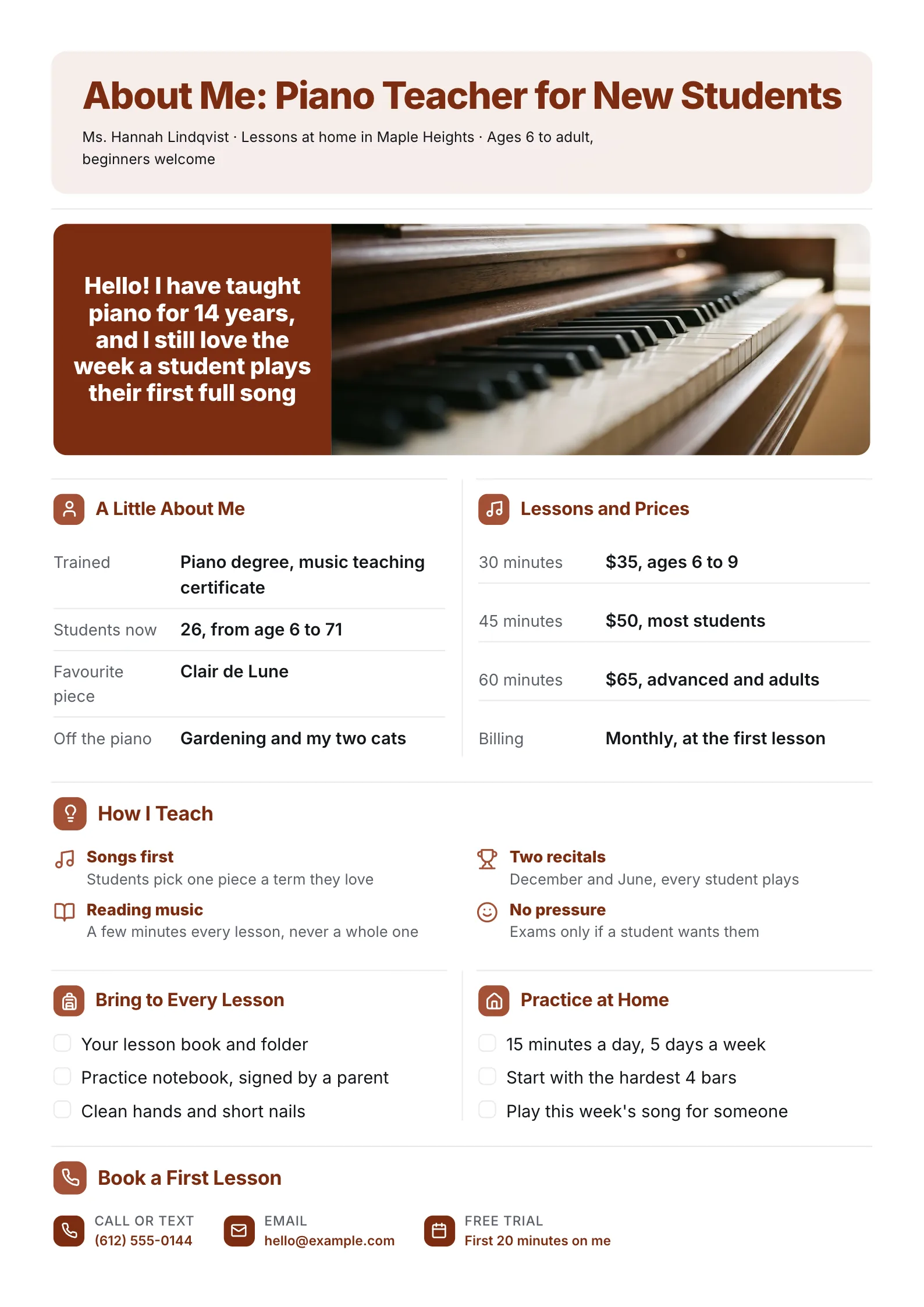
This piano teacher about me opens with "Hello! I have taught piano for 14 years," then does what no bio would. It lists lesson prices ($35, $50 and $65 by length), two recitals in December and June, and a free first 20 minutes. Those are the answers a parent needs before calling.
The bio version. Hannah Lindqvist has taught piano for 14 years and gives lessons at home in Maple Heights to students from age 6 to adult.
A freelancer who shows the next opening
 Edit this template
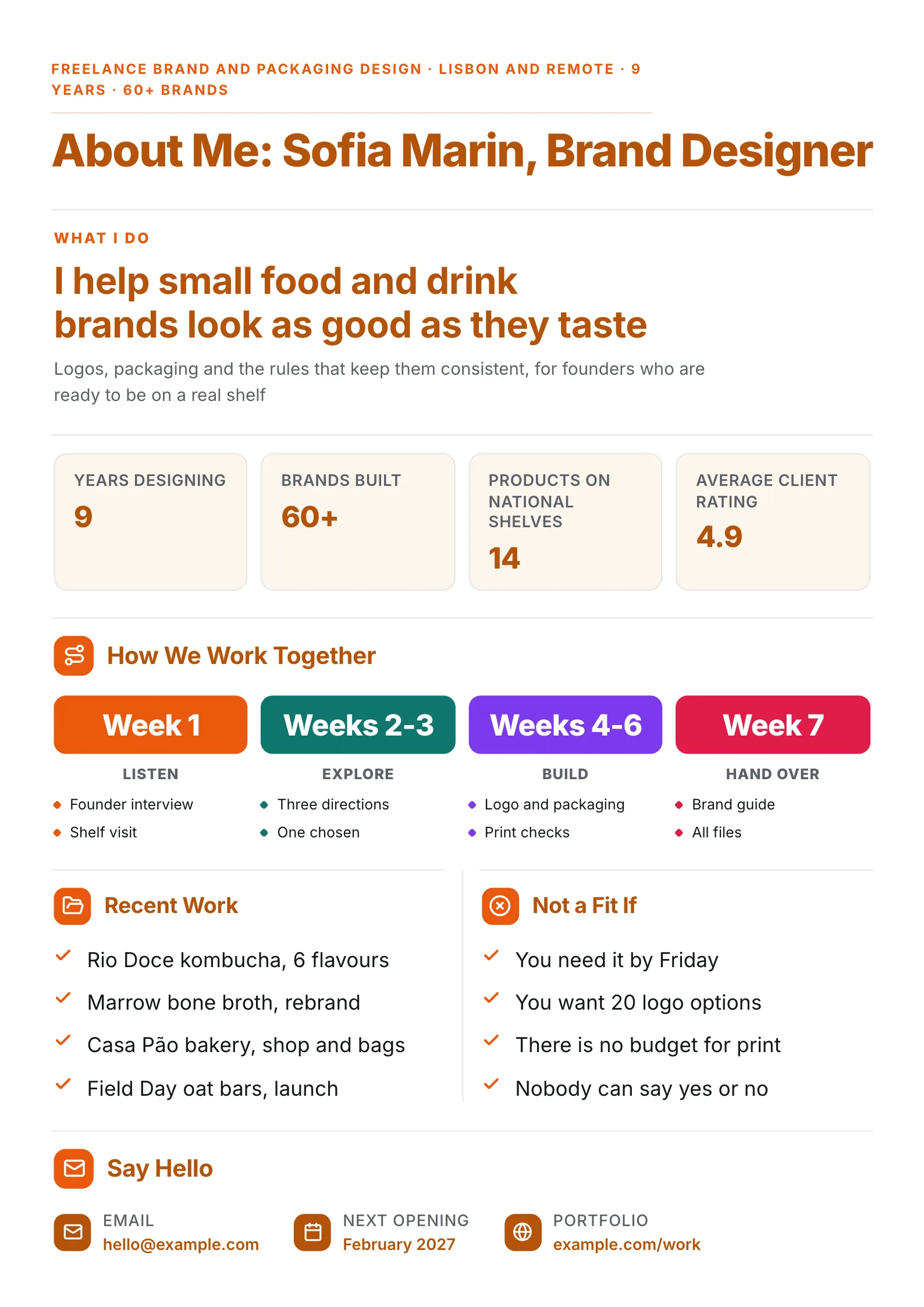
This freelancer about me talks to a client in one line: "I help small food and drink brands look as good as they taste." Then it lays out a seven-week plan from Listen to Hand over and ends on the line that matters most to a client, her next opening, February 2027.
The bio version. Sofia Marin is a brand and packaging designer based in Lisbon who has built 60+ brands over 9 years.
An exchange student writing to a host family
 Edit this template
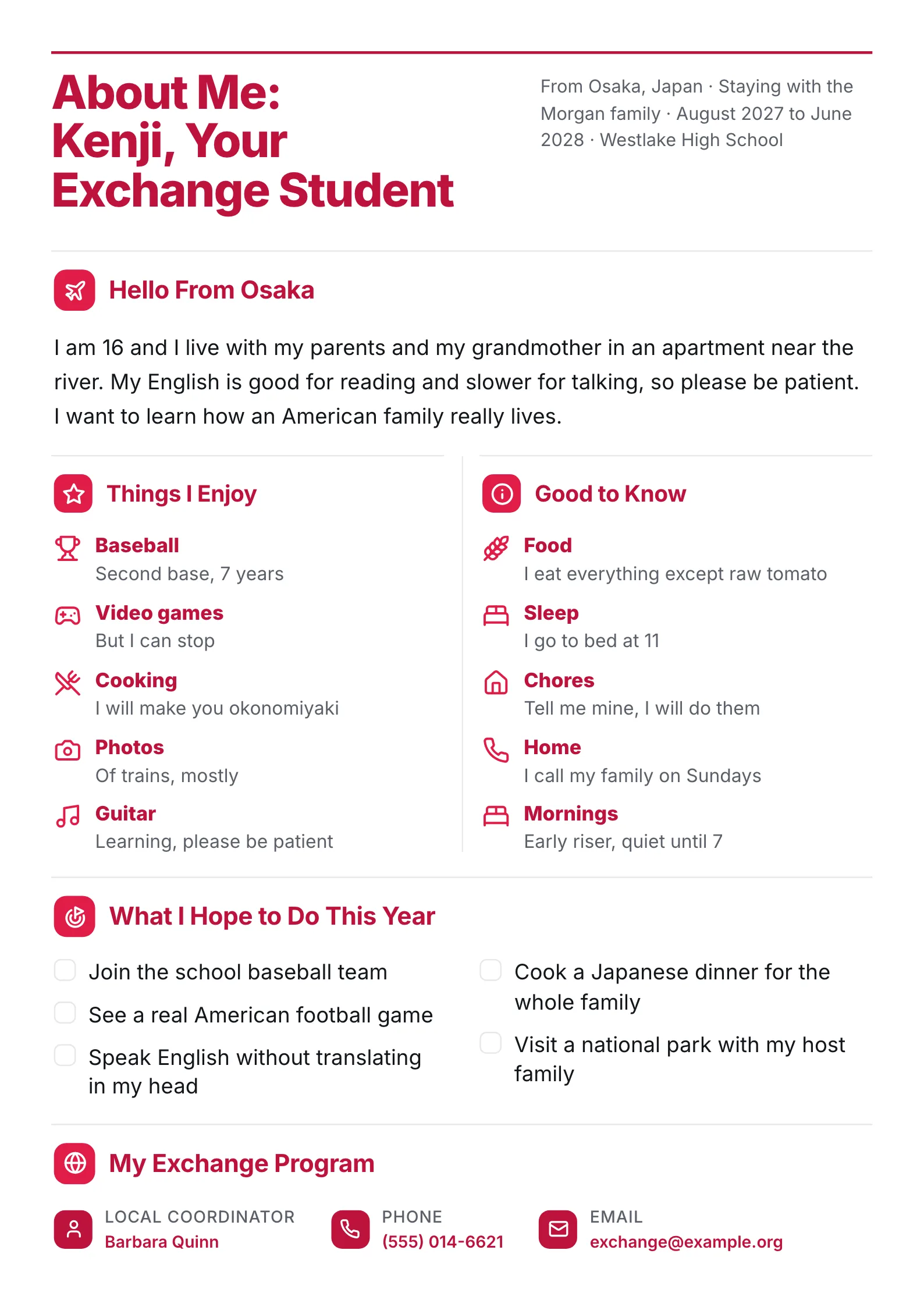
A host family wants the house rules first. This exchange student about me answers the questions they'd feel awkward asking. "I eat everything except raw tomato." "I go to bed at 11." "Tell me mine, I will do them," about chores. It's the same move as Duckworth's FAQ, in a teenager's voice.
The bio version. Kenji is a 16-year-old exchange student from Osaka, Japan, attending Westlake High School from August 2027 to June 2028.
A teacher who keeps one family line
 Edit this template
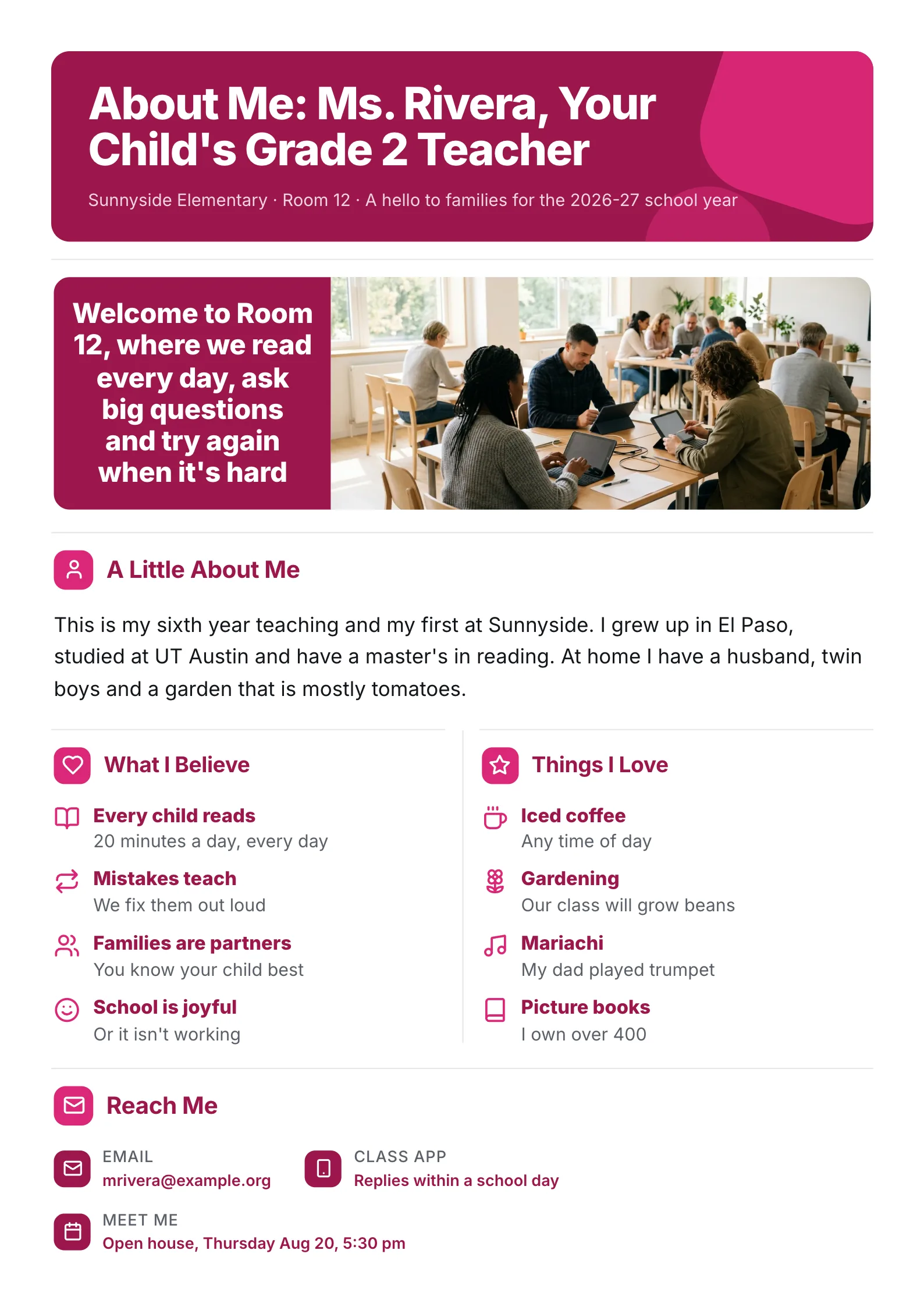
This teacher about me for parents puts her career into two sentences, then adds the kind of line Adam Grant kept for his own site: "At home I have a husband, twin boys and a garden that is mostly tomatoes." It closes with how to reach her, including a class app that "Replies within a school day," and an open house date.
The bio version. Ms. Rivera is in her sixth year of teaching, grew up in El Paso, studied at UT Austin and holds a master's in reading.
A new employee's guide to working together
 Edit this template
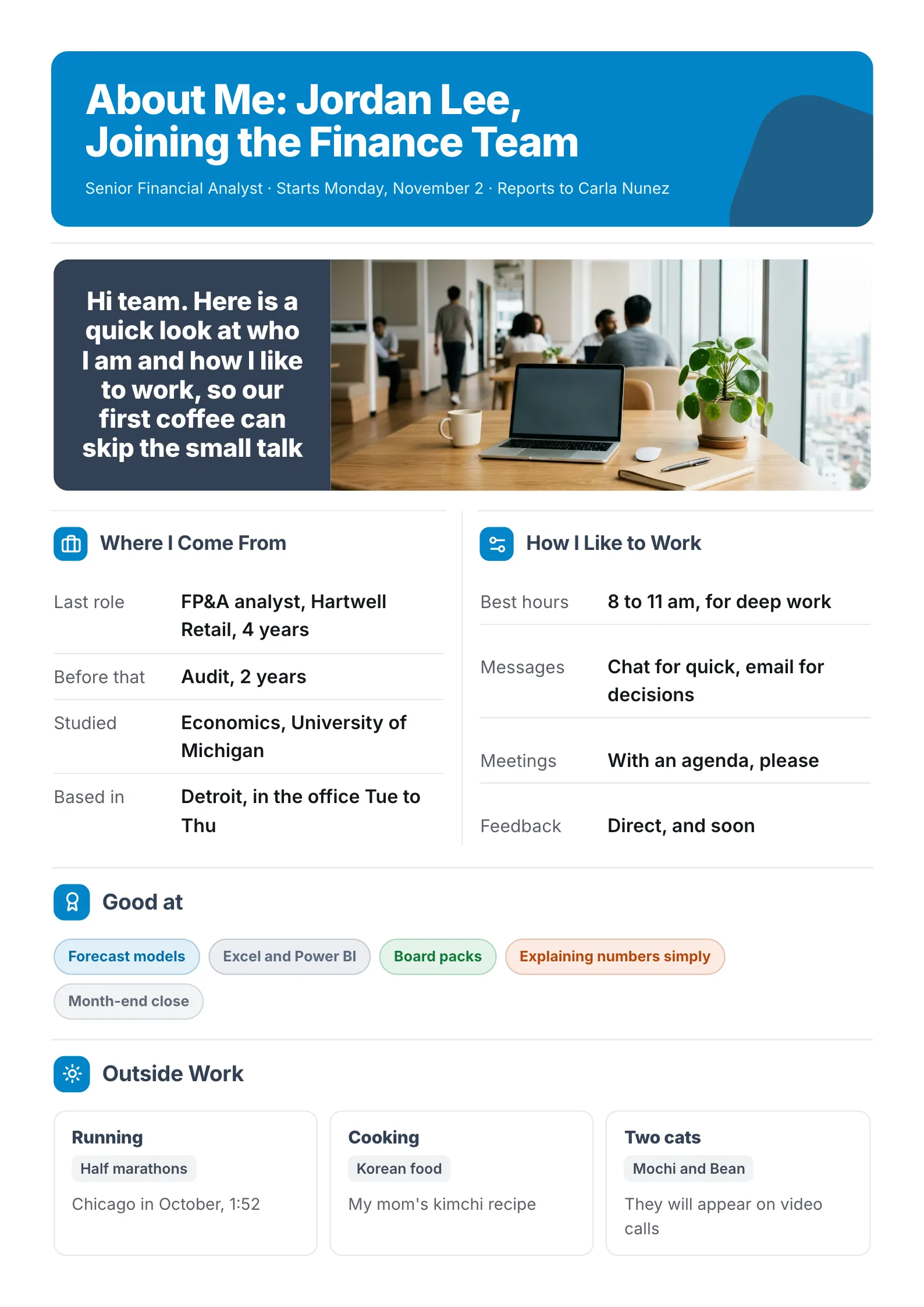
A new team wants to know how to work with you. This new employee about me gives best hours (8 to 11 am, for deep work) and a messaging rule: "Chat for quick, email for decisions." Like Grant, it mentions two cats, Mochi and Bean, who "will appear on video calls."
The bio version. Jordan Lee joins the finance team as Senior Financial Analyst after 4 years in FP&A at Hartwell Retail and 2 years in audit.
Make yours on one sheet
Pick the MakeOnepagers about me design closest to your reader, and write it in your own voice. Then copy its facts into one third-person paragraph, and you have your bio too. For a head start, drop your notes into the free AI One-Pager generator, then fix any line that doesn't sound like you. For more help, see how to write an about me for five kinds of reader, or the about me format guide for the boxes one-page profiles use.
Frequently asked questions
Is an about me page the same as a bio?
No. They overlap, but they do different jobs. A bio is a short third-person summary built to be reused by someone else. An about me is written for the visitor on your page. In our sample, 4 of 5 professors used a third-person bio on their own About page, and the extras sat around it.
Can I paste my bio onto my about me page?
Yes. In our sample, 4 of the 5 professors did. Katy Milkman's About page uses her Wharton bio with one word changed. Add what a visitor needs that a bio leaves out: how to reach you, a personal line and an answer or two to their common questions.
How long should each one be?
The Wharton bios we read ran about 300 to 340 words. The personal About text ran from about 120 words (Huang, Guo) to about 540 (Grant). For your own, a one-paragraph bio and an about me that fits on one sheet cover most uses.
What goes on an about me page that a bio leaves out?
Contact routes, prices or availability, a personal detail and answers to the questions people actually ask you. Adam Grant lists who to email about speaking, media and foreign rights. Angela Duckworth answers whether she's taking new PhD students.




