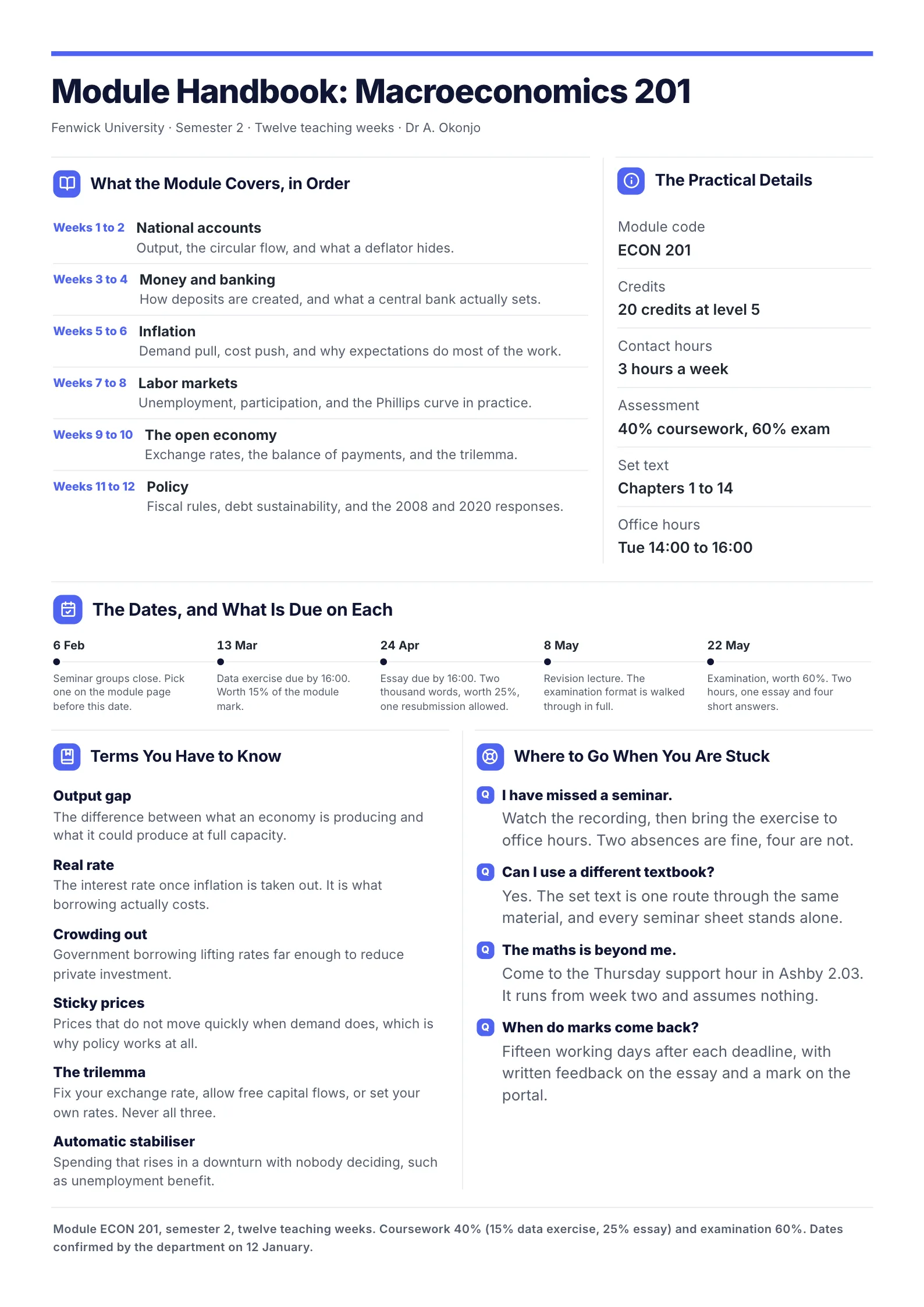
Students lose slide decks and keep handouts. One page holds the shape of the module, the terms they have to know and what is due. Something they can pin above a desk
Module Handbook — Macroeconomics 201. A finished One-Pager, made the way yours will be. Anything up to 50 pages counts as one document.
What it pulls out of a course material
Read out of the file you upload. Nothing is assumed and nothing is filled in.
What the module covers, in order
The terms they have to know
The dates, and what is due on each
Where to go when they are stuck
More finished One-Pagers from public & institutions
Every one made the same way, with nothing touched up for the website.
Questions about course material
What the document is, and what happens when you put one through here.
How do I make a one page course outline?
Include the course aim, learning outcomes, the weekly topics, assessments and key dates. Upload your handbook or reading list and MakeOnepagers builds a one page outline you can edit.
How do I turn a textbook chapter into a one page study summary?
Pull out the key ideas, definitions and one example of each, in the order they build. Make it as a One-Pager that students can read on a phone or print.
How do I make a one page summary for each module?
Use the same layout for every module (outcomes, topics, readings, assessment) so students know where to look. Make one One-Pager per module from the module notes.
What is a course outline?
A syllabus. A short account of what students will learn and how their progress is assessed through the term. University of Waterloo
What goes in a syllabus?
Administrative details, the course description, required texts, grading and deadlines, the policies, and the required institutional statements. University of Waterloo
How long should it be?
Three to five pages is usually enough to carry both the logistics and the wider context. University of Waterloo
What makes a good one?
Writing it for the learner. Students learn more, and enjoy the course more, when the syllabus is student centred. University of Waterloo
Should it list learning outcomes?
Yes, alongside the class schedule and something about how the course is taught. University of Waterloo
Can I print it for a class?
Yes. A print ready PDF at A4 or US Letter, so it hands out or pins up.
Does it work from a reading list or a handbook?
Yes. Paste the list or upload the handbook, up to 50 pages as one document. The page comes back with the whole module in order.
Can students read it on a phone?
Send the share link and it opens in any browser. No account, and nothing to install.
Can I make one per module?
Yes. Each module is its own document and its own page.
What does it cost?
Anything up to 50 pages counts as one document. The $15 plan covers 5 a month.