BlogGuide
Specific Aims Page Template: What 12 Funded NIH Pages Have in Common
We measured 12 funded NIH Specific Aims pages: words, aims, hypotheses, endings. A specific aims page template built from them, plus the NIH rules.

By MakeOnepagers Team
Updated · 15 min read
A specific aims page template gives the most-read page of an NIH grant its standard order: an opening that states the problem, the gap and your hypothesis, then two to four aims with a line on how each will be tested, then a closing on the expected outcome and its impact. It must fit on one page, and the whole proposal has to make sense from this page alone.
One‑Pager examples
Real One-Pagers made with MakeOnepagers. Open any one to edit it as your own.
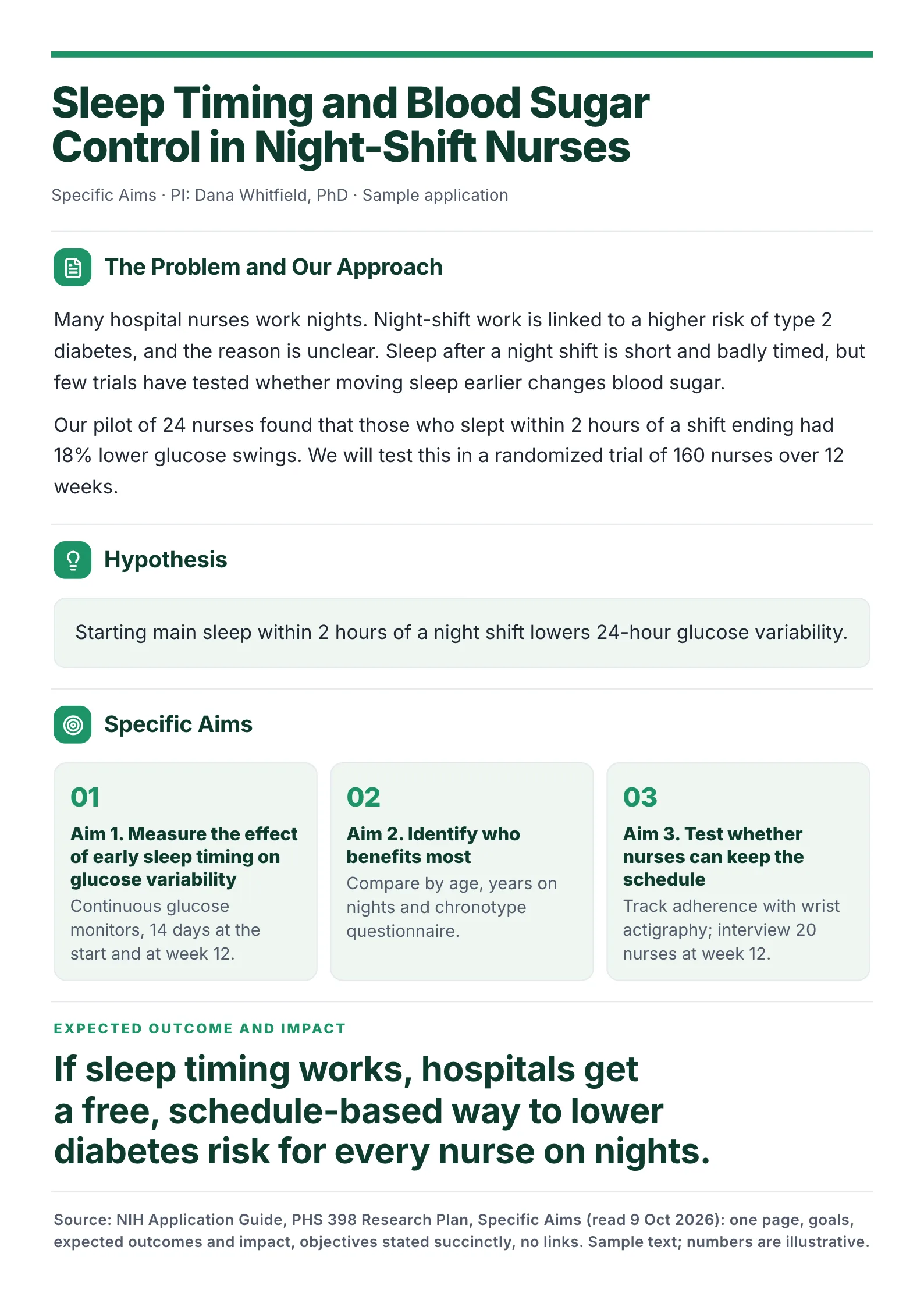 NIH Specific AimsEdit for free(opens in a new tab)
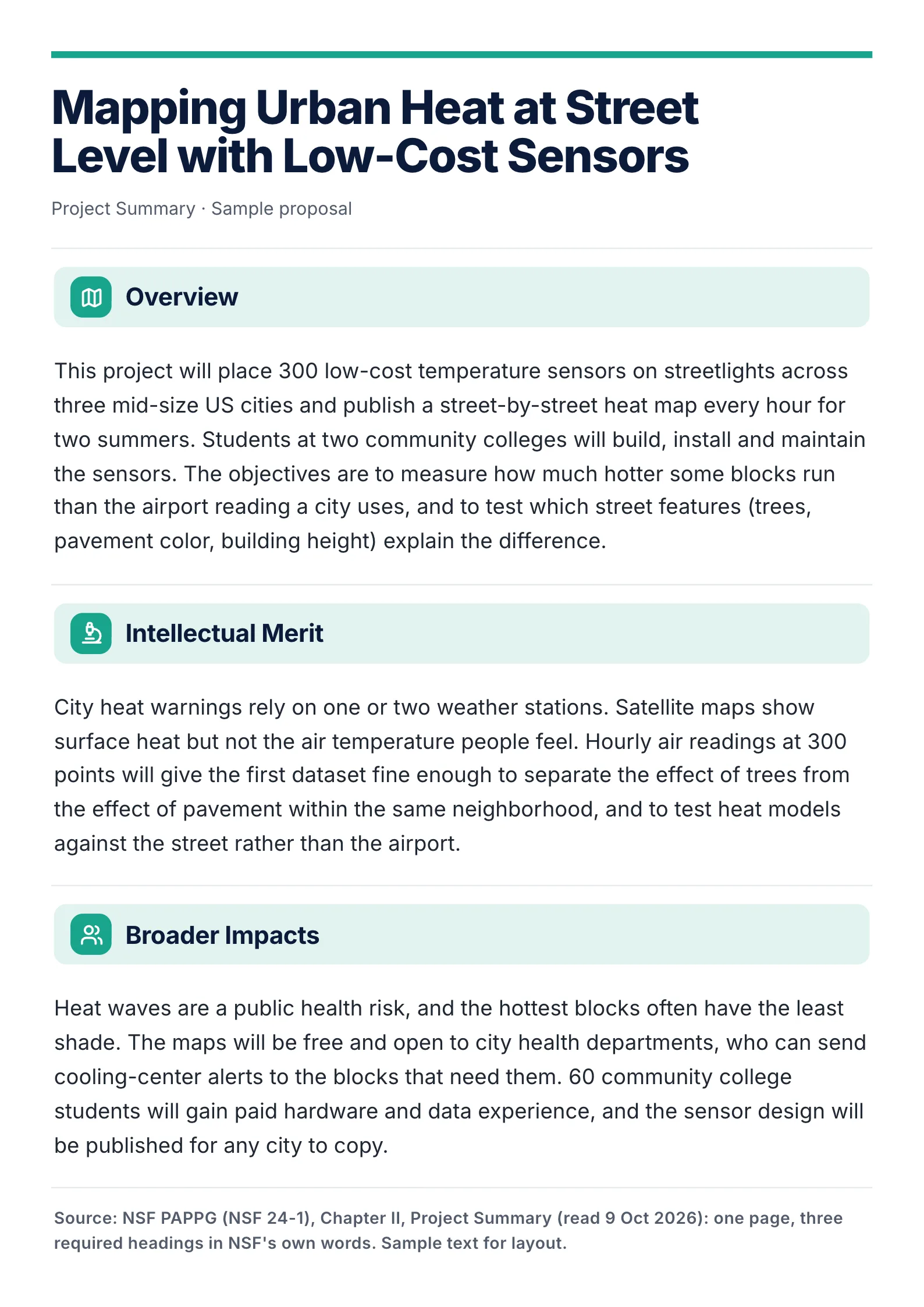 NSF Project SummaryEdit for free(opens in a new tab)
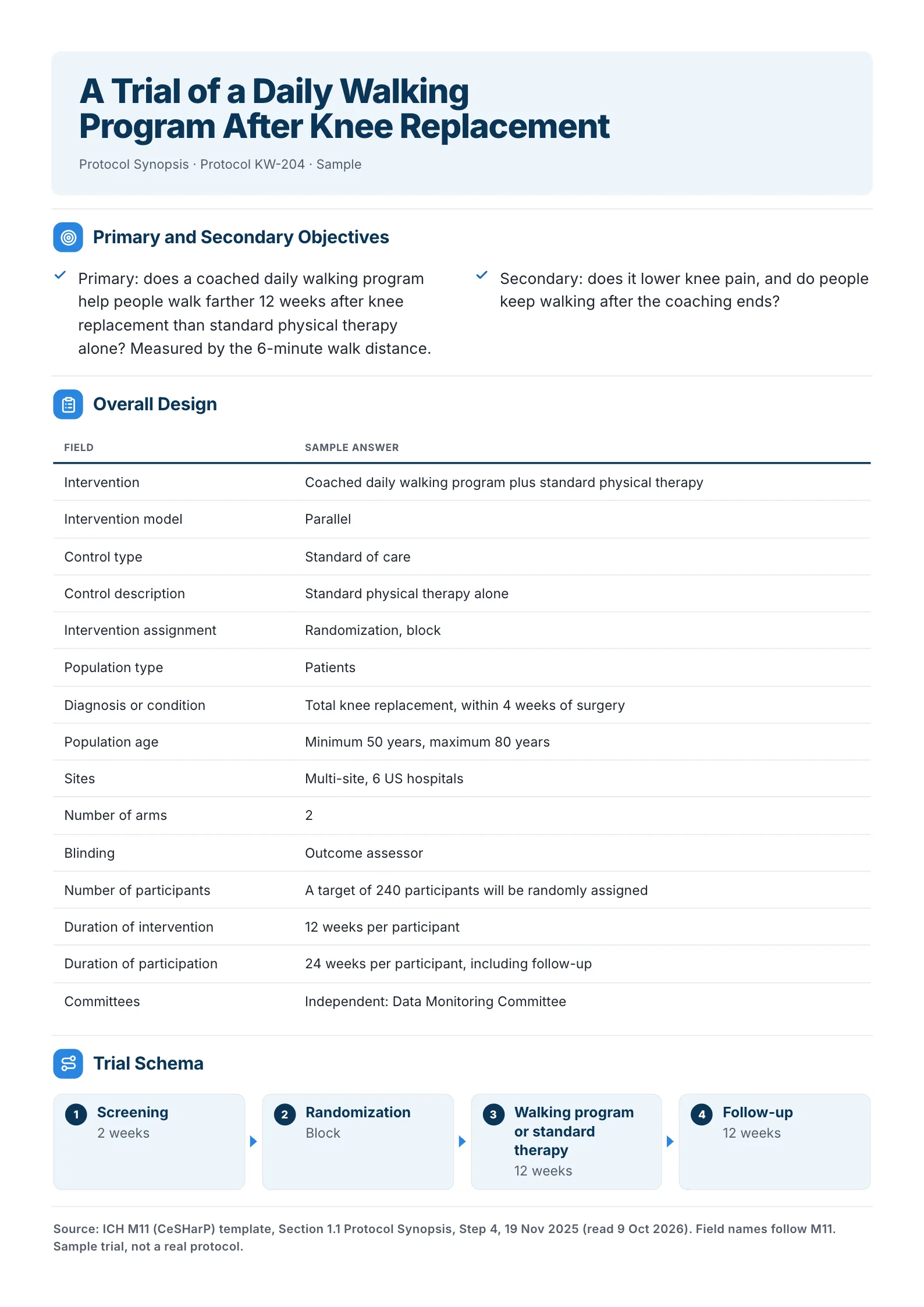 Clinical Protocol SynopsisEdit for free(opens in a new tab)
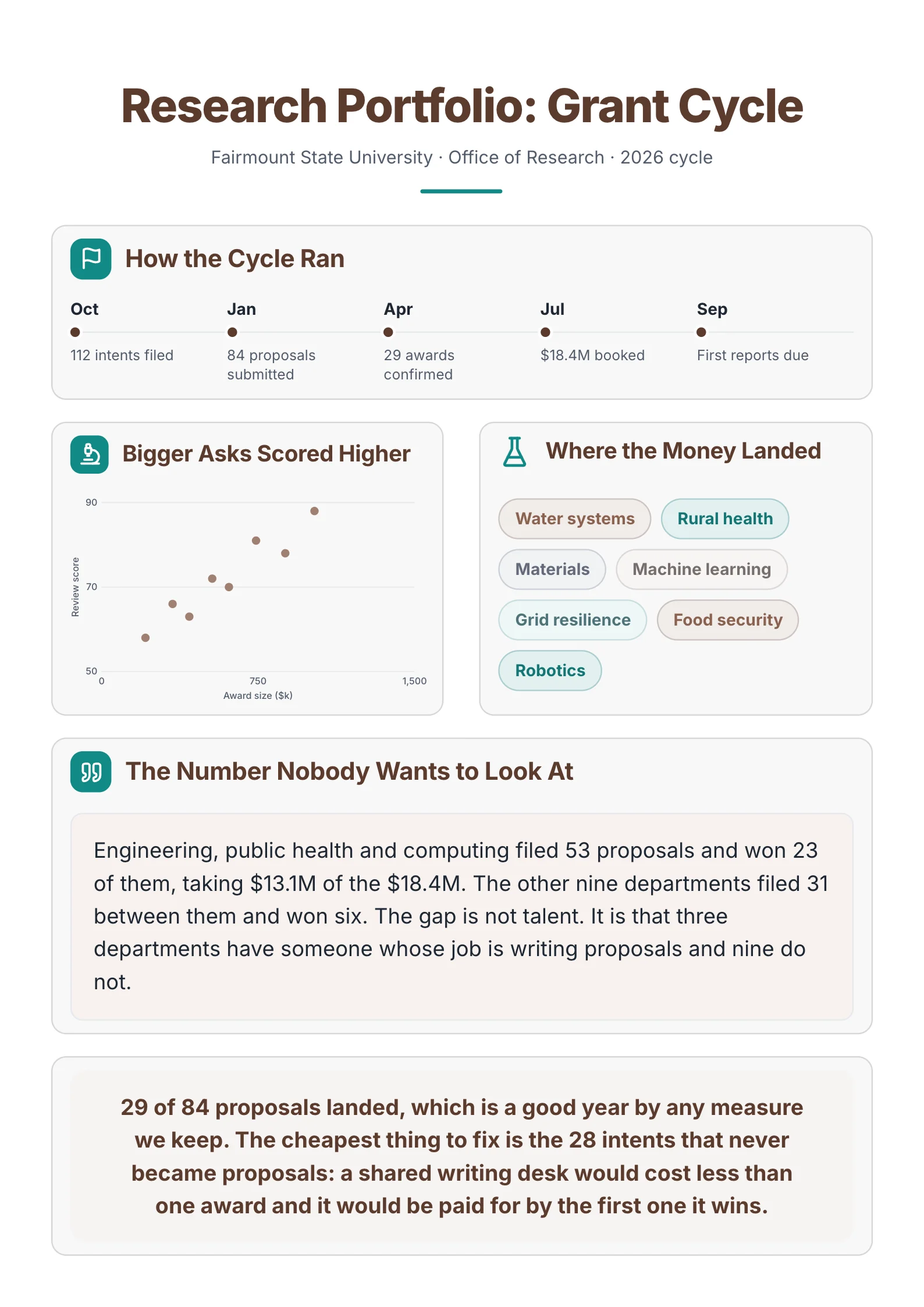 Research Funding ReviewEdit for free(opens in a new tab)
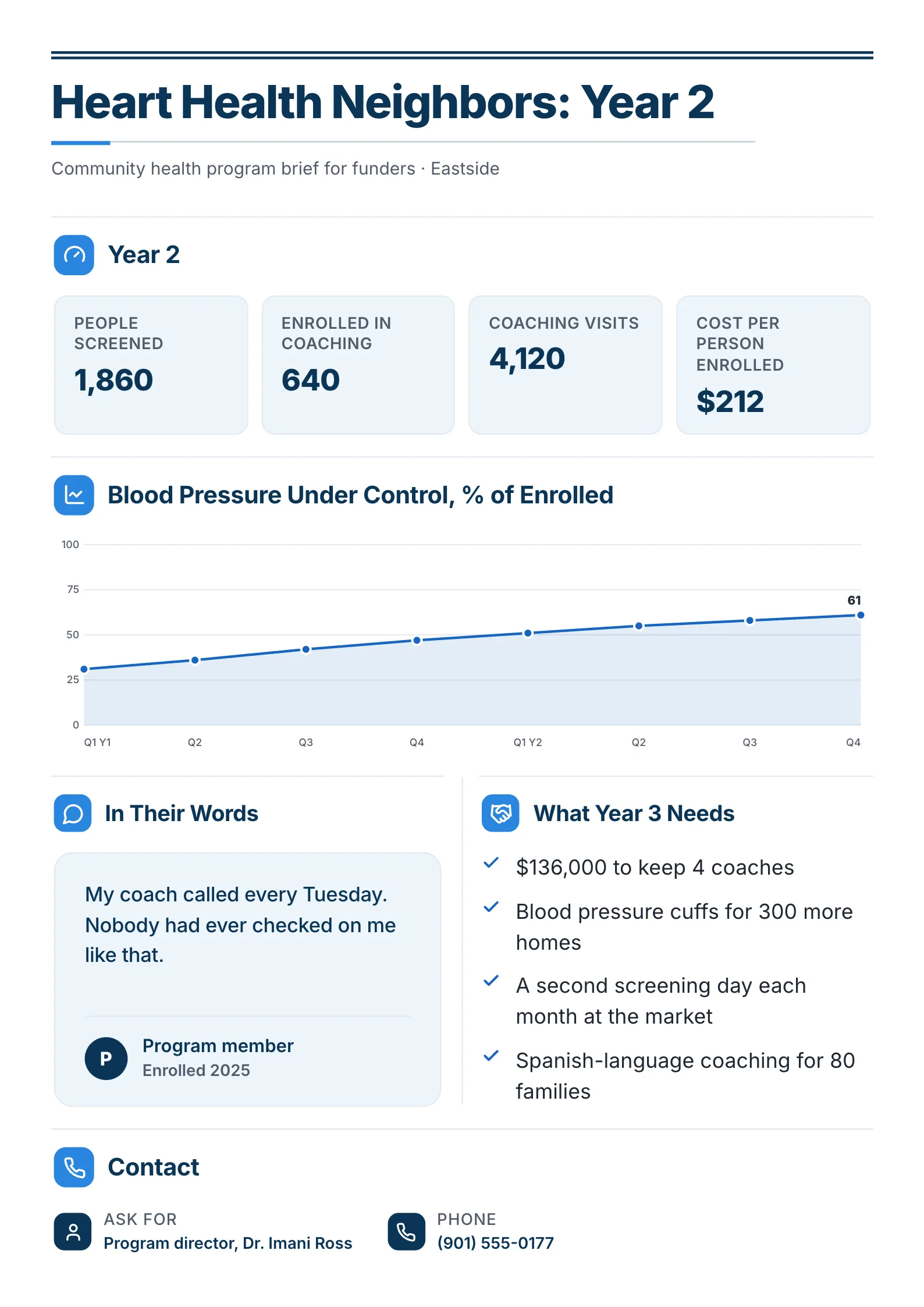 Community Health Program BriefEdit for free(opens in a new tab)
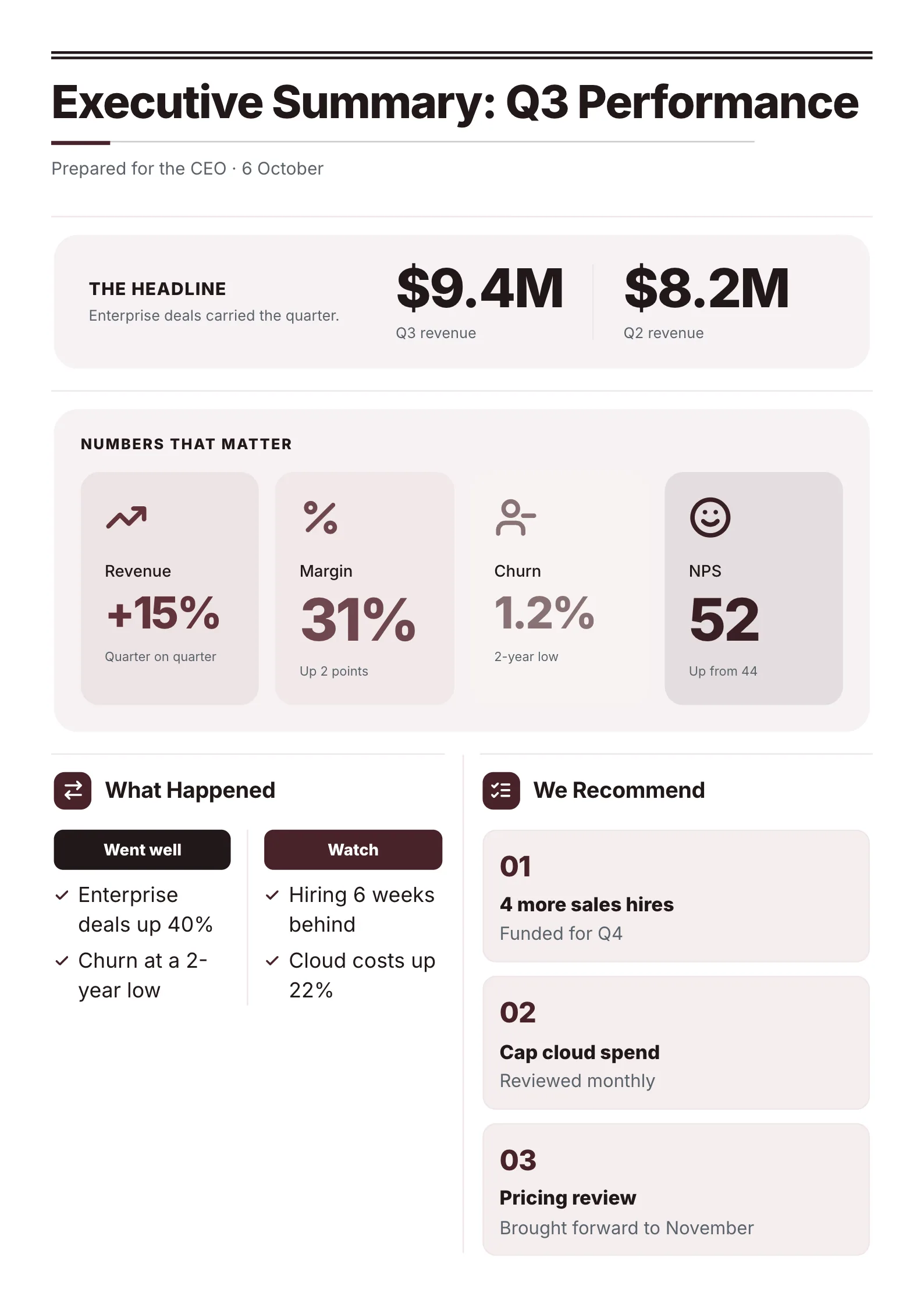 Executive SummaryEdit for free(opens in a new tab)
To give you real numbers instead of advice, we measured 12 funded Specific Aims pages on 12 October 2026. They come from the sample applications NIAID publishes, with the awardees' permission, so researchers can see what worked. We counted their words, aims, hypotheses and endings, read NIH's own format rules, and built the template below from both.
What is a Specific Aims page?
The Specific Aims page is a required one-page attachment in most NIH applications, item 2 of the Research Plan. NIH's instructions ask for two things in it: the goals of the research with the expected outcomes and their impact on the field, and a short list of the specific objectives. Those objectives can be testing a hypothesis, creating a new design, solving a problem, challenging a paradigm or clinical practice, removing a barrier to progress, or developing new technology.
In practice it works as the abstract of the whole proposal. The Research Strategy that follows explains how each aim will be done; the Specific Aims page says why it matters and what you will find.
What NIH requires on the page
These rules come from the NIH Application Guide pages on the Research Plan form, formatting attachments and page limits, read on 12 October 2026. Your funding opportunity can override them, so check it too.
| Rule | What NIH says |
|---|---|
| Length | One page. A Specific Aims attachment over the limit is flagged as an error on submission. |
| Font size | 11 points or larger. Smaller text inside figures is fine if it is legible at 100%. |
| Fonts | Arial, Georgia, Helvetica and Palatino Linotype are recommended; others are allowed if they meet the size rules. |
| Type density | No more than 15 characters per inch, spaces included. |
| Line spacing | No more than six lines per vertical inch. |
| Paper and margins | No larger than US Letter (8½ x 11 inches), with at least half-inch margins on all four sides. |
| Headers and footers | None. NIH adds its own when it assembles the application. |
| Links | Only when the funding opportunity allows them. NIH calls it "highly unusual" for that to be allowed in the Specific Aims. |
| File | PDF. |
| Text color | No restriction. |
What 12 funded Specific Aims pages look like
NIAID notes that time has passed since these were submitted, so a sample may not follow every current rule. The structure, though, is what reviewers scored.
| Application | Type | Words | Aims | Hypothesis | Ends with impact |
|---|---|---|---|---|---|
| Gordon: biofilm infections in chronic wounds | R01 | 670 | 3 | Central, plus one per aim | Yes |
| Muir: quorum sensing in S. aureus | R01 renewal | 810 | 3 | Inside the aims | Yes |
| Jiang: polyomavirus and DNA damage | R01 | 680 | 3 | Central, plus one per aim | Yes |
| Li: AAV gene therapy and immune response | R01 | 820 | 3, with sub-aims | One, in the opening | No, ends on the aims list |
| Troemel: antiviral immunity in C. elegans | R01 | 810 | 3, as questions | None | Yes |
| Faubion: EZH2 and immune cells in IBD | R01 | 570 | 3, each a hypothesis | Central | Yes |
| Gandhi: hair drug levels for HIV prevention | R01 renewal | 850 | 3 | Two, before the aims | Yes |
| Liu: protective antibodies to S. aureus | R01 | 750 | 3 | In the opening and Aim 3 | No, ends on Aim 3 |
| Raghavan: Coxiella metabolism | R15 | 730 | 3 | Central, plus one per aim | Yes |
| Domashevskiy: an inhibitor of ricin | R15 | 740 | 2 | None | No, ends on the next step |
| Rappleye: Histoplasma virulence screen | R03 | 590 | 2, with sub-aims | None | No, ends on Aim 2 |
| Karplus: a drug-resistance transporter | R03 | 540 | 2 | None | No |
Word counts are rounded and include figure captions. What the count shows:
- The page is full. About 540 to 850 words, median about 730. That is what one page of 11 point type holds.
- Three aims is the R01 standard. All 8 R01 pages have three. Both R03 pages, the small two-year grants, have two. The two R15 pages split, one with two and one with three.
- The opening is about half the page. Before Aim 1, the openings ran from 29% to 78% of the words, with a median of 49%, or about 330 words.
- Most state a hypothesis, not all. 8 of 12 do. The four that do not are a genetic screen, a computer modeling project, an inhibitor search and a page that frames its aims as questions. A discovery or tool-building project can lead with its objective instead.
- The ones with a central hypothesis test it aim by aim. All 4 pages that name a central hypothesis give each aim its own hypothesis or working hypothesis.
- Most end on the payoff. 7 of 12 close with a short paragraph on the expected outcome and its impact. The other five end on their last aim or a next step.
- Figures are rare. 3 of 12 put a small diagram on the page, and each one maps the aims onto a model.
A specific aims page template you can copy
Use this order. The word budgets come from the 12 pages above; aim for a total near their median of about 730 words.
Title (optional: two of the samples put the project title above the aims)
Opening: 250 to 400 words
- The problem, in one or two sentences, with a number if you have one: how many people, how much it costs, how often it fails.
- What is known, briefly. Only what the reader needs to see the gap.
- The gap. What nobody knows yet, and why that stops progress.
- Your long-term goal and the objective of this application. Three of the samples name all four pieces: a long-term goal, an objective, a central hypothesis and the reason it matters.
- Your central hypothesis, and what it is based on, usually your preliminary data.
- Why you, in one sentence: the model, data or team that makes this possible.
- A lead-in to the aims, such as "We will test this hypothesis with three aims."
Aims: 80 to 150 words each, two to four aims
- A bold aim statement that starts with a verb: determine, define, identify, test. Ten of the twelve samples open each aim this way.
- The working hypothesis for that aim, if you have one.
- The approach in one or two sentences: the model, the method, the measure.
- What the aim will produce.
Closing: 40 to 90 words
- The expected outcome of the project as a whole.
- The impact: what changes for the field, for patients or for practice when it is done.
How to write each aim
An aim is a goal you can finish within the grant, not a topic. Compare the two lines below, written for a sample study on sleep and blood sugar in night-shift nurses.
| Weak aim | Strong aim |
|---|---|
| Study sleep in nurses. | Aim 1. Measure the effect of early sleep timing on glucose variability. |
| Look at different groups. | Aim 2. Identify which nurses benefit most, by age, years on nights and chronotype. |
| Check feasibility. | Aim 3. Test whether nurses can keep the schedule, measured by wrist actigraphy. |
The strong versions each name an action, a measure and a group. Four more habits from the samples:
- Keep the aims independent. If Aim 1 fails, Aims 2 and 3 should still produce results. An aim that everything else depends on puts the whole grant at risk.
- Use sub-aims sparingly. Only 2 of the 12 pages split aims into parts (1a, 1b). They cost space and can make the page read like a methods section.
- Write the aim titles as a set. Read only the bold lines. They should tell the whole story of the project on their own.
- Match the aims to the grant. A two-year R03 had two aims in both samples. Three aims on a small grant can look like more than the budget can do.
A sample Specific Aims page, part by part
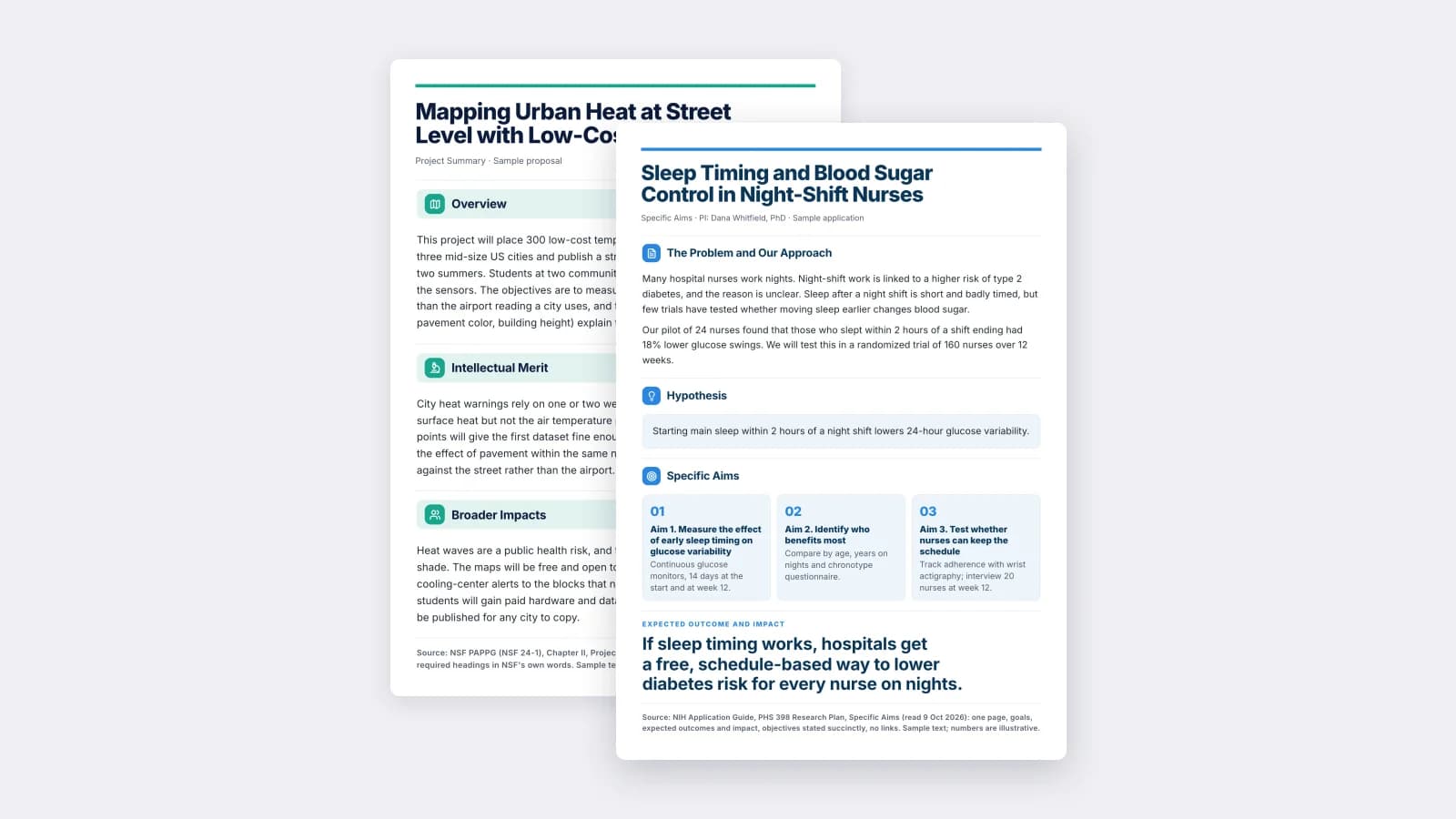
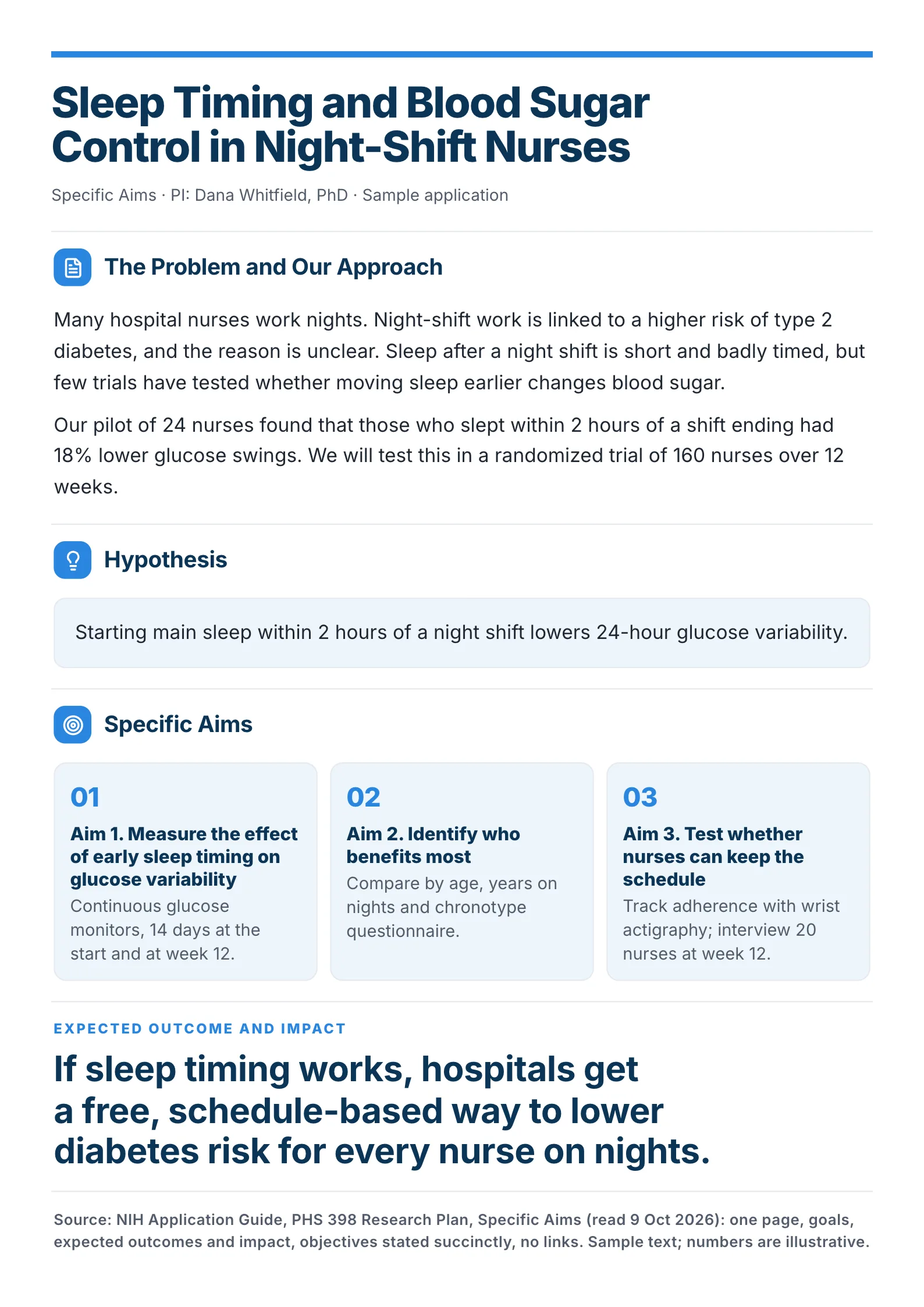
Before writing 700 words, many researchers lay the page out in blocks: problem, hypothesis, aims, payoff. Seen that way, a missing piece shows at once. This sample was made with MakeOnepagers; the study, the investigator and the numbers are invented for illustration.
 Edit this template
The four blocks every funded page above has, laid out so a reader sees the logic in ten seconds.
What each block does:
- The problem and our approach. The problem (night shifts are linked to diabetes risk, and the reason is unclear), the gap (few trials have tested sleep timing) and the preliminary data (a pilot of 24 nurses), then the plan: a randomized trial of 160 nurses over 12 weeks.
- Hypothesis. One testable sentence with a measure in it: starting main sleep within 2 hours of a night shift lowers 24-hour glucose variability.
- Specific Aims. Three numbered aims, each starting with a verb, each with its method in one line.
- Expected outcome and impact. One sentence on what hospitals would gain.
It is a planning and sharing version. Use it to agree on the logic with your mentor or co-investigators, to present at a lab meeting or a mock review, and to send to collaborators who will never read the full proposal. Then expand each block to its word budget for the attachment you submit.
Open it and swap in your project: NIH Specific Aims template.
Check your page against NIH's rules before you submit
| Rule | What to check on your page |
|---|---|
| One page | Export to PDF and count. Anything on a second page is an error. |
| 11 point type | Check the smallest text in the exported PDF, not in your editor. NIH warns that some PDF converters shrink the font. |
| US Letter, half-inch margins | Set the page to US Letter before you export, not A4, which is taller than 11 inches. Our guide to Letter and A4 has the exact sizes. |
| No headers or footers | Delete any running title, page number or source line at the foot of the page. NIH adds its own. |
| No links | Remove web addresses unless your funding opportunity allows them. One of the older samples has two in footnotes. |
| Save as PDF. Do not scan a printed page. |
R01, R21, R03, R15 and F31: how many aims?
| Grant | What the samples show | What to plan for |
|---|---|---|
| R01, research project | 8 of 8 had three aims | Three aims, each able to stand alone |
| R03, small grant | 2 of 2 had two aims | Two aims that fit the budget |
| R15, research enhancement | One had two aims, one had three | Two or three |
| R21 and F31 | Not in our sample | Check your funding opportunity and your institute's samples |
NIH's page-limits table sets the Specific Aims at one page for the common research grants, R01, R03 and R21 among them. What changes is the scope a reviewer will believe for the money and the time.
How reviewers score the page under NIH's simplified review
For applications due on or after 25 January 2025, NIH reviews most research project grants, R01, R03, R15 and R21 among them, under a simplified framework. It keeps the five review criteria but groups them into three factors:
| Factor | Criteria inside it | How it is scored | Where your aims page feeds it |
|---|---|---|---|
| 1. Importance of the Research | Significance, Innovation | 1 to 9 | The opening: the problem, the gap and why the answer matters; the closing impact line |
| 2. Rigor and Feasibility | Approach | 1 to 9 | The aims: a testable hypothesis, a method and a measure in each, aims that do not depend on each other |
| 3. Expertise and Resources | Investigators, Environment | Sufficient, or gaps that the reviewer must explain; no number | The one "why you" sentence: the model, the data or the team |
NIH says the change asks reviewers three questions: how important is the research, how rigorous and feasible are the methods, and do the investigators and institution have what the project needs. All three factors still feed the overall impact score.
What it means for the page:
- Factor 1 lives in the opening. If the gap and the payoff are not clear in the first paragraph, the most important score has nothing to work with.
- Factor 2 lives in the aims. An aim with no measure or no method gives a reviewer nothing to judge as rigorous.
- Factor 3 needs one sentence, not a paragraph. It is judged as enough or not enough for this project, so say what makes the work possible and move on.
From the aims page to the Research Strategy
The Specific Aims page is one page for every activity code that has it. The Research Strategy behind it is longer, and its limit depends on the grant, according to NIH's page-limits table (updated 30 September 2026):
| Grant | Specific Aims | Research Strategy |
|---|---|---|
| R01, R15 | 1 page | 12 pages |
| R03, R21 | 1 page | 6 pages |
Your funding opportunity can set a different limit, and it always wins.
How the two fit together:
- The opening becomes Significance and Innovation. Each sentence of your opening should have a paragraph waiting for it in the Research Strategy.
- Each aim becomes a heading in the Approach, with the same number and the same words. A reviewer who reads "Aim 2" on page one should find "Aim 2" on page six.
- The hypothesis appears in both, in the same sentence.
- Write the aims page first, and revise it last. The Research Strategy will change as you write it; the aims page has to match the final version.
The same page as an R21
The sample above is planned as a three-aim trial. Here is how the same idea would shrink to fit an exploratory R21 with a 6-page Research Strategy. The study is invented for illustration.
Opening, shorter: the same problem and gap, then a narrower objective: find out whether a sleep-timing schedule is workable for night-shift nurses and large enough an effect to justify a full trial.
Hypothesis: starting main sleep within 2 hours of a night shift is feasible for most nurses and lowers 24-hour glucose variability.
Aim 1. Test whether nurses can keep the schedule for 4 weeks, measured by wrist actigraphy and drop-out.
Aim 2. Estimate the effect on glucose variability with continuous glucose monitors, to size a future trial.
Closing: a feasibility answer and an effect size that a larger study needs.
What changed: two aims instead of three, a feasibility aim instead of a subgroup aim, and a closing that promises the next study rather than a change in practice. That is the scope a reviewer will believe for a smaller, shorter grant. Check your funding opportunity for what it expects about preliminary data.
Specific aims page mistakes
- Aims that depend on each other. If Aim 2 needs Aim 1 to succeed, a reviewer will ask what happens when it does not.
- No gap. A page that describes a field without saying what is unknown gives the reviewer no reason to fund the work.
- A hypothesis that cannot fail. "Sleep affects health" cannot be proven wrong. "Earlier sleep lowers glucose variability" can.
- Methods instead of aims. The aims page says what you will learn. The Research Strategy says how.
- No ending. Five of the twelve samples end without a closing paragraph, and all were funded, but a closing line on impact is the easiest place to tell the reviewer why the project matters.
- Small type to fit more in. Under 11 points breaks the rules, and the pages above show that about 730 words fit without it.
Specific aims page checklist
- The problem, with a number
- The gap in knowledge, in one or two sentences
- Your long-term goal and the objective of this application
- A central hypothesis that can be tested, or an objective if the project is discovery
- Why you are the team to do it
- Two to four aims, each starting with a verb, each able to stand alone
- A working hypothesis or expected result for each aim
- The expected outcome and impact
- One page, 11 point type or larger, US Letter, half-inch margins
- No headers, footers or links
Plan your Specific Aims page on one sheet
Open the free NIH Specific Aims template, replace the sample study with your problem, hypothesis and aims, and download it as a PDF to share with your mentor before you write the full page. Writing the summary for an NSF proposal instead? The NSF project summary template uses NSF's three required headings.
Frequently asked questions
How long is a Specific Aims page?
One page, set by NIH's table of page limits. In the 12 funded pages we measured, that page held about 540 to 850 words, with a median of about 730.
How many aims should a Specific Aims page have?
Two to four. All 8 funded R01 pages we measured had three, and both R03 pages had two. Each aim should produce results even if another aim fails.
What is the format of an NIH Specific Aims page?
An opening on the problem, the gap, your goal and hypothesis, then the aims, then a short closing on the expected outcome and impact. NIH requires 11 point type or larger, at least half-inch margins, paper no larger than US Letter, no headers or footers, and a PDF file.
Do I need a hypothesis on my Specific Aims page?
Usually. 8 of the 12 funded pages we read state one. A screen, a tool-building or a modeling project can lead with a clear objective instead, and NIH's instructions list developing new technology and solving a problem as valid objectives alongside testing a hypothesis.
Can I put a figure on the Specific Aims page?
Yes. 3 of the 12 funded pages did, each a small diagram tying the aims to a model. Text inside a figure may be smaller than 11 points if it is legible at 100%, but the figure takes words away from the page.
Where can I find real Specific Aims page examples?
NIAID publishes full sample applications, with the awardees' permission, including each one's Specific Aims page and, for most, the reviewers' summary statement. All 12 pages in our table come from that collection.