Sales Territory Plan Example: 5 Real Plans and What Each Gets Right
Five sales territory plan examples from software, medical devices, pharma, insurance and real estate, with the call math and account ranking behind each.

Most sales territory plan examples online are one fill-in-the-blanks table with no numbers in it. That shows you the headings but not the choices. Here are five filled plans from five industries, each built on MakeOnepagers, with what each one gets right and the math behind it.
One‑Pager examples
Real One-Pagers made with MakeOnepagers. Open any one to edit it as your own.
 Territory Sales PlanEdit for free(opens in a new tab)
 Solar Sales Territory PlanEdit for free(opens in a new tab)
 Industrial Supply Territory PlanEdit for free(opens in a new tab)
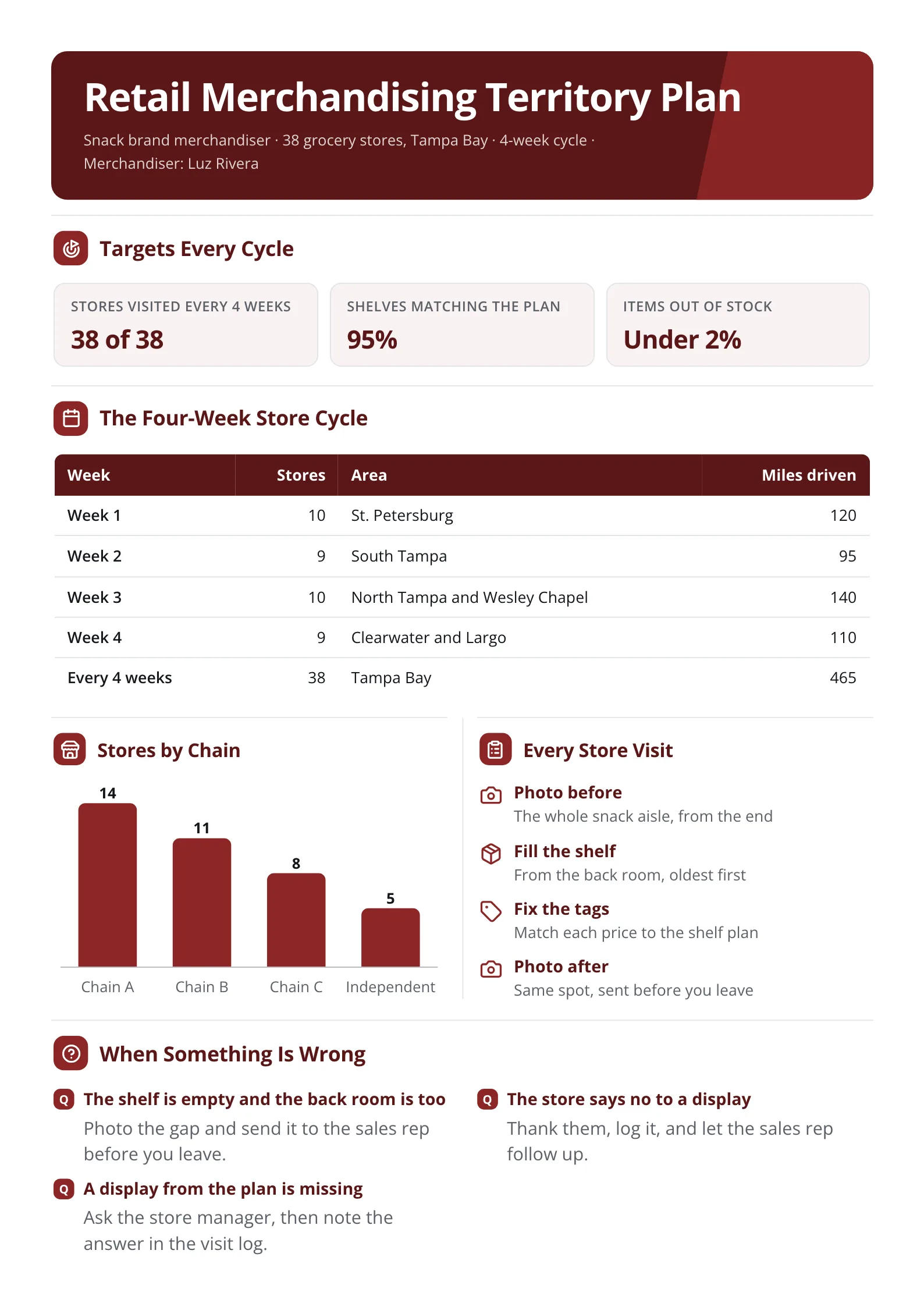 Retail Merchandising Territory PlanEdit for free(opens in a new tab)
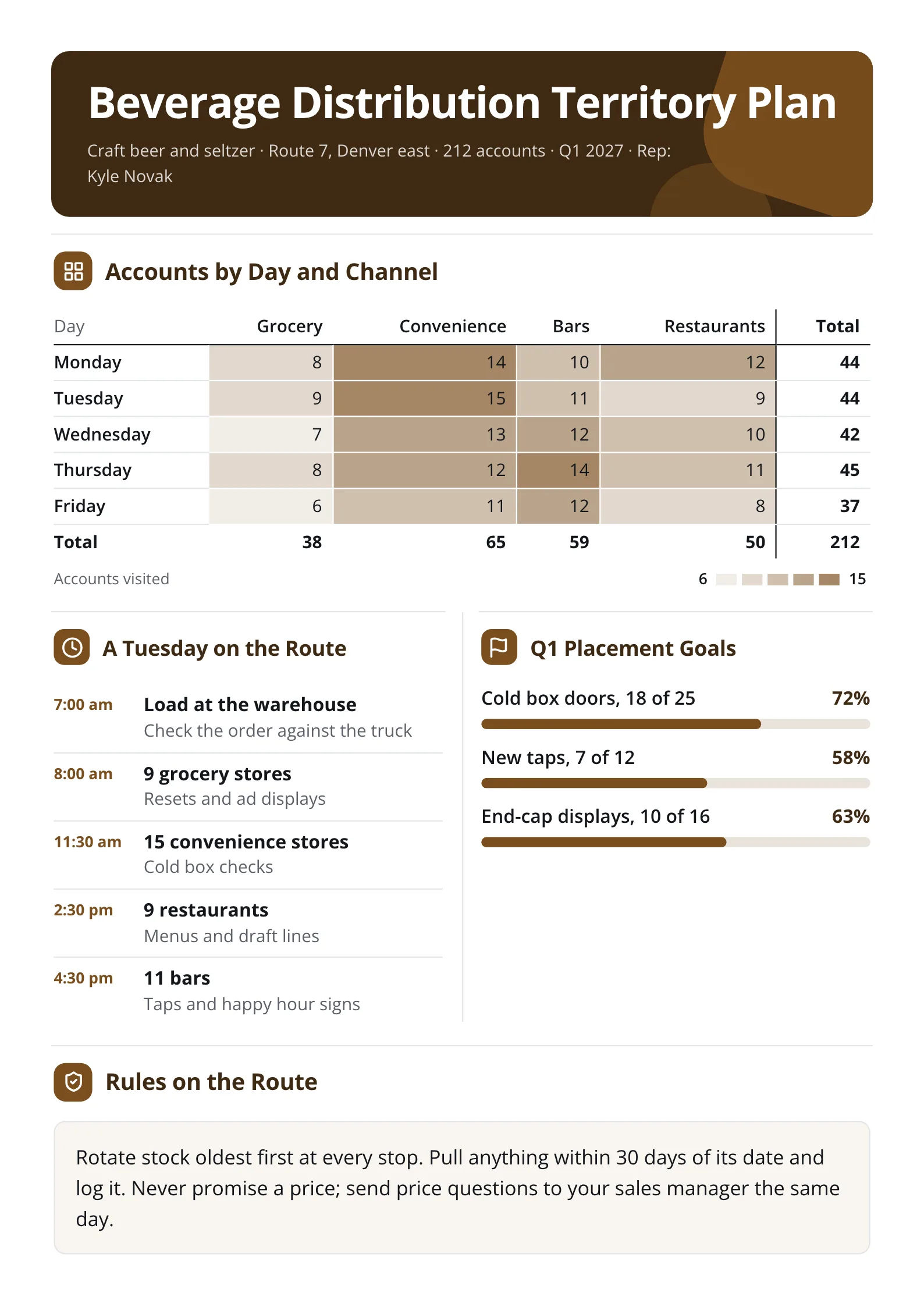 Beverage Distribution Territory PlanEdit for free(opens in a new tab)
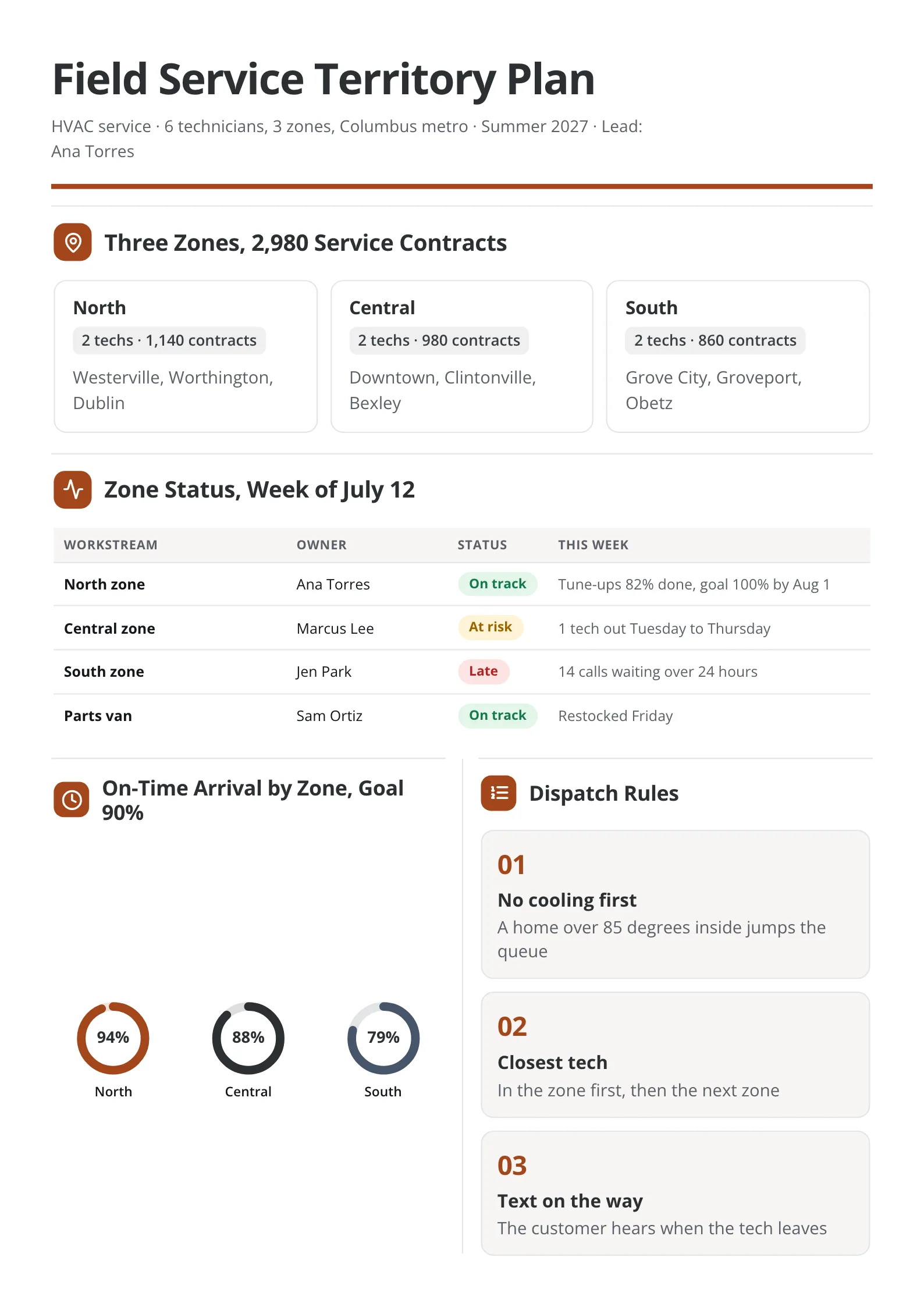 Field Service Territory PlanEdit for free(opens in a new tab)
The companies, reps and figures in them are made up. Keep the structure and put your own figures in.
What every sales territory plan example should show
Your territory plan has one job: to tell you where your hours go this year. Strip any good plan down and you'll find the same five parts.
| Part | The question it answers | What it looks like on the sheet |
|---|---|---|
| 1. The area | Where do I sell, and to whom? | Counties, zip codes, a named list of accounts, or a segment like "200 to 1,000 staff" |
| 2. The target | What number am I chasing? | A quota, a count of new accounts, or a share of a market |
| 3. The accounts, ranked | Who matters most? | A top-accounts table or tiers, with a reason for each rank |
| 4. The rhythm | How often do I see whom? | A call plan, a weekly cycle, a quarter-by-quarter list |
| 5. The measures | How do I know it's working? | Three or four numbers checked monthly |
We scored the five examples below against those parts. A tick means the part is on the sheet with real numbers. Partial means it's there in a lighter form, Missing means the sheet leaves it out, and Not needed means the trade doesn't use it.
| Example | Area | Target | Ranked accounts | Rhythm | Measures |
|---|---|---|---|---|---|
| Software sales | ✓ | ✓ | ✓ | Missing | Partial |
| Medical device | ✓ | ✓ | ✓ | Missing | ✓ |
| Pharmaceutical | ✓ | Missing | ✓ | ✓ | Partial |
| Insurance agent | ✓ | ✓ | Partial | ✓ | ✓ |
| Real estate farming | ✓ | ✓ | Not needed | ✓ | ✓ |
None of them scores five full ticks, and that's fine. The software and medical device plans have no visit rhythm on the sheet, and the pharma plan has no sales target, only call counts. Each plan leans on the part that matters most in its trade. A drug rep's year is decided by the call plan. A software rep's year is decided by five big accounts. So start with the example closest to how your own deals close.
5 sales territory plan examples, by industry
Software sales: the path to quota, account by account
 Edit this template
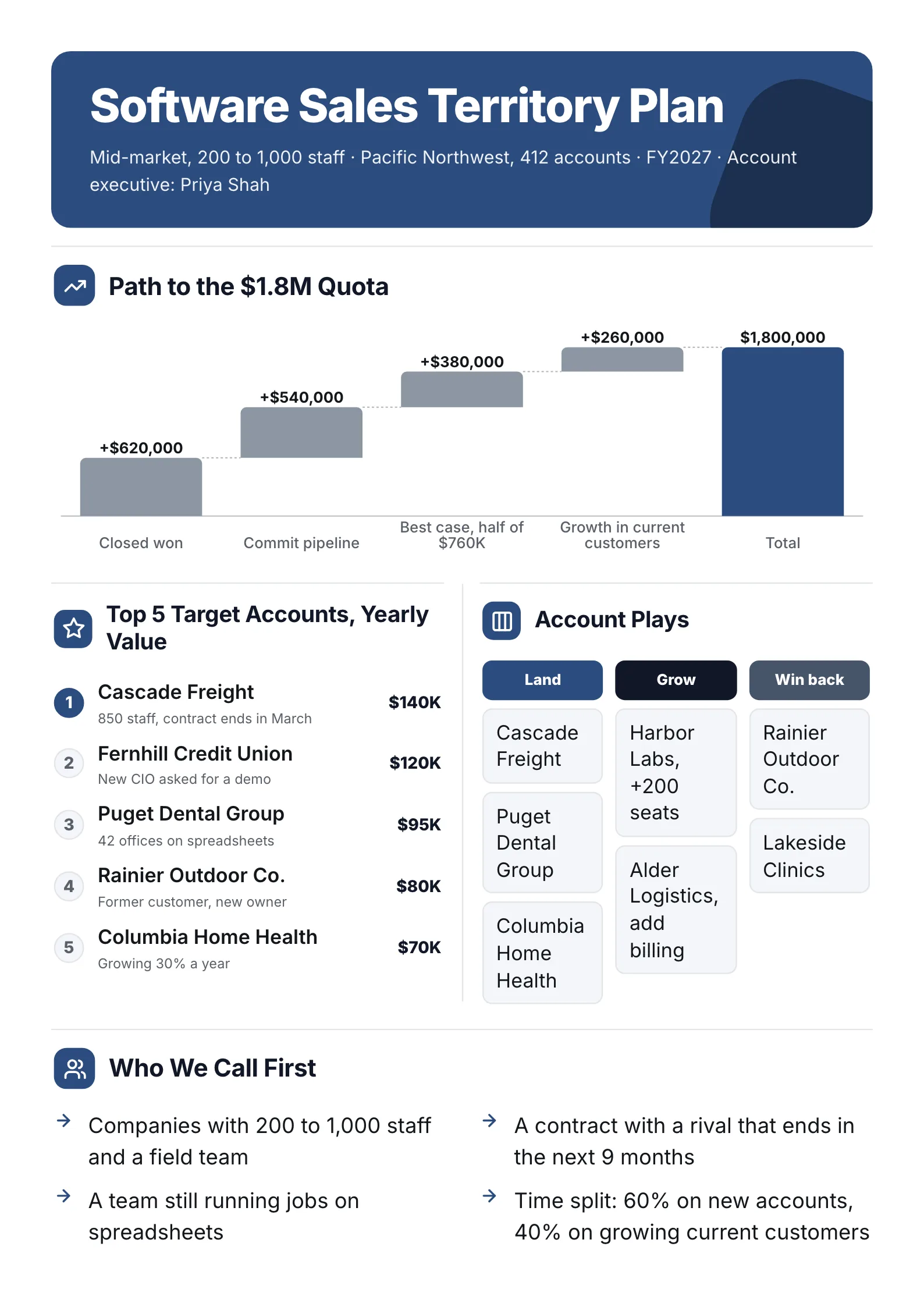
The software sales territory plan opens with the quota and shows how it gets filled: closed deals, committed pipeline, half of the $760K best-case pipeline, and growth in current customers. Counting only half of the best case is the honest move. Those deals are real, but not all of them will close.
Then it names five target accounts, from Cascade Freight at $140K a year to Columbia Home Health at $70K, together worth $505K. Each one carries a reason in a few words: "contract ends in March", "new CIO asked for a demo", "42 offices on spreadsheets". That reason is what turns a list of logos into a plan. If you can't write why now, the account isn't a target this year.
The plays split the list three ways: land new logos, grow current customers, win back lost ones. The last line sets the time split, 60% on new accounts and 40% on growth. Put your own split on the sheet. Leave it off and you'll drift toward the friendly customers you already have.
Medical device: four boxes that decide where the time goes
 Edit this template
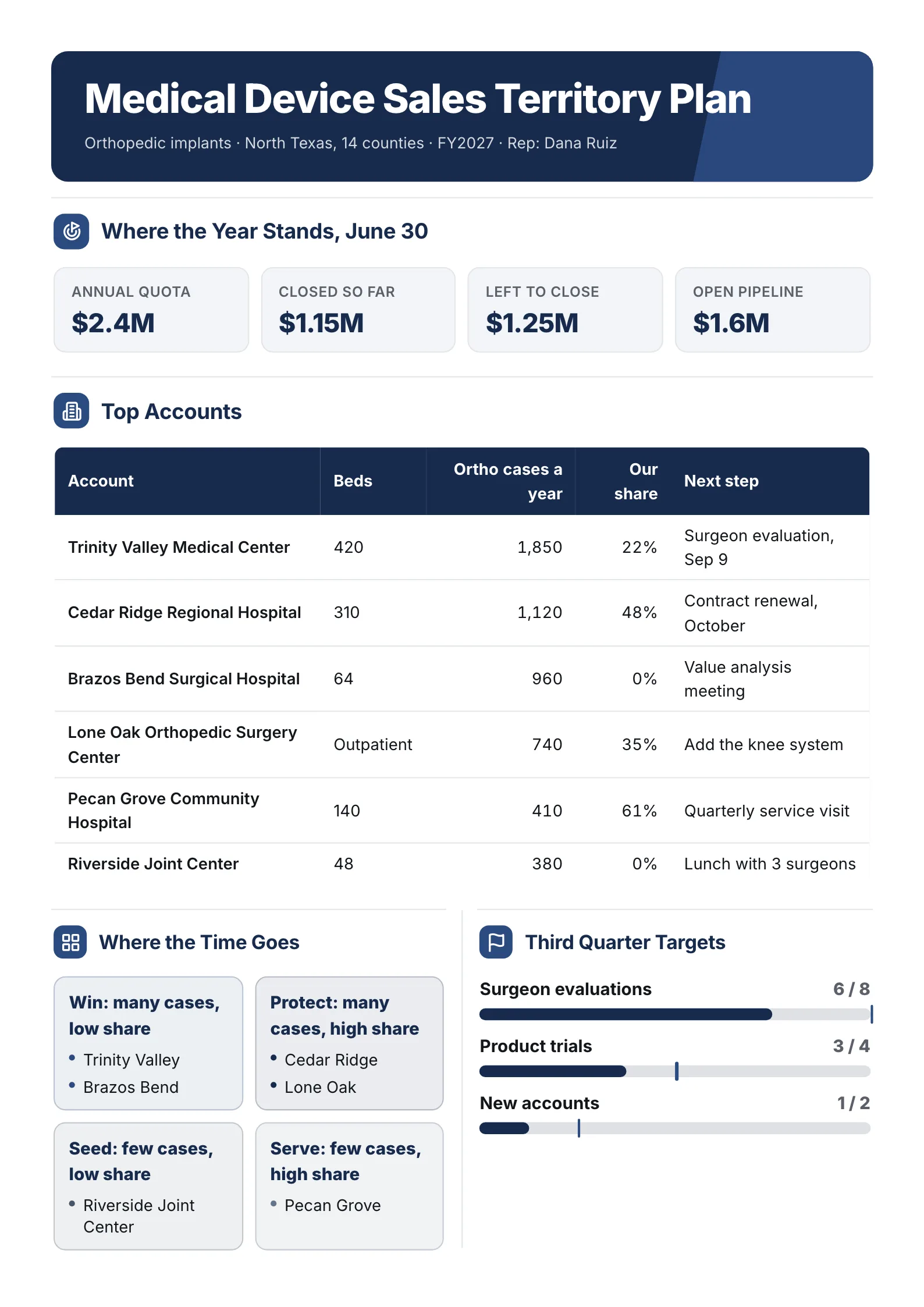
The medical device sales territory plan does something most plans skip. It ranks hospitals by two numbers at once: how many orthopedic cases they do a year, and how much of that the rep already has. That puts each account in one of four boxes.
| Box | Cases | Our share | Accounts | What the rep does |
|---|---|---|---|---|
| Win | Many | Low | Trinity Valley, Brazos Bend | Spend the most time here |
| Protect | Many | High | Cedar Ridge, Lone Oak | Keep the contract, add products |
| Seed | Few | Low | Riverside Joint Center | One meeting to open the door |
| Serve | Few | High | Pecan Grove | A steady service visit |
Trinity Valley does 1,850 cases a year at 22% share. Brazos Bend does 960 and the rep has none of them. If you sell into hospitals, that's where you'd spend next month. The status line at the top does the math for you: $1.25M left to close against $1.6M in open pipeline, so the pipeline covers about 1.3 times what's left. That's thin. The plan's third-quarter targets (surgeon evaluations, product trials, new accounts) exist to grow it.
Pharmaceutical: the call plan that fits in a working day
 Edit this template
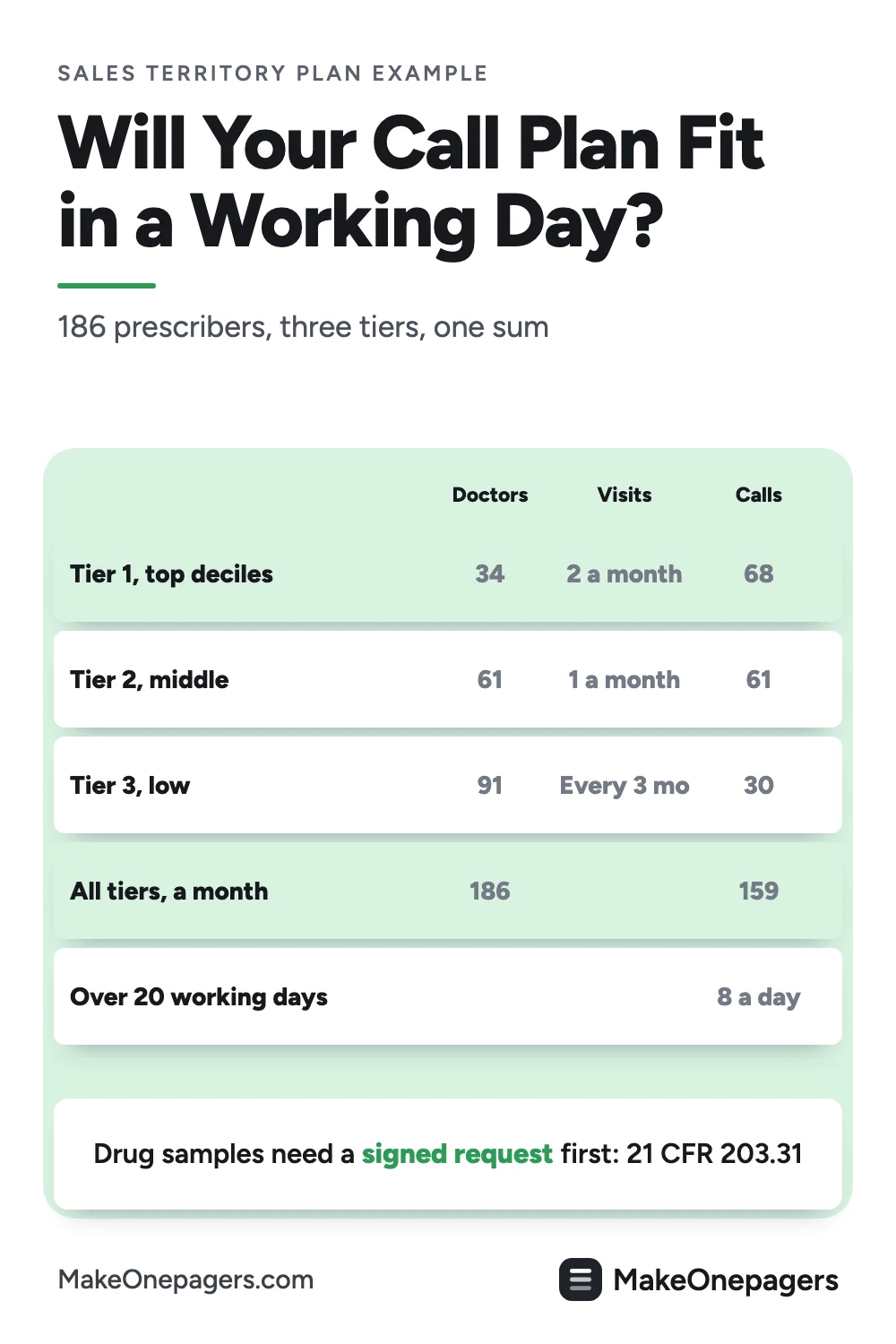
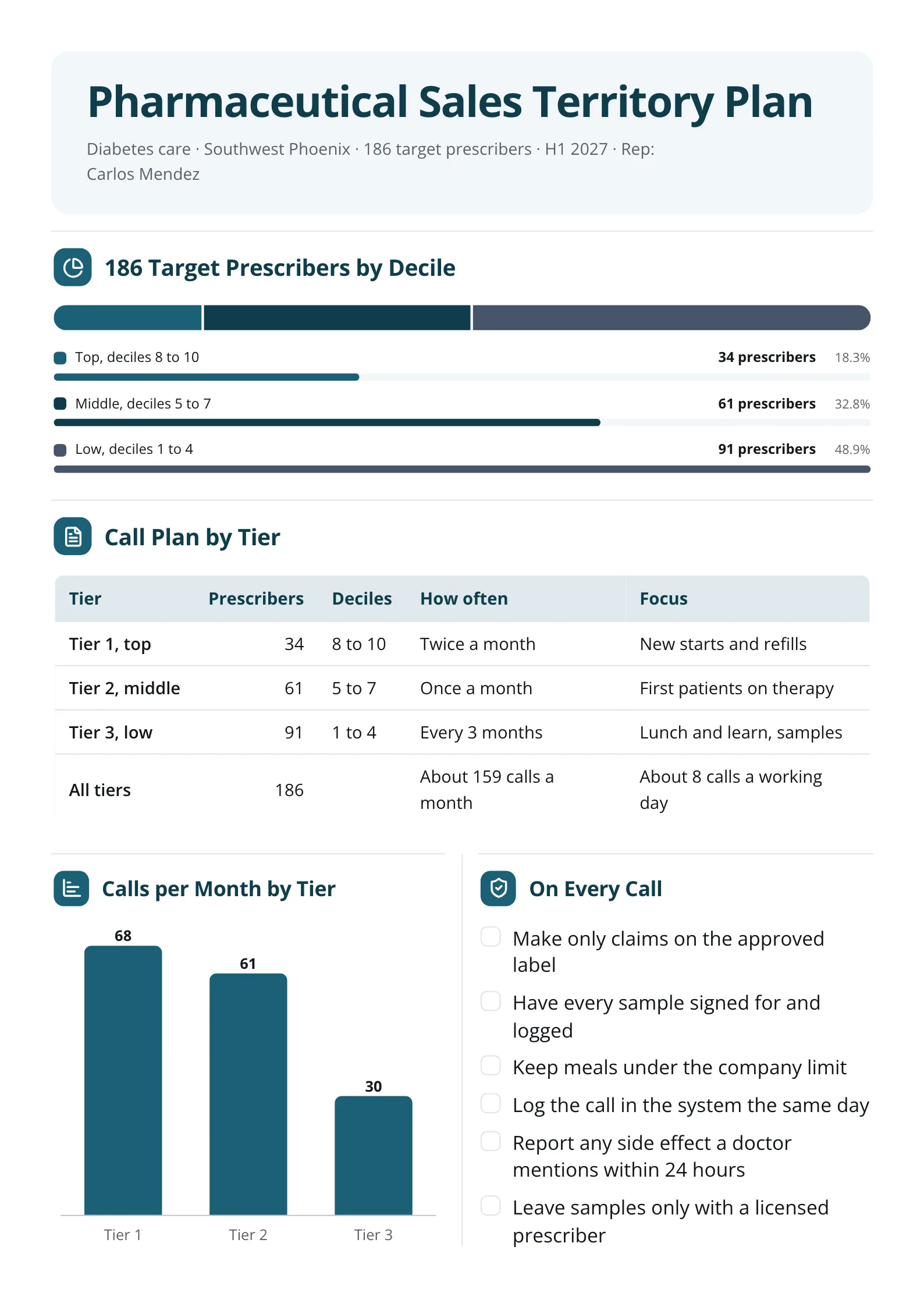
The pharmaceutical sales territory plan is the one to study if your plan lives or dies on visits. It sorts 186 prescribers into deciles (10 bands, by how much they prescribe in the category) and then into three tiers. Each tier gets its own visit rate. Here's the math the sheet rests on:
| Tier | Prescribers | Visits | Calls a month |
|---|---|---|---|
| Tier 1, deciles 8 to 10 | 34 | Twice a month | 68 |
| Tier 2, deciles 5 to 7 | 61 | Once a month | 61 |
| Tier 3, deciles 1 to 4 | 91 | Every 3 months | about 30 |
| All | 186 | about 159 |
At about 20 working days a month, that's 8 calls a day. Now you can test the plan. If a rep can really make 8 good calls a day, it works. If traffic and waiting rooms hold them to 6, something has to give, and the plan tells you what. Drop Tier 2 to every six weeks, or cut the bottom of Tier 3. Run the same math on your own list before you promise your manager a call rate.
Insurance agent: households, areas and a year in four quarters
 Edit this template
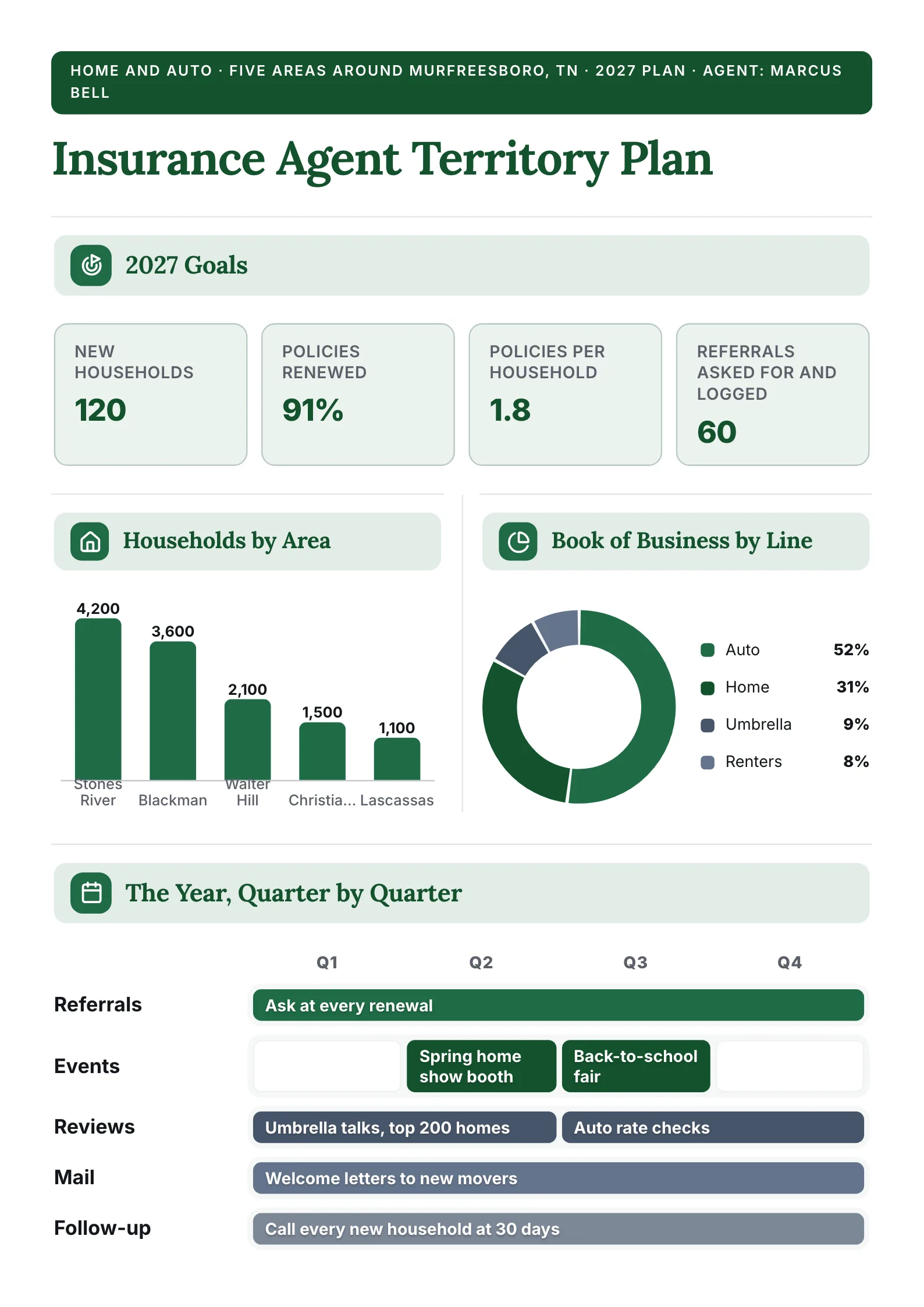
An agent's territory is a town, not an account list, so the insurance agent territory plan splits it into five areas: Stones River, Blackman, Walter Hill, Christiana and Lascassas. A chart shows how many households live in each area, from 4,200 in Stones River to 1,100 in Lascassas, so the agent can see where the market is biggest.
The goals are the ones that grow a book: 120 new households, 91% of policies renewed, 1.8 policies per household, and 60 referrals asked for and logged. Watch policies per household closely if you sell insurance. It rises when an auto customer adds home or umbrella cover, so it tracks how well you cross-sell.
The bottom half is a year in four quarters: ask for referrals at every renewal, a spring home show booth, a back-to-school fair, umbrella talks with the top 200 homes, and a welcome letter to every new mover. It's the plan's rhythm, written as dates instead of call counts.
Real estate farming: one neighborhood, every month
 Edit this template
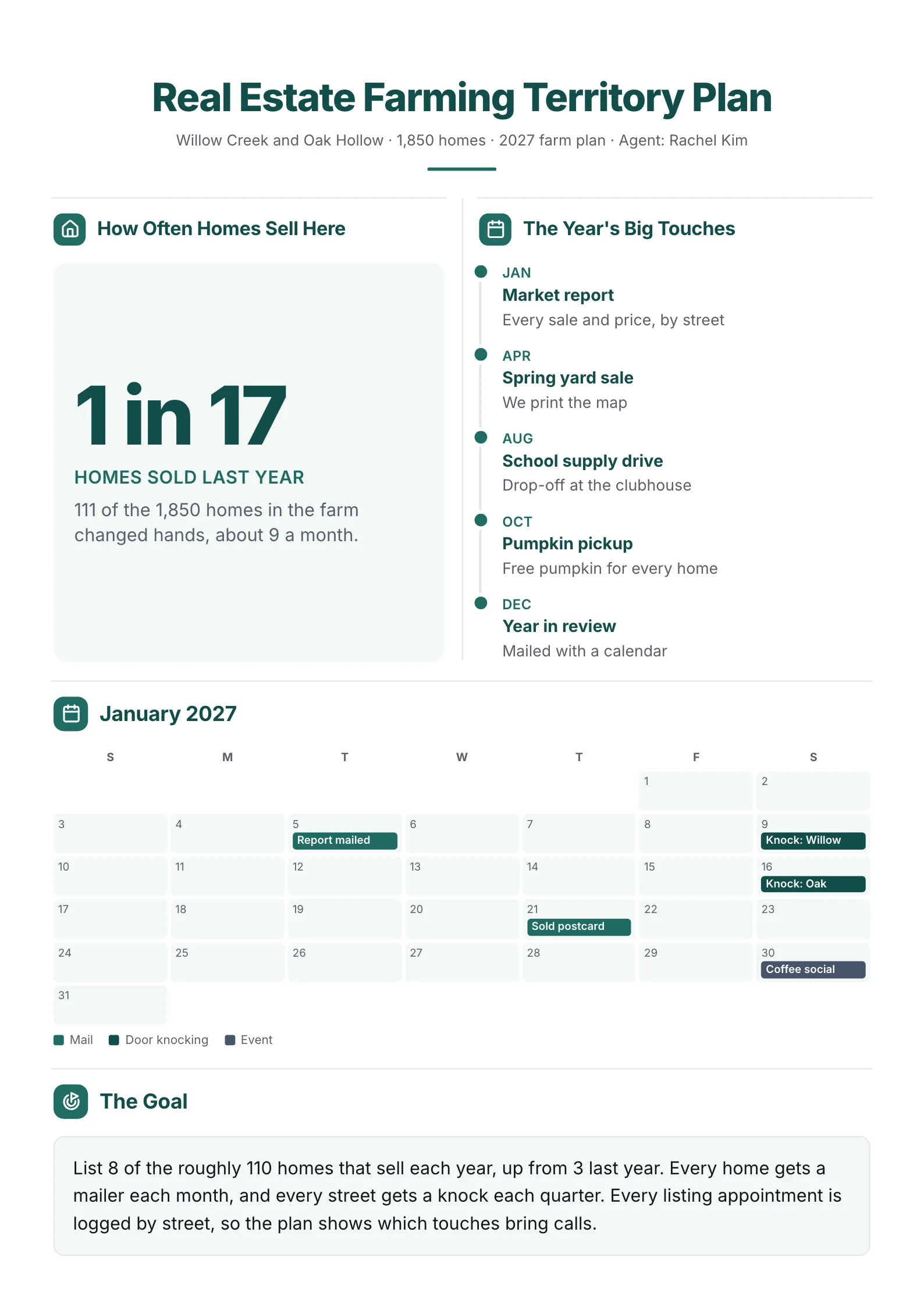
Agents call a chosen neighborhood their "farm", and the real estate farming territory plan is built around one number: 1 in 17. That's how many homes in the 1,850-home farm sold last year (111, or about 9 a month). Once you know your farm's turnover, you can set a goal you can actually check. The agent listed 3 of them last year and aims for 8 of the roughly 110 this year.
There's no ranked account list here, because any home could sell. Instead the sheet sets a rhythm for every home: a mailer each month, a knock on every street each quarter, and five big touches a year, from a market report in January to a pumpkin pickup in October. It also logs each listing appointment by street, which turns the plan into a test. Do the same and by December you'll know which touches brought calls.
The rule a pharma territory plan has to follow
Most territory planning guides stop at quotas and maps. A drug rep's plan also has to fit federal law, and the pharmaceutical example above carries those rules on the sheet ("Have every sample signed for and logged").
We read the rule on eCFR on November 16, 2026. It is 21 CFR 203.31, which covers drug samples handed over in person by a representative. Under it:
- the rep may deliver samples only to a practitioner licensed to prescribe that drug, or to a hospital pharmacy at that practitioner's written request
- the company must have a written, signed request from the practitioner before the sample is delivered
- the company must check with the state that the practitioner is licensed to prescribe it
- a receipt is signed when the sample arrives, and it goes back to the company
- the company must count every sample in each rep's stock at least once a year and reconcile the count against the last one
What does that mean for the plan? Sample drops take time, and the paperwork takes more. If Tier 3 calls are mostly "lunch and learn, samples", budget extra minutes for each. A plan that counts 8 calls a day without counting the sign-offs will run late every week. Check with your company's compliance team for the rest of the rules, since the PhRMA Code and your own policy add limits of their own, such as the company meal limit the example mentions.
How to write your own sales territory plan in 6 steps
- Draw the line. Write the area as a list anyone could check: counties, zip codes, named accounts, or a segment by size. "The Southeast" isn't a line.
- Count what's inside. How many accounts, prescribers, households or homes? Our territory plan template post shows how to count businesses by county from US Census Bureau data.
- Set one main target. A quota for most teams, or listings, households or placements. Put it at the top, with last year's number beside it.
- Rank the accounts. Use tiers, deciles, the four boxes or a top-five list. Give every top account a reason it's a target this year.
- Do the visit math. Accounts times visit rate, divided by working days. If the number is higher than you can really make, change the plan now, not in March.
- Pick three or four measures. Check them monthly, and put the date of the next review on the sheet.
Then fit it on one sheet. A territory plan nobody opens after January is worth nothing. One sheet a rep can pin by the desk, or open on a phone in the parking lot, gets used.
Mistakes that sink a territory plan
- A target with no accounts behind it. "$1.8M" means nothing until you can see which accounts add up to it.
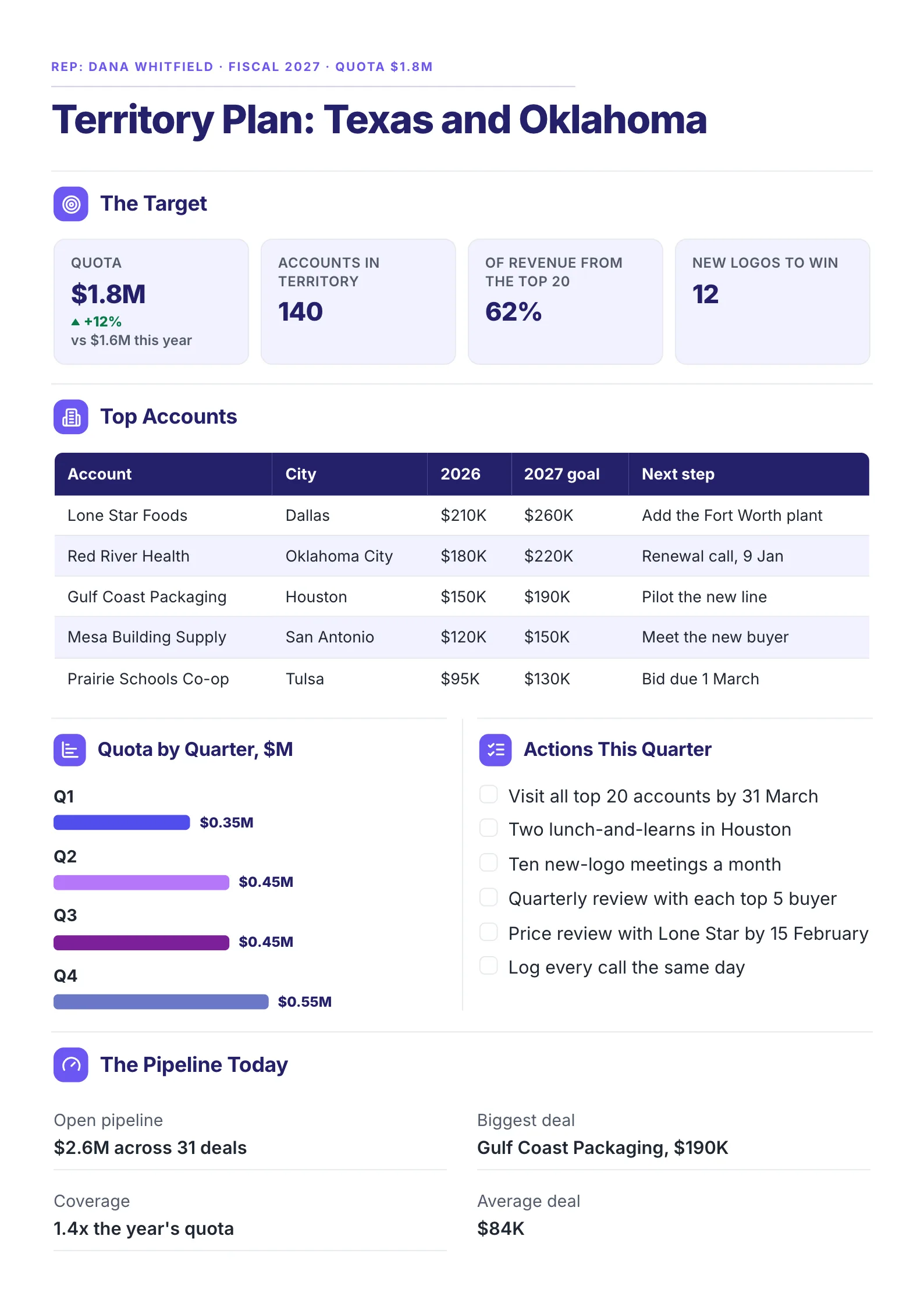
- Every account treated the same. In the territory sales plan example, the top 20 of 140 accounts bring 62% of the revenue. They're 1 in 7 of the accounts, so they need far more than 1 in 7 of your visits.
- Visit math nobody checked. The pharma example works because 159 calls fit 20 days. Do the same sum for yours.
- No date for the next review. Territories change: a plant opens, a hospital merges, a rival drops its price. Review monthly and rewrite each quarter.
- Too long to use. A 20-slide territory deck gets shown once. Keep the working plan to one sheet and put the backup behind it.
Make your sales territory plan today
Start from the example closest to your trade, keep its structure, and put your own area, accounts and numbers in. Do the visit math before you hand it in. Pick a territory plan template on MakeOnepagers, edit it free, and download it as a PDF.
Frequently asked questions
What is a sales territory plan?
A sales territory plan is a short document that says where a rep sells, the target for that area, which accounts matter most, how often each one gets a visit, and the numbers that show whether the plan is working. Most fit on a single One-Pager.
How do you write a territory sales plan?
Define the area, count the accounts in it, set one main target, rank the accounts, work out the visit rhythm and check it fits the working days, then pick three or four measures to review each month. The six steps above walk through each one.
What should a sales territory plan include?
The area, the target with last year's number, a ranked account list with a reason for each top account, a visit plan or weekly cycle, and the measures you'll check. Industries with rules, like pharma, also put the key rules on the sheet.
Can you give an example of a territory sales plan?
Yes. The pharmaceutical example above plans 186 prescribers in three tiers: 34 top prescribers seen twice a month, 61 seen monthly and 91 seen every three months. That's about 159 calls a month, or 8 a working day.
What is the 30-60-90 rule in sales?
It usually means a 30-60-90 day plan: what a new rep will learn in the first 30 days, start doing by day 60, and own by day 90. It's a ramp-up plan for a new hire. A territory plan covers the full year, and a new rep often writes both.




