Project Charter One Pager: What 6 Public Charters Ask For
A project charter one pager, built from 6 charters that state agencies and universities share: the 12 parts they ask for and a layout to copy.

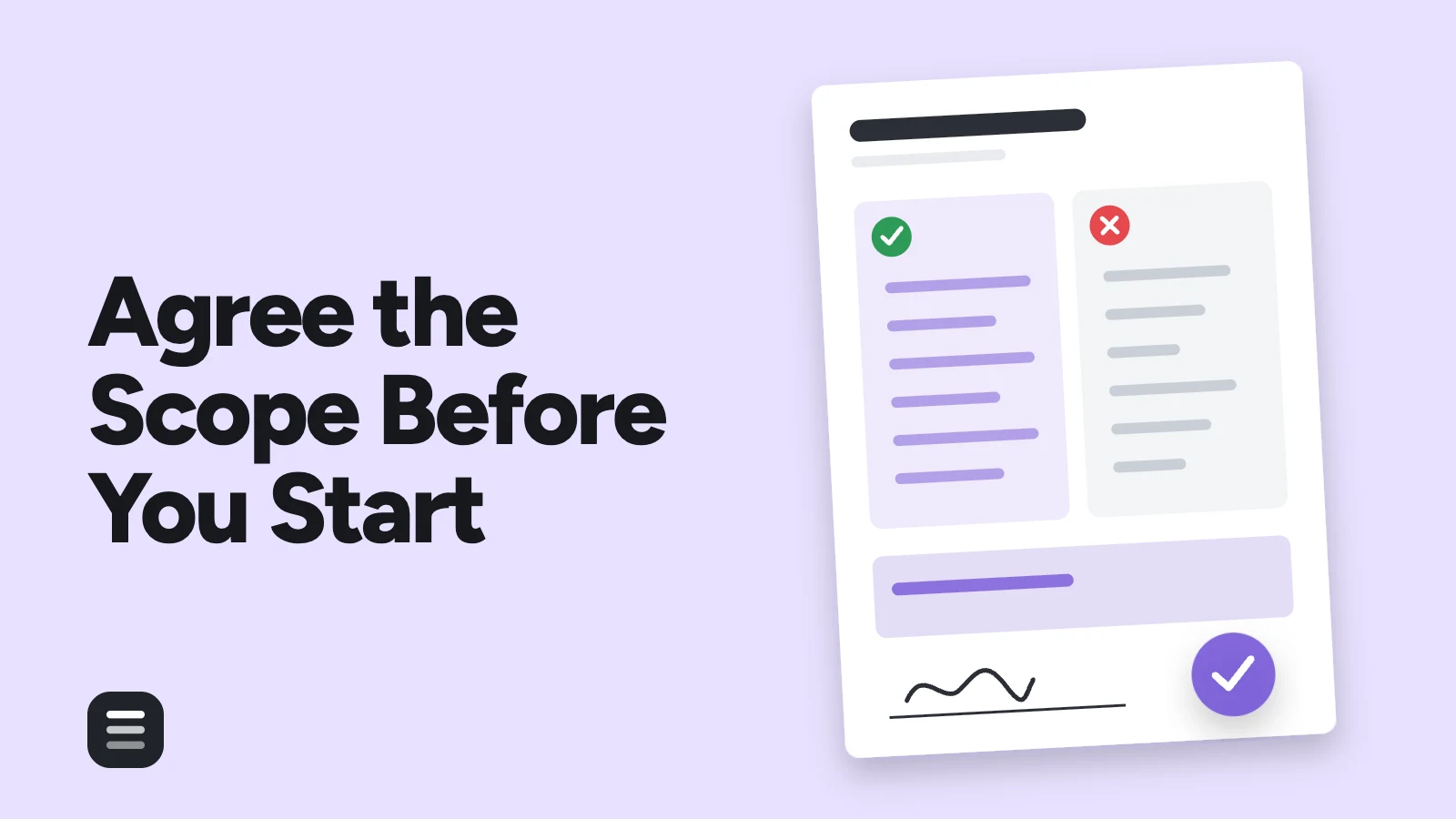
A project charter one pager puts the parts your sponsor signs onto one sheet. You get the problem, the goals, what's in and out of scope, the dates, the budget, the roles and the risks. To see which parts matter most, we read 6 project charters that state agencies and universities share. Five are blank forms their teams fill in. One is a charter a state health department filled in and signed. All 6 ask for the sponsor's approval, measurable goals, the scope, dates, roles and risks. Only 4 give the out-of-scope list its own section, and that's the one we'd never leave off yours. Start from a free one pager template.
One‑Pager examples
Real One-Pagers made with MakeOnepagers. Open any one to edit it as your own.
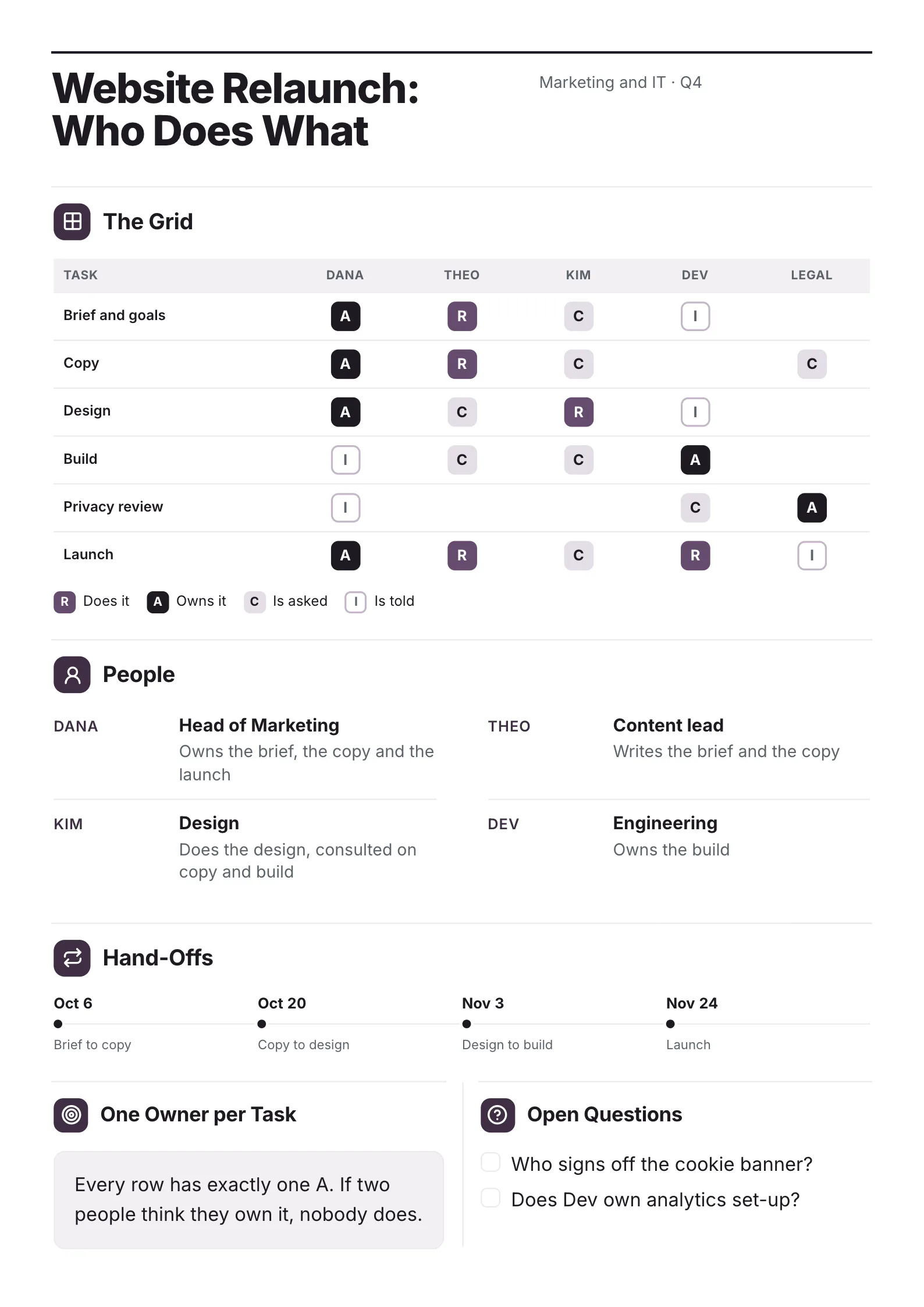 RACI MatrixEdit for free(opens in a new tab)
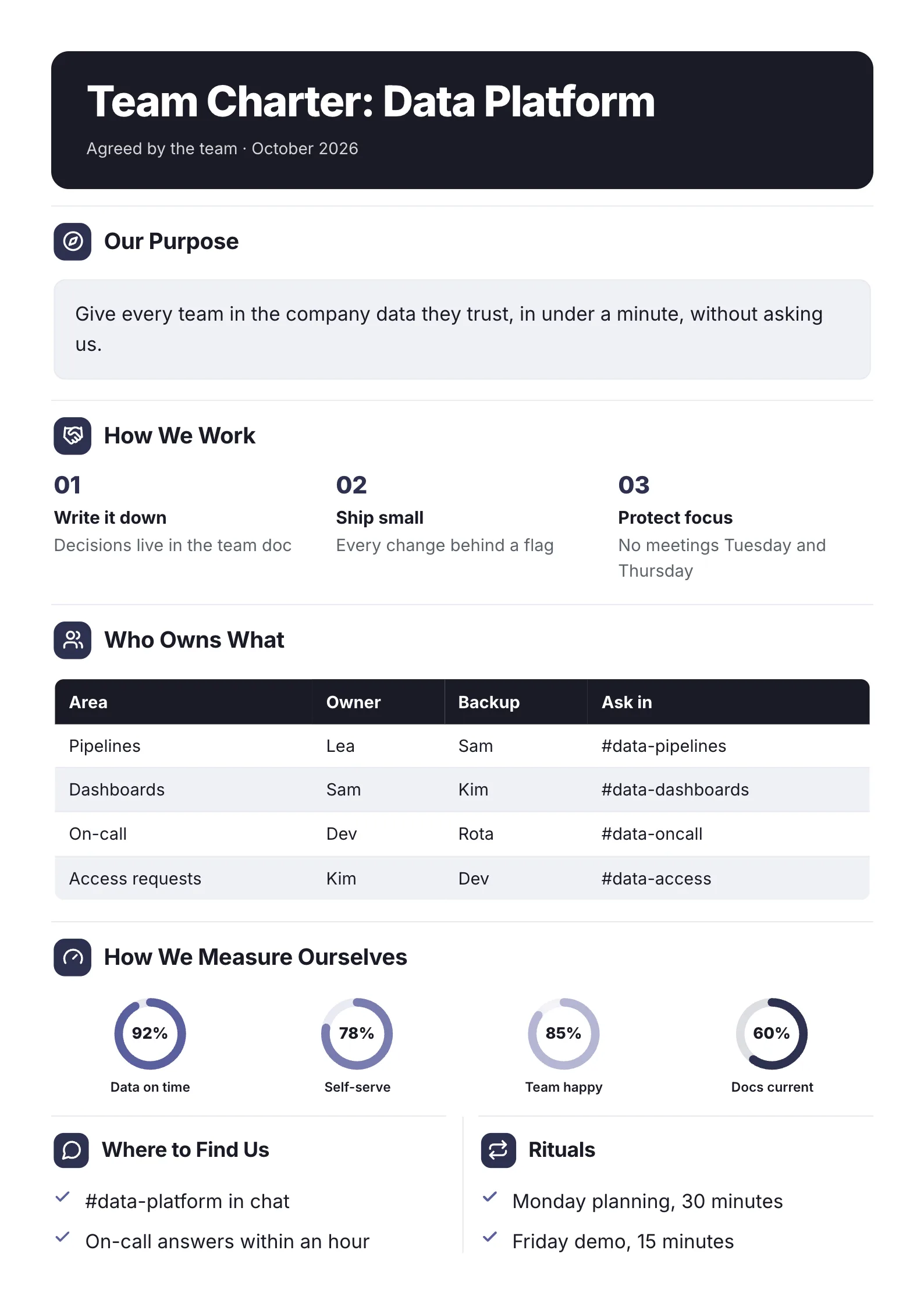 Team CharterEdit for free(opens in a new tab)
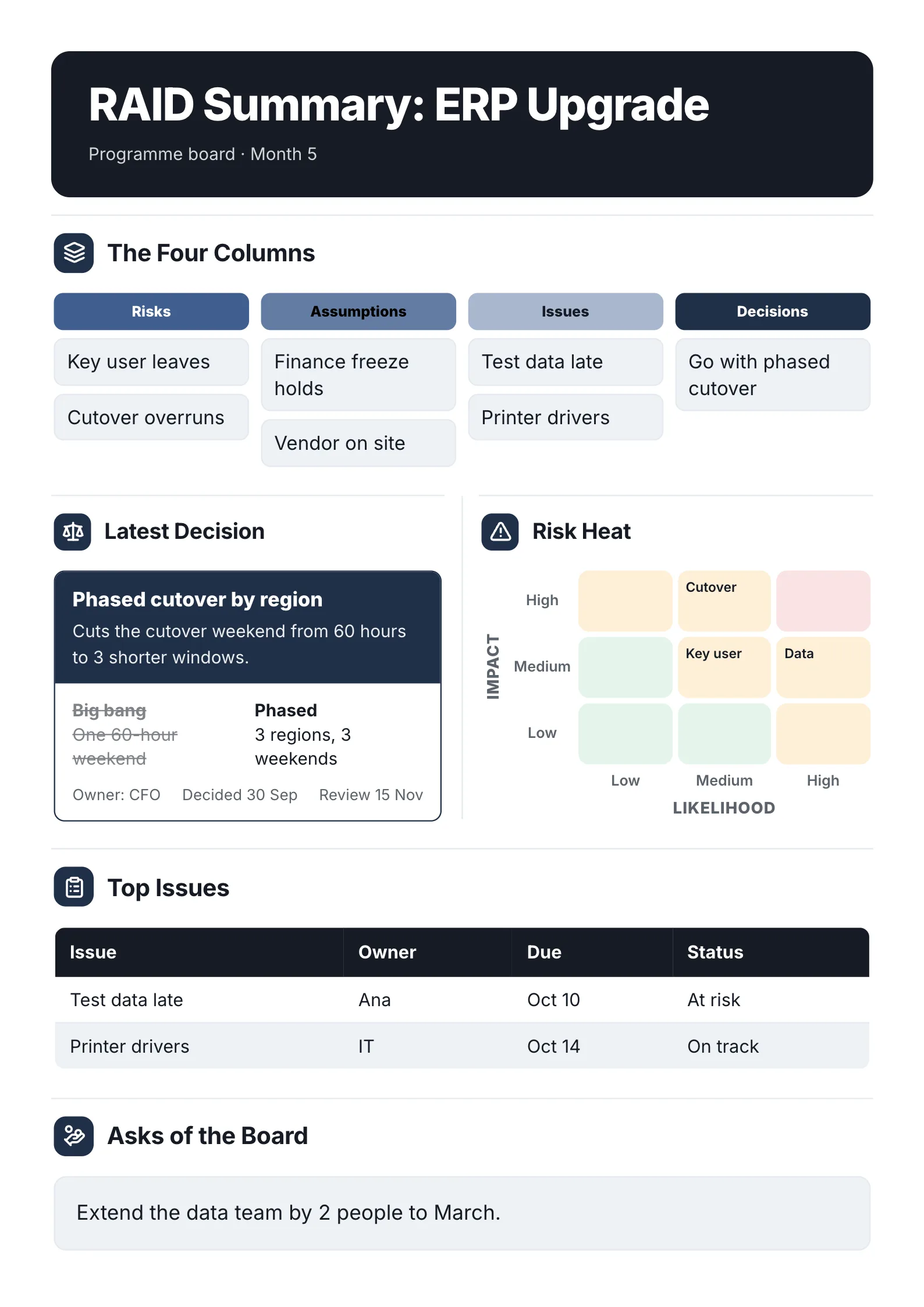 RAID Log SummaryEdit for free(opens in a new tab)
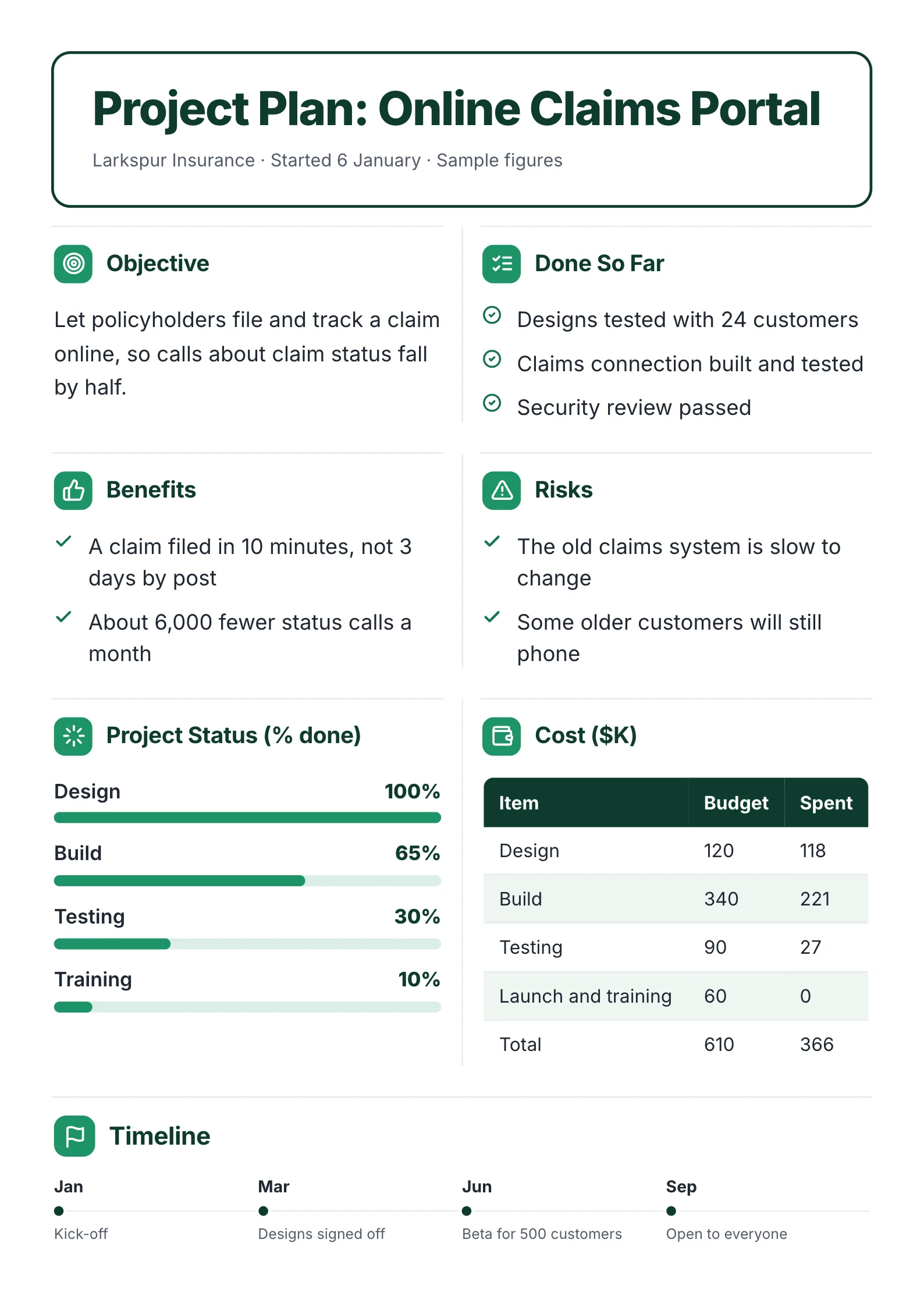 Project Plan with Objectives and CostEdit for free(opens in a new tab)
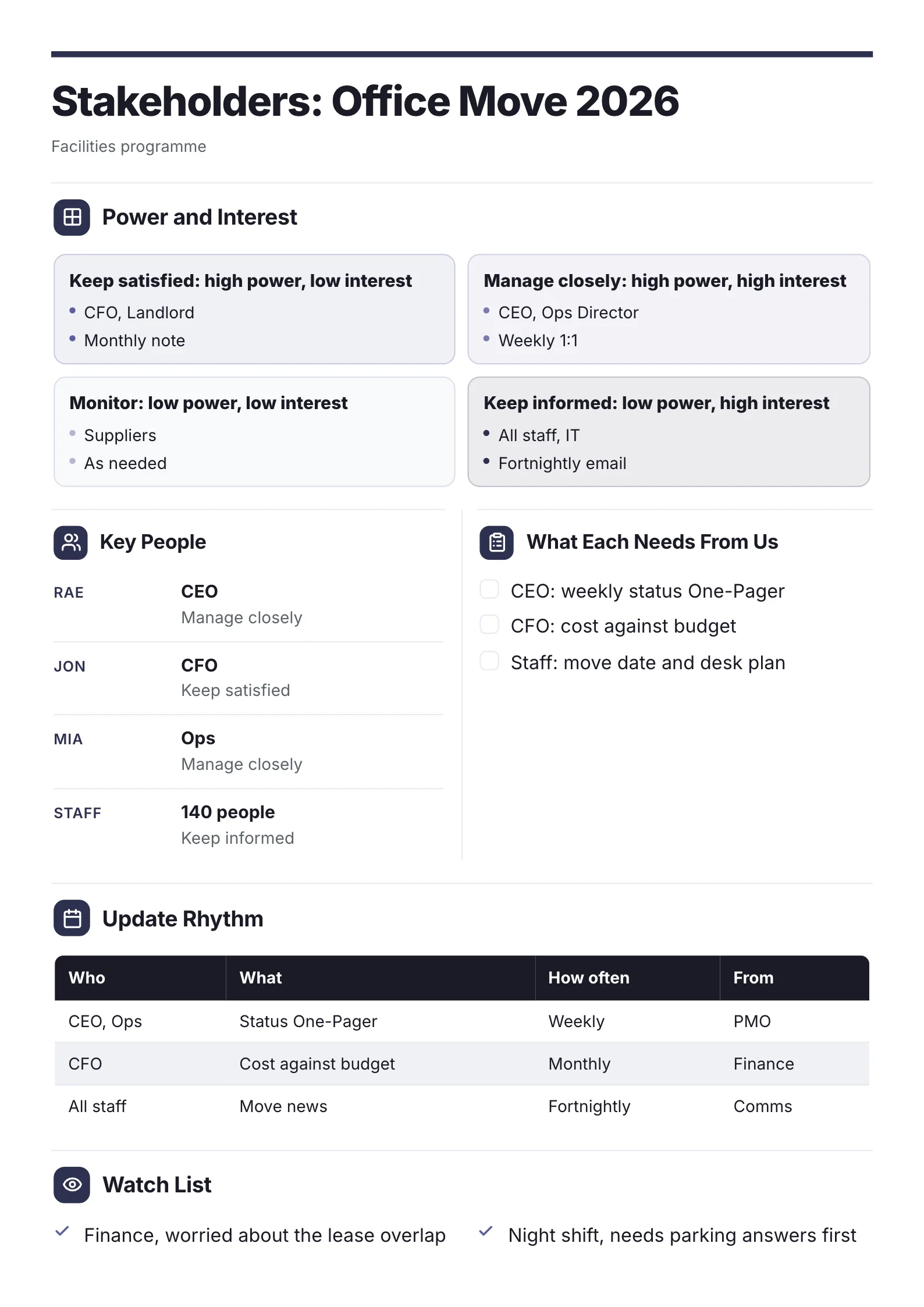 Stakeholder MapEdit for free(opens in a new tab)
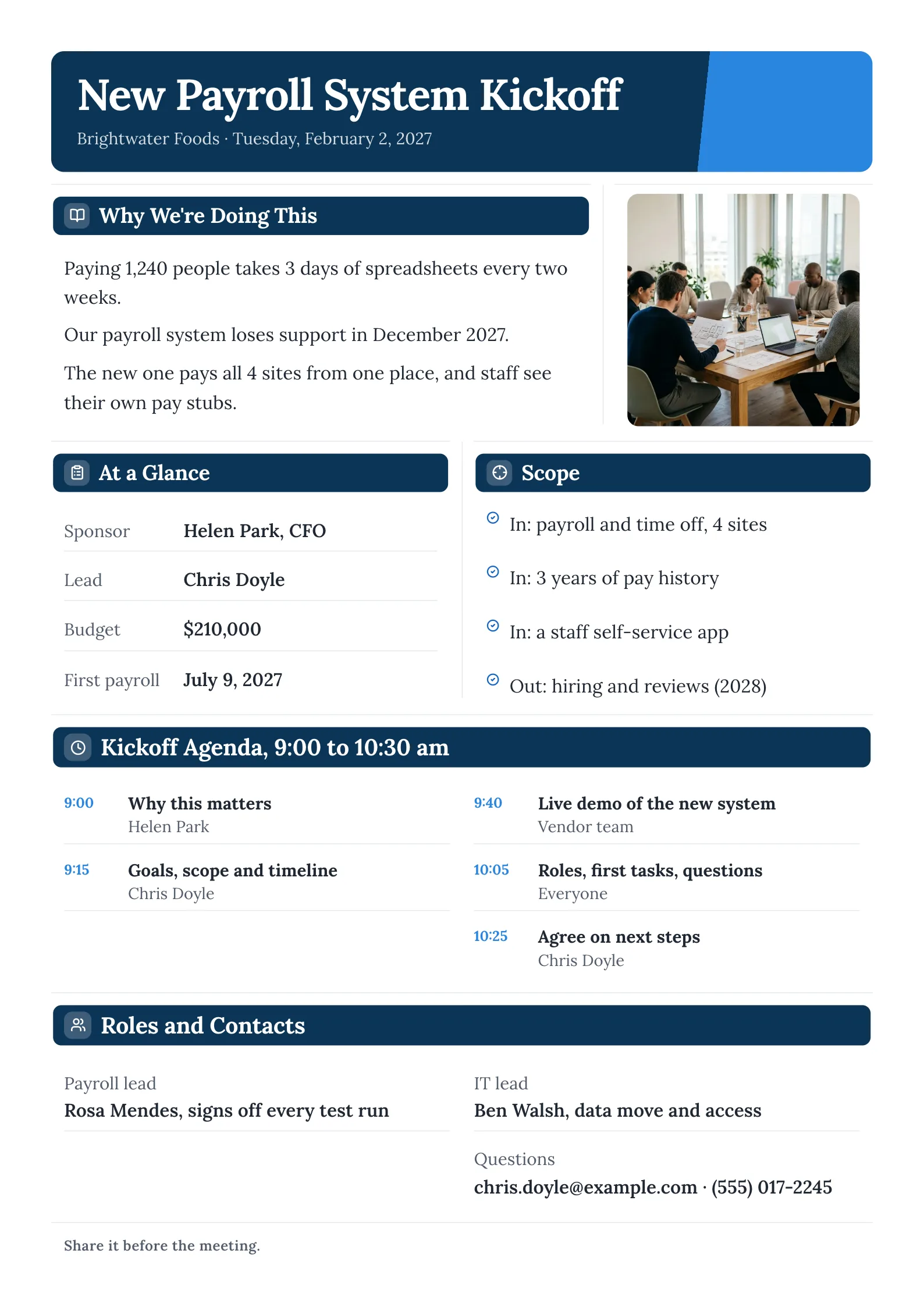 Project Kickoff BriefEdit for free(opens in a new tab)
Below you'll find the six charters, what they ask for, how a filled-in one reads, how short a charter can be, and a layout you can copy.
The six charters we read
- The WaTech IT Project Charter, from Washington State's technology agency, adopted July 19, 2023. It runs 12 pages.
- The Georgia Technology Authority project charter template, 11 pages.
- The California Project Charter mini, from the California Department of Technology. It's the short form, for small projects.
- The Statewide Min/Max Project Team Charter, from the Washington State Department of Health, started January 13, 2020. It's 7 pages, filled in with names.
- The Yale DHLab Project Charter, from the Yale University Library, 2 pages.
- The Graduate Research Project Charter, from the University of Saskatchewan, posted in 2023. It runs 9 pages.
We went through each charter section by section and marked which of 12 asks it makes. Every count below comes from that table. The charters are public, so a reader on any project team can hold our counts against the originals.
What all six ask for
| What the charter asks for | Charters that ask |
|---|---|
| The sponsor signs or approves it | 6 of 6 |
| Measurable goals or success criteria | 6 of 6 |
| What's in scope | 6 of 6 |
| Milestones or dates | 6 of 6 |
| Roles and who does what | 6 of 6 |
| Risks | 6 of 6 |
| Assumptions and constraints | 6 of 6 |
| The problem or need | 5 of 6 |
| Budget or cost | 5 of 6 |
| Out of scope as its own list | 4 of 6 |
| A version history | 4 of 6 |
| Who approves a change to scope, schedule or budget | 3 of 6 |
Source: MakeOnepagers.com read of 6 project charters (WaTech 2023, Georgia Technology Authority, California Project Charter mini, Washington State Department of Health 2020, Yale DHLab, University of Saskatchewan 2023), October 26, 2026.
Every charter treats the sponsor's approval as the start line. California's form says a project formally begins when the sponsor signs off. The health department's charter closes with a signature line for the Secretary of Health, who agrees to support the project as written. So leave room on your sheet for a name, a signature and a date.
Out of scope is the part most often missing
Georgia's form and California's short form have no out-of-scope section. You describe the scope, and whatever you leave out stays unsaid. WaTech gives it a heading of its own, with a sentence you finish by listing what the project does not include.
The health department's charter shows why that list pays off. It has three lines. The last one says the project team doesn't make the final decision, because the Secretary of Health does. That one line settles who decides before anyone argues about it.
Two of the forms also say who can grow the scope. Georgia's says that adding a deliverable needs the sponsor's approval, to stop scope creep. WaTech gives the sponsor the final say on any change to scope, schedule or budget. Put both on your sheet: a short list of what's out, and the name of the person who approves a change.
How a filled-in charter reads
A blank form shows you the boxes. The health department's charter shows them filled in, and three details are worth copying.
- The slip sits next to the date. The end date reads November 2020, with a note that it moved from June 30 because of the COVID-19 response. Your reader sees the change and the reason in one line.
- Every objective has an outcome you can check. One says the workgroup delivers its recommendations to the Secretary of Health by November 2020.
- The work has a ceiling. The deliverables include up to 10 facilitated workgroup meetings, so nobody plans for an eleventh.
It also lists 7 risks, from slow decisions to a workgroup that lacks the facts it needs. You don't need seven on one sheet. Pick your top three and keep the rest in the long version.
How short a charter can be
The six run from 2 pages to 12. Yale's fits in 2 pages and still holds goals, scope, out of scope, milestones, budget, risks and three signatures. California offers its short form for projects under $25,000 that take a few weeks or months. It adds that some groups call these short charters Project Data Sheets. WaTech's 12 pages are for state technology projects with a steering committee.
So one sheet suits a small or mid-size project on its own. On a large project, it works as the cover your sponsor reads first, with the full charter behind it.
A one-sheet charter layout you can copy
This layout uses all 12 asks, from top to bottom.
| Row | What to write |
|---|---|
| Name, sponsor and sign-off | The project, the sponsor's name and the date they approved it |
| The problem | One or two sentences on why the project exists |
| Goals | Two to four, each with a number and a date |
| In scope | What the project delivers |
| Out of scope | Three to five things it won't do, including who makes the final call |
| Dates | Four or five milestones, with any slip and its reason next to it |
| Budget | The total and where the money comes from |
| Roles | The sponsor, the project manager and one owner per task |
| Risks and assumptions | Your top three risks and what you're counting on |
| Changes and versions | Who approves a change, and the date of this version |
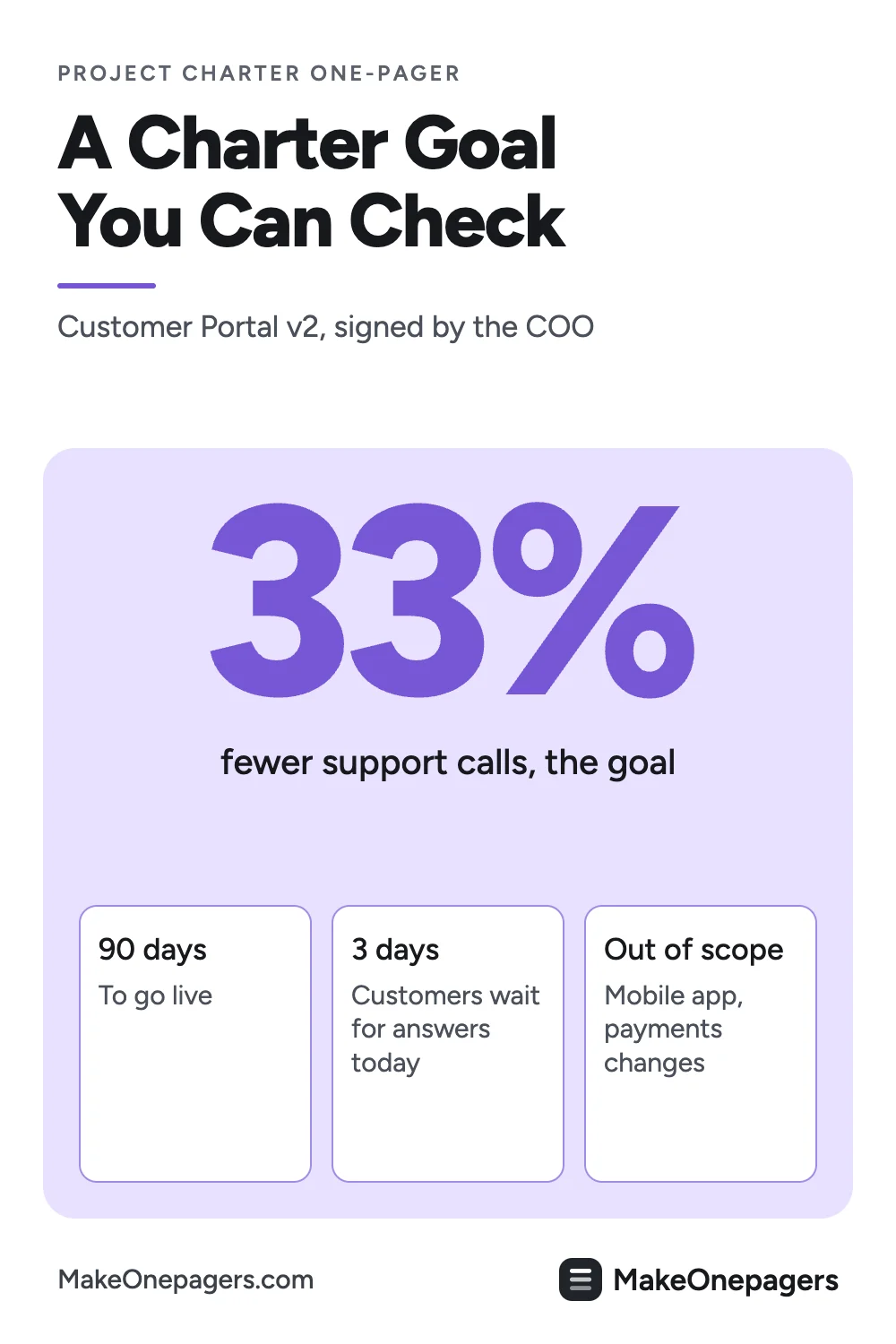
Here's a finished sample for a customer portal. It fills every row but risks and versions, and it already names who approves a change: the COO. Add your top three risks and the date of this version.
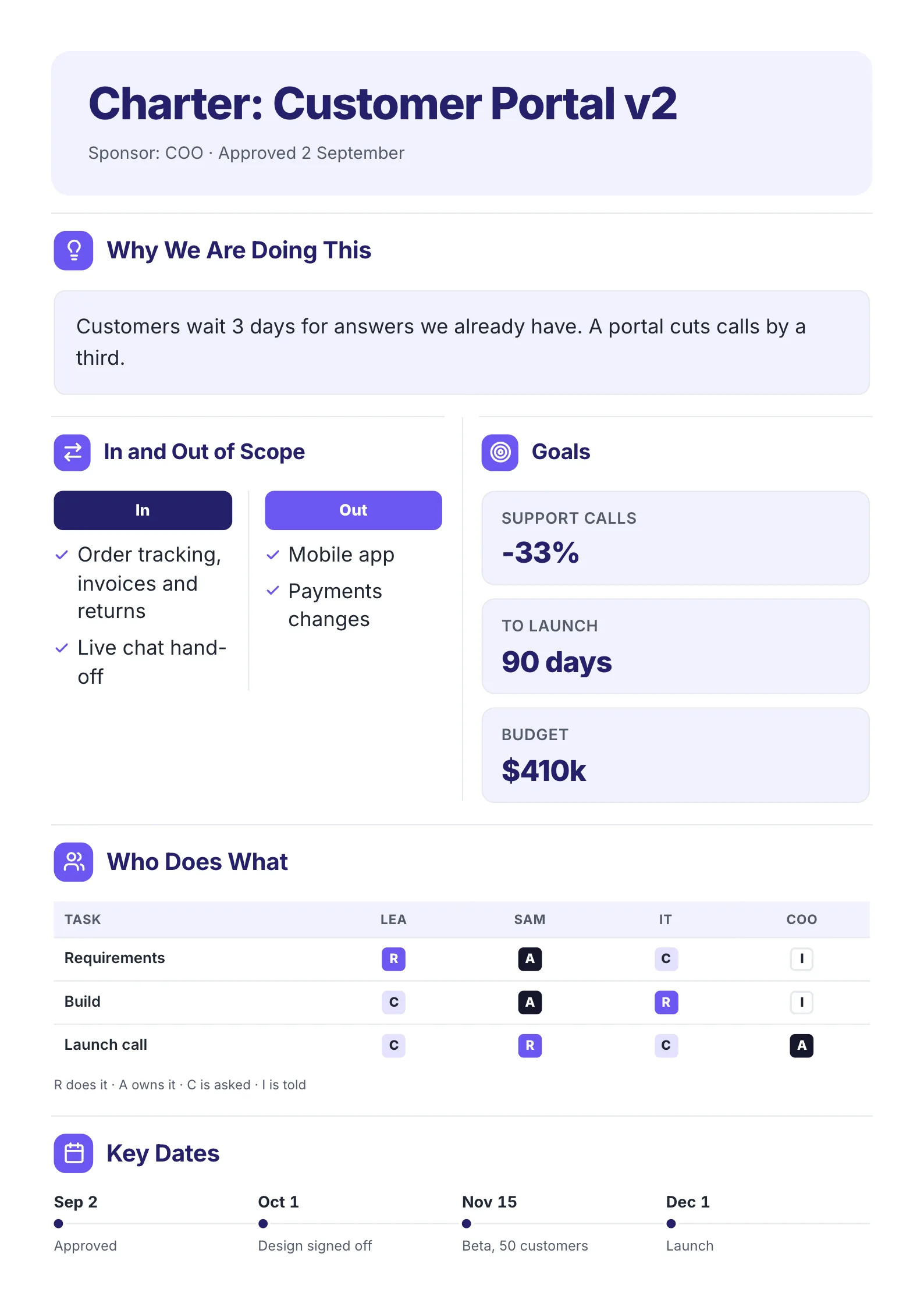 Edit this template
You can edit this project charter template for free in MakeOnepagers. Swap in your sponsor, your out list and your dates.
Questions people ask about project charters
What should a project charter one pager include?
Start with the seven parts all six charters ask for. That's the sponsor's approval, measurable goals, what's in scope, the dates, the roles, the risks and your assumptions. Then add the problem, the budget and an out-of-scope list. Finish with who approves a change.
Who signs a project charter?
The sponsor signs it in all six charters we read. Yale's also has the client and the project manager sign. The health department's has the executive sponsor sign, and it accepts a physical or an electronic signature.
How long is a project charter?
The six we read run from 2 pages to 12. California's short form is meant for projects under $25,000 that take weeks or months. For those, one sheet is enough.
What comes first, the business case or the charter?
WaTech's form says you write the charter after the business case is approved and the project is funded. The detailed work plan and schedule come after the charter, in the planning phase.
Is there a free project charter template?
Yes. The customer portal sample above opens in MakeOnepagers, and you can edit it by hand for free. If your team works in Word, California's mini charter is a free Word file from the state's Department of Technology, and it comes with instructions.
Get your sponsor's name on it
Open the charter sample in MakeOnepagers and fill in the ten rows, starting with what's out of scope. Download it as a PDF and take it to your sponsor to sign before the first task starts.




