Privacy Policy Summary: 9 Real Policies Measured, and Apple's on One Page
How to write a privacy policy summary on one page: 9 real policies measured, the federal one-page privacy format, and Apple's policy cut down.

A privacy policy summary is a one-page, plain-language version of your privacy policy. It tells your readers what personal data you collect and why you use it. It says who you share it with and what you never do with it. It also lists the choices your reader has and who to contact, and it links to the full policy. Your full policy still stands. The summary is the part people actually read. Start from a free one pager template.
One‑Pager examples
Real One-Pagers made with MakeOnepagers. Open any one to edit it as your own.
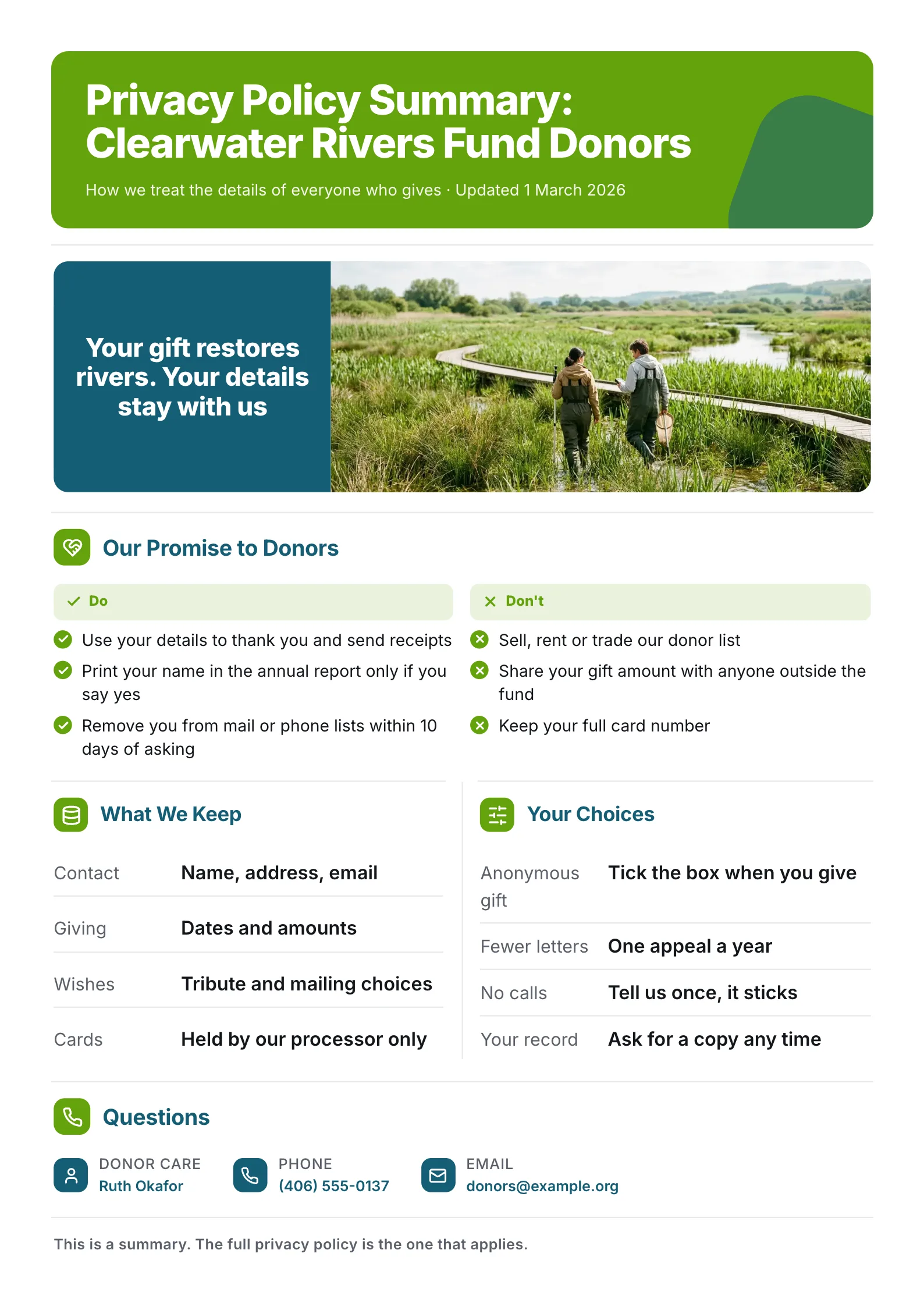 Privacy Policy Summary: Nonprofit Donor PrivacyEdit for free(opens in a new tab)
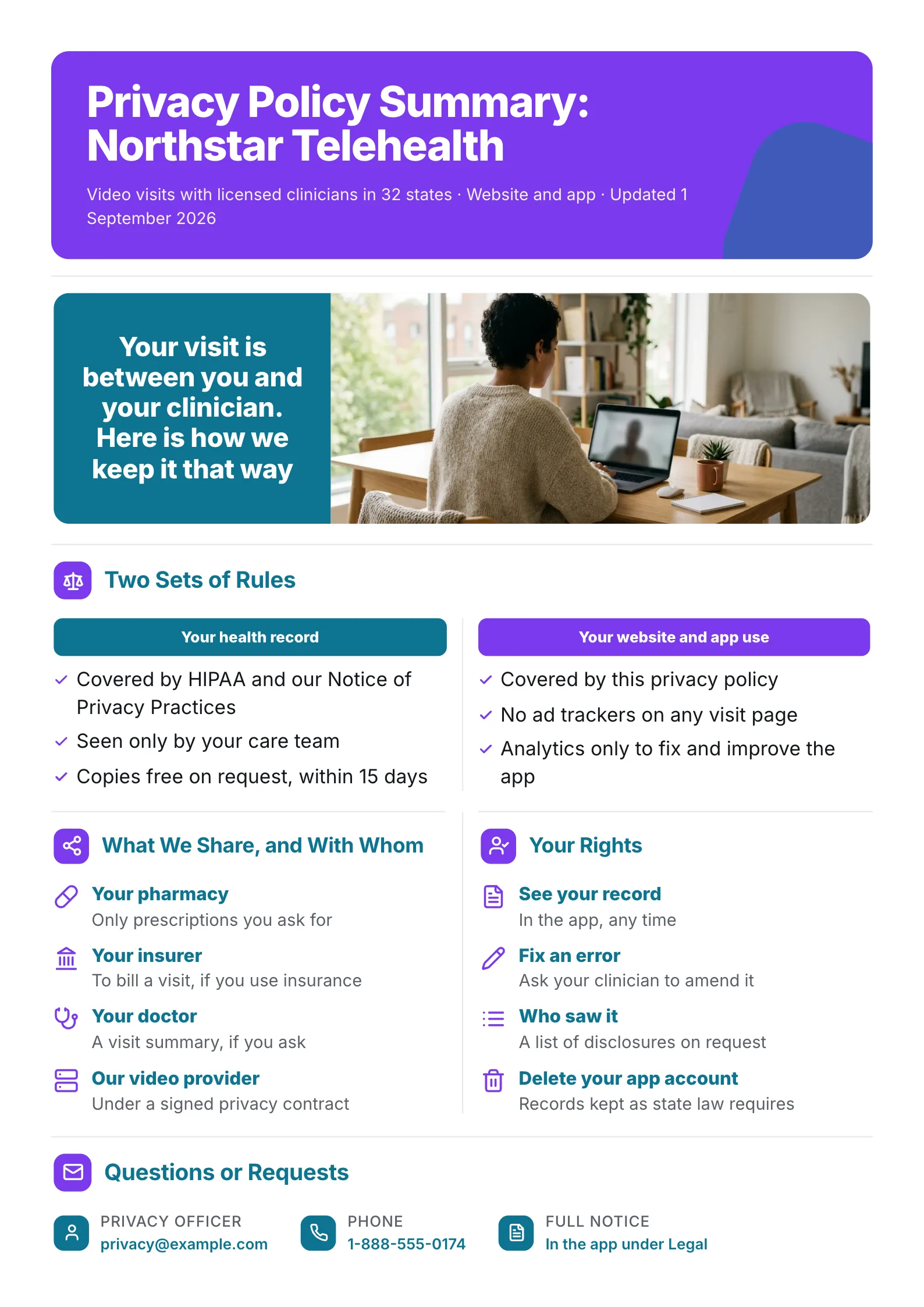 Privacy Policy Summary: Telehealth ServiceEdit for free(opens in a new tab)
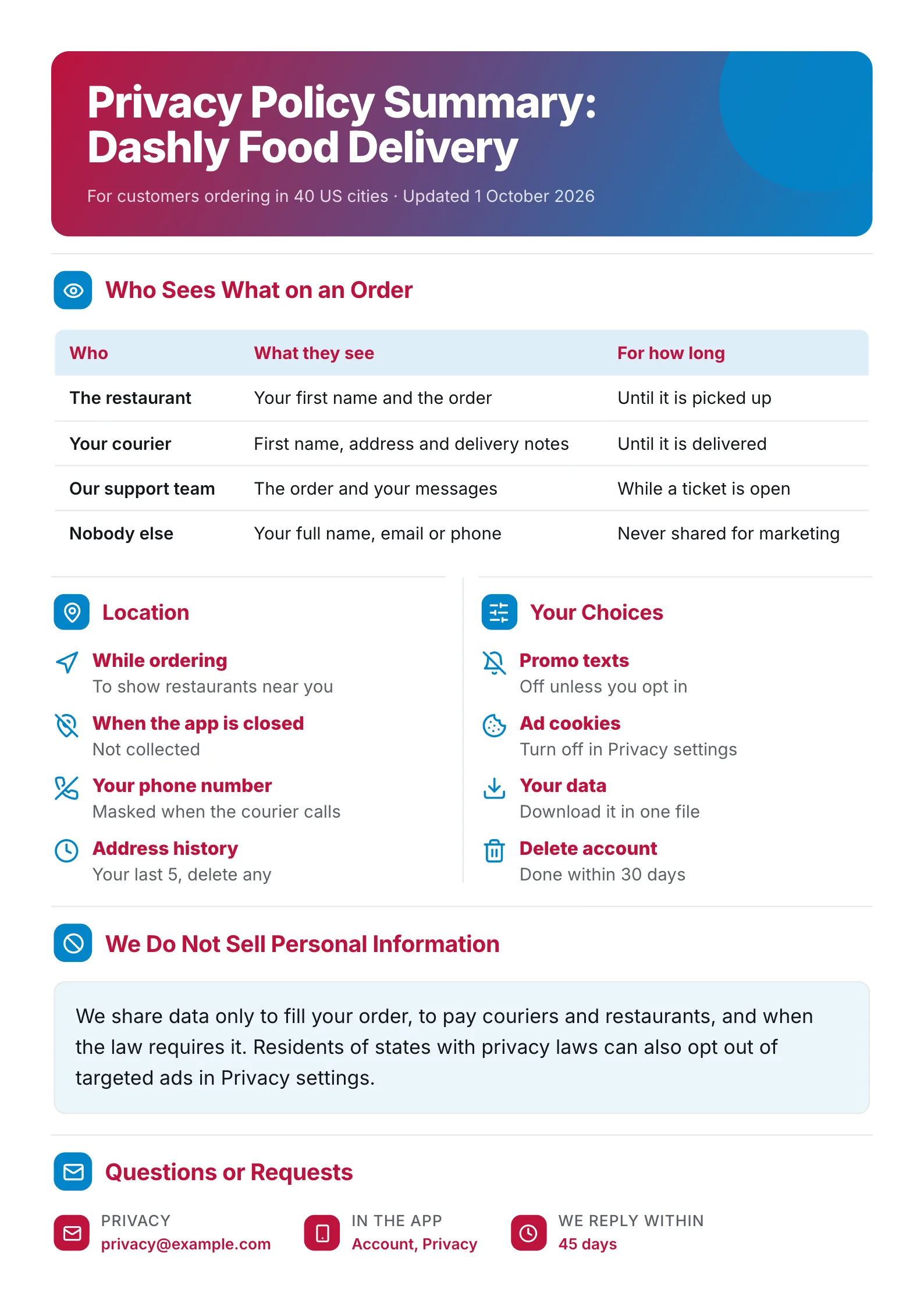 Privacy Policy Summary: Food Delivery AppEdit for free(opens in a new tab)
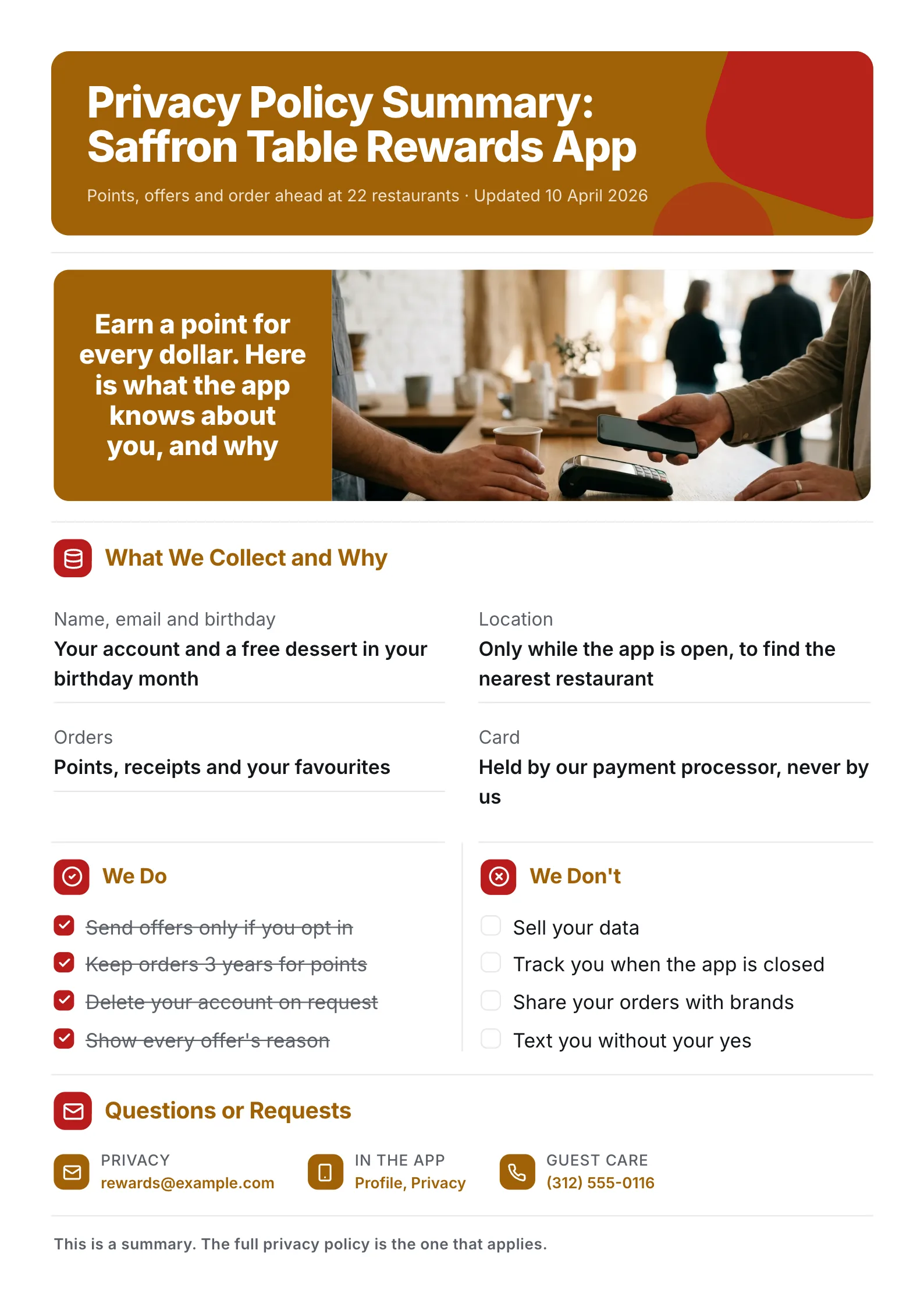 Privacy Policy Summary: Restaurant Loyalty AppEdit for free(opens in a new tab)
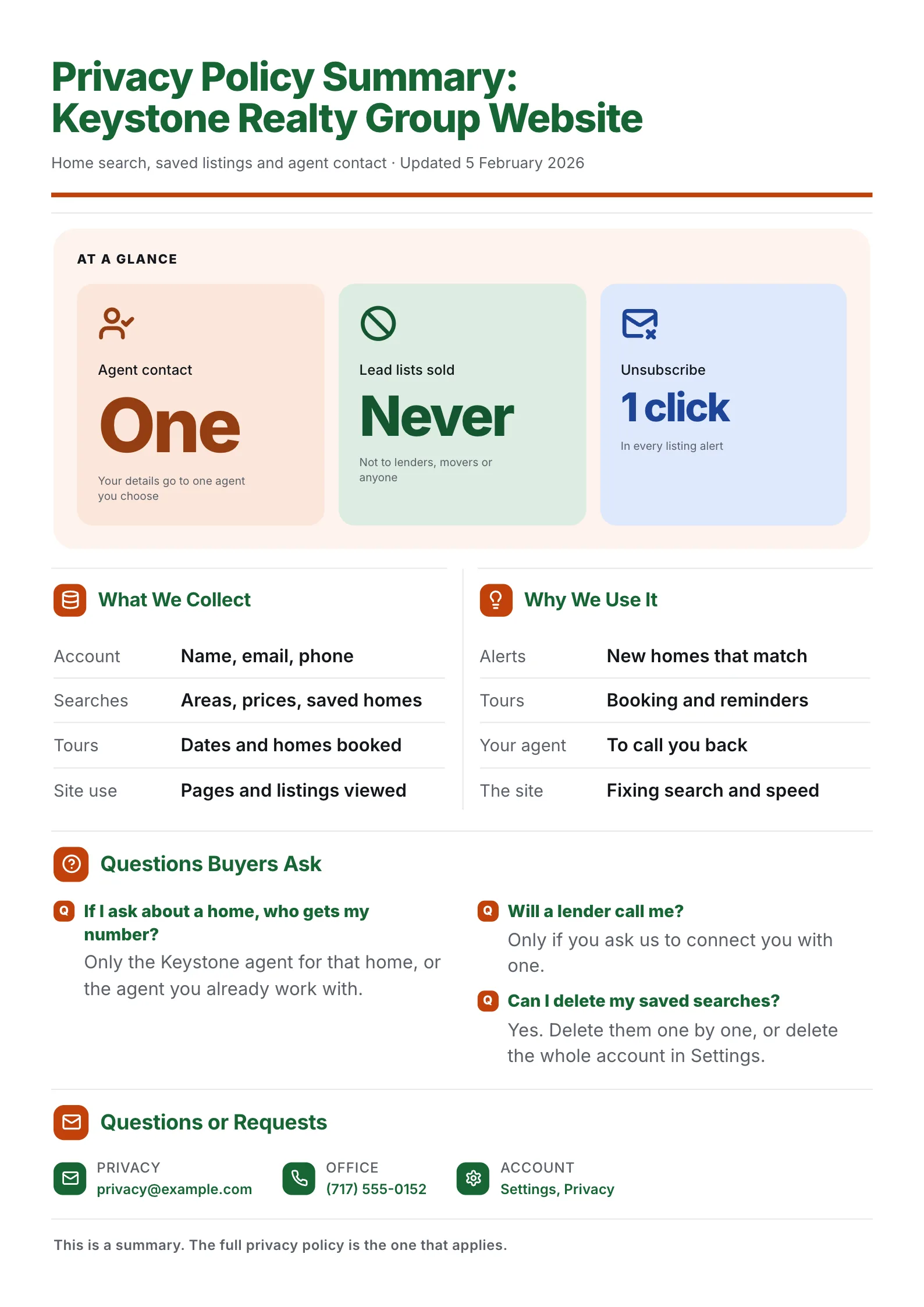 Privacy Policy Summary: Real Estate WebsiteEdit for free(opens in a new tab)
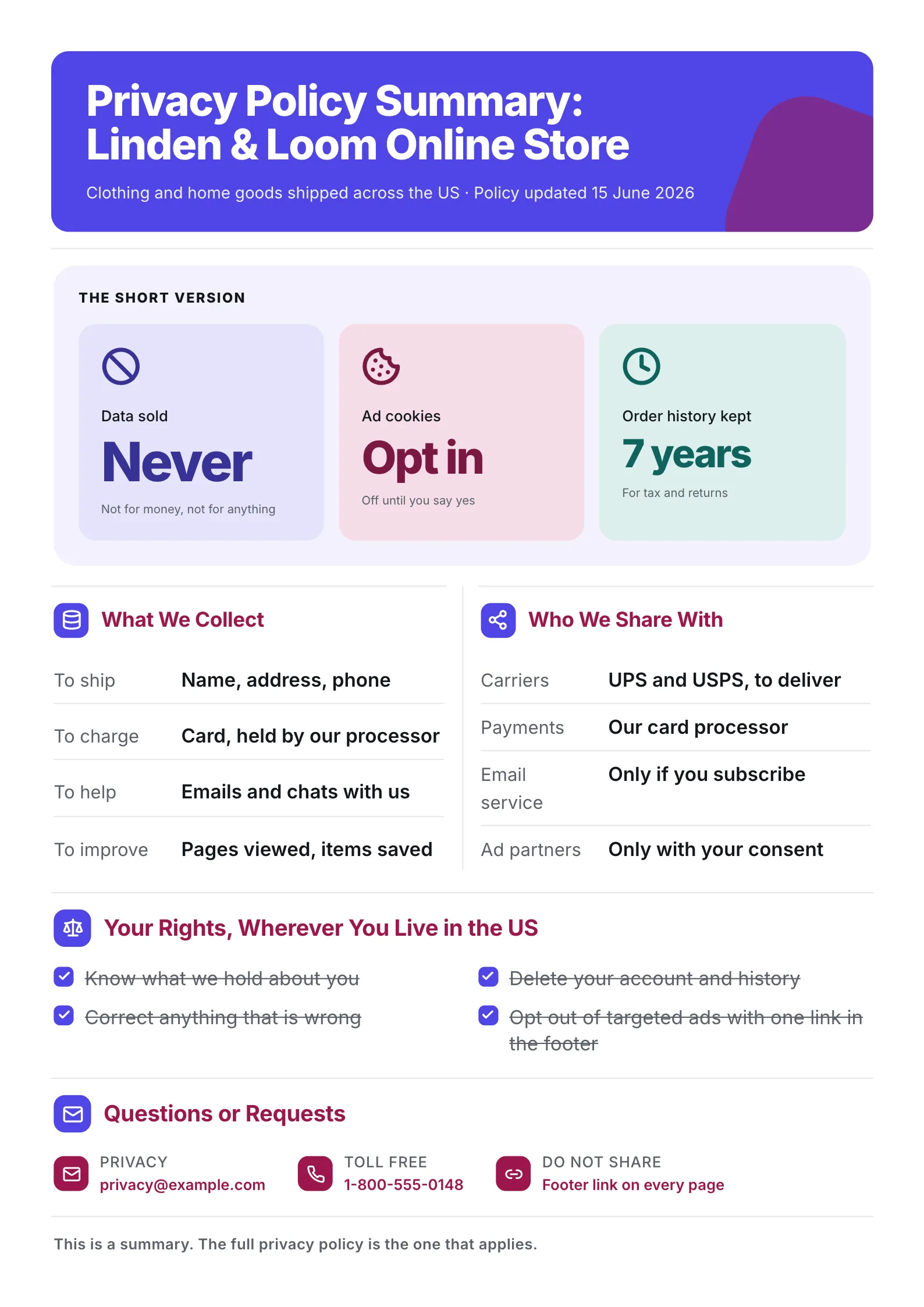 Privacy Policy Summary: Online StoreEdit for free(opens in a new tab)
To show you why it's needed and what goes on it, we measured 9 well-known privacy policies. We also read the one-page privacy format US federal rules give banks, and we cut Apple's privacy policy down to one page. Below you'll find the numbers, a privacy policy summary template, the worked example and five more examples on one page. This is a writing guide and isn't legal advice. Have your own policy and summary checked for the laws that apply to you.
What a privacy policy summary is for
A privacy policy is written for regulators and lawyers as much as for customers. A summary is written for your customer, who wants three answers. What do you take? What do you do with it? And how do I stop it?
You may also hear it called a privacy notice summary. Some call it the top layer of a layered notice, with the short version on top and the full policy underneath.
How long real privacy policies are
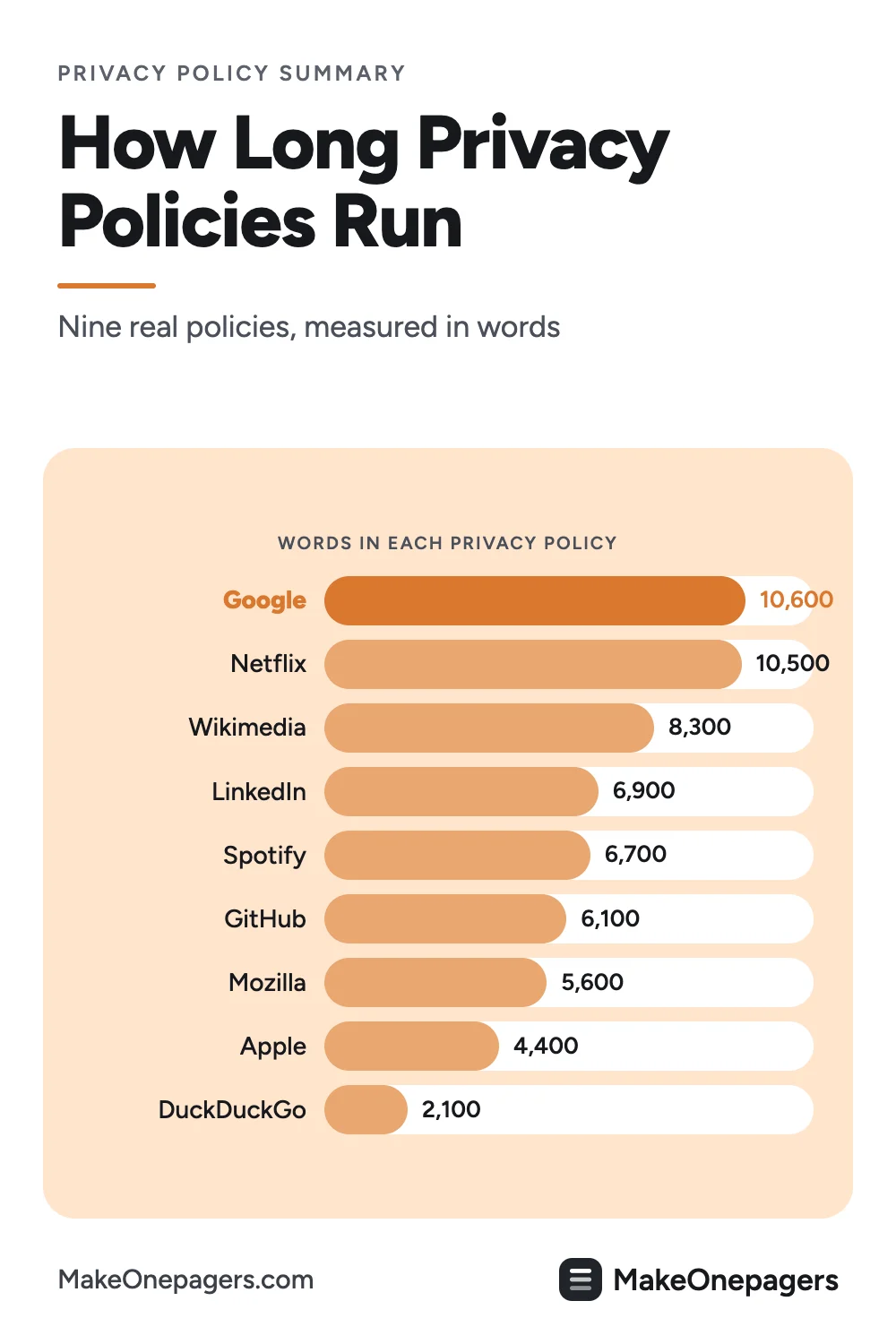
We measured the main text of 9 privacy policies on 12 October 2026, rounded to the nearest hundred words.
| Privacy policy | Words | Opens with a plain summary |
|---|---|---|
| DuckDuckGo | About 2,100 | Yes, one line |
| Apple | About 4,400 | No |
| Mozilla (Firefox) | About 5,600 | No |
| GitHub | About 6,100 | No |
| Spotify | About 6,700 | No |
| About 6,900 | No | |
| Wikimedia Foundation | About 8,300 | Yes, labelled as not part of the policy |
| Netflix | About 10,500 | No |
| About 10,600 | No |
What it shows:
- The median policy is about 6,700 words. At about 250 words a printed page, that is more than 25 pages.
- Only 2 of 9 open with a summary. DuckDuckGo puts its whole policy in one headline first. Wikimedia opens with a summary it calls "simply a handy reference" and says is not a legal document.
- Length is not the same as clarity. The shortest policy here is the one that sells itself on collecting the least.
The federal one-page privacy format
US federal rules already define a short privacy notice. Under Regulation P (12 CFR part 1016), banks and other financial companies may use a standard model privacy form; using it gives them a safe harbor for the notice's content. The instructions fix its layout. Page one holds:
| Part | What it does |
|---|---|
| Date last revised | Top right corner, as "rev." and the month and year |
| Title | Names the company |
| Key frame: Why? What? How? | Why the notice exists, what data is collected (a fixed list that always starts with Social Security number, plus five chosen types), and how it is shared |
| Disclosure table | Each reason for sharing, with "Yes" or "No" for whether the company shares, and whether the customer can limit it |
| To limit our sharing | How to opt out, by phone, website or mail, only if an opt-out exists |
| Questions | A phone number or website |
Page two holds questions and answers about who the company is and what it does. It also holds definitions and other important information. The rules set a minimum of 10-point type on portrait paper. The paper must be white or light with contrasting ink, and translation is allowed.
Two ideas from it work for any business. First, answer Why, What and How first. Second, put sharing in a table with Yes and No answers. Your reader can check a Yes or a No answer in seconds. A paragraph of "we may share" takes minutes and still leaves them guessing.
Privacy policy summary template
Copy this order for your own summary. Keep each part to one or two lines.
The header holds your company name, "Privacy summary" and the date last updated, plus a link to the full policy.
What we collect
- The main types, in plain words: account details, payment details, what you do in the app, location if you allow it.
Why we use it
- The purposes: to run the service, to process payments, to contact you, to keep accounts safe, to meet the law.
Who we share it with
- A short table: the type of recipient, whether you share with them (Yes or No), and whether the reader can stop it.
What we never do
- "We do not sell your data." Only if it is true, in the law's sense of the word.
Your choices
- The rights you give: see, correct, download, delete, opt out, and how to use them.
How long we keep it
- The rule, or the main periods.
Contact
- An email or a form for privacy questions, and the regulator's details if the law requires them.
Example: Apple's privacy policy on one page
Apple's privacy policy, updated 30 July 2025, runs about 4,400 words in 12 sections. Here's our summary. It uses only what the policy says, so you can check each line against it.
Apple collects 13 types of information that the policy lists. They include account, device, contact, payment, transaction, usage, location, health, fitness and financial information. Some come from other people or partners, for example when someone sends you a gift card.
Apple uses it to power its services, process transactions and communicate with you. It also uses it to prevent fraud and keep things secure, to personalize services if you choose to, and to comply with law.
Who Apple shares it with:
| Recipient | Does Apple share? |
|---|---|
| Apple-affiliated companies | May share |
| Service providers acting for Apple | May share; they must delete or return it after |
| Partners, such as for Apple Card | May share |
| App developers you subscribe to | Subscription reports with a subscriber ID and your country |
| Third parties for their own marketing | No |
Apple says it does not sell your personal data, or "share" it as California law defines the word.
Your choices are to know, access, correct, transfer, restrict and delete your data at privacy.apple.com. Apple won't treat you differently for asking.
Apple keeps your data only as long as it needs it for the purpose, or as long as the law requires.
For a material change, Apple posts a notice on its website at least a week in advance.
That's about 200 words for a 4,400-word policy. We cut the definitions, the legal bases and the cookie details. We also cut the children's section and the cross-border transfer section. Each of those belongs in the full policy, and the summary links to it.
A privacy summary laid out on one page
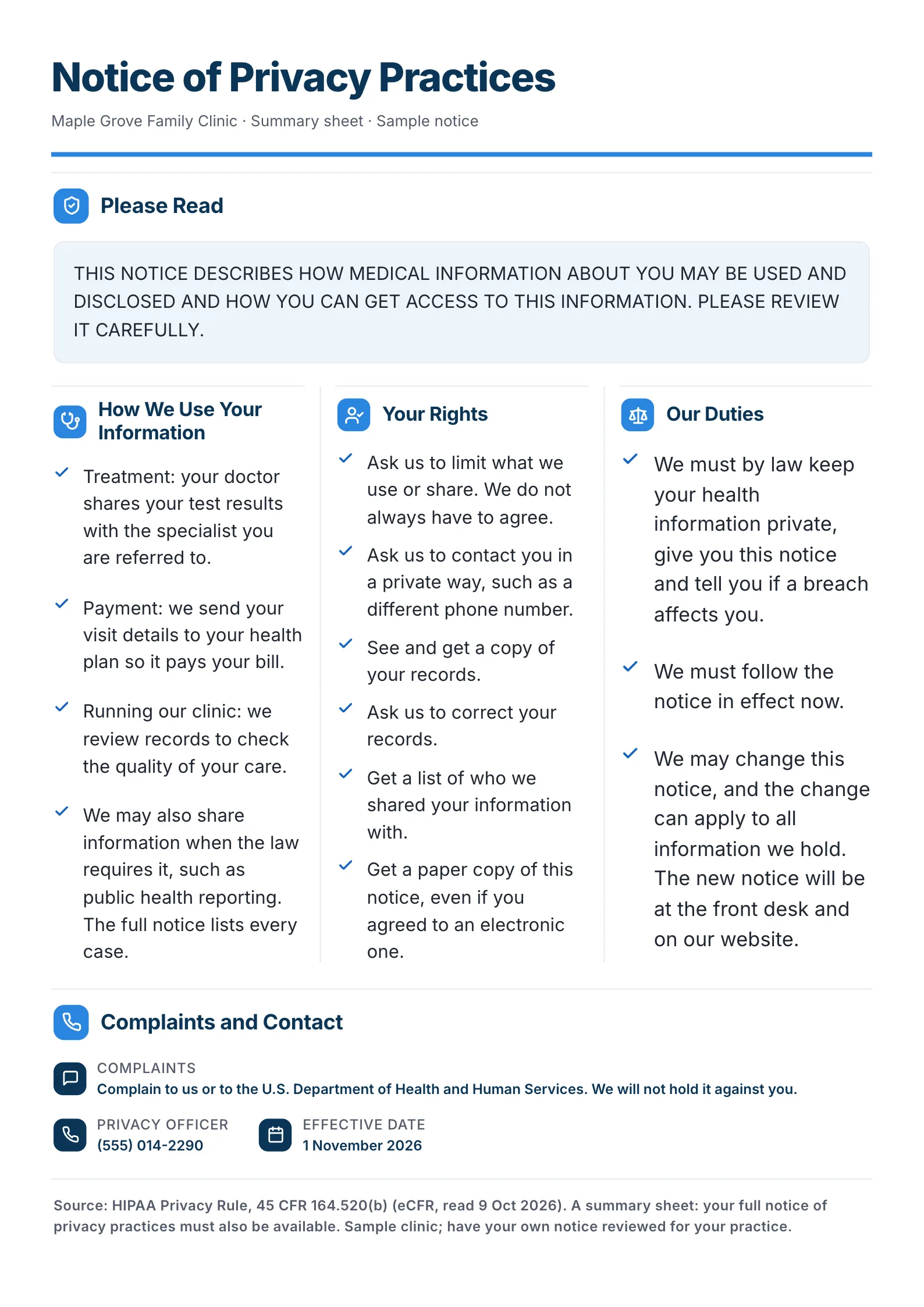
Text in that order works. But when you lay it out with each part in its own box, people read it faster. We made this sample with MakeOnepagers for a health clinic. There the law sets part of the wording, because a medical privacy notice must open with a fixed header. You can edit every word and color in it.
 Edit this template
The required header comes first. Below it, three columns cover uses and rights and the clinic's duties, with one number to call at the bottom.
What to copy:
- The notice in a box at the top, so nobody misses what the page is.
- Uses with an example each: "Payment: we send your visit details to your health plan so it pays your bill."
- Rights as short commands: see and get a copy of your records, ask us to correct them, ask us to limit what we share.
- Duties in plain words, including that the clinic must tell you about a breach.
- Who to complain to and who to call, with the promise that a complaint will not be held against you.
- A source line that says this is a summary and the full notice is also available.
You can edit this privacy notice summary template for free.
5 privacy policy summary examples
Here are five more privacy policy summaries on one page. They cover a travel booking site, a credit union, a fitness app, a kids' app and a home camera. Each keeps the six parts of the template and leads with what that reader worries about most.
1. Travel booking site privacy policy summary
 Edit this template
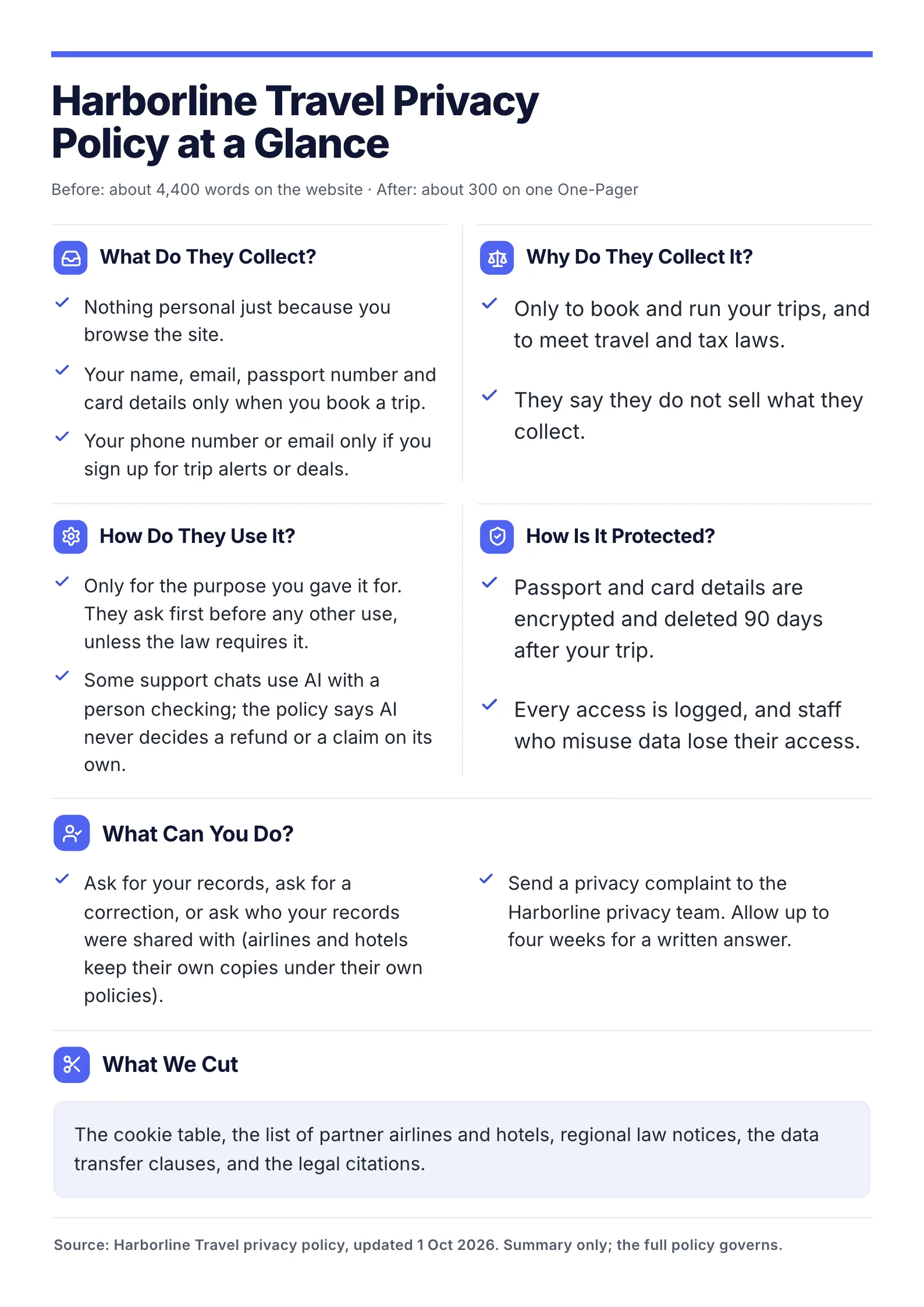
A long travel site privacy policy, reduced to the five questions a traveller asks.
What to copy:
- Before and after in the subtitle. About 4,400 words on the site, about 300 on the page.
- Each part as a question. What do they collect? Why? How do they use it?
- What was cut, named. The cookie table, the partner list and the legal citations.
You can edit this privacy policy summary template for free.
2. Credit union privacy notice summary
 Edit this template
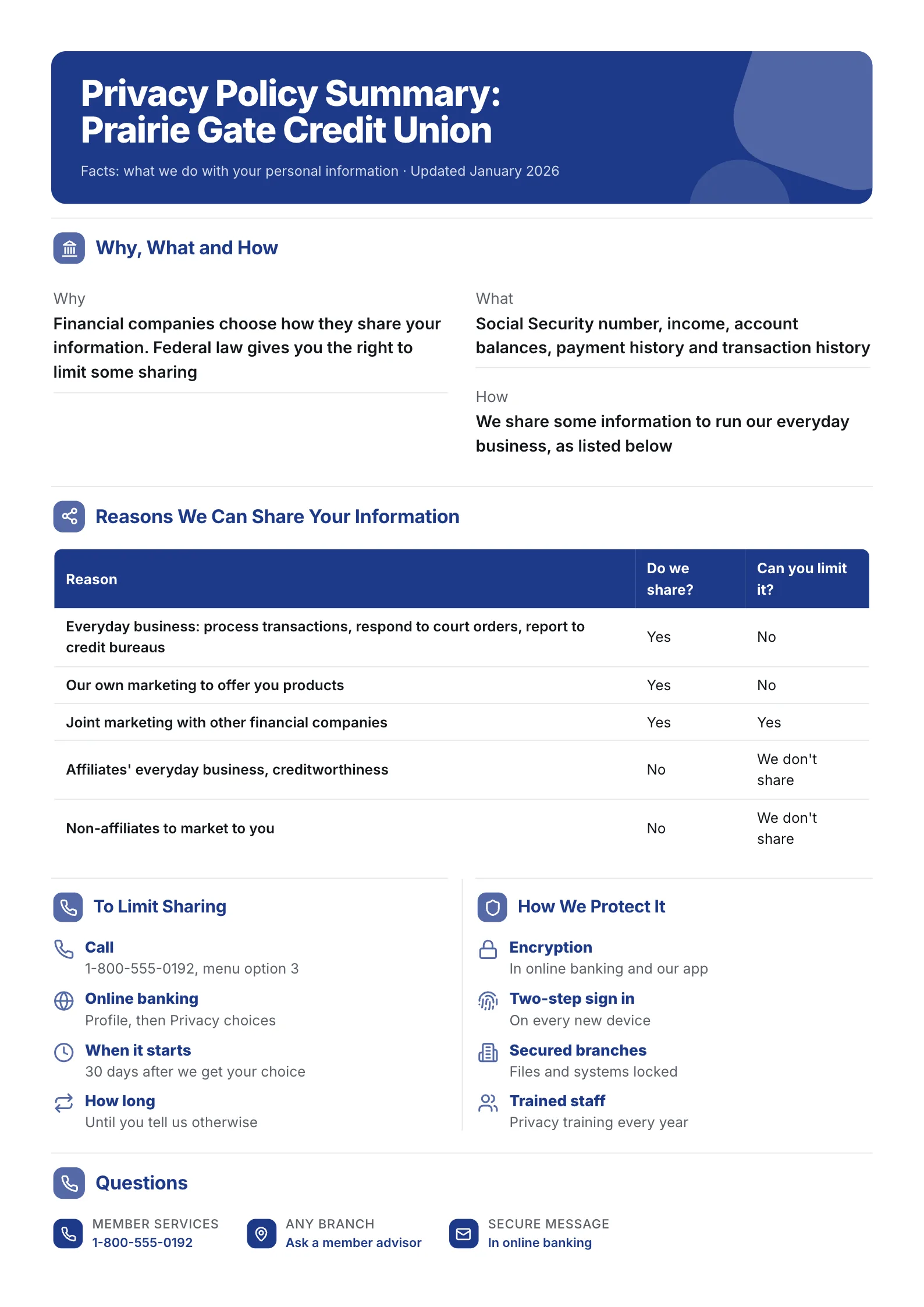
A credit union follows the federal one-page format for banks, with the three question boxes first and a sharing table after.
What to copy:
- Why, What and How first. Federal law gives members the right to limit some sharing.
- A table of reasons to share. Each reason with "Do we share?" and "Can you limit it?"
- How to say no, with a time. Call or use online banking, and the choice starts 30 days later.
You can edit this credit union privacy policy summary template for free.
3. Fitness app privacy policy summary
 Edit this template
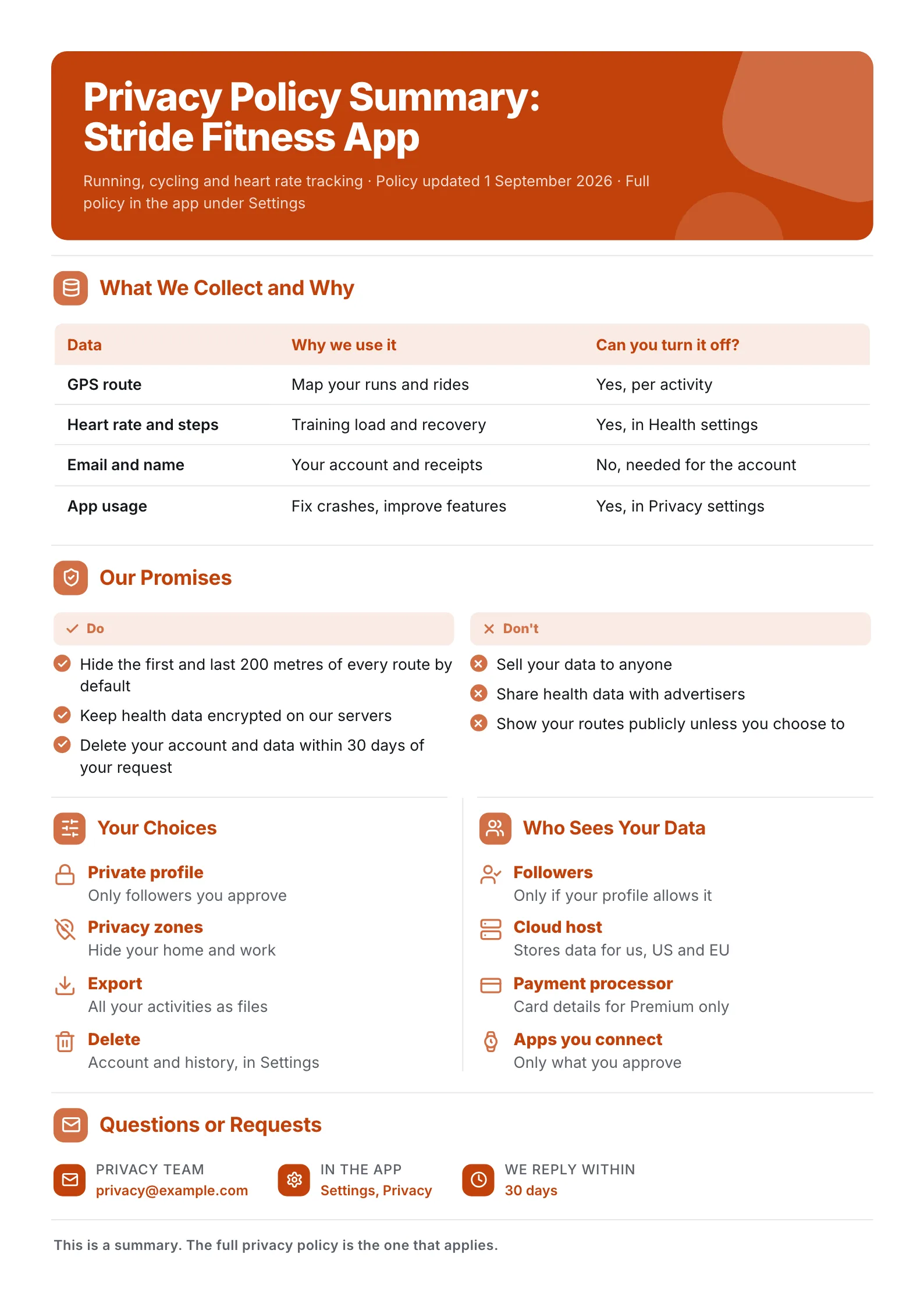
A tracking app shows every kind of data next to the switch that turns it off.
What to copy:
- A "can you turn it off?" column. GPS routes can be switched off per activity.
- Promises as dos and don'ts. Hide the first and last 200 metres of every route by default.
- A deadline on deletion. Account and data deleted within 30 days of the request.
You can edit this fitness app privacy policy summary template for free.
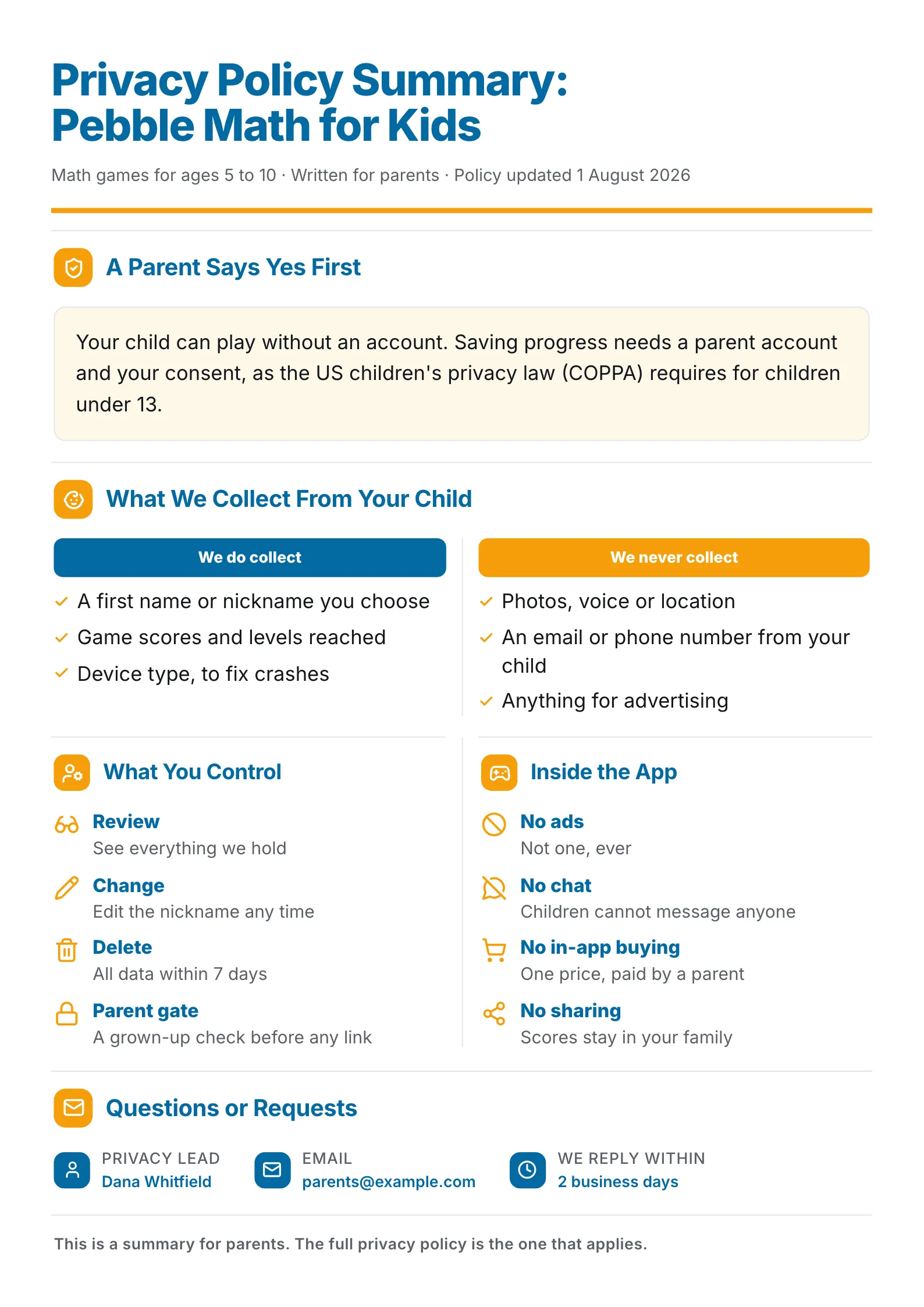
4. Kids' app privacy policy summary
 Edit this template
A math game for young children writes its summary for the parent instead of the child.
What to copy:
- Consent in a box at the top. Saving progress needs a parent account and consent, as COPPA requires under 13.
- Collect and never collect, side by side. No photos, voice or location, ever.
- What is not in the app. No ads, no chat and no in-app buying.
You can edit this kids' app privacy policy summary template for free.
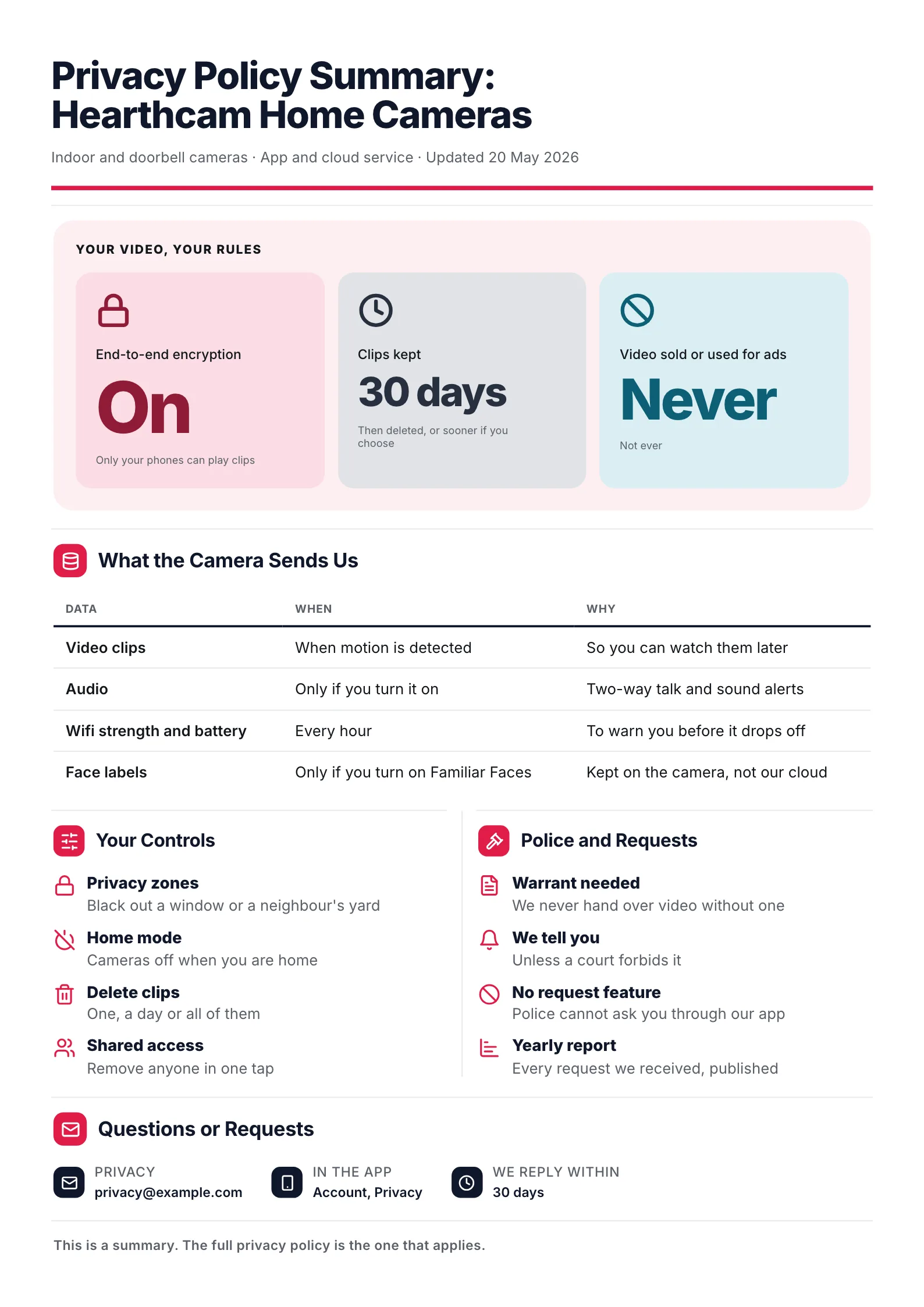
5. Smart home camera privacy policy summary
 Edit this template
A camera maker answers the question every buyer has: who else can watch this?
What to copy:
- The answer in three numbers. End-to-end encryption on, clips kept 30 days, video never sold.
- When each kind of data is sent. Audio only if the owner turns it on.
- Police requests spelled out. No video without a warrant, and the owner is told unless a court forbids it.
You can edit this smart camera privacy policy summary template for free.
How to write a privacy policy summary in 6 steps
- Read the full policy and list every type of data it names. You will group them, but you need the whole list first.
- Group the types into four to six plain categories. "Device information" is clear; "persistent identifiers" is not.
- Write each purpose as a verb: run, bill, contact, protect, comply.
- Make the sharing table: each kind of recipient, Yes or No, and whether the reader can opt out.
- Write what you never do, but only claims the full policy also makes, in the same words.
- Add the choices, the contact and the link, and the date. Check every line against the full policy before publishing.
Plain words for privacy terms
| The policy says | The summary says |
|---|---|
| Personal data or personal information | Information about you |
| Process | Collect, store or use |
| Third parties | Other companies |
| Service providers or processors | Companies that do work for us |
| Affiliates | Companies in the same group as us |
| Retention | How long we keep it |
| Legitimate interests | Reasons we decide are fair without asking you |
| Opt out | Tell us to stop |
Reading someone else's privacy policy
If you are summarizing a policy to decide whether to use a service, look for six things, in this order:
- Does it sell or share data for advertising? Search the page for "sell" and "advertising".
- What does it collect beyond what the service needs? Location, contacts and health data are the ones to check.
- Who are the third parties? Named companies or vague categories.
- Can you delete your data? And how: a setting, a form or an email.
- How long is it kept? "As long as necessary" tells you little on its own; look for actual periods.
- How will they tell you about changes? Apple promises a week's notice for a material change.
Privacy policy summary mistakes
- Saying something the full policy does not. The summary must never promise more than the policy. If the policy says "we may share", the summary cannot say "we never share".
- Copying the legal words. A summary full of "processing" and "legitimate interests" is a shorter policy, not a summary.
- Leaving out the sharing. It is what readers most want to know, and in a long policy it is often spread across several sections.
- No date. A summary without a date cannot be checked against the policy it summarizes.
- No link to the full policy. The summary is the top layer; the full text must be one click away.
Privacy policy summary checklist
- Company name, "Privacy summary" and the date last updated
- What you collect, in four to six plain categories
- Why you use it
- Who you share it with, as a Yes and No table
- What you never do, only if the policy says so too
- The reader's choices and how to use them
- How long you keep it
- A privacy contact
- A link to the full policy
- One page, every line checked against the policy
Make your privacy policy summary
Open the free privacy notice summary template and replace the header with your own. Fill in what you collect and why, who you share it with and your reader's choices. Add your contact and the link to your full policy. Then download it as a PDF, or put it on your website above the full text.
Frequently asked questions
What should a privacy policy summary include?
Your summary should say what data you collect, why you use it and who you share it with. Add what you never do with it, the reader's choices and how long you keep it. Finish with a contact, the date and a link to the full policy. The US model privacy form for banks puts Why, What and How first. Then it gives a table of reasons for sharing.
Can a summary replace the privacy policy?
No. Wikimedia's summary says so plainly. It says it isn't part of the policy and isn't a legal document. You should publish both, and link from your summary to the full text.
How long should a privacy policy summary be?
Keep yours to one page, about 200 to 400 words. Our summary of Apple's 4,400-word policy above runs about 200.
How long is a typical privacy policy?
The 9 we measured ran about 2,100 to 10,600 words, with a median of about 6,700.
Can I use AI to summarize a privacy policy?
You can use it to draft, yes. Then check every line yourself against the policy. A summary that says "we never share" when the policy says "we may share" is wrong in the way that matters most.




