BlogGuide
Plain Language Checklist: The 14 Federal Checks, Tested on Real Text
The 14-point federal plain language checklist, tested on real rules: reading grades before and after, and a one-page notice checked line by line.

By MakeOnepagers Team
Updated · 10 min read
A plain language checklist is a short list of tests a document must pass before it goes out: is it written for the average reader, organized around what they need, in short sentences, active voice and everyday words, with "must" instead of "shall"? The US federal government's version has 14 checks. Below is each one, three real sentences from federal rules rewritten against it with their reading grade before and after, and a one-page notice checked line by line, including the one place where the law says to break the checklist.
One‑Pager examples
Real One-Pagers made with MakeOnepagers. Open any one to edit it as your own.
 Privacy Notice SummaryEdit for free(opens in a new tab)
 Patient Education SheetEdit for free(opens in a new tab)
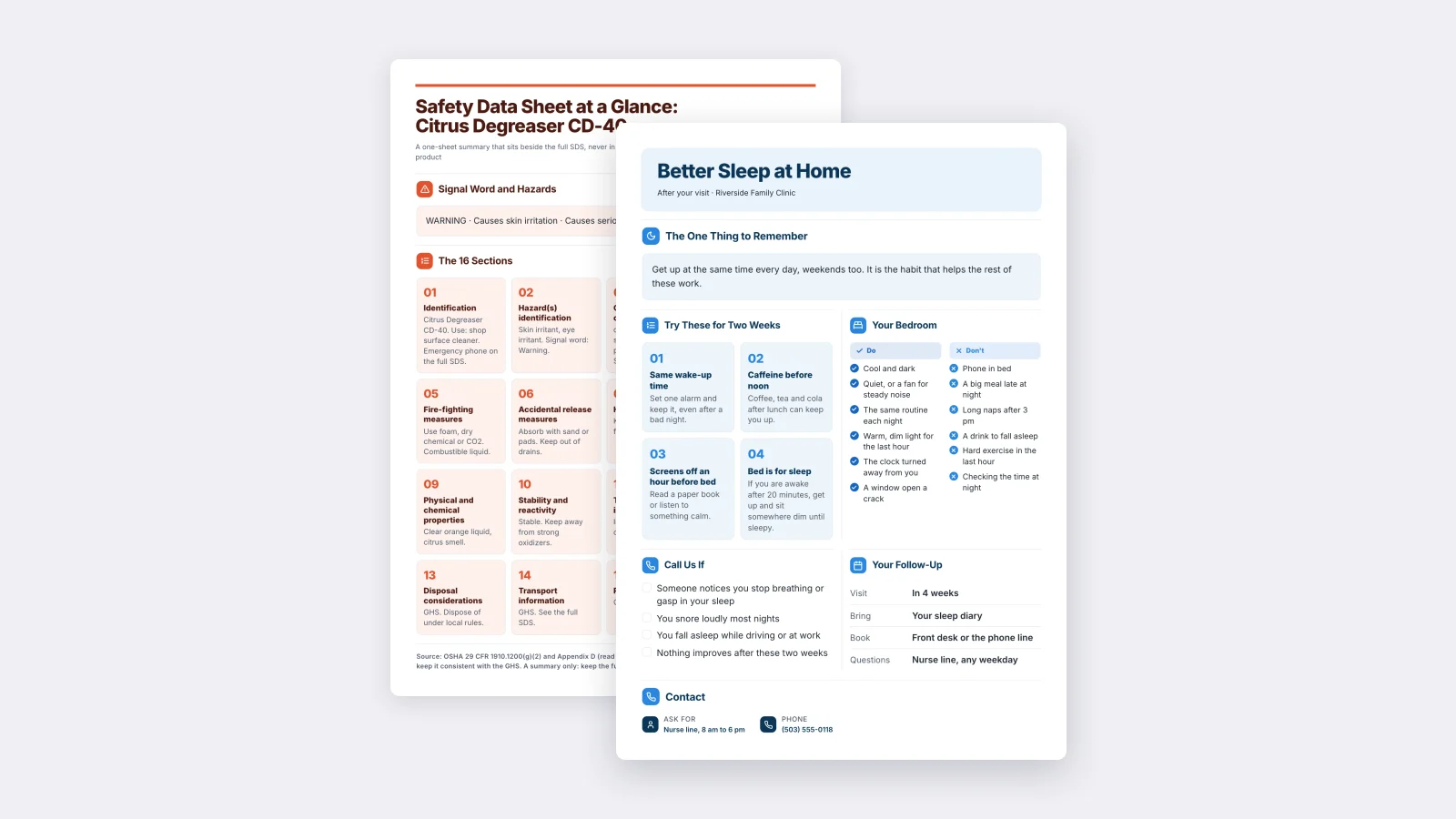
 Safety Data Sheet SummaryEdit for free(opens in a new tab)
 Health Plan Benefits SummaryEdit for free(opens in a new tab)
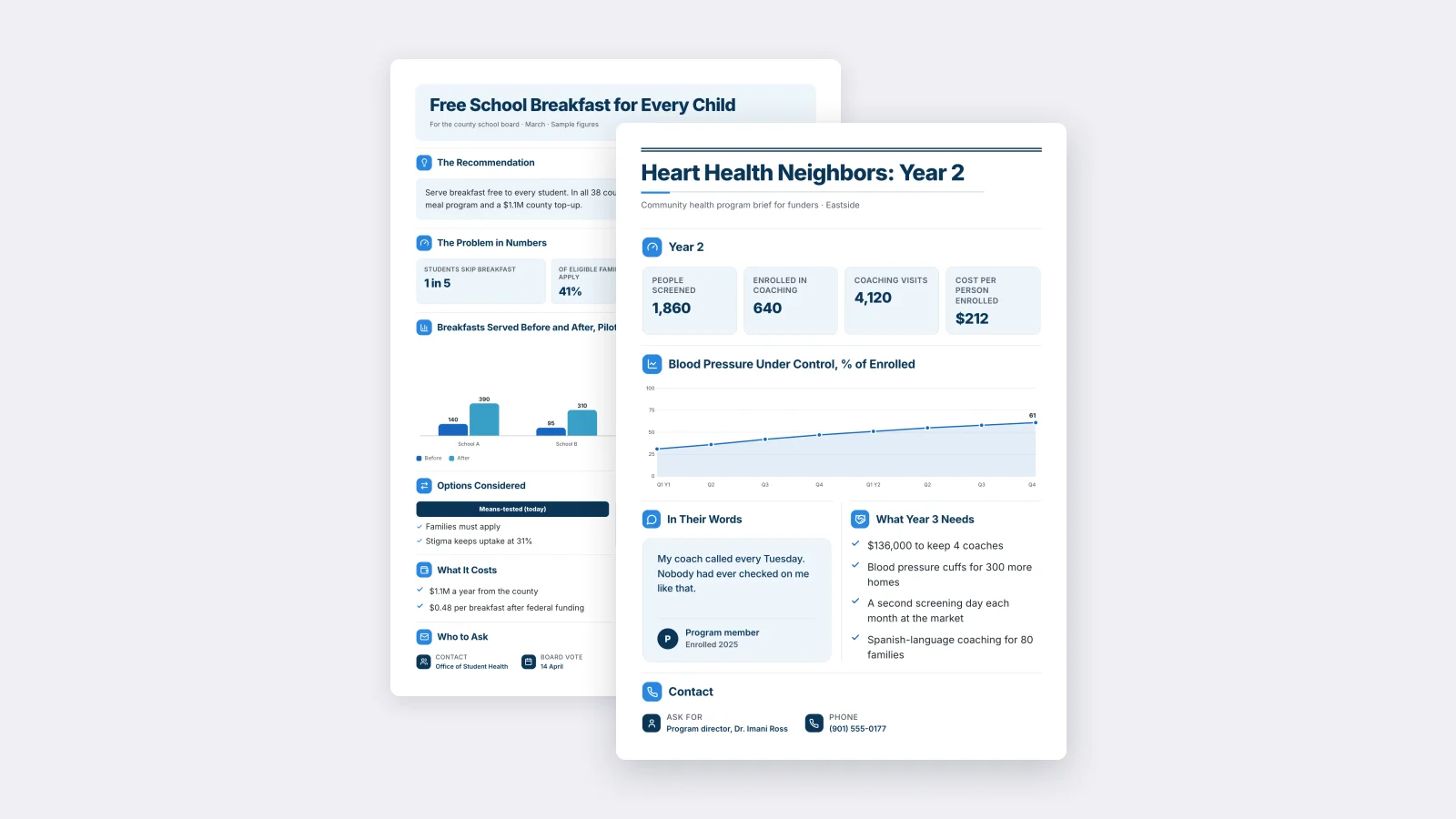
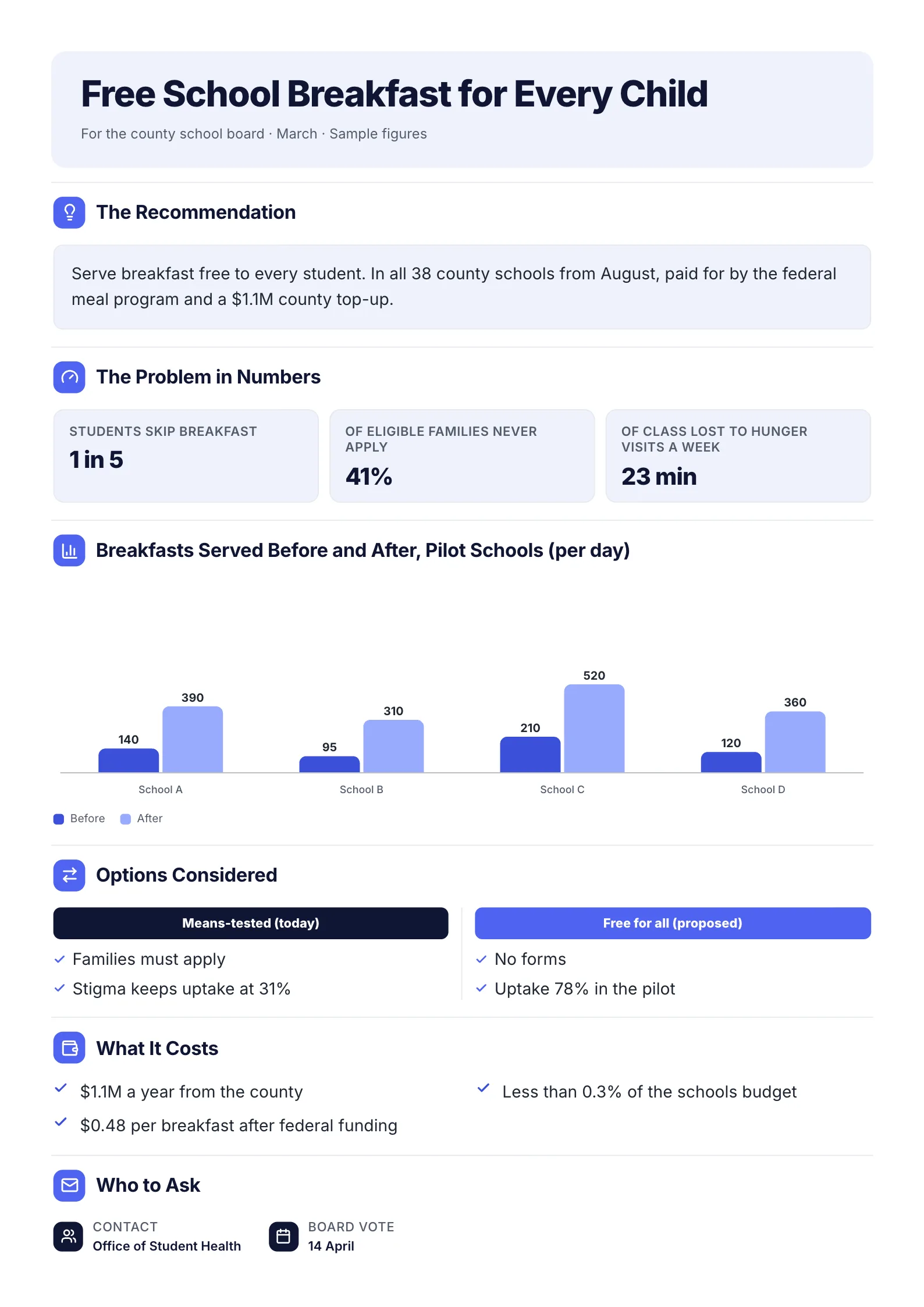 Policy Brief: Free School BreakfastEdit for free(opens in a new tab)
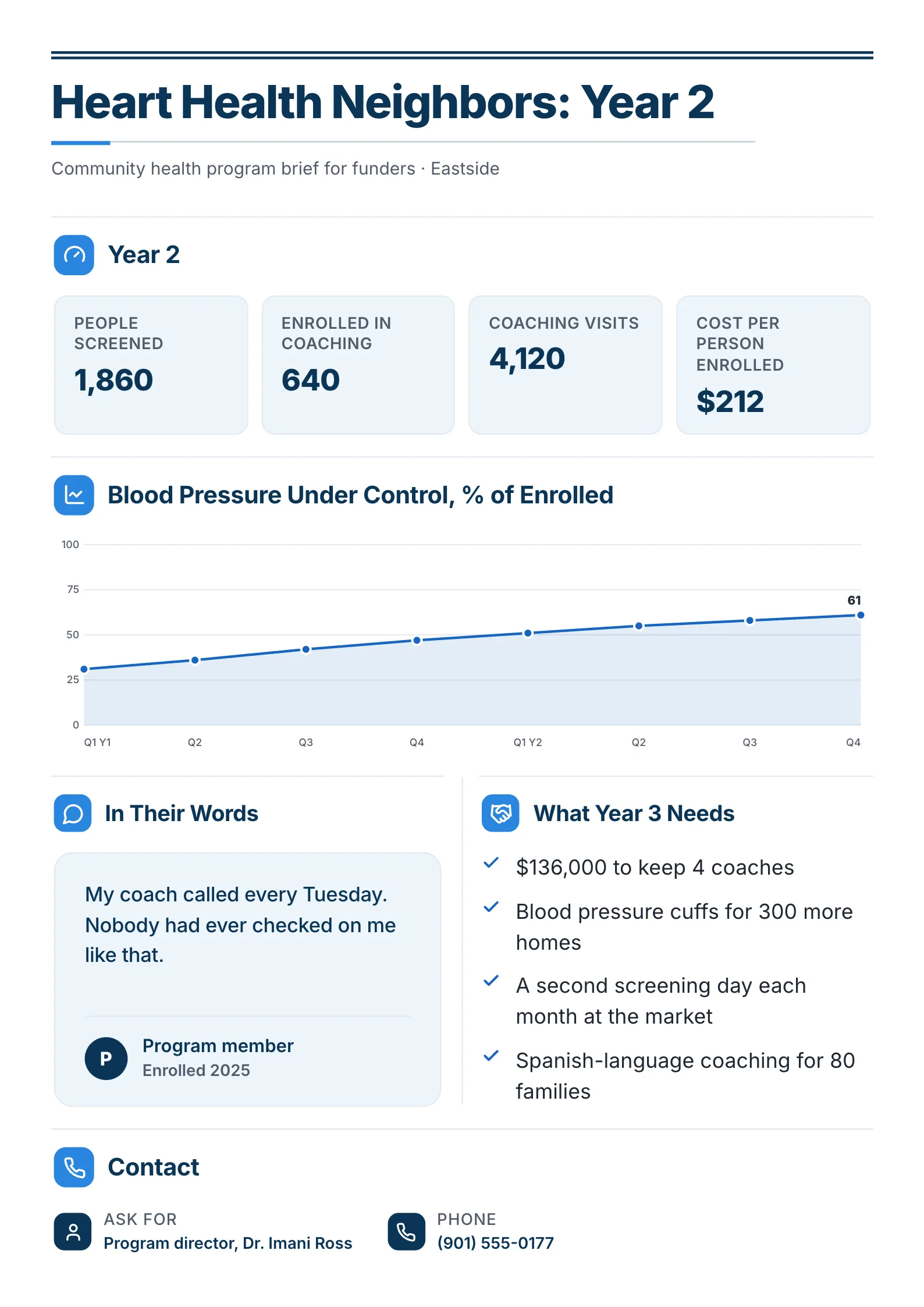 Community Health Program BriefEdit for free(opens in a new tab)
The federal checklist lived at plainlanguage.gov, which now redirects to the plain language guide on digital.gov. We quote the 14 checks from the archived checklist page (captured 15 December 2024), read on 12 October 2026.
The 14-point federal plain language checklist
The federal checklist says a document in plain language:
| # | Check | What to look for |
|---|---|---|
| 1 | Is written for the average reader | The reader's own words, not the writer's |
| 2 | Is organized to serve the reader's needs | What they need to do, in the order they need to do it |
| 3 | Has useful headings | A heading that says what the section holds |
| 4 | Uses "you" and other pronouns to speak to the reader | "You must", not "the applicant shall" |
| 5 | Uses active voice | Who does what, in that order |
| 6 | Uses short sections and short sentences | One idea a sentence |
| 7 | Uses the simplest tense possible | Simple present is best |
| 8 | Uses base verbs, not hidden verbs | "Decide", not "make a decision" |
| 9 | Omits excess words | Every word earns its place |
| 10 | Uses concrete, familiar words | "Use", not "utilize" |
| 11 | Uses "must" to express requirements | And avoids the ambiguous "shall" |
| 12 | Places words carefully | No big gaps between subject, verb and object, exceptions last, modifiers in the right place |
| 13 | Uses lists and tables to simplify complex material | Steps as a list, comparisons as a table |
| 14 | Uses no more than two or three subordinate levels | Headings and lists that don't nest deeper than that |
The checks are the federal page's own wording. The third column is our short version of how to check each one.
Why it matters: plain language is the law for federal agencies
The digital.gov guide puts it plainly: plain language "is also the law", through the Plain Writing Act of 2010, which covers federal agencies. Outside government, nothing requires it, but the reasons are the same. The guide's own example of what goes wrong: people rating government websites wrote "Cluttered" and "Information flow was poor".
The guide also takes apart the most common objection. Plain language does not mean writing for children: "Don't write for an 8th-grade class if your readers are PhD candidates, small business owners, or working parents." Write for the reader you actually have.
We tested the checklist on 3 real federal sentences
We took three sentences from federal rules, rewrote each against the 14 checks, and scored both versions. The reading grade is the Flesch-Kincaid grade level, computed by our own script with a standard syllable count; a grade of 8 means an average eighth grader could read it. These rewrites show the method. They are not legal advice and do not replace the rule.
1. Keeping safety data sheets at work (OSHA, 29 CFR 1910.1200(g)(8))
Before, from the rule on eCFR:
The employer shall maintain in the workplace copies of the required safety data sheets for each hazardous chemical, and shall ensure that they are readily accessible during each work shift to employees when they are in their work area(s). (Electronic access and other alternatives to maintaining paper copies of the safety data sheets are permitted as long as no barriers to immediate employee access in each workplace are created by such options.)
After:
You must keep a safety data sheet for each hazardous chemical at work. Workers must be able to read it during every shift without leaving their work area. You may keep the sheets on a computer instead of on paper. If you do, nothing can stop a worker from opening them right away.
| Before | After | |
|---|---|---|
| Words | 72 | 53 |
| Sentences | 2 | 4 |
| Words per sentence | 36 | 13.2 |
| Reading grade | 18.0 | 6.7 |
| "Shall" | 2 | 0 |
Checks that did the work: 4 (speak to "you"), 5 (active voice: "are permitted... are created by such options" became "you may keep"), 6 (one idea a sentence) and 11 ("must", not "shall").
2. Who needs a safety data sheet (OSHA, 29 CFR 1910.1200(g)(1))
Before:
Chemical manufacturers and importers shall obtain or develop a safety data sheet for each hazardous chemical they produce or import. Employers shall have a safety data sheet in the workplace for each hazardous chemical which they use.
After:
If you make or import a hazardous chemical, you must write or get a safety data sheet for it. If you use one at work, you must have its safety data sheet there.
| Before | After | |
|---|---|---|
| Words | 37 | 33 |
| Reading grade | 13.0 | 6.6 |
| "Shall" | 2 | 0 |
Checks that did the work: 10 (familiar words: "obtain or develop" became "write or get") and 11. The word count barely moved. The grade halved anyway, because the words got shorter.
3. What happens to a non-compliant application (NIH, Format Attachments)
Before, from NIH's Format Attachments page:
Applications that include PDF attachments that do not conform to the minimum requirements listed above may be withdrawn from consideration.
After:
If a PDF breaks these rules, we may not review your application.
| Before | After | |
|---|---|---|
| Words | 20 | 12 |
| Reading grade | 14.6 | 5.8 |
Checks that did the work: 5 (the passive "may be withdrawn" hides who acts) and 12 (the subject and its verb sat 14 words apart).
We checked a one-page notice against all 14
A rewrite of one sentence is easy. A whole document is the real test. We ran the checklist on our own Notice of Privacy Practices summary template, a one-page sheet a clinic hands to patients.
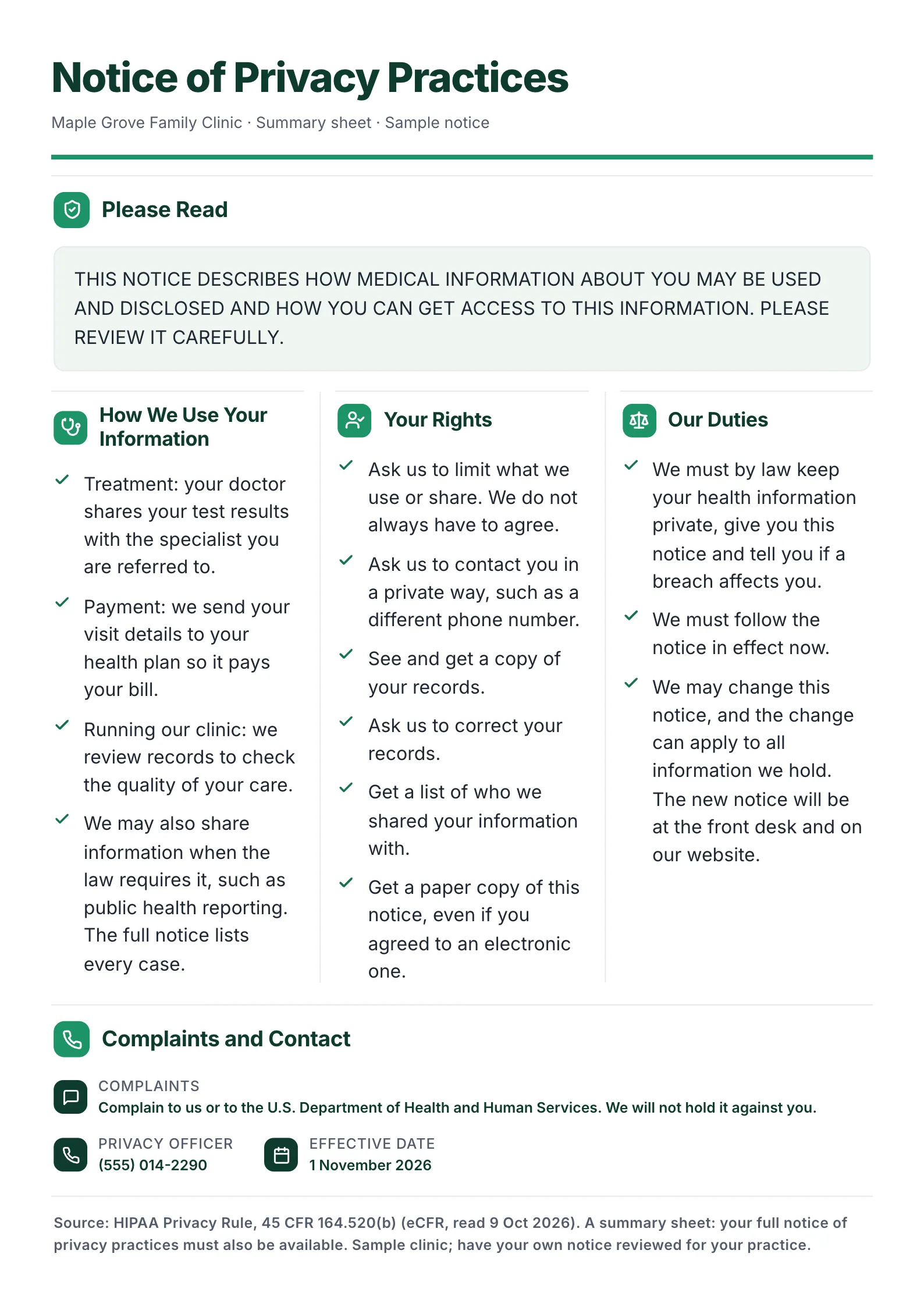
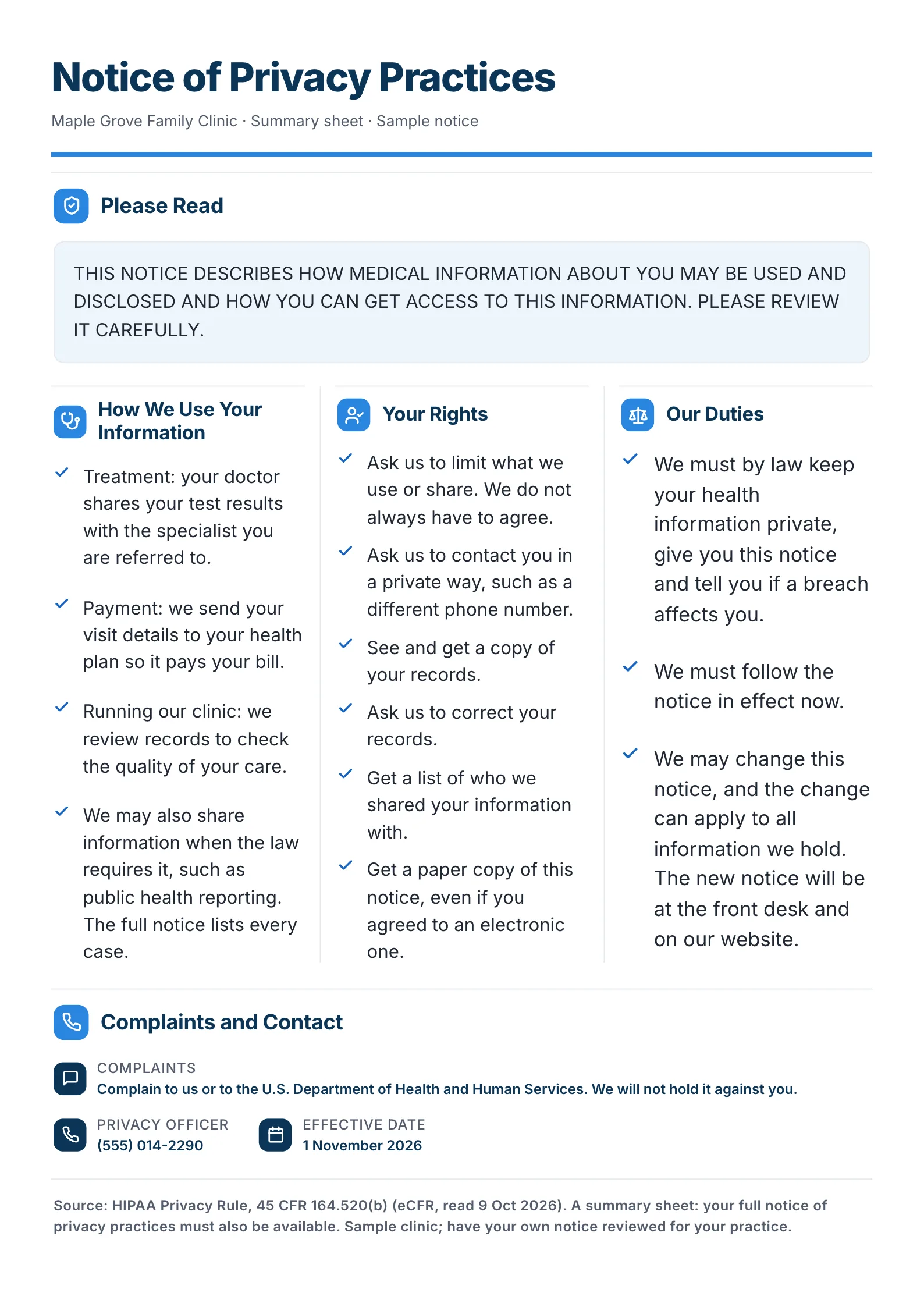 Edit this template
A sample clinic's privacy notice summary: a required header, three columns and a contact row.
| # | Check | Result |
|---|---|---|
| 1 | Average reader | Pass: the body reads at grade 4.5 by our script (211 words, 19 sentences) |
| 2 | Organized for the reader | Pass: how we use it, your rights, our duties, how to complain |
| 3 | Useful headings | Pass: "Your Rights", "Our Duties", "Complaints and Contact" |
| 4 | "You" | Pass: "your doctor shares your test results" |
| 5 | Active voice | Pass in our own words. The required header is passive: "may be used and disclosed" |
| 6 | Short sentences | Pass: 11.1 words a sentence on average |
| 7 | Simple tense | Pass: present tense, with "will" in 2 sentences |
| 8 | Base verbs | Pass: "ask us to correct", not "request a correction" |
| 9 | No excess words | Pass |
| 10 | Familiar words | Pass, apart from "breach", which the reader needs to know |
| 11 | "Must", not "shall" | Pass: "We must follow the notice in effect now" |
| 12 | Word placement | Pass |
| 13 | Lists | Pass: every right is its own line |
| 14 | Levels | Pass: one level of headings and one of lists |
The one exception is the header, and it is on purpose. The HIPAA Privacy Rule, 45 CFR 164.520(b)(1)(i), says the notice "must contain the following statement as a header or otherwise prominently displayed", and the rule prints that statement in capitals: "THIS NOTICE DESCRIBES HOW MEDICAL INFORMATION ABOUT YOU MAY BE USED AND DISCLOSED..." By our script, it reads at grade 9.0, twice the body's level, and the digital.gov design guide warns that all capitals make text harder to read. But when a law sets the exact words, you keep them and make everything around them plain.
How to run a plain language check in 15 minutes
- Name the reader in one line: who they are and what they need to do after reading.
- Score the reading grade with any readability tool, and write the number down. California's state plain language checklist sets grade 8 or lower as its target for the public.
- Search for "shall" and replace each with "must", "will" or "may", whichever is meant.
- Search for "be" verbs followed by a word ending in "-ed": "was approved", "are required". Each is a likely passive. Name who acts.
- Search for "-tion" and "-ment" words after "make", "give" or "take". "Make a determination" is a hidden verb for "decide".
- Split any sentence over 25 words, and turn any run of three or more items into a list.
- Test it on one real reader. The digital.gov guide recommends paraphrase testing: ask someone to read it and tell you in their own words what it says. Plan to test at least twice.
Plain language mistakes that survive a checklist
| Mistake | Fix |
|---|---|
| Shortening sentences by cutting the facts | Cut words, never the number, date or name the reader needs |
| Writing down to experts | Plain is for your reader. A specialist audience can keep its terms |
| Rewriting words the law fixes | Keep required text exactly, and simplify what surrounds it |
| ALL CAPS for emphasis | Use bold for the one thing that matters most |
| Scoring once and stopping | A reading grade is a smoke alarm, not a verdict. Test with a person |
| A plain text in a crowded layout | Headings, lists, white space and one page do half the work |
Plain language works best on one page
The design half of plain language is about the page, not the words. The digital.gov guide asks for "key information at the top", clear headings, lists for scanning and tables for complex relationships. A one-page summary forces all four: there is no room for a buried point.
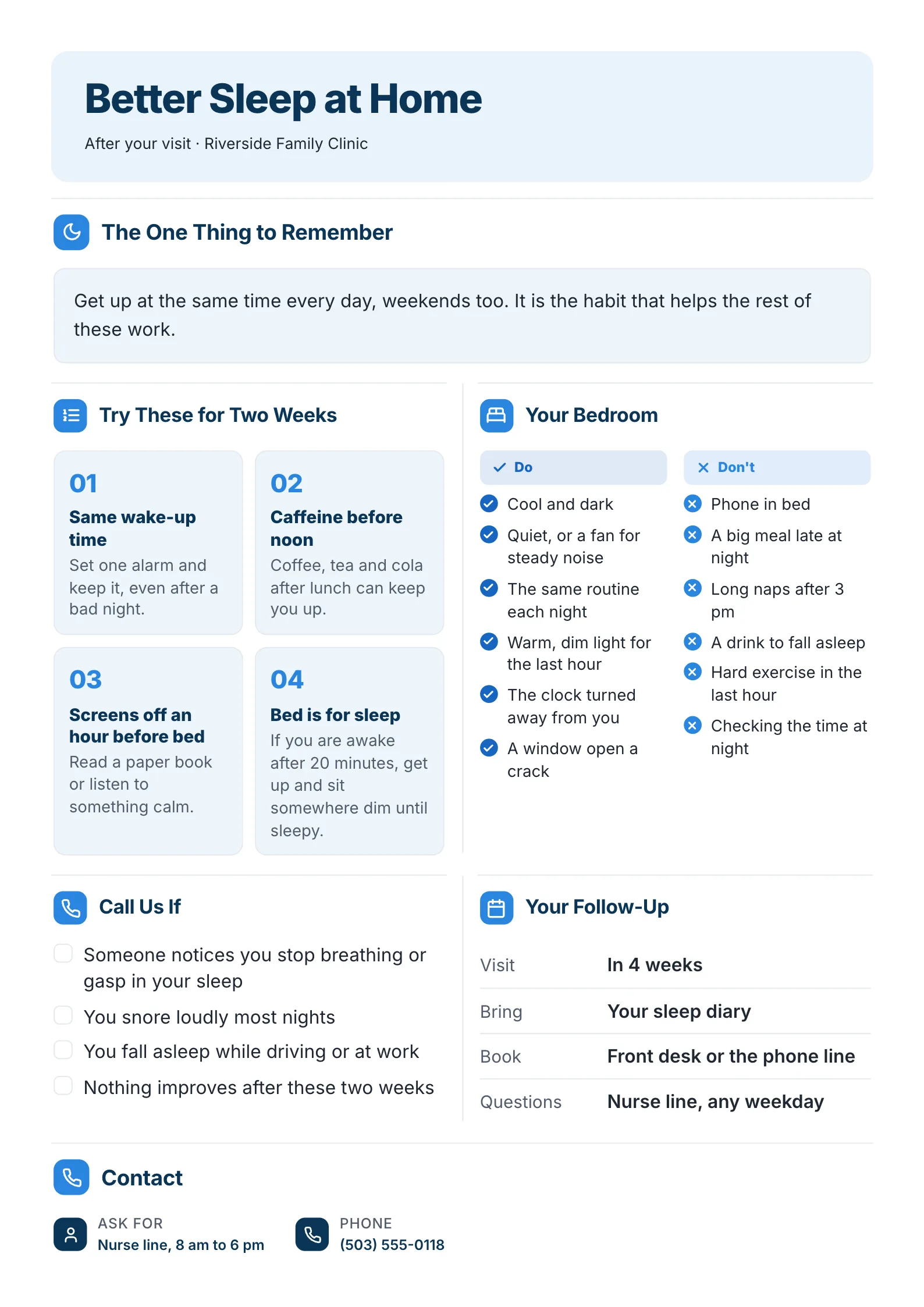
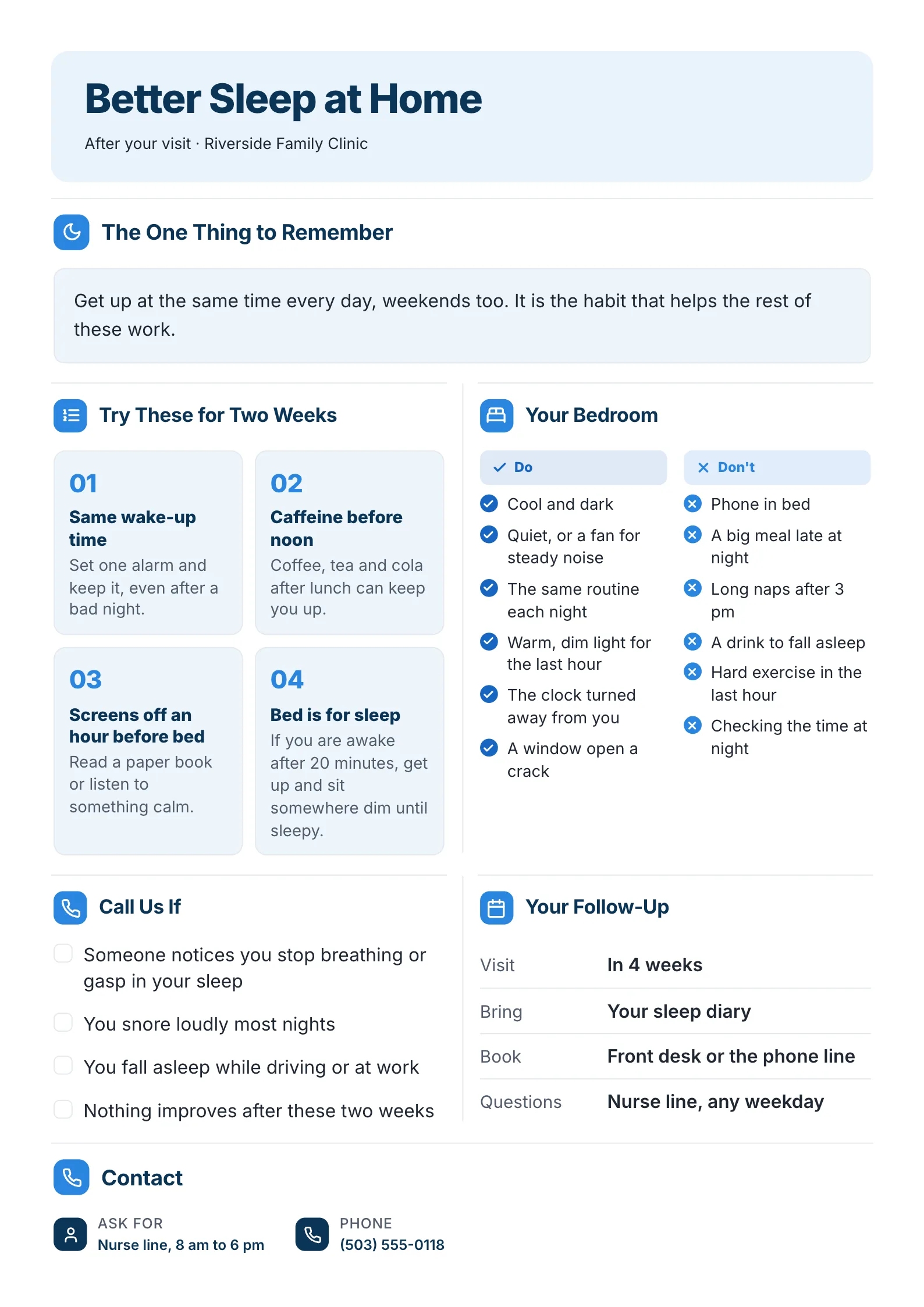 Edit this template
A sample patient handout: "Get up at the same time every day, weekends too" sits at the top as the one thing to remember, then short numbered steps, dos and don'ts and when to call.
Make a plain-language One-Pager
Open the free Notice of Privacy Practices summary template or the patient education sheet template, replace the sample with your own text, and run the 15-minute check above before you print. Have a long document to boil down? Paste it into the free AI One-Pager generator, then read the result against the 14 checks yourself.
Frequently asked questions
What is on a plain language checklist?
The federal checklist has 14 checks: written for the average reader, organized for their needs, useful headings, "you" and other pronouns, active voice, short sections and sentences, the simplest tense, base verbs, no excess words, concrete and familiar words, "must" instead of "shall", careful word placement, lists and tables, and no more than two or three levels.
What reading level is plain language?
There is no single federal number. The digital.gov guide says to write for your real audience and warns against writing for an eighth grade class unless that is who reads it. Many guides set grade 8 or lower for the general public, as California's plain language checklist does.
Why avoid "shall" in plain language?
The federal checklist calls "shall" ambiguous and says to use "must" to express requirements. "Must" leaves no doubt that something is required, and it is a word readers use themselves.
Is plain language required by law?
For US federal agencies, yes: the Plain Writing Act of 2010 requires plain writing in the documents they issue to the public. Many states and other countries have their own rules, and some laws, such as HIPAA's privacy notice header, fix exact wording that you must keep.
How do I test if my writing is plain language?
Score the reading grade, run the 14 checks, then ask a real reader to tell you in their own words what the document says and what they would do next. The digital.gov guide calls this paraphrase testing and recommends testing at least twice.