How to Write an Event Program With a Time on Every Line
Seven real commencement, gala and conference programs, read line by line, show how to write an event program with a time and a name beside every item.

Three university commencements, two charity galas and two professional conferences gave us the 7 event programs behind this guide, each one printed or posted by a real host for its guests. Each program gives a start time, but the clock usually stops there. The 2 conference schedules are the only ones with a time on every item. None of the 5 ceremonies and galas tells you when the speeches end or the award is handed out. Start from a free one pager template.
One‑Pager examples
Real One-Pagers made with MakeOnepagers. Open any one to edit it as your own.
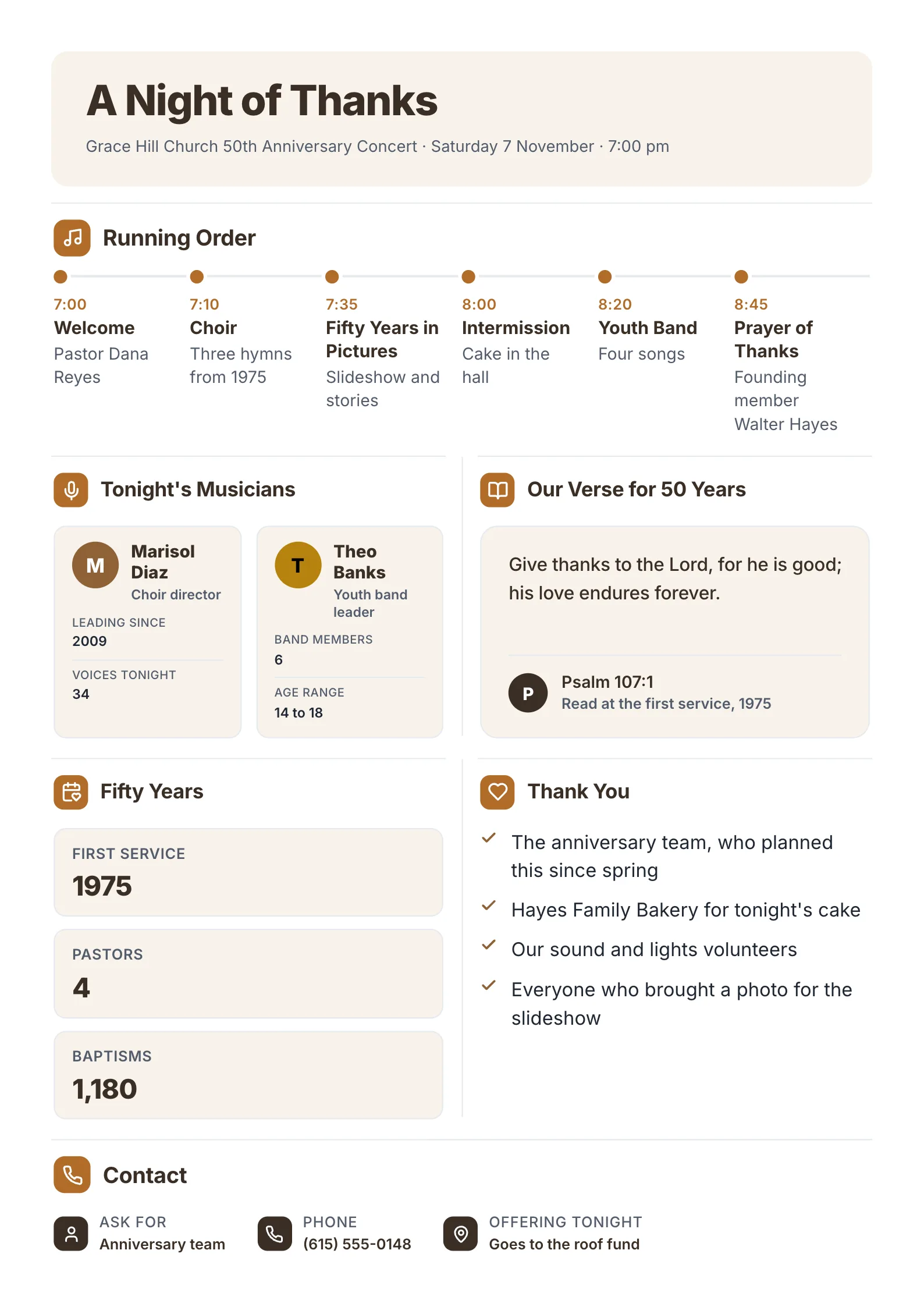 Church Event ProgramEdit for free(opens in a new tab)
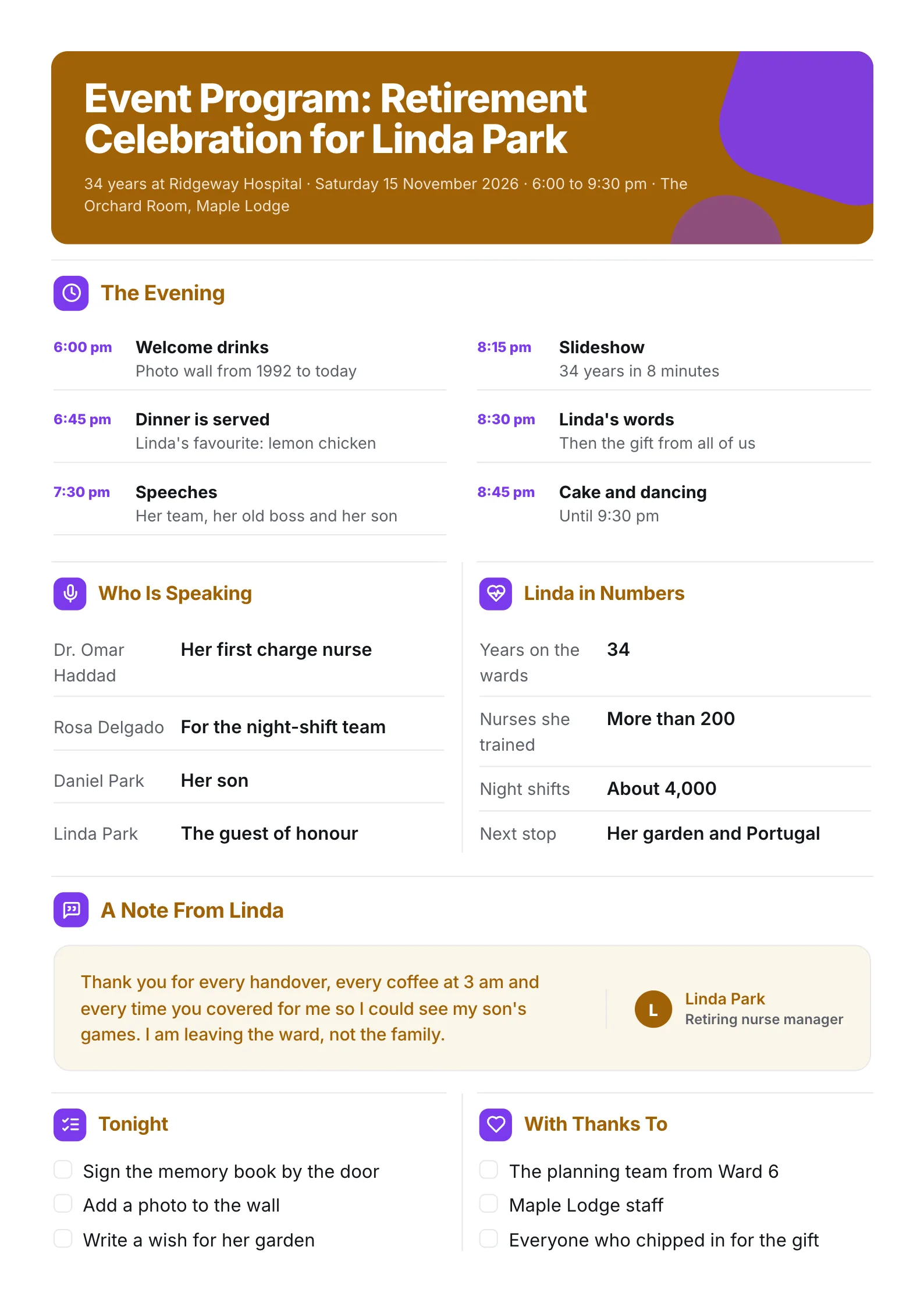 Event Program: Retirement CelebrationEdit for free(opens in a new tab)
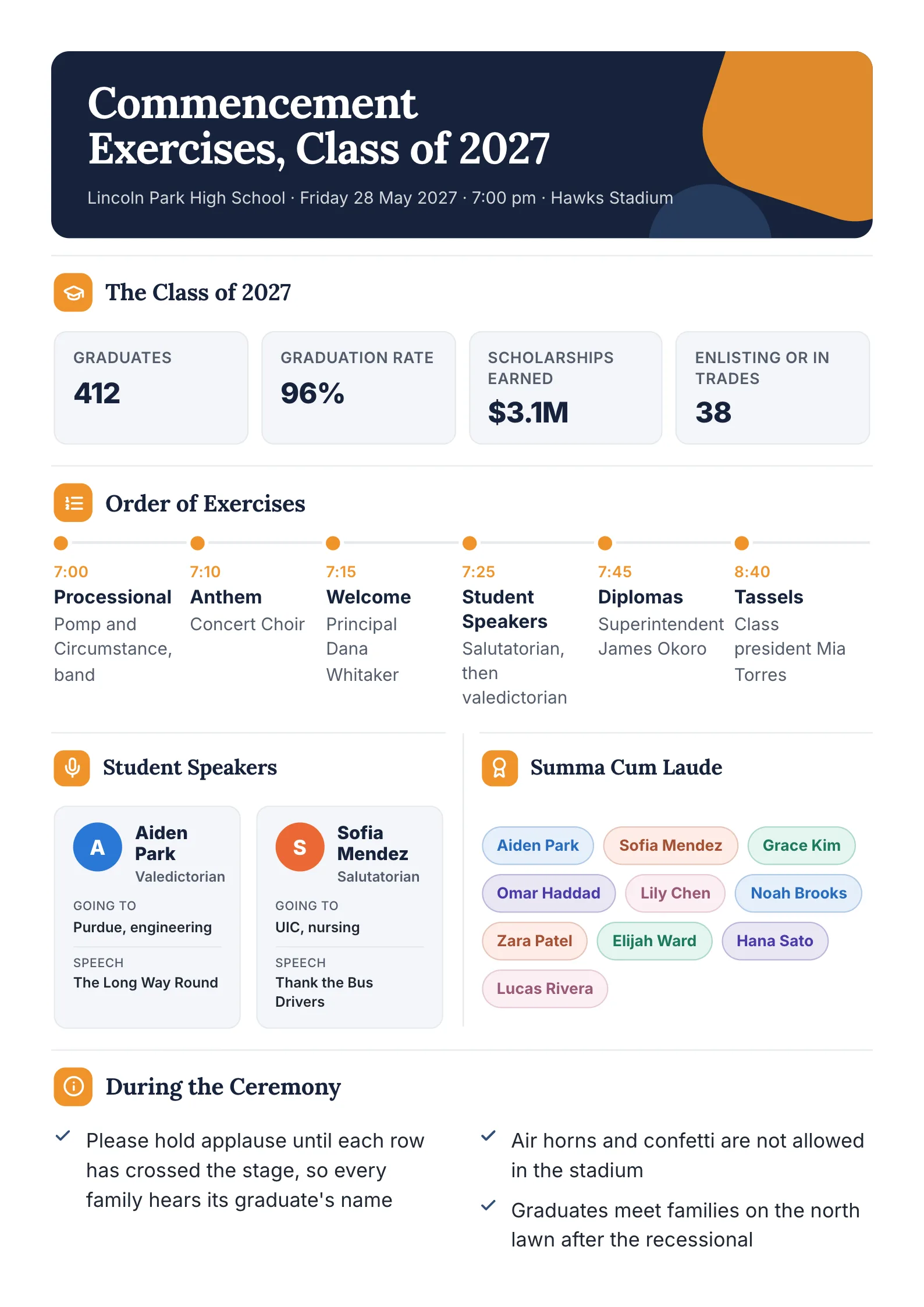 Event Program: High School GraduationEdit for free(opens in a new tab)
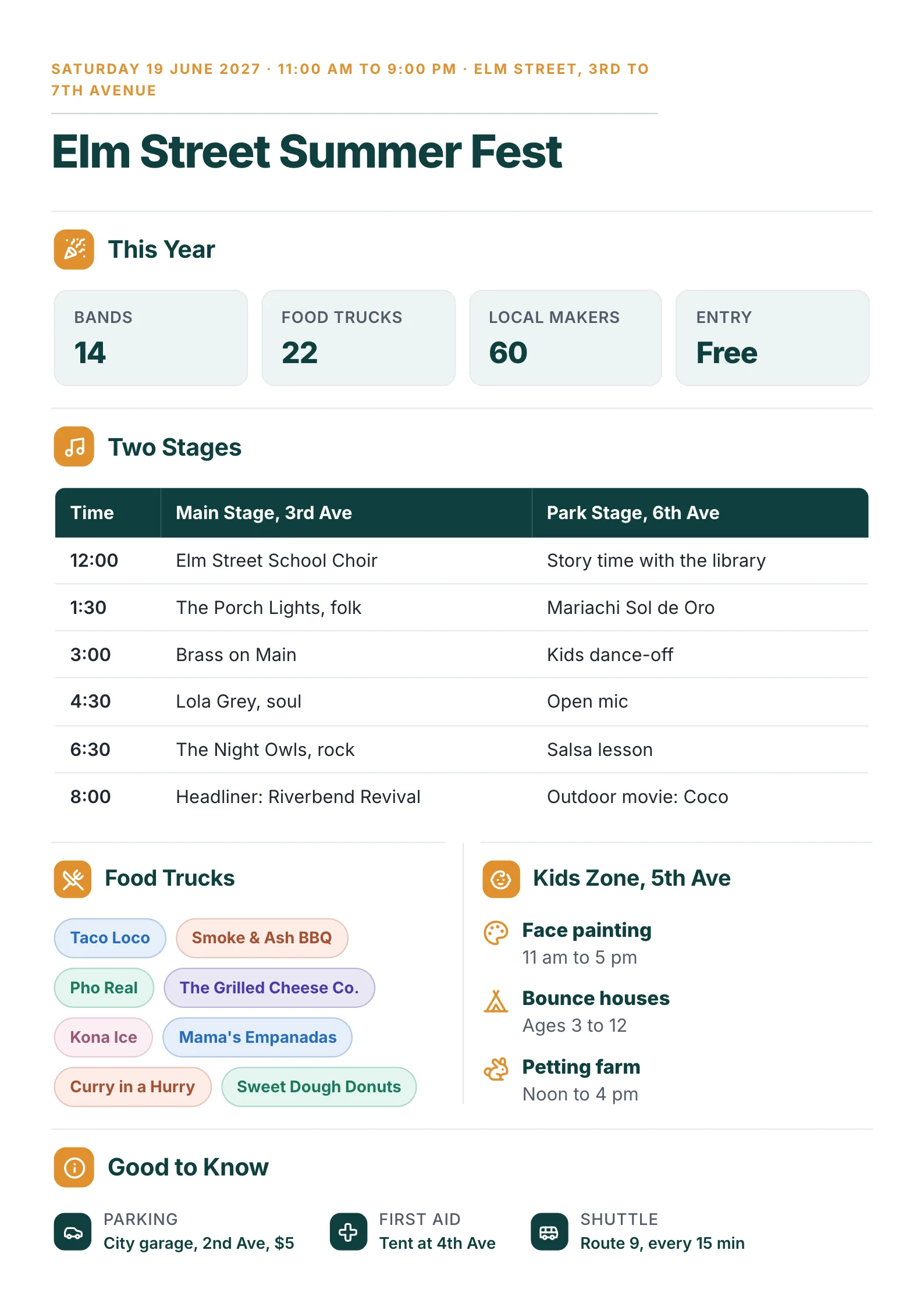 Event Program: Street FestivalEdit for free(opens in a new tab)
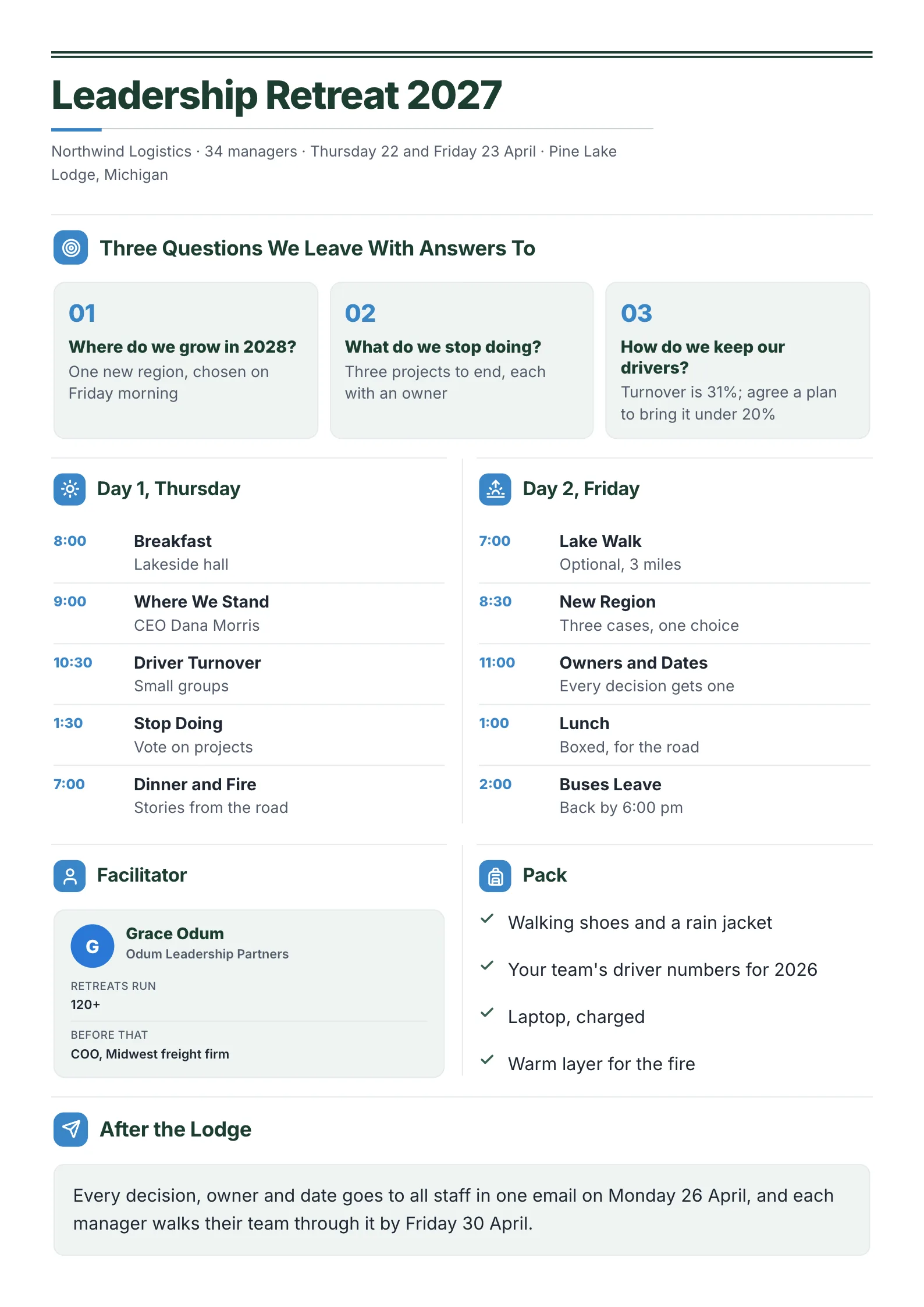 Event Program: Two-Day Leadership RetreatEdit for free(opens in a new tab)
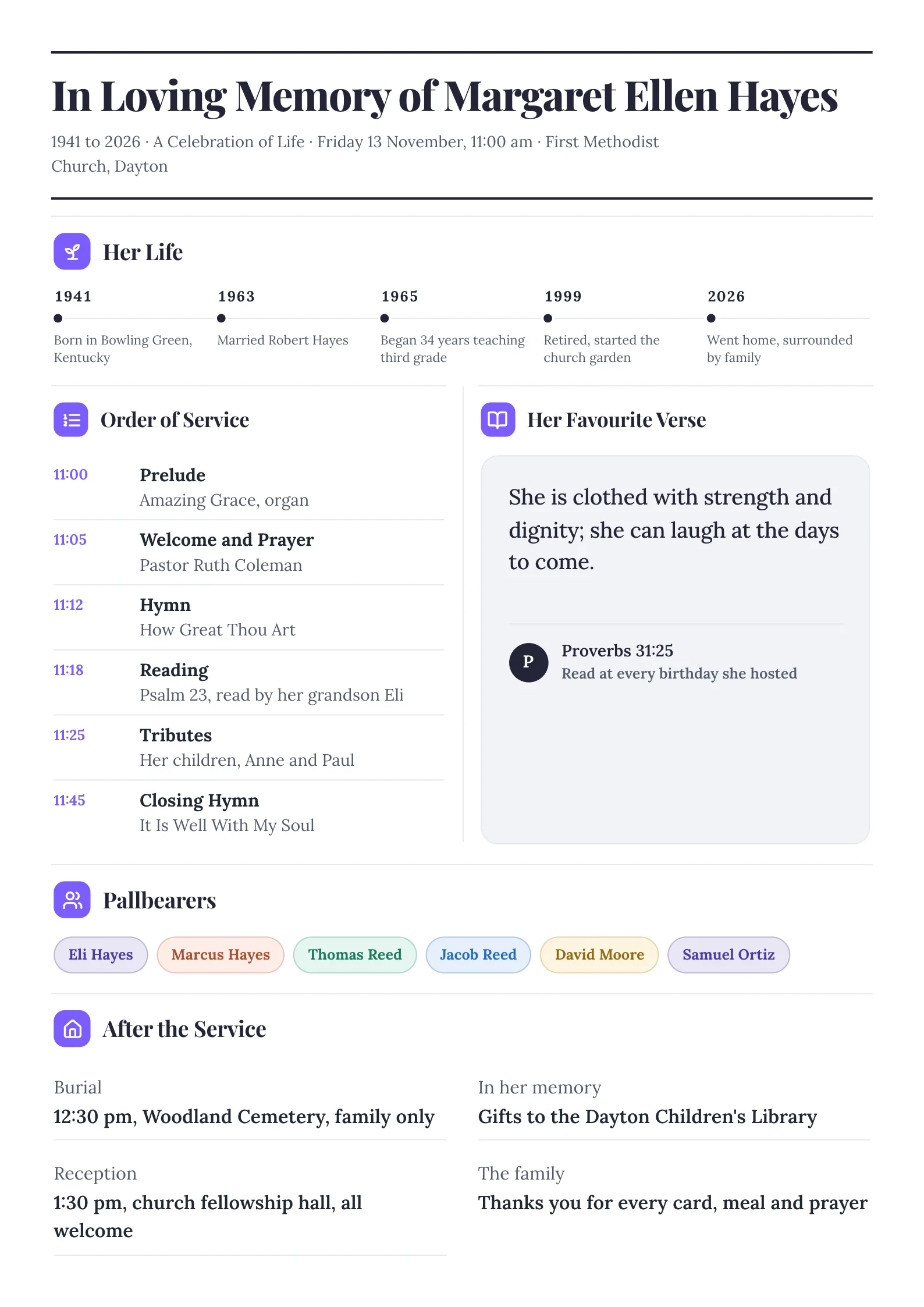 Event Program: Memorial ServiceEdit for free(opens in a new tab)
A guest opens a program for two answers: what happens next, and when. Every step below on how to write an event program serves those two answers, starting with the times.
Seven programs, counted line by line
We picked programs you can open yourself, so you can check every count. They range from a 2-page gala sheet to a 148-page conference book, and every one was written for the guests in the seats.
| What the program includes | Programs that do |
|---|---|
| A start time for the event | 7 of 7 |
| A name beside each item | 5 of 7 |
| Instructions for the audience | 4 of 7 |
| Parking, dress code, Wi-Fi or a map | 3 of 7 |
| A link to an online version or livestream | 3 of 7 |
| A time on every item | 2 of 7 |
| A note that times may change, or where to check | 2 of 7 |
| A blank left in, like "TBA" | 1 of 7 |
The full list, with links and what each one does, is in the sources section near the end.
Decide what your program has to do
Before you type a line, picture the guest holding it. A graduation guest wants to know when their child crosses the stage. A gala guest wants to know when dinner arrives and when the paddle raise starts. A conference guest wants the room for the 10:15 session.
Write down the one question your guests will ask most, then build the page around the answer. If your event has one room and one stage, a single running order does the job. With more than one room, you need a grid with a column for each room and a row for each time.
 Edit this template
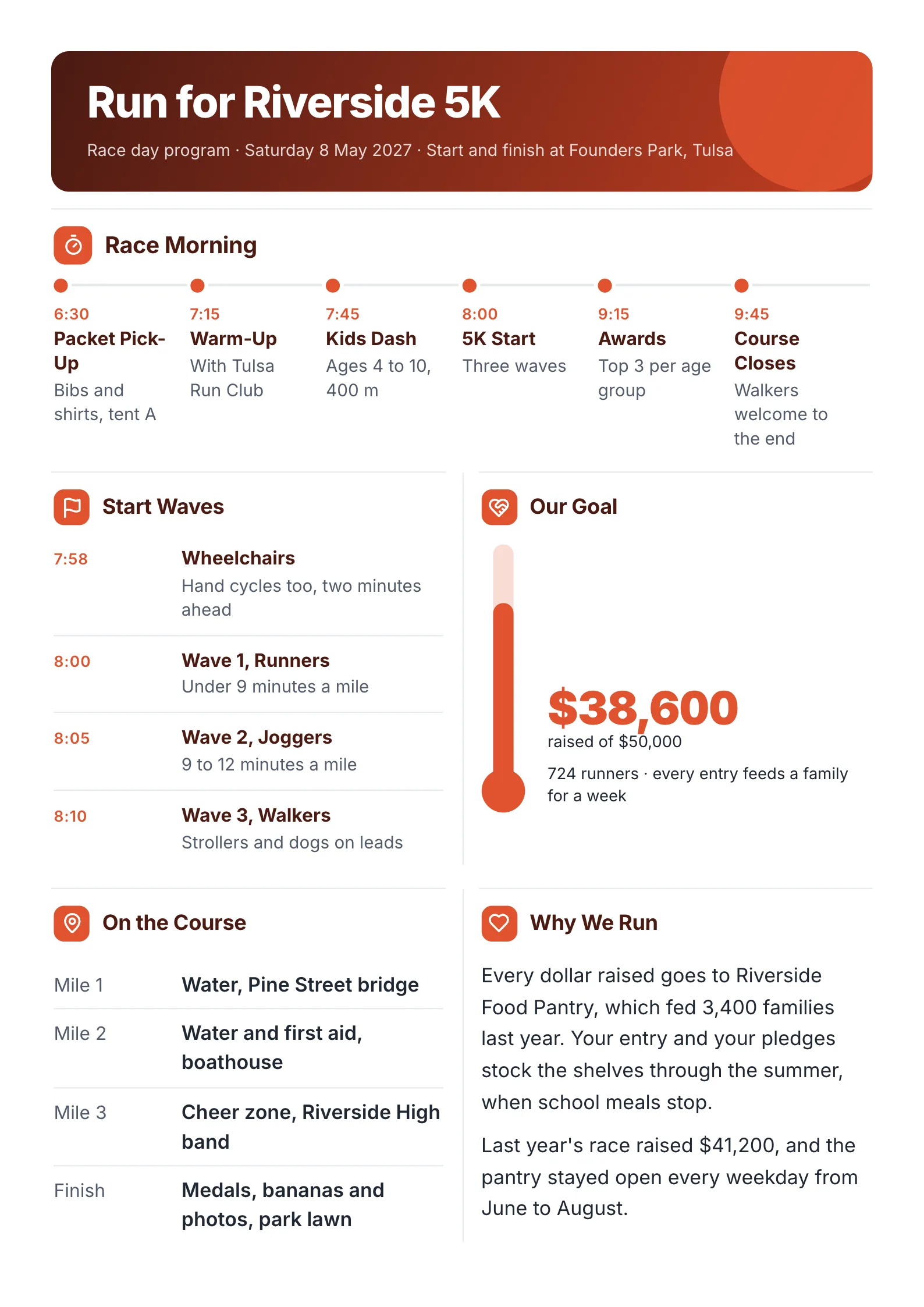
A race day program with six timed steps across the top, start waves with times, and the water stops by mile.
Put a time beside every item
This is the step most programs skip. Northwest Missouri State's commencement lists 25 items in its order of exercises, from the processional to the recessional, and doesn't give a time for any of them. The American Cancer Society's New Orleans gala gives block times for cocktails, seating and the program, then lists nine program items between 7:15 and 8:45 with no times at all.
The two conference programs show the fix. The American School Counselor Association prints a start and end time on every block, from 8:30 am pre-conference sessions to the evening reception. The Poultry Science Association gives each session a time and a room.
You don't need to promise the minute. Round to five minutes, and give each item a start time even if it's approximate. "7:50 Ten Years on Film" and "8:15 Awards" tell a guest they can step out during the film and be back for the awards. A list with no times tells them nothing.
To set your times, work backward from the item that can't move. If dinner must be served by 7:10, and the welcome takes ten minutes, the welcome starts at 7:00. Add up the minutes, then add five spare minutes for every hour. Your program will run long far more often than short.
 Edit this template
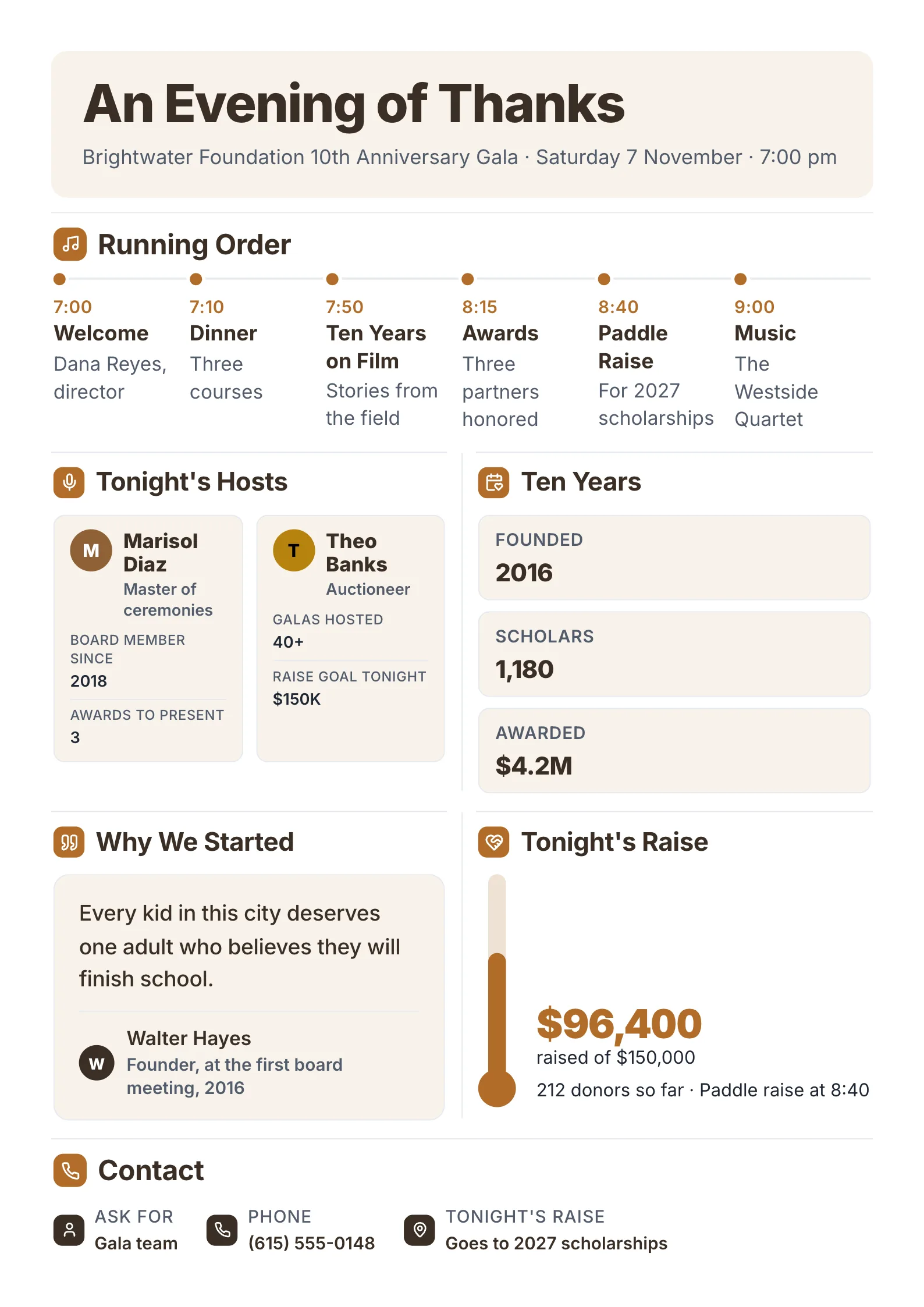
A gala program with six timed items, two hosts, a ten-year record and a raise goal of $150,000.
Name who leads each item
Five of the 7 programs name a person beside each item, and it's the easiest way to make yours useful. The University of Dubuque lists who leads the call to order, the welcome, the invocation and every part after, down to who reads the names.
Names do two jobs for you. Guests know who is speaking without asking the person next to them. Your speakers see their own name in print, which is a quiet reminder that they're on the clock.
Give each person their role in a few words, like "Principal Hannah Lowe" or "Rev. Elena Hart." Skip long bios in the running order. If a speaker needs a bio, put it in its own box lower on the page.
 Edit this template
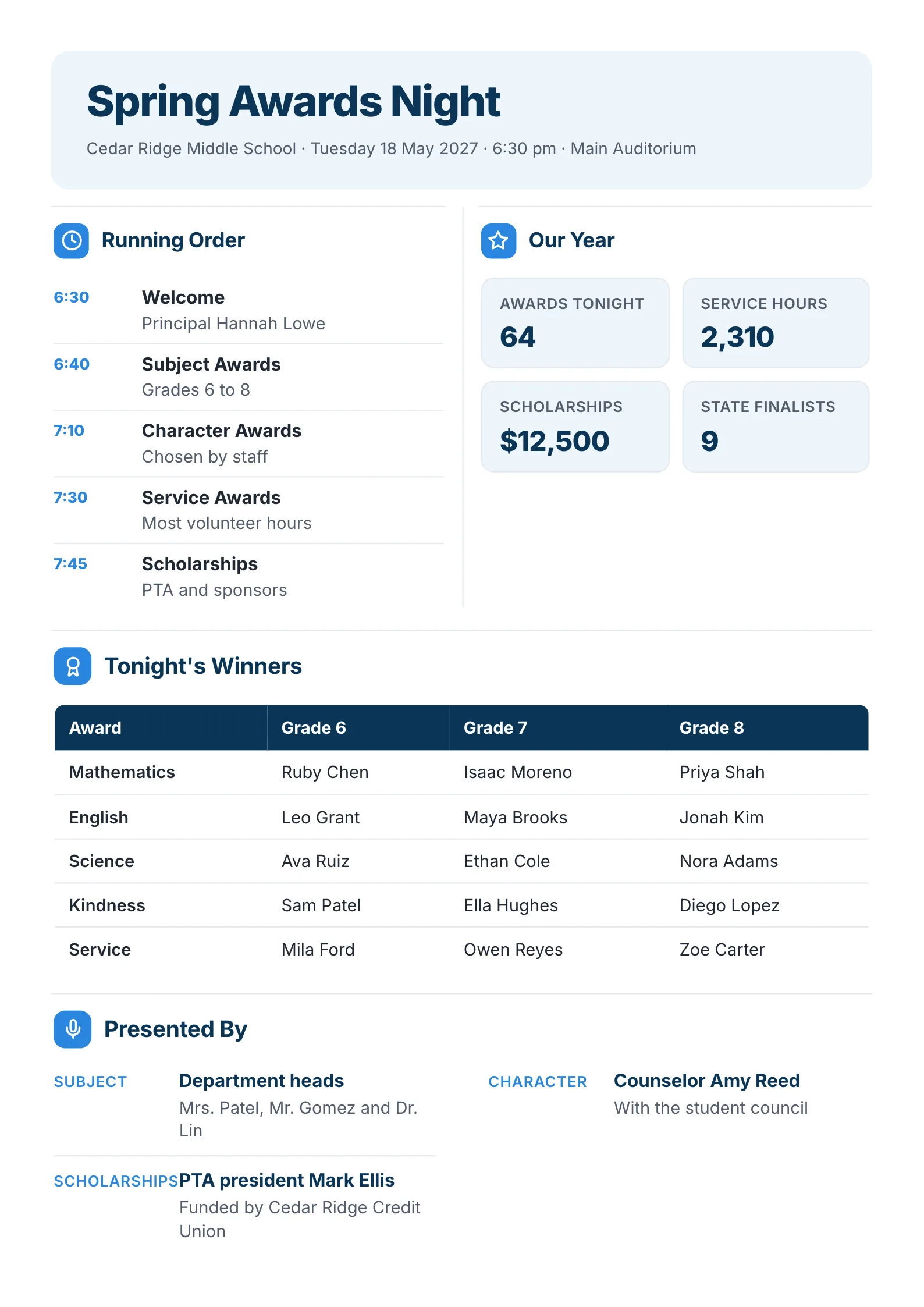
An awards night program with five timed segments, the presenters for three of them, and the winners in a table by grade.
Tell guests what to do, and when
Four of the 7 programs give the audience instructions, and these lines save you the most trouble on the day. Northwest Missouri State asks guests not to take photos in the aisles, to let the platform party leave first, and to text their graduate about where to meet afterward. Dubuque asks the audience to stay seated until the graduates have left.
Think about the moments when your guests might do the wrong thing. They might stand too early, wander toward the stage, or leave before the last award. Write one plain line for each moment and place it right beside the item it belongs to.
Keep your tone friendly. "Please hold applause until each row has crossed the stage" works better than a list of rules in capital letters.
Add the details guests need before they arrive
Three programs include practical details, and the gala that does it best shows why. The American Cancer Society tells its 700+ guests that valet parking is limited to 125 cars, so they should use a ride share. It gives the dress code as black tie, and it prints a map of where ride shares pick you up when you leave.
Ask yourself what your guests will search for on their phones in the car. Parking, the entrance, the dress code and the Wi-Fi password are the usual ones. Each one fits on a single line, and every line you print is one less question at the door.
 Edit this template
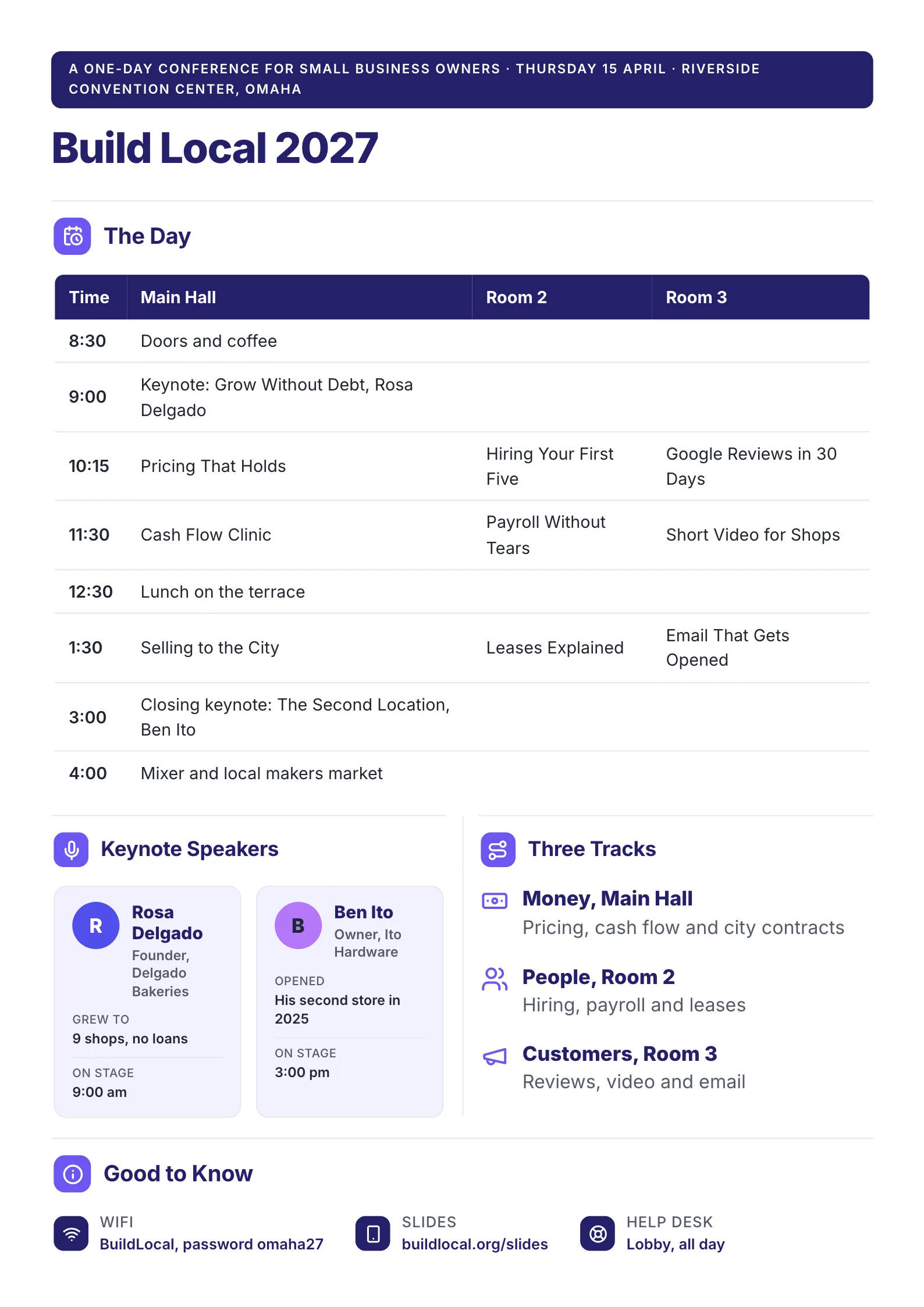
A conference day program with a schedule for three rooms from 8:30 to 4:00, two keynote speakers and the Wi-Fi password.
Say where changes will be posted
Your program goes to print days or weeks before your event, and things change. Only 2 of the 7 admit it. The Poultry Science Association says the printed program was finalized before the meeting and that its event app is the current version. The ASCA schedule simply says "Schedule subject to change."
Add one line that tells guests where to look for updates. It could be an app, a web page, a sign at the door or the host's announcement. Three of the programs also link to an online version or a livestream, which helps family who couldn't travel.
Check for blanks before you print
One gala program went to guests with an award listed as "TBA." It's an easy miss when you're waiting on a final name, and it looks unfinished in a guest's hands.
Before you print, search your file for TBA, stray question marks and empty brackets. If a name truly isn't confirmed, write the item without it, as "Champion of the Year Award," and leave the name off. Then read every time aloud in order. If two items share a start time, or one starts before the last one ends, fix it now.
Also check that the program matches the event. Read it beside the run of show your team uses. If the stage manager has the toast at 8:15 and your program says 8:30, one of them is wrong.
The same gala running order, rewritten
Here's a gala running order written the way most programs do it:
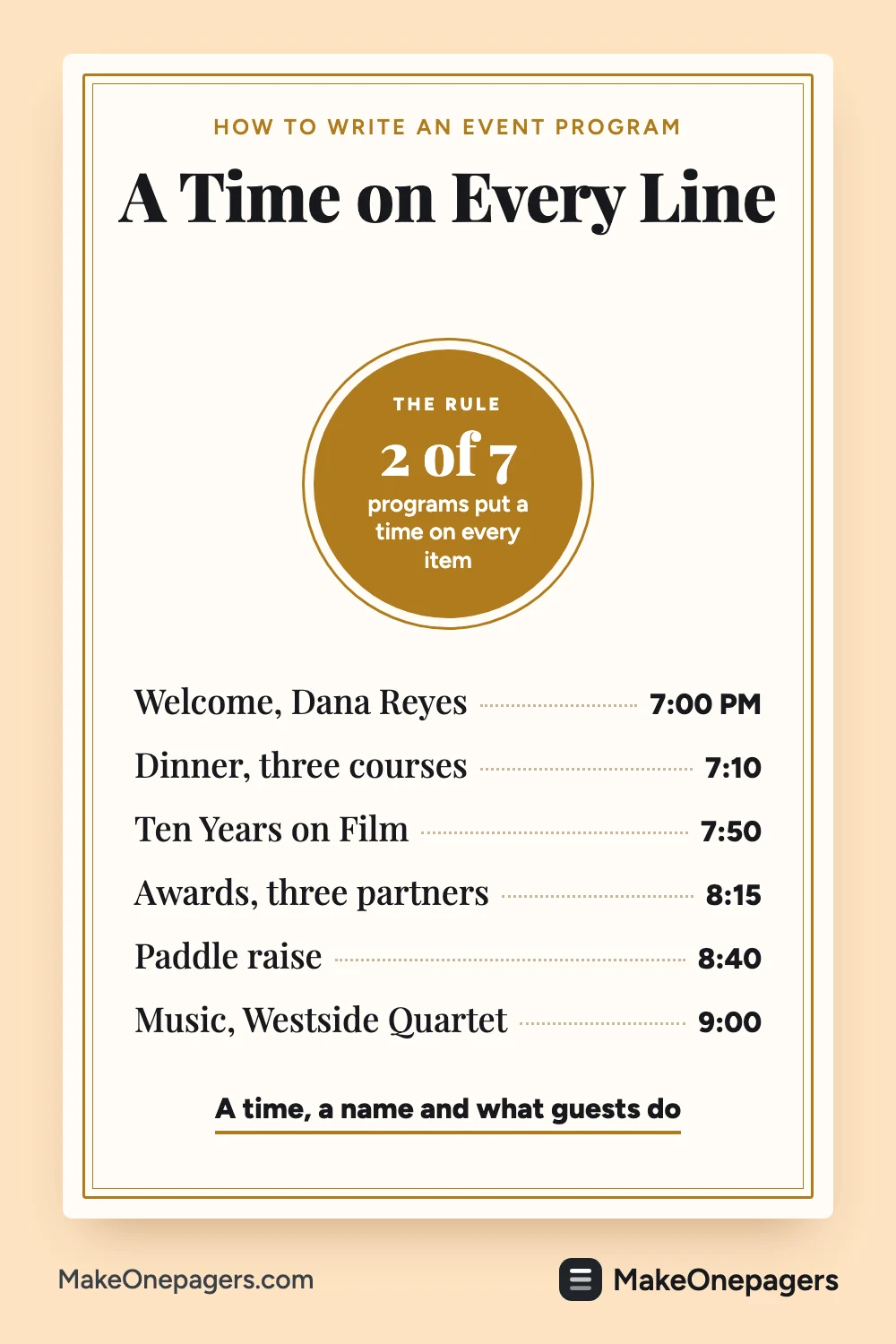
Welcome. Dinner. Video. Awards. Paddle raise. Music.
And here it is with the advice above:
7:00 Welcome, Dana Reyes, director 7:10 Dinner, three courses 7:50 Ten Years on Film, stories from the field 8:15 Awards, three partners honored 8:40 Paddle raise for next year's scholarships 9:00 Music, The Westside Quartet
The second version tells a guest when they can step out, who is speaking and what the paddle raise is for. It names the same six items either way.
 Edit this template
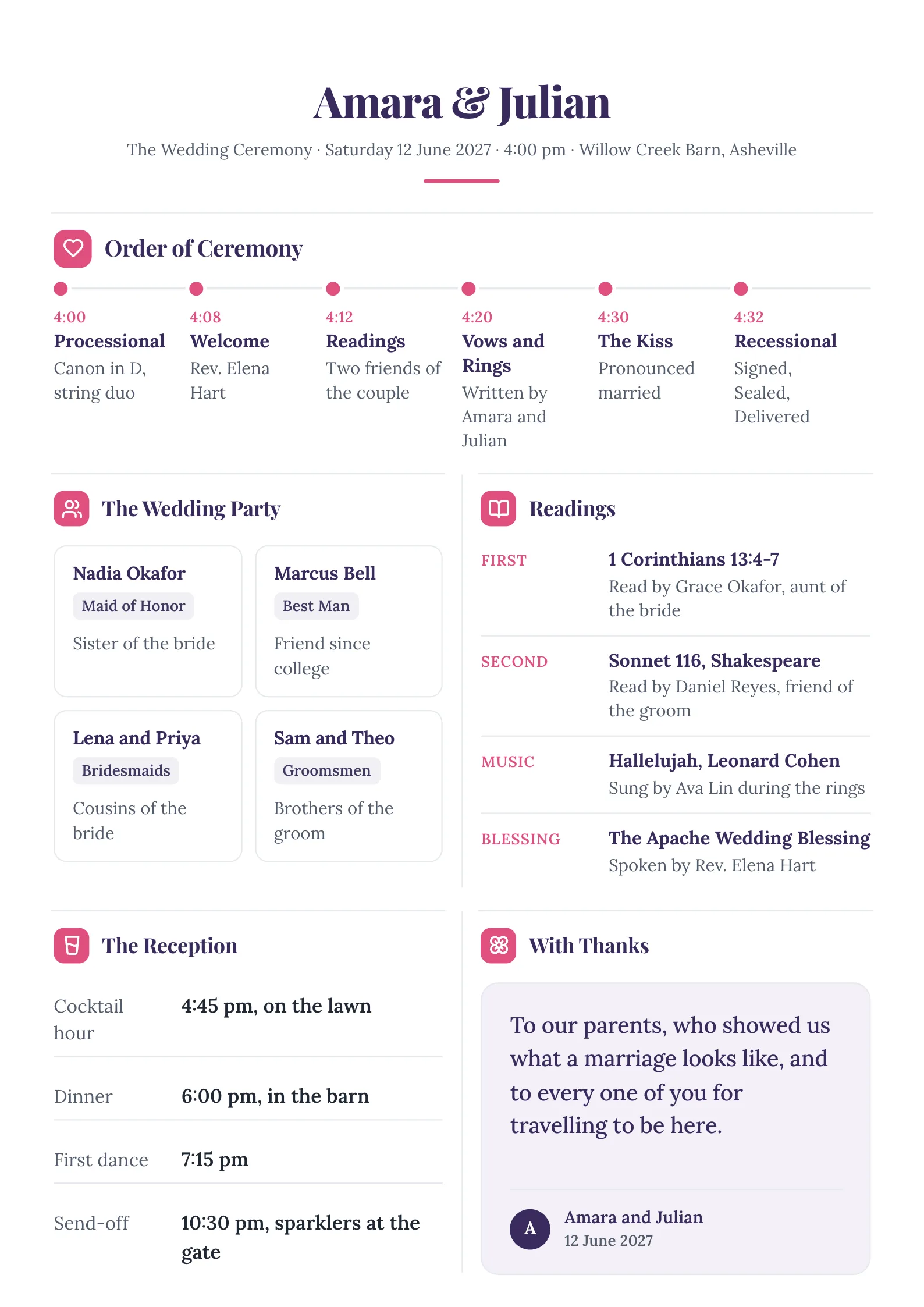
A wedding program with six timed ceremony moments, the wedding party, two readings, a song, a blessing and reception times.
Choose what goes on the back
The front of your program holds your running order. Everything else goes lower down or on the back. Across the 7, the extra pages held lyrics, sponsor lists, graduate names, maps and thank-yous.
Decide what's worth the space for your guests. Graduation guests want the list of names. Gala guests like to see the sponsors and the fundraising goal. Conference guests want the map and the Wi-Fi. A memorial guest may keep the program, so a photo and a favorite verse matter more there than a sponsor list.
If you're making a one-page program, you'll have room for the running order plus two or three of these boxes. That's usually enough. You can start from one of the programs pictured here and replace the times, names and boxes with your own.
Ceremonies and conferences need different programs
The programs we read split into two kinds, and you'll want to know which one you're writing. Ceremonies and galas follow one path from start to finish, so a single list works. Conferences run several things at once, so a grid works better.
| Ceremony or gala | Conference or festival | |
|---|---|---|
| Layout | One running order | A grid of times and rooms |
| Times | Start time for each item | Start and end for each block |
| Names | Who leads each item | Speaker for each session |
| Instructions | When to stand, sit or leave | Badges, Wi-Fi, room changes |
| Length | 1 to 2 pages for guests | One page at a glance, plus a full book if needed |
If you're planning a big conference, you'll likely want both. ASCA's two-page schedule at a glance sits beside a much longer program, and many guests only ever read the short one.
The 7 programs we read
| Program | Type | What stood out |
|---|---|---|
| Western Michigan University, Summer 2026 commencement | Commencement | Start times by college, a link to watch online, and a hashtag for photos |
| Northwest Missouri State University, Spring 2026 commencement | Commencement | 25 items with a name each, plus clear rules for photos and leaving |
| University of Dubuque, May 2, 2026 commencement | Commencement | A leader for every item, and a request to stay seated at the end |
| American Cancer Society, Cure by Design gala, September 27, 2025 | Gala | Valet limits, dress code and a ride share map, with one award left as TBA |
| University of Arizona public health 25th anniversary gala, November 7, 2025 | Gala | Reception, dinner and program times, with the keynote unnamed |
| Poultry Science Association, 2026 program book | Conference | A time and room for every session, and the app named as the current version |
| American School Counselor Association, 2026 schedule at a glance | Conference | A start and end time on every block, and "Schedule subject to change" |
The time column, filled in
Print a draft of your program and run a pen down the left edge. If there's a blank where a time should be, fill it in, then add a name beside every item. Five of the 7 real programs left at least part of that time column empty. Once the column is full, move your running order into an event program design from MakeOnepagers. For more filled-in examples, open the event program template post.
Frequently asked questions
Do you need a time on every item in a ceremony program?
It helps your guests more than anything else you can add. None of the five ceremonies and galas we read did it, so most guests could only guess when the part they came for would happen. Round to five minutes and add a little slack, and nobody will hold you to the minute.
How many programs should you print?
Plan on one for every guest, plus about one in ten spare for late arrivals and people who want a keepsake. For a ceremony where families share, one per couple can work. Post the same program online so anyone without a copy can read it on a phone.
What's the difference between an event program and an agenda?
An agenda is for people taking part in a meeting, and it lists topics to discuss and decide. An event program is for an audience. It tells guests what will happen, when, who's leading it and what they should do. If your guests mostly watch, you want a program.
How far ahead should you finish the program?
Lock the running order a week before a printed event, then print two or three days out. The Poultry Science Association finalized its printed book well ahead and pointed guests to its app for changes, which is a good model when your times might still move.




