How to Write a Travel Itinerary, One Column at a Time
How to write a travel itinerary as a grid you fill one column at a time, checked against 5 published group trip plans. All 5 say where the group sleeps.


Most of how to write a travel itinerary that holds up on the road comes down to one grid, with a row for each day. Fill it one column at a time, in this order: where you'll sleep, how you'll move, and the times that won't wait for you. Leave one row nearly empty, list your bookings under the grid and put a phone number at the bottom. That's enough for almost any trip, from a weekend away to two weeks abroad. Start from a free one pager template.
One‑Pager examples
Real One-Pagers made with MakeOnepagers. Open any one to edit it as your own.
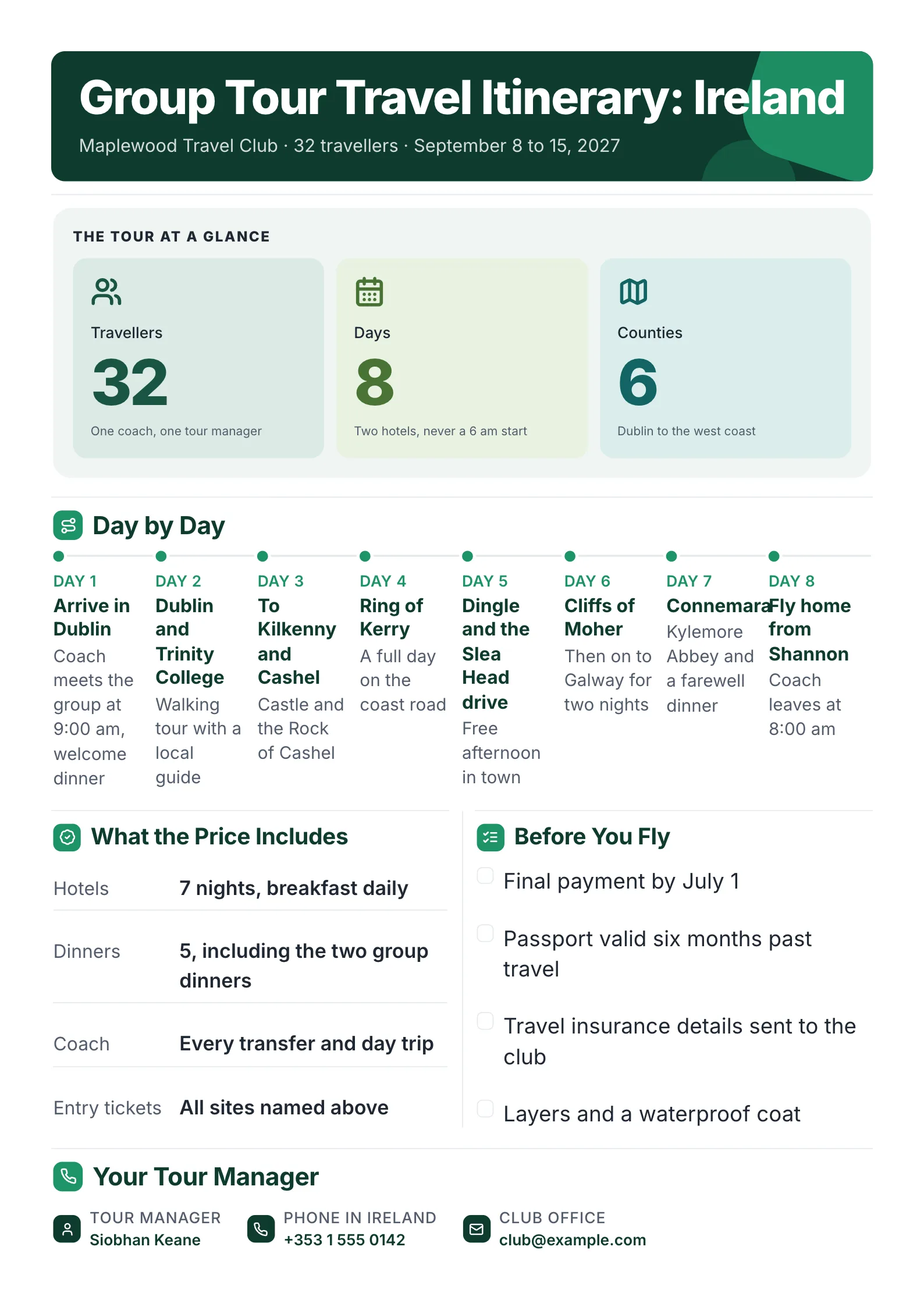 Group Tour Travel ItineraryEdit for free(opens in a new tab)
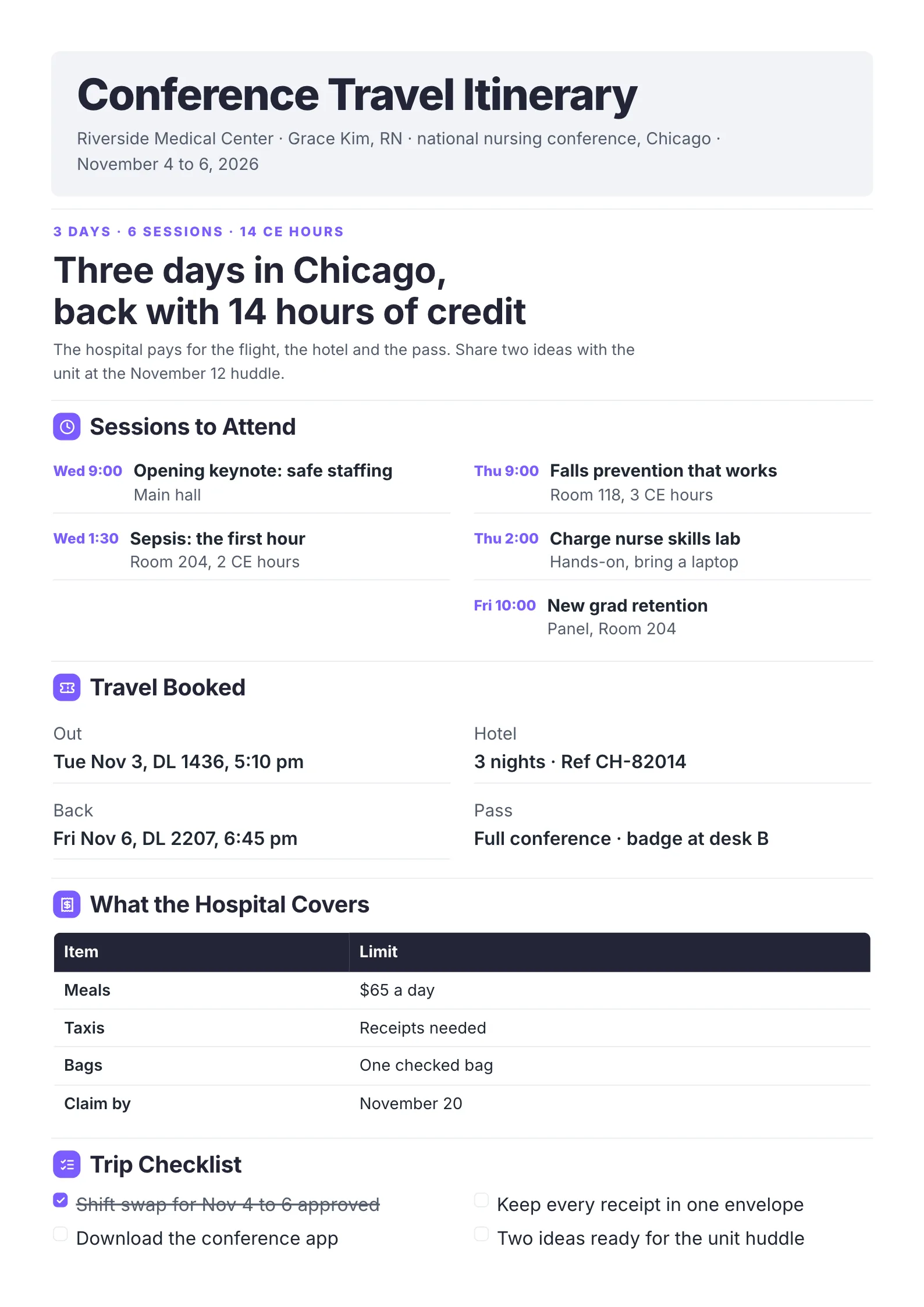 Conference Travel ItineraryEdit for free(opens in a new tab)
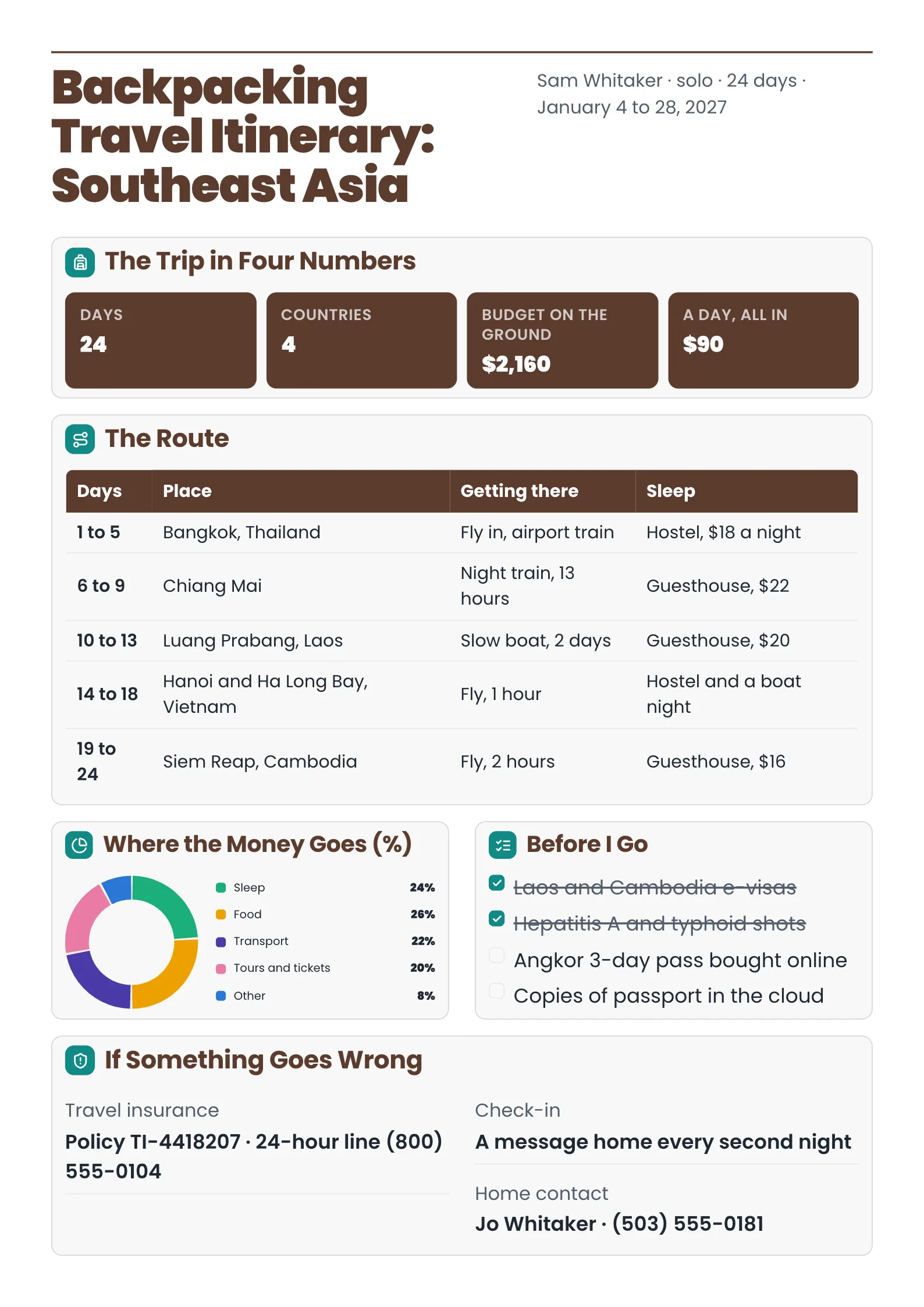 Backpacking Travel ItineraryEdit for free(opens in a new tab)
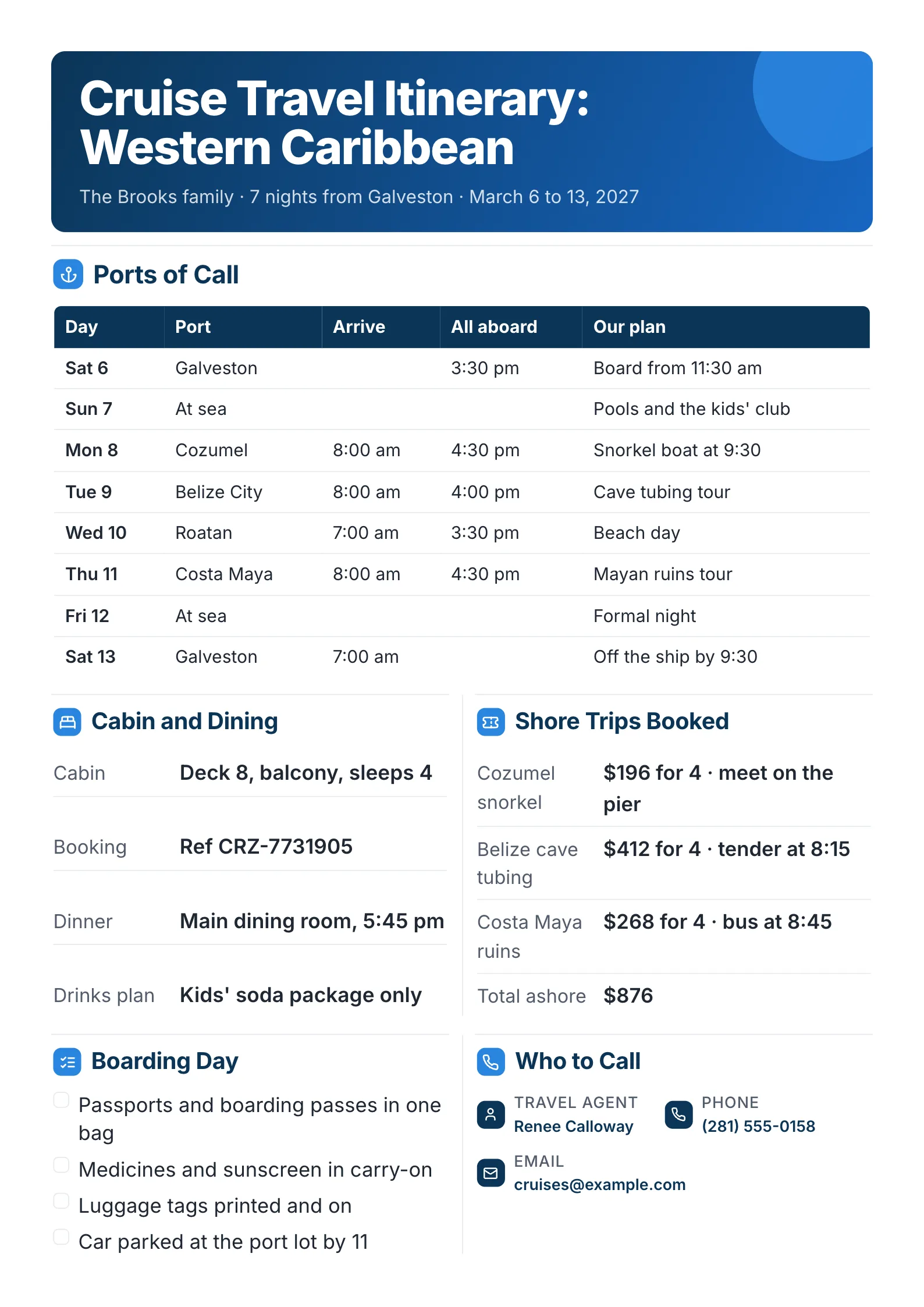 Cruise Travel ItineraryEdit for free(opens in a new tab)
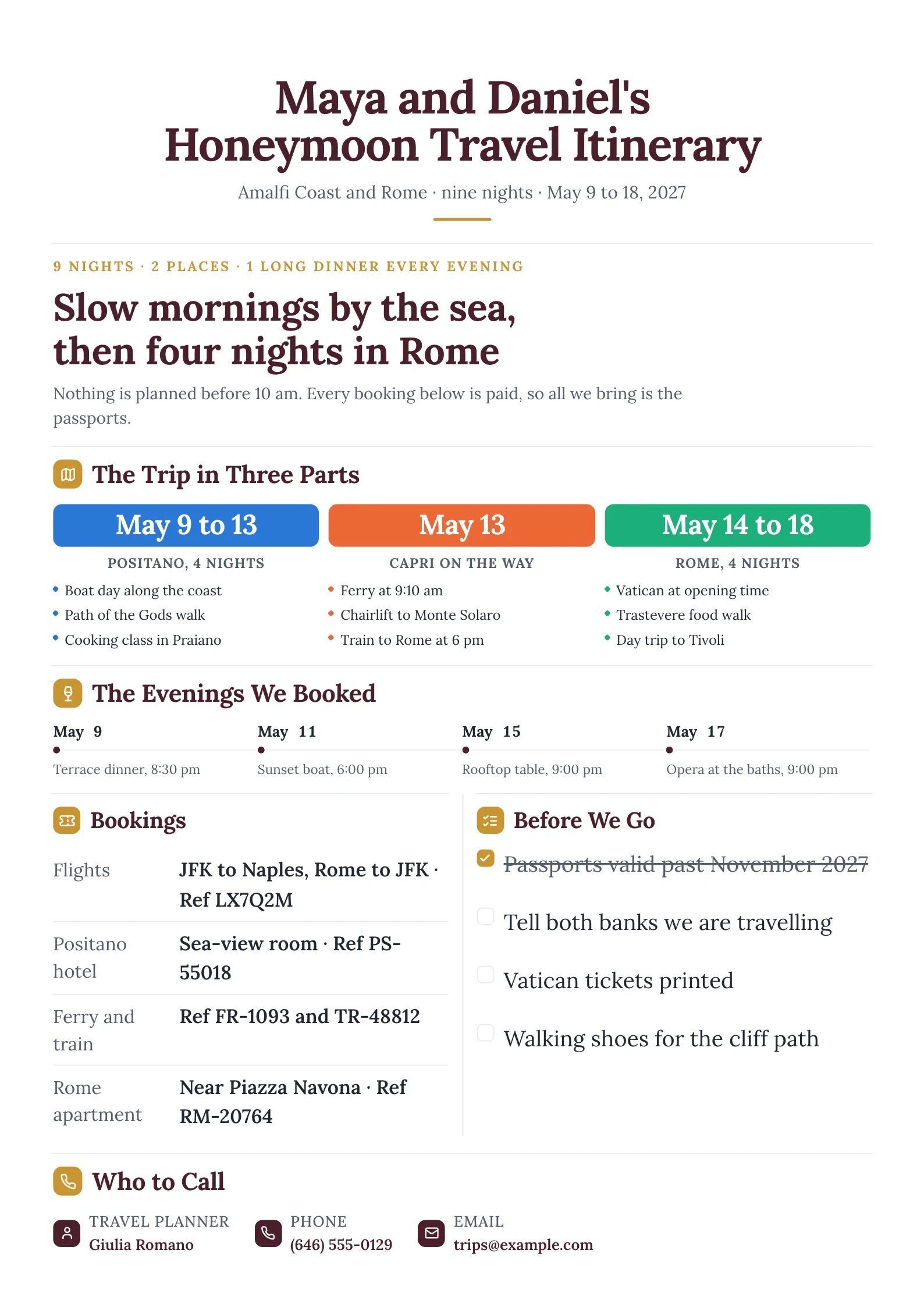 Honeymoon Travel ItineraryEdit for free(opens in a new tab)
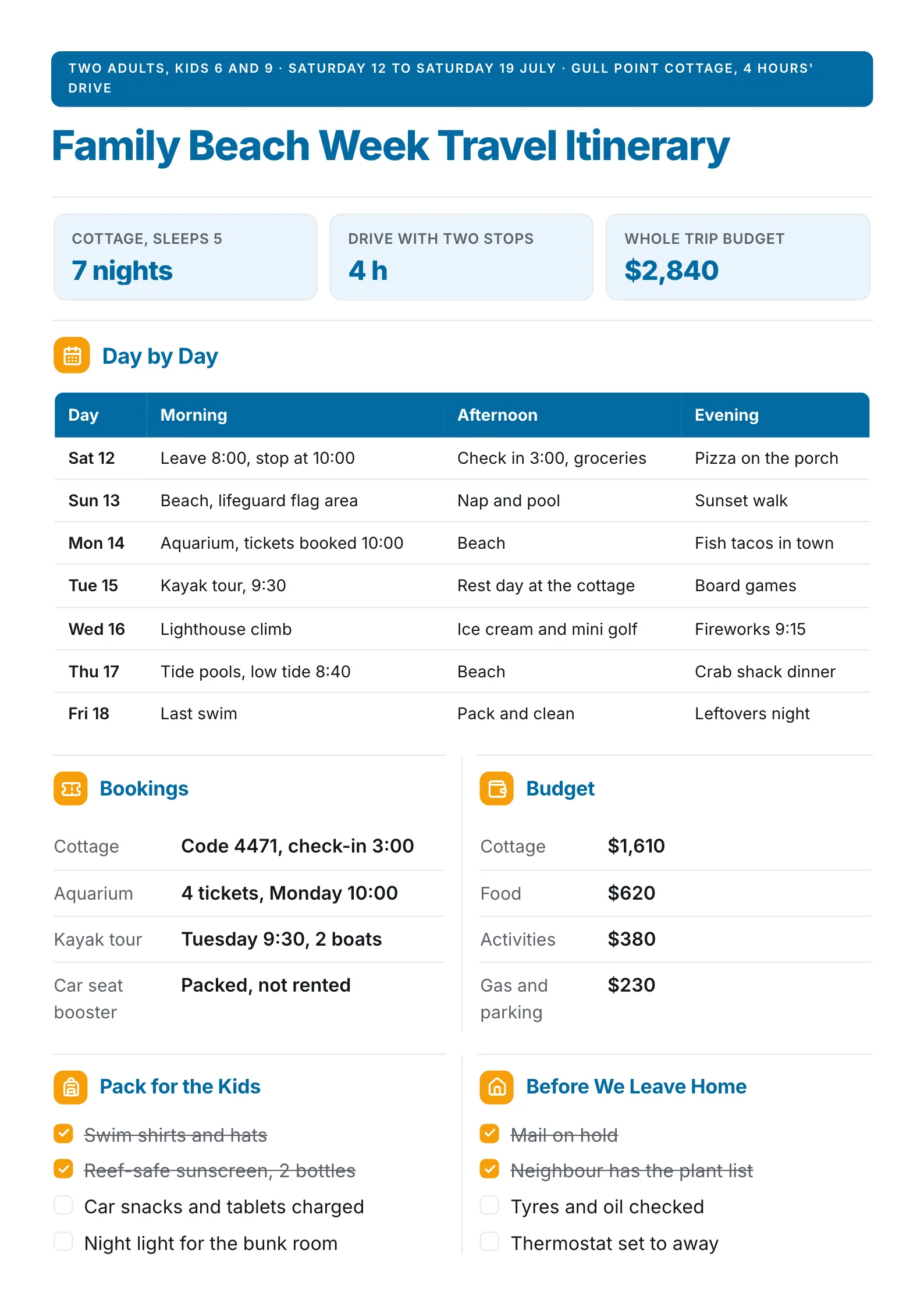 Family Beach Week Travel ItineraryEdit for free(opens in a new tab)
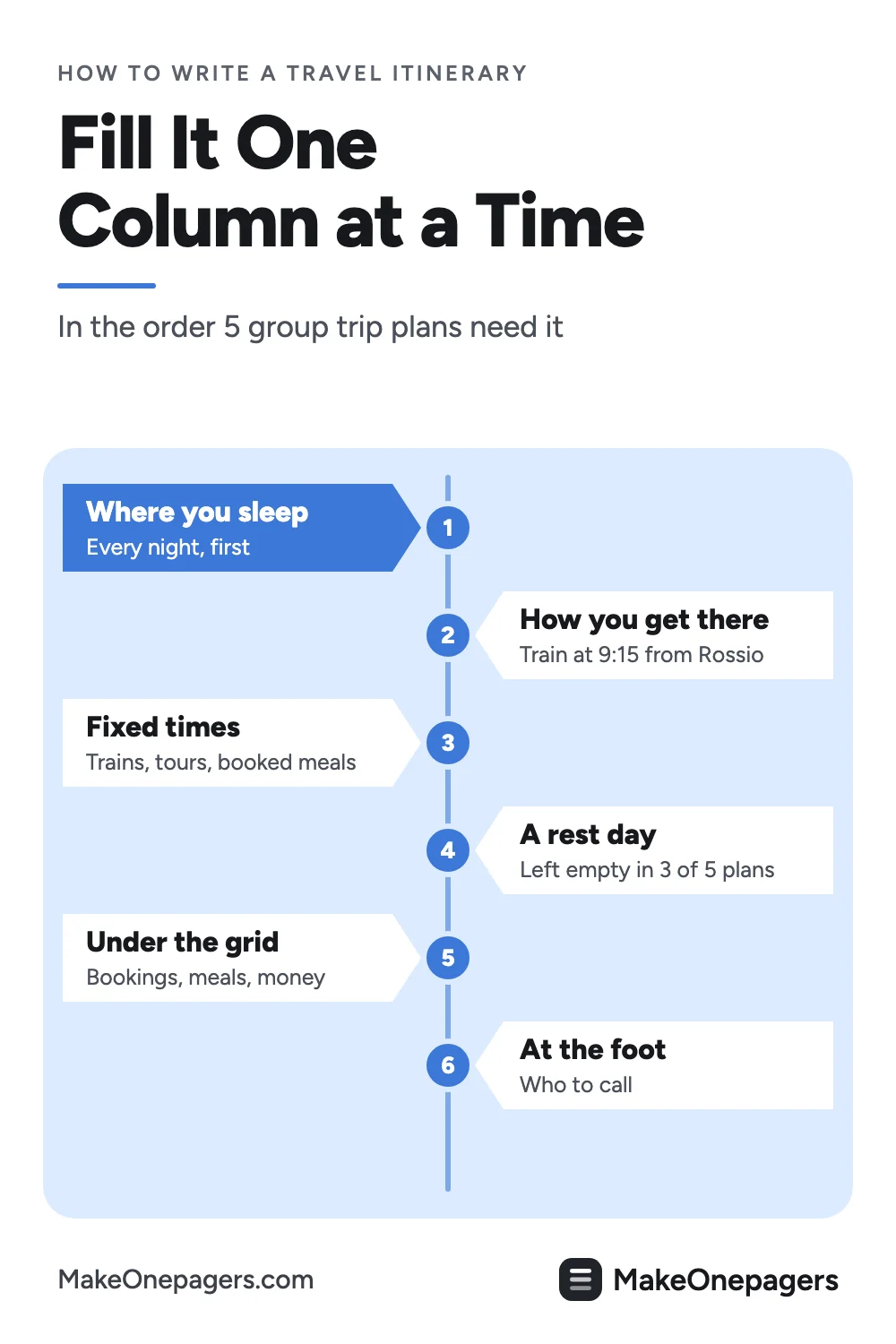
The order comes from group trips, where a leader has to put the whole plan in writing before anyone leaves. Four colleges and a study abroad program publish their trip plans or the forms their leaders fill in, and we read 5 of them on October 30, 2026. Below, each column gets what those plans did with it and a sample page that does it well.
Column 1: where you sleep
Fill this column first, for every night of the trip. It's the one fact that decides the rest of each day, because it sets how far you travel and when you need to stop.
All 5 plans say where the group sleeps, but they say it at different levels of detail. Montana State Billings named the same Porto hotel, the Clip Hotel, on every night of its 10-day Portugal trip, from March 1 to March 10. SIT's week in Senegal gave the hotel its own row across the whole grid. The other three wrote hotel, monastery or accommodation without a name. If someone at home may need to reach you, name your hotel and its phone number for each night.
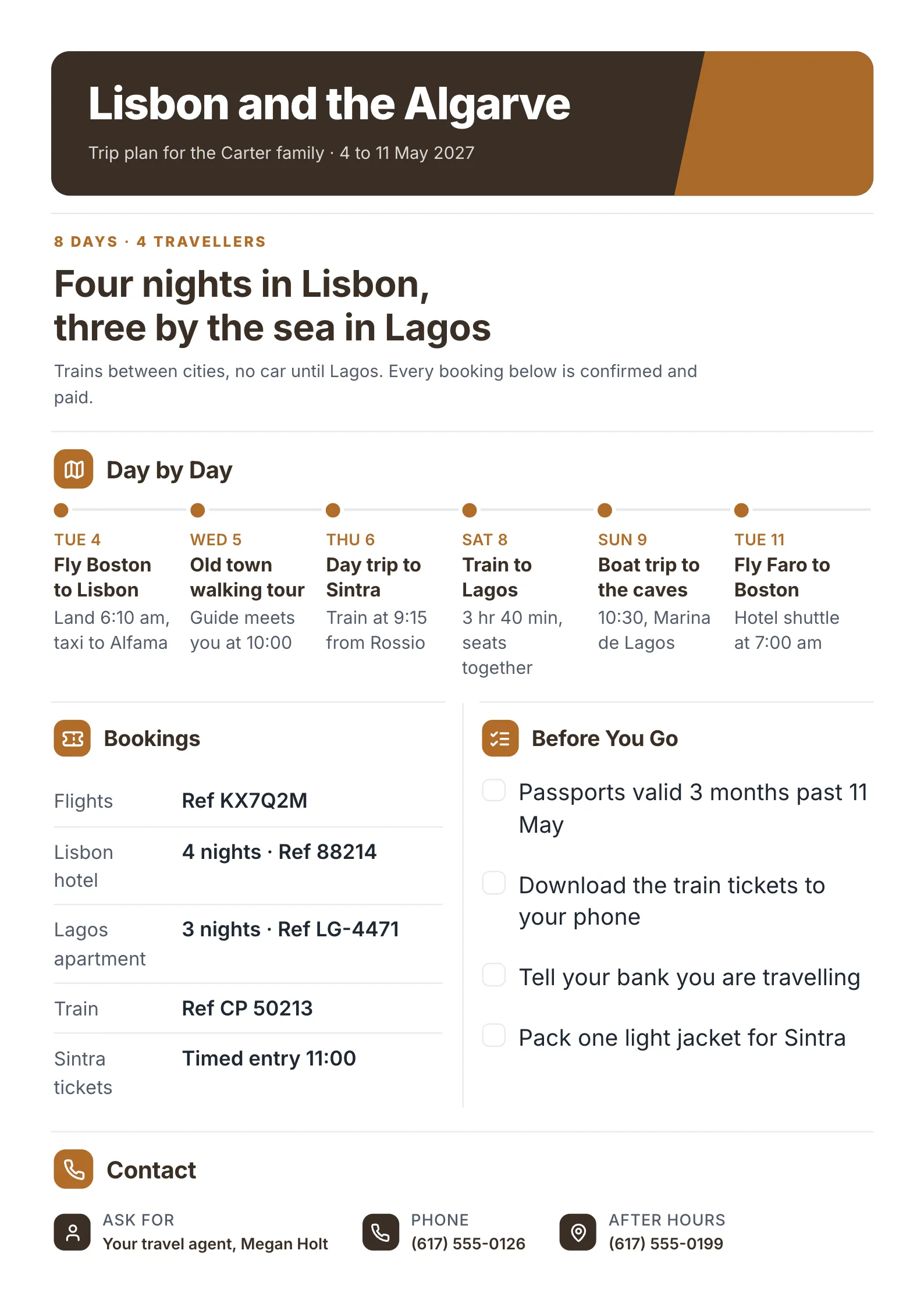
Fixed nights show you which days have a long move and which ones let you stay put. The sample below is an 8-day family trip to Lisbon and the Algarve. Four nights sit in Lisbon and three in Lagos, and the line under the title tells you so before you reach the first day.
 Edit this template
Every trip shown here is invented, references included. The split between two bases is clear before you read a single day.
Column 2: how you get there
All 5 plans named the transport. Purdue's two-week sample listed metro, motor coach and train in its own Notes column. SIT gave the ferry a time, 9 AM. Emory's suggested plan for visiting faculty named the flights home, some of them near midnight.
Write the mode, the time it leaves and where it leaves from. "Train at 9:15 from Rossio" tells a tired traveler exactly where to stand. "Train to Sintra" sends them looking for a station.
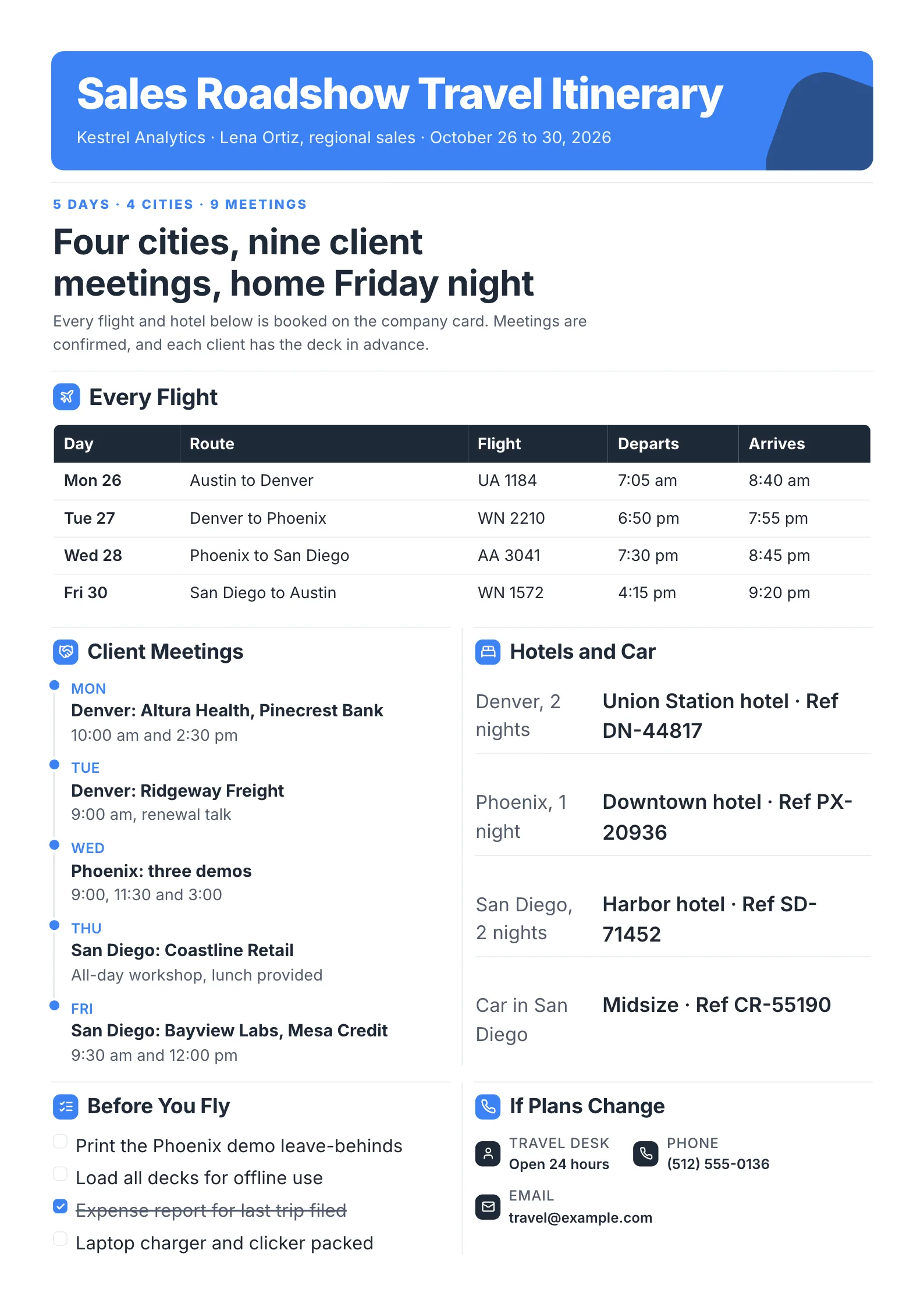
On a work trip, this column is often the hardest one. Four cities in five days means every flight goes into one table, where a tight connection shows up before you book it.
 Edit this template
Every flight sits in one table with its number, so a change is easy to check.
Column 3: the times that won't wait
Here the plans split. SAIC's itinerary form asks trip leaders for morning and afternoon rows with clock times. Its example day lands at Rome's airport, with an official start on a 10:15 am bus to Umbria and a mandatory first group dinner. SIT puts times only on the moves that matter, like the 9 AM ferry, check-out at noon and arrival by 10 PM. Purdue gives a clock time once, and Montana State Billings gives none.
Our advice is to follow SIT's lead unless you're running a large group that has to move together. Write a time beside anything that leaves without you, such as flights, trains, tours and booked meals. Leave the rest as a plain note for the morning or afternoon. A page full of clock times reads like a work shift, and on a family trip it rarely survives the first day.
The row you leave empty: a rest day
Three of the 5 plans leave a day nearly empty on purpose. Purdue scheduled one right after arrival. Emory's fourth day was a "Mandatory Site Day" for rest and a tour of the facilities. SIT treats its first day as an arrival day, with a recommended arrival by 10 PM.
Your body will thank you after a long flight. An empty row also gives you room to catch up when something slips, like a closed museum or a rained-out boat trip.
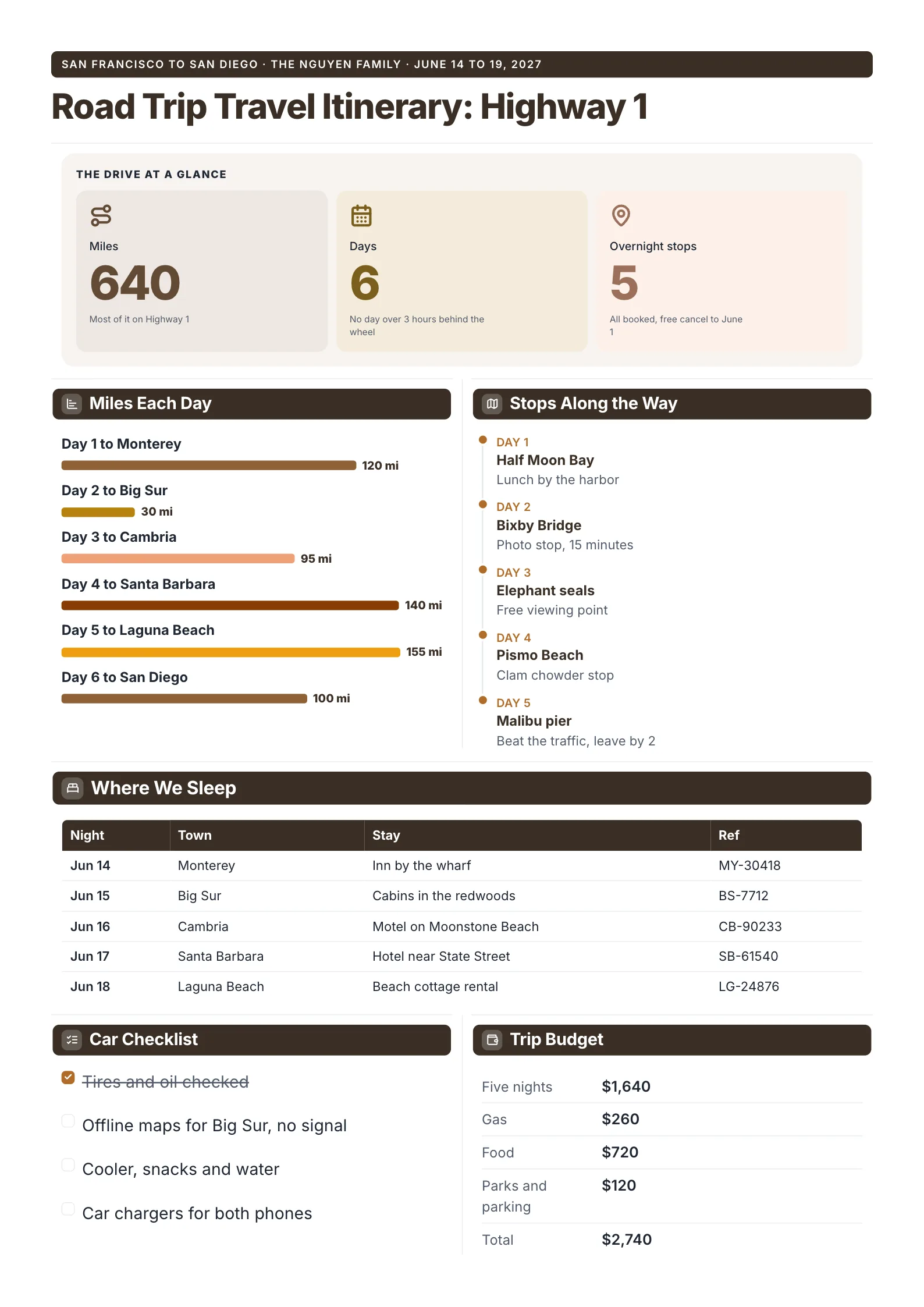
The road trip sample paces itself another way. Its 640 miles down Highway 1 are spread over six days, with no day over 3 hours behind the wheel. That leaves room in every row for the stops, from lunch by the harbor in Half Moon Bay to the elephant seals near Cambria.
 Edit this template
A daily driving cap does the job of a rest day.
Under the grid: bookings, meals and money
Four of the 5 plans mark meals, and SIT is the clearest. Breakfast at the hotel every day, then each lunch and dinner marked as a group meal or on your own. Montana State Billings was the only one with a cost line, the average flight price as of October 12, 2023: $647 one way out and $864 to come home.
Under your grid, list every booking you've made with its reference number. If your phone dies at the front desk, a printed reference saves your night. Add a line for your trip budget if you're splitting costs with anyone.
At the foot of the page: who to call
SAIC's form asks for one staff member to leave at the latest possible time, as the emergency contact. You can copy that idea for your own trip. Put a phone number at the bottom of your page and leave a copy with someone who isn't traveling with you.
If you're leaving the country as a US citizen, you can also enroll in the State Department's Smart Traveler Enrollment Program. Its federal notice, from January 22, 2026, estimates 5 minutes to sign up and 1,750,000 people a year. Embassies use it to reach travelers in an emergency, and it's free and voluntary.
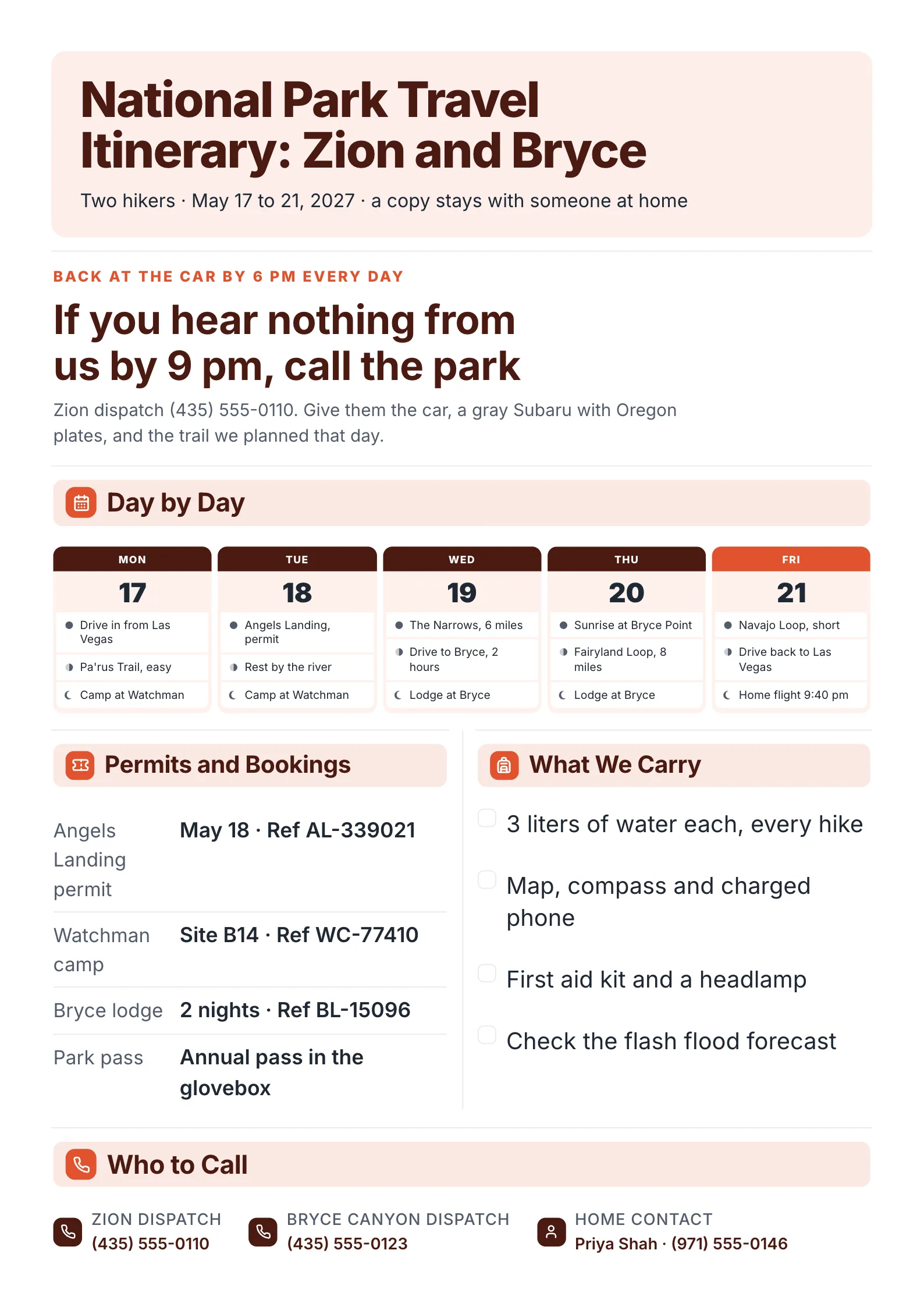
For hiking trips, the national park sample moves this part to the top. A box called If We Are Not Back gives a time to be back at the car, a time to call the park and the number to call.
 Edit this template
The safety plan sits at the top, where the person at home will look first.
When the page goes to parents
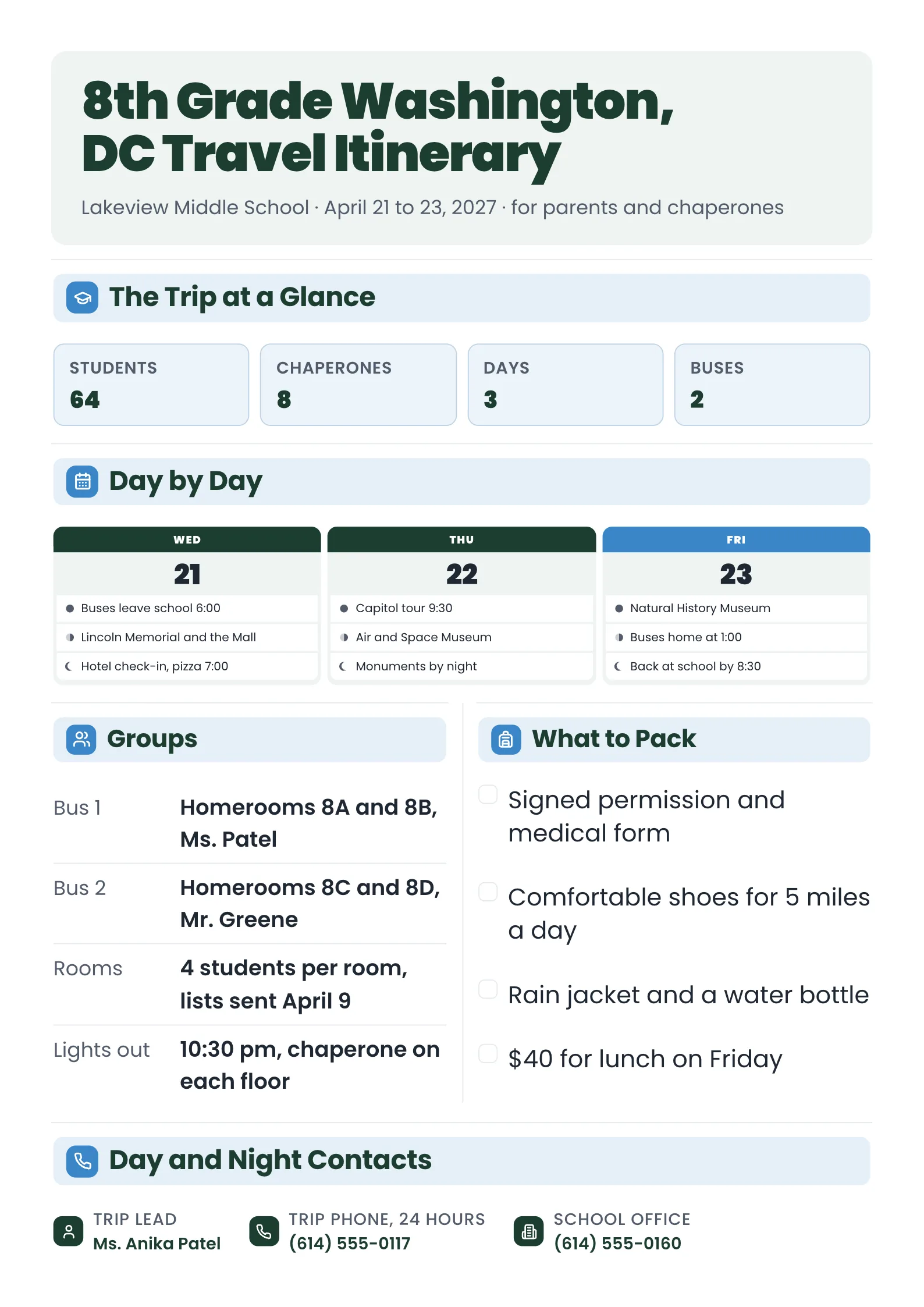
A group itinerary has a second reader, the people at home. Write it for them as well as for the travelers. The school trip sample is written for parents and chaperones. Under the day-by-day grid it lists which homerooms ride each bus, how rooms are shared and when lights go out. A parent can answer most of their questions without calling the school.
 Edit this template
Parents get the bus, the room plan and the packing list on one page.
For a printable layout with the grid already drawn, see our travel itinerary template post.
Start with the beds
Write the nights first, one per row. Fill in the travel between them and the times that won't move, then pick your empty row. Print two copies of the finished page and leave one at home. A day-by-day grid from MakeOnepagers saves you drawing the table yourself.
Frequently asked questions
What should a travel itinerary include?
At minimum, each day's date, where you'll sleep, how you'll travel and anything with a fixed time. Add your bookings with reference numbers, an emergency contact and a rest day for trips longer than five days.
How detailed should an itinerary be?
Give a clock time only to things that leave without you, like flights, trains, tours and booked meals. For everything else, a morning or afternoon note is enough. Of the 5 plans we read, SIT works this way, with times for the ferry, check-out and arrival.
How do I make an itinerary for a group?
Write one shared plan with the meeting point and time for each move. Then add what the people at home need, like the hotel, a contact number and which meals are covered. A school or club trip also needs who rides with whom and the rules for the evening.
Should I share my itinerary with someone at home?
Yes. Leave a copy with a person who isn't traveling, along with your hotel names and a time they should worry if they haven't heard from you. US citizens going abroad can also enroll in the State Department's free traveler program.




