Family Budget Template: Free One-Page Monthly Plan, With Example
A free family budget template that fits a household's month on one sheet: the 6 parts, a worked $6,200 example, the 50/30/20 split and a monthly money check.

A family budget template puts your household's month on one sheet everyone can read. It shows your take-home pay and where the money goes. It also shows how spending compares with the plan, how much you saved and which bills are coming. A spreadsheet is where you track every receipt. This sheet goes on the fridge, so the whole family sees the same numbers. Below you'll find the six parts of a family budget and a free template to copy. You'll also get a worked example and a 20-minute monthly routine that keeps your budget current. Start from a free one pager template.
One‑Pager examples
Real One-Pagers made with MakeOnepagers. Open any one to edit it as your own.
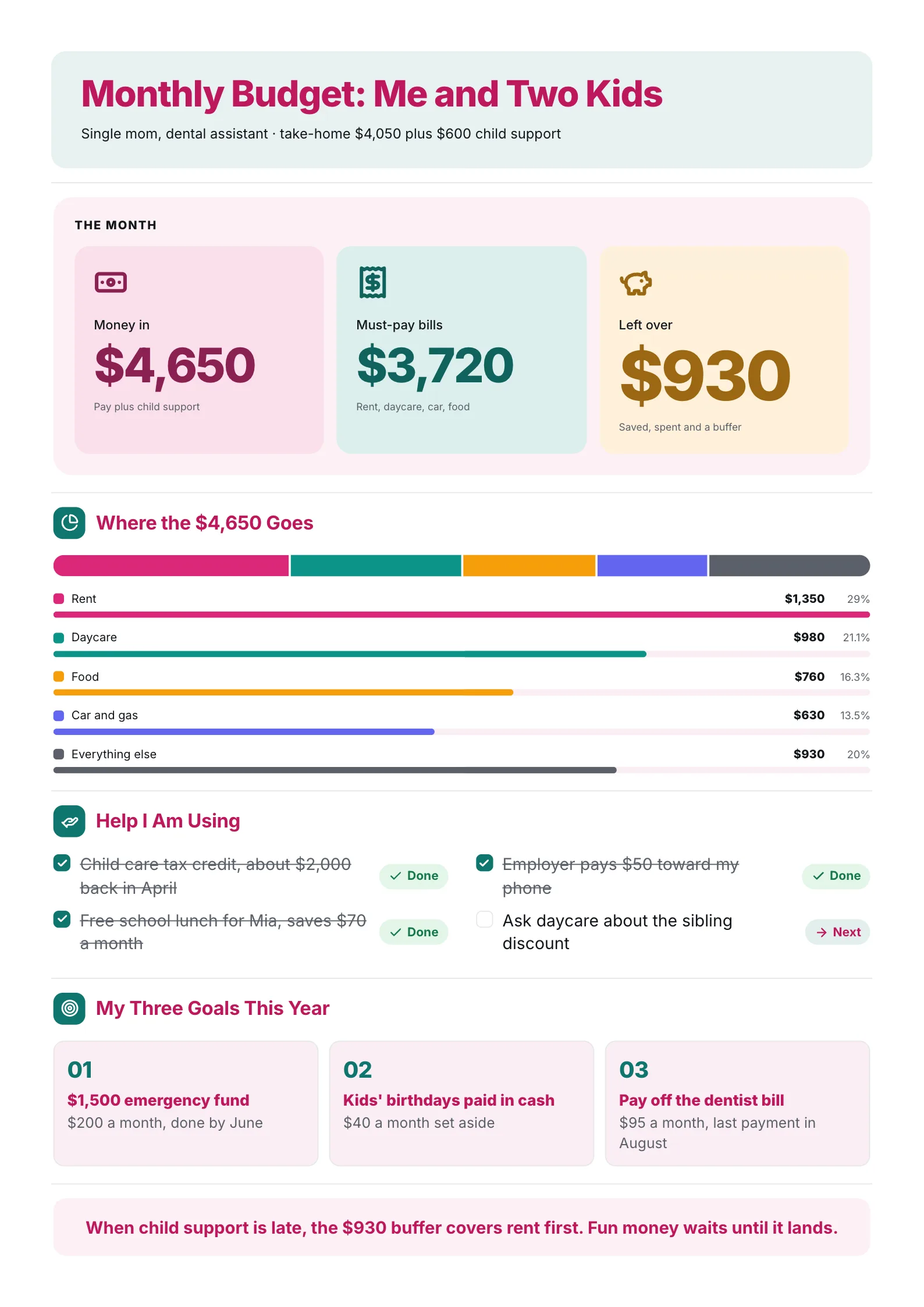 Personal Budget: Single Parent MonthlyEdit for free(opens in a new tab)
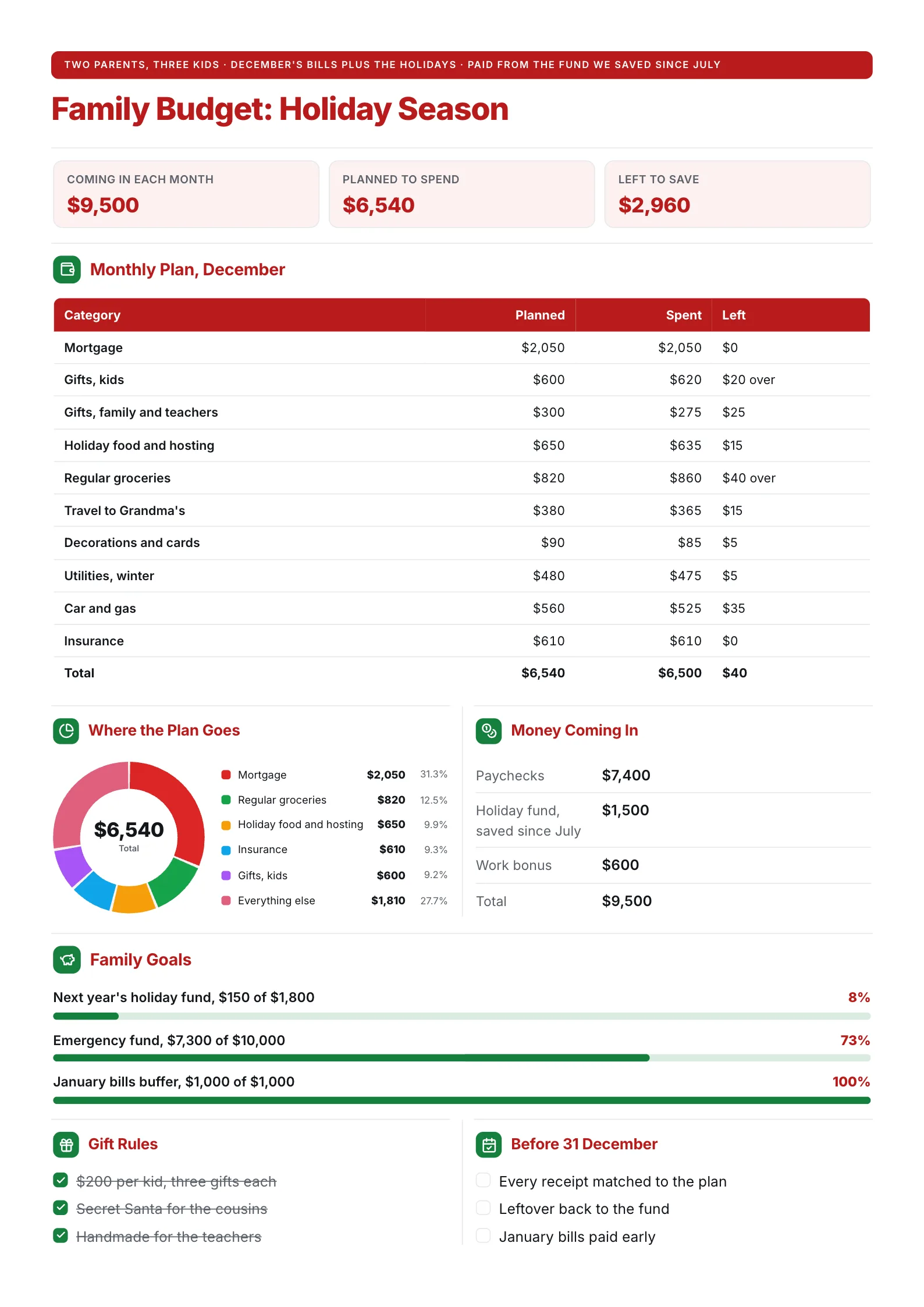 Family Budget: Holiday SeasonEdit for free(opens in a new tab)
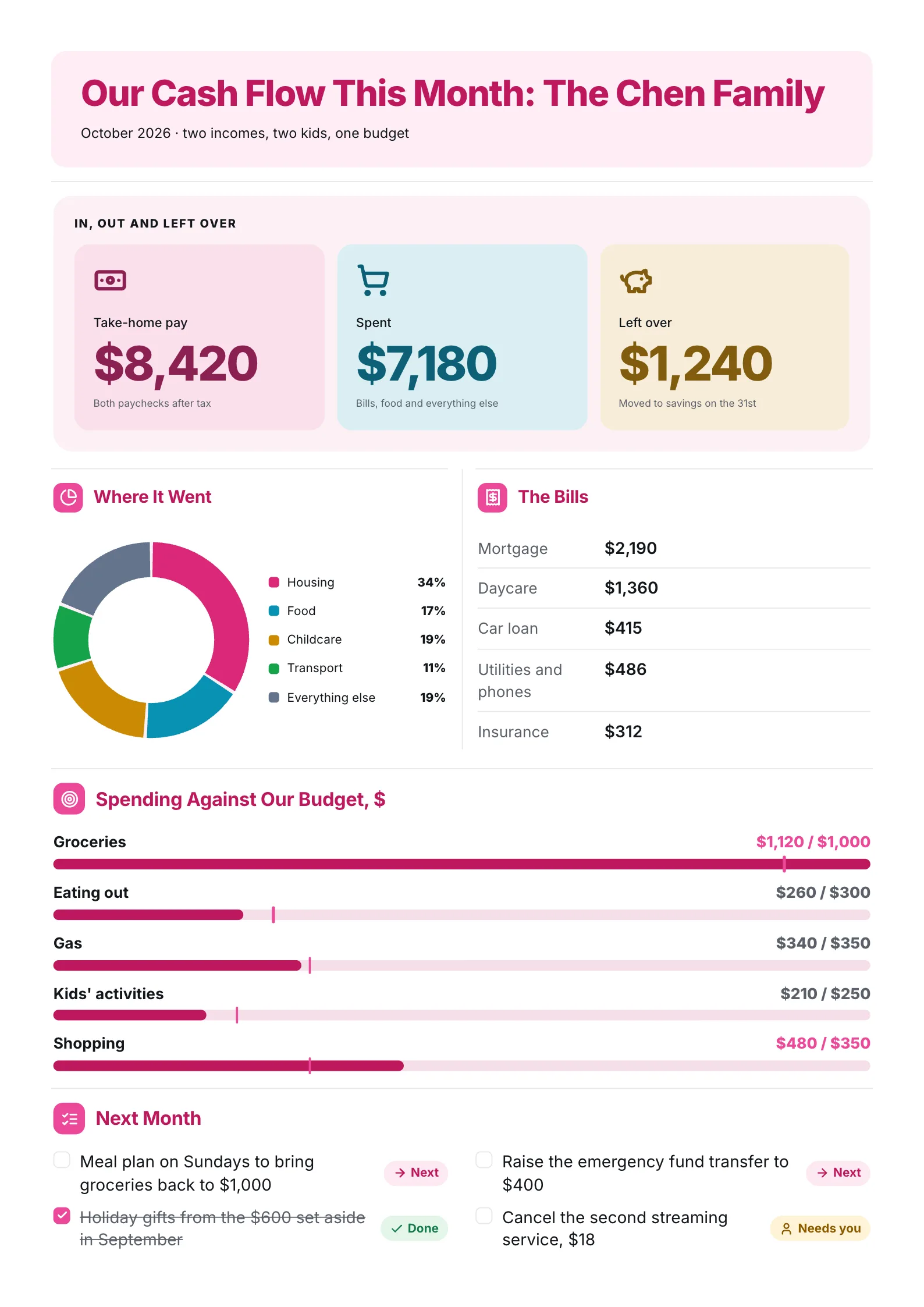 Cash Flow Summary: Household MonthEdit for free(opens in a new tab)
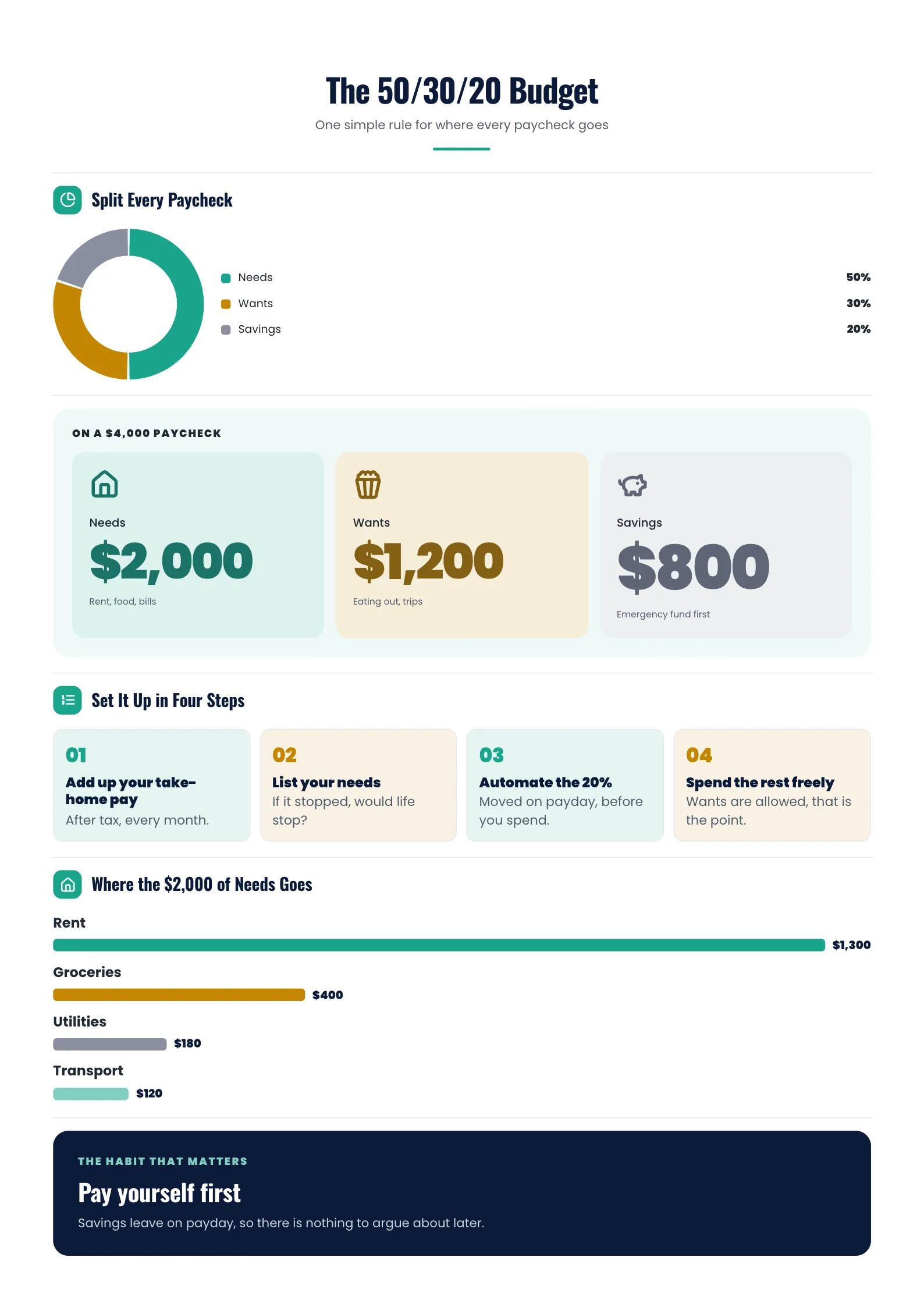 Budget InfographicEdit for free(opens in a new tab)
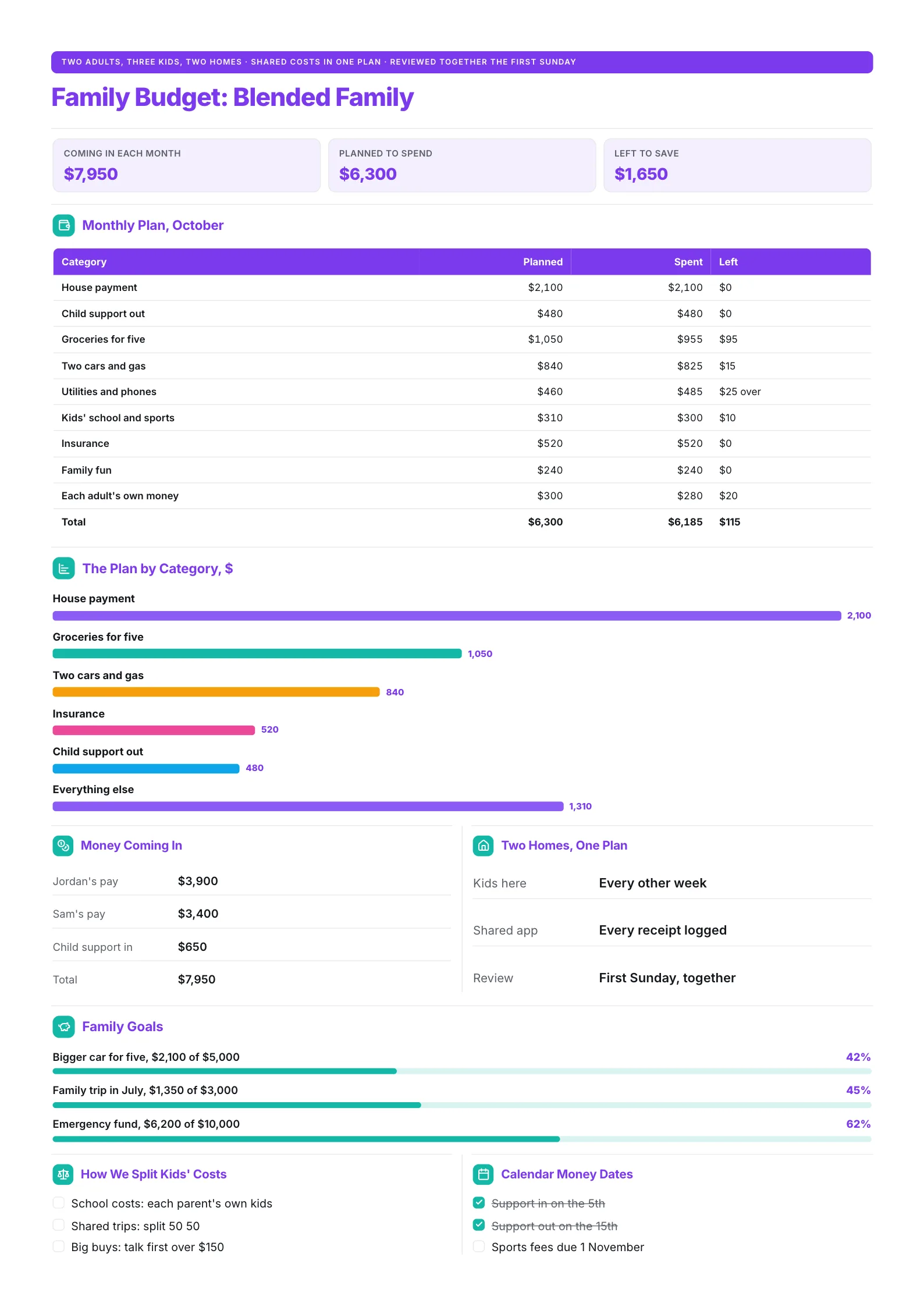 Family Budget: Blended FamilyEdit for free(opens in a new tab)
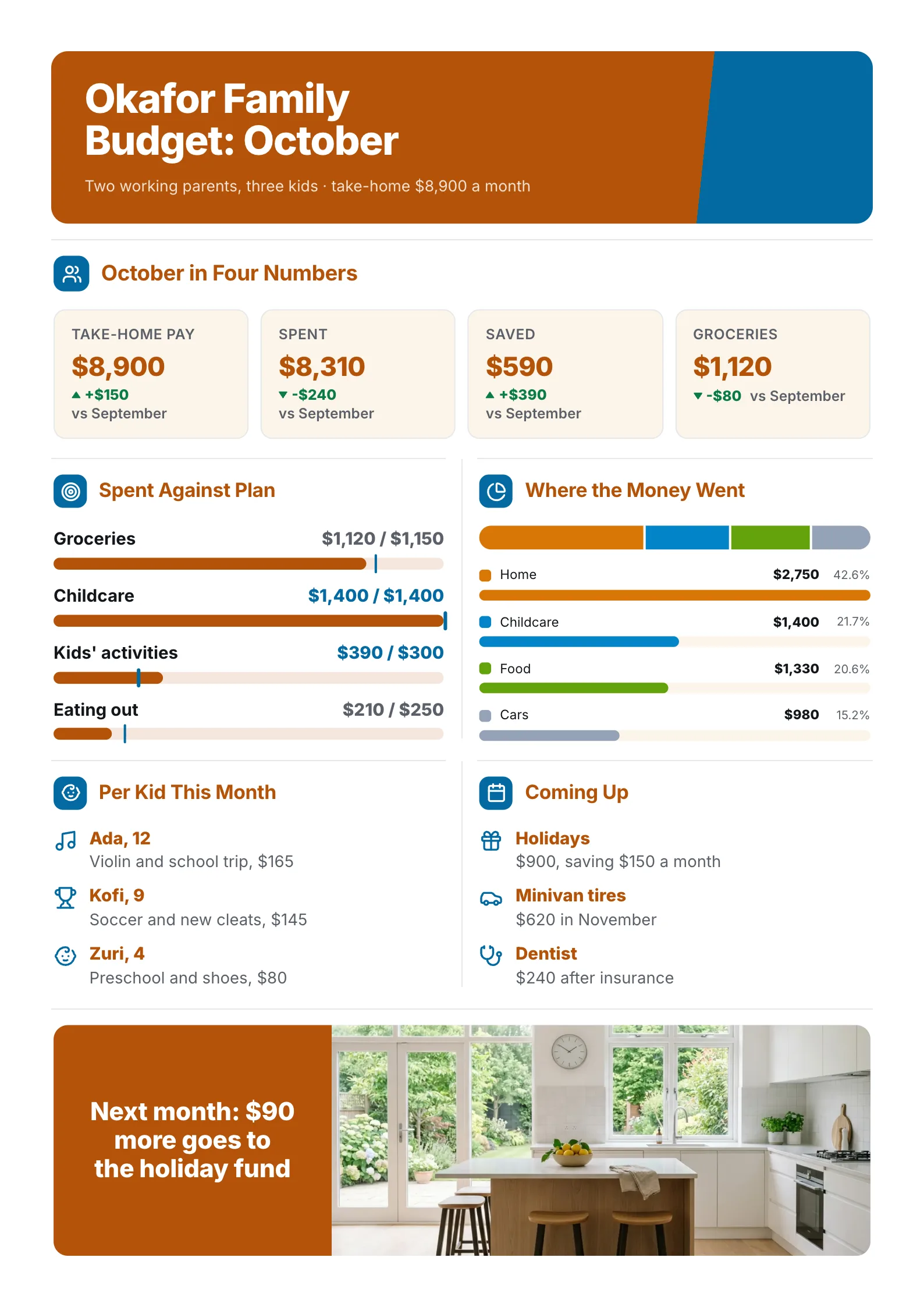 Personal Budget: Family of FiveEdit for free(opens in a new tab)
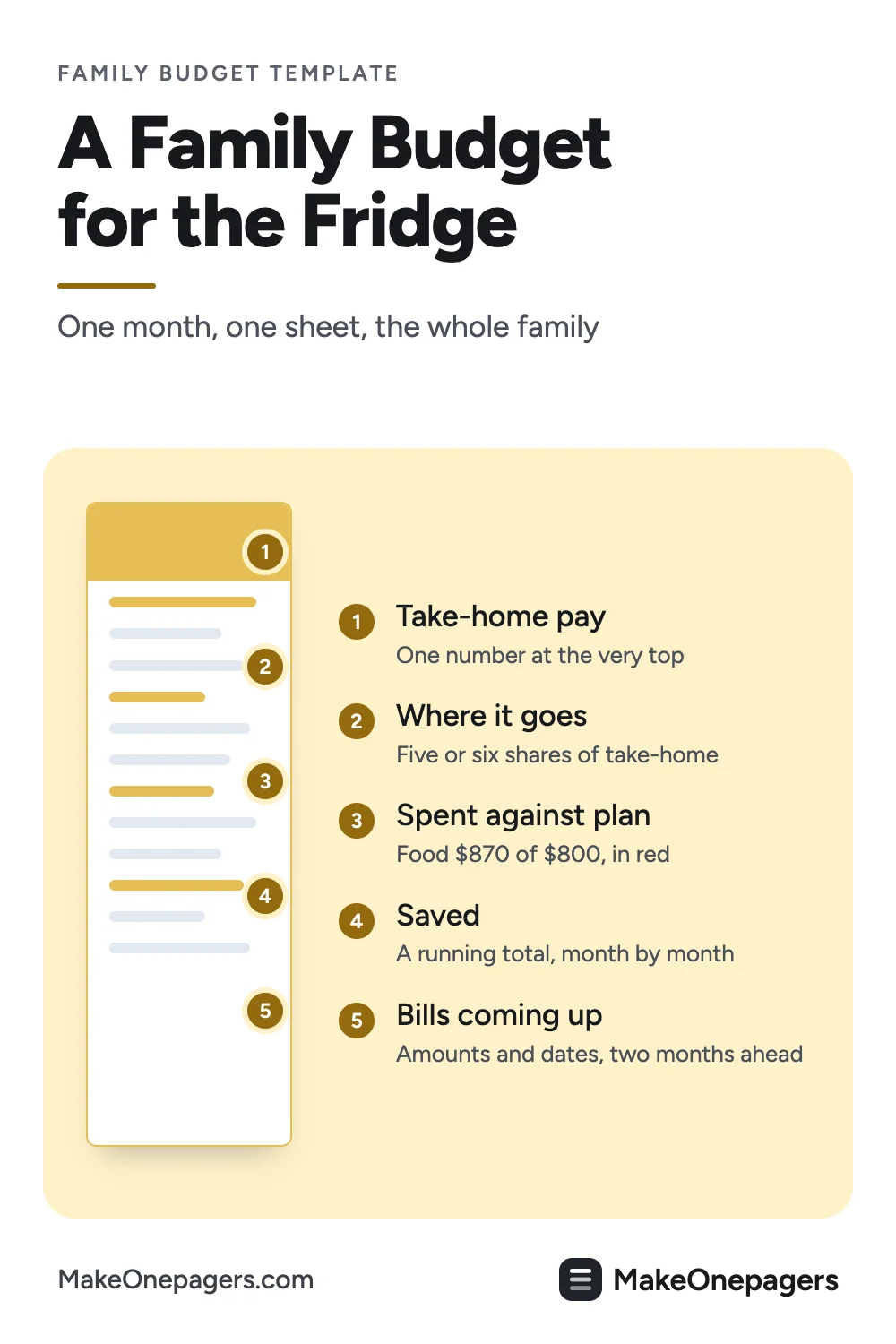
We made every example with MakeOnepagers, and you can open each one as a template and edit it for free.
What is a family budget?
A family budget is a plan for a household's income and spending over a month, written so that every adult, and older children, can follow it. It answers four questions:
- How much comes in after tax?
- Where is it going, and is that where we want it to go?
- Did we stay inside the plan this month, and where did we not?
- What is coming up that we need to save for?
Most families keep the detail in a spreadsheet or a banking app. That detail helps the person who manages the money, but everyone else never sees it. A one-sheet summary closes that gap for you.
The 6 parts of a family budget
- Take-home pay at the top, as one number. Every share below depends on it.
- Where it goes, as five or six categories with their share of take-home pay.
- Spent against plan for the categories that move month to month: food, transport, fun, bills.
- Savings, as a running total and a month-by-month line, so progress is visible.
- Next month's changes: two or three decisions, written as a checklist.
- Bills coming up, with amounts and dates, for the next two or three months.
A free family budget template
| Part | What to write, with an example |
|---|---|
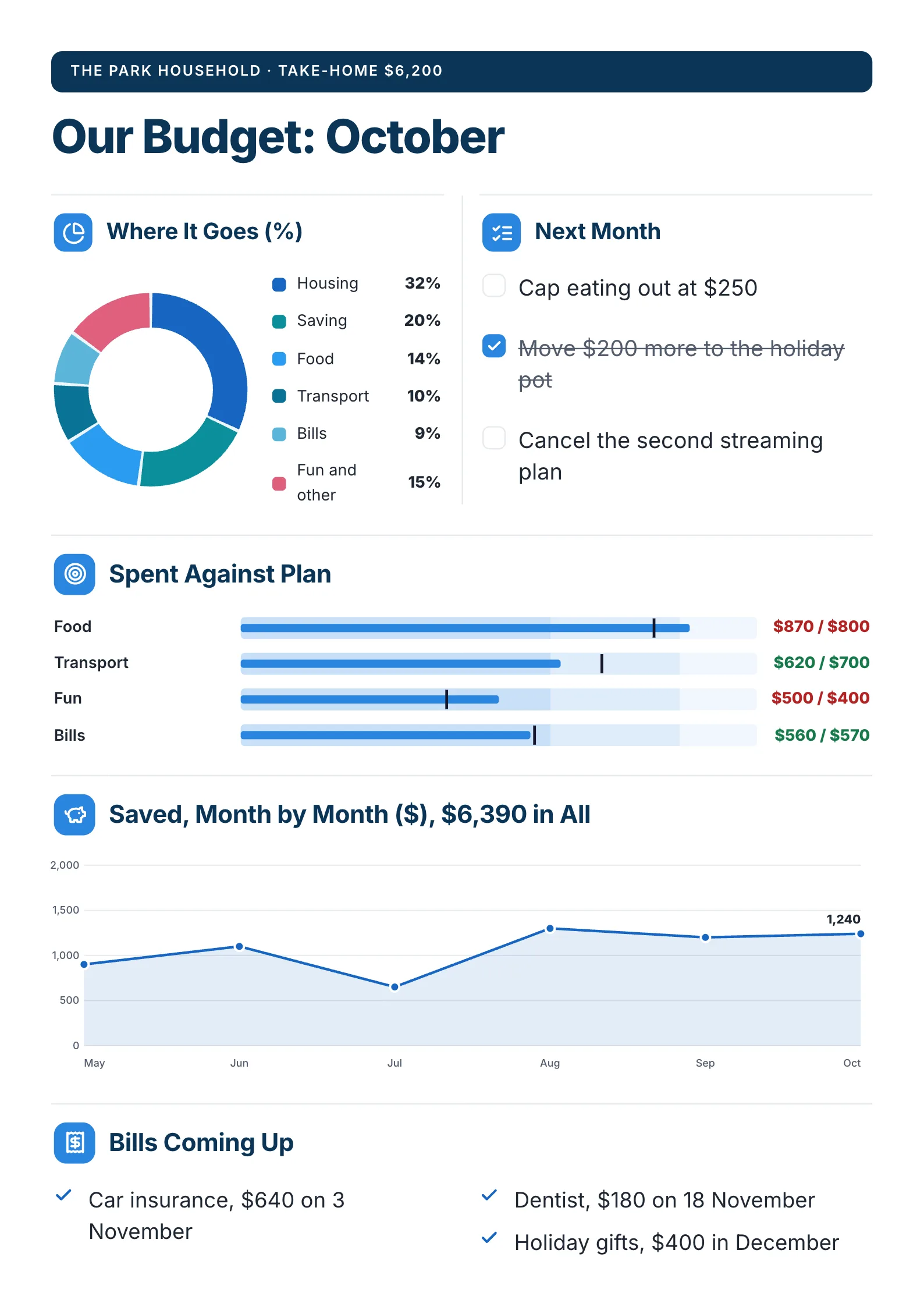
| Title | Household and month. The Park household, October |
| Take-home pay | $6,200 |
| Where it goes | 5 or 6 shares. Housing 32%, saving 20%, food 14%, transport 10%, bills 9%, fun and other 15% |
| Spent against plan | Category, spent, plan. Food $870 of $800 |
| Saved | Total and by month. $6,390 since May, $1,240 this month |
| Next month | 2 or 3 decisions. Cap eating out at $250 |
| Bills coming up | Amount and date. Car insurance, $640 on 3 November |
If you keep your numbers in Google Sheets or Excel, link this sheet to the totals there and update it once a month.
Family budget example: one household's October
 Edit this template
Here's an example monthly family budget. We made up the household and every figure.
What to copy:
- Take-home pay in the banner: $6,200. Every percentage below it is a share of that one number.
- Spent against plan in color. Food at $870 of $800 and fun at $500 of $400 show in red; transport at $620 of $700 and bills at $560 of $570 in green. Nobody needs to read the table to see where the month went wrong.
- Savings as a line, not a single total. The dip in July and the climb back in August tell a story a total cannot.
- Three changes for next month, one already ticked: move $200 more to the holiday pot.
- Bills coming up with dates: car insurance $640 on 3 November, dentist $180 on 18 November, holiday gifts $400 in December.
You can edit this personal budget template for free, type in your own take-home pay and categories, and print it for the fridge the same evening.
5 family budget examples
Here are five households, each with its own money problem. You'll see one income with three small children and a blended family across two homes. Then come a first baby, the weekly grocery shop and the back-to-school rush. Each one keeps the parts above, laid out around the question that family asks most.
1. One-income family budget
 Edit this template
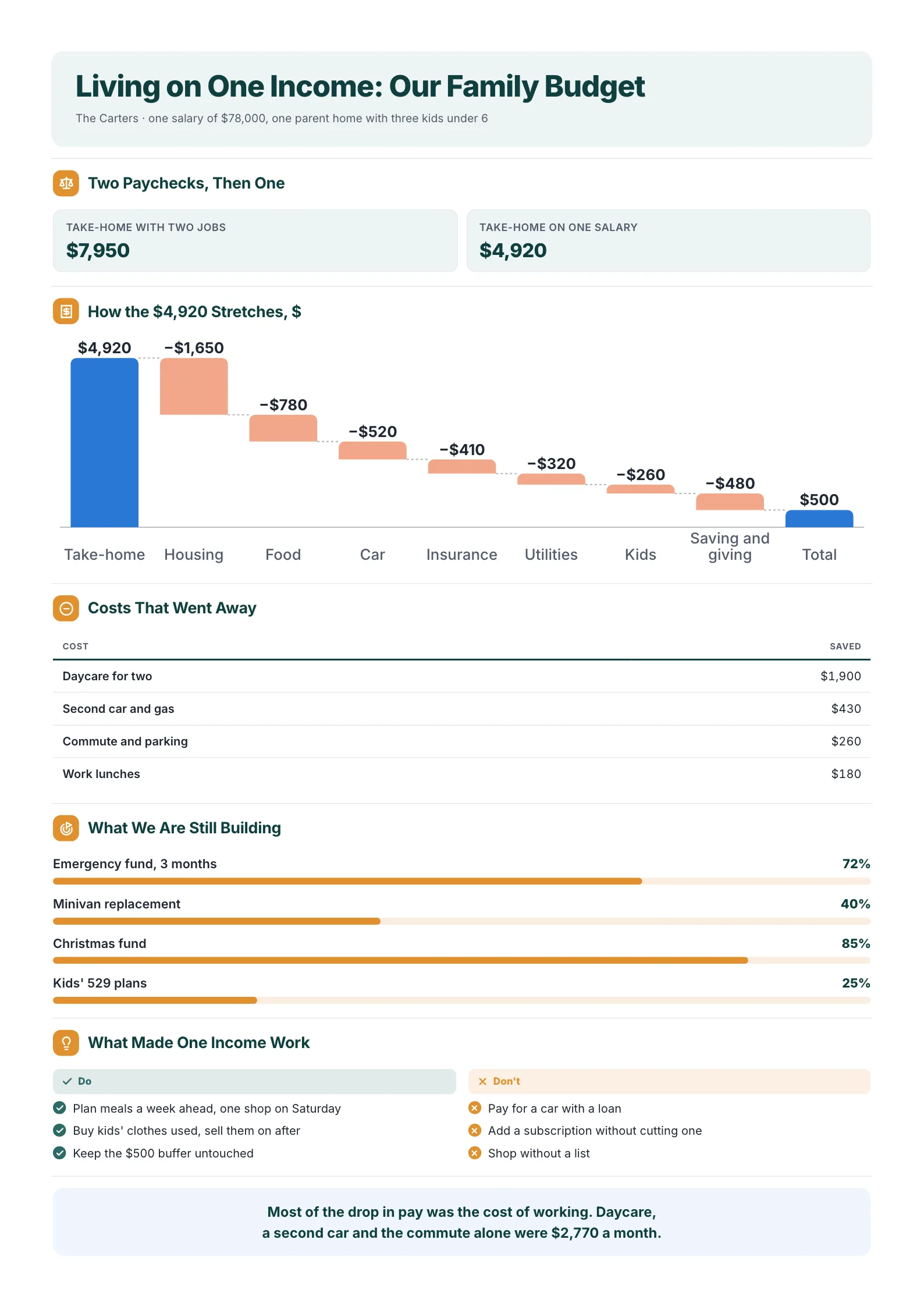
A family that went from two paychecks to one when a parent stayed home with three children under six.
What to copy:
- Before and after in one line. $7,950 against $4,920 is the whole story, so it goes first.
- The costs that went away, counted. Daycare, the second car, the commute and work lunches came to $2,770 a month, most of the drop in pay.
- A buffer with a number on it. The $500 left at the end of the waterfall is untouchable, and the sheet says so.
You can edit this one-income family budget template for free and put your own before and after numbers at the top where everyone sees them first.
2. Blended family budget
 Edit this template
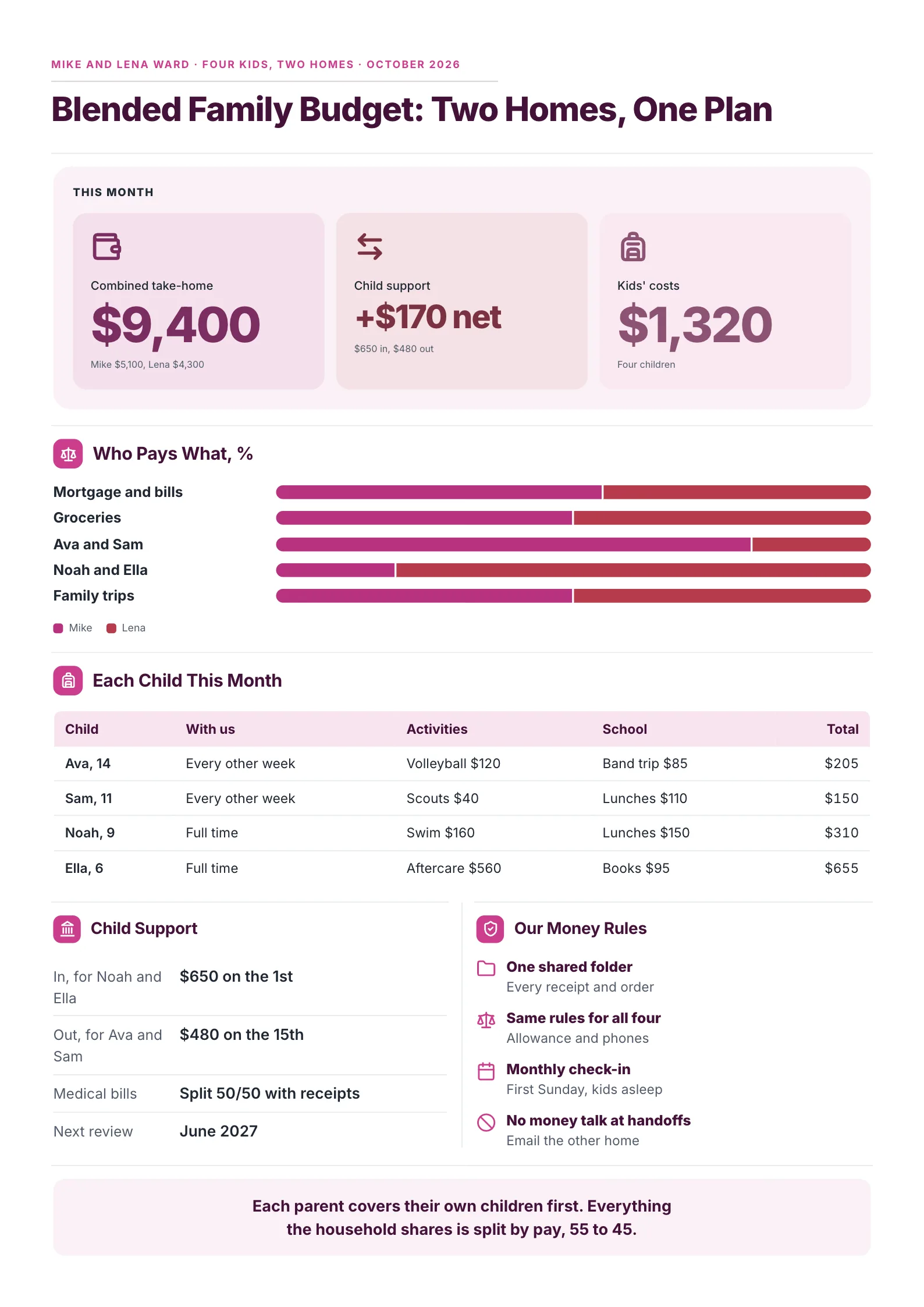
Two parents, four children and two homes, with child support coming in and going out.
What to copy:
- Who pays what, as shares. Household bills split 55 to 45 by pay; each parent covers most of their own children's costs.
- Every child on their own row, with the weeks they live in the home, so nobody feels counted twice or not at all.
- Rules that keep money out of handoffs. Questions go to email, never the driveway.
You can edit this blended family budget template for free.
3. New baby family budget
 Edit this template
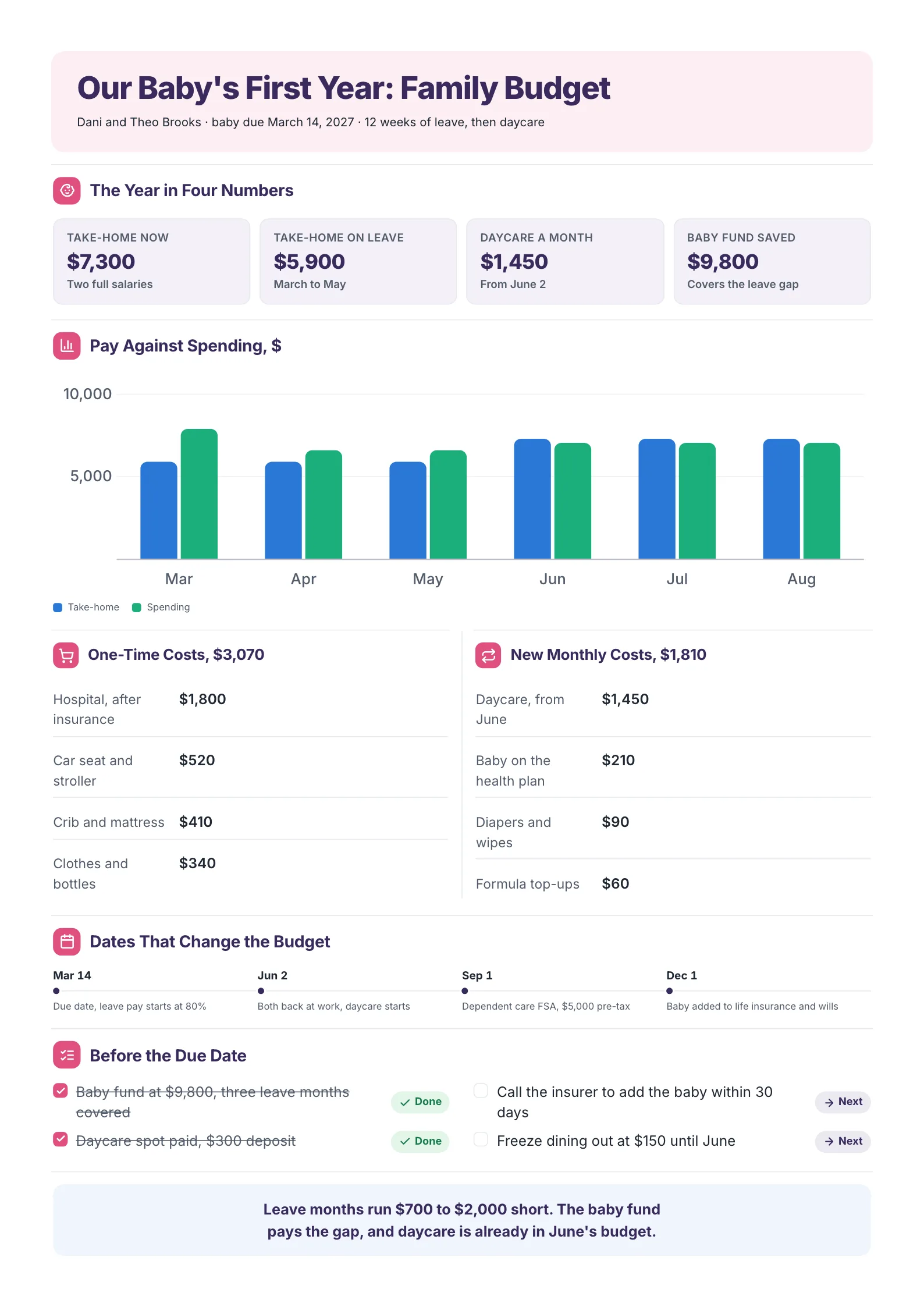
A couple planning the year before the due date, with twelve weeks of leave and daycare from June.
What to copy:
- The gap shown before it happens. The chart shows leave months running $700 to $2,000 short, and the $9,800 baby fund covers them.
- One-time and monthly costs kept apart, because a $410 crib and a $1,450 daycare bill are different kinds of money.
- Dates that change the budget, such as adding the baby to health insurance within 30 days.
You can edit this new baby family budget template for free.
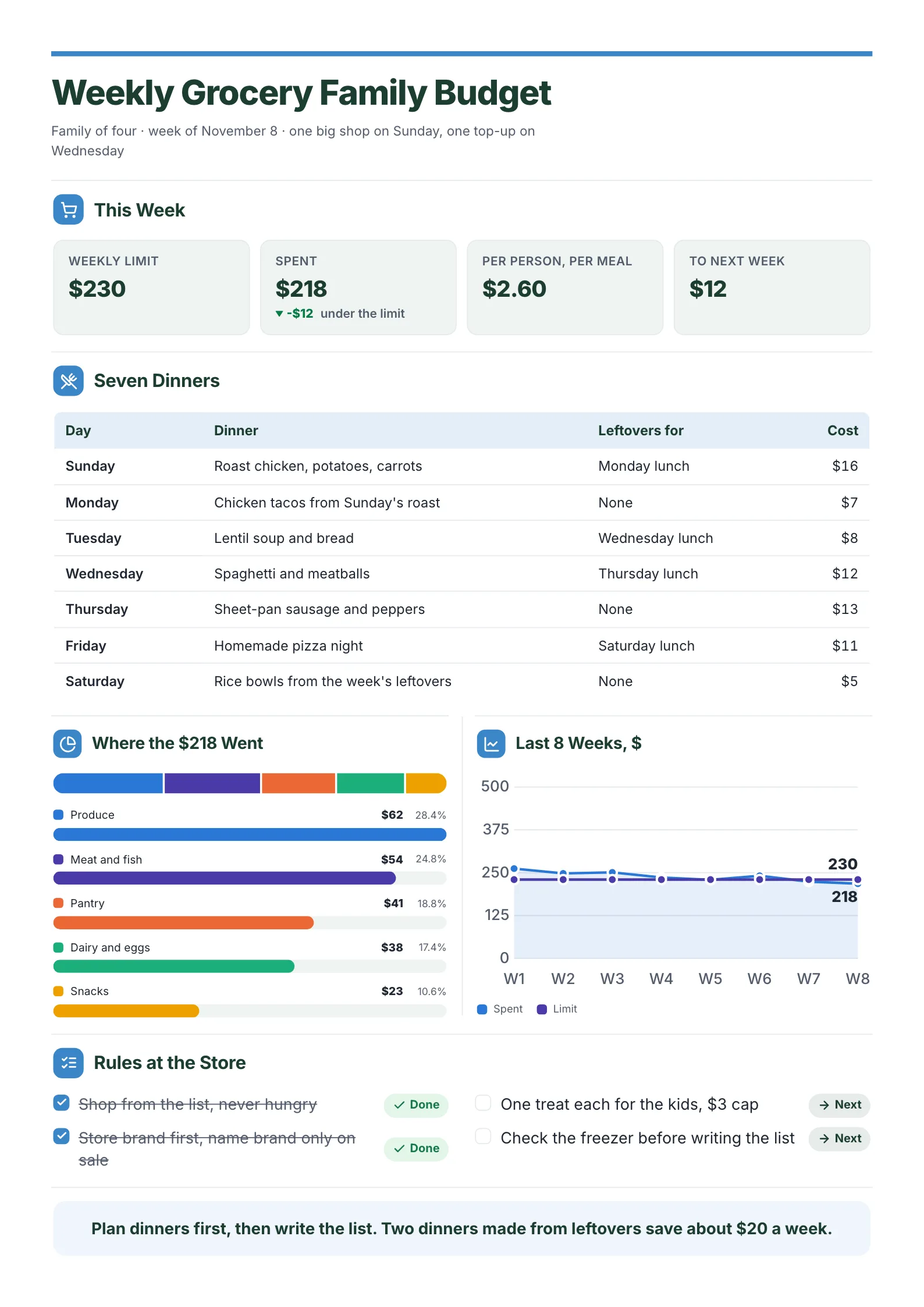
4. Weekly grocery family budget
 Edit this template
Food is the line most families can change fastest, so this one is planned a week at a time.
What to copy:
- Cost per person per meal. $2.60 is easier to judge than $218.
- Dinners planned before the list is written, with the leftovers each one makes for lunch the next day.
- Eight weeks on one line, so the trend toward the limit is visible.
Try it for one month. You can edit this weekly grocery family budget template for free.
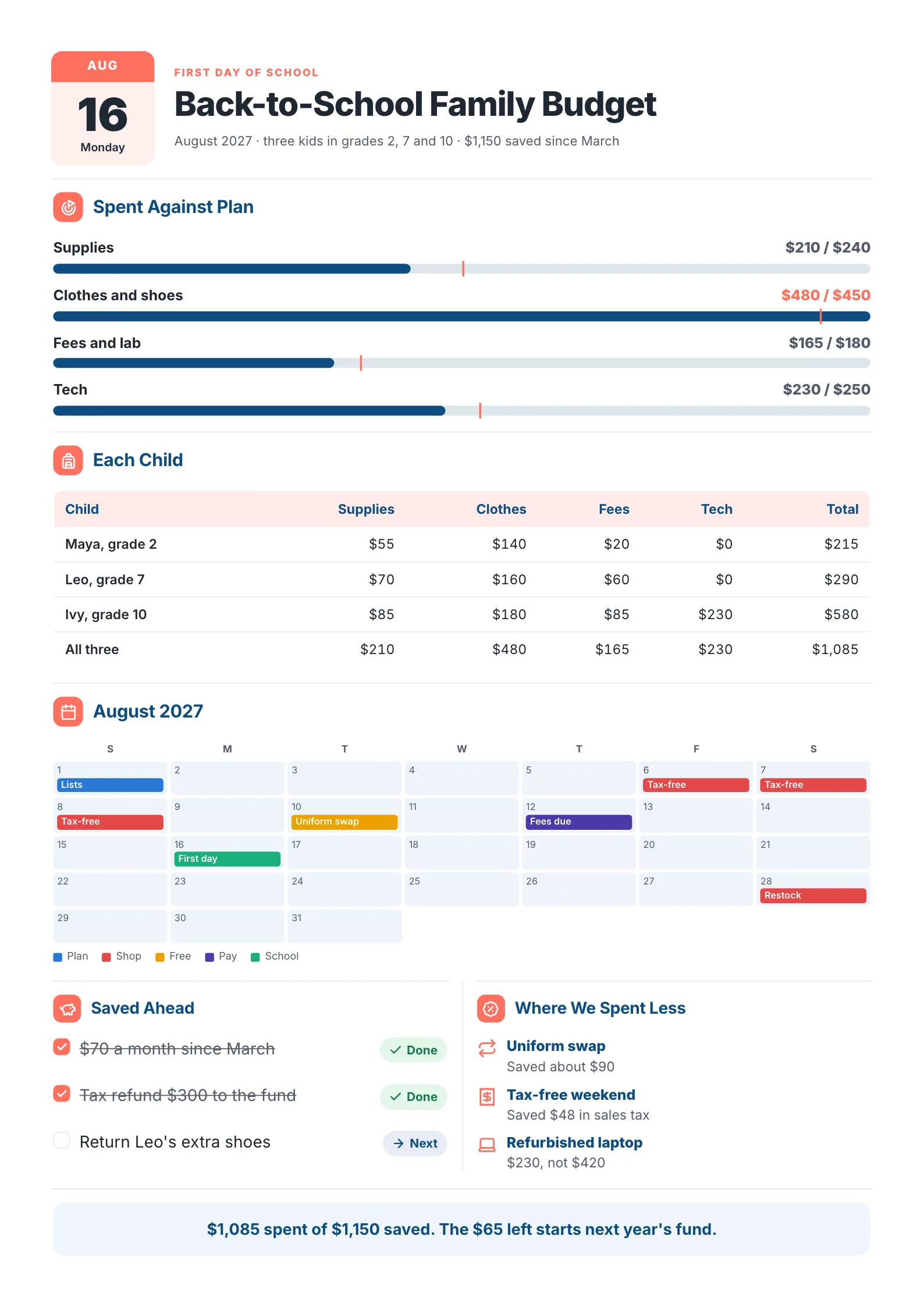
5. Back-to-school family budget
 Edit this template
The most expensive month of the school year for many families, planned from March.
What to copy:
- One row per child, so the high school student's laptop does not hide inside a family total.
- The calendar does the shopping plan. Lists on the 1st, the tax-free weekend from the 6th, the uniform swap on the 10th.
- What is left starts next year's fund: $65 here.
You can edit this back-to-school family budget template for free.
Worked example: setting the plan with the 50/30/20 rule
The 50/30/20 rule was popularized by Elizabeth Warren and Amelia Warren Tyagi in their 2005 book All Your Worth. It splits your take-home pay into needs (50%), wants (30%) and savings or debt repayment (20%). Treat it as a starting point you can adjust. Here it is applied to the example household's $6,200.
| Bucket | Share | Amount | In the example budget |
|---|---|---|---|
| Needs | 50% | $3,100 | Housing, food, transport, bills: 32 + 14 + 10 + 9 = 65% |
| Wants | 30% | $1,860 | Fun and other: 15% |
| Saving | 20% | $1,240 | Saving: 20% |
The example family saves exactly 20%, $1,240 this month. Its needs run at 65%, well over 50%, mostly because housing alone is 32%. That's common where rents are high. So don't pretend the rule fits. Look at which of your needs can move. Here food, at $70 over plan, is the one most within the family's control. That's why "cap eating out at $250" is first on next month's list.
A 20-minute monthly money check
- Update take-home pay if it changed.
- Pull the month's totals for each category from your bank or spreadsheet.
- Fill in spent against plan and color anything over in red.
- Add this month's savings to the line.
- Look ahead two months and list every bill over $100 with its date.
- Agree two or three changes as a family, write them as a checklist and print the new sheet.
Do it on the same day each month, such as the first weekend, and it becomes a habit for your family instead of a crisis.
Family budget mistakes
- Budgeting gross pay. Plan from what actually reaches your account after tax and deductions.
- Forgetting the lumpy bills. Car insurance, school trips, birthdays and holidays wreck a month that ignored them. List them ahead.
- Too many categories. Twenty lines become a chore. Five or six are enough on the sheet; the detail stays in the spreadsheet.
- A plan nobody else sees. If only one adult knows the numbers, the other cannot help keep them.
- No savings line. Seeing savings grow is the reward that keeps a family on a budget.
Budgeting with children
Older children can join the monthly check. Two things help:
- Give them one category to watch, such as fun or groceries, and let them suggest one change.
- Show the savings goal as a picture: a holiday, a bike, a trip. A goal they can see is easier to wait for.
Want to plan a whole year of household money, including net worth and long-term goals? A financial planning One-Pager puts that bigger picture on one sheet too.
Make your family budget
Open the free personal budget template and put in your household's numbers. Or drop your bank export or budget spreadsheet into the free AI One-Pager generator, and you'll get a finished family budget back to edit.
Frequently asked questions
What should a family budget include?
Start with your take-home pay and your spending by category as shares. Show each moving category against its plan, then your savings to date. End with two or three changes for next month and the bills coming up, with their dates.
Is the 50/30/20 rule right for every family?
No. It's a useful starting split of needs, wants and saving. But in many places, housing costs alone can push your needs well past 50%. Use it to see where you stand, then set your own targets.
Is there a family budget template in Google Sheets or Excel?
Yes, both include budget templates for tracking. Use one for your detail, then put the month's totals on a one-sheet summary the whole family can read.
How often should a family update its budget?
Update your summary once a month. If a category tends to run over, take a quick look at your spending once a week too.
Should couples keep one budget or two?
Either works if you can both see the same summary. Many couples keep one shared budget for the household's bills and food, plus their savings. Each person also keeps a small personal amount that the other doesn't question. Put the shared plan on the sheet. Then list each person's personal amount as one line, so you've both agreed to it out in the open.
What if we go over budget in a month?
Write down why on your sheet, beside the red number. A one-off, such as a car repair, needs no change to the plan. If a category runs over three months in a row, you need a new plan or a cut somewhere else, agreed at your monthly check.




