Contract Summary Template: What 8 SEC Filings Teach About Summarizing a Contract
Free contract summary template built from 8 summaries public companies filed with the SEC in Oct 2026: what they lead with and what they flag.

A good contract summary template fits one agreement onto one sheet: who signed, when, the money, how long it runs, how it ends and where the full text lives. You don't have to invent the format, because public companies write summaries like this all the time. When a US public company signs a major contract, the SEC requires it to describe the deal in a Form 8-K within days. We read 8 of those summaries, filed in October 2026, and built the template below from what they include. Start from a free one pager template.
One‑Pager examples
Real One-Pagers made with MakeOnepagers. Open any one to edit it as your own.
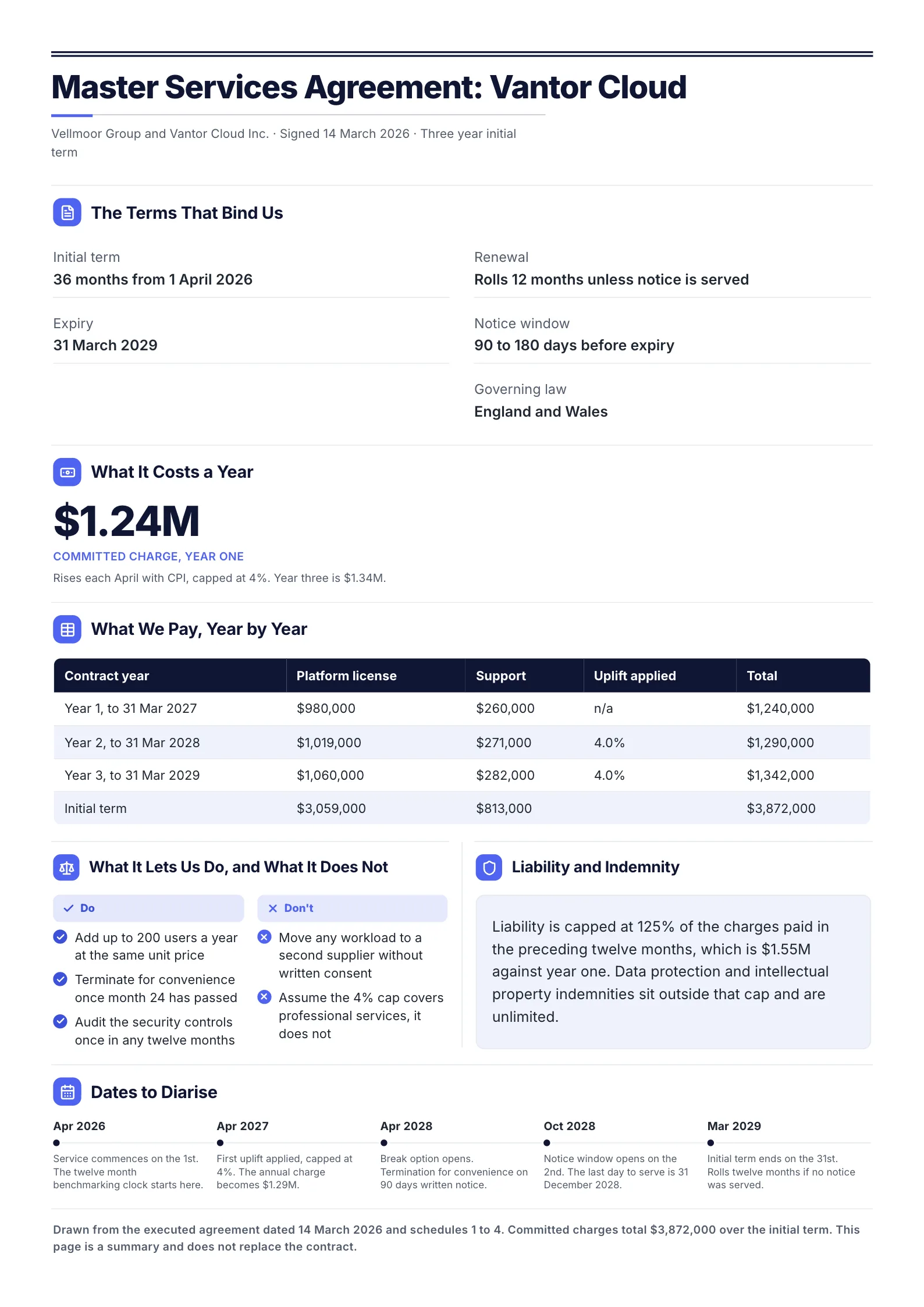 Contract SummaryEdit for free(opens in a new tab)
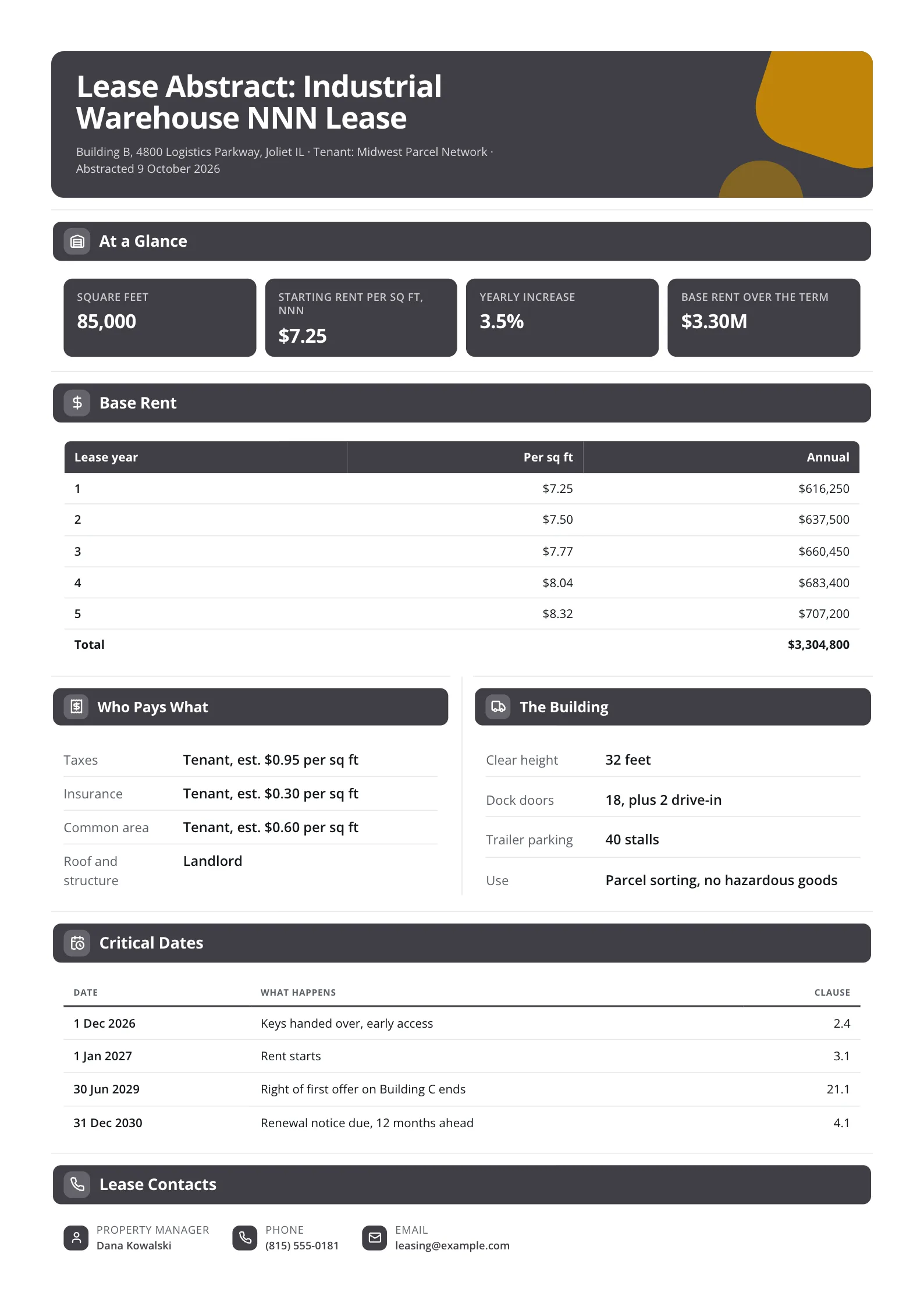 Lease Abstract: Industrial Warehouse NNN LeaseEdit for free(opens in a new tab)
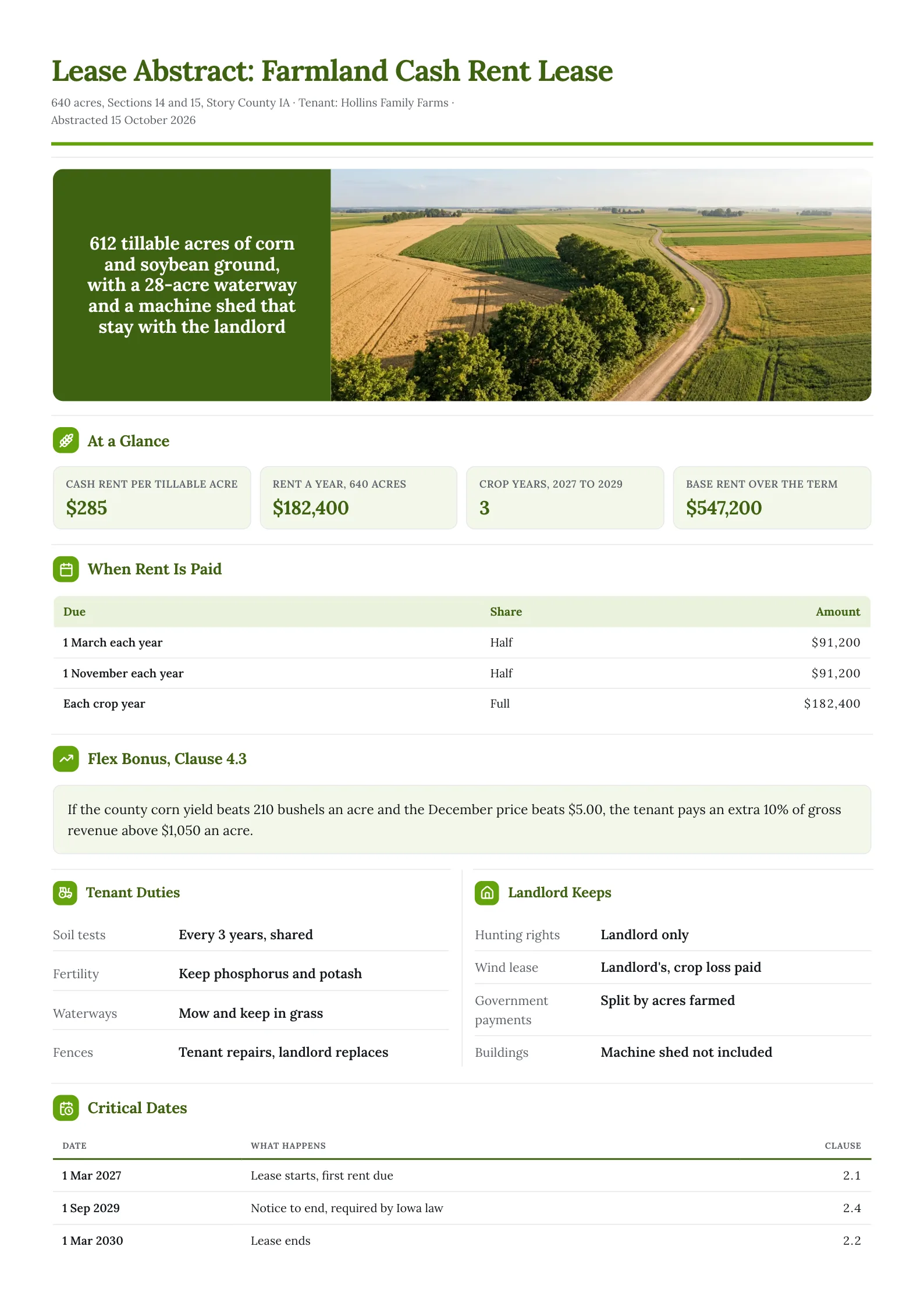 Lease Abstract: Farmland Cash Rent LeaseEdit for free(opens in a new tab)
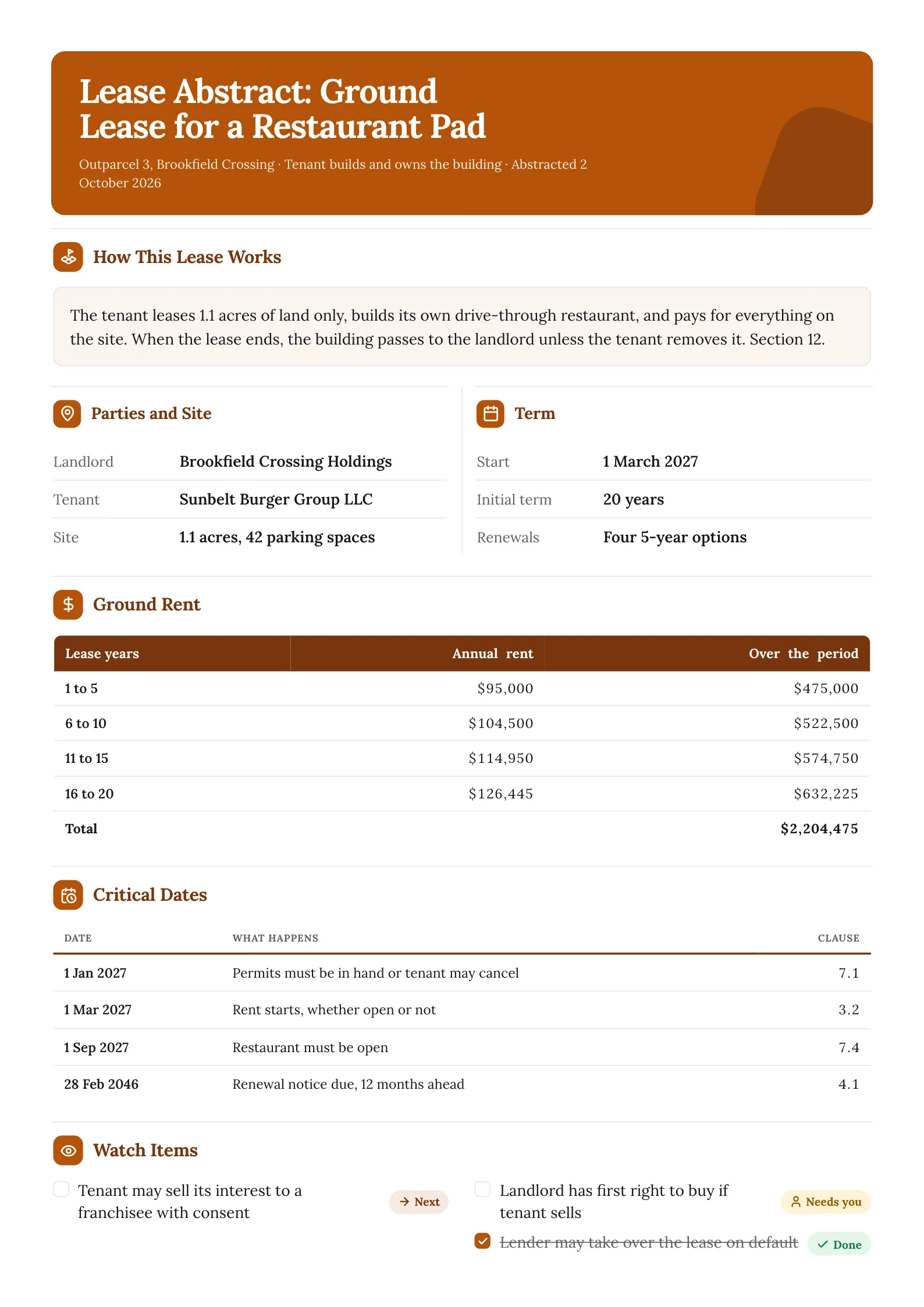 Lease Abstract: Ground Lease for a Restaurant PadEdit for free(opens in a new tab)
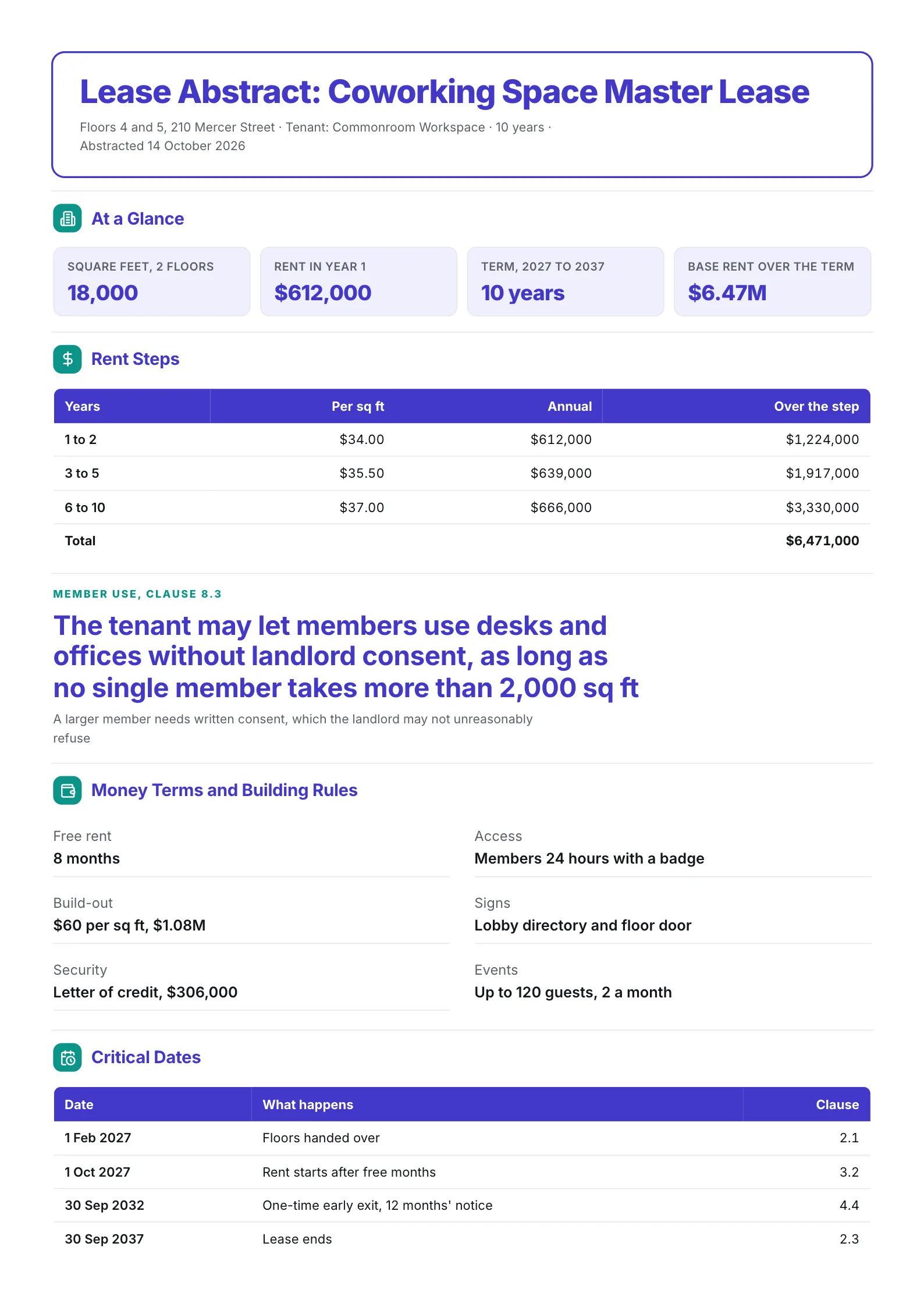 Lease Abstract: Coworking Space Master LeaseEdit for free(opens in a new tab)
 Solution Brief: Contract Review Software for In-House LegalEdit for free(opens in a new tab)
Below you'll find the 8 summaries, the template you can copy, and how to flag the parts that can cost you later.
The 8 summaries we read
The SEC's Form 8-K instructions set the rule under Item 1.01. A company must give "the date on which the agreement was entered into or amended, the identity of the parties" and any material relationship with them. It must also give "a brief description of the terms and conditions of the agreement or amendment that are material."
On October 26, 2026, we searched EDGAR, the SEC's filing database, for 8-K reports filed from October 1 to 23 that use Item 1.01. That found 679 filings. About 235 report little else alongside the contract, only routine announcements or exhibits. We opened 31 and kept 8 that summarize the kinds of contracts most teams deal with: a lease, an employment agreement, a channel deal, purchases and sales, and a joint venture. We left out loans and stock offerings, since you'd usually leave those to a lawyer.
| Company | The contract | Words | The headline terms |
|---|---|---|---|
| Entravision | Station affiliation agreement, amended | 128 | A new end date, March 31, 2027, with 3-month renewals |
| Healthcare Services Group | Purchase of NEXDINE Hospitality | 179 | About $93.5 million, plus payments tied to results |
| Ultragenyx | Sale of an FDA priority review voucher | 257 | $210 million in cash, with 20% owed to the NIH |
| Bolt Biotherapeutics | Office and lab lease, second amendment | 308 | $1.0 million paid and an early end date |
| Leidos | Joint venture agreement | 321 | Who controls the board |
| The Joint Corp | Buying back regional developer rights in Texas | 348 | $8.0 million now, up to $2.0 million more |
| Stoneridge | Employment agreement for a vice president | 473 | Salary of €330,000 and a 50% bonus target |
| Rocky Mountain Chocolate Factory | Sale and leaseback of its headquarters | 490 | A $6.6 million sale and a 10-year lease |
Word counts are the Item 1.01 section only, without the signature block or the new executive's biography.
What the 8 summaries do
The contract, the parties and the date come first, so you know what you're reading. 7 of the 8 give a date in the opening sentence. Leidos refers back to a "Closing Date" defined elsewhere, and Ultragenyx calls the other side only "the buyer."
The money comes early. 5 of the 8 state an amount within the first few sentences. Entravision and Leidos lead with what matters more in those deals, the new end date and who controls the board, and The Joint Corp holds its price until well into the summary.
The ongoing deals say how they end. Entravision's runs to March 31, 2027 and renews for three months at a time "unless either party gives 30 days' notice." Bolt's lease now ends December 31, 2027, or earlier if the company closes a financing or sale. Leidos gets "certain liquidity demand exit rights" after seven years.
They end with the same caution you should use. All 8 say the description "does not purport to be complete" and point to the full contract. Five attach it as an exhibit. Three say it will be filed with the next annual report.
Flag the money that can move later
This is the part your own summary needs most, and the filings show why. 6 of the 8 include money that depends on something that hasn't happened yet:
- Payments tied to results. The Joint Corp may pay up to $2.0 million more if Texas sales targets are met over two years. Healthcare Services Group owes "contingent consideration" if performance conditions are met.
- A payment on a future deal. Bolt owes its landlord another $4.5 million if it closes a financing or sale.
- A buyback. If Rocky Mountain Chocolate Factory changes control, the landlord can make it buy the building back for the greater of $6.93 million or its appraised value.
- A share owed to someone else. Ultragenyx must pay 20% of the $210 million to the NIH under an older license.
- Money to pay back. Stoneridge's new vice president must repay a €50,000 sign-on bonus on resigning before November 2, 2027.
In your summary, give these their own section. Write the trigger, the amount and the date it could happen. If your reader only sees the headline number, they'll miss what you owe later.
Say who the other side is
The SEC asks for "any material relationship" with the other party, and three summaries address it. Entravision notes that TelevisaUnivision owns about 10% of its stock. Rocky Mountain Chocolate Factory sold its building to a company "controlled by the family of" its interim CEO and says an independent appraisal supported the price. Stoneridge states there are "no family relationships" with its new executive.
Your summary probably won't need SEC language, but you'll want the habit. If the other side is your shareholder, a relative, a former employee or your biggest customer, tell your reader in one line.
Skip "customary"
5 of the 8 summaries describe some terms as "customary" or "typical" without saying what they are. That works in a filing, where investors get the full contract as an exhibit, now or with a later report. In a summary for your own team, "customary termination provisions" doesn't tell you when you can get out. Write the actual notice period, fee or condition so your team can act on it.
The contract summary template
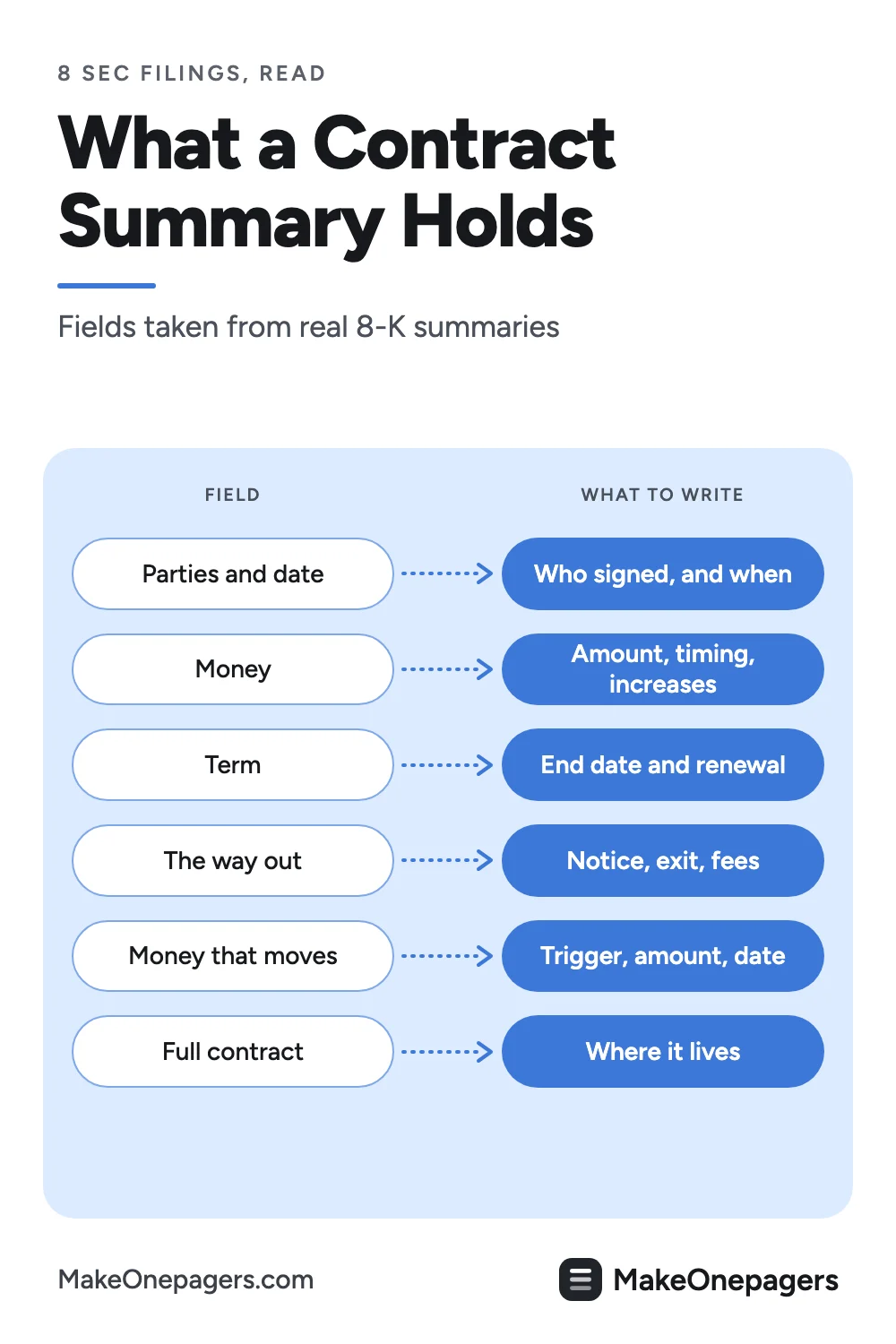
Copy these fields into your doc, spreadsheet or design. Most come straight from the 8 filings. We added two for your own use: who signed for each party, and the clause number beside each key date.
| Field | What to write |
|---|---|
| Contract | Its name and type, and whether it's new or an amendment |
| Parties | Every party by name, and who signed for each |
| Date signed and start date | Both, if they differ |
| Money | The amount, when it's paid and any yearly increase |
| Term | The end date and how it renews |
| How it ends | Notice periods, early exit rights and any fee for leaving |
| Money that can move later | Each trigger, amount and possible date |
| The other side | Any relationship beyond this contract |
| Key dates | Every date someone must act on, with the clause number |
| Where the full contract lives | A link or file location, and "this summary does not replace the contract" |
Keep yours short. The 8 filings run 128 to 490 words, and the median is about 315. For one contract, that gives you room for every field above.
Track many contracts in one register
When you have more than a handful of contracts, add a register to your summaries: one row per contract with the counterparty, annual value, end date, notice deadline and owner. Sort it by notice deadline, so your next decision is always at the top, and link each row to that contract's full summary.
What the finished summary looks like
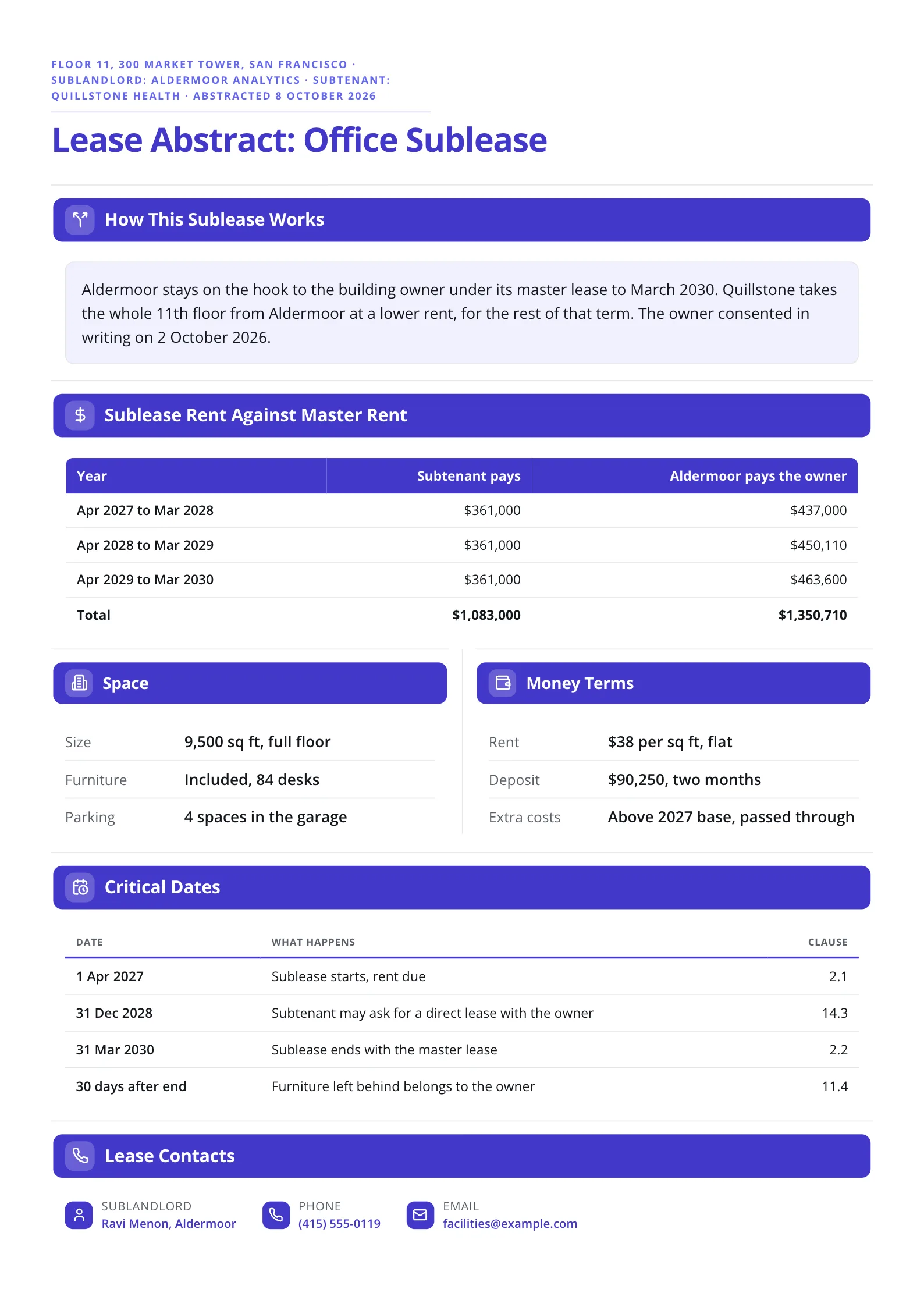 Edit this template
Sample names and figures. It names both parties and explains the deal in three sentences, and each key date points to its clause, the way an 8-K points to its exhibit.
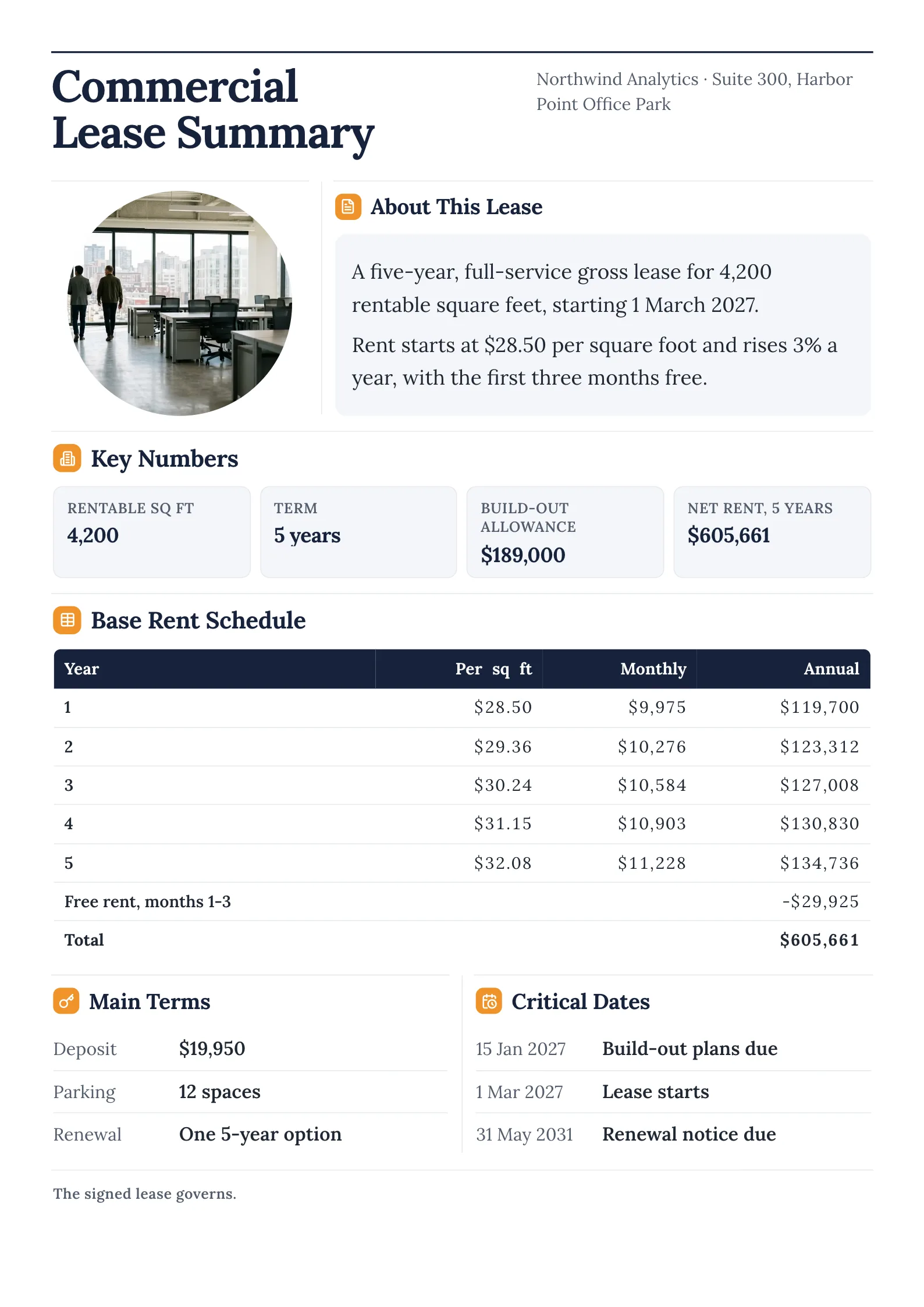 Edit this template
Sample names and figures. The money is up front, the yearly increases are spelled out, and it ends by saying the signed lease governs.
A lease summary, often called a lease abstract, is a common kind of contract summary. Both designs above are lease summaries, and you can adapt either to any agreement by renaming its sections. You'll find more on our lease abstract template post.
Questions people ask about contract summaries
How long should a contract summary be?
As short as your deal allows. The SEC summaries we read run 128 to 490 words, and the longest covers two agreements at once. One sheet is enough for most of the contracts you'll summarize.
Who should write the contract summary?
You, if you negotiated the deal, or someone who reads the whole contract. Then ask the people who'll live with it, like your finance and operations teams, to check it answers their questions.
Can I use a contract summary instead of the contract?
No. Every one of the 8 filings says the summary isn't complete and points to the full text. Put the same line on yours, with a link to your signed copy.
Where can I find real contract summaries to learn from?
Search EDGAR at sec.gov for 8-K filings with Item 1.01. Each one summarizes a contract a public company just signed, and many attach the full contract for you to compare.
Make your contract summary
Start from a design that already gives you places for the parties, the money, the dates and the way out. Browse every summary design in MakeOnepagers, or turn your contract notes into a first draft with our One-Pager maker (free for 7 days).




