BlogGuide
Leave Behind One Pager: 3 Real Ones Read, and What Works
A leave behind one pager for funder, legislator and pitch meetings: 3 real leave-behinds measured, 4 guides compared, a template and an example.

By MakeOnepagers Team
Updated · 7 min read
A leave behind one pager is the sheet you hand over at the end of a meeting: who you are, the problem, the evidence, exactly what you are asking for, and who to call. It matters because the person you met is often not the person who decides. A legislative staffer briefs the member; a program officer briefs the foundation board; a development executive pitches your idea to their boss. Your leave-behind is what they carry into that second meeting. We read 3 real leave-behinds and 4 published guides on 12 October 2026, measured each leave-behind, and built the template below from what the best one does.
One‑Pager examples
Real One-Pagers made with MakeOnepagers. Open any one to edit it as your own.
 Nonprofit Donor AppealEdit for free(opens in a new tab)
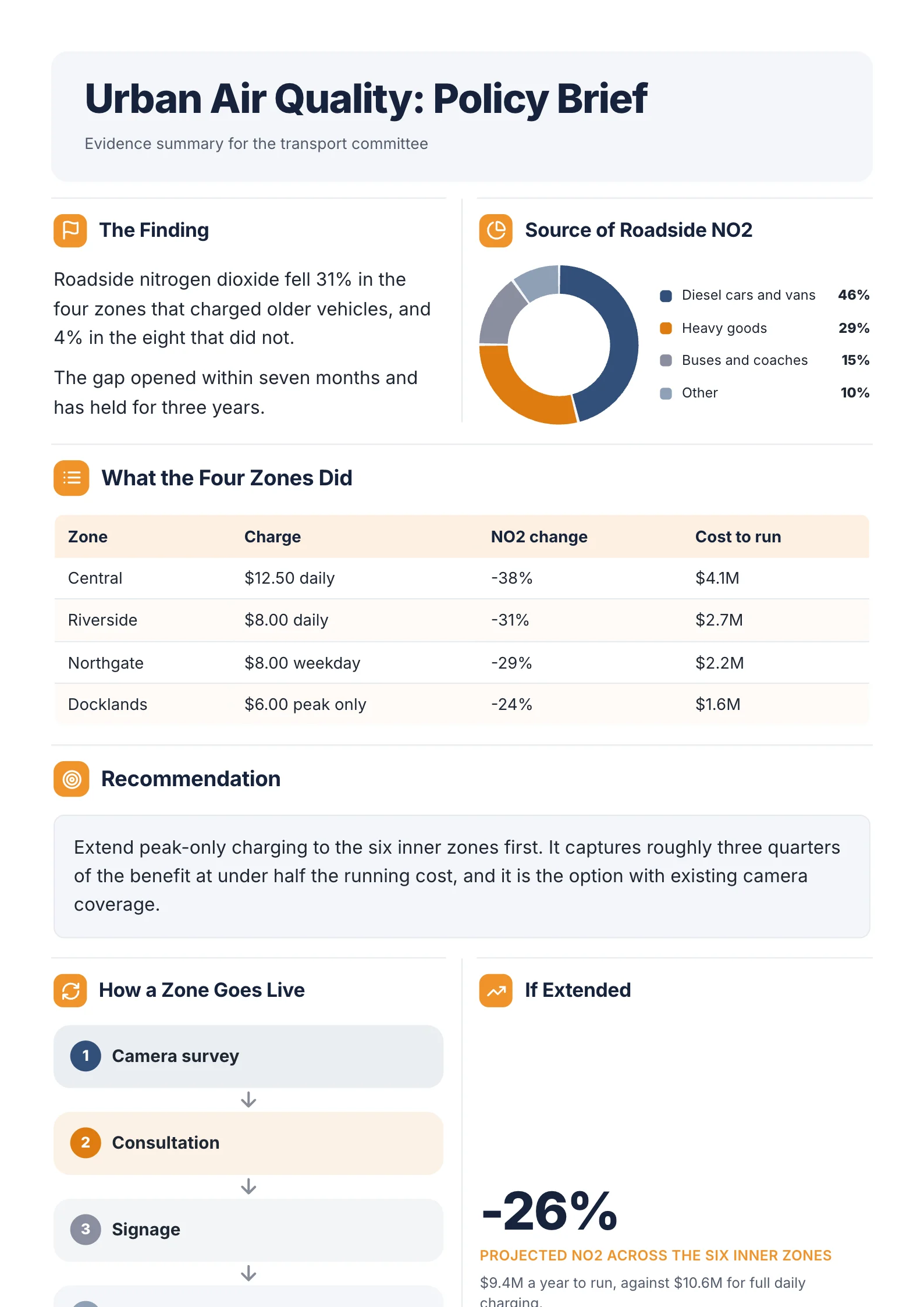 Policy BriefEdit for free(opens in a new tab)
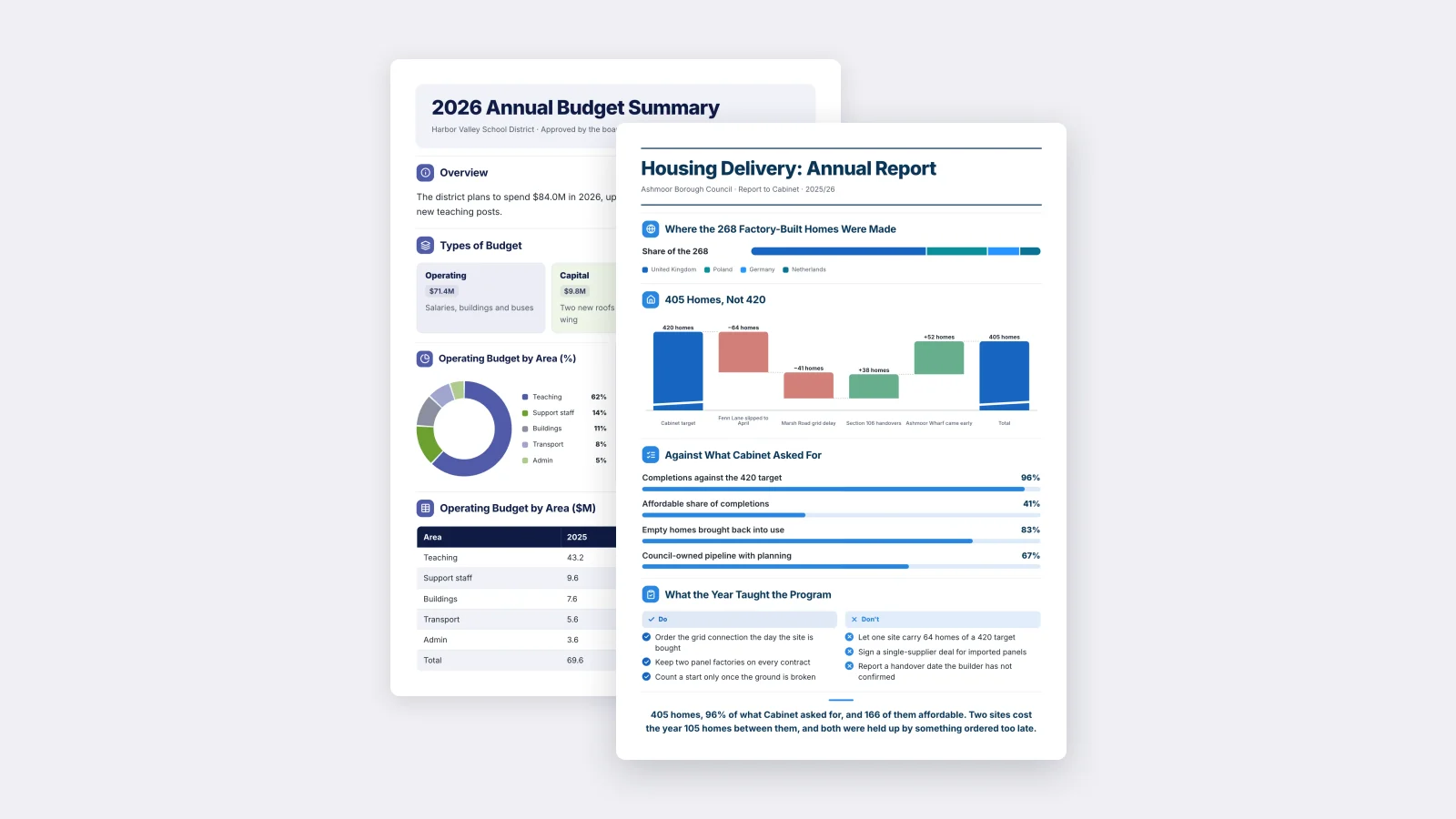
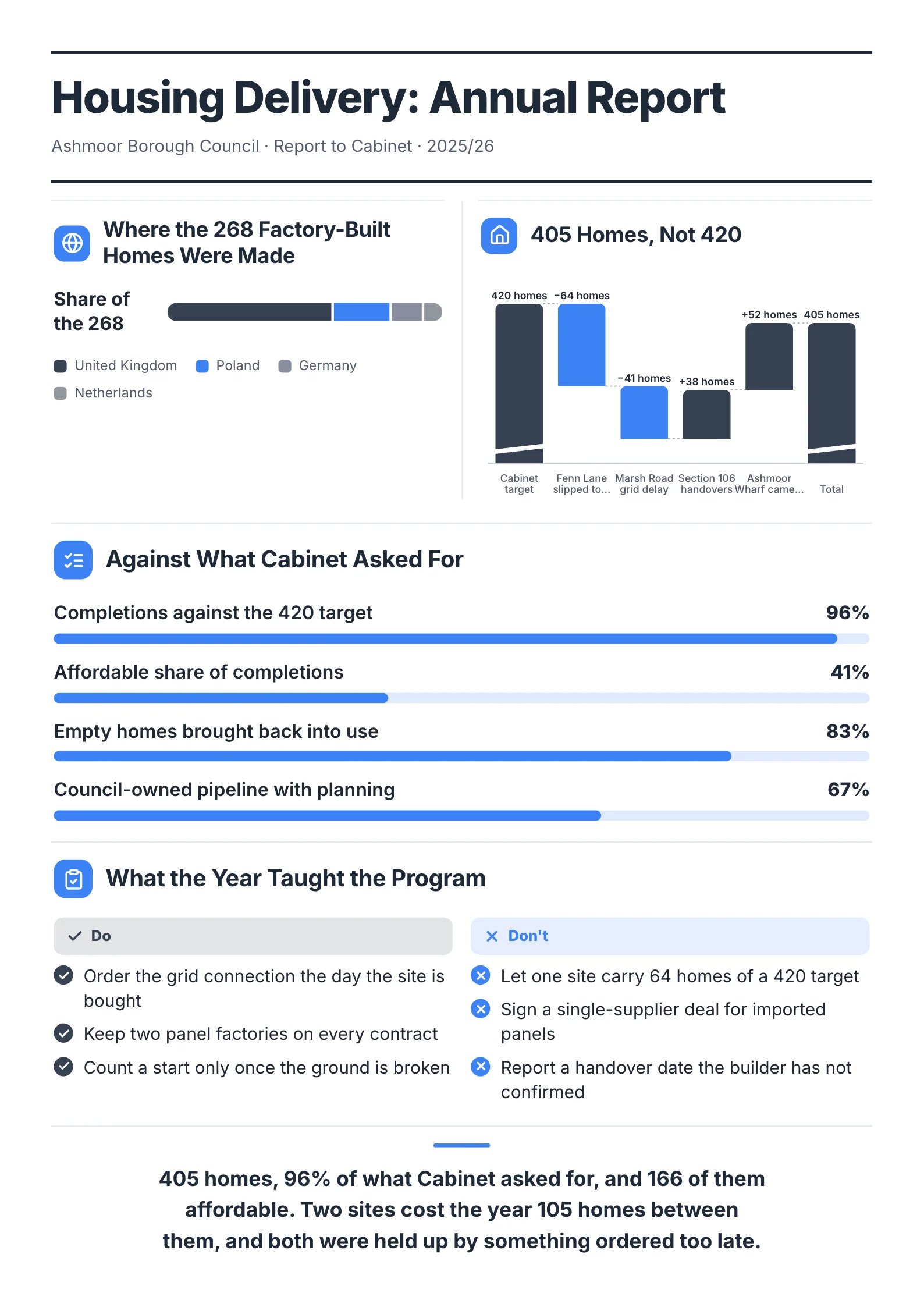 Housing Delivery ReportEdit for free(opens in a new tab)
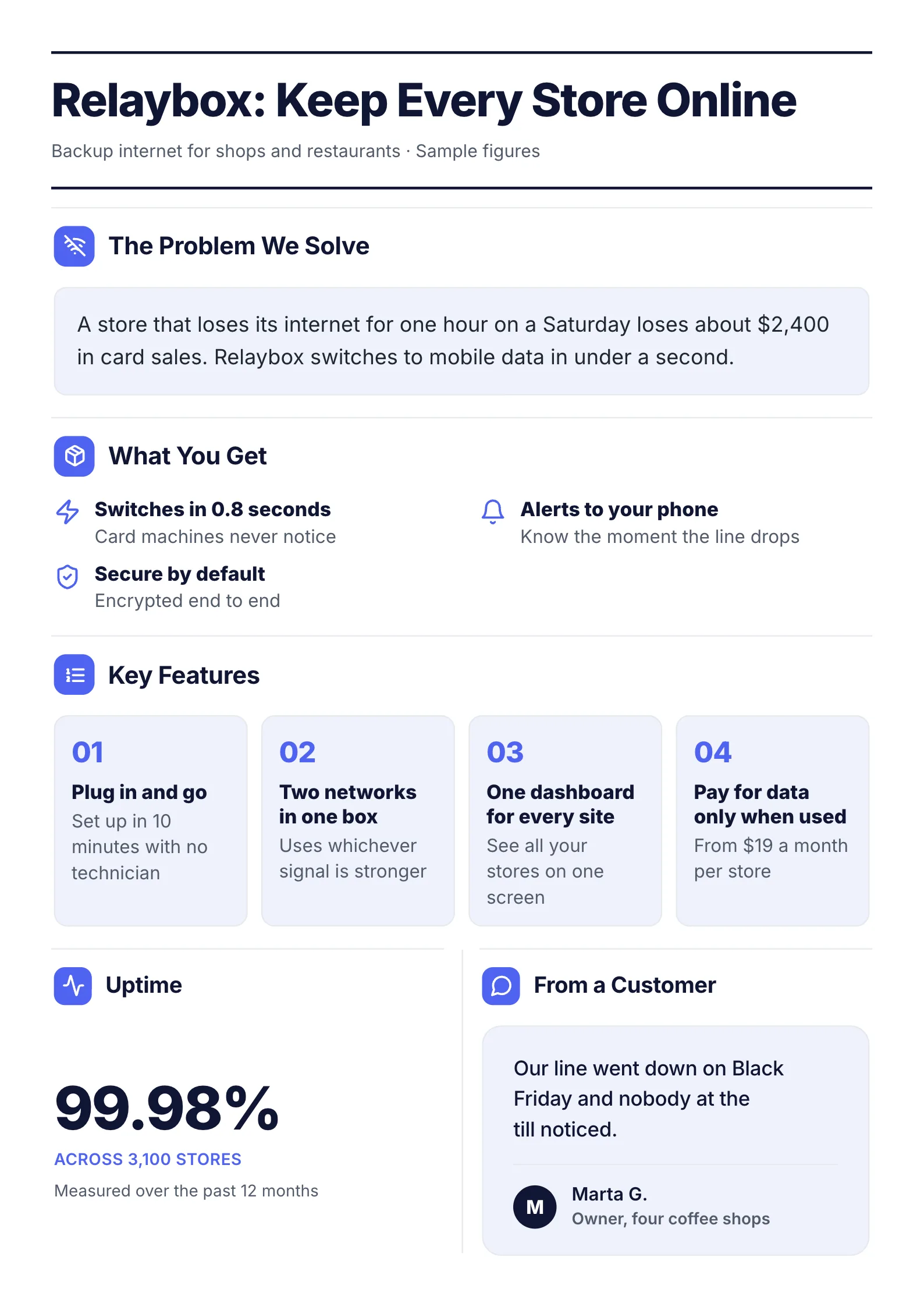 Technology Sell SheetEdit for free(opens in a new tab)
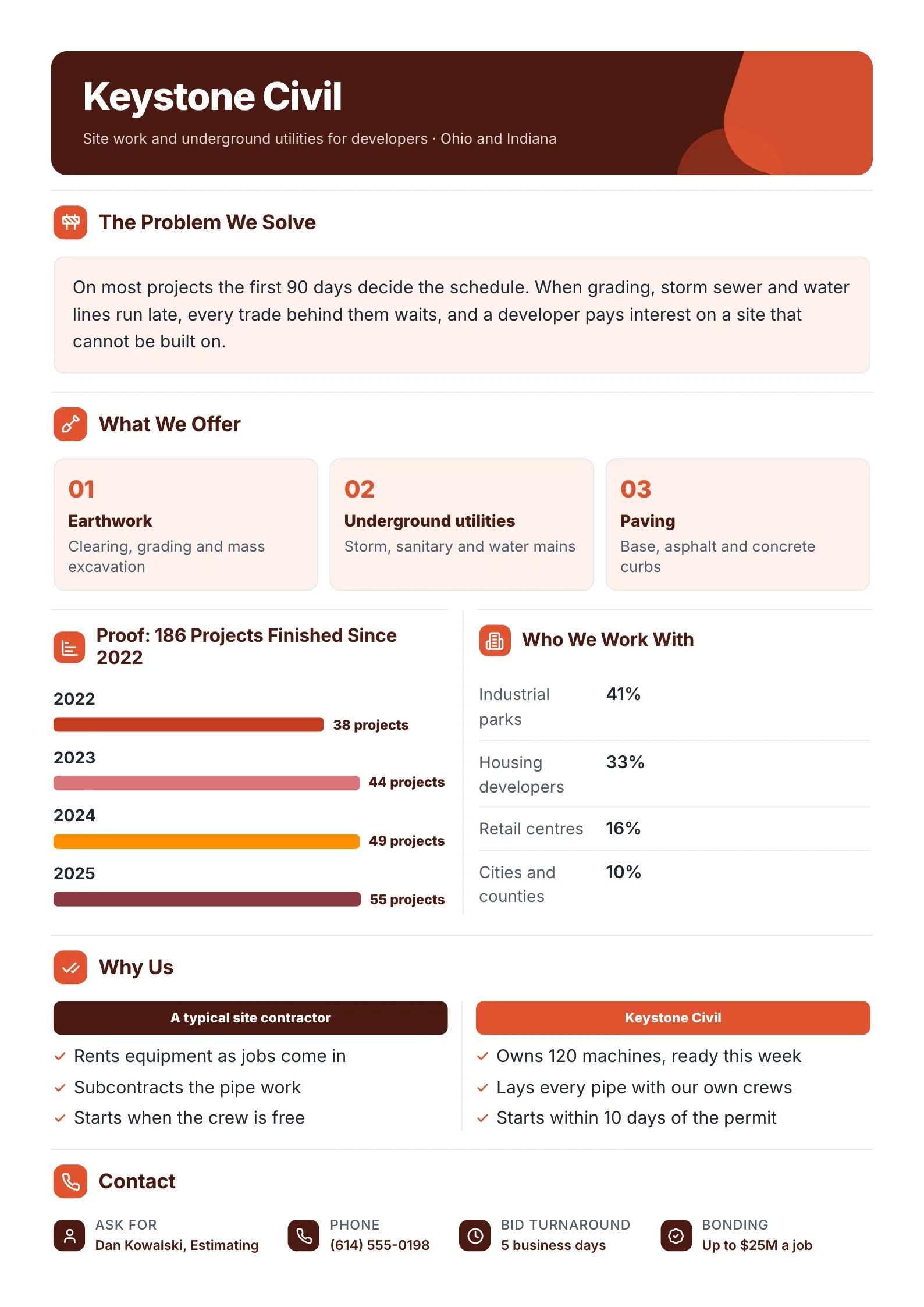 Site Contractor ProfileEdit for free(opens in a new tab)
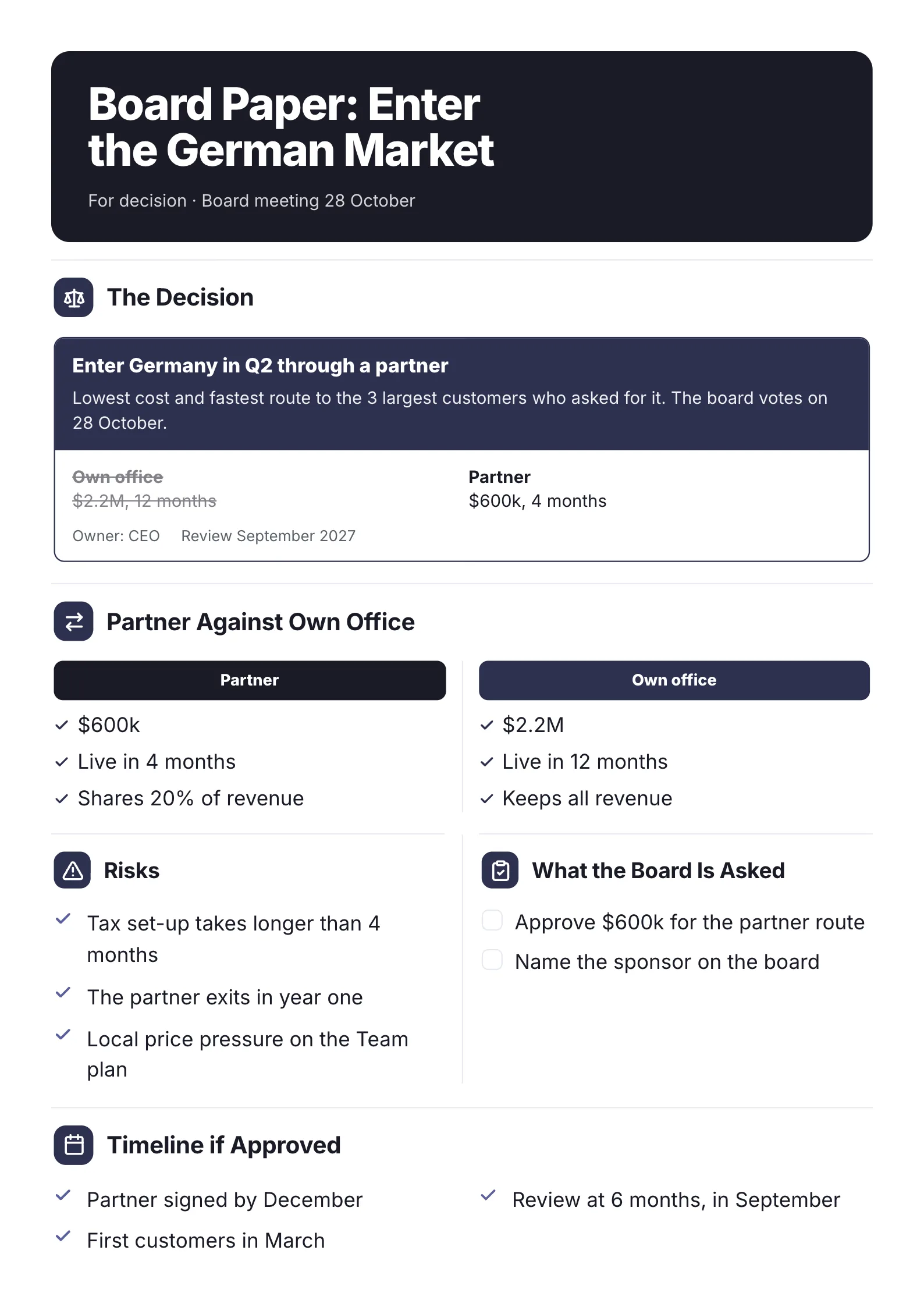 Board Decision PaperEdit for free(opens in a new tab)
What is a leave-behind?
A leave-behind is a short document, usually one page, left with someone after a meeting to remind them of what you discussed and what you asked for. The name says when it is used: not before the meeting, and not instead of it. A grant consultant's guide calls it an "elevator pitch on paper," and a rare disease advocacy group's tip sheet says to use it during the meeting and then leave it with the legislator or staffer at the end.
Three settings use them most:
- Meetings with legislators and their staff. Advocacy days, district office visits and Hill visits.
- Meetings with funders. Foundations, major donors and corporate sponsors.
- Pitches. Film and TV pitches, and sales calls, where the sheet is often called a one-sheet or sell sheet.
3 real leave-behinds, measured
We read each one at the source and counted what it does.
| Leave-behind | Setting | Pages | Words | The ask | Contact | Sources |
|---|---|---|---|---|---|---|
| Association for Psychological Science, Hill leave-behind, 2026 | Legislators | 1, letter | 395 | A box labeled "Our Ask," 4 items | A named person and email | Every headline number, with its source |
| Common Sense, children's privacy leave-behind, 2021 | Legislators and regulators | 2, letter | 977 | Four headed recommendations, with sub-points | Two named people and emails | 2 footnotes |
| NRDC Rewrite the Future, 2023 | Film and TV creators | 1, legal size | 591 | An offer of consulting, mostly free, and questions for your project | A team inbox | Studies named, no dates |
Three things stand out:
- Only one labels its ask. The science society's sheet ends with a box headed "Our Ask," four checkmarked lines a staffer can copy into a memo. The other two make the reader assemble the ask.
- Only one sources every headline number. Each of the science society's three headline figures carries its source under it. A staffer who repeats a number needs to know where it came from.
- Length varies. One letter page, two letter pages, and one legal-size page of 8.5 by 14 inches, which will not fit a standard folder or print on default settings.
What 4 published guides say to include
| Element | Advocacy tip sheet | Education group toolkit | Grant consultant | TV executive |
|---|---|---|---|---|
| Who you are, briefly | Yes | No | Implied | No |
| The problem, with data | Yes | Yes, with background | Yes, "the need" | No |
| Your solution or recommendation | Yes | Yes, up front | Yes, "the impact" | The logline and the world of the show |
| A specific ask | Yes, "the Ask" | Yes, at the end | Yes, an amount or range | No |
| Supporters or proof | Yes, other supporters | Yes, evidence | Yes, outcomes and testimonials | Main characters |
| Contact | Yes | No | Yes, a team contact | No |
| Length | One single page | Brief | 1 to 2 pages | Brief |
The advocacy tip sheet gives the clearest examples of an ask: cosponsor a bill, vote against one, or sign a letter. The education group's toolkit, from ISTE, ends with "an ask such as 'please vote for' or 'come and visit our school.'" The grant consultant says to give "a single amount or range" or a tangible item a donor can fund.
The TV executive is the outlier. Her advice for pitches to studios and networks: do not leave one unless asked, since at a network someone in the room is almost always taking notes. But prepare one anyway, in case they want something for the rest of the team.
A free leave behind one pager template
| Part | What to write |
|---|---|
| Header | Your organization, the topic, and the date |
| The ask | In a box at the top or bottom: what you want this person to do, by when |
| The problem | Two or three sentences, with one number |
| The evidence | Three numbers, each with its source and date under it |
| Your solution | What changes if they say yes |
| Who agrees | Supporters, cosponsors, partners or clients |
| Contact | One named person, with email and phone |
A leave-behind example
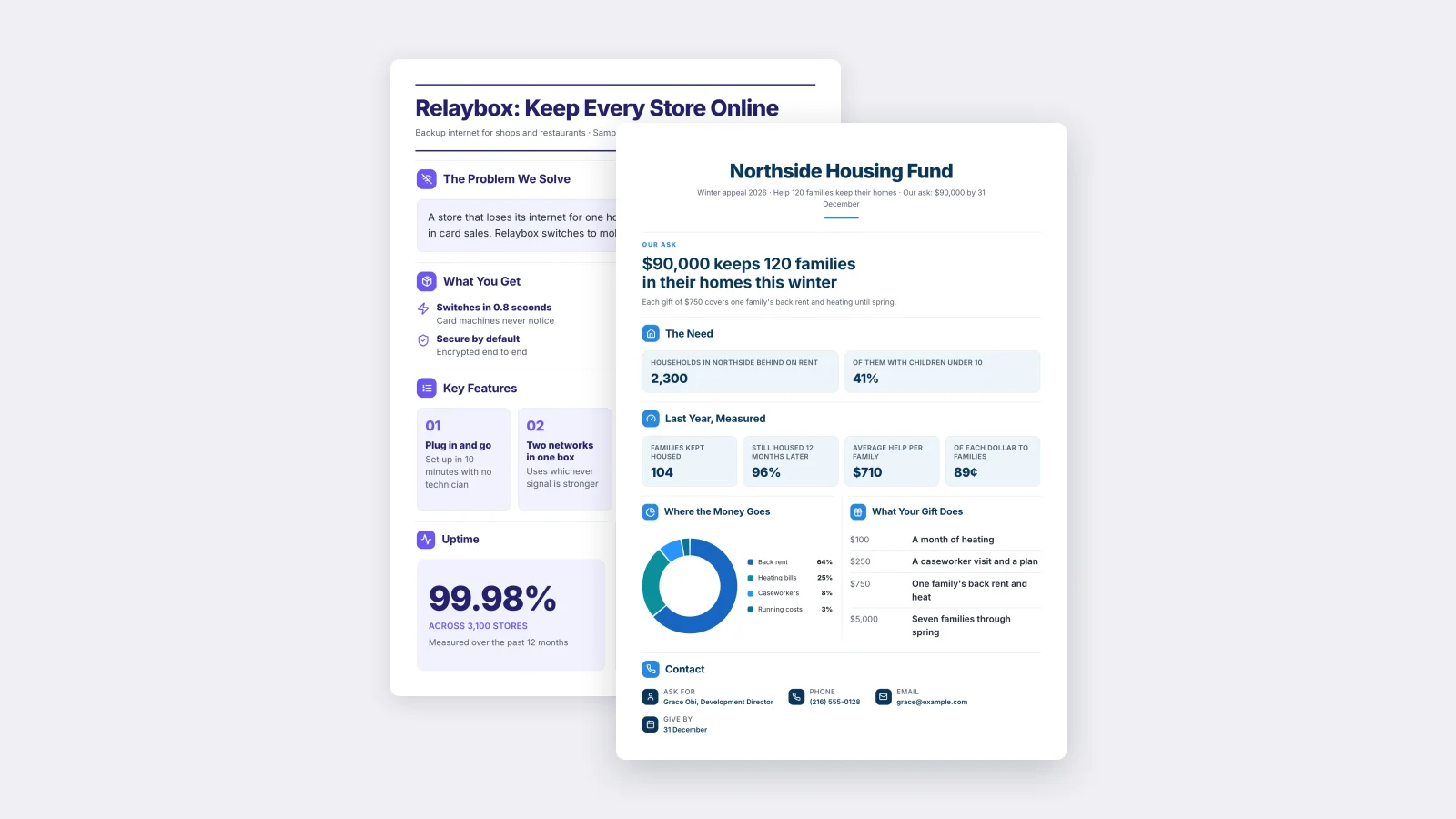
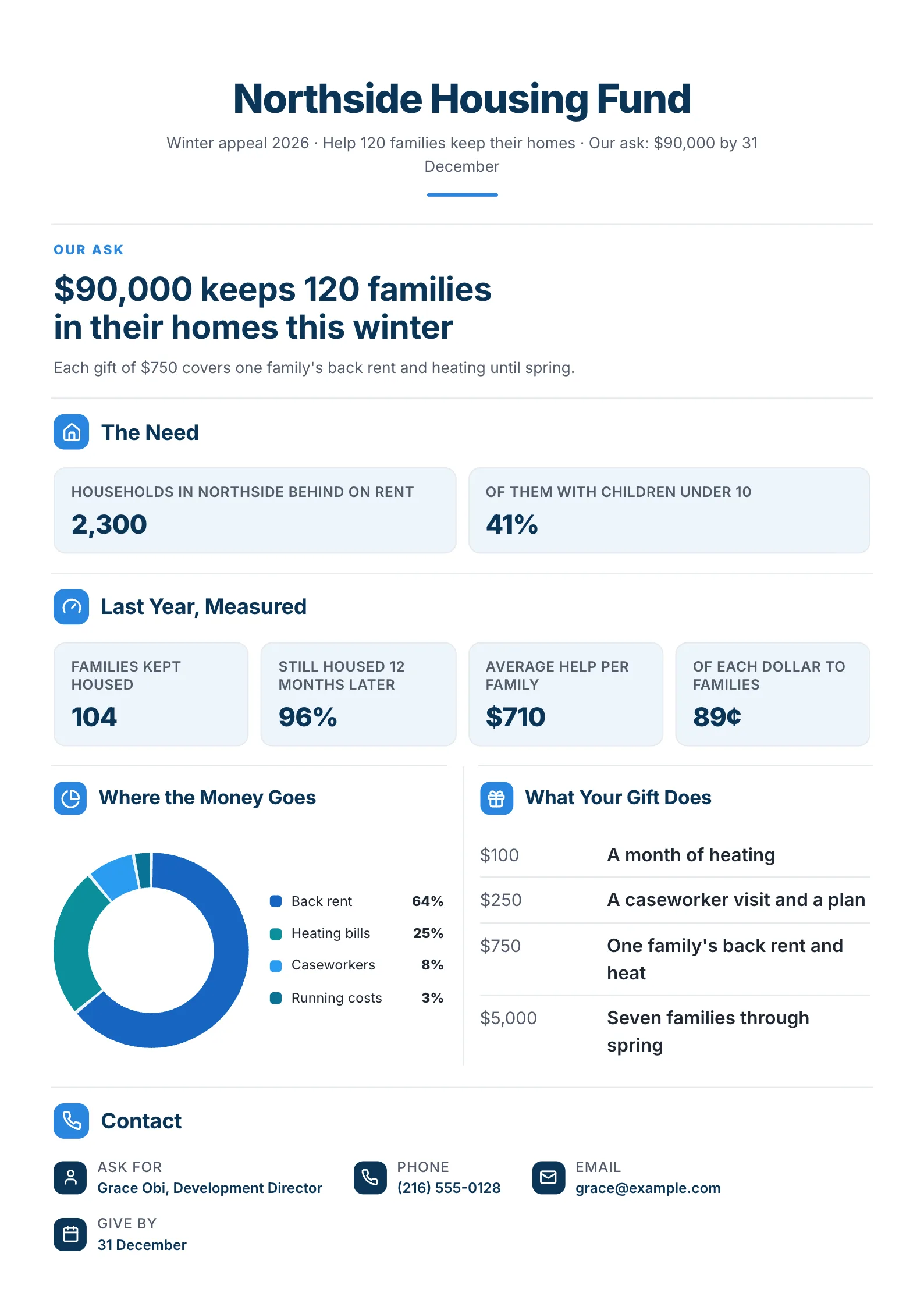
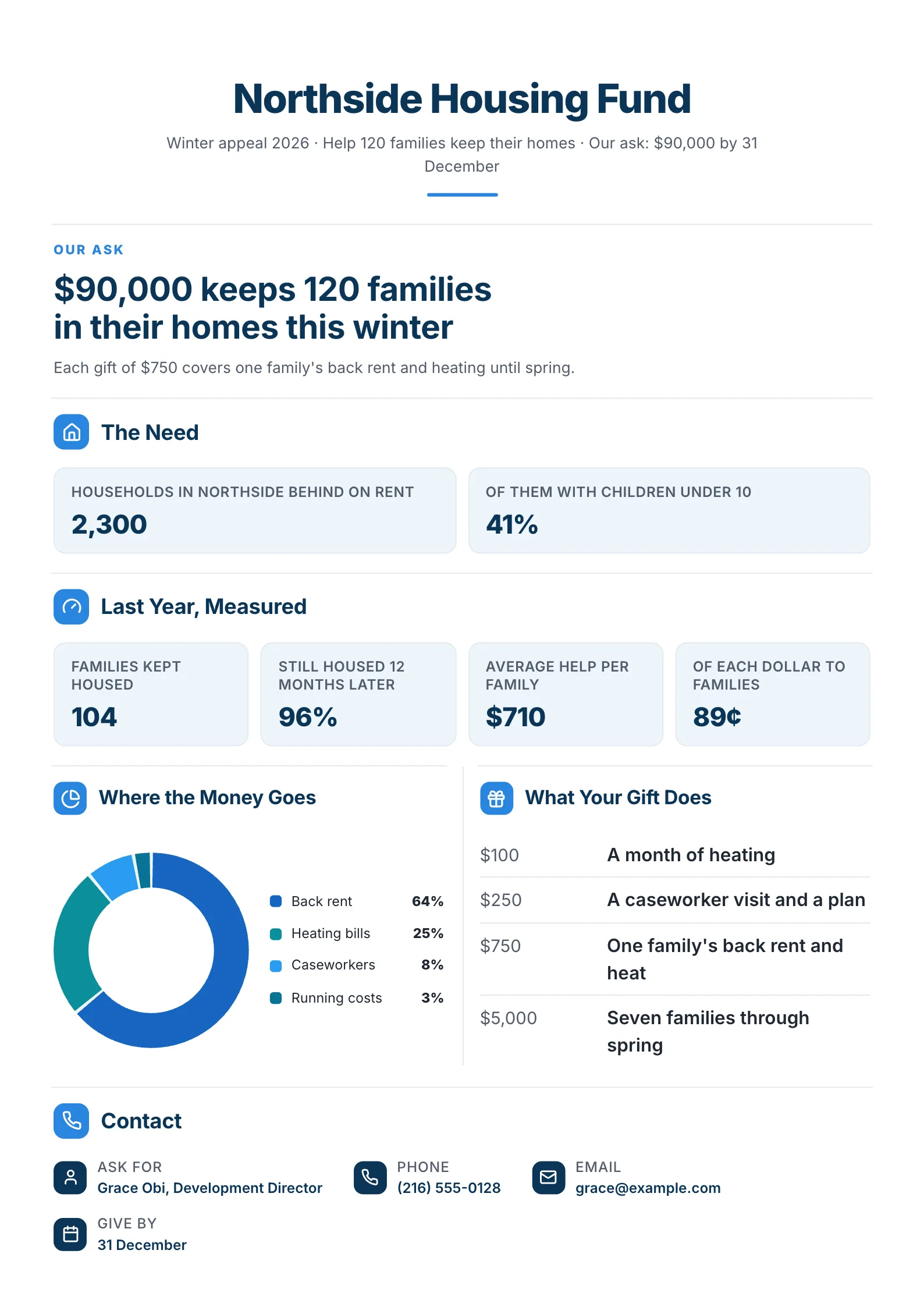
A funder leave-behind, from our library: a sample housing charity's winter appeal.
 Edit this template
A sample funder leave-behind: the ask at the top, the need, last year's results, what each gift does and one named contact.
What it does right:
- The ask is the first thing under the title: an amount, a number of families and a date.
- Gift levels make the ask concrete, as the grant consultant's guide suggests.
- One named person with a phone, an email and a give-by date.
What a real one would add: a source under each number, as the science society's sheet does. The charity and its figures are a sample.
Open it: donor appeal template.
How to write a leave-behind in 6 steps
- Write the ask first, in one sentence, with a number or a bill and a date.
- Pick three numbers that prove the problem or the result, and write the source under each.
- Say who you are in one line.
- Add who already agrees: supporters, cosponsors, partners.
- Put one named person at the bottom, with email and phone.
- Print it on letter paper and bring one copy per person in the meeting, plus a PDF to send afterward.
Have a long report or a briefing memo to boil down? Paste it into the free AI One-Pager generator to get a first layout, then check every number and its source before you print.
Leave-behind mistakes
| Mistake | Fix |
|---|---|
| No ask, or an ask spread through the text | One box, headed "Our ask," with a number and a date |
| Numbers with no source | The outlet or study and the date under each |
| A team inbox only | One named person |
| Two pages, or legal size | One letter page; put the rest in a follow-up email |
| The same sheet for every meeting | Change the ask for each person you meet |
| Left at a pitch when no one asked | Offer to send it; leave it only when asked |
Make your leave behind one pager
Use the template table above, write the ask first, and source every number. To lay it out, open the free donor appeal template for funders, or the policy brief template for legislators, and keep it to one page.
Frequently asked questions
What is a leave-behind?
A short document, usually one page, that you leave with someone after a meeting so they remember your ask and can pass it on to whoever decides.
What should a leave-behind include?
Who you are, the problem with a number or two, your solution, a specific ask, who supports it, and one named contact. Source every number.
How long should a leave-behind be?
One page. Two of the 3 real leave-behinds we read fit on one page, and the advocacy tip sheet we read says it "should be one single page."
Is a leave-behind the same as a one-pager?
A leave-behind is a one-pager with a job: it is written to be left after a meeting. Most are one-pagers; not every one-pager is a leave-behind.
Should I bring a leave-behind to a pitch meeting?
Bring one, but for film and TV pitches to studios and networks, the executive's advice we read is to leave it only if they ask.