BlogGuide
Family Emergency Plan Template: FEMA and Red Cross, Combined
A family emergency plan template built from FEMA's communication plan card, Ready.gov's 4 steps and the Red Cross plan, on one page.

By MakeOnepagers Team
Updated · 9 min read
A family emergency plan template gives your household one written answer to the questions you will not have time for in an emergency: how you will hear about it, where you will meet if you are apart, who you will call if phones are down, who picks up the children, who grabs the medicines and the pets, and which numbers you will need. We read the three plans most families are pointed to, at the source on 12 October 2026: Ready.gov's Make a Plan page, FEMA's Family Emergency Communication Plan card (FEMA P-1095), and the Red Cross family disaster plan template. Below is what each one asks for, where they differ, and a one-page template that combines them.
One‑Pager examples
Real One-Pagers made with MakeOnepagers. Open any one to edit it as your own.
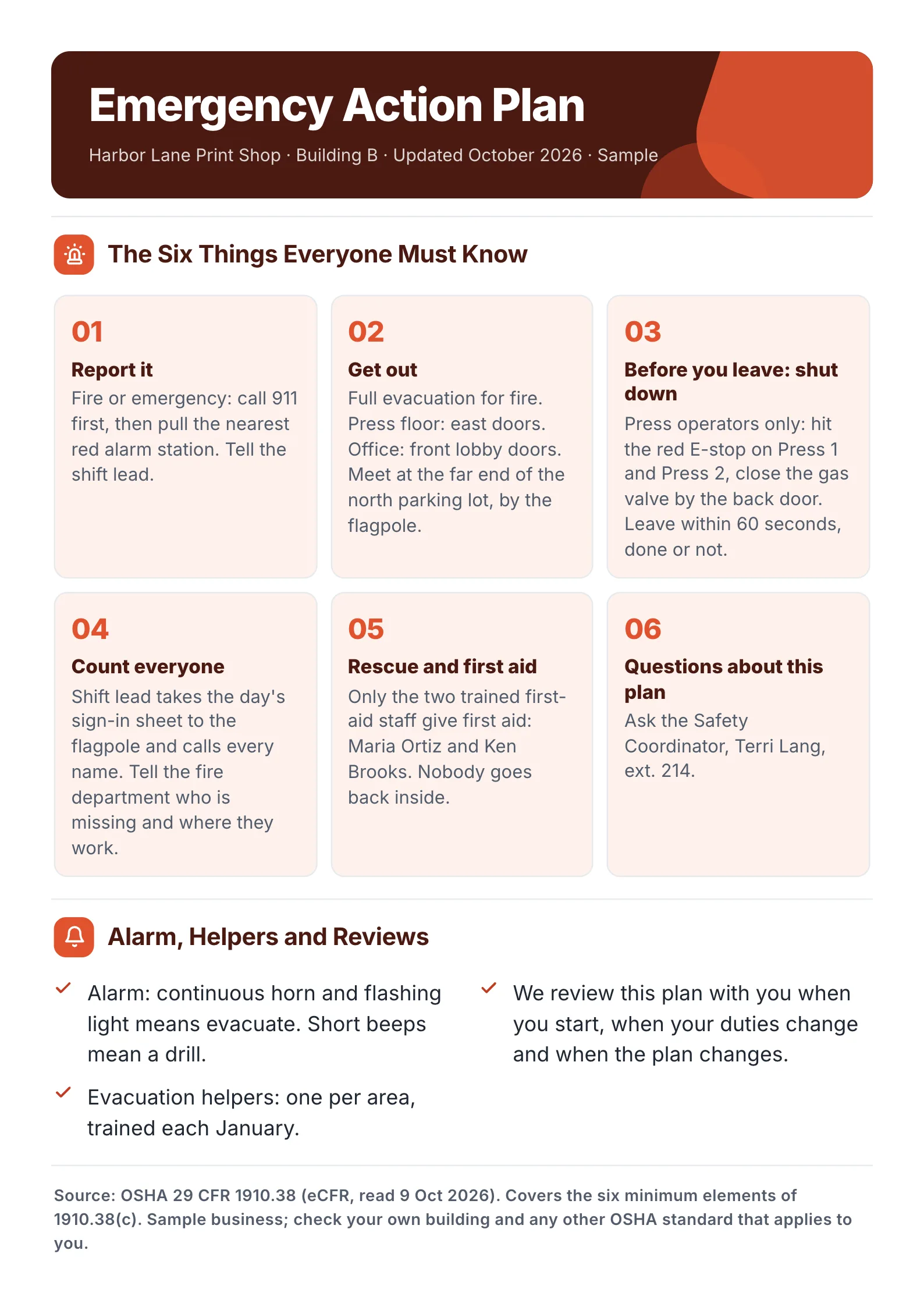 Emergency Action PlanEdit for free(opens in a new tab)
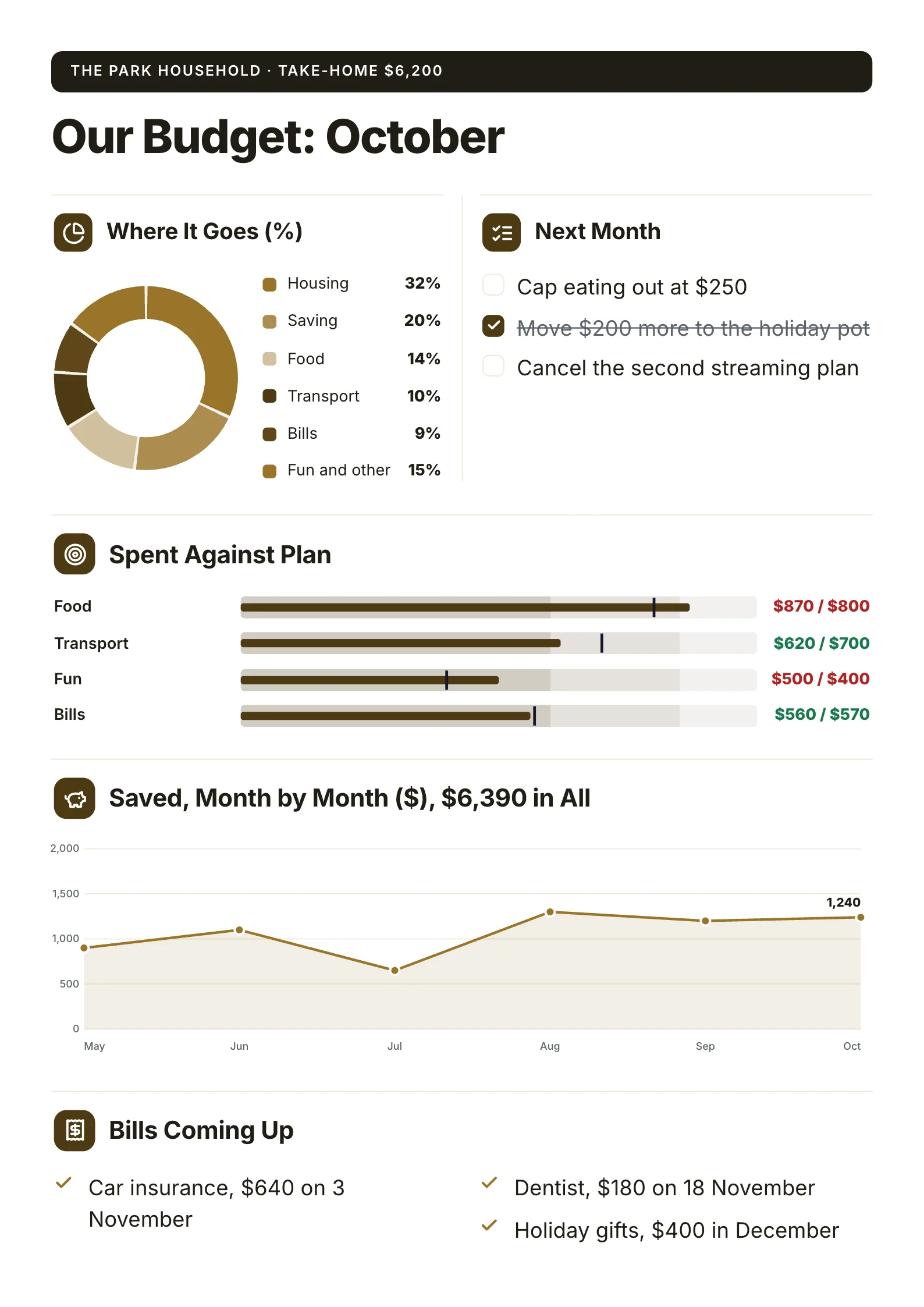 Personal BudgetEdit for free(opens in a new tab)
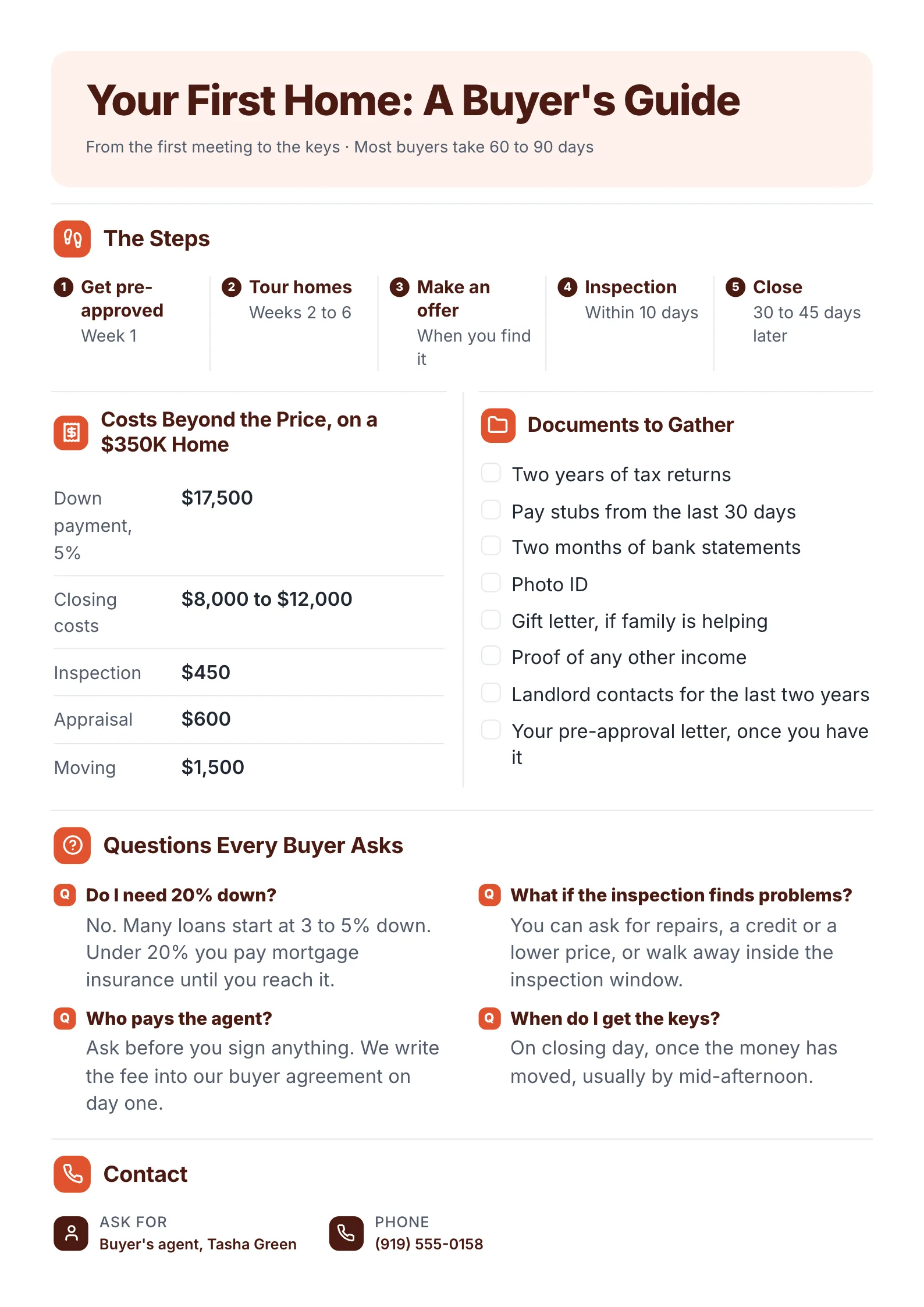 Home Buyer GuideEdit for free(opens in a new tab)
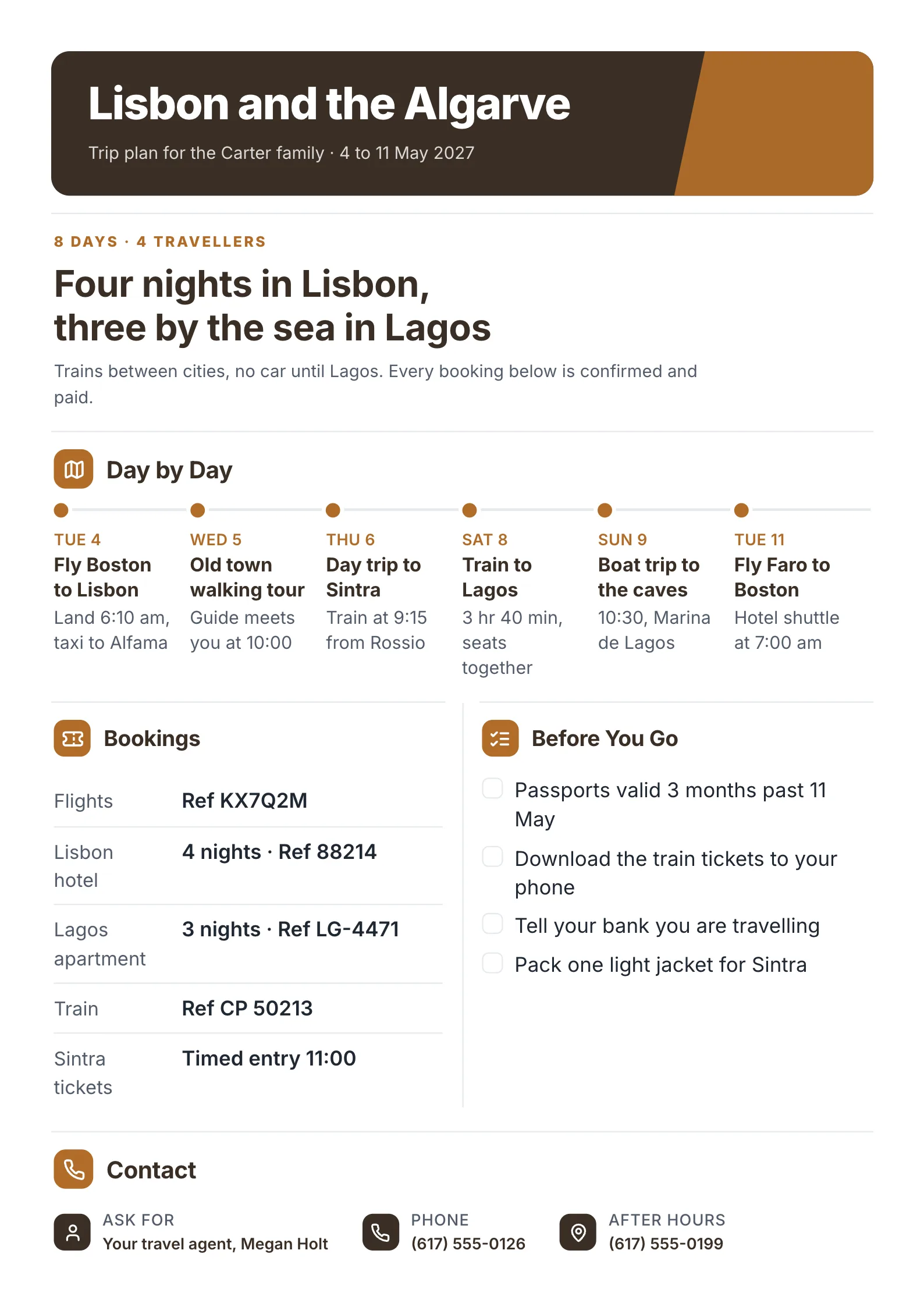 Travel ItineraryEdit for free(opens in a new tab)
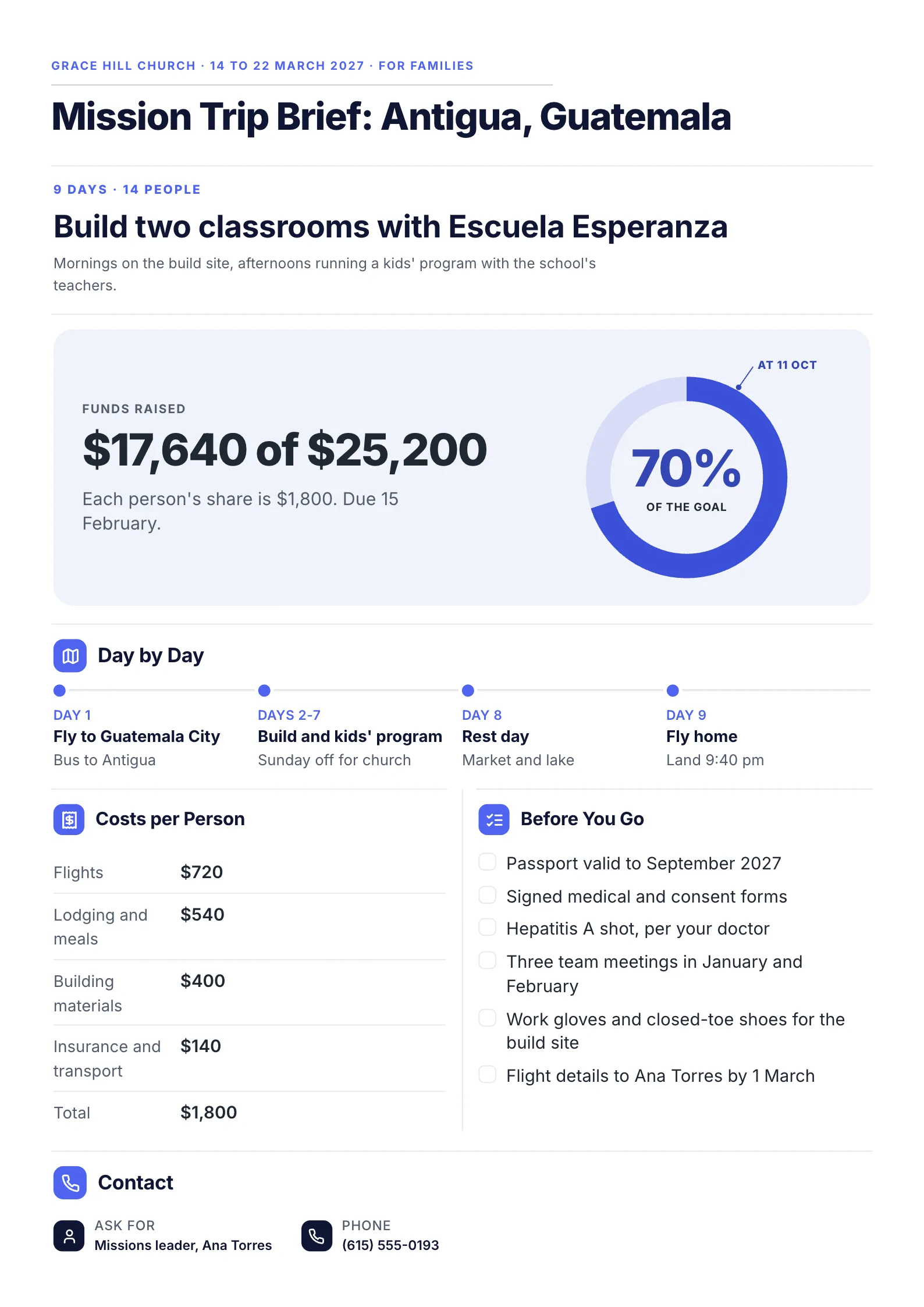 Mission Trip BriefEdit for free(opens in a new tab)
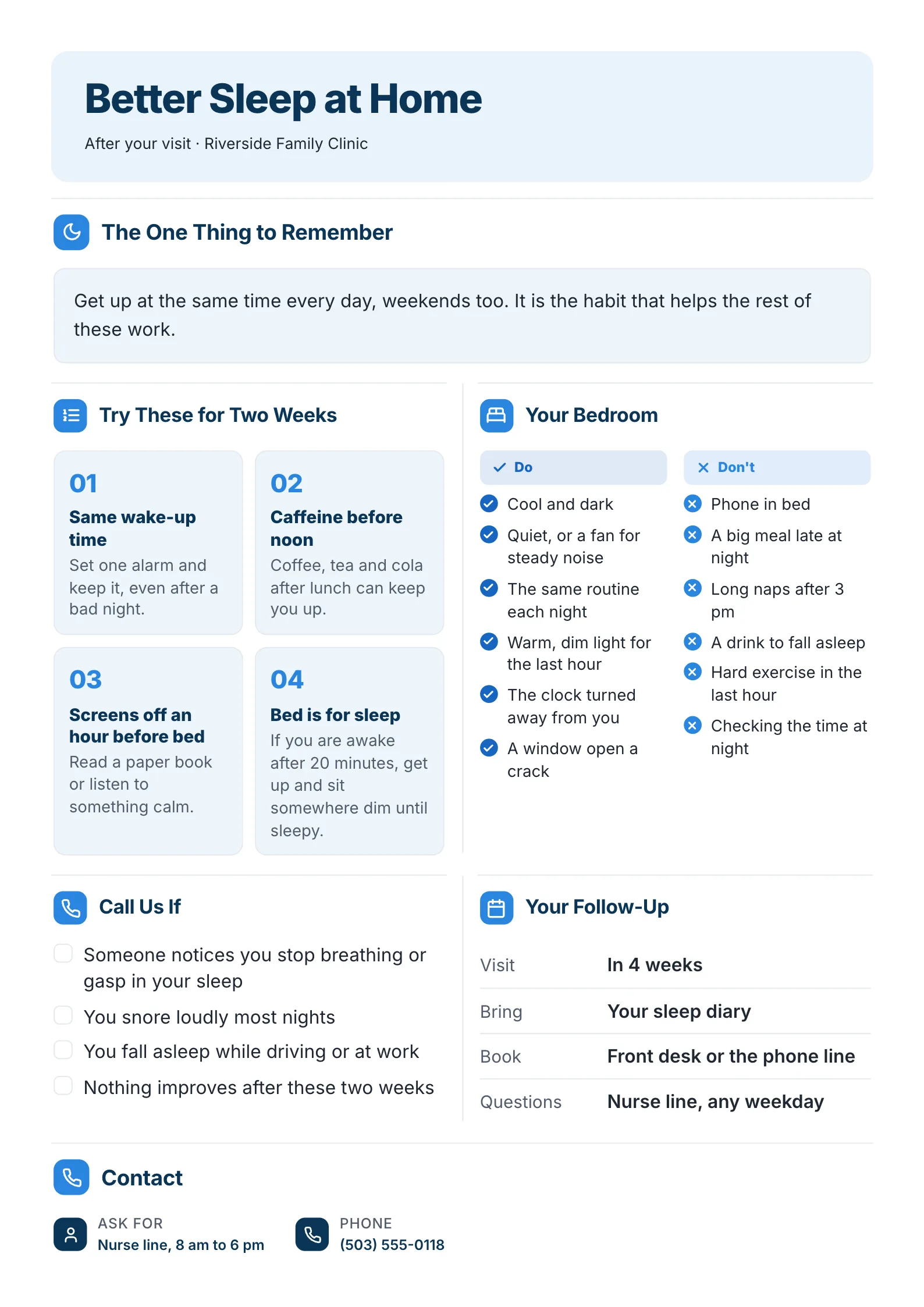 Patient Education SheetEdit for free(opens in a new tab)
Why a written family emergency plan matters
Ready.gov puts the reason in one line: "Your family may not be together if a disaster strikes." A plan in someone's head fails the moment that person is at work, out of signal or hurt. A plan on paper, in every bag, on the fridge and in each phone, works without anyone remembering it.
What Ready.gov says to do: 4 steps
Ready.gov's Make a Plan page, updated 1 September 2026, sets out four steps.
Step 1: Meet with your family
Talk through five questions together:
- How will we receive emergency alerts and warnings?
- What is our shelter plan?
- What is our evacuation route?
- What is our family communication plan?
- Do we need to update our emergency kit?
Step 2: Assess your household's needs
Ready.gov lists what to plan around: the ages of everyone in the household, who is responsible for helping others, places you go often, dietary needs, medical needs including prescriptions and equipment, disabilities and access needs, languages spoken, cultural and religious considerations, pets or service animals, and school-aged children.
Step 3: Write it down
Ready.gov offers an online form with six parts: household information, family members, emergency plans, emergency contacts, emergency meeting places and medical information.
Step 4: Practice it
The last step is one line: practice your plan with your household. A plan nobody has walked through is a plan nobody will follow.
What FEMA's communication plan card asks for
FEMA's Family Emergency Communication Plan, FEMA P-1095, is a fold-up card. We read the fillable version Ready.gov links to. It has six parts:
| Part | What it asks for |
|---|---|
| Household information | Home phone and address, then for each person: mobile, other number or social media, email, and important medical or other information |
| School, childcare, caregiver and workplace plans | For each place: name, address, emergency or hotline number, website, and its emergency or pick-up plan |
| In case of emergency (ICE) contact | Name, mobile, home phone, email, address |
| Out-of-town contact | Name, mobile, home phone, email, address |
| Emergency meeting places | Four of them: indoor, neighborhood, out of the neighborhood and out of town, each with instructions |
| Important numbers | Police, fire, poison control, doctors, pediatrician, dentist, medical insurance, hospital or clinic, pharmacy, home or renter's insurance, flood insurance, veterinarian, kennel, electric, gas and water companies, and accessible transportation |
The card's strength is contacts. Four meeting places, from a room in the house to another town, is more than most plans have.
What the Red Cross family disaster plan asks for
The Red Cross template we read is a three-page fill-in plan. Its "Plan of Action" asks nine questions:
- The disasters most likely to affect your household.
- The escape routes from your home.
- A meeting place near home.
- A meeting place outside the neighborhood, with a route and an alternate route.
- An emergency contact outside your area.
- Where your children will be evacuated from school or daycare.
- The plan for anyone in the household with a disability or special need.
- A safe room to shelter in place.
- Who in the family is responsible for each task, such as the disaster kit, staying informed and taking the family's medical information.
Its strength is action: routes, a room to shelter in, and a name beside each job.
Where the three differ
| Part of the plan | FEMA card | Red Cross plan | Ready.gov |
|---|---|---|---|
| Everyone's contacts | Yes | Yes | Yes |
| Medical information | Per person | As a task | Yes |
| School, childcare and work plans | Yes, with pick-up plans | School and daycare evacuation site | Yes |
| Out-of-town contact | Yes | Yes | Yes |
| Meeting places | 4 levels | 2 | Yes |
| Likely disasters where you live | No | Yes | Yes |
| Escape and evacuation routes | No | Yes, with an alternate | Yes |
| Where to shelter in place | No | Yes | Yes |
| Who does what | No | Yes | Step 2 |
| Pets | Vet and kennel numbers | Pet details | Yes |
| Important numbers, insurance and utilities | Yes, long list | No | Medical information only |
| How you get alerts | No | As a task | Yes |
Neither form alone covers everything Ready.gov tells you to think about. The FEMA card has no routes and no jobs; the Red Cross plan has no list of numbers and only two meeting places.
A free family emergency plan template
This combines the three on one page. Print one copy per person and keep a photo of it on every phone.
| Part | What to write |
|---|---|
| Our household | Each person's name, mobile, and anything a responder must know: allergies, medicines, devices |
| How we get alerts | The local alert sign-up, the weather radio, the app |
| Likely emergencies here | The 2 or 3 that actually happen where you live |
| Meeting places | Indoor (a room), neighborhood (a landmark), out of the neighborhood (an address) and out of town (an address) |
| Routes | Two ways out of the house, and two routes to the out-of-neighborhood place |
| Shelter in place | The room, and what is kept there |
| Out-of-town contact | One person everyone calls or texts to check in |
| School, childcare and work | Each place's emergency number and pick-up plan, and who picks up whom |
| Who does what | Kit, medicines, pets, documents, checking on a neighbor: one name each |
| Pets | Names, vet, a place that takes pets |
| Important numbers | Doctor, pharmacy, insurance and policy numbers, utilities, poison control |
| Practice | The date of the last drill and the next one |
A filled example
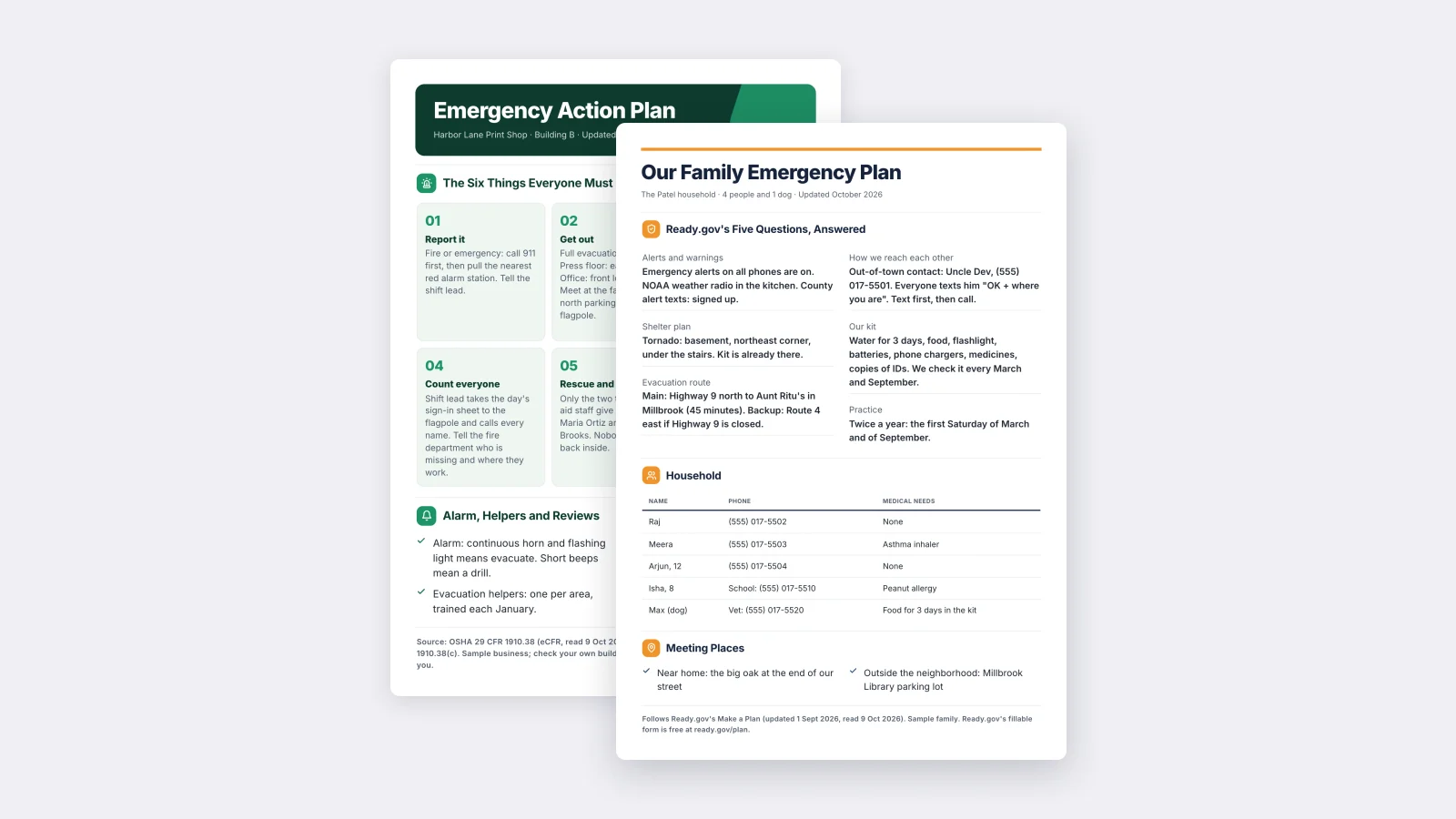
A sample household of four, on one page:
| Part | Sample |
|---|---|
| Household | Ana (mobile), David (mobile), Sofia, 12 (mobile; peanut allergy, carries an EpiPen), Leo, 7 |
| Alerts | County text alerts, all four phones. Weather radio in the kitchen |
| Likely here | Severe storms and tornadoes; flash flooding on the creek road |
| Meeting places | Indoor: the downstairs hall closet. Neighborhood: the mailboxes at the corner. Out of neighborhood: the public library. Out of town: Grandma's house, two towns north |
| Routes | Front door or the back slider. To the library: Main Street, or Oak Avenue if Main floods |
| Shelter in place | Downstairs hall closet: water, flashlight, shoes, the spare EpiPen |
| Out-of-town contact | Aunt Rosa. Everyone texts her: "OK, at [place]" |
| School and work | Leo's school releases only to Ana, David or Grandma. Sofia walks to the library if school closes early |
| Who does what | David: kit and the dog. Ana: medicines and documents. Sofia: checks on Mrs. Lee next door |
| Pets | Biscuit, dog. Vet's number. The county shelter on 5th takes pets |
| Practice | Last drill: September. Next: March |
The family is a sample. Two details are worth copying: one out-of-town contact everyone checks in with, and a named person for every job.
How to make your plan in one evening
- Sit down together, children included, and answer Ready.gov's five questions.
- Pick the four meeting places and walk to the neighborhood one together.
- Choose one out-of-town contact and tell them they are it.
- Get each school's and workplace's emergency plan, and agree who picks up whom.
- Write the plan on one page, print a copy for each person, and photograph it on every phone.
- Practice it. Walk the routes and set a date for the next drill.
Prefer to type it out? Write your notes in any order and drop them into the free AI One-Pager generator to lay them out on one page, then check every name, number and address before you print. Leave out anything you would not want on a lost piece of paper, such as full policy numbers, or keep that copy at home.
The same idea at work
Employers write the workplace version, an emergency action plan, under OSHA's rule. It covers the same ground: how to report, where to go, who counts heads and who to ask.
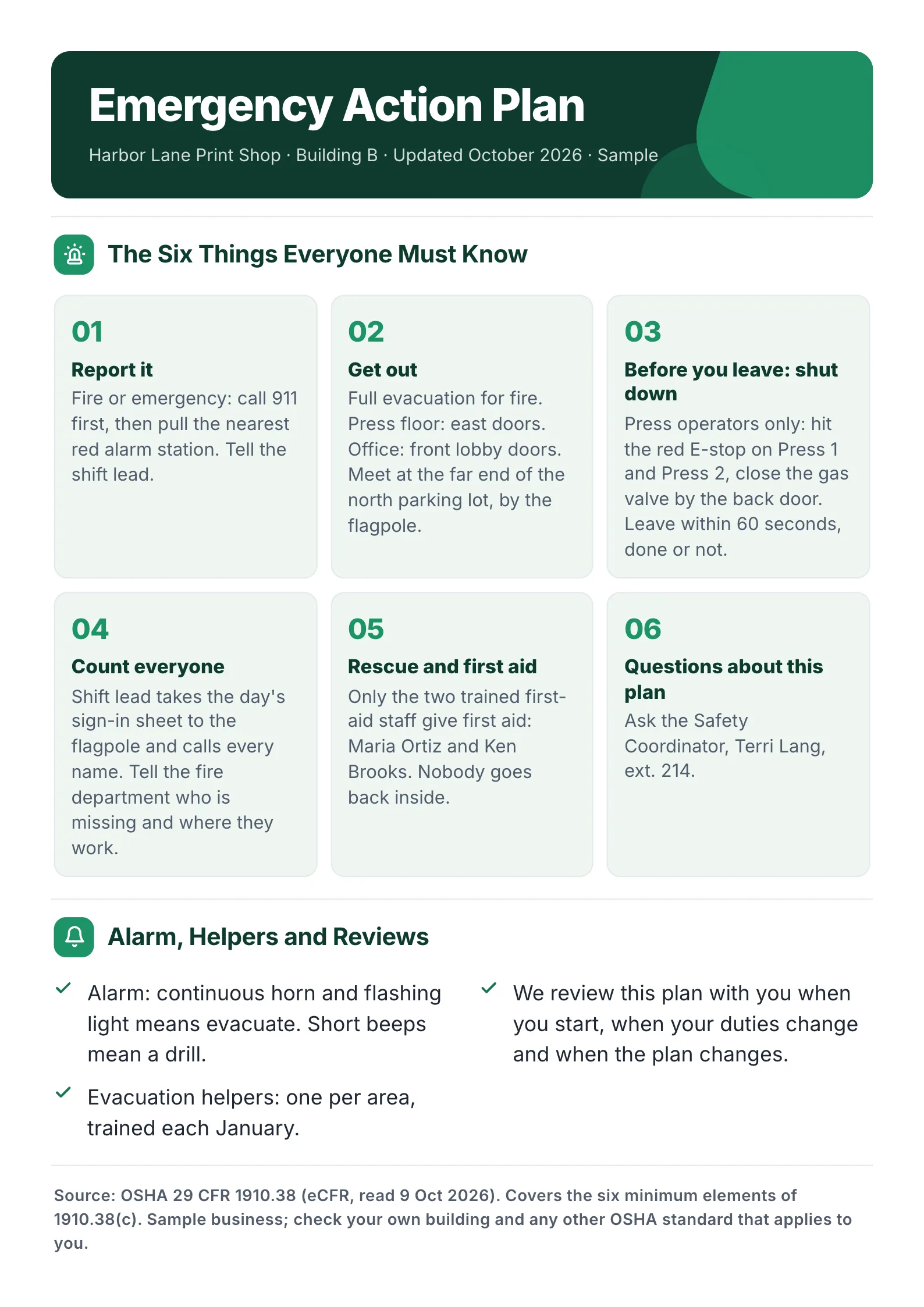 Edit this template
The workplace version: a sample print shop's emergency action plan on one page.
Open it: emergency action plan template.
Family emergency plan mistakes
| Mistake | Fix |
|---|---|
| One meeting place | Four, from a room in the house to another town |
| The plan lives in one person's head | Paper in every bag and a photo on every phone |
| No out-of-town contact | One person outside your area everyone checks in with |
| Nobody owns the kit, the medicines or the pets | One name beside each job |
| School pick-up assumed | Know each school's plan and who it will release children to |
| Never practiced | A drill twice a year, with a date on the plan |
Make your family emergency plan
Use the template table above, fill it in together tonight, and print one copy per person. To lay it out as a One-Pager, drop your notes into the free AI One-Pager generator, check every detail, and put a copy where everyone will see it.
Frequently asked questions
What should be included in a family emergency plan?
Everyone's contacts and medical needs, how you get alerts, the emergencies likely where you live, four meeting places, routes, a place to shelter in place, an out-of-town contact, school and work plans, who does what, pets, important numbers and the date of your next practice.
Is there an official family emergency plan template?
Yes. Ready.gov links to FEMA's Family Emergency Communication Plan card and an online form, and the Red Cross publishes a family disaster plan. Each covers different parts, which is why the template above combines them.
Why do I need an out-of-town contact?
When your household is separated, one person outside the affected area gives everyone a single place to check in.
How often should we practice our family emergency plan?
Ready.gov's fourth step is to practice it with your household. Pick a regular date, such as twice a year, and write the next one on the plan.
Where should we keep our family emergency plan?
A printed copy in each person's bag or backpack, one on the fridge, one in your emergency kit, and a photo on every phone.