BlogGuide
Budget Variance Report Template: Free One‑Pager Example
A free budget variance report template on one page: totals against plan, each line's variance, the reason for the big ones and a recommendation, with a worked example.

By MakeOnepagers Team
Updated · 5 min read
A budget variance report shows what you spent against what you planned for a period, line by line, and explains the lines that are off. Finance teams, program managers and department heads send one every month or quarter, and the reader is usually someone who has five minutes and one question: are we over, and what are we doing about it? Below is a free budget variance report template on one page, a worked example and the math behind it.
One‑Pager examples
Real One-Pagers made with MakeOnepagers. Open any one to edit it as your own.
 Treasury reviewOpen itOpen this One-Pager (opens in a new tab)
 Board updateOpen itOpen this One-Pager (opens in a new tab)
 Investment memoOpen itOpen this One-Pager (opens in a new tab)
 Product launch briefOpen itOpen this One-Pager (opens in a new tab)
 Case studyOpen itOpen this One-Pager (opens in a new tab)
 Startup pitchOpen itOpen this One-Pager (opens in a new tab)
Every example was made with MakeOnepagers. The names and figures are samples, and the example opens as a template you can edit for free.
What goes on a budget variance report
| Block | What the reader wants to know | Keep it to |
|---|---|---|
| Totals | Are we over or under, and by how much? | Spent, plan and the variance |
| By line | Where is it coming from? | Five or six budget lines |
| Why | What caused the big ones? | A table of the lines over your threshold |
| By month | Is it getting better or worse? | One number a month |
| Recommendation | What should we do? | Two or three sentences |
| Full year forecast | Where will we land? | One line |
Pick a threshold before you write, such as 5% or $25k. Any line past it gets a reason. Any line inside it does not.
How to work out budget variance
Variance is actual minus plan. Divide by plan to get the percentage.
| Line | Plan | Actual | Variance | Variance % |
|---|---|---|---|---|
| Contractors | $540k | $660k | +$120k | +22% |
| Hardware | $300k | $330k | +$30k | +10% |
| Total | $2.30M | $2.41M | +$110k | +4.8% |
A positive number on a cost line means you spent more than planned, so it is shown in red. A negative number means you spent less. On a revenue line it is the other way around, so say which kind of line you are reporting.
Budget variance report example
 Edit this template
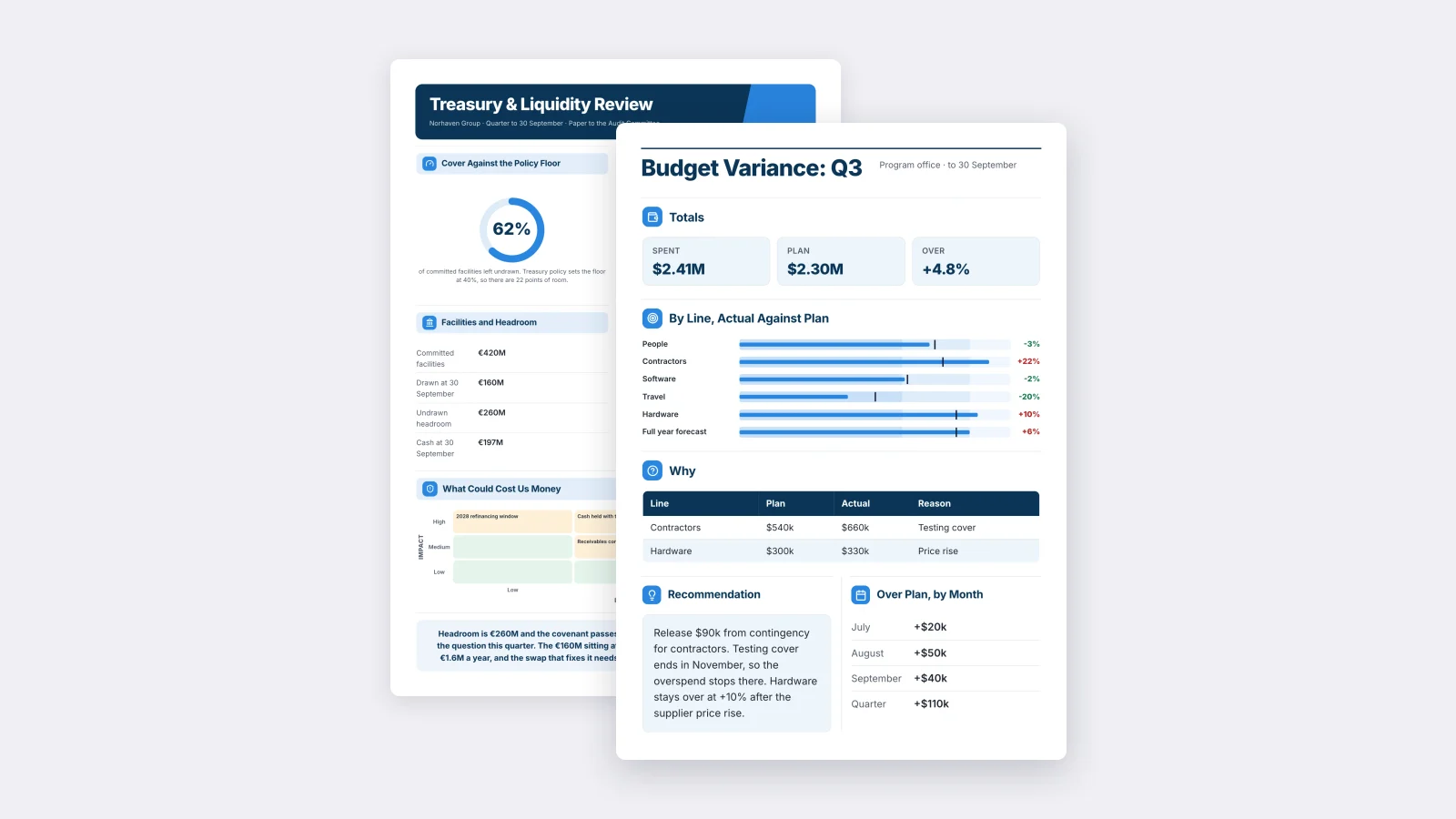
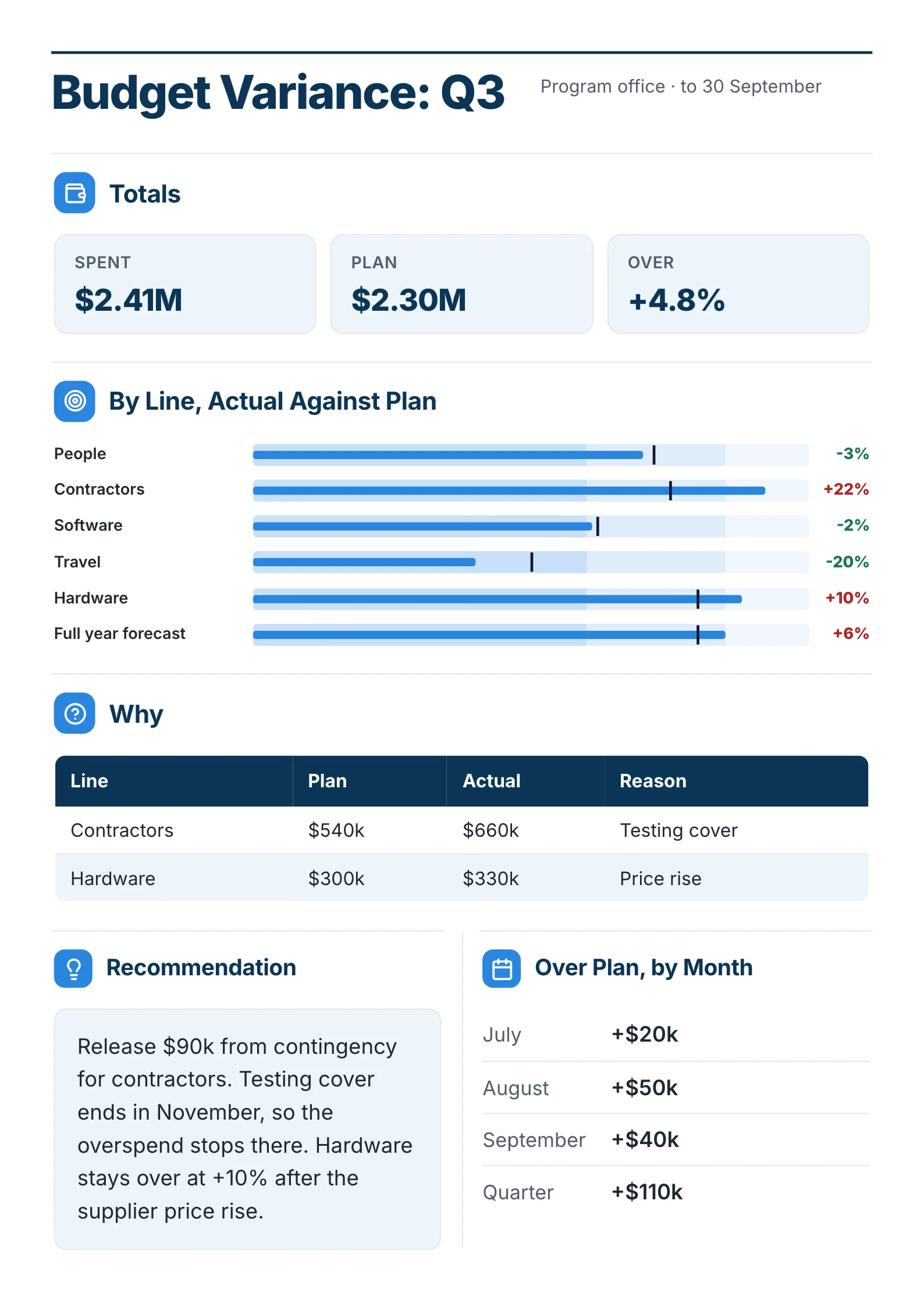
A program office's quarter: three totals, six lines against plan, two reasons and one recommendation.
What to copy:
- Three numbers at the top: spent $2.41M, plan $2.30M, over +4.8%. The reader has the answer before the first chart.
- Every line as a bar against a plan marker, with the variance in green or red on the right. Contractors at +22% and travel at -20% stand out at a glance.
- Reasons only for the lines that matter: contractors ($540k planned, $660k spent, testing cover) and hardware ($300k, $330k, a price rise). Travel was under plan, so it needs no story.
- A recommendation with a number and an end date: "Release $90k from contingency for contractors. Testing cover ends in November, so the overspend stops there."
- The overspend by month: +$20k, +$50k, +$40k, adding up to the +$110k in the totals. The reader can check the math.
Open it: budget variance report template.
 Edit this template
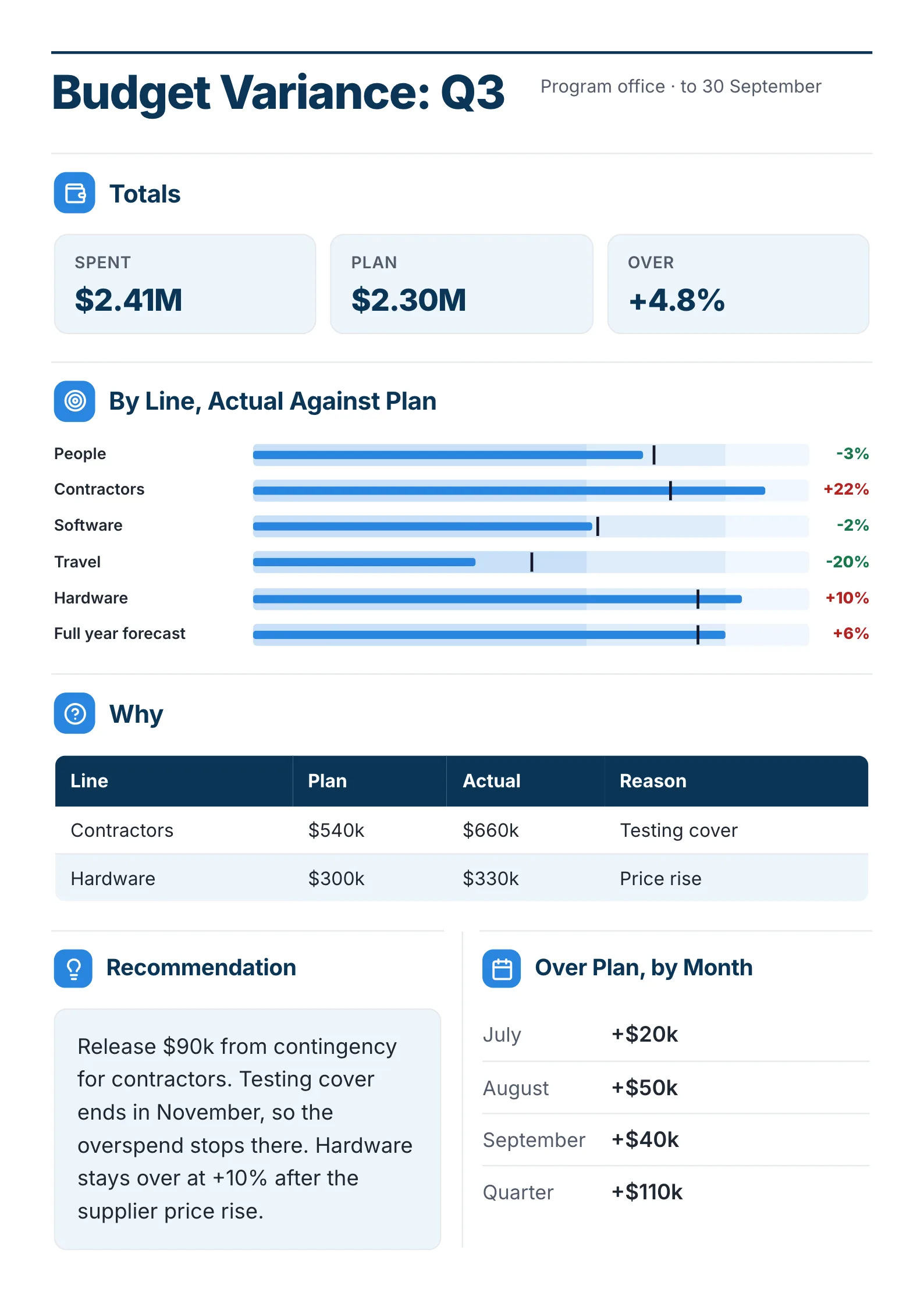
A free budget variance report template
Copy this outline, or open the example above and edit it.
- Headline: Budget variance: [period], with the team and the end date.
- Totals: spent, plan and the variance as a percentage.
- By line, actual against plan: five or six lines and the full year forecast, each with its variance.
- Why: a table of every line past your threshold, with plan, actual and the reason in a few words.
- Recommendation: what you want approved, how much and until when.
- By month: the variance each month and the total for the period.
For a budget that has not started yet, use a budget summary One-Pager instead.
How to make a budget variance report in 5 steps
- Export plan and actual for the period from your accounting system, by budget line.
- Work out each variance in dollars and as a percentage of plan.
- Set a threshold and mark every line past it.
- Write one reason per marked line in a few words, such as "price rise" or "testing cover".
- End on a recommendation with the dollar amount and when the variance stops.
Have a long finance pack or a spreadsheet? Drop it into the free AI One-Pager generator and get a first budget variance report back to edit.
Budget variance report mistakes
- A reason for every line. The reader stops reading before the two that matter.
- Percentages without dollars. +22% on a small line can matter less than +5% on a big one. Show both.
- No forecast. The reader wants to know where the year will land, not only the quarter.
- Mixing cost and revenue lines without saying which is which, so red and green mean different things.
- No recommendation. A variance report that only reports leaves the decision to someone with less context than you.
Make your budget variance report
Open the free budget variance report template and put in your numbers, or drop your finance pack into the free AI One-Pager generator and get a finished page back. Browse every One-Pager template for more layouts.
Frequently asked questions
What is a budget variance report?
A report that compares actual spending or income with the budget for a period, shows the difference for each line and explains the biggest differences.
How do you calculate budget variance?
Subtract the planned amount from the actual amount. Divide the result by the planned amount and multiply by 100 for the percentage. $660k actual against $540k planned is +$120k, or +22%.
What is an acceptable budget variance?
Many teams treat anything within 5% as normal and explain anything beyond it. Set the threshold with whoever reads the report, and use the same one every period.
How often should you send a budget variance report?
Monthly for most teams, quarterly for boards and funders. A One-Pager is short enough to send every month.